
Facebook still gives marketers something many platforms can’t: scale with intent signals attached. It had almost three billion monthly active users as of April 2024, and India alone accounted for 378 million users, with the United States, Indonesia, and Brazil each at well over 100 million, according to Statista’s Facebook market overview. That reach is why a Facebook page view still matters.
But the useful part isn’t the raw count. It’s what the count suggests about behavior.
A Facebook Page view sits in an awkward middle ground. It’s stronger than a casual feed impression, but weaker than a lead, reply, purchase, or booked call. If you treat it like a vanity metric, it will mislead you. If you treat it like a diagnostic metric, it becomes one of the fastest ways to check whether your targeting, offer, and profile setup are doing their job.
For most brands, the right question isn’t “How do we get more views?” It’s “Are the right people moving from awareness into active interest, and what happens after that?”
Why Facebook Page Views Still Matter in 2026
A lot of Facebook metrics look bigger than they are. Page Views still matter because they sit one step closer to intent than reach or impressions, without pretending to be a conversion metric.
That makes them useful in 2026.
For client work, I treat Page Views as a health check on the top of the funnel. They help answer a practical question: after someone sees your content, ad, or comment, do they care enough to investigate your business further? That matters because profile visits often happen right before a person decides whether to message, follow, click through, or leave.
Why does this metric still show up in real client work
Page Views are not a success metric on their own. They are a diagnostic metric with context.
If a campaign pushes up Page Views, it usually means the creative or offer is generating enough interest to earn a second look. If impressions rise but Page Views do not, the content may be getting distribution without building curiosity. If Page Views rise and qualified Messenger conversations rise with them, the Page is helping move people from attention into active consideration.
That last point matters more for businesses using chatbots, automated DMs, or Messenger-based lead capture. A Page View is high-volume. A message start, reply, or booked call is high-intent. Smart teams use the first signal to judge whether awareness is healthy, then they judge performance by what happens after the visit.
Where Businesses Misread Page Views
The common mistake is treating every spike as proof of demand.
A spike can come from broad targeting, a controversial post, a giveaway, or curiosity from people who will never buy. Useful analysis comes from pairing Page Views with follow-up actions such as clicks on your CTA button, Messenger conversations, website traffic, lead form opens, or review checks. That combination shows whether people are only looking or moving deeper into the funnel.
This is why I rarely ask, “How do we get more Page Views?” in isolation. The better question is, “Are the right people checking the Page, and does the Page help them take the next step?”
Small setup details affect that answer. Make sure your branding is consistent, contact options are visible, and the correct Facebook Page URL is easy to find and share. If the Page supports lead generation, every point of friction on the profile reduces the value of the traffic you worked to earn.
What Is a Facebook Page View Really
Think of your Facebook Page like a storefront.
Your posts are the signs in the window and the flyers people see while walking by. Your Page itself is the place they enter when they want to look around, check credibility, read details, or decide whether to take the next step.
A Facebook Page view is that moment when someone walks in.
The official definition
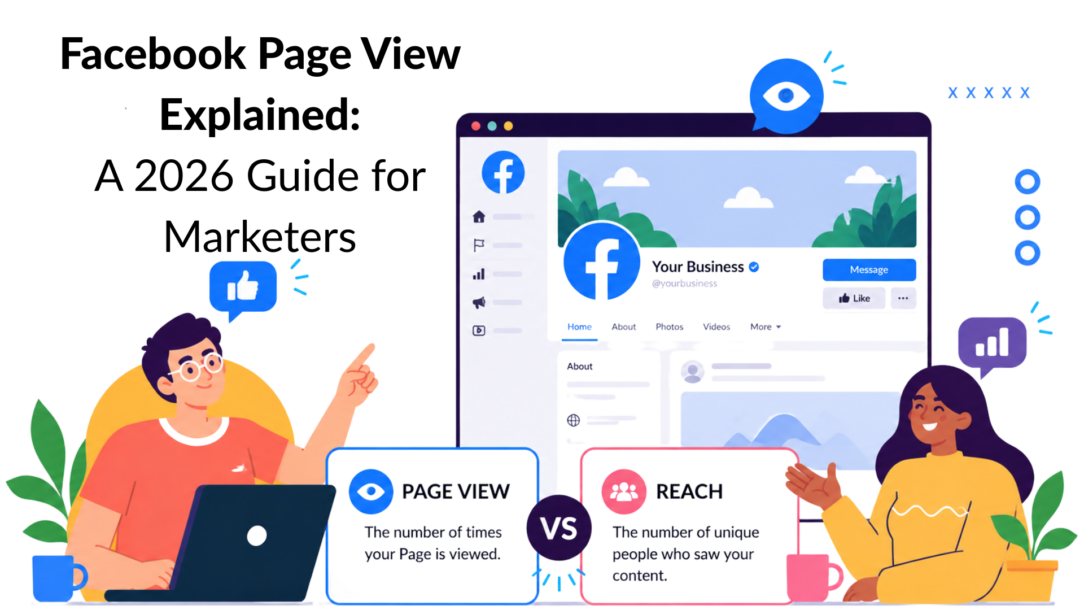
Meta defines Page views as the number of times a Page’s profile has been viewed by people, including users who are logged in and those who are not. Meta also separates this from reach, which is people who saw any content from the Page, and impressions, which are the times content entered a screen, as explained in Meta’s Page views help documentation.
That distinction matters because it tells you what the metric is not.
A Page view does not mean someone read your caption carefully. It doesn’t mean they watched a full video. It doesn’t mean they’re ready to buy. It means they made an active move from seeing your content to checking your profile.
What does that mean in practice
This is why I treat Facebook Page views as a top-of-funnel consideration signal.
Someone may visit your Page because:
- They want proof you’re legitimate. They’re checking your branding, posts, reviews, and contact details.
- They’re comparing options. They saw your ad or post and want to see whether the Page feels trustworthy.
- They need one more piece of information. That could be pricing context, location, support options, or how to message you.
- They’re interested but not ready. The visit signals attention, not commitment.
A Page view is an intent step, but it’s still an early one.
The business takeaway
Marketers often miss the point: a Facebook Page view is neither fluff nor finish line.
It’s useful because it captures movement. A person has shifted from passive exposure to active evaluation. That gives you a concrete clue about whether your creative, targeting, and profile presentation are strong enough to create curiosity.
If your Page looks weak once they arrive, the view dies there. If your Page answers the next question fast, the same visit can become a message, click, lead, or purchase path.
Page Views vs Reach vs Impressions: A Clear Comparison
Most reporting mistakes happen here.
Teams see one metric go up and assume everything is improving. But Page views, reach, and impressions answer different questions. If you mix them together, you can end up celebrating visibility when what you need is a stronger profile intent.
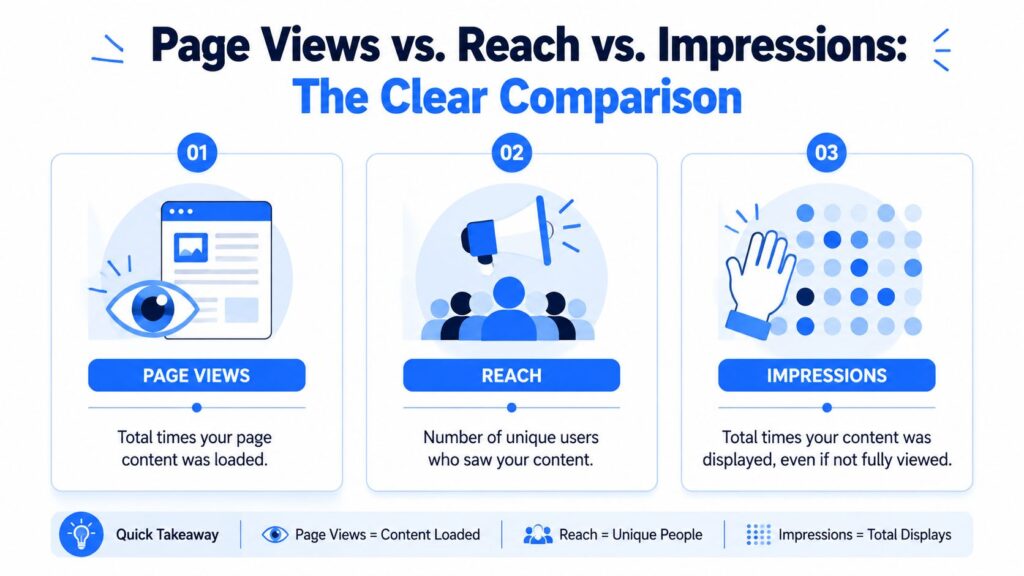
Facebook Page View Metric Comparison
The simplest way to think about it
Use the storefront model:
| Metric | What it means | Storefront analogy | Best use |
|---|---|---|---|
| Reach | Unique people who saw your content | People who walked past your shop | Measure audience exposure |
| Impressions | Total times content appeared on screen | Total walk-bys, including repeats | Measure content distribution frequency |
| Page views | The number of times people visited your profile | People who actually entered the shop | Measure profile-level interest |
Reach tells you how many different people you touched. Impressions tell you how often your content showed up. Page views tell you who cared enough to investigate further.
Where confusion creates bad decisions
A useful warning comes from Move Digital Group’s guide to Facebook Page Insights, which says this nuance is absent in 85% of existing 2025 to 2026 tutorials. That’s a big reason brands confuse strong visibility with real audience growth.
If impressions rise but page views don’t, your content may be getting exposure without pulling people deeper.
If reach is steady and page views rise, your messaging may be doing a better job of creating curiosity.
If page views rise but qualified inquiries don’t, the Page may be attracting broad attention without enough commercial intent.
Client shorthand: Reach shows who noticed you. Impressions show how often you appeared. Page views show who leaned in.
How I use these three metrics together
I don’t look at them as competing numbers. I use them as a sequence.
- Start with reach when the question is visibility.
- Check impressions when the question is about frequency and content distribution.
- Look at page views when the question is whether visibility is turning into active interest.
That’s also why broader engagement reporting matters. If you want a clean framework for how these signals fit together, GroupOS insights on engagement are a useful companion read because they help separate passive exposure metrics from stronger interaction signals.
A quick example
Say an ecommerce brand runs a product tease campaign.
The posts generate a lot of impressions. Reach looks healthy. But page views barely move. That usually tells me the creative may be entertaining enough to stop the scroll, but not specific enough to push people toward the brand itself.
Now flip it. Reach stays modest, but page views jump after a founder video or a testimonial post. That often means the content is attracting fewer people, but the right people are becoming curious enough to inspect the business.
That’s a better sign than a big impression chart with no downstream action.
How to Find and Analyze Your Page View Data
Many marketers don’t need another dashboard tour. They need to know what to look for once they find the number.
Meta groups Page-level reporting inside its business tools, where admins can review how people respond to posts, audience demographics, and the times when the audience is on Facebook. Meta also separates page views, reach, and impressions as different metrics, and some reporting tools use standardized windows such as the past seven days or 28 days, with some third-party systems refreshing Facebook channel metrics once every 24 hours at 7 AM UTC, based on definitions summarized in Facebook Business Help for Insights.
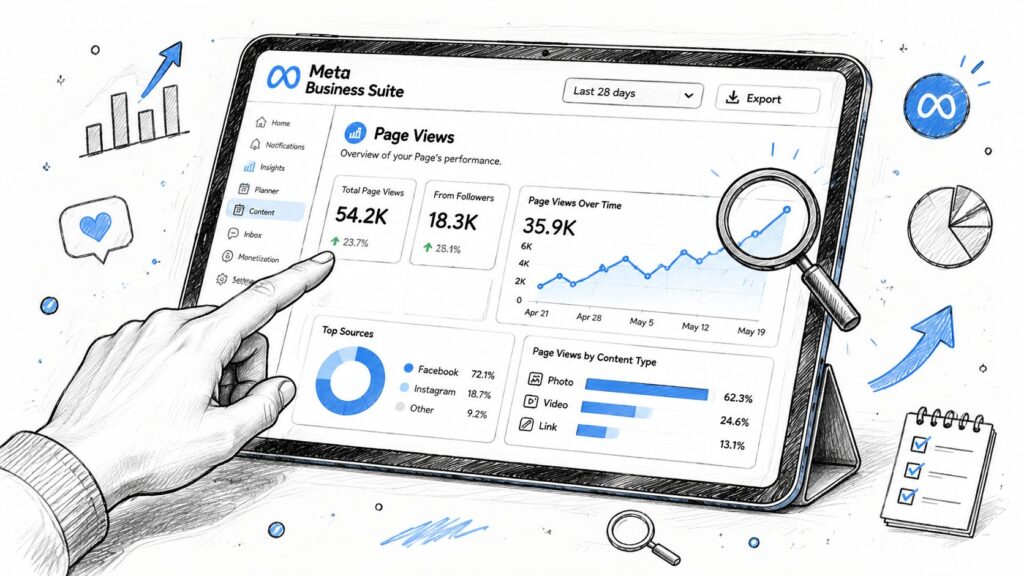
Facebook Page View Analytics Dashboard
Where to look inside Meta tools
Depending on your setup, you’ll usually be working in Meta Business Suite or the Professional Dashboard tied to the Page.
What matters is finding the Page-level metric panel, then checking trends rather than reacting to a single day. I like to compare short and medium windows because they show different things:
- Seven-day view helps spot campaign impact, creative fatigue, or sudden spikes.
- A twenty-eight-day view smooths out noise and shows whether interest is building or slipping.
- Longer internal comparisons help you judge whether a change is a one-off event or a pattern.
What the number is actually good for
According to Databox’s Facebook Page Views metric library, Page views include both organic and paid visits and are useful for diagnosing top-of-funnel discovery. The same explanation notes that a strong increase often indicates your targeting, Page branding, and call-to-action placement are converting awareness into active consideration.
That’s the right mindset. Don’t use Page views to prove bottom-line success. Use them to test whether your front-end marketing is strong enough to create interest.
How to read common patterns
Here’s how I usually interpret changes:
-
Sharp spike after a launch
That often means the campaign created enough curiosity to push people from the feed into your profile. Then I check whether the Page gave them a clear next action. -
Slow decline over time
This usually points to fatigue. The audience may still be seeing your content, but they’ve stopped feeling a reason to inspect the brand. -
High views, weak website actions
That often signals a profile mismatch. People arrive interested, then hit a weak CTA, unclear offer, or poor transition to your site.
If you want that transition mapped properly, website visitor tracking approaches help connect what happens on Facebook with what happens after someone leaves the Page. For ecommerce brands, it also helps to understand how page behavior and site behavior fit together through tools like Facebook Pixel for e-commerce optimization.
If a Facebook Page view rises and nothing else improves, the metric did its job as a diagnostic. It showed where the funnel started leaking.
Actionable Tactics to Increase High-Intent Page Views
A Page view has value when it comes from someone evaluating fit, not someone tapping out of casual curiosity.
That distinction changes how to improve the metric. The goal is to earn visits from people who are close enough to act, then make the Page useful enough to move them toward a message, click, or lead capture.
Tighten the Page before you add more traffic
A lot of brands try to buy or post their way to more Page visits before the Page can answer basic questions. That usually creates a vanity lift and a conversion problem.
Start with the parts a visitor sees first:
- Profile identity. The name, profile image, cover image, and bio should signal the business clearly in a few seconds.
- Offer clarity. Visitors should understand what you sell, who it helps, and what to do next.
- Primary action. The Page button, pinned post, and first visible content should all support the same next step.
- Proof and reassurance. Reviews, recent activity, product examples, FAQs, and visible response options reduce hesitation.
A Page works like a store entrance. If people walk in and cannot tell what aisle to go to, traffic volume does not help much.
Publish posts that create inspection, not just engagement
Likes and comments can make a post look strong while producing weak profile traffic. Posts that drive high-intent Page views usually create a specific reason to verify the brand.
These formats tend to work well:
| Post type | Why does it drive page views |
|---|---|
| Problem-aware content | It makes the reader check whether your business solves that exact issue |
| Offer teaser posts | It creates enough curiosity that people visit the Page for details |
| Social proof content | It prompts credibility checks before someone takes the next step |
| Founder or brand story posts | It gives people a reason to assess trust and fit |
Copy matters here. “Visit our Page” is weak. “See pricing options in our pinned post” or “Message us from the Page to check availability” gives the click a clear purpose.
Use paid traffic to qualify interest
Paid campaigns can raise Page views quickly, but broad traffic often produces weak commercial value. I usually see this when the ad creative promises something general and the Page speaks to a narrow buyer.
Alignment fixes that. Match the audience, message, and Page experience so the visitor gets immediate confirmation that they are in the right place. If you need a better setup for that, this beginner’s guide to Facebook advertising gives a useful foundation for connecting campaign intent to Page behavior.
Broad curiosity inflates the metric. Message match improves it.
Turn the Page visit into a live qualification step
Page views are strategically useful, especially for brands using Messenger or chatbot flows.
A visitor who lands on the Page is often trying to answer one of three questions. Is this relevant to me? Can I trust this business? What happens if I reach out? If the Page only offers static content, that intent can fade fast. If the Page makes it easy to start a guided conversation, the visit becomes a qualification moment instead of a dead end.
Facebook Page View Clepher Marketing
Clepher is one example of that kind of setup. It uses AI chat flows across Facebook, Messenger, Instagram, WhatsApp, and websites. For a Page visitor, that means they can move from browsing to asking a question, getting routed based on intent, and sharing lead details without waiting for a team member to reply manually.
That trade-off matters. Fewer Page views with more conversations usually beat higher Page views that go nowhere.
What tends to improve high-intent Page views
I’d focus on these moves before pushing for more raw volume:
- Pin a post built for decision-making. Answer the top objection, explain the offer, and give one clear next action.
- Match ad copy to Page copy. Consistency reduces drop-off after the click to profile.
- Add Messenger prompts or chat entry points. Let visitors ask about pricing, availability, fit, or next steps right away.
- Segment creative by awareness level. Cold audiences need context. Warm audiences need proof and a clear offer.
- Audit the Page like a first-time buyer. If the value proposition is buried, unclear, or split across multiple messages, fix that first.
Better objective: Increase the number of Page visitors who show buying intent, not just the number of people who land on the Page.
When Chasing Page Views Is the Wrong Strategy
There are times when higher Page views are a bad target.
This usually happens when teams start treating traffic volume as proof of commercial quality. A Facebook Page view is still a low-intent signal. It tells you someone checked the profile. It does not tell you they’re qualified, ready, or profitable.
That distinction got sharper after platform changes affected what brands saw at the top of the funnel.
The hidden dip problem
According to the source provided in the brief, the March 2025 Andromeda algorithm update caused a 20 to 30% decline in organic Page Views for some DTC brands, while brands using granular micro-angles saw stable conversion rates. The same source says brands that kept chasing views saw a 40% drop in qualified leads in Q1 2026, as discussed in this YouTube analysis of the Andromeda shift.
That doesn’t mean page views stopped mattering. It means they became easier to misread.
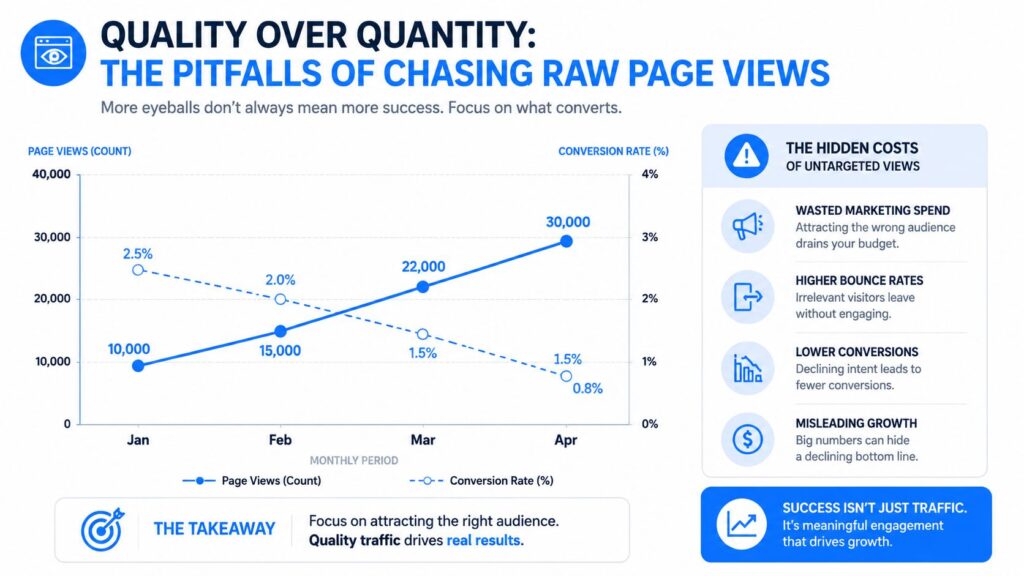
Facebook Page View Conversion Chart
When lower views can still be fine
For SaaS, subscription businesses, coaches, and higher-ticket offers, lower Page views can still produce better outcomes if the visitors are better matched.
A smaller stream of interested prospects often beats a larger stream of loosely curious people. That’s especially true when the sale depends on education, qualification, or follow-up rather than impulse purchase.
Watch for these warning signs:
- Views rise, but message quality falls. More inbound volume, weaker buyer fit.
- Views rise, but sales conversations don’t. Curiosity is broad, not commercial.
- Views fall while qualified actions hold steady. The funnel may be getting cleaner, not weaker.
High-volume Page views can hide a poor audience match. Lower-volume Page views can reflect sharper targeting.
The right strategic use of the metric
Use Facebook Page views to evaluate the health of the top of the funnel. Stop there.
Then shift your attention to what happens next. Did the visitor start a chat, click through, submit details, ask about pricing, or enter a nurturing flow? That’s where business value shows up.
If your business depends on qualified leads, your job isn’t to maximize profile visits. It’s to build a path where the right visitor quickly becomes a real conversation.
A Facebook Page view is useful when you treat it as a signal, not a scoreboard. If you want to turn Page visitors into conversations across Facebook, Messenger, Instagram, WhatsApp, and your site, Clepher gives teams a no-code way to capture interest and nurture it automatically.

Related Posts
Revenue Optimization: A Practical Playbook for Growth
October 19, 202610 Lead Capture Software Tools Compared for 2026
October 18, 2026WhatsApp Chatbot for Ecommerce: A Practical 2026 Guide
October 17, 2026
Founder Clepher