
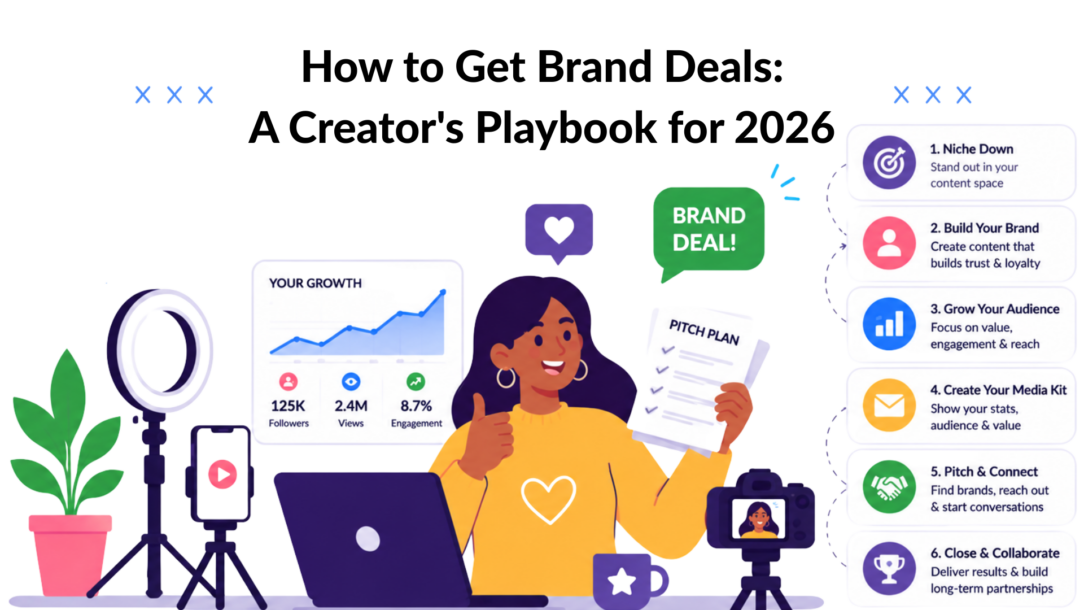
Impact.com reports that 42% of brands commit to long-term partnerships only with creators who can prove campaign KPIs through post-campaign reporting. That changes the entire conversation around how to get brand deals.
The old model was simple. Build an audience, look polished, hope a brand notices, send a pitch, and wait. The current model is tighter. Brands want creators who can bring a relevant audience, package a clear offer, negotiate like a business, and report results after the campaign.
That’s why most advice on how to get brand deals falls short. It spends too much time on subject lines and not enough on the parts that protect your margin and create repeat revenue. The pitch matters. But the core business gets built in positioning, qualification, contract terms, and reporting.
A good deal is not just a paid post. It’s a scoped agreement with the right usage terms, the right timeline, the right contact, and a path to the next campaign.
Build Your Foundation Before You Pitch
Most creators start in the wrong place. They ask, “How many followers do I need?” The better question is, “Why should this brand trust me with budget?”
Follower count helps, but it doesn’t close deals by itself. In niche categories, relevance beats vanity every time. That matters even more outside lifestyle content, where expertise often carries more weight than aesthetics.
2025 Gartner data shows that 45% of B2B and DTC brands are shifting 30% of ad spend to micro-influencers in niche professional fields with 500-2,000 highly engaged followers. If you create content about accounting software, industrial tools, local services, operations, coding, logistics, or SaaS workflows, that’s not a disadvantage. It’s usable commercial context.
Define the commercial version of your niche
Brands don’t buy “content.” They buy access, context, and trust.
Your niche needs to be translated into business language. For example:
- Fitness creator: not “I post workouts,” but “I help busy professionals test practical routines they’ll stick to.”
- SaaS creator: not “I talk about tools,” but “I help teams compare software in a way that shortens decision-making.”
- Local service creator: not “I make educational clips,” but “I help homeowners understand who to hire, what to ask, and what quality looks like.”
That framing changes your pitch from creator-centric to buyer-centric.
Practical rule: If your positioning only describes what you make, it’s too weak. It should describe what problem your content helps solve for a brand’s target customer.
Pull the audience data brands actually care about
Before outreach, open your Instagram, TikTok, YouTube, or newsletter analytics and build a simple partner snapshot.
Include:
- Audience demographics: age bands, top locations, gender split, language, and job relevance if you serve a professional niche
- Content patterns: which formats consistently get saves, shares, replies, comments, or watch time
- Buyer signals: DMs, questions, replies, product requests, click behavior, and recurring pain points
- Brand fit indicators: products your audience already asks about or categories that naturally appear in your content
If you’re building toward Instagram partnerships, your content quality still carries signal before anyone checks your metrics. Clean hooks, useful carousels, strong visual consistency, and a clear point of view matter. This guide to creating quality Instagram content is worth reviewing if your feed still looks more casual than commercial.
Build proof before the pitch
You don’t need a paid deal to create partnership proof.
Post about products you already use. Review workflows. Compare options. Show the before, after, and decision criteria. If you’re in a B2B or service niche, break down tools, processes, or customer mistakes in a way that naturally frames a future sponsor.
A brand manager should be able to visit your profile and immediately understand three things:
- Who you talk to
- What kind of buyer trust do you hold
- How their product would fit your content without feeling forced
That’s the foundation. Without it, every pitch feels colder than it should.
Create Your Professional Media Kit and Rate Card
A weak media kit says, “I want to work with brands.” A strong one says, “I’m already set up for partnerships.”
Most creators overbuild these documents. They add fluff, multiple pages of vague personality copy, and random screenshots. Brand managers don’t need a scrapbook. They need a fast commercial read on whether you fit the campaign.
What your media kit must include
Put the essentials on one clean document first. You can always attach more details later.
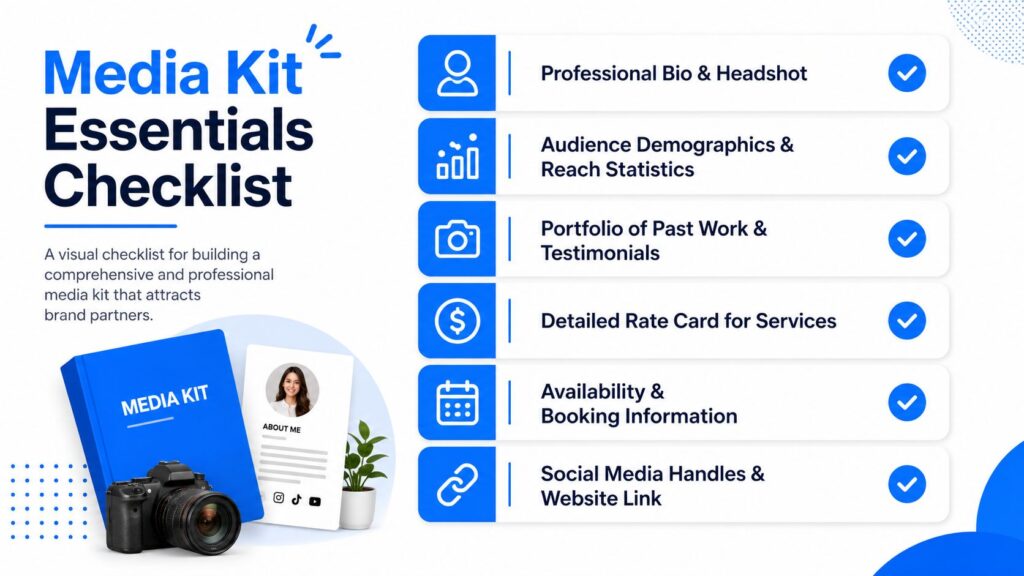
Media Kit Checklist
Use this checklist:
- Professional bio and photo: one short paragraph on who you are, what niche you serve, and the kind of partnerships you take
- Audience profile: platform-by-platform reach, demographics, audience interests, and any relevant niche context
- Content examples: links or thumbnails that show sponsored-style content, product education, or strong native integrations
- Service menu: what you sell, such as reels, stories, short-form video, UGC-style assets, newsletter placements, or bundle packages
- Availability details: turnaround expectations, booking windows, and contact info
- Proof of professionalism: prior collaborations, testimonials, or examples of polished campaign reporting, if you have them
A strong media kit reads as if an operator built it. Clean layout. Clear categories. No clutter.
What to leave out
Some additions hurt more than they help.
Avoid:
- Long personal backstory: brands care about fit, audience, and execution
- Unfiltered vanity metrics: if a number doesn’t support the offer, leave it out
- Too many package variations: confused buyers stall
- “DM for rates” language: this creates friction when a serious brand wants to qualify you quickly
A media kit should answer the first commercial questions before the brand has to ask them.
How to structure your rate card
Rate cards don’t need to be rigid, but they do need to signal that you know how scope works. The easiest setup is to use a one-page sheet with your core deliverables and a note that custom packages are available.
Three pricing models work well in practice:
| Model | Best use | Trade-off |
|---|---|---|
| Flat fee | Simple sponsored content with clear scope | Easy to quote, but easy to underprice if edits expand |
| Package pricing | Multi-asset campaigns across formats | Increases average deal size, but requires tighter deliverable definitions |
| Performance-informed custom pricing | Deals where audience quality, complexity, and usage vary | More flexible, but requires stronger negotiation skills |
Flat fees work when the brief is straightforward. Packages work when a brand needs more than one touchpoint, such as a reel plus stories plus raw asset delivery. Custom pricing works best when the campaign includes layered rights, exclusivity, or internal content use.
Set rates like a business, not a guess
You do not need a universal industry number to quote confidently. You need your floor, your preferred price, and your scope triggers.
Build your rate logic around:
- Production complexity
- Audience relevance
- Revision load
- Turnaround pressure
- Whitelisting, usage, and exclusivity
- Whether the brand wants creator posting, asset delivery, or both
Your rate card should also separate content creation from licensing. That distinction becomes critical once brands want to use your content outside your channel.
If your pricing sheet doesn’t distinguish between deliverables and rights, you’re leaving room for margin loss before the negotiation even starts.
Find and Qualify the Right Brand Partners
Most creators waste time pitching brands that were never a fit. Wrong audience. Wrong contact. Wrong budget. Wrong expectations.
The fastest route to better deals is not more outreach. It’s better target selection.
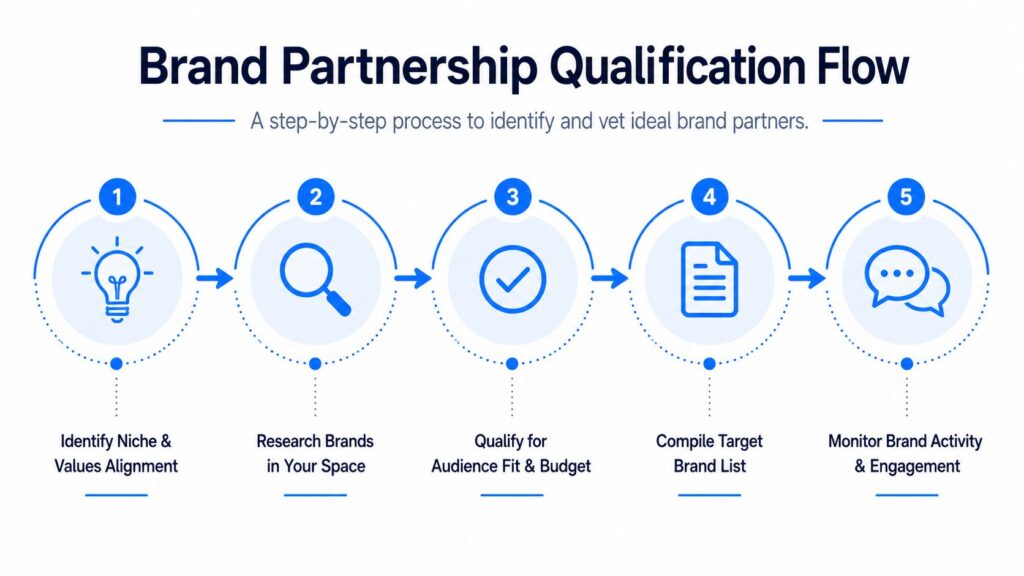
How to Get Brand Deals Partnership Flow
A useful outreach playbook is to pick only 2–3 target brands, plan monthly organic content around them, and contact the person with “partnerships” in their title on LinkedIn. That works because it forces focus. You stop acting like a cold seller and start showing category alignment before you ever send the email.
Compare the three main channels
Not every source of deals works the same way.
Creator marketplaces are easy to access and useful when you’re new. The downside is that they can turn you into a profile in a crowded directory.
Agencies can bring bigger campaign infrastructure and repeat work. The trade-off is that you’re often one name among many, and negotiations can be more structured.
Direct outreach gives you the best control. You choose the brand, shape the angle, and avoid getting buried in a portal. It takes more research, but the fit is usually better.
Vet brands before you pitch
Use a qualification filter. It saves time and protects you from bad-fit partnerships.
Ask:
- Does the product already fit my audience? If you have to explain the relevance too hard, skip it.
- Does the brand work with creators in my size or niche? Check tagged posts, creator reposts, and campaign style.
- Is there a likely budget owner? If no one on the team appears to manage partnerships, the process may stall.
- Would I use or recommend this product without payment? If not, your content will feel thin.
- Can I imagine more than one campaign angle? If the answer is no, this is probably a one-off mention, not a partnership.
For lead qualification discipline, sales teams use the same logic. This overview of how to qualify sales leads maps well to creator outreach because the principle is identical. Spend attention where fit is strongest.
Find the right person, not the loudest account
The main Instagram account is rarely the best place to pitch. Social inboxes are flooded with customer service noise and generic messages.
Look for partnership managers, influencer marketing managers, brand managers, social leads, or community leads. LinkedIn is often the cleanest starting point. If you need help identifying and verifying contact details, these strategies for LinkedIn email discovery are useful because they keep your research focused on real decision-makers.
The quality of the contact matters almost as much as the quality of the pitch.
Good qualification feels slower at first. Then it speeds everything up, because the brands you contact make sense.
Master the Art of Outreach and Follow-Up
Most outreach fails because it’s self-focused.
Brands don’t care that you “love their mission” unless you can connect that to a usable content idea, a relevant audience, or a campaign angle they can picture running. The best pitches make the buyer’s job easier.
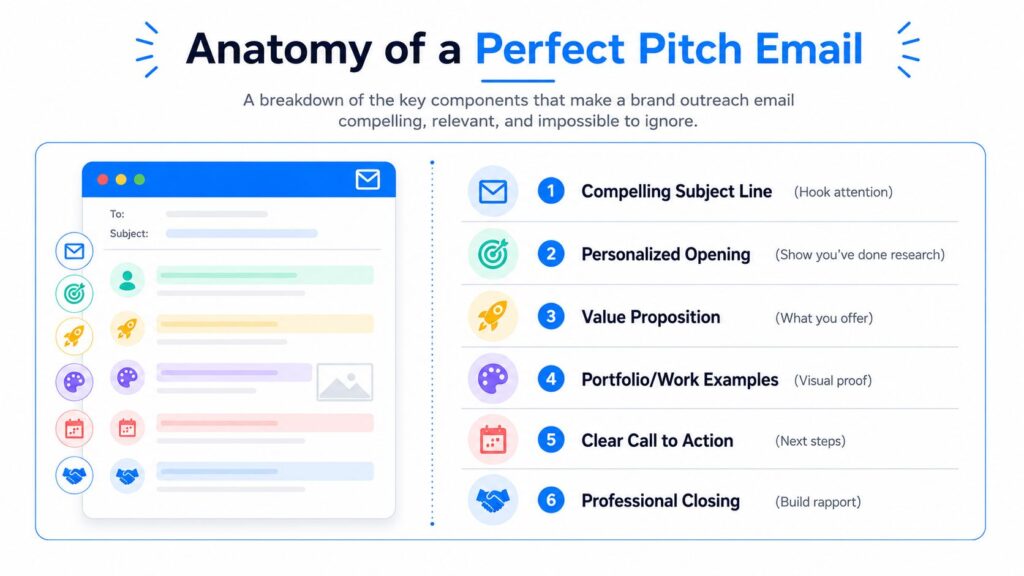
How to Get Brand Deals Pitch Email
Use a value-led pitch structure
A working outreach email usually has five parts.
-
A specific opening
Mention something real. A campaign, product launch, creator partnership style, or audience fit observation. -
A quick positioning line
Explain who you reach and why that audience overlaps with the brand. -
A concrete idea
Give one or two campaign angles, not a vague “I’d love to collaborate.” -
A proof point
Share your media kit, a relevant content example, or an audience snapshot. -
A simple CTA
Ask if they’re the right person for partnerships or open to discussing a concept.
Here’s a template that works well:
Hi [Name],
I’ve been following how [Brand] shows up in [category/channel], especially the way you [specific observation].
I create content for [audience] around [topic], and I think there’s a strong fit between your product and the questions my audience already asks about [problem/category].
One angle I’d propose is [idea one]. Another is [idea two]. Both would let me feature the product in a way that feels native to my content rather than bolted on.
I’ve linked my media kit and a few relevant examples below. If partnerships are handled by someone else on your team, I’d appreciate being pointed in the right direction.
Best,
[Name]
That structure works because it respects inbox time.
Keep your examples tight
Don’t send a dump of everything you’ve ever made. Send the closest commercial match.
If the brand sells a skincare product, send the product demo or ingredient breakdown. If it’s B2B software, send the workflow explainer or comparison post. Relevance beats volume.
Cold email teams use the same principle. These cold email tips for sales teams are useful because creator outreach and outbound sales share one rule. Clarity wins.
This quick video is also a solid companion if you want to sharpen your outreach instincts:
Follow up without sounding desperate
Most creators either never follow up or overdo it. Both are mistakes.
Use a short sequence:
- First email: clear pitch with one focused idea
- First follow-up: brief bump with a new angle, example, or seasonal tie-in
- Second follow-up: ask whether there’s a better contact or better timing
- Final closeout: polite note saying you’ll close the loop for now
Keep every follow-up shorter than the original. No guilt. No “just checking in again.” Add context each time.
If you’re also opening conversations in DMs, keep them even lighter. Instagram can warm the contact, but email usually closes the business. If your inbound deal flow starts spreading across channels, it helps to use a system for organizing conversations and lead sources. This guide to Instagram direct message marketing shows how brands structure those interactions without letting opportunities disappear into a messy inbox.
Outreach works best when it feels like a customized business proposal, not a fan message.
Negotiate Deals and Contracts Like a Pro
The pitch gets attention. Negotiation protects your income.
A surprising number of creators get excited at the first yes and stop thinking commercially. That’s where margin disappears. The fee matters, but the contract terms often matter more because they define how much work you’re doing, how long the brand can benefit from it, and what restrictions you take on afterward.
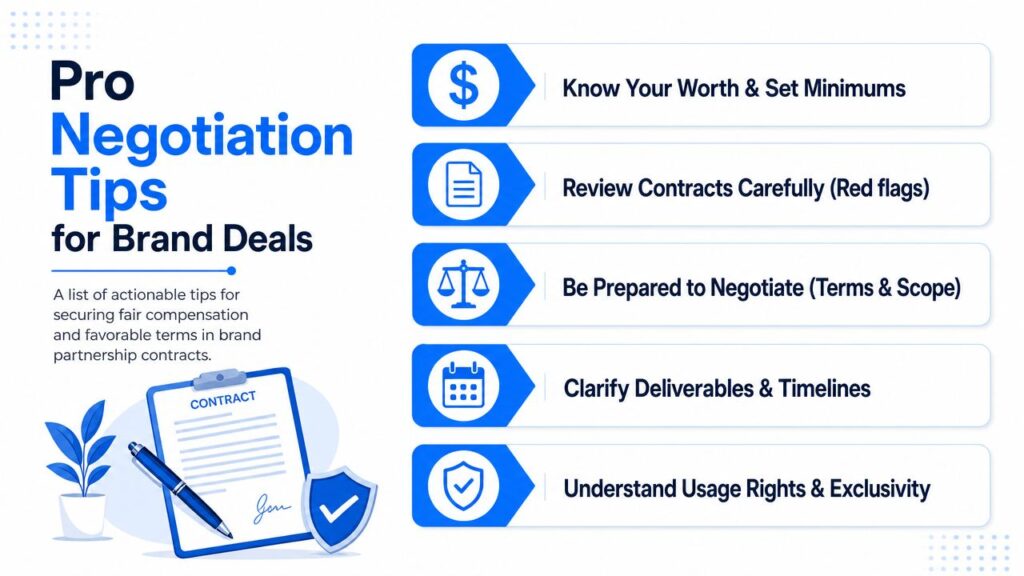
Superwider notes that creators whose first quoted rate is accepted immediately are likely undervaluing their work by 20-30%, and it also reports that 80% of creators struggle with negotiating usage rights. That lines up with what happens in real negotiations. Brands expect a conversation. If you skip it, you often absorb extra value transfer without realizing it.
How to Get Brand Deals Negotiation Tips
Negotiate the scope before you negotiate comfort
A lot of bad deals start because the creator is trying to seem easy to work with. Be collaborative, yes. Be vague, no.
Clarify these points before agreeing to anything:
- Deliverables: exactly what is being created, posted, edited, and supplied
- Platforms: where the content will appear
- Deadlines: draft date, review date, posting date, reporting date
- Revision limits: how many rounds are included
- Approvals: who signs off and how long they have to review
- Payment timing: deposit, post date, net terms, or milestone structure
If a brief says “one reel,” that’s not enough. Ask whether hooks, captions, cutdowns, raw clips, alt versions, and story support are included or separate.
Treat usage rights as a separate product
Undercharging is common among many creators. You are not only selling production and posting. You may also be licensing your likeness, your edit, your script, and your content asset library.
Usage terms should answer:
| Clause | What to ask |
|---|---|
| Channel usage | Will they use the content only on your page, or also on their social, website, paid ads, email, retail, or internal decks? |
| Duration | How long can they use it? |
| Geography | Is usage limited to one market or broader? |
| Format | Can they crop, edit, subtitle, or repackage it? |
| Whitelisting | Will they run ads through your handle? |
If a brand wants broad usage, that should not be folded into the base creative fee as if it costs nothing.
A clean way to handle it is simple language, such as:
The quoted fee covers content creation and posting as scoped. Paid usage, whitelisting, and extended brand-owned usage can be added under separate licensing terms.
That sentence alone fixes a lot of confusion.
Don’t ignore exclusivity
Exclusivity sounds harmless until it blocks revenue.
If a supplement brand wants to be exclusive in the category, define the category tightly. “Wellness” is too broad. “Protein powder” is narrower. The broader the restriction, the more expensive it should become.
Watch for these red flags:
- Unlimited usage of language
- Open-ended exclusivity
- Undefined revision rounds
- Delivery obligations that exceed the paid scope
- Terms that let the brand edit your content into new assets without permission
Contracts don’t need to be hostile. They need to be specific.
Use negotiation language that keeps momentum
You don’t need to posture. You need to redirect the conversation.
Useful phrasing:
- On fee: “I can make this work if we adjust the scope or revise the fee to reflect the added deliverables.”
- On usage: “That level of brand usage falls outside the base content rate, so I’d scope that as licensing.”
- On exclusivity: “I’m open to category exclusivity if we define the category clearly and account for the restriction in the agreement.”
- On timelines: “I can commit to that date once review windows and feedback rounds are locked.”
The creators who do well long-term are not the ones who say yes fastest. They’re the ones who know exactly what they’re selling.
Deliver Value and Prove Your ROI
Renewals usually come down to one question inside the brand team: can they justify hiring you again?
That decision is rarely based on the post alone. It comes from how you handled the campaign, whether the asset was usable beyond your feed, and how clearly you tied the work to a business outcome. Creators who get repeat work make the manager’s job easier. They deliver on time, keep approvals organized, flag issues early, and send a recap the team can forward to a director without rewriting half of it.
The post is one deliverable. The result is the product.
Execute like a partner, not a content vendor
Strong campaigns are managed before publication day. If you wait until the content is live to clarify expectations, small mistakes turn into expensive ones. A missing claim disclaimer, a late approval, or a cropped frame that does not fit paid placement can reduce the value of the asset fast.
Keep delivery tight:
- Restate the live scope in writing: deliverables, deadlines, approval steps, CTA, tracking links, and any restricted claims
- Confirm asset specs early: dimensions, hook variations, caption requirements, and whether the brand wants raw files
- Track what the brand can use after posting: organic reposting, paid usage, whitelisting access, and end dates on any license
- Flag friction early: shipping delays, product issues, legal questions, or changes that affect performance
- Protect what made them hire you: brand-safe does not mean generic. Your audience still needs to recognize your voice
This is also where smart creators protect margin. If a brand asks for extra cutdowns, stills pulled from video, or alternate hooks after the approved scope, treat that as added production work or licensing, not a favor that gets absorbed unpaid.
Report the metrics the brand can actually use
A good post-campaign report helps the marketing manager defend the spend internally. A great one also sets up the next deal.
Skip vanity reporting. Start with the campaign goal, then map your recap to that goal. If the brand wanted awareness, lead with reach, watch time, saves, shares, and comment quality. If they wanted clicks or conversions, include link performance, code usage, landing page behavior when available, and any signals of purchase intent from replies or DMs.
Useful reports usually include:
- Campaign summary: objective, deliverables, publish dates, and audience fit
- Performance by asset: views, reach, completion rate, CTR, saves, shares, comments, and link clicks where available
- Audience quality signals: comments that show intent, repeated questions, sentiment, and objections
- Creative analysis: hooks, offers, visuals, and messaging angles that held attention or drove action
- Usage value: whether the content produced assets the brand can reuse in paid social, email, product pages, or sales collateral
- Recommendation: the next test, next format, or next package based on what performed
Interpretation is where the money is. Numbers alone are easy to ignore. Context gets approved.
For example, 80,000 views means very little on its own. If the first three seconds held above your usual benchmark, comments included pricing and shipping questions, and the brand has licensed the asset for paid usage, that campaign did more than generate awareness. It created a strong candidate for ad creative and a case for a second flight.
Tie performance to revenue, not just reach
Brand teams care about outcomes in different ways. Creator managers may care about content quality and timeliness. Paid social teams care about usable assets and thumb-stop rate. Ecommerce teams care about clicks, conversions, average order value, and customer questions that block purchase.
Your recap should speak to more than one stakeholder.
If you have affiliate data, use it. If you have UTM links, use them. If you do not have direct conversion visibility, report proxy signals accurately. High save rate on an educational video, repeated comment questions about product fit, or strong story sticker taps can support a case for continued testing, but do not present them as sales proof.
That trade-off matters. Discerning brands can tell when a creator is overselling weak attribution.
Turn one campaign into a retained relationship
One-off campaigns reset the sales process every time. Retainers come from showing a brand what the next 90 days should look like.
Do not end with a generic “let me know if you want to work together again.” End with a specific recommendation based on the campaign you just ran. If the testimonial angle drove stronger watch time than the product demo, propose a three-part customer proof series. If story replies showed active buying questions, suggest a monthly FAQ format plus a limited-time offer. If the brand licensed the content for paid use, pitch a quarterly UGC package with fresh variations to prevent ad fatigue.
Use language like this:
- For a follow-up test: “This angle pulled the strongest response. I’d recommend a second asset that answers the objections showing up in comments.”
- For recurring content: “There’s enough signal here to justify a monthly package. I’d structure it around one hero video, two cutdowns, and usage rights for paid social.”
- For broader internal buy-in: “If your team wants consistency, I can map this into a 90-day content plan with clear testing goals and renewal checkpoints.”
That is how six-figure creator relationships are built. Good content gets you paid once. Clear reporting, smart licensing, and a concrete next proposal turn a single deliverable into an account.
Related Posts
Client Account Management: A Practical Playbook
October 13, 2026Chat Bot Responses That Convert: A Practical Guide
October 12, 202610 Broadcast Automation Software Platforms Compared
October 11, 2026
Founder Clepher