
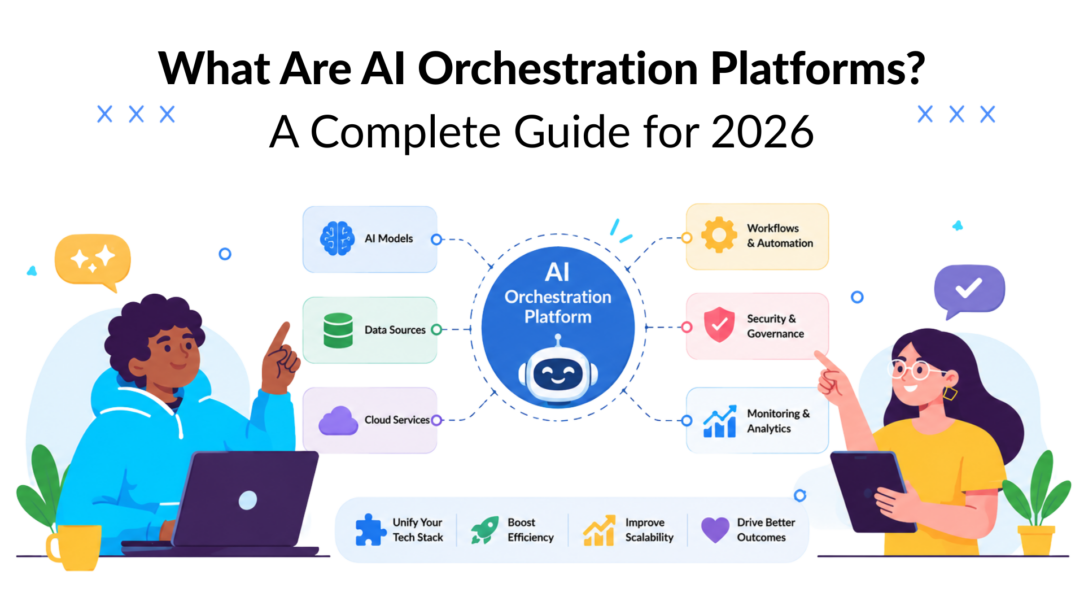
Imagine your company’s AI tools are star players on a team. You’ve got a slick chatbot, a powerful CRM, and a sharp analytics engine. But if they’re not working together, you just have individuals running in different directions, not a winning team.
AI orchestration platforms are the coach that gives them a playbook. They ensure every tool communicates, coordinates, and plays its part to achieve a common business goal—whether that’s a sale, a resolved support ticket, or a killer customer experience.
This guide will give you practical, actionable insights on how these platforms can transform your business.
What Is AI Orchestration and Why It Matters Now
At its heart, an AI orchestration platform is a central command center. It connects and automates workflows across all your different AI systems and business apps. It’s the glue that turns a collection of siloed, single-purpose tools into one unified, intelligent machine.
Let’s look at a real-world marketing example. A new sales lead comes in from an Instagram ad. Without orchestration, it’s a messy, manual process:
- The marketing team spots the lead.
- They copy the info into a spreadsheet.
- They email a sales rep.
- The sales rep types it into the CRM before finally making contact.
Every step is a bottleneck, full of delays and potential mistakes.
Now, picture that with an AI orchestration platform. The entire sequence becomes a smart, seamless workflow that happens in seconds. The platform manages the whole journey automatically, transforming a messy process into a revenue-generating machine.
AI Orchestration at a Glance
This table simplifies what AI orchestration is all about and why it’s a game-changer for modern businesses.
| Concept | What It Means in Practice | Business Result |
|---|---|---|
| Centralized Control | A single dashboard to build, manage, and monitor all your automated workflows. No more app-hopping. | Less chaos, more clarity. Your team saves hours by not having to juggle multiple logins and systems. |
| Intelligent Workflows | Moving beyond simple “if/then” rules to create multi-step journeys with complex logic and AI-driven decisions. | Smarter decisions. High-value leads get VIP treatment automatically, while others are nurtured without manual effort. |
| System Integration | Connecting all your tools—from chatbots and CRMs to analytics and ad platforms—so they can share data and work together. | A unified view of the customer. Data flows freely, eliminating silos and creating a seamless experience. |
| End-to-End Automation | Automating an entire business process from start to finish, like lead nurturing or customer onboarding, without manual handoffs. | Massive scalability. You can handle 10x the volume of leads or support tickets without hiring 10x the staff. |
In short, orchestration gives you the power to make your entire tech stack operate like a single, well-oiled machine, driving efficiency and growth.
From Simple Automation to Intelligent Workflows
It’s easy to confuse AI orchestration with basic automation tools like Zapier. While those are great for simple “if this, then that” tasks (like “if I get an email, add it to a spreadsheet”), orchestration is built for something much bigger. It handles complex, multi-step scenarios that need real logic, decision-making, and coordination between many systems.
An orchestration platform can:
- Manage Complex Journeys: It guides a process through multiple stages, like nurturing a lead from that first Instagram click all the way to a sales-qualified handoff.
- Enable AI-driven Decisions: It can use AI to determine the next best action. For example, it might instantly route a high-value lead to a senior sales agent while sending a lower-priority one into an automated email sequence.
- Provide a Central Command Center: You get one place to build, monitor, and tweak all these intricate workflows, finally ending the chaos of juggling dozens of disconnected apps.
Understanding how AI fits into these automated processes is key. For example, knowing more about Leveraging AI in web scraping shows how intelligent data collection can feed these powerful workflows from the very beginning.
The Takeaway: The real power of AI orchestration is that it helps your business think beyond isolated tasks. It creates a strategic system that connects your conversational marketing, sales processes, and customer support into one cohesive operation that runs without constant human intervention.
Ultimately, these platforms ensure the right data gets to the right tool—or person—at the perfect moment. It’s no longer about making one tool work; it’s about making all your tools work together to create better customer experiences and unlock new levels of efficiency.
How AI Orchestration Platforms Actually Work
Forget the abstract theory. Let’s see these platforms in action by following a real-world customer journey in e-commerce. This isn’t just about connecting tools; it’s about making them work together like a well-drilled team.
Picture this: a potential customer, Sarah, is scrolling through Instagram and sees your ad for a new skincare product. She clicks it. With an orchestration platform, that click kicks off an intelligent, automated workflow designed to convert her.
The Central Brain in Action
The second Sarah clicks that ad, the AI orchestration platform jumps into action. It acts as the central brain, coordinating a sequence of events across tools that would otherwise never speak to each other.
First, it triggers your conversational AI tool—like Clepher—to start a chat with Sarah right in her Instagram DMs. The AI agent might ask a simple qualifying question, “Are you interested in products for dry or oily skin?” This isn’t a basic chatbot response; it’s the first data point in a goal-oriented process.
As Sarah replies, the platform is already capturing and sorting that information, preparing the next step in her journey.
The diagram below perfectly illustrates this shift—from a bunch of siloed tools to a powerful, unified system.
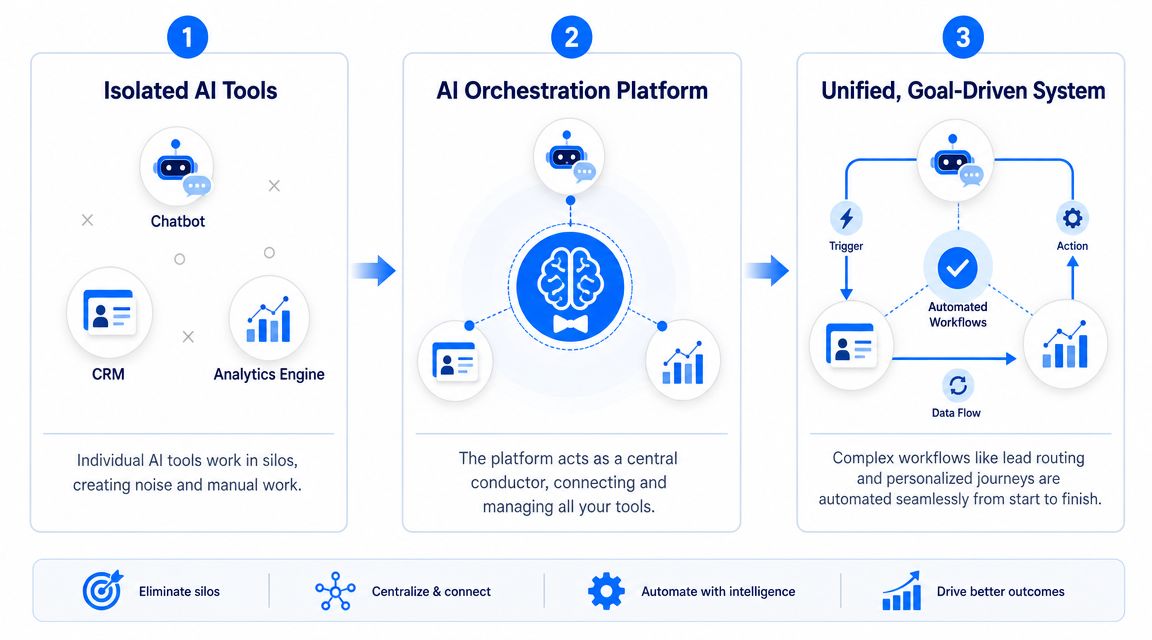
AI Orchestration Platforms Workflow Diagram
It’s all about taking separate systems and getting them to work in concert toward a single business goal.
Managing the Hand-Offs Seamlessly
What happens if Sarah asks a tricky question about specific ingredients that the AI agent isn’t trained to handle? This is where the platform really shows its intelligence. Instead of the conversation hitting a wall, the platform’s workflow engine makes a smart move.
Actionable Insight: The platform instantly recognizes the AI’s limit and routes the conversation to a live support agent. Critically, it doesn’t just send a vague notification. It pushes the entire chat history and Sarah’s customer profile directly into the agent’s helpdesk.
This seamless hand-off is a game-changer. The agent has all the context they need to jump in without making Sarah repeat herself. Behind the scenes, the platform uses APIs (Application Programming Interfaces) as digital messengers, letting your chatbot, CRM, and helpdesk software all talk to each other fluently.
The Core Components at Play
This elegant process is managed by three key components inside the AI orchestration platform:
- The Workflow Engine: Think of this as the “brain.” It holds the business logic, telling the system what to do and when, based on triggers and rules you set up. For example: IF a lead is marked as “hot,” THEN send their contact info to the CRM and notify the sales team.
- The Integration Layer (APIs): These are the connectors, the digital plumbing that allows data to flow between all your different tools—from Instagram DMs to your email marketing platform and back.
- The Central Dashboard: This is your command center. It’s where you build your workflows in a visual editor, monitor how they’re performing in real-time, and tweak them for better results.
These components are brought to life by AI agents, the individual “doers” that execute specific tasks in a workflow. You can learn more about what AI agents are and the roles they play in these systems.
Ultimately, this coordinated effort turns a simple ad click into a fully managed customer journey that feels personal, responsive, and incredibly efficient.
What Are the Real Business Wins with AI Orchestration?
Thinking about AI orchestration as just another piece of software is missing the point. It’s not about adding a tool; it’s about fundamentally transforming how your business runs. The biggest win? You can scale operations massively without hiring a massive team.
This is about automating the complex, multi-step jobs that used to be a nightmare of manual work—the kind that’s slow, tedious, and ripe for human error.
An orchestration platform can automate an entire lead nurturing flow, from the first ad click to booking a sales call, making smart decisions based on every action the user takes. This isn’t a simple “if this, then that” rule. It’s a strategic system that frees your team from repetitive tasks so they can focus on work that actually grows the business.
A Truly Unified Customer Experience
Customers today are everywhere: chat, email, social media, your website. AI orchestration brings all those conversations into one single, intelligent journey. By connecting these scattered systems, you create an experience where the customer never has to repeat themselves.
Someone might start a conversation in your Instagram DMs, follow up via email, and then finish by talking to a live agent. With orchestration, all that history and context travels with them. This consistency doesn’t just make customers happier—it builds trust and loyalty.
The Transformation: You move from a mess of disconnected interactions to a single, continuous conversation. It’s the difference between a frustrating, broken experience and one that feels personal and seamless.
The data backs this up. While 88% of organizations use AI somewhere, only about a third use it across their entire business. That gap is exactly where orchestration comes in. And even though 80% of Fortune 500 companies use AI agents, many lack a unified way to manage them. Connecting these AI experiments to actual revenue is key. You can discover more insights about this AI orchestration trend.
Future-Proof Your Tech Stack
Here’s a powerful benefit many people miss: AI orchestration platforms future-proof your business. Tech moves fast. Today’s “it” AI tool could be old news tomorrow. An orchestration platform acts like a flexible adapter, separating your core business rules from the specific tools you use.
This means you can easily unplug one tool—like a specific chatbot—and plug in a new, better one without rebuilding your entire system.
This modular setup gives you incredible agility. You can test and roll out new AI innovations as they appear, always using the best tech for the job. Instead of being locked into a clunky system, you get a flexible, adaptable stack that evolves with your business.
Real-World Examples: Before and After AI Orchestration
Let’s get practical. What does this transformation look like in a real business? Here are some “before and after” snapshots showing how different businesses go from manual chaos to a smart, automated system.
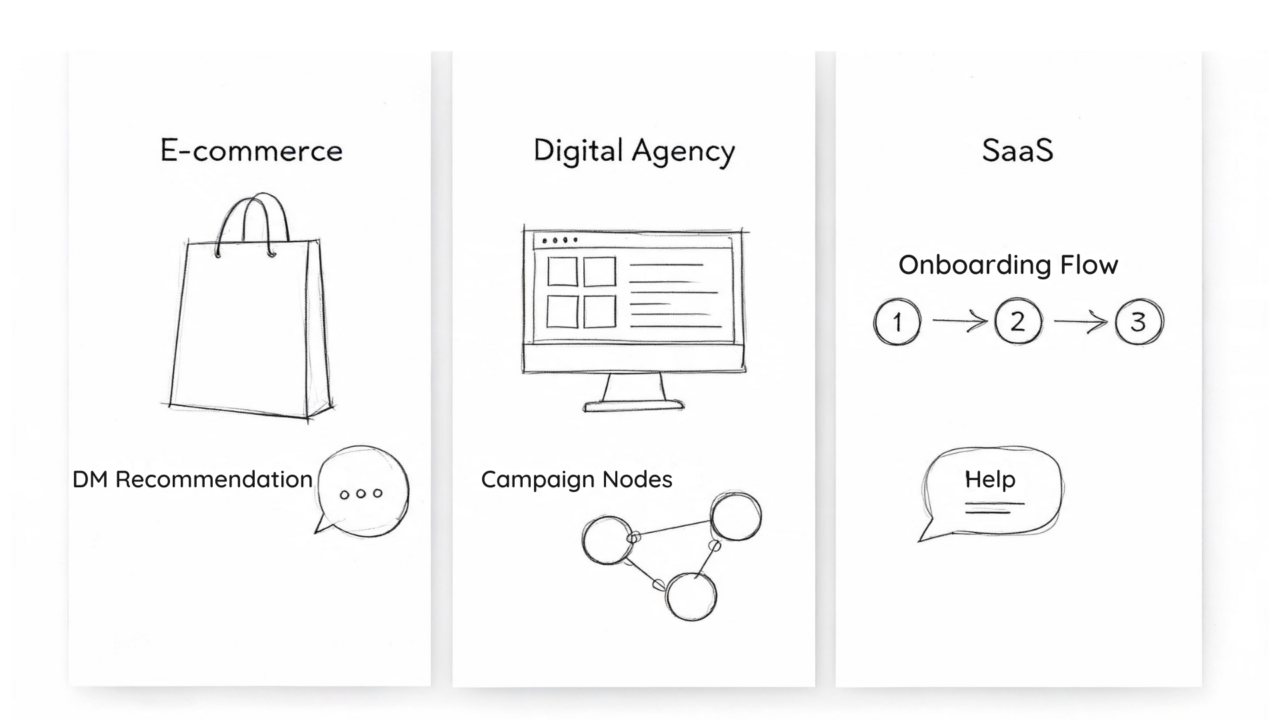
AI Orchestration Platforms Workflow Sketches
For E-commerce Brands
- Before: A customer comments “I want this!” on an Instagram post. A social media manager manually replies, sends a DM with the link, and adds the user to a messy spreadsheet for follow-up. It’s slow and impossible to manage at scale.
- After: The same comment triggers an instant workflow. An AI agent immediately sends a personalized DM with the product link. It simultaneously captures the user’s info as a new lead in your CRM and enrolls them in a post-purchase follow-up sequence. The whole process is flawless and happens in seconds.
For Digital Marketing Agencies
- Before: Your team is drowning in logins, switching between client Facebook pages, exporting chat data into spreadsheets, and manually building reports. It’s a logistical nightmare that kills productivity.
- After: You manage every client from a single, unified dashboard. New leads from every campaign are automatically qualified, tagged, and funneled into the correct client’s CRM. You get a clear, real-time view of performance, freeing your team to focus on strategy instead of admin.
Key Takeaway: AI orchestration platforms don’t just connect your tools; they build intelligent systems out of them. They create a seamless flow where one action reliably triggers the next, transforming how you engage with customers and manage complex processes.
For SaaS Companies
- Before: A new user signs up and is left to figure out the software alone. If they get stuck, they have to hunt through a knowledge base or file a support ticket and wait. This leads to frustration and high churn.
- After: The moment a user signs up, an automated onboarding sequence kicks in. Smart, contextual help bots appear to explain key features. If a user is still stuck, the system seamlessly hands them off to a live agent who already has the full context of what they were trying to do.
These examples just scratch the surface. To see how AI can orchestrate even highly complex creative tasks, you only need to look at the rise of specialized tools like a smart video creation platform for SMBs that automates the entire ad production pipeline.
How to Choose the Right AI Orchestration Platform
With the market flooded with options, picking the right AI orchestration platform can feel overwhelming. The key is to find a solution that solves your specific business problems and grows with you.
The global AI orchestration market was valued at USD 9.76 billion in 2024 and is projected to explode to USD 58.92 billion by 2033. This growth is a clear signal: businesses need a central hub to manage their automated workflows. You can discover more insights about this AI market growth here.
Key Questions to Ask Before You Buy
Treat this process like you’re hiring a key team member. Use these questions to cut through sales pitches and find a true partner.
- Integration and Compatibility: Does it have native integrations with the tools you use every day (CRM, email, ad platforms)? Avoid platforms that require complex custom coding.
- Ease of Use: Can your non-technical team members—like marketers—actually use it? A no-code, visual workflow builder is essential for adoption.
- Scalability and Performance: Can it handle a massive spike in traffic during a Black Friday sale without crashing or sending your costs through the roof?
- Support and Onboarding: What does setup really look like? Ask for specifics on the hands-on support you can expect.
Dedicated Platform vs. Built-in Features
It’s critical to know the difference between a dedicated AI orchestration platform and a tool with basic automation features. Many apps now offer simple “if this, then that” rules, which are fine for single tasks.
The Difference: A dedicated platform is built to be the central “brain” of your entire operation. It manages complex, multi-step journeys with branching logic and coordinates handoffs between dozens of systems.
For instance, you’ll eventually need a platform that can manage sophisticated tasks carried out by different AI agent platforms. A dedicated solution provides the power and flexibility to build an interconnected system that evolves as your business grows.
Implementing Your First AI Orchestration Workflow
Getting started doesn’t mean you have to rip and replace everything. The smart move is to start small. Target a single, high-impact problem, get a quick win, and build from there. The goal is progress, not perfection.
Let’s walk through building your first automated flow: qualifying inbound leads from your social media ads. This is a classic bottleneck begging for automation.
Step 1: Map Your First Workflow
Before touching any software, grab a whiteboard. Map out your current manual process, step by painful step.
- User comments on an Instagram ad.
- Team member manually replies and sends a DM.
- They ask the same qualifying questions repeatedly.
- Info gets copied into a spreadsheet.
- An email is sent to a sales rep for follow-up.
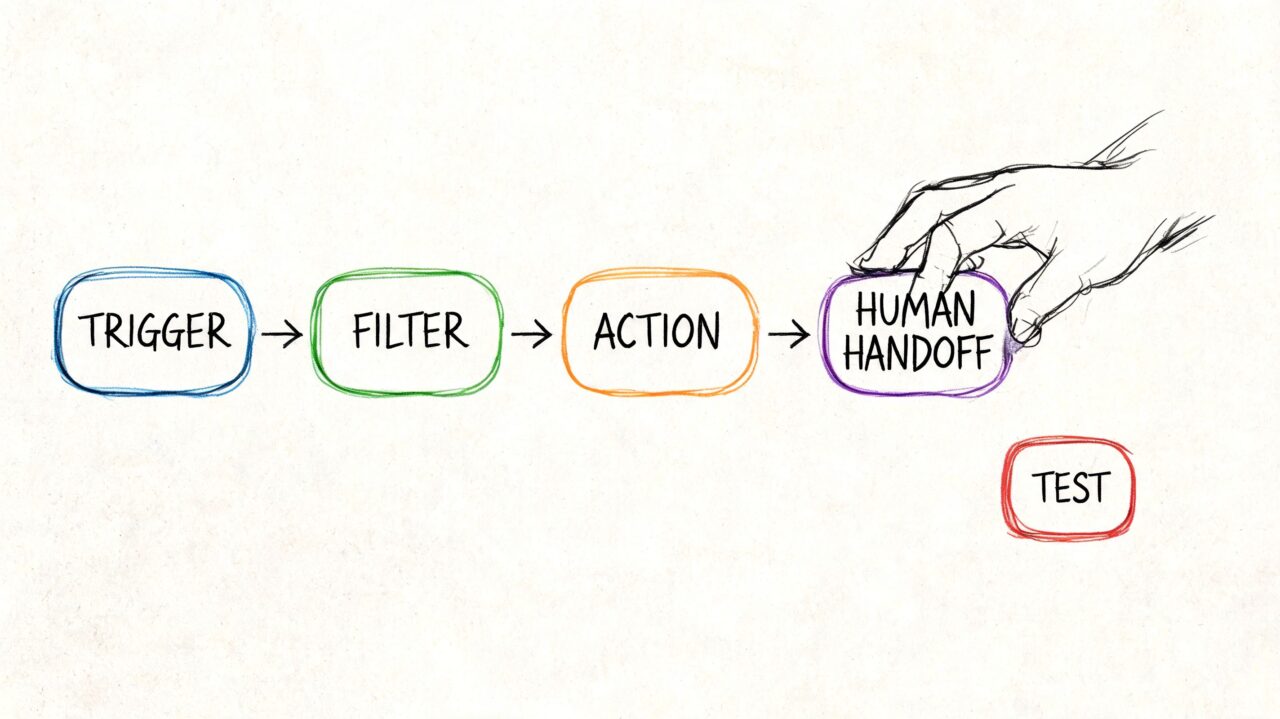
AI Orchestration Platforms Process Flow
When you see the process laid out, the bottlenecks are obvious. You can pinpoint exactly where automation will have the biggest impact.
Key Insight: This mapping exercise shines a spotlight on the points of friction and delay in your current system, giving you a clear blueprint for what your automated workflow must achieve.
This process is easier today thanks to the industry’s shift to the cloud. While on-premise solutions held about 56% of the market share in 2023, cloud-based platforms are now dominant. This makes connecting your website chat, social DMs, and CRM a breeze. You can learn more about these AI orchestration market trends here.
Step 2: Build and Test with a No-Code Builder
Modern AI orchestration platforms make this incredibly fast. With a visual, drag-and-drop interface, you can recreate the workflow you mapped out without writing any code.
For our social media lead example, your automated flow would look like this:
- Trigger: New comment on a specific Instagram ad.
- Action: Immediately send an automated DM using a pre-built conversational flow.
- Action: Let AI analyze the user’s reply, extract key info, and add it to your CRM.
- Condition: If the AI flags the lead as qualified, automatically notify the sales team.
Building these first workflows is simpler than you think, especially with a modern no-code AI agent builder that lets you visually design the entire logic. The aim is to get a working version live, let it run, and quickly prove its value.
Common Questions About AI Orchestration
Whenever we talk about AI orchestration, the same few questions pop up. Let’s clear the air with some straight answers.
Conclusion
Selecting the right AI orchestration platform is critical for building production-ready AI that can scale AI systems and coordinate multiple AI components across distributed AI and cloud orchestration environments. Whether you choose an open-source framework or a commercial AI platform, an orchestration tool that supports workflow orchestration, data orchestration, and AI workflow orchestration will streamline AI deployments and improve AI execution for enterprise AI and AI applications.
Modern AI orchestration tools and orchestration frameworks enable multi-agent orchestration, agentic AI, and autonomous AI agents by providing an orchestration layer that connects AI models, AI services, and AI workloads into cohesive AI workflows. For teams evaluating the 10 best AI orchestration options or the top AI orchestration tools and orchestration tools in 2026, consider capabilities like AI agent orchestration, agent builder support (including Vertex AI agent builder), orchestrating AI agents within secure environments, and strong AI integration for generative AI and conversational AI use cases.
The right orchestration tool or orchestration platform helps coordinate AI, scale AI, and make advanced AI and distributed AI feasible in production, unlocking AI capabilities across AI ecosystems and enabling developers to focus on building AI applications rather than low-level orchestration. Ultimately, the best AI orchestration strategy blends an orchestration framework, robust orchestration capabilities, and the right mix of open-source and enterprise AI providers to deliver reliable, production-ready AI deployments and accelerate building AI that drives real business value.
Related Posts

Founder Clepher