
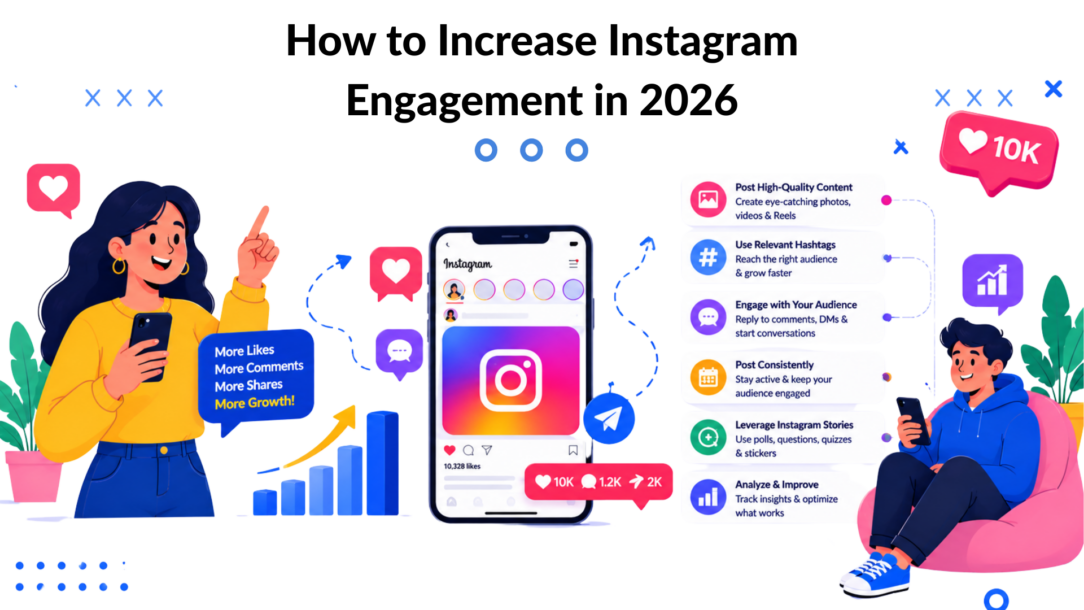
Instagram’s average engagement rate sits at about 0.50%, according to recent Instagram statistics compiled by Sprout Social, which also notes that this is still higher than Facebook and X in those roundups (Sprout Social’s Instagram stats). That number changes the conversation.
Most brands don’t have an engagement problem because they’re “bad at content.” They have an engagement problem because they’re still measuring success like it’s a popularity contest. Likes feel good. Comments look active. Reach screenshots impress clients. None of that matters much if the interaction ends ona the post.
If you want to learn how to increase Instagram engagement in a way that helps a business grow, stop treating engagement as public applause. Treat it as a conversation system. The post gets attention. The story gets a reaction. The DM turns interest into intent.
That shift matters for e-commerce brands trying to answer buying questions, coaches trying to qualify leads, and creators trying to turn attention into repeat action. Public engagement gets the signal. Private engagement gets the sale, the booking, or a genuine relationship.
A lot of the old advice still has value. Good hooks, strong visuals, consistent posting, and clear calls to action still work. If you need a broader foundation, these proven social media tips are a useful companion. But in practice, the accounts growing strongest right now usually do one extra thing well. They create content that opens a path into a real exchange.
Why Your Instagram Engagement Has Stalled
Instagram feels harder because it is harder. The average benchmark is low, competition is constant, and every feed is crowded. If your posts aren’t moving the way they used to, that doesn’t automatically mean your content is broken.
It often means you’re optimizing for the wrong layer of engagement.
A lot of teams still chase surface signals. They ask for likes. They write “comment below.” They stack hashtags and hope distribution picks up. Those tactics can help at the edges, but they rarely fix the deeper issue. People may notice the post without caring enough to continue the interaction.
The algorithm isn’t your only problem
The bigger issue is usually friction.
A DTC skincare brand might publish polished product shots that look premium but give followers nothing to do. A business coach might post good advice in long captions but never create a clean next step. A fashion label might get story views and reactions but fail to turn that momentum into product questions, waitlist interest, or fit guidance.
That’s where stagnation starts. You’re visible, but not conversational.
Practical rule: If a post earns attention but doesn’t create a next action, engagement stalls even when reach looks healthy.
Vanity metrics create false confidence
Likes are the easiest metric to inflate mentally. They’re also one of the least useful if your goal is revenue, lead quality, or stronger customer relationships.
A better read is this:
- Saves usually signal useful content people want to revisit.
- Shares often signal content worth passing along.
- Replies and DMs signal personal intent.
- Comment threads matter more when they continue beyond a single response.
If your content calendar is filled with “brand presence” posts but not many conversation triggers, your engagement ceiling will stay low. The fix isn’t posting more for the sake of it. The fix is designing content around response behavior.
What changed in practice
The brands that keep growing on Instagram tend to use a simple sequence:
- Publish something easy to consume
- Prompt a specific reaction
- Move interested people into a deeper exchange
- Follow up consistently
That’s a much better model than posting and hoping the algorithm rewards you. It also makes your engagement less fragile because you’re not relying only on public metrics.
Master Your Content Mix for Maximum Interaction
Accounts that post the same type of content over and over usually hit an engagement ceiling fast. The problem is not volume alone. It is role confusion. If every format is trying to educate, sell, entertain, and convert at the same time, each one gets weaker.
A stronger content mix gives each format a clear job, then connects public interaction to private follow-up.
Assign one primary outcome to each format
Instagram gives you three practical workhorses for engagement. Each one produces a different kind of response.
| Content Format | Primary Goal | Best For |
|---|---|---|
| Reels | Reach and first interest | New audiences, product hooks, fast problem awareness |
| Carousels | Consideration and savings | Education, comparisons, how-to content, buying context |
| Stories | Replies and DM starts | Polls, objections, quick feedback, low-friction prompts |
That structure matters.
A skincare brand, for example, can use Reels to show a quick before-and-after texture demo, carousels to explain who the product is for, and Stories to ask, “Want help choosing between these two routines?” Each format supports a different step. Together, they create momentum instead of scattered activity.
Reels bring in cold attention
Reels work best when they answer one question quickly. The opening needs a clear payoff, not a vague teaser.
For e-commerce, strong Reels often show fit, use case, or transformation. A fashion brand might post “how this dress fits on three body types.” A supplement company might post “what customers get wrong about taking creatine.” For coaching, Reels that call out a bottleneck tend to perform better than generic inspiration. “Why your sales calls stall after the proposal” is sharper than “3 mindset shifts for success.”
The trade-off is simple. Reels can expand reach fast, but a lot of that attention is shallow unless the post gives viewers a reason to comment, save, or message. Add a direct prompt that filters intent, such as “Comment ‘guide’ if you want the checklist” or “DM ‘fit’ if you want sizing help.” That turns passive views into conversations you can continue later.
Carousels build intent better than single-image posts
Carousels give you more room to earn attention slide by slide. That usually leads to better saves, better shares, and stronger product understanding than a single graphic with a clever caption.
Social Insider’s analysis of Instagram engagement found that carousel posts can generate more saves than single-photo posts and significantly stronger overall engagement (Social Insider’s Instagram engagement analysis). That lines up with what shows up in client accounts. When a post teaches something useful, buyers come back to it.
Good carousel topics are usually practical:
- Buying guides such as sizing help, bundle comparisons, or “which option fits your goal.”
- Objection handling with one concern per slide
- Educational breakdowns like “why your offer is hard to say yes to”
- Decision support such as “best plan for beginners vs advanced clients.”
This is often the best format for moving someone from curiosity to consideration. A coach can post a carousel on “5 reasons leads ghost after the first call,” then use the last slide to invite readers to DM “audit” for a script review. An apparel brand can post a fit guide, then ask viewers to message for personalized recommendations. Public engagement starts the signal. DMs capture the intent.
If your team needs to improve the quality and consistency of these posts, this guide to creating quality Instagram content gives a useful framework. If you work in apparel, these AI tools for fashion brands can also help speed up concepting, creative production, and merchandising support.
Stories convert attention into replies
Stories are where interest gets easier to act on. They sit closer to conversation than feed posts do, which makes them useful for gathering intent without asking for a public comment.
The difference is in the prompt. “New product available now” is a broadcast. “Reply ‘shade’, and I’ll help you choose the right one” creates a next step. “Applications close Friday” is a reminder. “Want to know if this program fits your stage? Reply ‘fit’” starts a qualifying conversation.
Use Stories for actions that feel light but reveal real buying signals:
- Polls that expose preferences or objections
- Question stickers that surface concerns you can answer in content or DMs
- Reply prompts tied to a resource, recommendation, or product match
- Behind-the-scenes clips that make the offer easier to trust
Stories also give you faster feedback than the main feed. If a product, angle, or offer gets replies in Stories, it is usually worth expanding into a carousel or using as a DM entry point.
The best content mix is not about posting an equal number of formats. It is about building a path. Reels get attention. Carousels build consideration. Stories open the door to private conversations you can track, follow up on, and scale.
Expand Your Reach with Smart Discovery Tactics
Good content still needs discovery. But most discovery advice is stuck in old habits. Posting and dropping a block of hashtags isn’t a strategy. It’s a placeholder.
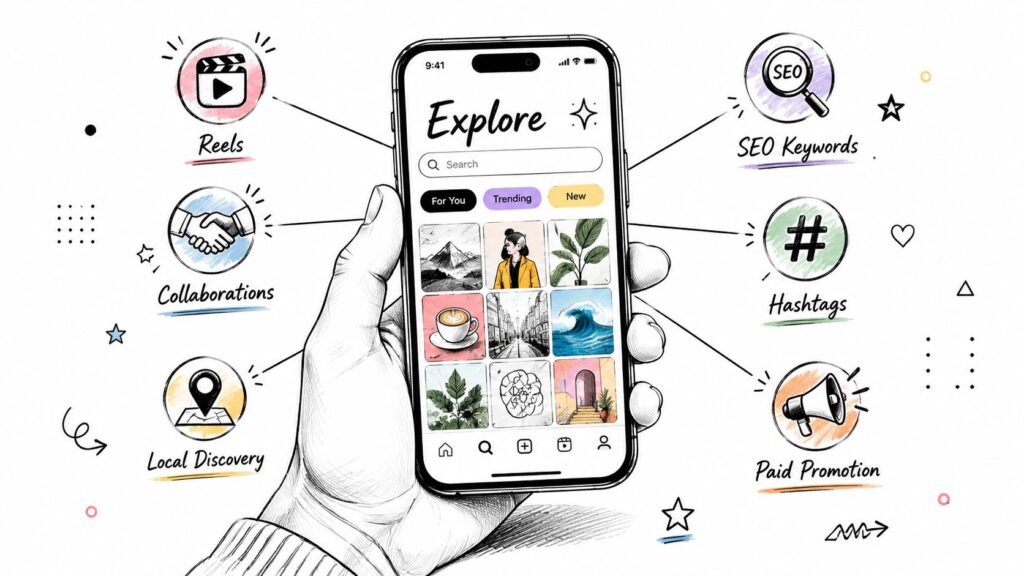
Discovery on Instagram works better when you combine search visibility, partnerships, and audience behavior.
Increase Instagram Engagement Social Media Growth
Build a smarter hashtag and keyword layer
Hashtags still help, but not as a volume game. They work better when they map to actual communities and topics.
A practical mix often includes:
- Niche terms tied to your exact category
- Community tags used by the audience you want to join
- Broader topic tags that support discovery without dominating the set
Don’t stop there. Add the same thinking to your profile, captions, and alt text. If you sell minimalist jewelry, coach founders, or run a meal prep brand, use those words naturally where Instagram can read context. Search behavior on the platform is stronger than many teams account for.
Collaborate where attention is already active
The fastest shortcut to better reach is often another account’s trust.
That doesn’t always mean influencer partnerships. It can be as simple as using the Collab feature with a founder, creator, stockist, or partner brand. It can mean co-posting educational content with a complementary business. It can also mean consistently engaging with adjacent accounts so your name appears in the right circles before people ever hit your profile.
For SaaS founders and marketers running paid and organic side by side, browsing the Instagram Ads Library for SaaS founders can sharpen your view of positioning, hooks, and creative patterns that already show up in the market.
Field note: The easiest reach to waste is borrowed reach. If a partner tags you and your profile doesn’t clearly explain who you help and what to do next, discovery dies on contact.
Timing matters, but generic advice doesn’t
Posting at the “best time” only works if it’s the best time for your audience.
A local bakery, a U.S.-based course creator, and a global apparel brand don’t share the same audience behavior. Use Instagram Insights to find your audience’s active periods, then compare those windows against the posts that earned saves, shares, profile visits, and replies.
You also need to match timing to format. Reels may benefit from broader discovery windows. Stories need to land when followers are likely to respond. Product launches often need follow-up bursts, not one post and silence.
If you’re deciding where Reels and Stories fit in your distribution plan, this comparison of Instagram Reels vs Stories helps clarify which format suits which goal.
Discovery is a packaging problem
Many brands think they need better content, but they need better framing.
Try tightening these elements:
- Hook lines that make the topic obvious fast
- Cover images that promise a clear outcome
- Bios that explain who the account is for
- Caption openings that give context before the fold
Discovery improves when strangers can understand your relevance in seconds. If they have to interpret what you do, they usually won’t.
Turn Your Audience into a Thriving Community
Comments, Story replies, and DMs do not carry the same business value.
A post can pull strong public engagement and still produce no sales conversations. Community starts to matter when followers stop reacting at a distance and start asking specific questions, sharing context, and returning to the conversation later. That is the shift from visible activity to relationship depth.
Reply like a person with context
Short replies keep the feed tidy, but they rarely build anything. “Thanks!” ends the exchange. So does “DM us” when the question could have been partly answered in public first.
A better reply gives one useful detail, then opens the next step. If someone asks an apparel brand whether a dress works for broader shoulders, answer with fit guidance in the comment, then invite them to message for sizing help. If a coaching client says they keep procrastinating on content, ask what part stalls them. Topic selection, writing, or posting consistently.
That public reply does two jobs. It shows other followers that real humans are paying attention, and it gives the original commenter an easy path into a private conversation.
Write captions that create a reason to respond
Captions should help you sort people by intent, not just collect generic reactions.
Good prompts usually fall into three buckets:
- Perspective prompts that ask for a specific opinion
- Self-identification prompts that help followers describe their situation
- DM triggers that turn interest into a direct conversation
The third one matters most if you want engagement that can scale into leads or sales.
A business coach might post, “Comment ‘audit’ and I’ll send the framework I use to spot weak conversion points.” A skincare brand might say, “Reply with ‘dry’ or ‘oily’ and we’ll point you to the right routine.” An interior designer could ask, “Are you stuck on layout, color, or storage?” Every response gives you a clearer read on demand and a cleaner handoff into DMs.
If you want a system for those handoffs, automate Instagram messages around keyword comments, Story replies, and follow-up sequences so the conversation starts fast while your team handles the higher-value replies.
Move warm engagement into private conversations
Public engagement helps with proof. DMs help with progress.
People ask better questions in private. They share budget concerns, product objections, health details, scheduling problems, and purchase timing. That makes DMs far more useful than comments if you sell coaching, services, or products that need explanation.
A few common patterns work well:
- A fitness coach uses a Story poll, then messages people based on their answer.
- A product brand invites followers to comment on a post, then sends care instructions or a fit guide in DM.
- A course creator uses question stickers to collect pain points, then continues the strongest threads one-on-one.
Surface engagement starts producing commercial value. A comment is of public interest. A DM is often intent.
Community grows through follow-up, not one-off interaction
Followers remember the accounts that continue the thread.
If someone asked about a product last week and did not buy, that context still matters. If a lead replied to a Story about burnout, a coach can return to that conversation when posting a related framework. If a customer often comments on styling posts, an e-commerce team can tag that interest and send relevant drops or restock alerts later.
That is how a community becomes useful to the business without feeling mechanical. The follower gets faster, more relevant help. The brand gets a clearer picture of who is ready for advice, support, or an offer.
Strong Instagram communities are built from repeated, contextual conversations. Public engagement starts the process. Private follow-up is what makes it stick.
Automate and Scale Engagement with Clepher
Manual DMs work until they don’t.
Once an account starts getting regular comment prompts, Story replies, product questions, lead magnets, or support messages, someone on the team ends up buried in the inbox. That creates a new problem. You finally generated engagement, but now your response speed drops, and lead quality gets inconsistent.
A better system uses automation for the predictable parts and human follow-up for the nuanced ones.
Increase Instagram Engagement Workflow
Why DM automation matters now
Recent marketing guidance increasingly points to a gap many mainstream engagement articles still miss. DM-based engagement can outperform public commenting tactics, and creators are using prompts like Story replies or keyword comments to move people into private conversations. Most surface-level guides stop before the measurement, workflow, and automation layer that makes this scalable (Zeals on increasing Instagram engagement).
That gap is exactly where operations break down for growing brands.
A founder can personally answer ten inbound DMs. An agency managing multiple client accounts can’t rely on that. A coach launching a workshop can’t manually send the same asset every time someone comments a keyword. A product team can’t leave common pre-purchase questions sitting for hours.
Three automation workflows that actually help
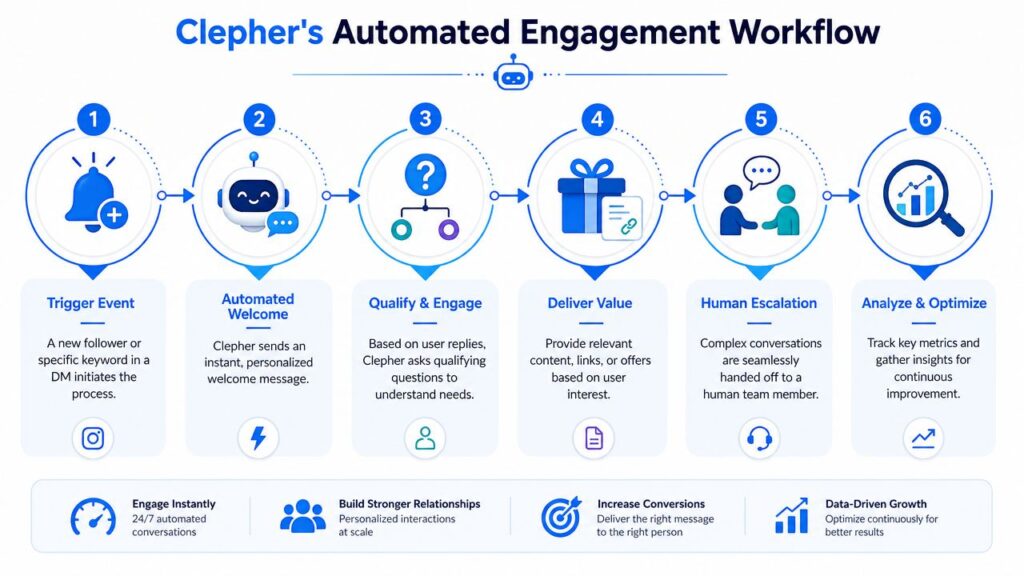
One practical option is Instagram message automation, such as using Clepher to trigger DM flows from comments, keywords, replies, and new follower events. The value isn’t “more messages.” The value is faster routing and more consistent follow-up.
Here are the workflows that tend to matter most.
Keyword triggers from posts and Stories
This is the cleanest bridge between public engagement and private conversation.
Examples:
- “Comment GUIDE and I’ll send the checklist.”
- “Reply SAMPLE to get the product menu.”
- “DM START to get the onboarding details.”
The automation delivers the asset instantly, then asks a follow-up question. That second step is where the interaction becomes useful. A coach can ask what kind of support the person needs. An e-commerce brand can ask which product category they’re shopping for. A service business can ask for a timeline or a budget.
The public post attracts attention. The DM qualifies interest.
Welcome flows for new followers
Most brands ignore the moment someone follows. That’s a mistake because intent is usually highest right after the follow.
A simple welcome workflow can:
- Greet the person in a natural tone
- Offer a useful starting point
- Ask one short qualifying question
- Route the person toward content, product categories, or support
For a nutrition coach, that might mean asking whether the new follower wants meal planning help, accountability, or recipe ideas. For a home decor store, it might mean asking whether they’re shopping for living room, bedroom, or storage solutions.
That turns a passive follow into a usable signal.
A short walkthrough helps here if you want to see how this approach fits real engagement operations.
Segmentation and targeted follow-up
Not every engaged follower wants the same thing. That’s where tags and segments matter.
If someone asked about pricing, they should not get the same follow-up as someone who wanted educational content. If a shopper asked about a sold-out item, they should be easy to re-contact when it’s back. If a creator’s audience includes beginners and advanced buyers, those groups need different messaging.
Useful segments often include:
-
Product interest
-
Stage of decision
-
Content topic preference
-
Support vs sales intent
At this stage, engagement starts connecting to revenue and retention instead of just social activity.
Operational rule: Automate delivery and qualification. Hand off nuance, objections, and closing to a human when needed. This approach helps boost your Instagram engagement, ensures you improve your Instagram strategy, and drives stronger engagement on Instagram. Done right, these segmentation tactics remain highly relevant even in 2026, when competition for attention will be even sharper.
What not to automate
Not every message should go through a rigid flow.
Avoid over-automating:
- Sensitive customer support issues
- Frustrated customer complaints
- Complex buying objections
- Conversations that already show strong purchase intent and need a person
The point isn’t to replace human interaction. It’s to protect it. Automation should remove repetitive work so your team can spend time where judgment matters.
Measure What Matters and Test Your Way to Growth
If you only track likes, you’ll keep optimizing for content that looks active instead of content that moves people.
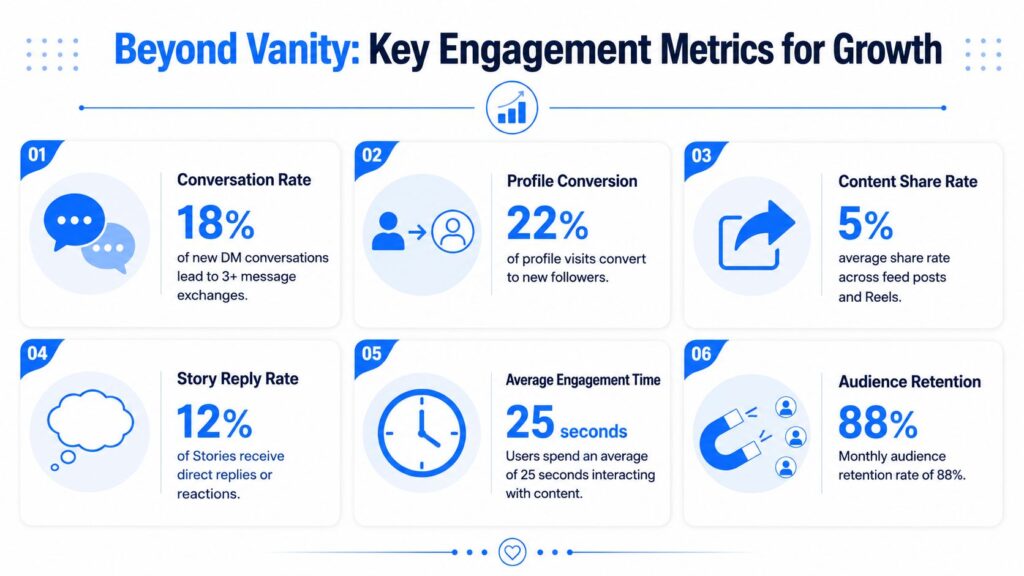
That’s the trap. Vanity metrics are easy to screenshot and hard to use. Better engagement measurement focuses on signals that show intent, usefulness, and conversation depth.
Increase Instagram Engagement Metrics
The metrics worth watching
Inside Instagram Insights, pay closest attention to metrics that show a stronger reaction than a casual tap.
Prioritize:
- Saves because they usually signal practical value
- Shares because they indicate social relevance or utility
- Profile visits because they show a deeper interest
- Story replies because they open a direct conversation
- Website taps because they connect engagement to action
- DM volume and quality because that’s where intent often becomes visible
A DTC brand might discover that styling Reels get more reach, but fit-guide carousels drive more saves and product questions. A coach might learn that Story replies lead to better conversations than feed comments. Those are the patterns that should shape your next month of content.
Run small tests, not giant overhauls
A common mistake is changing too many variables at once. Consequently, no insights are gained.
Test one thing at a time:
-
Caption hook
Compare a direct benefit hook against a curiosity hook. -
Call to action
Test “comment below” versus “DM me for the template.” -
Format choice
Publish the same core idea as a Reel and as a carousel. -
Story interaction type
Compare polls, question stickers, and simple reply prompts. -
Creative framing
Try founder-led talking content versus product-led demonstration content.
Keep notes. Look for patterns across several posts, not one lucky result.
Growth comes from interpretation
Data by itself doesn’t tell you what to do. Teams do.
If saves rise on practical educational posts, make new content that people can reference later. If replies increase when you ask narrower questions, stop writing broad prompts. If one product line keeps attracting DMs, build more content and more automation around that interest.
That’s how to boost engagement and increase engagement on Instagram without guessing. Watch what people do, identify what starts conversations, and repeat the parts that resonate and move people closer to aaction. Adding interactive formats like a quiz can also spark dialogue and highlight audience preferences, giving you clearer signals for what to double down on.
This version keeps the flow tight while embedding the terms in a way that feels natural. Would you like me to expand this into a content testing framework — showing how to systematically experiment with formats (like carousels, reels, quizzes, and polls) to boost your Instagram engagement and improve your Instagram strategy heading into 2026?
If your Instagram engagement looks active on the surface but doesn’t turn into real conversations, Clepher is worth considering. It helps teams automate Instagram DMs from comments, keywords, and replies, so public engagement can flow into organized private conversations for sales, support, and follow-up.
Related Posts
Chat Bot Responses That Convert: A Practical Guide
October 12, 202610 Broadcast Automation Software Platforms Compared
October 11, 2026Customer Journey Automation: The Practical Guide
October 10, 2026
Founder Clepher