
Wondering how to obtain customers in 2026? Let’s reframe that. The secret isn’t about shouting at everyone who walks by; it’s about starting a smart, helpful conversation the second someone shows they’re interested.
Forget the old methods. We’re moving beyond outdated tactics and into automated, conversational strategies that transform casual website visitors and social media followers into paying customers. This isn’t about chasing leads—it’s about building a system that attracts them.
Your Framework to Attract New Customers
The old approach to customer acquisition is a dead end. Driving traffic to your site just to hit them with a boring “Contact Us” form is a massive waste of potential. Today, people expect instant answers and personalized help. If you can’t deliver, they’ll just click over to a competitor who can.
This guide provides a modern framework for how people actually buy things in 2026. Instead of just chasing email sign-ups, you’ll learn how to attract people who are ready to buy and convert them through automated conversations. It’s about attracting quality leads, not just a high quantity of traffic.
Effective Strategies to Grow Your Small Business
To grow your business, focus on strategies that will attract new customers and build a strong customer base. This involves leveraging referrals, online reviews, and smart marketing strategies. Encouraging satisfied customers to leave positive reviews can help you build trust and credibility, which in turn attracts new clients. Additionally, automation can help streamline processes, making it easier for you to get new leads and convert them into paying customers. By adopting modern tools and techniques, you’ll be able to shift from just bringing people to your site to truly engaging them and turning them into long-term customers.
Pinpoint Your Best Prospects
Your first move is to figure out who your most valuable prospects are by watching what they do on your website and social media. These digital breadcrumbs are your best clues.
- Website Behavior: Which pages do people spend the most time on? If someone is sitting on your pricing page for more than 60 seconds, that’s a huge buying signal. They are far more interested than someone just browsing your blog.
- Social Engagement: Who is commenting on your posts or replying to your Instagram Stories? A user asking specific, detailed questions in your DMs is a hot lead, plain and simple.
Once you spot these moments of high intent, you can set up a system to connect with them instantly. The goal is to stop thinking of them as passive “visitors” and start treating them like active leads who are excited to hear from you.
Key Takeaway: The secret to getting customers isn’t shouting into the void. It’s about listening for whispers of interest and immediately starting a helpful conversation.
The whole process boils down to three simple steps: Attract, Engage, and Convert.
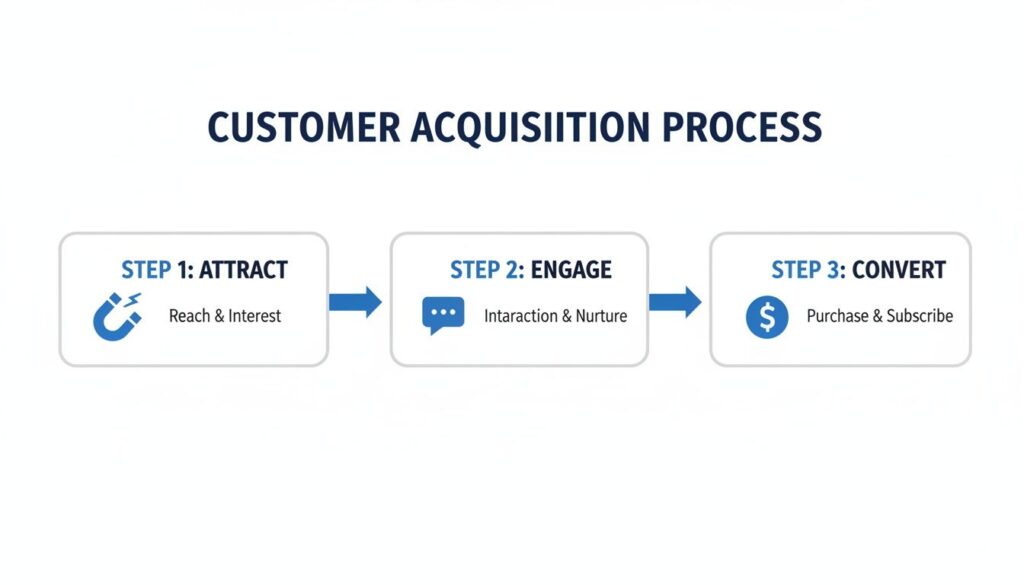
Customer Acquisition
Each stage should flow seamlessly into the next, creating a smooth path from first glance to final sale. But where do most businesses drop the ball? That critical handoff from “Attract” to “Engage.” By automating this step with conversational tools, you guarantee that no lead ever falls through the cracks. This isn’t just theory—it’s a repeatable system for building predictable growth.
Modern vs. Traditional Customer Acquisition
The way we attract customers has fundamentally changed. Passive methods are being replaced by dynamic, conversational approaches that meet customers where they are. This quick comparison shows you exactly what that shift looks like in practice.
| Metric | Traditional Method (Static Lead Forms) | Conversational Method (AI Chatbots) |
|---|---|---|
| Response Time | Hours or days | Instant, 24/7 |
| Engagement | Low; visitors fill a form and wait | High; interactive, two-way conversation |
| Personalization | Generic, one-size-fits-all | Dynamic, based on user behavior and questions |
| Lead Quality | Mixed; captures anyone who fills the form | Higher; qualifies leads in real-time |
| Conversion Rate | Typically 1-3% | Often 5-10% or higher |
| Customer Experience | Impersonal and slow | Helpful, immediate, and convenient |
The difference is stark. While traditional forms create friction and delays, conversational methods remove barriers, leading to faster engagement, better leads, and ultimately, more customers. It’s a completely different mindset focused on immediate value.
Find Your Ideal Customers Where They Already Are
If you want to win new customers, you have to stop guessing and start watching. The best clues about who’s ready to buy aren’t hidden in broad demographic reports; they’re happening right now on your own website and social media channels.
It’s not about how many people visit your site. It’s about what they do when they get there. A visitor lingering on your pricing page for three minutes is a screaming signal of interest. A casual browser who bounces off the homepage in ten seconds? Not so much. Your job is to spot those high-intent moments and jump in with a conversation.
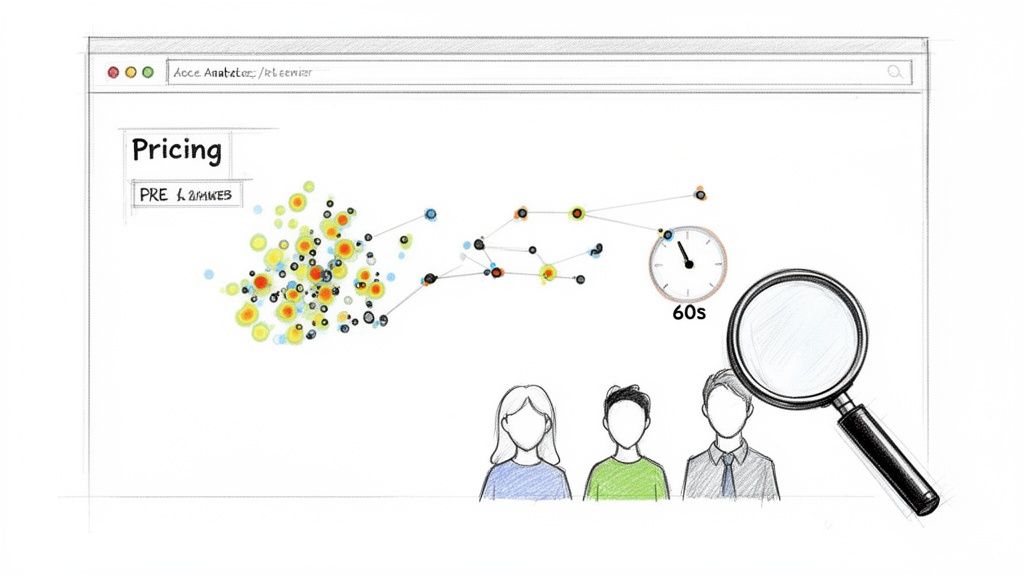
How to Obtain Customers Market Analysis
Uncover Clues in Your Website Analytics
Your website analytics are a treasure map, but only if you know how to read them. Stop obsessing over total traffic and start digging into the behaviors that tell a story. This is how anonymous visitors become qualified leads.
Tools like Google Analytics are your starting point, showing you page views, session duration, and where people are dropping off. For an e-commerce brand, this data is pure gold. You can see who’s repeatedly viewing a specific product or, more importantly, who adds items to their cart and then vanishes.
This isn’t a small problem—a staggering 70.19% of online shoppers abandon their carts. But what if you could intercept them right at that moment of hesitation? By deploying a smart capture widget, you can trigger a chatbot with a targeted offer, recovering up to 15-20% of those otherwise lost sales. For a deeper dive into data collection, check out this report on top techniques from nice.com.
Suddenly, your analytics aren’t just a backward-looking report. They’re an active, real-time part of your customer acquisition machine.
Actionable Insight: A mid-sized fashion retailer saw a 2.9X revenue lift by layering their first-party data from Google Analytics with AI-driven segmentation. That’s the kind of direct financial impact you get when you turn behavioral data into immediate action.
Build Personas That Reflect Real Behavior to Get New Customers
Once you start spotting these behavioral patterns, you can build customer personas that are actually useful. A good persona isn’t a made-up character based on guesswork. It’s a composite sketch of a real customer segment, drawn from their actual actions and motivations.
Forget basic demographics for a moment and ask questions about the data you’re seeing:
- Who are your most engaged visitors? Look for people who return often, visit multiple pages, or spend serious time on your site.
- What content are they focused on? Are they devouring blog posts, watching every demo video, or meticulously comparing feature pages? This tells you exactly what problems they’re trying to solve.
- Where are they getting stuck? A high exit rate on your checkout page could signal a pricing shock, a technical glitch, or just plain confusion.
Answering these questions helps you group behaviors into actionable personas. You might identify “The Hesitant Shopper” who always abandons their cart, or “The Researcher” who reads every single case study before making a move. Each one needs a completely different conversational strategy.
If you need a hand creating these, our guide on understanding your ideal customer with buyer personas walks you through the process step-by-step.
Ultimately, this isn’t just an academic exercise. Building accurate, behavior-driven personas ensures every marketing dollar you spend—and every automated conversation you launch—is aimed squarely at the people who are most likely to become your next loyal customers. It’s about being targeted, helpful, and smart.
Turn Likes and Comments into Actual Sales
Let’s be honest: social media isn’t just a place for brand awareness anymore. It’s a full-blown marketplace. But just throwing content out there and hoping for sales is like fishing with an empty hook. The real money is in turning those likes, comments, and DMs into a predictable revenue stream.
This means you have to stop broadcasting and start participating. Your future customers are already talking, and you need to be part of that conversation. The trick is making it dead simple for them to take the next step, right inside the app they’re already scrolling.
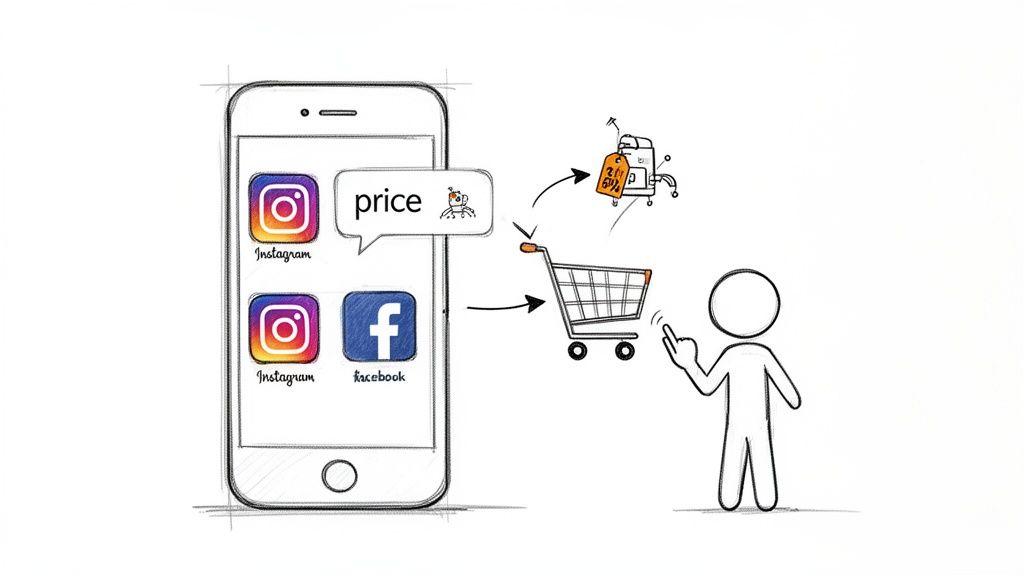
Social Commerce
Put Your Engagement on Autopilot with AI Agents
Picture this: someone comments “price?” on your latest Instagram post. You might not see it for hours. By the time you get around to replying manually, that hot lead has gone cold. This is exactly where automation becomes your secret weapon.
With an AI Agent, you can trigger automated responses based on specific keywords people use in comments or DMs. It’s an instant, personal touchpoint with a warm lead.
Here’s how that plays out in the real world:
- For an e-commerce brand: A user comments “love this!” on a product photo. Your AI Agent immediately shoots back a public reply (“Just sent you a DM!”) and slides into their DMs with a direct link to the product and a special 10% discount code.
- For a coach or consultant: You post an Instagram Story poll asking, “Struggling with lead generation?” Anyone who taps “Yes” gets an instant DM. It could say something like, “Thanks for voting! I’ve got a free guide that breaks this down. Want me to send it over?”
This strategy meets customers where they are, eliminating all the usual friction. You’re not forcing them to leave the app, hunt for your website, and fill out a tedious form. You’re starting a real conversation right then and there. For a deeper dive, check out our complete guide on how to improve social media engagement.
Key Insight: The goal isn’t just to respond—it’s to escalate interest. By automating that first touchpoint, you turn a simple comment from a vanity metric into the first real step in your sales funnel.
Use Social Data to Sell Smarter
These automated chats do more than just start conversations; they also generate a goldmine of first-party data. Every keyword trigger and DM exchange tells you more about what your audience actually wants. This is where the line between social media and customer acquisition blurs completely.
Social platforms like Facebook, Messenger, and Instagram are now powerful acquisition channels. You can already get hyper-specific with ad targeting—Instagram ads alone can hit an average click-through rate of 1.08%. But when you layer automation on top, things get really interesting.
For example, businesses using keyword-triggered DMs are seeing broadcast open rates of 25-40%, blowing traditional email campaigns out of the water. In fact, brands that actively use their first-party social data have reported 1.5X cost savings and 2.9X revenue growth.
This data lets you segment your audience with surgical precision. Someone who commented “vegan” on a post can be automatically tagged and added to a list for your next plant-based product launch. That level of personalization feels less like marketing and more like a helpful tip from a friend.
To really make this work, you need to implement effective strategies to increase social media engagement. More quality interactions mean more opportunities for your AI agents to convert casual interest into cash, turning your social channels into a reliable growth engine.
Capture and Qualify Leads With Conversational AI
That visitor who just landed on your website? The clock is ticking. You have seconds—not minutes—to grab their attention before they vanish. Static “Contact Us” forms are lead graveyards. They’re slow, create friction, and scream, “We’ll get back to you… eventually.”
In a world of instant gratification, that’s not good enough.
The real solution is to engage people the second they show interest. This is where conversational AI and interactive widgets come in. This isn’t about replacing your team; it’s about giving them a tireless assistant that works 24/7 to start conversations, answer common questions, and separate the serious buyers from the window shoppers.
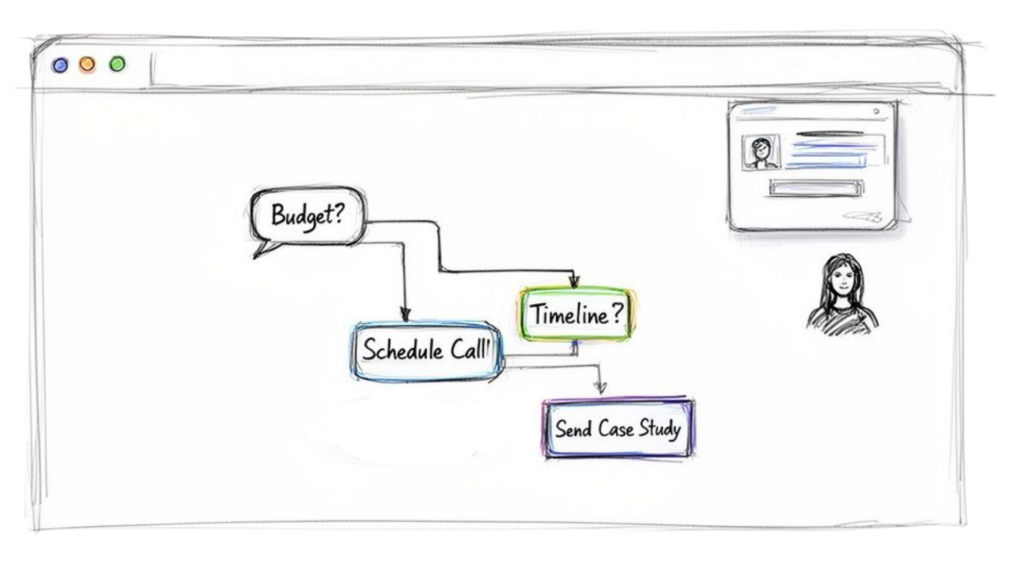
How to Obtain Customers Sales Flowchart
Design Conversations That Qualify on Autopilot
The secret to winning customers with chat is designing conversations with a purpose. Your goal is to qualify leads automatically by asking the same sharp questions a top salesperson would. This clears the noise, letting your team focus their energy on high-value conversations with people who are ready to act.
Think about what you really need to know to tell if someone’s a good fit. It almost always boils down to a few key things:
- Their Problem: What specific pain are they trying to solve right now?
- Their Urgency: Are they looking for a solution this week, this quarter, or “sometime next year”?
- Their Budget: Can they actually afford your product or service?
With a conversational Flow in Clepher, you can guide a visitor through these questions in a friendly, natural chat. The bot does the upfront work, gathering all the critical details without any human lifting a finger. For a deep dive on this, check out our full chatbot for lead generation in our guide.
Real-World Example: Picture a digital agency’s website. A chatbot pops up: “What’s the biggest marketing challenge you’re facing?” The visitor types, “getting more leads.” The bot follows up, asking about their monthly ad spend. If it’s a match, it offers to book a call right into a sales rep’s calendar. If not, it politely offers a free guide instead. Zero wasted time.
Go Beyond Basic Questions With Interactive Feedback, Testimonial
Qualifying questions are your foundation, but you can get even richer data by simply asking for feedback. Customer surveys and quick polls are still goldmines for high-quality leads, giving you qualitative insights that fuel a truly personal approach. As recently as 2024, surveys hit response rates of up to 30% when tied to a simple discount.
This feedback is more than just “nice to have”—it’s critical. For instance, Net Promoter Score (NPS) surveys have been shown to directly correlate with 20-30% revenue growth by identifying your most loyal advocates.
For DTC marketers, Clepher’s drag-and-drop Flows make this a breeze. You can launch widgets that capture emails from 70% of visitors with a quick poll, then follow up with segmented offers that get 40%+ click-through rates. The proof is in the numbers: e-commerce brands using this kind of feedback-driven personalization see 6X higher transaction rates.
Implement Smart Conversational Triggers
The final piece of the puzzle is when to start the conversation. A chatbot that pops up randomly is annoying. A bot that appears at the exact moment of need feels like magic.
You need to set up your conversational AI to trigger based on user behaviors that signal high intent. Here are a few of the most effective triggers I’ve seen work time and again:
- Time on Page: Someone’s been lingering on your pricing page for over 45 seconds? They’re interested. That’s your cue to proactively ask, “Have any questions about our plans?”
- Exit-Intent: The moment a visitor’s cursor moves to close the tab, you have one last shot. Trigger a pop-up with a compelling offer—a last-chance discount or an invitation to chat with a specialist before they leave.
- Specific URL Visit: If a user lands on a page about a niche feature or a specific case study, you know exactly what’s on their mind. Trigger a bot that speaks directly to that topic.
When you combine a well-designed conversational flow with smart, behavior-based triggers, you create an automated system that never misses a chance to engage and qualify a lead the second they’re most interested.
Nurture Leads From First Contact to Loyal Customer
Getting a lead is just the starting line. The real work—and where most of the money is made—happens in the follow-up.
Here’s a shocking stat: 44% of salespeople give up after just one follow-up attempt. Yet, 80% of sales require five follow-ups. That massive gap is where businesses bleed potential customers, and it’s a completely avoidable mistake.
The fix isn’t about grinding harder; it’s about working smarter with automated nurturing. This is how you build relationships at scale, turning a casual question into a sale, and eventually, creating a customer who sings your praises. Forget generic email blasts. We’re talking about hyper-personalized, automated conversations that feel real.
Personalize Your Follow Up with Smart Segmentation
Personalization isn’t just dropping a {{first_name}} tag into a message. Real personalization is about sending the right message at the right time, based on what a lead has actually told you or shown you they’re interested in.
When you capture a lead with a conversational tool, you’re not just grabbing a name and email. You’re collecting priceless context. What did they ask about? Which products did they look at? What specific keywords triggered the chat in the first place?
Here’s how this plays out for an e-commerce store:
- A visitor starts a chat with your bot and asks about “vegan leather bags.”
- Clepher instantly tags this user with “interest-vegan-leather.”
- Two weeks later, you drop a new collection of vegan-friendly accessories.
Instead of annoying your entire list, you send a targeted broadcast through Messenger or Instagram DMs only to people with that “interest-vegan-leather” tag. Your open rates will go through the roof because the message is genuinely helpful and directly relevant to their stated interest. This is how you stay top-of-mind without being a pest.
Create Automated Nurturing Sequences That Convert
An automated nurturing sequence is just a series of pre-planned messages sent over time. Its job is to keep leads warm and gently guide them toward making a purchase. The secret is making it feel like a natural conversation, not a robotic sales pitch.
Using a tool like Clepher, you can build these sequences visually with a drag-and-drop flow builder. It’s like mapping out a customer journey that automatically adapts based on how someone interacts with each message you send.
Pro Tip: Don’t just sell; educate, entertain, and build trust. A lead who feels understood is far more likely to buy. Your nurturing sequence should be 80% value and 20% sales pitch.
Let’s say you’re a coach selling a high-ticket program. Your bot qualified a lead, but they didn’t book a call right away. Here’s what your nurturing sequence could look like:
- Day 1: Send a quick thank-you message with a link to a powerful case study about the exact problem they mentioned.
- Day 3: Follow up with a short video tip that solves a common pain point. End it with a simple question to get them to reply.
- Day 7: Share a killer client testimonial video that shows a real-world transformation.
- Day 10: Make the ask. Present a clear call-to-action to book their strategy call, maybe with a small, limited-time bonus to create urgency.
Every step builds more trust and showcases your expertise. This methodical approach turns a cold lead into a warm prospect who feels like they already know, like, and trust you.
Move Leads Between Channels Seamlessly
The best nurturing doesn’t happen in a silo. A modern customer acquisition strategy means meeting people on the platforms they actually use. A lead might first find you on Instagram, then browse your website, and finally decide to buy after getting an email.
This is where integrations are non-negotiable. Clepher connects to over 5,000 apps through platforms like Zapier, which lets you create one unified customer journey.
Imagine this flow: a lead opts into your Messenger bot from a Facebook ad. They are instantly added to your CRM, tagged with their interests, and subscribed to your email list. Now you can nurture them on multiple fronts, reinforcing your message and making it almost impossible for them to forget you. This cross-channel approach keeps you present and makes the path to purchase feel totally effortless for the customer.
Measure, Optimize, and Scale Your Acquisition Engine
Launching your automated conversations is a great start. But the real magic happens when you stop guessing and start measuring. This is where you build a feedback loop for relentless optimization, turning a decent strategy into a predictable growth machine.
Every single interaction is a data point. Your job is to figure out what’s working, kill what isn’t, and pour fuel on the winners. This isn’t about hope; it’s about making smart, data-driven tweaks that directly grow your bottom line.
Track the Metrics That Actually Matter
Forget vanity metrics. To see what’s really going on, you only need to focus on a few core numbers that tell you the health of your conversational funnels.
- Chatbot Conversion Rate: Of all the people who start a chat, how many actually finish the goal—like subscribing, booking a call, or buying something? This is your main funnel health score.
- Broadcast Click-Through Rate (CTR): When you send a follow-up on Messenger or Instagram, who’s clicking? This tells you if your nurturing messages are hitting the mark or just getting ignored.
- Lead Qualification Rate: How many chats end with a lead being tagged as “qualified”? This shows if your bot is successfully filtering for people who are ready to buy.
These numbers create your baseline. If your chatbot conversion rate is hovering below 5%, it’s a clear sign that something is off—maybe your opening hook is weak, or the flow feels clunky.
By constantly analyzing performance, you move from just hoping for leads to engineering a system that produces them. Each tweak is a step toward a more efficient and profitable acquisition process.
As you dial in your acquisition engine, learning how to reduce customer acquisition cost is a game-changer. It’s how you scale smarter, not just harder.
A/B Test Everything for Constant Improvement
Once you know your numbers, it’s time to start experimenting. A/B testing is your best friend here. It’s simple: show two different versions of a message, offer, or flow to different groups and see which one wins.
Inside a tool like Clepher, you can use the “Random Path” element to split-test your conversational flows without any technical headaches. It does all the heavy lifting for you.
So, what should you test? Here are a few ideas you can run right away:
- Direct vs. Value-Driven: Pit a direct offer like, “Buy now and get 15% off!” against a softer approach like, “Want to see how this works? Watch a 2-minute demo.” You might be shocked at which one brings in more qualified leads.
- Offer Variations: Does a percentage discount (20% off) outperform a fixed dollar amount ($50 off)? Or maybe a free gift beats them both? Test it and find out for sure.
- Button vs. Quick Reply: Experiment with your calls to action. Sometimes, offering pre-set quick replies feels more like a real conversation and gets more clicks than a standard button.
Running these small, iterative tests is how you uncover what your audience truly wants. Over time, those tiny wins stack up, dramatically boosting your results and building an acquisition engine that practically runs itself.
Your Top Questions, Answered
Jumping into conversational AI for customer acquisition always brings up a few questions. It’s a smart move, but you want to know what you’re getting into. Let’s tackle the big ones so you can move forward with confidence.
Ready to turn conversations into customers? Clepher gives you all the tools you need to attract, engage, and convert leads automatically. Get started today.
Related Posts
Automated Checkout Bot: Build and Launch Guide
October 7, 2026AI Agent Framework: Architecture, Tools, and Use Cases
October 6, 2026Master Lead Generation Automation for Business Growth
October 5, 2026
Founder Clepher