
Instagram can produce reach and still fail as a growth channel.
The gap is usually structural. Content gets views, but there is no system that turns that attention into replies, DM conversations, email subscribers, qualified leads, or sales. A real instagram growth strategy fixes that by connecting three layers that have to work together: content that earns attention, engagement that signals intent, and DM flows that capture and nurture that intent while it is still fresh.
I’ve seen small accounts outperform larger ones because they built that system early. They did not treat Instagram as a posting calendar. They treated it as an acquisition engine. Every Reel, carousel, Story sequence, and comment path had a job. Pull in the right audience, start a conversation, then move interested people into an automated but relevant DM experience that qualifies, delivers value, and creates a clear next step.
That is the shift that matters in 2026.
Follower count still matters, but only as a secondary metric. The stronger asset is an account that consistently turns attention into owned audience and demand. The accounts that keep growing do that on purpose, with repeatable inputs, clear conversion paths, and measurement tied to business outcomes instead of vanity spikes.
Why Your Old Instagram Playbook Is Broken
Instagram now sits inside one of the most competitive attention markets in digital media. As noted earlier, the platform is attracting serious ad spend, which means you are competing against trained operators with creative teams, testing budgets, and tight feedback loops. Old growth advice was built before that shift.
Follow and unfollow, generic hashtag stacks, engagement pods, and posting just to stay visible still create activity. They do not create a reliable pipeline. In practice, they inflate weak signals, attract low-fit followers, and train teams to chase motion instead of conversion.
The old playbook failed because it focused on vanity activity instead of business outcomes.
What stopped working
The biggest mistake I still see is operational. Teams treat Instagram like a publishing task when it behaves more like a response channel.
- Post and disappear. A Reel goes live, then nobody works the comments, Stories, or inbox.
- Chase broad reach. Views go up, but there is no path from attention to subscriber, lead, or sale.
- Overvalue follower count. Large audiences underperform all the time when replies, shares, profile actions, and DMs stay flat.
- Reuse low-context content. Cross-posted clips without native framing usually get weak watch time and weaker downstream action.
I see this a lot with brands looking for ways to grow Instagram followers organically. They improve posting frequency, then wonder why growth still feels fragile. The missing piece is usually system design, not effort.
Practical rule: If a tactic increases activity but does not improve reach quality, engagement quality, or conversation volume, cut it.
What works now
A strong Instagram growth strategy works like a connected acquisition system.
It starts with a clear audience definition, because weak targeting poisons everything downstream. If your content attracts the wrong viewer, the algorithm may still give you reach, but your comments get thinner, your DMs stay cold, and your offers convert poorly. If that part is still fuzzy, review this framework on how to identify your target audience.
From there, the account needs four parts working together:
- Positioning that attracts a specific buyer or subscriber
- Content designed for reach and response
- Engagement patterns that turn passive views into intent signals
- DM automation that captures and nurtures that intent
That last piece is where intent becomes measurable.
A Reel can teach a process and drive a keyword comment. A Story can screen for urgency with a poll or a question box. An automated DM can deliver the asset, ask one qualifying question, tag the lead, and route the person toward email signup, product education, or a sales conversation. That is a growth engine. It connects content, engagement, and private conversion steps in one track.
The accounts that still rely on the old playbook usually have one thing in common. They produce content, but they do not build follow-through. That is why growth looks inconsistent even when the reach looks healthy.
Laying the Foundation for Sustainable Growth
Most accounts don’t have a content problem first. They have a foundation problem.
If your audience is vague, your profile is unclear, and your goals are fuzzy, better posting won’t fix much. Strong growth starts before the first Reel goes live.
Instagram Growth Strategy Target Audience
Define the audience with precision
“Small business owners” isn’t a target audience. Neither is “women aged 25 to 44.” That’s a demographic shell.
Useful audience definition starts with problems, buying triggers, objections, and language. If you need a practical way to sharpen that work, this guide on how to identify your target audience is a good framework.
Build your audience profile around questions like these:
- What are they trying to fix right now? Slow sales, weak retention, messy onboarding, low content reach, poor conversion from social.
- What do they already believe? “I need to post more.” “My niche is too saturated.” “DMs take too much time.”
- What do they want quickly? Better leads, clearer messaging, more qualified inquiries, repeat purchases.
- What content do they save or share? Playbooks, templates, examples, scripts, before-and-after comparisons.
A coach and a skincare brand might both target women in the same age bracket, but the content engine will be completely different because the problems and desired outcomes are different.
Turn your profile into a landing page
A profile should do three jobs fast. Explain who you help, what kind of value you publish, and what someone should do next.
Most bios are too clever and not clear enough.
A strong setup usually includes:
- A clear name field with searchable keywords tied to the niche
- A bio that states the audience and outcome
- A profile image that is readable at a small size
- Highlights organized around offers, proof, FAQs, and onboarding
- A link destination that matches the current campaign or business objective
Here’s the test. If a stranger lands on the profile from one Reel, can they understand the account in a few seconds without scrolling through the whole feed?
If not, tighten it.
For teams that want a practical benchmark for organic account setup, this walkthrough is useful because it focuses on compounding habits instead of shortcuts.
A good profile doesn’t just earn a follow. It reduces friction for the next action.
Set goals that change decisions
Follower count matters, but it’s not enough to steer strategy.
Set goals tied to business movement, such as:
| Goal type | Better question to ask |
|---|---|
| Audience growth | Are the right people following, replying, and returning? |
| Engagement | Which topics consistently earn comments, shares, saves, and replies? |
| Lead generation | Which posts start the most qualified DM conversations? |
| Sales support | Which content shortens the path from interest to purchase? |
An e-commerce brand might prioritize DMs that ask about fit, shipping, or product match. A service business might track consultation inquiries. A course creator might focus on lead magnet requests from Stories and Reels.
Aim for category clarity before scale
There’s an important milestone early in growth. Instagram’s algorithm applies a clearer category shift once an account posts consistently 3 to 4 times per week and crosses 1,000 followers, which can lead to more favorable recommendations because the platform recognizes creator categories more distinctly (Tailored Tactiqs).
That gives smaller accounts a useful operating rule.
Don’t obsess over hacks before the account has clear signals. Build consistency, sharpen the niche, and publish enough quality content for the platform to understand who the account serves.
That’s a better foundation than trying to force momentum with shortcuts.
Designing Your Unbeatable Content Engine
Accounts stall when content production runs on instinct instead of a system. A few trend-driven wins can hide the problem for a while, but they do not build predictable growth, qualified conversations, or a repeatable path into DMs.
A content engine solves that by assigning each post a clear role in the business.
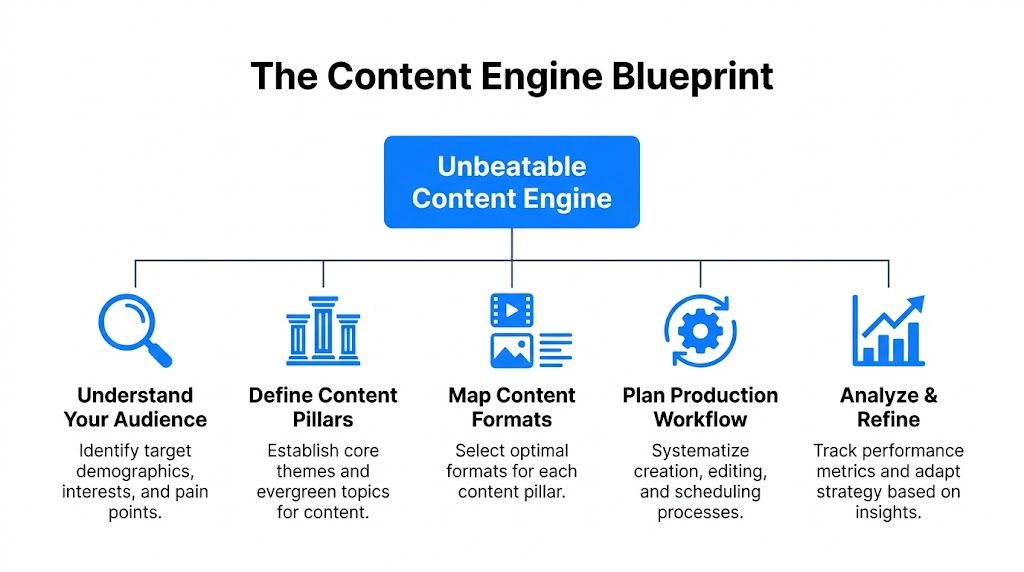
Instagram Growth Strategy Content Engine
Start with content pillars that support the full customer path
Strong accounts usually operate with a small set of repeatable pillars. Four is enough for many brands. More than that often creates noise, weakens positioning, and makes production harder than it needs to be.
Use pillars that connect attention to action:
- Education. Teach a tactic, explain a mistake, or clarify a decision.
- Proof. Show results, customer evidence, product use, or transformations.
- Trust. Build familiarity through opinions, behind-the-scenes context, and brand perspective.
- Action. Prompt the next step, whether that is a click, a reply, a save, or a DM.
That structure keeps content tied to business outcomes instead of chasing variety for its own sake.
An apparel brand might answer fit concerns, show customer wear tests, share design decisions, and post restock prompts. A SaaS company might publish workflow tutorials, feature walkthroughs, common support questions, and onboarding shortcuts. A coach might rotate between mistake breakdowns, teaching posts, belief-shifting opinions, and offers tied to webinars or consultations.
The format changes by business model. The job stays the same.
Build for distribution first, then for production efficiency
Instagram now separates content performance into follower reach and non-follower reach, and it rewards original posts that earn stronger intent signals such as shares and saves, as explained by Trimark Digital.
That changes how content should be planned.
Posts for current followers should deepen relevance. Posts for new audiences should make sense fast, without requiring prior context. In practice, that means the first second of a Reel, the first slide of a carousel, and the first line of a caption carry more weight than the production polish marketers usually obsess over.
Useful design rules:
- Open with a clear problem, outcome, or opinion
- Give context early so a cold viewer can follow
- Use native framing instead of recycled trend formats
- Write captions that add detail, examples, or next steps
- End with a prompt that can continue in comments or DMs
This is the difference between publishing content and building an engine. An engine is designed to produce attention, response, and hand-raisers on purpose.
Optimize for saves, shares, and DM intent
Likes are weak signals. Saves and shares usually reflect a stronger intent.
A save often means, “I want this later.” A share often means, “Someone else needs this now.” Both actions improve distribution and tell you which ideas deserve expansion into Stories, follow-up posts, and DM prompts.
Formats that consistently produce those signals include:
- Checklists
- Mistake roundups
- Before-and-after breakdowns
- Step-by-step carousels
- Process demos
- Strong opinion posts with clear stakes
The best posts also create a second action. Someone saves the post, then replies to a Story about it later. Someone shares the Reel, then comments with a question. Someone watches a tutorial, then DMs for the template or link.
That second action matters because it turns content performance into a pipeline.
Give each format one primary job
Reels, carousels, and Stories should not be judged by the same standard. They play different roles inside the growth engine.
Reels
Use Reels for discovery and demand creation. Good Reel topics stop the scroll because they frame a familiar problem in a sharper way.
High-performing themes usually include:
- Contrarian takes on common advice
- Fast demonstrations of a process
- Objection handling
- Pattern interrupts tied to a niche pain point
- Clear before-and-after scenarios
If you need a repeatable research process, this guide on how to find viral video patterns is useful because it pushes you to study structure, pacing, and framing instead of copying surface-level trends.
Carousels
Carousels are strong for saves and deeper education. They work well when the audience needs a sequence, framework, or comparison before taking action.
Use them for:
- Decision guides
- Tactical breakdowns
- Common mistakes with examples
- Mini case studies
- Swipe-by-swipe teaching that ends with a prompt to comment or DM
Stories
Stories qualify attention. They help separate passive viewers from people who are close to action.
A practical sequence looks like this:
- Share a quick observation, result, or behind-the-scenes moment
- Run a poll or question box around the related pain point
- Teach one useful point
- Ask for a reply, keyword, or question
That last step is where content starts feeding the DM system. For teams that need a stronger publishing process behind that output, this guide to creating quality Instagram content covers the workflow discipline many brands miss.
Plan series, not isolated posts
Single-post thinking leads to random output. Series thinking creates momentum and makes production easier.
A good series has a repeatable angle, a familiar format, and a built-in next step. One B2B creator might run “3 mistakes in 30 seconds” every Tuesday. A skincare brand might post weekly ingredient breakdowns. A consultant might turn real sales objections into a recurring Reel and Story sequence.
Series matter for two reasons. The audience learns what to expect, and the team gets faster at producing winning formats. Both improve consistency without lowering quality.
This also makes testing cleaner. If one topic family keeps earning saves, profile visits, and replies, expand it. If another gets views but no downstream action, cut it or rework the angle.
Make the engine operational
Content quality improves when production is simple enough to repeat every week. Teams that grow steadily usually have a lightweight operating rhythm behind the scenes.
A workable system looks like this:
| Workflow step | What to do |
|---|---|
| Topic capture | Collect audience questions from comments, DMs, sales calls, and customer support |
| Weekly planning | Match each topic to a pillar, a format, and a business goal |
| Batch production | Record multiple videos in one session and write captions separately |
| Repurposing | Turn one idea into a Reel, carousel, Story sequence, and comment prompt |
| Review | Keep formats that drive saves, shares, replies, and qualified DMs. Cut weak concepts fast |
The true advantage is not volume. It is alignment. Good Instagram growth comes from a system where content earns attention, engagement reveals intent, and the next step into DMs is already built in.
Building Engagement Loops That Drive Growth
Posting content is only half the job. Growth comes from what happens around the content.
A lot of accounts publish solid posts and still stall because they treat engagement as reactive admin work. Reply later. Maybe answer comments. Maybe post a Story tomorrow. That approach leaves momentum on the table.
The stronger approach is to build engagement loops. One action should trigger another.
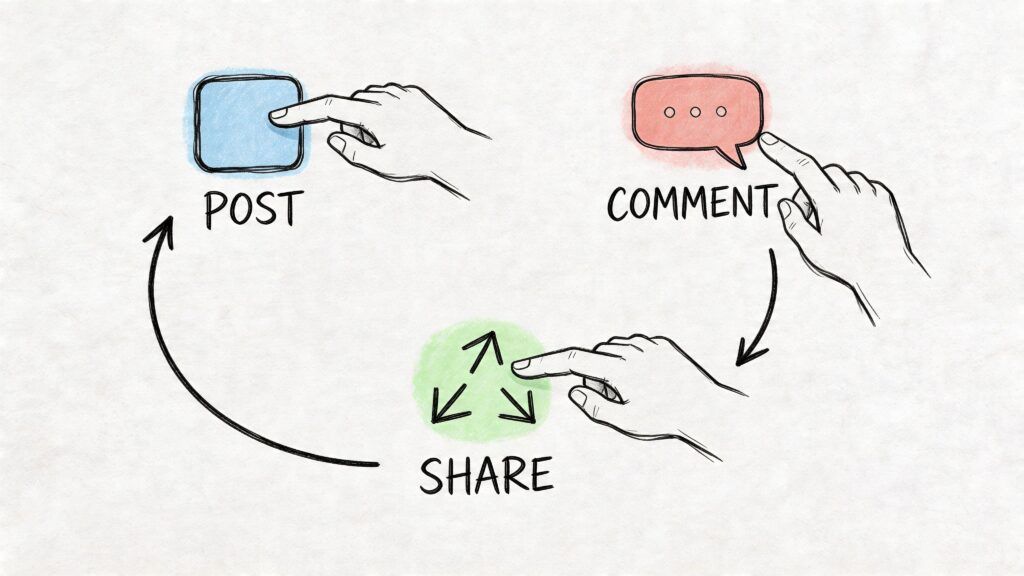
Instagram Growth Strategy Social Media
Stop thinking only about audience size
Some of the healthiest accounts grow more slowly than people expect.
That’s not a weakness. It’s often a sign that the account is building a real community. As one expert put it, “slow and steady growth is highly underrated” because it creates real impact and a more loyal base than strategies built around rapid spikes.
Fast spikes can help. But if those people don’t stick, respond, or buy, the spike was mostly cosmetic.
Create loops instead of isolated posts
A simple engagement loop looks like this:
- A Reel identifies a problem
- The caption asks a specific question
- Comments reveal objections or interest
- Stories follow up on that theme
- Replies open a deeper conversation
- New content is created from those replies
That loop compounds because the audience starts participating in what gets made next.
Here’s what that looks like in practice.
For an e-commerce brand
Post a Reel showing three ways to style one item. End the caption with a question about the biggest reason someone hesitates before buying. Use Story polls the next day to sort responses into fit, color, price, or occasion. Turn the most common answer into the next Reel and a FAQ Highlight.
For a service business
Publish a carousel about a common mistake in ad creative or onboarding. Ask people where they get stuck. Reply to comments with personalized follow-ups, then use Story question boxes to collect examples. Build next week’s content from the exact language people used.
Be proactive in your niche
Good engagement isn’t only what happens on your own profile.
If you manage growth seriously, spend time engaging where your audience already pays attention. That means niche creators, adjacent brands, customer communities, and peer accounts.
The key is relevance.
- Comment with substance. Add a perspective, an example, or a useful disagreement.
- Reply while the post is fresh. Early, thoughtful comments get seen more.
- Stay close to adjacent niches. A meal-prep brand might engage with fitness coaches, grocery creators, and wellness educators.
This isn’t about spraying comments everywhere. It’s about making your expertise visible in rooms your buyers already trust.
The goal of proactive engagement isn’t attention from everyone. It’s recognition from the right people.
Use collaborations and UGC to tighten the loop
Collabs and user-generated content work when they fit the audience’s current trust level.
A practical collaboration strategy includes:
- Peer swaps with complementary brands or creators
- Joint Lives or Story takeovers around one problem
- Creator seeding, where the product naturally appears in use
- Customer prompts that invite buyers to share their experience
UGC is especially useful because it does two jobs at once. It gives you content, and it gives prospects social proof.
The mistake is treating UGC as a one-time repost. Instead, build a process:
- Ask for it at the right moment after purchase or success
- Give people a simple prompt
- Save and tag the best submissions by theme
- Repackage them into proof posts, Stories, testimonials, and FAQ content
That’s how an audience starts behaving like a community. People don’t just consume the content. They help create the next layer of it.
Automating Your Growth with DMs and Funnels
A large share of Instagram engagement never turns into revenue because the next step is missing.
Likes and views create visibility. DMs capture intent. If someone comments on a resource, replies to a Story, or asks a product question, that person is giving a stronger buying signal than a passive viewer. A sound strategy for followers on Instagram turns those signals into an owned audience you can segment, nurture, and convert.
Applying Instagram growth tips helps you attract the right people, increase engagement, and keep your content visible. The goal is not just vanity metrics—it’s to grow your Instagram following with an audience that actually interacts and moves toward conversion.
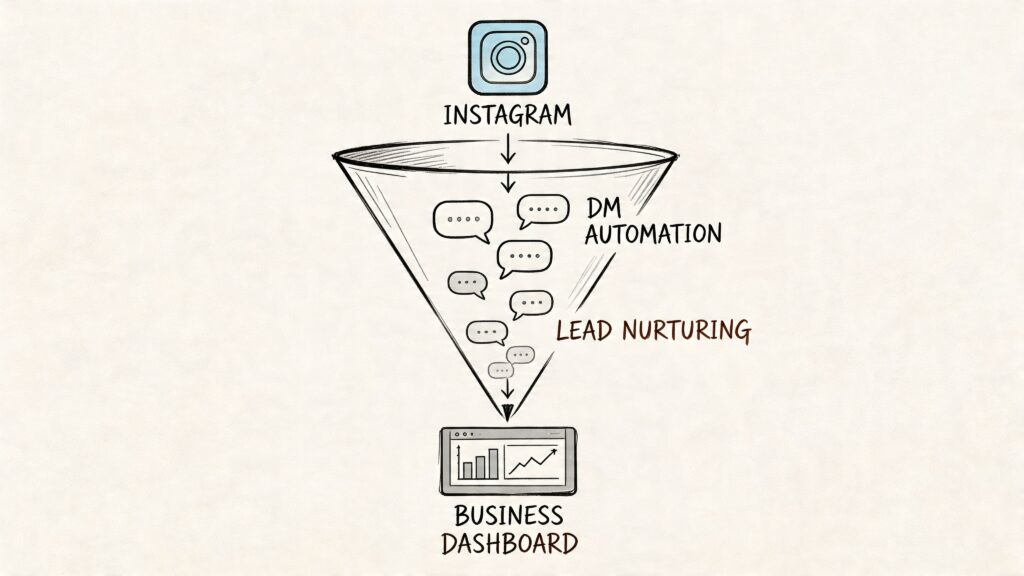
Instagram Growth Strategy Marketing Funnel
Turn content into conversations
Content should do more than attract attention. It should start a specific conversation.
The simplest way to do that is to pair each campaign with one clear DM action:
- Comment a keyword to get a checklist
- Reply to a Story for a recommendation
- Send a word in DM to get a guide, template, or offer
- Mention the brand in Stories to trigger a follow-up
Many accounts stall at this point. They publish strong posts, get visible engagement, and then leave people waiting in the inbox or force them to click around for the next step. Response lag kills momentum.
Tools like ManyChat or Clepher help teams automate the first reply, apply tags, and route people into the right follow-up based on what they asked for. For a practical breakdown of that setup, this guide to Instagram DM automation for growth explains the workflow. The goal is speed and relevance, not robotic over-automation.
Build a simple DM funnel
You do not need a complicated funnel to make Instagram productive. You need one path that matches the content and gives people a useful next step.
Step one: choose the entry trigger
Use one trigger per campaign so the audience knows what to do and your team knows what to measure.
Examples:
- A Reel with “comment GUIDE”
- A Story with “reply PLAN”
- A post about a common problem with “DM AUDIT”
- A product demo with “message SIZE”
Clear triggers improve conversion because they reduce hesitation. They also make reporting cleaner. If one post drives comments but no qualified replies, the CTA or offer probably needs work.
Step two: deliver one useful asset
The first DM should answer the reason they engaged.
Good first-touch assets include:
- Buying guides
- Product match quizzes
- Appointment prep details
- Mini training
- Coupon or restock access
- Lead magnet delivery
Keep it tight. One asset, one promise, one next step.
Step three: segment based on intent
Once people reply, sort them by what they want.
An e-commerce brand can be tagged by product category, purchase stage, or customer status. A coach can tag by goal, business model, or readiness. A SaaS team can tag by use case, team size, or onboarding stage.
That changes the role of DMs. The inbox stops being a pile of scattered replies and becomes a subscriber database tied to real interests.
Create a testing loop between posts and DM flows
The best DM funnels improve because content and automation are tested together.
A post attracts the right audience.
A keyword or reply prompt starts the conversation.
The DM flow delivers the asset and asks one qualifying question.
The responses show you which hooks bring attention and which ones bring buying intent.
That loop matters because high reach and high conversion are not always driven by the same creative. Some posts get shares but weak follow-through. Others bring fewer views and far better conversations. The second type is often more valuable.
Here’s a walkthrough that shows how DM flows fit into that testing process:
Connect paid traffic to the same funnel
Organic and paid traffic should feed the same message path.
Teams often waste ad spend by sending Instagram users to a generic landing page when the primary barrier is a simple question about fit, pricing, timing, or product selection. Click-to-message campaigns can outperform page clicks when the offer needs context before someone is ready to buy.
Common use cases:
- Services that require qualification
- Products with sizing or selection friction
- Offers with objections are better handled in conversation
- Lead magnets that naturally lead into a sales call or product recommendation
A local clinic can send ad traffic into DMs to pre-qualify consultation requests. A skincare brand can run people into a routine quiz. A course creator can deliver a workshop invite, then segment by topic interest before making the offer.
Nurture without becoming intrusive
Automation works when each message earns the next one.
A good nurture sequence is short, specific, and tied to the original action. If someone asks for a checklist, send the checklist first. Then ask one qualifying question. Then send the most relevant proof, FAQ, or offer based on their answer.
A practical sequence looks like this:
| Stage | DM objective |
|---|---|
| Initial response | Deliver the promised asset |
| Follow-up | Ask one qualifying question |
| Segmentation | Tag by need, product, or intent |
| Nurture | Send relevant tips, FAQs, or proof |
| Conversion | Present the right offer or booking step |
That is the shift that matters. Instagram stops being a channel where attention comes and goes, and starts functioning like a growth engine with subscriber capture, lead qualification, and repeatable follow-up built into the system.
Measuring What Matters and Optimizing Your Strategy
Most Instagram reporting is too noisy.
Teams track everything, learn nothing, and keep posting. A useful review process is narrower. You need a handful of metrics that tell you whether the system is healthy.
Build a small dashboard
Track the metrics that connect content to business movement.
A clean weekly dashboard can include:
- Reach to see whether the distribution is expanding or tightening
- Engagement rate to judge content quality
- Website clicks or offer clicks if link traffic matters
- DM subscriber growth if you’re using automation
- Qualified conversations to measure intent, not just activity
Here’s a simple format:
| Metric | Week 1 | Week 2 | Week 3 | Week 4 | Monthly Goal |
|---|---|---|---|---|---|
| Reach | |||||
| Engagement rate | |||||
| Website clicks | |||||
| DM subscriber growth | |||||
| Qualified conversations |
Read performance by pattern, not emotion
One low-performing Reel doesn’t mean the strategy failed. One strong post doesn’t mean you found the permanent formula.
Look for patterns such as:
- Topics that consistently earn saves
- Hooks that attract comments from the right people
- Stories that generate replies instead of passive views
- CTAs that start conversations
- Formats that drive curiosity but not conversion
When something works, ask why. Was it the topic, format, hook, timing, framing, or CTA? Usually, it’s a combination.
Content optimization gets easier when you stop asking “Did this perform?” and start asking “What signal did this produce?”
Run small tests
You don’t need elaborate experimentation.
Test one variable at a time:
- Caption style
- Opening hook
- Carousel vs Reel
- Educational vs opinion framing
- Direct CTA vs softer CTA
Keep notes. If a pattern repeats, turn it into a standard.
Review on a fixed cadence
A good rhythm is weekly for tactical adjustments and monthly for strategy calls.
Weekly review questions:
- Which post drove the best quality engagement?
- Which Story sequence produced replies?
- Which CTA triggered DMs?
- What should be repeated next week?
Monthly review questions:
- Are the followers getting more aligned?
- Is content driving more conversations?
- Are DM flows producing useful segmentation?
- Is the account supporting revenue goals or just creating activity?
That’s how optimization stays practical. You’re not trying to predict the algorithm. You’re reading your own operating signals and adjusting quickly.
Your Instagram Growth Strategy Is a System, Not a Task
The strongest Instagram accounts don’t grow because they found one trick. They grow because they run a connected system.
The foundation gives the account clarity. The content engine creates consistent opportunities for reach and response. Engagement loops turn passive viewers into active participants. DM automation captures intent and gives the business a way to nurture it.
When those parts work together, Instagram stops being a daily posting chore and starts acting like an asset.
That shift matters.
Instead of asking, “What should I post today?” ask, “Which part of the system needs attention?” Maybe the hooks are weak. Maybe the profile isn’t converting. Maybe Stories aren’t opening conversations. Maybe DMs aren’t segmenting people well enough after they respond.
That’s a better operating question because it leads to repeatable improvement.
A serious Instagram growth strategy in 2026 isn’t built for vanity. It’s built for compounding results. Better signals. Better conversations. Better conversion paths. That’s what makes growth sustainable.
If you want to turn Instagram engagement into structured DM conversations, subscriber capture, and segmented follow-up, Clepher is built for that workflow across Instagram and other messaging channels. It’s a practical option for teams that want to connect content, automation, and nurturing in one system.
Related Posts
Customer Journey Automation: The Practical Guide
October 10, 2026Lead Qualification Marketing: A Practical 2026 Guide
October 9, 2026Customer Experience Optimization Playbook
October 8, 2026
Founder Clepher