

80% of consumers show higher purchase intent when brands deliver personalized content, according to McKinsey’s research on personalized marketing. That number reframes personalization in marketing. It isn’t a design flourish or a CRM trick. It’s a revenue lever.
Most SMBs and DTC brands still treat personalization as a campaign tactic. They add a first name to an email, swap a homepage banner, and call it done. That approach misses the true opportunity. Effective personalization changes how a business listens, segments, responds, and follows up across web, email, and chat.
For smaller teams, the good news is that you don’t need an enterprise stack to do this well. You need clean signals, a few high-intent journeys, and tools that can react in real time, especially in channels like Messenger and Instagram DM, where buyers already ask questions, compare options, and hesitate before purchase.
What Is Personalization in Marketing Really?
Personalization in marketing means giving people a more relevant experience based on what they do, what they want, and what they tell you. It’s not just inserting a name into a subject line. It’s recognizing intent and adjusting the message, timing, offer, or path.
A simple example makes the difference clear. A generic brand sends the same promotion to everyone on its list. A personalized brand notices that one shopper viewed a product twice, asked a sizing question in Instagram DM, and never checked out. The next message doesn’t repeat the full catalog. It answers the sizing concern, shows the right product category, and nudges the next step.
That is the primary standard. Personalization should feel like a useful continuation of the customer’s journey, not a louder version of your sales calendar.
Relevance beats decoration
Many teams confuse personalization with surface customization. They change copy without changing logic. Customers notice that immediately.
Useful personalization usually relies on signals like:
- Behavior: Pages viewed, products clicked, carts started, messages opened
- Declared preferences: Style choices, goals, budget range, product interests
- Stage in journey: First visit, repeat browse, recent purchase, lapsed customer
- Context: Device, timing, and channel of interaction
If you want a practical primer on how behavior-based grouping works, Rebus insights on customer behavior are worth reviewing. The core idea is simple. Actions usually tell you more than demographics about what someone needs next.
Personalization works when the customer thinks, “That helped,” not “How did they get that?”
It’s a conversation strategy
The biggest shift is moving from campaign thinking to conversation thinking. Instead of asking, “What blast do we send this week?” ask, “What should this customer experience next based on their last action?”
That matters even more in conversational channels. On a website, a visitor may browse without interacting. In Messenger or Instagram DM, they often reveal intent directly. They ask if an item is in stock, whether shipping is available, or which option fits their use case. Those are strong buying signals. Good personalization captures them and responds immediately.
For SMBs, personalization in marketing becomes manageable. You don’t have to personalize everything at once. You need to personalize the moments that decide whether someone buys, books, subscribes, or leaves.
The Undeniable Business Case for Personalization
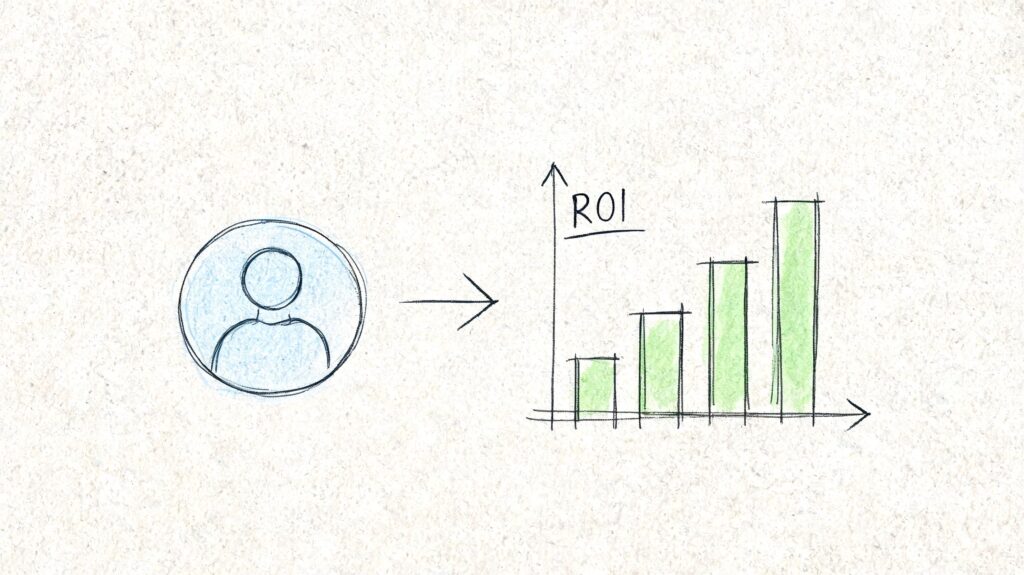
McKinsey’s research found that fast-growing companies get more revenue from personalization than slower-growing peers. For an SMB or DTC brand, that is not an abstract branding win. It shows up in conversion rate, repeat purchase rate, and how much revenue you can produce from the same traffic.
Personalization in Marketing ROI Graph
Revenue impact is real
The business case gets stronger when personalization is tied to moments that influence purchase decisions. McKinsey’s research also noted higher purchase intent for brands that deliver relevant content, and stronger retention for companies that coordinate personalization across channels.
That combination is powerful, connecting three outcomes owners care about:
- More first purchases
- More repeat purchases
- Less revenue lost between channels
Those gains matter because many growth tactics improve one metric while hurting another. Discounting can raise conversion and shrink margin. More ad spend can lift sales and make customer acquisition less efficient. Good personalization improves fit instead. It helps the right buyer move faster without training your audience to wait for a coupon.
Where SMBs usually miss the payoff
The gap is rarely budgeted alone. It is usually poor prioritization.
Teams say they want personalization, but they start with broad ideas instead of a revenue event. No one defines whether the goal is recovering abandoned carts, increasing average order value, qualifying leads in DMs, or getting a second purchase within 30 days. Without that choice, the project turns into extra work with no clear return.
Channel fragmentation is the next problem. A shopper clicks a product page, joins your email list, then asks a question on Instagram. If those systems do not share context, the brand responds like it has never seen that person before. That hurts conversion most in conversational channels, where buyers often state their intent directly.
A DTC skincare brand does not need an enterprise recommendation engine to start. It needs a useful answer when someone asks in Instagram DM, “Which product works for sensitive skin?” A local service business does not need predictive modeling first. It needs Messenger or web chat to identify the service category, collect booking intent, and route follow-up correctly.
Practical rule: Personalize the moment where hesitation is slowing down revenue.
Why conversational personalization pays off faster
Email and website personalization still matter, but SMBs often get faster returns from channels like Messenger and Instagram because the customer is already engaged. They are asking a question, comparing options, checking stock, or looking for reassurance before they buy. That is active intent.
A simple conversational flow can do work that usually requires a sales rep or support agent. It can ask one or two qualifying questions, recommend the right product, handle common objections, and hand off high-intent buyers to a human when needed. For many smaller brands, that is the accessible version of enterprise personalization. It is not fancy. It is timely, relevant, and connected to revenue.
If you are evaluating tools or workflows, this guide on using AI in marketing for practical customer journeys is a useful reference point.
Why cross-channel coordination affects profit
One of the most expensive mistakes in digital marketing is treating every channel like a fresh start. A customer browses a product, leaves, opens an email later, then asks a question in DM. If each touchpoint ignores the last one, your business spends more to recover a sale that was already close.
Cross-channel personalization reduces that waste. The site captures interest. Email reinforces relevance. Conversational AI handles objections in real time. Support or sales closes the loop when the case needs a person.
That is why the business case is so strong. Personalization improves conversion quality, retention, and operating efficiency at the same time. For SMBs, that usually means one thing. More revenue from the traffic and attention you already paid for.
The Engine Room Data and Technology
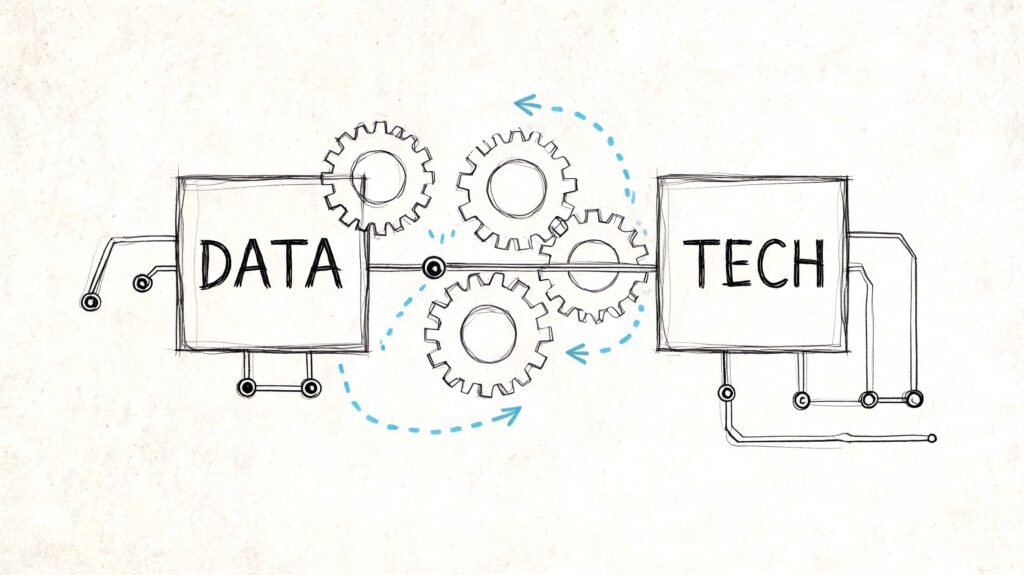
Most personalization projects fail for boring reasons. Not because the strategy was bad, but because the inputs were messy. If the data is wrong, late, or disconnected, the experience feels random.
Personalization in Marketing Data Technology
Start with the data you actually control
The most useful data for SMBs is usually first-party data. That includes browsing behavior, transaction history, email engagement, chat interactions, and on-site actions. It’s valuable because you collected it directly.
Then there’s zero-party data, which customers intentionally give you. Think quiz answers, preference selections, product goals, or form responses. This is often underused, even though it can make conversational personalization much sharper.
Context also matters. Device, location, and timing can influence what message makes sense right now. According to involve.me’s roundup of personalization statistics, 92% of businesses use personalization for growth, while 61% cite inaccurate data as a major risk. The same source notes that effective personalization combines first-party data with contextual signals to build precise audiences, and that this can contribute to a 40% revenue uplift for top performers.
Think of your stack as capture, organize, activate
You don’t need a complicated architecture diagram to understand the job each tool performs.
| Layer | What it does | Typical tools |
|---|---|---|
| Capture | Collects signals from site visits, forms, purchases, and conversations | Website widgets, chat tools, forms, and an e-commerce platform |
| Organize | Stores customer data and makes it usable | CRM, CDP, email platform |
| Activate | Triggers the next message or experience | Automation platform, email system, chatbot, ad audiences |
For most SMBs, the key isn’t owning more tools. It’s making sure one action can trigger the next step somewhere else.
Why conversational AI changes the setup
Chat tools used to sit off to the side as support widgets. Now they can act as an active marketing infrastructure. In channels like Messenger and Instagram DM, conversational AI can capture intent, label that intent, and move someone into the right follow-up without manual sorting.
That’s particularly useful when the team is small. Instead of checking DMs one by one and trying to remember who asked about what, you can structure flows around product interest, urgency, objections, or sales stage. A platform like Clepher’s guide to using AI in marketing shows how AI can support that activation layer through automated flows and segmented interactions across channels.
Here’s what works in practice:
- Tag by intent, not just source: “Asked about shipping” is often more useful than “came from Instagram.”
- Use custom fields for decision data: Size, plan type, preferred category, or service interest.
- Trigger off behavior quickly: If someone abandons a path after asking a buying question, that follow-up should happen while the context is still fresh.
Bad data creates fake personalization. Good data creates useful timing.
What not to overbuild
A lot of teams overinvest in dashboards before they have repeatable journeys. Don’t start with an elaborate data warehouse if your welcome flow, cart recovery sequence, and lead qualification path still send the same message to everyone.
Get three things working first:
- Reliable event capture
- Basic audience segmentation
- One automated response path per priority use case
Once those are stable, more technology becomes helpful. Before that, it becomes overhead.
Your Practical Roadmap to Implementation
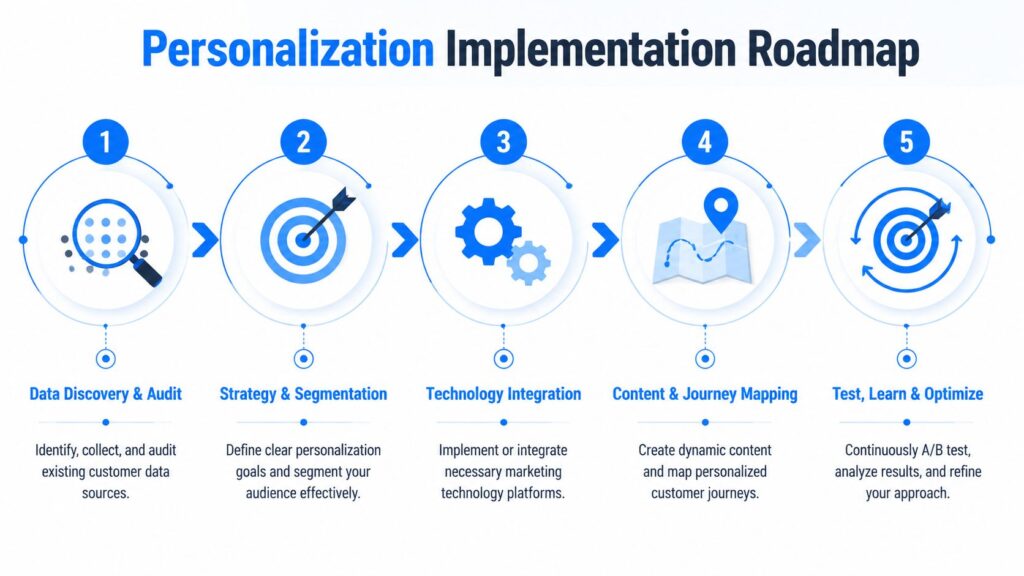
Most SMBs fail at personalization because they try to launch a finished system instead of a useful pilot. Start narrower. Build one path that responds better than your current default, then expand from there.
Personalization in Marketing Implementation Roadmap
Pick one business outcome
Don’t begin with “improve customer experience.” That’s too broad to execute. Choose a business problem with a clear next action.
Good starting points include:
- Recover carts: Follow up differently based on product category or objection
- Increase lead quality: Route inquiries by service type, budget, or urgency
- Improve first-purchase conversion: Personalize welcome flows based on source or interest
- Drive repeat sales: Trigger replenishment or cross-sell paths after purchase
The strongest pilots usually sit where intent is already visible, and revenue impact is close.
Audit the signals you already have
Before buying anything new, inspect what your current stack can already tell you. Most brands are sitting on enough signal to start.
Look for:
- Behavioral actions: Product views, cart starts, repeat visits, form abandonment
- Conversation signals: DM questions, FAQ clicks, support requests, keyword triggers
- Commercial history: Past purchases, high-value categories, average order patterns
- Declared preferences: Quiz answers, onboarding choices, consultation forms
At this stage, segmentation matters more than volume. If you need a simple foundation, this overview of audience segmentation is a useful reference for turning raw signals into groups you can market to.
Build around the perception gap
A common mistake is assuming that because your team added dynamic content, customers feel understood. That assumption is risky. Deloitte highlights a personalization perception gap in its research on personalizing growth: 61% of brands believe their experiences are personalized, but only 43% of consumers agree. The same analysis notes that for SMBs, closing this gap with no-code tools and micro-interactions can prevent over 50% of customers from disengaging due to misfired personalization attempts.
That’s why small touches often outperform large but generic automation. If someone clicks “vegan options,” then every follow-up should respect that choice. If someone asks for pricing, don’t send a brand story sequence first.
The fastest way to improve personalization is to stop sending people steps they’ve already outgrown.
A short explainer can help your team visualize the process before building:
Launch a pilot that is easy to judge
Choose one channel and one journey. Instagram DM welcome flow. Cart recovery in Messenger. A website quiz that routes people into segmented email follow-up. Keep the scope tight enough that you can clearly tell whether it worked.
A practical pilot often looks like this:
- Trigger: User visits a product page twice or starts a DM from a product post
- Question: Ask one useful qualifier, such as intended use, size, or budget
- Branch: Send the next message based on that answer
- Offer: Present one relevant CTA, not five
- Fallback: If they don’t convert, send one timed reminder tied to their last action
Use no-code tools, but keep human review
Automation should remove repetitive work, not remove judgment. Someone on the team still needs to review tags, read conversation transcripts, and check whether the branches still match real buyer behavior.
The best implementation rhythm is simple:
- Weekly: Review path drop-offs and common objections
- Biweekly: Refine one segment or one message branch
- Monthly: Promote the winning flow to another channel or audience
That cadence keeps personalization practical. You’re not trying to engineer a perfect system. You’re building a better response to the moments that drive sales.
Channel-Specific Tactics That Work
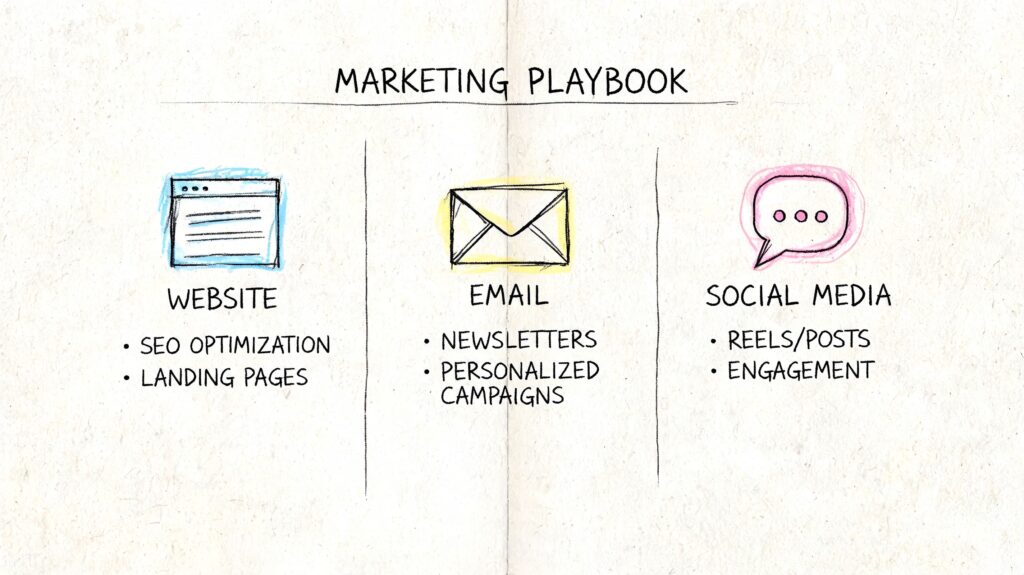
Response time shapes revenue in these channels. A shopper who asks a product question in Instagram DM usually wants help in minutes, not a generic follow-up tomorrow. That is why channel fit matters more than trying to personalize everything at once.
Personalization in Marketing Playbook
Website tactics that reduce hesitation
On-site personalization should remove friction near the buying decision. If someone is browsing a specific category, reflect that context on the page they are already viewing instead of sending them back into the full catalog.
Tactics that tend to pay off:
- Dynamic CTA swaps: Show “See options for sensitive skin” instead of “Shop now” when product interest is clear
- Return-visitor modules: Bring back recently viewed items or adjacent categories
- Contextual proof: Match reviews, use cases, or before-and-after content to the product type on screen
- Short qualification flows: Ask one or two questions that narrow the path fast
Regional context can matter here too, especially for service businesses and local brands. For a concrete example of a message fit by audience and context, see these personalized advertising campaigns in NYC.
Email still works when the message matches the intent
Email underperforms when brands send one stream to everyone. A browse abandoner, a first-time buyer, and a repeat customer should not get the same sequence.
Useful email plays for SMBs and DTC teams:
- Browse follow-up: Send products from the category viewed, not a general newsletter
- Post-purchase education: Explain setup, usage, care, or replenishment timing based on the item purchased
- Lead nurturing: Separate early research from comparison-stage buying intent
- Reactivation: Re-enter the customer based on the last product viewed, purchased, or clicked
This is usually a segmentation problem before it is a deliverability problem. If opens are low, this guide on how to increase email open rates is a useful reference for subject lines and audience splits.
Conversational AI gives SMBs an unfair speed advantage
Messenger and Instagram DM are often easier places for smaller brands to personalize than email or a full e-commerce site. The tech is lighter, the buying signals are clearer, and the path from question to sale is shorter.
A strong DM flow does not need heavy AI. It needs three things. Recognize intent, ask one useful qualifier, and route the person to the next best action.
For example, a skincare brand can map common inbound messages like “gift,” “acne,” “routine,” or “shipping” to separate paths. A fashion brand can branch on “sizing help,” “restock,” “bundle,” or “delivery before Friday.” Those are simple rules, but they feel personal because they respond to the buyer’s immediate context.
Conversational AI becomes practical for SMBs in this context. It can classify inbound intent, pull product context from the ad or post that started the conversation, and hand off to a human only when the question needs judgment. That saves support time and raises conversion rate because buyers do not have to repeat themselves.
High-yield use cases include:
- Abandoned cart recovery: Start with the exact product left behind and answer likely objections in chat
- Lead qualification: Ask one branching question before sending a lead to sales or booking
- Product launches: Message only the people who clicked, replied, or asked about that category before
- Support-to-sales handoff: Route buying questions into a sales path with product recommendations and a clear CTA
Personalization tactics by channel
| Channel | Simple Tactic (Start Here) | Advanced Tactic (Scale Here) |
|---|---|---|
| Website | Swap CTA based on the product or category viewed | Build branch paths from quiz answers or on-page behavior |
| Segment by last action or purchase | Run behavior-triggered lifecycle sequences | |
| Messenger | Respond to common buying keywords with relevant options | Tag intent and route users into follow-up automations |
| Instagram DM | Use story replies or post triggers to start relevant flows | Personalize launches and offers by prior engagement |
| Send timely service or order updates with relevant next steps | Combine support, upsell, and retention messaging in one flow |
The trade-off is operational, not technical. Every new branch creates more copy, more QA, and more transcript review. For most SMBs, five strong paths tied to revenue moments will outperform a large decision tree nobody maintains.
How to Measure Personalization Success and Prove ROI
Personalization gets approved faster when it’s tied to business outcomes, not just engagement screenshots. If you can’t show what changed, it will eventually be treated like a creative preference instead of a growth lever.
Track the metrics that connect to money
Start with a short scorecard. Don’t bury yourself in dashboards.
Focus on:
- Conversion rate uplift: Did the personalized path convert better than the generic path?
- Average order value: Did relevant recommendations or bundles change basket size?
- Segment-specific revenue: Which audience groups produced incremental sales?
- Repeat purchase or return rate: Did the experience increase follow-on action?
- Lead qualification rate: Did more conversations turn into sales-ready opportunities?
Those metrics are easier to defend than vanity indicators. Opens and clicks can still help diagnose performance, but they aren’t the finish line.
Use controlled comparisons
The cleanest way to prove impact is with a simple A/B structure. One group receives the default journey. Another receives the personalized version. Keep the difference narrow enough that you can attribute the result to the change you made.
Good examples:
- Generic cart reminder versus category-specific cart reminder
- Standard welcome flow versus source-based welcome flow
- Broad DM response versus intent-based DM branch
Personalization often feels obviously better to the team that built it. Measurement keeps that instinct honest.
Measurement test: If a personalized journey wins, you should be able to explain exactly what signal triggered it, what changed in the message, and what business metric improved.
Build one practical reporting view
For SMBs, a useful report doesn’t need to be complex. One shared dashboard or even a disciplined spreadsheet can work if it shows:
| Personalization use case | Primary KPI | Comparison baseline | Review cadence |
|---|---|---|---|
| Cart recovery | Conversion rate | Generic reminder flow | Weekly |
| Post-purchase cross-sell | Average order value | Standard product follow-up | Monthly |
| DM lead qualification | Qualified leads | Manual inbox handling | Weekly |
| Reactivation | Segment revenue | Batch campaign send | Monthly |
If you’re already used to modeling return in other channels, tools that help measure SEO profitability can also sharpen how you think about baselines, inputs, and payback in personalization efforts.
The main point is discipline. Tie every personalization effort to a before-and-after business result. If a tactic improves relevance but doesn’t improve outcomes, refine it or cut it.
Best Practices Privacy and the Future of Personalization
According to research on the personalization-privacy paradox, 73% of consumers prefer personalized communications. Preference drops fast when the message feels like surveillance instead of service.
For SMBs and DTC brands, privacy usually breaks down in ordinary execution. A customer opts in through Instagram DM, then gets a follow-up email they never expected. Support collects a product preference in chat, but marketing cannot see the consent status tied to that conversation. One team pauses messages. Another keeps sending them. The problem is rarely “not enough data.” It is poor control over who collected what, why it was collected, and where that permission is stored.
Chat makes this more sensitive because the interaction feels personal by default. A website pop-up can be ignored. A DM feels closer to a one-to-one conversation, so relevance has to be earned.
Keep personalization tied to declared signals
The safest rule is simple. Personalize from the signals the customer gave you directly, in a context they would recognize.
For example, if someone asks in Messenger whether a product comes in sensitive-skin formulas, you can use that answer to route them to the right products in that same conversation. If they opt in, you can send a follow-up when that category comes back in stock. This is an example of effective personalized marketing, where the customer’s interaction directly shapes their journey. What you should not do is pull that detail into unrelated campaigns across channels without clear permission.
Personalization tools like these ensure you’re not overstepping and using customer data responsibly, which leads to a more positive customer experience. That kind of restraint protects revenue. It cuts list fatigue, reduces unsubscribes, and keeps your best customers responsive.
The benefits of personalization are clear: it drives customer loyalty, increases conversion rates, and builds stronger connections with your audience. By sticking to what your customers share with you, you can create relevant, meaningful interactions that make them feel valued while ensuring long-term brand loyalty.
Set clear consent rules for conversational channels
A practical privacy standard for SMB teams looks like this:
- Ask for the minimum data needed to improve the next step
- State the reason at the moment you ask
- Store consent and preferences in the same system as the conversation history
- Separate service messages from promotional follow-ups
- Make opt-out language easy to find and easy to use
Here is what that looks like in practice. A shopper starts an Instagram DM asking about restock timing for a sold-out size. The brand offers two options: “Reply YES for a one-time restock alert” or “Reply DEALS for ongoing promos.” Those are different permissions. They should be stored differently and used differently.
Many small brands encounter difficulty by treating every reply as blanket permission for future marketing.
Compliance improves execution when the setup is right
GDPR and similar rules can feel administrative, but they usually expose a weak process that was already hurting performance. If your team cannot answer “How did this person opt in?” within a minute, your personalization system is too messy.
I advise clients to use one practical test. If a customer asked why they received a message, could the team point to the exact consent, channel, and trigger without guessing?
That standard is especially useful with conversational AI. AI can qualify leads, recommend products, and handle common support questions at scale, but it still needs firm rules. The bot should know which fields can be used for routing, which permissions allow follow-up, and when to stop collecting data and hand off to a human.
The future belongs to brands that use fewer, better signals
Related Posts
Customer Journey Automation: The Practical Guide
October 10, 2026Lead Qualification Marketing: A Practical 2026 Guide
October 9, 2026Customer Experience Optimization Playbook
October 8, 2026
Founder Clepher