You know the feeling. The calendar isn’t empty, but it’s not full of the right people either. A few warm intros come in, a couple of DMs trickle through, and then you spend half your week talking to prospects who were never going to buy, never had the budget, or just wanted free advice.
That’s not a traffic problem; it’s a lead quality issue. It’s a pipeline problem.
For coaches, referrals are still the main engine in the market. The 2024 Insurance Canopy Personal Training Report found that 84% of personal trainers get most of their clients from referrals, and an ICF-linked 2024 global coaching study reported that personal referrals are the primary acquisition source for 62% of established coaching practices. Independent benchmarks put referral-sourced coaching clients in the 55–65% range, which says the same thing in three different ways: word of mouth is still the foundation of the coaching economy. lead generation for coaches
That creates fragility. When referrals are flowing, everything feels easy for generating leads. When they slow down, the whole business feels thinner than it should.
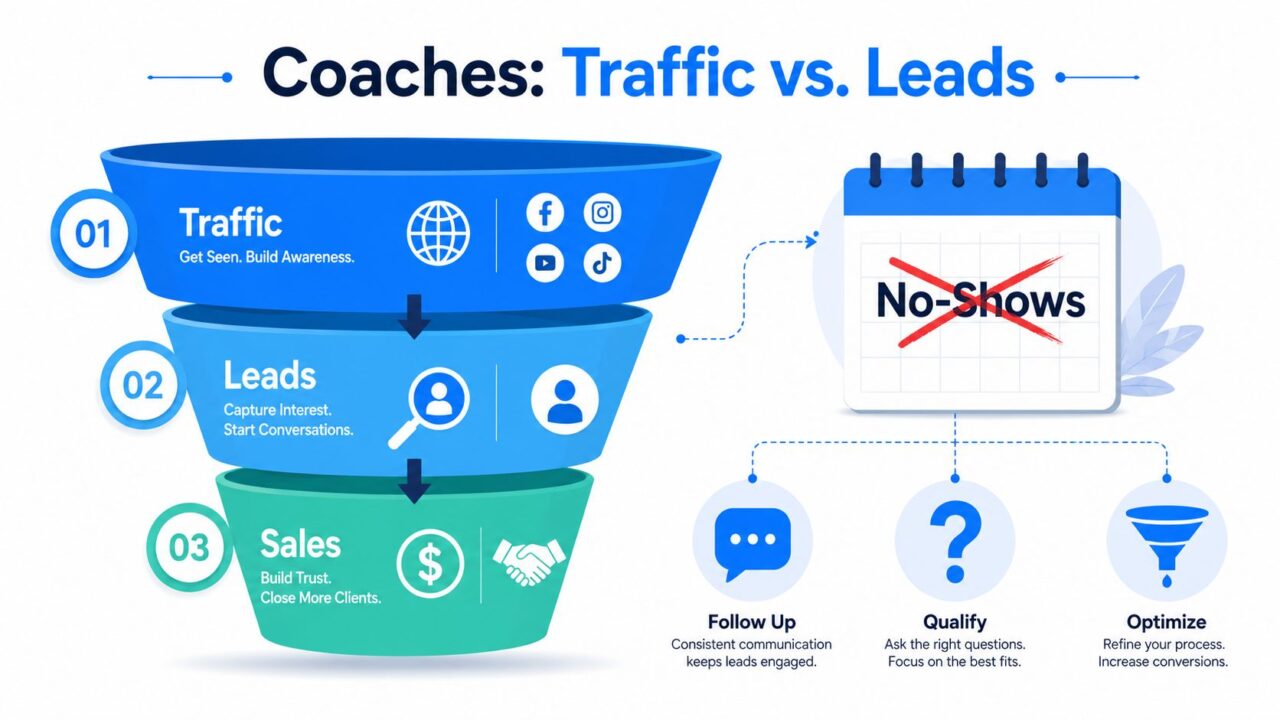
Lead Generation for Coaches Sales Funnel
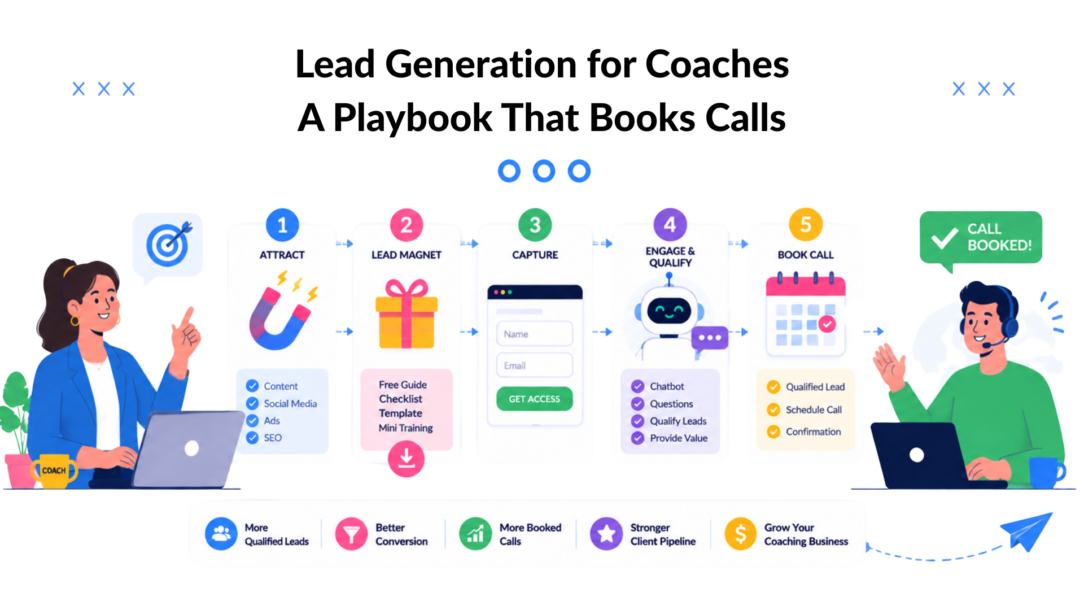
The fix is to stop treating every inquiry like a potential client inquiry. A coach needs a pipeline that moves people through Attract → Capture → Qualify → Book. Attract brings in the right attention through content, ads, partnerships, or visibility. Capture turns that attention into a name and an email with a lead magnet, quiz, or checklist. Qualify screens for budget, timeline, and readiness. Book puts the right person on the calendar inside the conversation flow, instead of tossing them into a vague “DM me” pile.
Practical rule: If a lead doesn’t have a clear next step, it isn’t really a lead yet.
That sequence sounds simple because it is, yet it effectively improves the conversion rate. The hard part is doing each stage on purpose. Most coaches skip qualification, book too early, and then wonder why the calendar fills with polite no-shows and low-intent calls.
A cleaner workflow looks like this. Traffic lands on a focused page. The page offers one useful thing. The opt-in form collects contact details. The follow-up asks a few short fit questions. The booking step only appears once the prospect has already shown some seriousness.
That’s where a resource like top lead gen strategies to boost revenue fits nicely, because the core lesson is the same across industries: good lead generation isn’t random attention, it’s routing.
If you want leads to behave like a business asset, track them like one. Every lead should have a person, source, fit notes, stage, last meaningful interaction, next action, and follow-up date. Once those fields exist, the conversation stops living in scattered inboxes and starts acting like a real pipeline.
Why Most Coaches Have a Lead Problem, Not a Traffic Problem
A coach can have plenty of attention and still have an empty calendar. That usually happens when the business confuses visibility with progress. A post gets liked, a story gets viewed, a referral comes in, and none of it turns into a qualified conversation because there’s no system between interest and booking.
The usual pattern is brutally familiar. A coach opens the laptop, sees a few warm messages, replies late, books anyone who asks, and then spends the afternoon trying to rescue calls that should never have been scheduled. The calendar looks busy, but the business isn’t moving forward.
The four jobs your pipeline has to do
Each stage has a different job, and mixing them up causes the mess.
- Attract creates reach. Content, ads, partnerships, podcast guesting, and other visibility tactics live here.
- Capture converts attention into a contact. That usually means a lead magnet, quiz, checklist, or opt-in page.
- Qualify filters for fit. Short questions about budget, timing, readiness, and authority do the heavy lifting here.
- Book hands the right prospect a real calendar slot inside the flow, not a dangling link and a hope.
A lot of coaching advice skips straight from “get seen” to “get on a call.” That shortcut feels productive, but it burns time. The cheapest lead is not the best lead, and the fastest call is not the best call.
The cleanest way to think about this is operationally. Every inquiry needs a path, not a pile. If a prospect is ready, booking should be easy. If they’re curious but not ready, the lead magnet and nurture sequence should keep the conversation alive. If they’re a poor fit, they should filter out early without wasting anyone’s time.
The best pipeline isn’t the one with the most activity, it’s the one with the fewest dead ends.
That’s why a short screening layer matters so much. It protects your calendar from people who were never likely to buy and keeps stronger leads moving faster. The goal isn’t to reject prospects but to identify ideal clients. It’s to stop treating every prospect as if they belong in the same bucket.
A simple rule keeps the whole thing honest. If someone hasn’t shown a problem, a fit, and a willingness to take the next step, they’re not ready for a discovery call. They may still be a good future client, but they’re not a same-week booking.
That’s also why a coach should stop measuring only reach. Reach can look impressive while booked calls stay flat. The better metrics are the number of relevant conversations, the quality of those conversations, and the speed with which they move to the next step.
Niche Down and Define an Offer That Sells Itself
A vague offer kills lead generation before the funnel even starts. “I help people live their best life” sounds warm, but it gives no one a reason to raise their hand for your webinar. A specific promise does the opposite. It helps the right person recognize themselves immediately and decide they want the call.
The fastest way to tighten an offer is to stop describing your identity and start describing the buyer’s situation. A coach can be talented and still be hard to buy from if the offer stays broad. The market responds faster when the prospect can see the problem, the outcome, and the next step in one pass.
Turn a broad identity into a sharp promise
Take a leadership coach. “I help managers grow” is fuzzy. “I help first-time managers run one-on-ones their team shows up to” gives the prospect a clear outcome and a specific use case. The difference is not just wording; it is buyer recognition, and that recognition does a lot of the selling before a call ever happens.
The same logic works across coaching niches, but the promise has to stay grounded in a real problem the buyer already feels.
- Leadership coach: first-time managers, one-on-ones, team engagement, confidence in early management.
- Nutrition coach: busy parents, meal planning, energy, realistic routines.
- Business coach: solo consultants earning under $10K/month, pricing confidence, pipeline stability, simpler positioning.
Each one can be turned into a one-sentence promise, then matched to a single primary CTA. If the offer is a free consultation, make that conversation about fit and next steps. If the offer is a paid audit, the CTA should feel like a diagnostic with a clear deliverable. If the offer is application-only, the funnel should signal selectivity from the start. That structure keeps the message aligned with the level of commitment you want from the lead.
The point is not to sound exclusive for its own sake. The point is to make the right person feel understood and the wrong person self-filter out. A generalist offer pushes the explanation burden into sales calls, DMs, and follow-up messages, which is a slow way to fill a calendar.
Practical rule: The more valuable the coaching, the more specific the promise has to be.
That specificity also shapes the capture step. A leadership coach with a promise around one-on-ones can offer a checklist or quiz on meeting quality. A nutrition coach for busy parents can offer a routine builder or grocery planning aid. A business coach for solo consultants can use a pipeline audit or pricing self-check. If you want the offer to support list building too, use a clean resource path like how to build an email list so the lead capture step matches the promise of your coaching business instead of drifting away from it.
Once the niche, promise, and CTA line up, the rest of the funnel gets easier. The message is clearer. The lead magnet is cleaner. The qualification questions make sense for identifying potential clients. And the booking link feels like a next step instead of a leap.
Lead Magnets That Actually Convert Coaches’ Traffic
A lead magnet should do one job well. It should make the right person think, “This coach understands my problem,” and then give them a natural next step. Education matters, but education alone doesn’t book calls.
The strongest format usually depends on the niche and the complexity of the problem. A quiz is fast and interactive. A checklist is simple. A template feels practical. A mini-training works when the value needs a little more explanation. A PDF guide can still work, but only if the promise is tight and specific.
Lead Magnet Formats for Coaches
| Format | Typical Conversion | Best For | Build Effort |
|---|---|---|---|
| Checklist | Strong when the problem is clear and action-oriented, enhancing the effectiveness of your lead generation system. | Busy prospects who want quick wins | Low |
| Quiz | Strong when diagnosis matters or the prospect needs self-awareness to become a qualified lead. | Leadership, mindset, wellness, and identity-based coaching | Medium |
| Template | Strong when the buyer wants immediate implementation | Business, operations, planning, and systems-focused coaching | Medium |
| Mini-training | Strong when trust needs more teaching before the ask | Higher-consideration offers | Higher |
| PDF guide | Works best with a narrow promise and a clear next step | Simple lead capture is essential for early-stage audiences and generating inbound leads. | Low |
A practical framework keeps the magnet from becoming a content dump. Use promise, quick exercise, and next-step recommendation. Promise the result. Give the reader a short action they can complete quickly. End with a recommendation that points to a consult or diagnostic call.
That matters more than most coaches realize. If the magnet gives away too much or rambles through generic advice, it becomes a library item. If it solves one obvious problem and opens the door to a deeper conversation, it becomes a qualifying handshake that can lead to coaching services.
A clear example helps. “Find your manager blind spots in 5 minutes” is much stronger than “5 coaching tips for leaders.” The first one speaks to a specific identity and a useful self-assessment. The second one sounds like content anyone could have written.
For capture and follow-up, a useful companion resource is analytics to track lead generation system effectiveness. Build an email list for coaching leads, because the magnet only matters if the follow-up sequence moves people forward. A simple three-email flow works well here. Send the magnet immediately, then follow with three value emails that teach one idea, show one relevant win, and invite a decision-stage conversation.
A soft-sell line can stay human if it sounds like a next step instead of a pitch. Something like, “If you want help applying this to your situation, book a short diagnostic call and we’ll see whether it makes sense to work together.” That’s clear without being pushy.
The magnet’s real job isn’t to educate. It’s to qualify interest.
Building the Website and Chatbot That Capture Visitors
A coaching website should do one job well. It has to answer three questions fast: who this is for, what problem it solves, and what the next move is. If those answers are hard to find, visitors leave before the first conversation starts.
A simple site structure usually works better than a sprawling one. Keep the home page focused on positioning and one primary call to action to attract your target audience. Use the about page for credibility, not biography trivia, to attract ideal clients. Give each niche its own landing page with one audience, one promise, and one next step. Use the blog to answer the questions prospects already type into search. Keep the booking page tight so the path to a call stays obvious.
That structure also gives the chatbot a clear job. A welcome widget on the home page can open with one line of value, ask one qualifying question, and offer two paths. One path can be a free 15-minute consult. The other can be the quiz or checklist that fits the visitor’s stage.
The best flows move from broad interest to relevance quickly. On a leadership page, the bot can open with, “I help new managers build better 1:1s and team follow-through. What’s your biggest challenge right now?” From there, it can branch into booking or self-assessment.
A nutrition coach can keep it just as direct. “I help busy parents build realistic food routines. Want a quick plan or a short call to talk through your situation?” That split keeps the conversation useful without feeling mechanical.
For coaches who want a closer look at how the flow and routing work together, chatbot flows for lead generation show how one conversation can capture intent and move people to the right next step. The conversation layer matters just as much as the form, and chatbots for capturing sales leads are a useful reference when the goal is to collect contact details without making the visitor work for it.
Practical rule: The chatbot should behave like a front desk, not a quiz show.
The small details affect response rates more than most coaches expect. Personalization tags make the conversation feel less scripted. Typing indicators buy a moment of realism. Conditional branches let the bot respond when someone says they are not ready yet or wants more information first. Consent prompts keep the capture process clean, especially when the bot collects email or phone data.
The final piece is integration. Every captured contact should sync into the coach’s CRM or email tool right away. No one should disappear into a DM thread or a half-finished browser tab. When the bot catches the lead, the system should catch the lead too.
Picking the Acquisition Channels That Fit Your Coaching Style
A coach who loves live conversation will usually grow faster in channels that reward presence. A coach who prefers writing can build a steadier pipeline through search and partnerships. A coach who wants fewer public posts needs a route that still brings in people with intent.
The channel buckets that drive results
Organic channels include LinkedIn, Instagram, YouTube, and podcast guesting. Paid channels cover Meta ads, Google ads, and LinkedIn ads. Partnerships include joint webinars, newsletter swaps, and referral allies. SEO covers blogs, YouTube search, and podcast search.
Each bucket asks for something different, and that is the decision for your coaching business.
- Organic: low cash cost, high time cost, slower control, good for trust-building.
- Paid coaching services can significantly improve your conversion rate: faster visibility, tighter control, more direct testing, but it needs budget and clean targeting.
- Partnerships: borrowed trust, warm audience transfer, a strong fit when the partner serves the same buyer.
- SEO: slower build, durable once it gains traction, useful for coaches who want a lower-publicity pipeline.
A coach who is tired of posting every day should give the non-social route serious weight. SEO, guest contributions, newsletter partnerships, and referral relationships can create a steadier flow without living on the content treadmill. That path gets less attention than LinkedIn or Reels, but it fits a lot of coaches who want clients without constant visibility.
For a useful check on intent-based traffic, Google Search Ads lead generation insights show why search behavior and social attention do not produce the same kind of lead. Someone searching for help is already naming the problem. Someone scrolling may still be deciding whether the problem matters.
The smart move is usually two channels you can sustain, not five that drain you. A business coach might pair SEO with partnerships. A wellness coach might pair Instagram with referrals. A quieter operator might use blog content and newsletter swaps, then let the chatbot and email flow handle capture and follow-up to improve conversion rates.
Channel choice is a lifestyle decision as much as a marketing one.
Some coaches build an entire practice without a constant Reel strategy. The setup is simple enough: a clear offer, visible search or partnership entry points, a capture flow that does not waste the visitor’s time, and disciplined follow-up. The platform changes, but the pipeline logic stays the same.
For the qualification side of that pipeline, this guide to lead qualification is a useful companion when you want the channel to hand off cleaner leads instead of just more names.
Pre-Qualifying Leads So Your Calendar Stops Filling With No-Shows
A full calendar looks good until the calls start. Then the pattern shows up. People book, then ghost. Others show up with no budget, no timeline, and no real intent to move.
Pre-qualification keeps that from happening. The job is to separate curiosity from commitment before a slot is reserved, while still making the process feel useful on the prospect’s side. If the questions are too thin, you get tire-kickers. If the gate is too heavy, good prospects drop out before they ever speak to you.
Use value first, filter second
For LinkedIn outreach, one source recommends keeping only 10% of your questions pre-qualifying and making 90% of them value-driven, which is a useful ratio for any direct conversation. In practice, that means you earn the right to ask about budget, timing, or authority by first helping the prospect understand their own situation more clearly.
A simple DM flow should feel like curiosity, not screening. Start with an observation, ask a question about the problem, and then respond to what they say. Once the person opens up, fit questions can come later without making the exchange feel mechanical or cold.
For higher-ticket coaching, the application form should do the filtering. Keep it short, but make it specific. Ask about the challenge, what they’ve tried, budget, desired start date, and what success looks like. Add a couple of questions that reveal readiness and authority, especially if the offer depends on commitment from the buyer, not just interest.
A simple lead score helps here. Someone with a clear problem, a realistic budget, and a near-term start date gets a call. Someone who wants a free taste but not a real commitment gets a self-serve resource. Someone with no fit gets a polite no.
A lead qualification process like ours belongs in the form or screening step, not after the booking. That keeps the calendar reserved for people who are more likely to buy.
The three-email value sequence before the ask
The mistake many coaches make is asking for a call too early. A discount or “book now” message before value has landed attracts low-intent leads and trains people to wait for the next discount. The result is a funnel that fills the calendar with bargain hunters.
A better sequence looks like this.
- Teach one useful idea.
- Show what the idea changes in real life by providing social proof through testimonials.
- Invite a decision-stage conversation.
That sequence can support a consultation, an audit, or an application for coaching services. It also gives the prospect enough context to self-select before they ever hit the calendar.
Don’t use the call to find out whether the lead is serious; instead, focus on generating qualified leads through effective lead generation strategies. Use the call to confirm it.
When a coach gets this right, the calendar gets quieter in the best possible way. Fewer random calls. Fewer awkward no-shows. Better conversations. More people who already understand the offer before they talk to you.
Measuring and Optimizing the Pipeline Like an Operator
Most coaches don’t need a fancier marketing idea, but they do need to understand their target audience. They need a cleaner operating rhythm. The pipeline gets better when the coach reviews it the way an operator would, by checking where people are entering, where they’re dropping, and what happens before the booking.
Track the bottleneck, not just the volume
The useful weekly questions are simple.
- Qualified conversations per week: Are enough real prospects entering the pipeline?
- Fit score: Are the right people making it through qualification?
- Speed-to-call: Are prospects getting a next step quickly enough?
- Show rate: Are booked calls turning into actual conversations?
- Close rate of qualified leads: Are the right calls turning into clients?
Those numbers tell you where the work belongs. If conversations are low, the problem is upstream in your lead generation strategies. If conversations are high but fit is weak, the issue is the lead magnet, the page, or the targeting. If fit is good but calls aren’t showing, the follow-up and reminder flow needs attention. If show rate is fine but close rate is low, the offer or qualification logic is off.
A weekly review should live in a CRM or a simple spreadsheet. Log the source, fit notes, stage, last meaningful interaction, next action, and follow-up date for every lead. That discipline matters because a pipeline leaks in the gaps between messages, not just in the obvious sales stages.
A 30-day sprint that doesn’t require more hours
Run one acquisition channel, one capture asset, and one follow-up sequence for a full month. Keep the structure stable long enough to see what’s happening. Every Friday, review what got traffic, what got opt-ins, what got qualified, and what booked.
If the bottleneck is top-of-funnel volume, improve distribution. If capture is weak, tighten the offer and the landing page for effective lead generation. If qualification is weak, improve the questions and the screening layer. If close rate is weak, rework the promise and the call structure to enhance lead quality.
The point is not to spam more content into the market but to provide valuable case studies. It’s to remove friction where it already exists. A coach who knows the weak link can fix the right part of the funnel without working more hours.
If you want the chatbot, capture, and qualification layer handled without stitching together five tools yourself, Clepher gives coaches a way to build conversational flows on their website and messaging channels, collect leads, and route people into the right next step. If your goal is a calmer calendar with better-fit conversations, it’s worth setting up a simple flow and testing it against your current booking path.