
You already know the pattern. Leads come in from ads, forms, chat widgets, webinars, and social. A few get quick follow-up. Most sit in a spreadsheet, a CRM view, or an inbox folder while the team handles whatever feels most urgent that day.
Then the same thing happens again next week.
That’s why lead nurturing software matters. Not because it sends automatic emails, but because it gives your team a repeatable way to keep conversations moving after the first touch. Done well, it turns inconsistent follow-up into a system that responds to what people do.
The old model was a simple drip email. The modern model is broader. Buyers read an email, click a page, reply in chat, ask a question on Instagram, disappear, come back from a retargeting ad, then book a call. If your setup only knows how to send a scheduled email on day three, you’re behind how people buy.
What if Your Leads Nurtured Themselves
A common growth problem looks small until you zoom out. A business spends time and budget generating leads, then loses momentum in the handoff between interest and decision. Nobody ignores leads on purpose. Follow-up just gets handled manually, unevenly, and too late.
A coach downloads a list of webinar registrants and plans to message the most engaged attendees the next morning. A DTC brand exports abandoned carts and means to send offers later that afternoon. A SaaS team promises every trial signup a personalized path, but the sequence never goes beyond two generic emails.
The result is familiar. Warm interest cools off. Sales says the leads aren’t ready. Marketing says the leads never got proper follow-up.
Leads rarely go cold all at once. They cool one missed response, one generic message, and one delayed handoff at a time.
Lead nurturing software fixes that by taking routine follow-up out of memory and putting it into workflows. Instead of hoping someone remembers who clicked the pricing page or who asked a question in chat, the system can react automatically. It can route, tag, score, send, and notify based on behavior.
That matters because companies that excel at lead nurturing software strategies generate 50% more sales-ready leads while reducing cost per lead by 33%, and more than 71% of leaders running these programs say warmer, sales-ready leads are the primary benefit. The same verified dataset also notes that 23% report a 30% increase in sales opportunities as a direct result of their software investment.
The useful shift in 2026 isn’t just automation. It’s moving from one-way email drips to omnichannel, conversational nurturing. The strongest setups don’t chase leads. They guide people forward through email, site behavior, retargeting, live chat, social DMs, and sales follow-up that feels timely instead of random.
What Is Lead Nurturing Software Really
Lead nurturing software runs the follow-up system between first interest and sales readiness. Its job is to respond to buying signals, adjust the message, and keep momentum across the channels buyers already use.
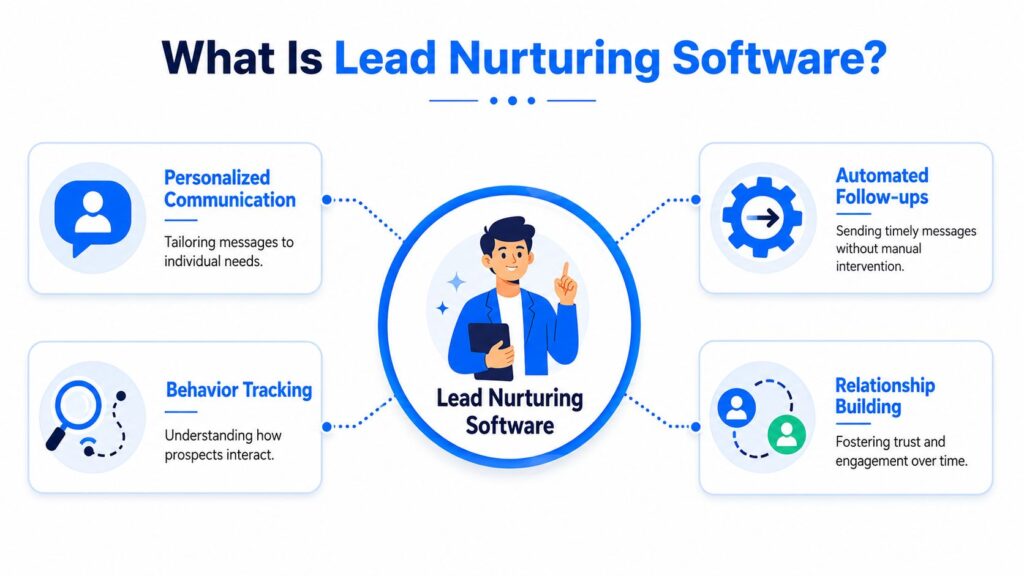
Each lead arrives with a different level of intent. One person is comparing options. Another is trying to justify the budget. Another person already asked a question in chat and just needs a fast answer to move forward. A useful platform tracks those signals and changes the path instead of forcing everyone through the same timetable.
Lead Nurturing Software Overview
It responds to intent, not just time
A basic email tool sends scheduled messages. That still has a place, especially for simple onboarding or newsletter flows. But a fixed sequence breaks down fast once leads show different levels of interest.
Lead nurturing software uses behavior, profile data, and CRM context to decide what happens next. If someone visits pricing twice, asks a product question in chat, or books a demo, the system should change the content, route the lead, or alert sales. If you need a baseline definition of scheduled email sequences, this guide to what a drip campaign is and how it works is a useful reference point. Nurturing goes further because it adapts.
That shift matters because good follow-up is rarely single-channel now. A prospect might click an email, return through a retargeting ad, ask a question in a chatbot, then respond to a sales rep in LinkedIn DMs. The software should hold that context together so the conversation feels connected instead of repetitive.
Its primary job is to guide progression
Strong nurturing reduces friction at each step. It gives leads to the next piece of information they need, at the moment they are ready for it.
In practice, that can include:
- Educational follow-up after a content download
- Qualification questions inside a chatbot or Messenger flow
- Reminder sequences tied to webinar attendance or no-show behavior
- Sales alerts when someone shows high buying intent
- Retention and expansion paths after the first purchase
I usually evaluate nurturing software with one simple question. Can it change the journey based on what the buyer just did?
If the answer is no, the tool is probably handling messaging, not nurturing. Real nurturing requires timing, channel coordination, and logic that reflects how people buy. Email still matters, but it now works alongside chat, social DMs, retargeting, rep outreach, and post-purchase follow-up. That broader channel mix is what turns a static sequence into a working revenue system.
Core Features Every Nurturing Platform Should Have
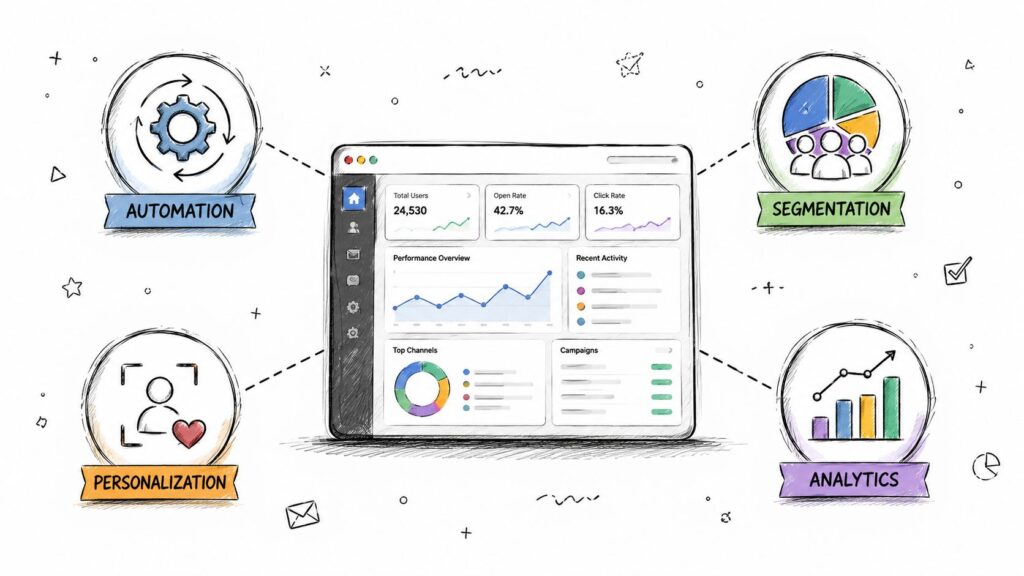
Some platforms claim to do lead nurturing because they send autoresponders. That’s not enough. The core question is whether the tool helps your team react to intent, personalize follow-up, and coordinate across channels.
Lead Nurturing Software Marketing Dashboard
The non-negotiable feature set
-
Segmentation that updates automatically
Static lists age fast. You want segments that change as people visit pages, answer questions, click offers, or move pipeline stages. Example: create a segment for people who viewed pricing but didn’t start checkout, then send a product comparison instead of a welcome email. -
Workflow automation with if-then logic
The platform should branch based on actions, not just wait periods. Example: if a trial user completes setup, send advanced onboarding. If they don’t, trigger a help message and route them to support. -
Multi-channel messaging
Email still matters, but the software should also support conversational channels like website chat, Messenger, WhatsApp, or Instagram DM when those fit your business. Example: if a shopper abandons checkout after asking a product question in chat, continue the conversation in the same channel. -
Lead scoring or intent signals
Sales need a way to separate casual readers from active buyers. Example: increase priority when someone attends a webinar, revisits the pricing page, and replies to a nurture message. -
CRM sync and handoff rules
Marketing and sales shouldn’t work from different realities. Example: when a lead becomes sales-qualified, stop promotional nurture and create a rep task with context from prior interactions. -
Analytics tied to journey steps
You need more than opens and clicks. Example: compare how leads from a webinar follow-up path convert versus leads from a demo-request path.
One tactical area many teams overlook is the structure of the sequence itself. If you want a useful refresher on how message timing and progression work, this guide to a drip campaign framework is a good reference point.
Why email still matters, and where it falls short alone
Email remains the dominant channel in many nurture programs. Verified data shows 78% of marketers prefer it as the primary way to build professional connections, and automated sequences see an average 43.46% open rate and 2.09% click rate in 2025 benchmarks. The same dataset notes that 51% of marketers now use AI in lead nurturing, with adopters seeing a documented 63% increase in conversion rates.
Those numbers explain why email stays central. They don’t justify making it your whole strategy.
A lead might ignore three emails and still convert through a chatbot, a DM reply, or a sales follow-up triggered by site activity. That’s why the best platforms treat email as one lane in a larger journey.
A short walkthrough helps if you’re comparing platform capabilities in practice:
From Theory to Revenue: Concrete Use Cases and KPIs
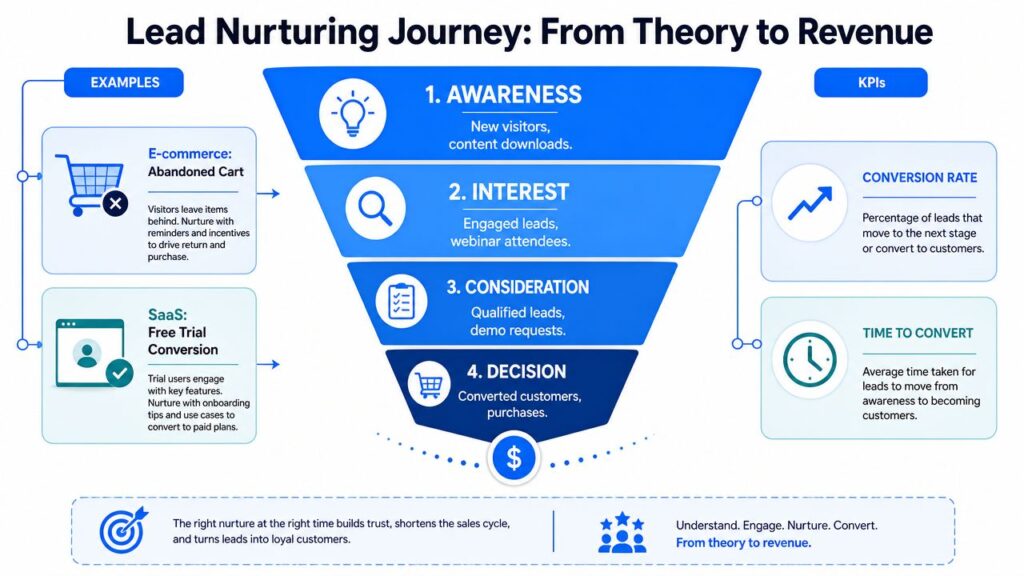
The fastest way to understand lead nurturing software is to look at what it does when there’s money on the line. Different businesses use different channels, but the pattern is consistent. A lead shows intent, the system responds with the next useful interaction, and the team measures movement toward revenue.
Lead Nurturing Software Lead Funnel
E-commerce with abandoned cart recovery
A shopper browses, adds products to the cart, asks a sizing question in chat, then leaves. An email-only setup sends a reminder hours later. A stronger nurture setup keeps the context intact. It sends the standard cart email, but it also follows up through the conversational channel where the question happened and routes common objections into a short decision flow.
The KPI mix is straightforward:
- Conversion rate from abandoned cart to completed purchase
- Time to convert after abandonment
- Reply rate on support or sales-assist messages
Nurturing becomes a revenue system, not merely a reminder tool. Companies that excel at lead nurturing software strategies generate 50% more sales-ready leads and reduce cost per lead by 33%. The same verified data says more than 71% of leaders see warmer, sales-ready leads as the primary benefit.
SaaS with webinar and trial qualification
A B2B SaaS company runs webinars and free trials. Some registrants attend live and ask detailed questions. Others watch part of the session and disappear. Treating both groups the same wastes momentum.
A better path splits follow-up by behavior. Attendees who ask product-fit questions get a demo-oriented path. No-shows get a replay and a lower-friction next step. Trial users then move into different sequences depending on whether they activated key features, stalled in setup, or invited teammates.
The KPI that matters most often isn’t top-of-funnel volume. It’s whether the nurture path shortens the distance between initial interest and a qualified sales conversation.
Useful KPIs here include:
- Demo booking rate
- Sales cycle length
- Trial-to-paid conversion
- Pipeline stage progression
If you want to measure these flows with more discipline, this breakdown of email marketing KPIs to track helps connect campaign metrics to business outcomes.
High-ticket services with long consideration windows
Consultants, agencies, coaches, and service firms rarely close on the first interaction. Leads compare options, ask for proof, pause, come back, and often need multiple touches before they’re ready to talk.
That makes nurturing especially valuable. A service business can build a long-cycle path that mixes educational emails, case-example content, FAQ follow-up, conversational check-ins, and booking prompts tied to return visits or repeat engagement.
The KPIs are different from e-commerce:
| KPI | Why it matters |
|---|---|
| Booked consultations | Shows whether nurture creates real sales conversations |
| Lead-to-opportunity rate | Measures qualification quality |
| Average time to inquiry response | Protects momentum in high-consideration sales |
| Close rate by nurture path | Reveals which sequence creates better-fit buyers |
White papers and webinars can play a meaningful role here, too. In the verified dataset, white papers are 83% effective in nurturing leads, while webinars reach a 63% success rate. That’s a strong reminder to match content format to buying complexity.
How to Choose the Right Lead Nurturing Software
Organizations often buy lead nurturing software by comparing feature grids. That’s a mistake. A long checklist doesn’t tell you whether the tool fits your motion, your team, or your customers’ preferred channels.
Start with a simple question. Where do your best leads continue the conversation after the first touch?
If the answer is “mostly email,” then a traditional automation platform may cover a lot. If the answer includes website chat, social DMs, rep outreach, retargeting, and post-demo follow-up, then an email-centric tool will leave gaps you’ll feel every day.
What matters in practice
The first filter is channel fit. Many platforms still treat nurturing as a scheduled email with a few add-ons. That’s too narrow for businesses where buyers ask questions in chat, reply on Instagram, or expect near-immediate answers after browsing high-intent pages. Omnichannel capability matters because behavior is fragmented. Your software should follow that behavior instead of forcing everything back into one inbox.
The second filter is workflow depth. Look for branching logic, stage-aware journeys, and event-based triggers. If the builder can’t easily express “if this happens, move the lead here and notify this team,” you’ll end up with blunt sequences that create noise.
The third filter is operational readiness for AI-assisted nurturing. Plenty of tools now offer summarization, message suggestions, and automated responses. That’s useful only if the platform also helps your team control risk and quality. Guidance summarized in the verified data points to practical safeguards such as consent practices, preference centers, frequency controls, and journey-stage diagnostics. Those aren’t nice extras. They keep automation from becoming spam, misrouting, or compliance trouble.
The hard part with AI in nurturing isn’t sending more messages. It’s making sure the right message goes to the right person at the right moment, with clear limits and clean data.
Evaluation checklist
| Evaluation Criteria | What to Look For | Why It Matters |
|---|---|---|
| Channel coverage | Email plus chat, DMs, and other customer-facing touchpoints | Buyers don’t stay in one channel |
| Journey builder | Visual workflows with branching, conditions, and stage logic | Simple linear drips break on real buying behavior |
| CRM integration | Two-way sync for contact fields, stages, owners, and activity history | Sales needs context, not disconnected alerts |
| Ease of use | No-code or low-code setup for marketers, with room for advanced logic | Complex tools often stall after purchase |
| AI controls | Approval rules, message review, guardrails, and diagnostics | Automation quality matters as much as automation speed |
| Segmentation model | Dynamic audiences based on events and attributes | Better targeting lowers wasted follow-up |
| Reporting | Journey-level performance, handoff visibility, and channel comparisons | You need to know which path drives revenue |
| Scalability | Can support more brands, products, journeys, and team roles over time | Replatforming is expensive and distracting |
A useful buying rule
Don’t buy for the campaign you’re running this month. Buy for the handoffs you need all year.
A platform limited to email may be enough for a newsletter-led motion. It won’t be enough for brands and sales teams that rely on live questions, social conversations, and fast qualification. In 2026, the difference between average nurturing and effective nurturing is often whether the software can support those conversational moments without duct-taping five tools together.
Implementation and Integrating Your Tech Stack
A lead fills out a form, asks a pricing question in chat, then messages your brand on Instagram two days later. If those actions land in three different tools with no shared context, nurturing breaks before the second touch. This is one of the most common failure points in lead nurturing strategies, and it’s fixable before you add any new lead generation activity.
Implementation works better when the first decision is operational, not technical. Choose one journey that already affects pipeline or revenue, then connect only the systems needed to run that journey well. The right lead nurturing tool ties these touchpoints together so marketing automation can carry the conversation forward without your team manually stitching context between platforms.
Good starting points for your best lead nurturing campaigns include abandoned cart recovery, demo follow-up, webinar qualification, and trial onboarding. Each has a clear trigger, a clear next step, and a clear owner — which makes them easier to build, measure, and hand off across your stack.
Start with one event and one handoff
The best first rollout is event-based. A lead does something. The system responds in the right channel. If intent rises, ownership shifts to sales or support with the full interaction history attached.
That sounds simple. The setup is where teams usually get stuck.
-
Define the starting event
Pick one behavior that signals interest, such as a form fill, cart abandonment, chatbot opt-in, webinar signup, or pricing-page conversation. -
Map the path changes
Decide which actions should reroute the journey. Replies, bookings, page revisits, product views, and pipeline stage changes are more useful than vanity engagement. -
Create the minimum message set
Build the first sequence with only what the journey needs. One primary path, one fallback branch, and one human handoff alert is enough to launch. -
Set channel rules
Decide where each step belongs. Email may handle recap and education. Chat and social DMs may handle qualification, objections, and short back-and-forth questions faster. -
Check the sync before launch
Confirm that fields, tags, owners, stages, and conversation history move cleanly between systems. A broken sync creates duplicate follow-up, missed alerts, and bad reporting.
Lead Nurturing Software Chatbot Marketing
Connect channels around the customer, not around your org chart
Email platforms, CRMs, chat tools, ad platforms, and support systems often get set up by different teams at different times. That history creates friction. The fix is to make the nurture layer responsible for context transfer across channels.
For conversational flows, that usually means capturing intent in chat or social, qualifying it with a few short exchanges, and pushing that context into the CRM before a rep reaches out. A tool like Clepher’s CRM and ticketing setup fits that model when the first meaningful interaction happens in chat rather than in an inbox. The value is not just automation. It is giving sales and support the full thread, not a cold notification that says someone converted.
Ecommerce stacks add another layer. Cart events, order status, customer records, support tickets, and post-purchase messaging need to stay aligned or the nurture logic gets messy fast. This guide on how to streamline Shopify operations with integrations is useful if you need to map those dependencies before building automations on top of them.
Start smaller than you want to.
One event, one journey, and one integration that removes a real bottleneck is enough for a first launch. Teams get better results from a clean handoff model and reliable data flow than from an ambitious workflow that touches every channel but breaks in production.
Your Path to Automated Growth
Lead nurturing software works when it stops acting like a scheduler and starts acting like a system for timely, relevant conversations. That’s the shift that matters now. Buyers don’t move in straight lines, and they don’t limit themselves to one channel. The best lead nurturing software reflects that reality by reacting to behavior across the full sales funnel, not just sending the next email in a sequence.
The practical takeaway is simple. Move beyond basic email drips. Build journeys that react to behavior, support handoffs across the sales process, and continue the conversation where the lead is already active. For many teams, a strong lead nurturing program means adding chat, social DMs, and other conversational touchpoints to the nurture mix instead of treating them as separate projects.
You don’t need a massive rollout to get value. Start by mapping just one journey. Pick a high-intent moment, define the trigger, decide what should happen next, and connect the data so the lead never falls into a gap between tools or teams. The goal is to automate lead nurturing in a way that feels responsive rather than robotic.
That’s how lukewarm leads become ready-to-buy customers. Not through more messages, but through better-timed ones.
If your funnel already depends on website chat, Messenger, WhatsApp, or Instagram conversations, Clepher is worth exploring as a practical way to build no-code conversational nurture flows, capture leads, and route them into the rest of your stack without relying on email alone.
Related Posts
Customer Journey Automation: The Practical Guide
October 10, 2026Lead Qualification Marketing: A Practical 2026 Guide
October 9, 2026Customer Experience Optimization Playbook
October 8, 2026
Founder Clepher