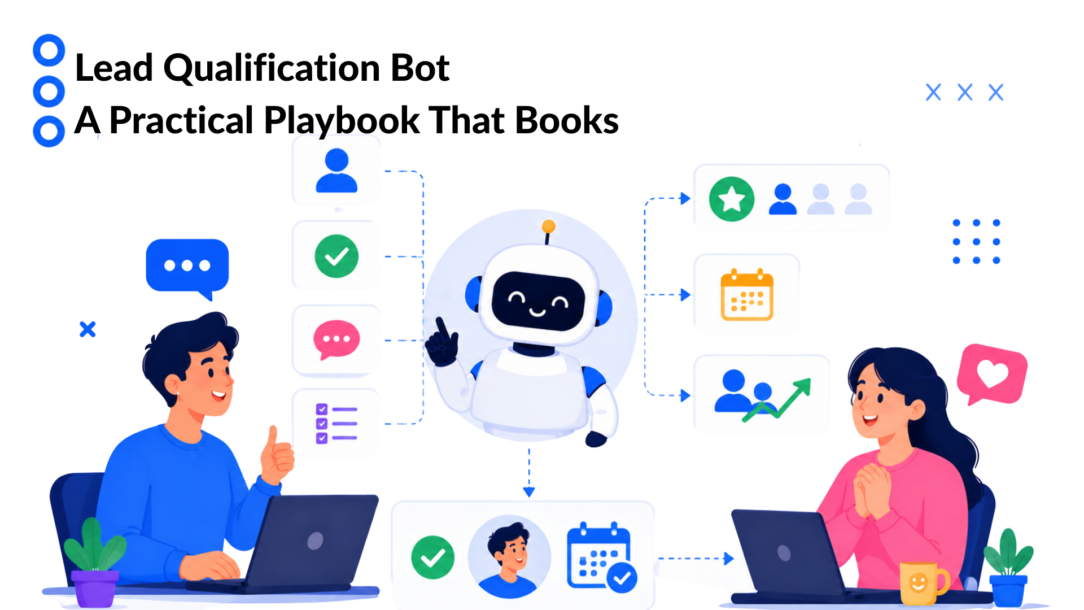
A lead qualification bot can turn a missed midnight conversation into a routed sales opportunity in minutes. That matters because teams that contact a lead within 5 minutes are 21 times more likely to qualify it than teams waiting 30 minutes, while companies attempting contact within an hour are nearly 7 times as likely to qualify a lead as those waiting 60 minutes, according to Rework’s lead response research.
For growth teams, the challenge isn’t just collecting more names. It’s deciding who should receive a product recommendation, who belongs in nurture, and who deserves a human response now. This playbook treats the bot as a practical scoring and segmentation system, not a BANT questionnaire wearing a chat bubble.
Why a Lead Qualification Bot Earns Its Place in 2026
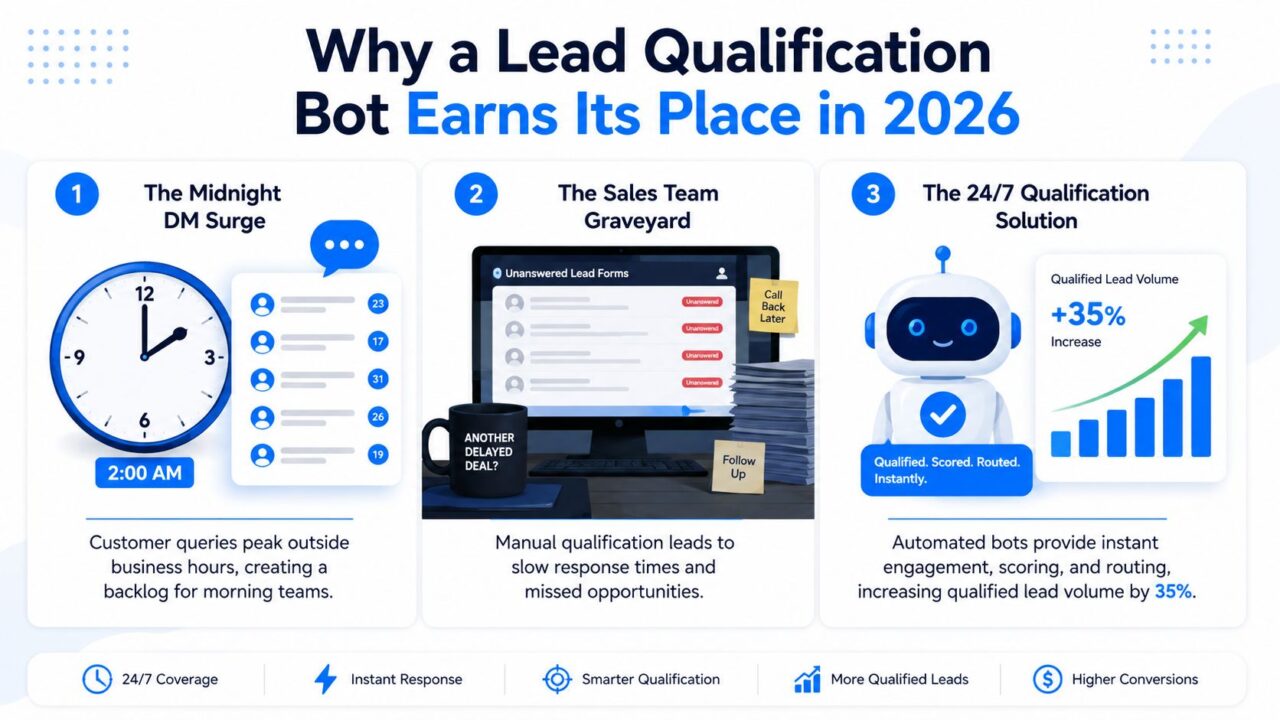
At 2 AM, a Shopify skincare brand’s Instagram inbox can fill with questions about sensitive-skin routines, delivery timing, bundle discounts, and whether a product is suitable for a specific concern. By morning, the sales team sees a graveyard of half-answered DMs. The brand hasn’t suffered from a customer service failure alone. It has a speed-to-lead problem and a routing problem at the same time.
The operational gap is substantial. A 2026 benchmark summary from Aloware’s lead response analysis reports that the median B2B team takes 42 hours to respond to an inbound lead, and only about 7% respond within five minutes. The same summary reports conversion of roughly 21% for five-minute responders versus 2.3% For teams waiting a day, consider implementing an AI chatbot for follow-up.
Lead Qualification Bot Infographic
A bot doesn’t need to pretend it’s a skincare consultant or replace a sales rep. Its job is narrower and more useful:
- Capture intent: Ask what the visitor wants before the conversation disappears.
- Score fit: Separate product curiosity, purchase readiness, and high-value opportunities.
- Route intelligently: Send a booking link, a relevant answer, a nurture sequence, or a human handoff through an AI-powered lead generation chatbot.
The same principle applies to agencies, coaches, SaaS teams, and local businesses. A visitor who arrives through an ad, comments on an Instagram post, or clicks to WhatsApp shouldn’t have to wait for office hours before giving the business enough context to respond properly.
Practical rule: Automate the first useful response, not the entire relationship.
A well-designed Implementing a conversational AI workflow for sales can significantly boost conversion rates. acts as a 24/7 front door. It welcomes prospects, asks only the questions that affect the next action, stores the answers, and alerts a person when nuance matters. The result isn’t automation for its own sake. It’s a funnel that stops treating every visitor as either a form submission or a sales-ready opportunity.
What a Qualification Bot Actually Does Inside Your Funnel
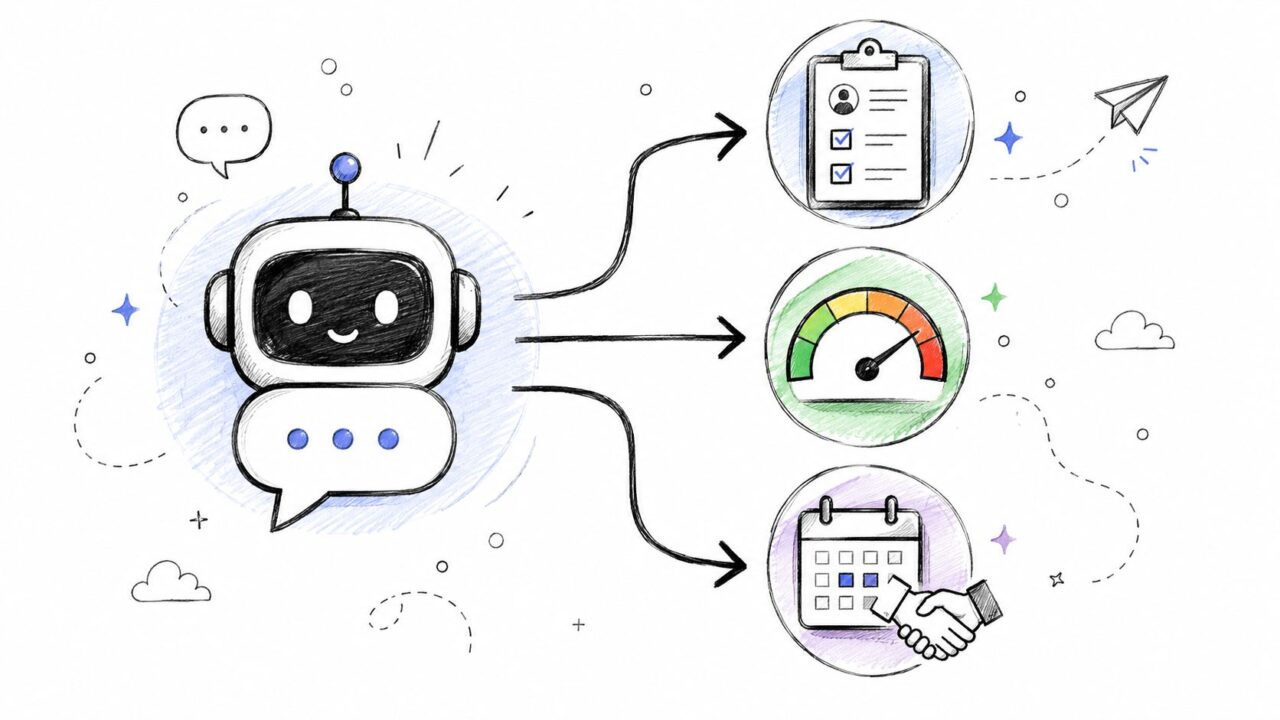
A lead qualification bot performs three distinct jobs: capture, scoring, and handoff. Confusing those jobs creates bloated flows. Separating them makes the funnel easier to build, measure, and improve.
Lead Qualification Bot Chatbot Automation
Capture starts the conversation
Capture is the entry layer for an agency serving multiple DTC clients; that might mean an Instagram comment trigger for a product launch, a website widget on a high-intent service page, an ad that opens Messenger, or a click-to-WhatsApp campaign.
The opening should acknowledge the context. Someone clicking an ad for a skin consultation shouldn’t receive the same greeting as someone asking about shipping; a lead generation chatbot can personalize this interaction. Use the source, campaign, product, or page to create a relevant first question.
Scoring turns answers into decisions
Scoring gives the bot a way to distinguish a browser from a buyer. The bot may collect budget, use case, timeline, company size, or product interest, but those answers only matter when they change the route.
For an agency lead, “We need paid social management this quarter” should carry more weight than “I’m researching marketing options.” For a skincare shopper, a large basket, a clear product concern, and a request for help choosing a routine may justify a stylist handoff. The score is not a verdict on the person. It’s an operational signal.
Teams designing conversion-focused websites can also review HubSpot’s tools for improving conversion rates. Quarter Digital’s guide to skyrocketing conversions with Webflow for broader ideas about combining interactive experiences with conversion paths.
Handoff closes the loop
Handoff is where many bots fail. A high score should open a calendar or notify a rep. A warm score may start a nurture sequence. A low-fit visitor should receive a useful self-serve path, not an awkward request to book a call.
The funnel stages map cleanly:
- Awareness: Capture the visitor’s source and broad intent.
- Consideration: Ask the minimum questions needed to segment the opportunity.
- Decision: Offer the right next step, human contact, booking, checkout, or education.
An AI-powered system should make that decision for a practical chatbot for lead generation explicit. If every branch ends with “a sales representative will contact you,” the bot is collecting data without improving the funnel.
Designing the Qualification Flow Step by Step
Start with a blank canvas in a no-code builder such as Clepher, ManyChat, or another platform that supports fields, conditions, and integrations. The first version should be short enough to test in one sitting and specific enough to make a routing decision.
Lead Qualification Bot Clepher Landing Page
1. Set the greeting and expectation
For a skincare brand, open with two clear paths:
“Hi, I can help you find the right routine. Are you here to shop the sale, or would you like help from a skincare specialist?”
The buttons might be Shop the sale and Talk to a specialist. This gives the visitor control and creates an initial intent field without forcing a long intake form.
2. Ask the intent question early
Don’t begin with name, email, phone number, and company. Start with the reason for the visit:
- “What are you looking for today?”
- “Which concern are you trying to solve?”
- “Are you ready to choose a product, comparing options, or just learning?”
The answer determines which questions are relevant. Someone browsing shouldn’t see the same path as someone asking for a recommendation before checkout.
3. Qualify in a friendly order
For a service or agency flow, use a sequence like this:
- Use case: “What would you like help with?”
- Company size: “How many people are on your team?”
- Timeline: “When would you like to get started?”
- Budget: “Which range best matches what you’ve set aside?”
- Contact preference: “Would you rather book a call or receive resources from our lead generation chatbots first?”
This order earns context before requesting sensitive information. It also lets the bot abandon irrelevant questions when an answer already makes the next route obvious.
Conversational flows report 72% average completion versus 33% for static forms, visitor engagement of 10% to 18% versus 2% to 4%, and SQL rates of 38% to 52% versus 18% to 25%, according to Conferbot’s qualification benchmark. Treat those figures as directional benchmarks, not a promise for an untested flow.
4. Add fields and scoring
Create fields for intent, use case, timeline, budget, and lead score. Start the score at zero, then add points when a visitor selects an answer associated with fit or urgency. Keep the scoring visible in your builder so another marketer can audit it without reverse-engineering hidden prompts.
5. Build three result branches
- Hot: Offer the calendar, show the right booking message, and notify the assigned rep.
- Warm: Tag the lead by interest and send a short nurture sequence using Salesforce.
- Cold: Provide a useful FAQ, product finder, guide, or self-serve checkout path.
The flow is finished when every answer has a next action. A dead end is not a neutral outcome. It’s a broken funnel.
Scoring Leads and Splitting Them Into Tiers
A flow without a scoring model is just a survey, and it can be enhanced by incorporating real-time lead data. The bot needs a rule for translating answers into a decision, and the rule should reflect how the business sells.
Use a simple BANT-style structure, but don’t force all four questions on every visitor: an AI agent can streamline this process.
- Budget: “Which range best matches your current budget?”
- Authority: “Are you choosing the solution, recommending it, or researching for someone else?”
- Need: “What problem are you trying to solve?”
- Timeline: “When do you want to begin?”
Assign +30 to a hot answer, +15 to a warm answer, and +0 to a cold answer. The values aren’t universal. They’re a clear starting model that you should adjust against closed-deal outcomes.
| Question | Hot Answer (+30) | Warm Answer (+15) | Cold Answer (+0) |
|---|---|---|---|
| Budget | “We’ve approved the budget” | “We’re evaluating options” | “We don’t have budget yet” |
| Authority | “I make the decision” | “I’m part of the buying group” | “I’m gathering information” |
| Need | “We have a defined problem” | “We’re exploring a possible need” | “Just browsing” |
| Timeline | “We want to start soon” | “Later this quarter” | “No timeline” |
A practical threshold might route the highest-scoring leads to a calendar, middle-tier leads to a 14-day nurture sequence, and low-scoring leads to self-serve resources. Set those thresholds based on sales capacity and deal economics, not on a generic framework.
A DTC visitor who selects “under $100” and “just browsing” shouldn’t occupy a rep’s calendar. Send product education, a routine finder, or a relevant promotion and tag the conversation for future segmentation. An agency lead who selects “$5k monthly retainer,” identifies a specific launch need, and wants to start in Q2 should go straight to a strategist.
For service businesses that rely on qualified demand rather than broad form volume, it can help to understand PPL models for service businesses. The same principle applies inside the bot: pay attention to the definition of a qualified opportunity, not merely the number of captured contacts.
A 2024 benchmark across 42 B2B deployments reports a median chat-to-meeting conversion of 17.4% for top-quartile bots versus 4.8% for static forms, with median time to qualification of 2 minutes and 47 seconds, as reported by The Starr Conspiracy. The useful lesson isn’t to copy the benchmark. It’s to make qualification fast enough that the visitor reaches a meaningful route while intent is still present.
Stop asking questions once the route is obvious. Every additional field must earn its place by improving routing, personalization, or rep preparation.
Adapting the Bot for E-commerce, Agencies, and Coaches
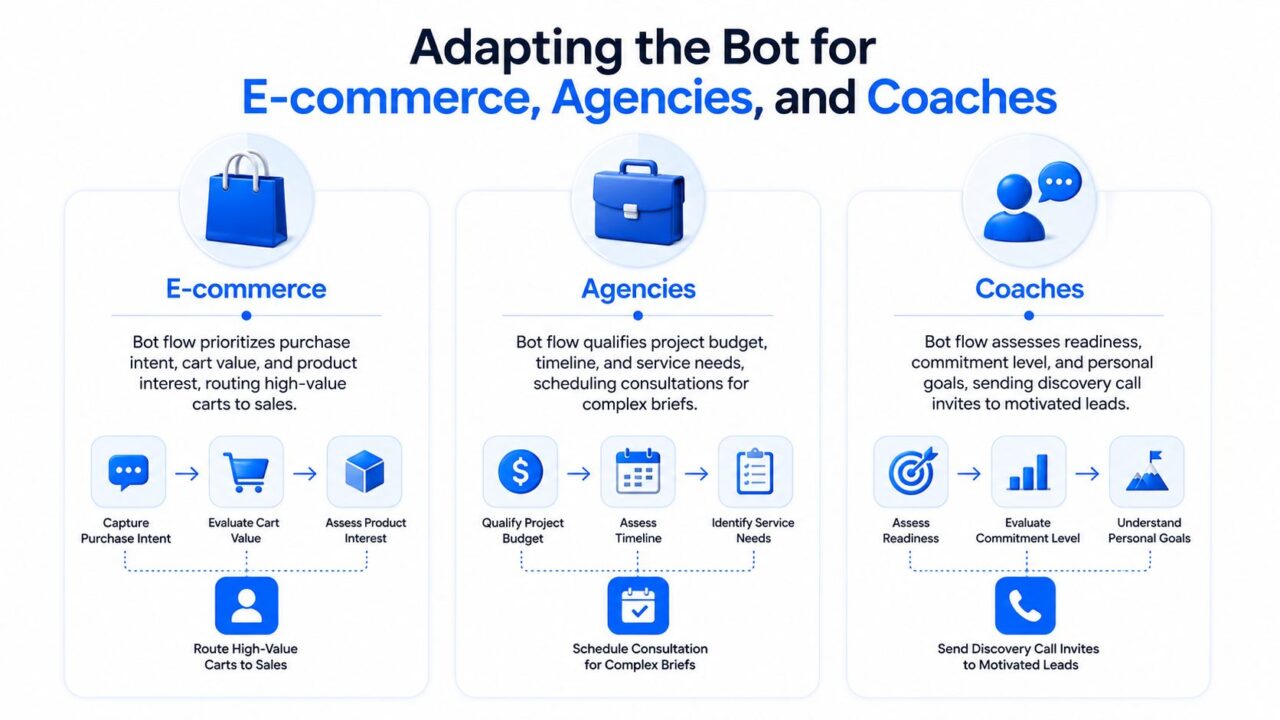
The same architecture works across business models, but the signals of value change. A skincare brand shouldn’t qualify shoppers like a marketing agency, and a coach shouldn’t use a product cataloger’s questions.
Lead Qualification Bot Strategy
DTC e-commerce
The DTC flow should prioritize immediate purchase intent and product fit. Ask:
- “Which product category are you considering?”
- “Are you shopping for yourself or someone else?”
- “Would you like a recommendation or are you ready to order?”
Use cart value, product interest, and the need for advice as segmentation signals. A high-value shopper asking a nuanced question can reach a stylist or live agent, while a routine shopper can receive a product recommendation and checkout link.
The channel matters too. Instagram Direct Message often works well for comment-triggered product conversations, while the website widget can support product discovery and cart recovery.
Marketing agencies
Agency qualification needs more context because one client’s “we need help” can represent a small project or a substantial engagement. Ask about team size, monthly ad spend, current tools, service need, and desired launch window.
An agency might route only the strongest scores to a strategist, while middle-tier opportunities receive a case study sequence or service explainer. Don’t make “book a call” the default for every lead. Complex briefs deserve human attention, but early researchers usually need evidence before a conversation.
Coaches and course creators
Coaches should qualify readiness, not just affordability. Useful questions include:
- “What outcome are you working toward with our AI-powered solutions?”
- “What have you already tried?”
- “How soon do you want support?”
- “Are you looking for self-paced material or direct coaching?”
A motivated prospect can receive a discovery-call invitation. Someone who needs foundational education can enter a mini-course or email sequence without being pushed into a sales conversation.
The scoring weight follows the business model. Order value and conversion rate matter for e-commerce, especially with the use of AI agents. Commercial fit matters for agencies, and readiness plus goal clarity matter for coaches.
AI can score leads faster than any human team, but it only gets the right answer if you tell it what a good outcome looks like for your business. Feed it clicks and it will chase clicks, so the real work is defining the signals that actually predict revenue,” said Kevin Baragona, founder of DeepAI.
Handoffs, Integrations, and the Done-for-You Template
A bot that doesn’t hand off cleanly creates more work. The human route should preserve the conversation history, the score, the answers, and the reason for escalation.
Escalate when a visitor:
- Shows hesitation: They ask whether the price is negotiable, repeat the same concern, or say they aren’t sure.
- Requests nuance: Understanding lead data can refine responses. Their question depends on personal circumstances, contract terms, or a complex implementation.
- Signals urgency: They need an answer before a launch, purchase, appointment, or deadline.
- Asks for a person: Don’t make someone argue with automation to reach support.
Connect the bot to the CRM with mapped fields for source, intent, score, segment, timeline, and conversation summary. Add a calendar integration for hot leads, and send a notification to the relevant sales channel when a booking or high-fit conversation occurs. A CRM and ticketing system can help keep the conversation and follow-up work in one operational view.
Use this agency-ready template as a starting point:
- Greeting: “What brought you here today in real-time?”
- Intent split: “Are you ready to start, comparing providers, or gathering ideas?”
- Need: “Which outcome matters most?”
- Authority: “Are you the decision-maker?”
- Budget: Present ranges that match the actual offer.
- Timeline: Ask when the project needs to begin.
- Scoring: Add points to the lead score field.
- Hot branch: Display the calendar, notify the rep, and pass the summary.
- Warm branch: Apply an industry tag and start nurture.
- Cold branch: Send a relevant resource or self-serve path.
Messaging channels need their own safeguards. A 2026 WhatsApp lead-generation analysis reports gains above 500% in lead volume, 28% conversion, and a 61% reduction in time to qualify when messaging flows replace static forms, according to CallSphere’s analysis. Those figures are tied to that analysis, not a guarantee for every channel or audience.
When a visitor moves from Instagram to WhatsApp or from chat to voice, pass the original intent and answers forward. Asking the same BANT questions again makes the business look disconnected and increases abandonment.
The Quality-vs-Quantity Trade-off and Your Weekly Bot Health Check
More captured leads don’t automatically create more revenue. A bot can fill a CRM with contacts that match a loose definition of “qualified” while making the sales team less efficient.
Some coverage reports that AI chatbots can increase qualified leads by 40% and sales conversions by 3x compared with forms. Other analysis takes a more conservative position, arguing that bots work best with explicit criteria such as budget, timeline, company size, and industry fit, while hesitation signals should trigger a human handoff, as discussed by Agentive AIQ’s analysis of chatbot qualification.
Both observations can be true. Structured answers are easy to score. Emotional uncertainty, skepticism, unusual requirements, and objections are harder to interpret reliably. A bot should identify those signals and stop trying to automate the conversation.
Run this review every week
- Check hot-tier accuracy: Compare booked meetings with actual fit and sales acceptance.
- Find the largest drop-off: Look at the exact question where visitors leave.
- Audit dead ends: Test every branch, fallback, calendar link, and notification.
- Review disqualifications: Confirm that valuable leads aren’t being excluded by a rigid answer.
- Reweight from outcomes: Change points based on closed deals and sales feedback, not intuition.
Watch chat-to-booking rate during the first week. It connects conversation quality to a concrete commercial action without pretending that every captured contact is revenue.
A focused launch sequence keeps the first test manageable:
- Day 1: Map the funnel and choose the primary channel.
- Day 2: Draft the flow and scoring rules.
- Day 3: Connect the calendar and CRM.
- Day 4: Implementing an AI chatbot can improve lead generation. Run internal tests across every branch.
- Day 5: Go live with a small traffic slice.
- Day 6: Review the first 100 conversations.
- Day 7: Tune scoring and expand to full volume.
The operating model is simple. Capture intent, score fit, segment the audience, and hand nuanced conversations to people. The bot earns its place when it helps your team spend more time on the right opportunities, not when it merely makes the inbox look active.
Clepher provides a no-code builder for conversational flows across website, Messenger, WhatsApp, and Instagram Direct Message, with AI keywords, conditions, segmentation, live chat, analytics, and native integrations for connecting qualification to follow-up. Visit Clepher to start building the first version of your lead qualification bot and test its chat-to-booking rate with real conversations.