
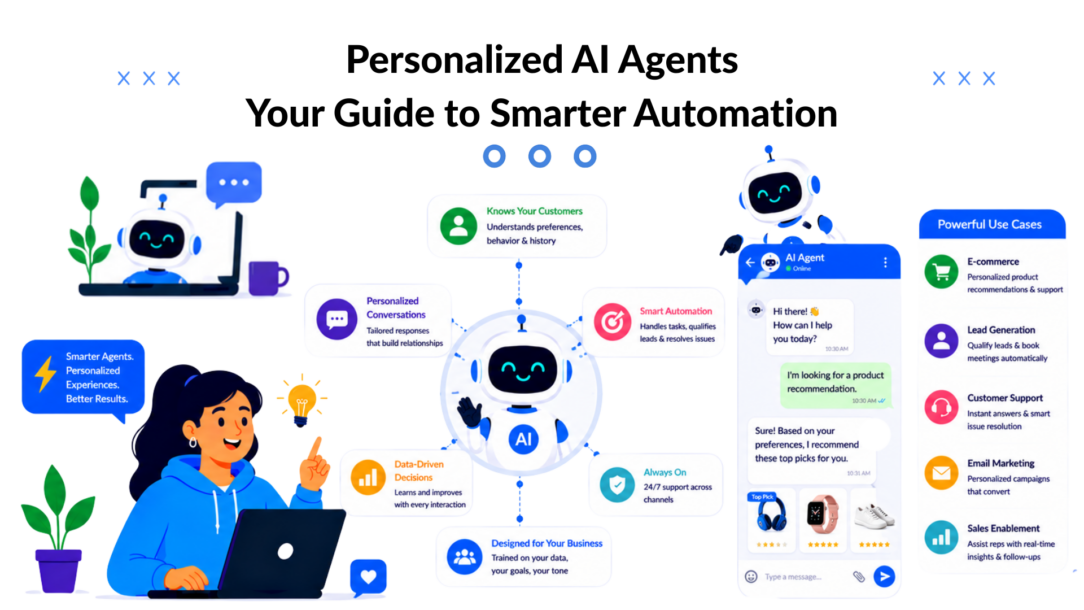
The biggest clue that personalized AI agents have moved out of the hype cycle is the market itself. The global AI agents market is projected to grow from USD 5.1 billion in 2024 to USD 47.1 billion by 2030, at a 44.8% CAGR, according to Research and Markets. That’s not a niche software category developing without notice in the background. It’s a signal that businesses are reorganizing customer interaction around automation that can understand context and take action.
The common perception of chatbots remains rooted in old terms, picturing a scripted widget that answers a few FAQs, fails on anything nuanced, and hands the mess to support. That mental model is outdated. Personalized AI agents are closer to digital operators. They can recognize intent, pull context from past behavior or live systems, tailor the reply, and move the conversation toward a business goal like lead capture, order completion, or ticket deflection.
That matters because buyers don’t separate marketing, sales, and support the way org charts do. A customer might discover a product on Instagram, ask a question on your site, hesitate on price, and return later to complete the purchase. A generic bot treats those as disconnected moments. A well-built agent treats them as one conversation.
The good news is that this isn’t reserved for companies with large engineering teams. The tooling has improved, no-code options are viable, and practical use cases are easier to start than commonly believed. If you’re trying to turn more visitors into leads, recover abandoned interest, or answer pre-purchase questions faster, personalized AI agents are already a present-day growth tool.
The New Standard in Customer Conversations
Customer conversations have changed faster than most businesses have. People expect fast answers, accurate answers, and answers that reflect what they’re trying to do. A reply that ignores browsing history, product interest, or purchase stage feels broken, even if the wording sounds polite.
That shift is why personalized AI agents matter now. They’re not just better chat interfaces. They’re systems that can adapt the conversation based on who the customer is, what they’ve done, and what the business wants to happen next. In practice, that means the same agent can answer a product question, qualify a lead, and route a support issue without forcing the user to start over.
A lot of teams are already redesigning engagement around this model. If you want a practical sense of how conversational systems fit into modern customer experience, this guide to conversational AI for customer engagement is a useful companion read.
Why the old chatbot model falls short
The old model depended on decision trees and canned answers. That worked when the main goal was deflecting repetitive questions like store hours or return policy basics. It breaks down when the user asks something situational.
A shopper asking, “Can I get this by Friday if I’m leaving for a wedding?” doesn’t want a policy page. They want a specific answer tied to shipping options, stock status, and timing. A B2B buyer asking, “Will this integrate with our current workflow?” doesn’t want a generic sales line. They want confidence that the product fits their setup.
What businesses are really buying
Businesses aren’t buying “AI” in the abstract. They’re buying faster qualification, better conversion paths, and fewer dropped conversations.
Practical rule: If your agent can’t move a conversation toward a measurable next step, it’s still just a chat interface.
The strongest implementations do three things well:
- Recognize context: They know whether the user is a first-time visitor, returning lead, or existing customer.
- Reduce friction: They answer in-channel instead of sending people hunting through pages.
- Create momentum: They suggest the next best action, such as booking a demo, checking order status, or adding a product to cart.
That’s why personalized AI agents have become a new standard. They don’t replace human teams. They handle the repeatable parts of high-value conversations so humans can focus where judgment matters most.
What Are Personalized AI Agents Really
A generic chatbot is like a public library FAQ desk. It can point you to the right aisle. It might even give a decent summary. But it doesn’t know what you’ve read before, what you usually like, or why you came in today.
A personalized AI agent is more like a personal librarian. It knows your reading history, understands what you’re asking beneath the surface, and can put the right book in your hands instead of sending you to browse shelves on your own.
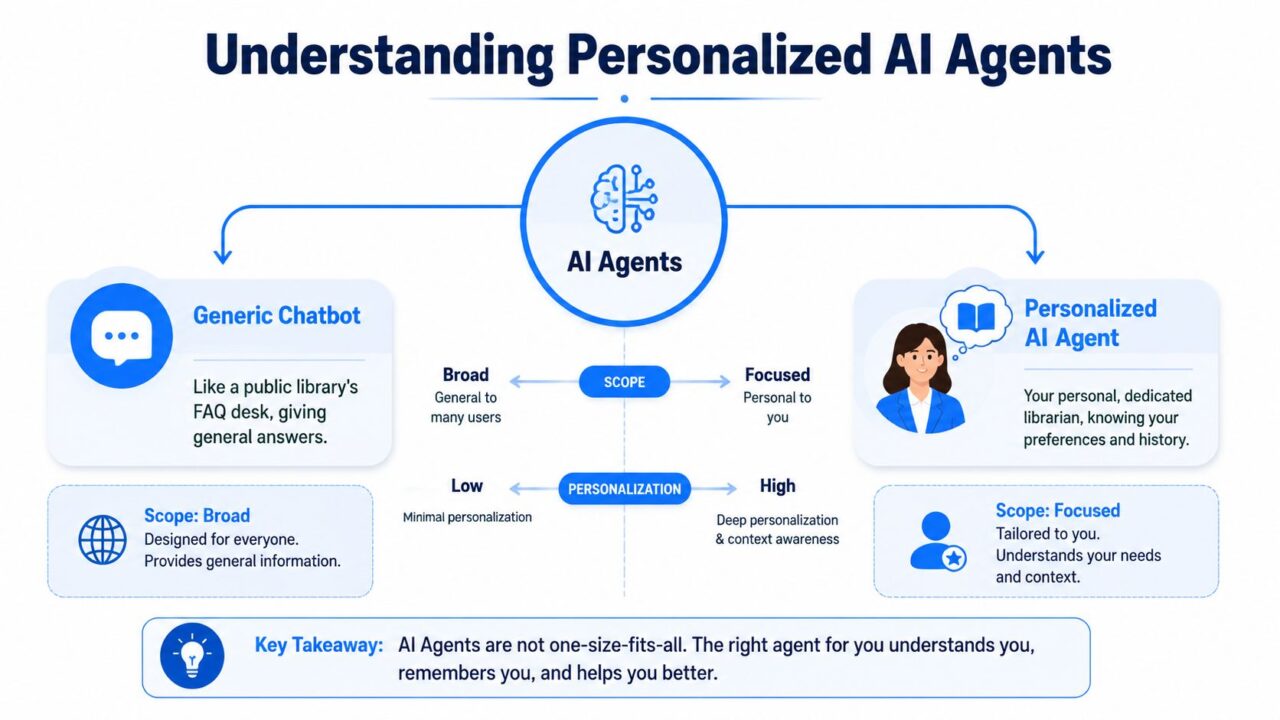
Personalized AI Agents Comparison Chart
That difference is what makes these systems useful for revenue work. They don’t just answer. They adapt. If you want a deeper primer on the broader category, what AI agents are is worth reviewing before you design one for customer-facing use.
The three parts that matter
You don’t need to drown in technical jargon to understand how personalized AI agents work. Think in terms of brain, memory, and hands.
The brain
The brain is the language model. It interprets what the person means, not just the exact words they typed. That lets the agent handle phrasing variation, messy questions, and multi-part requests much better than a rules-only bot.
A customer might type, “I’m looking for something like the black set I saw last week, but cheaper.” A simple bot struggles. An agent can infer product category, preference, and price sensitivity.
The memory
The memory is the context layer. Personalization occurs within this layer. It may include recent browsing, purchase history, support history, CRM fields, location, preferred channel, or lead source.
Without memory, the agent sounds smart but generic. With memory, it can say something useful like, “You viewed the black bundle twice. The smaller version is closer to your budget and ships sooner.”
The hands
The hands are the tools and actions the agent can use. It might search inventory, retrieve an order, apply a tag, book a call, send a link, open a ticket, or pass the conversation to a human with notes attached.
A good agent doesn’t stop at “Here’s the answer.” It continues to “Would you like me to do that for you?”
What personalization actually means
Personalization isn’t inserting a first name into a message. It’s changing the response and the next action based on relevant context.
That might look like:
- For e-commerce: Recommending products based on browsing behavior and cart intent
- For SaaS: Asking qualification questions, then routing the lead to the right demo path
- For local services: Recognizing location and offering appointment times that fit nearby availability
The weak version of personalization feels theatrical. The strong version removes work for the customer.
Where teams get it wrong
Many businesses overbuild too early. They try to make the agent do everything, across every audience, in every channel. That usually creates vague prompts, messy logic, and brittle performance.
The better approach is narrower. Pick one conversation type. Give the agent access to the right context. Let it perform a few useful actions reliably. Expand after that.
How Personalized AI Agents Understand and Act
A personalized AI agent feels smooth when the plumbing underneath is solid. To see the difference, use a simple retail question: “Will this dress arrive before my trip on Friday?”
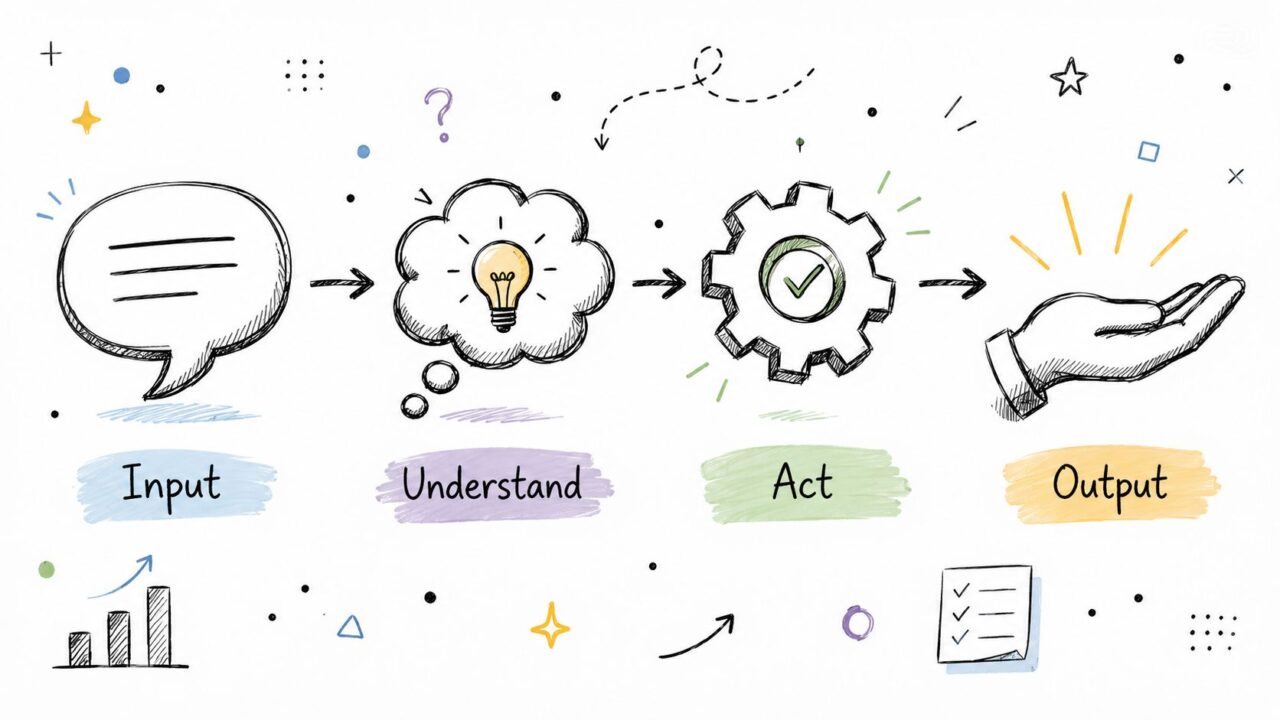
Personalized AI Agents Process Flow
A keyword bot might spot “arrive” and reply with a shipping policy. That’s technically related, but it doesn’t solve the question. A personalized agent handles the exchange more like a capable store associate. If you want to understand the language layer behind that shift, this overview of chatbot natural language processing helps connect the mechanics to the user experience.
Step one is intent, not words
The agent first works out what the person is trying to accomplish. In this case, the surface topic is shipping, but the actual intent is decision support. The customer is trying to decide whether to buy now.
That distinction matters. If the system only hears “shipping,” it gives policy. If it hears “purchase decision with deadline,” it knows speed and certainty are the core needs.
Step two is context retrieval
Once the intent is clear, the agent pulls the details it needs. That could include:
- User context: Location, prior browsing, account status
- Product context: Size availability, inventory position, fulfillment location
- Operational context: Shipping methods, cut-off times, delivery estimates
A lot of projects succeed or fail at this juncture. The model may be excellent, but if the data it can access is stale or incomplete, the answer still disappoints.
Field note: Most agent failures aren’t language failures. They’re context failures.
Step three is response generation
With context in hand, the agent can reply in a way that feels specific. It might say: yes, with express shipping it should arrive by Thursday, and standard shipping is too risky for your timeline.
That kind of answer does two jobs at once. It resolves doubt and removes the need for the shopper to compare options manually.
Step four is action
The best agents don’t leave the customer hanging after the answer. They offer the next move.
That might be:
- Cart support: “Want me to add the express option?”
- Lead progression: “Would you like to book a demo with the implementation team?”
- Support completion: “I can pull your tracking link now.”
This is the dividing line between chat and agent behavior. A chat tool talks. An agent advances the task.
What works better than rules alone
Rules still matter. They help control risk, handle edge cases, and keep the brand voice aligned. But rules alone don’t scale well across messy, real customer language.
The strongest setups combine flexible understanding with clear boundaries. The model interprets intent. The business defines what data the agent can see, what actions it can take, and when a human should step in.
That’s how personalized AI agents become reliable. Not by acting like magic, but by combining language understanding with grounded business logic.
Transforming Business with AI Agent Use Cases
Most companies don’t need another abstract explanation of AI. They need to know where it improves revenue and where it saves time. Personalized AI agents do both when they’re connected to actual workflows instead of sitting on the site as a novelty.
One useful benchmark comes from product recommendations. According to Quinnox, personalized product recommendations driven by AI agents can increase conversion rates by 20% or more. That’s a meaningful commercial result because it ties personalization directly to buying behavior, not just engagement vanity metrics.
Marketing that reacts instead of broadcasts
In marketing, the main advantage is timing plus relevance. Most campaigns are still batch-driven. Someone browses a product twice, leaves, and gets the same generic follow-up as everyone else.
A personalized agent can do better. If a shopper views a product repeatedly but doesn’t convert, the agent can trigger a message in the right channel with the right context. For a beauty brand, that might be a quick Instagram DM acknowledging the item they viewed, answering a common objection, and offering a path back to purchase. For a course creator, it might be a Messenger flow that asks what stopped them and routes them to the most relevant FAQ or offer.
The point isn’t to flood inboxes with automated nudges. It’s to create a timely conversation that feels connected to intent.
If your team handles social campaigns and community messaging, this roundup of essential AI tools for social media professionals can help map where agent workflows fit alongside content and response operations.
Marketing use cases that pull their weight
- Re-engagement: A visitor who viewed the same product multiple times gets a message specific to that product, not a broad promotion.
- Lead magnet follow-up: An agent asks one or two clarifying questions after opt-in and tags the lead based on interest.
- Audience segmentation: Instead of static lists, the system updates messaging paths based on recent behavior.
Sales that qualify while the buyer is paying attention
Sales teams lose momentum when inbound interest sits unanswered or gets routed badly. A personalized agent can start qualification the moment the prospect raises a hand.
For a SaaS company, that can mean asking about company size, use case, timeline, and current stack. For an agency, it can mean sorting leads by budget range and service need before a human ever steps in. The strongest sales agents don’t try to close every deal by themselves. They reduce dead-end conversations and send the right opportunities to the right rep with context already attached.
That shortens the path between curiosity and calendar booking. It also improves handoff quality, which is where many chat experiences fall apart.
Buyers don’t mind answering qualifying questions when the questions clearly help them get to the right next step faster.
Support that resolves common issues without dead ends
Support is where poor automation gets exposed quickly. Customers will tolerate a short wait. They won’t tolerate being trapped in a useless loop.
A good support agent handles repetitive requests cleanly. “Where is my order?” is the obvious example. Instead of sending users to a tracking page and hoping they figure it out, the agent retrieves the order status, shares the live update, and offers the next relevant option if there’s a delay.
That same pattern applies to subscription changes, appointment confirmations, return policies, and onboarding questions. The business outcome is straightforward. Human agents spend less time on repetitive work and more time on exceptions, escalations, and relationship-saving moments.
The practical takeaway
The best use cases share the same shape:
- There’s clear intent
- The needed data is available
- The next action is obvious
- The business outcome is measurable
Start there. Don’t launch with a broad promise that your agent can “handle customer conversations.” Launch with a concrete job like recovering product interest, qualifying demos, or resolving shipping questions. That’s where personalized AI agents stop being interesting and start being commercially useful.
Three Paths to Implementing Your First AI Agent
Once the use case is clear, the next question is the build path. There are generally three realistic options. The right one depends less on hype and more on your speed requirement, technical resources, and tolerance for operational complexity.
There’s real upside in getting this right. According to Tenet, organizations using AI agents report a 55% increase in operational efficiency and a 35% reduction in costs. That makes implementation choice more than a tooling decision. It affects time to value.
No-code builders
No-code is the fastest on-ramp for most businesses. Marketing teams, operators, and founders can design flows, connect data sources, and launch targeted automations without waiting for a custom product roadmap.
This path works best when the goal is to improve a known conversation journey such as lead capture, cart recovery, qualification, or common support questions. It’s especially useful when teams want to test multiple scenarios quickly and refine prompts, routing, and handoffs in production.
The trade-off is control. No-code platforms are great for speed, but they may not support every niche system or unusual workflow exactly the way an enterprise architect wants.
Custom-built solutions
Custom builds make sense when the agent needs deep internal access, highly specific business logic, or a tightly governed security setup. Large enterprises often choose this route when the agent must interact with internal systems, proprietary data environments, or regulated workflows.
The advantage is precision. The downside is time, cost, and maintenance burden. You’re not just building an agent. You’re building infrastructure, testing standards, and ownership processes around it.
Custom solutions also fail more often when teams start too broadly. If there isn’t a sharply defined business use case, the project expands into a platform initiative and stalls.
API-based integrations
This is the middle path. Teams use existing agent platforms, models, or orchestration layers and connect them to their systems through APIs. That gives more flexibility than pure no-code, without taking on the full complexity of a custom build.
It’s a solid option for companies that have some technical support but don’t want to manage the entire stack. API-based approaches are especially effective when the business already has clean systems for CRM, product data, ticketing, or booking.
AI Agent Implementation Approaches Compared
| Approach | Best For | Time to Launch | Cost | Technical Skill |
|---|---|---|---|---|
| No-code builders | Small teams, marketers, fast validation | Fast | Lower relative cost | Low |
| Custom-built solutions | Enterprises with unique workflows and internal systems | Slow | Higher relative cost | High |
| API-based integrations | Teams that want flexibility without building everything from scratch | Medium | Moderate | Medium |
How to choose without overthinking it
A simple filter helps:
- Choose no-code if you need to prove value quickly in a live customer journey.
- Choose custom if the agent’s value depends on deep proprietary integration and strict internal control.
- Choose API-based if you have a technical team and want a flexible middle ground.
Build for the conversation you need today, not the platform you might want two years from now.
What usually works best
For a first launch, speed matters more than architectural purity. You need real conversation data, real drop-off points, and real examples of where users get stuck. The fastest way to learn that is to put a narrow agent into production, monitor what happens, and improve from there.
The strongest teams treat version one as operational research. They don’t chase a perfect universal assistant. They ship a focused agent that solves one painful problem well.
Best Practices for Effective and Ethical AI Agents
An effective agent isn’t just one that replies fluently. It has to be useful, restrained, transparent, and measurable. That takes design discipline. It also takes patience, because personalization improves as the system learns from behavior over time. According to Aprimo, effective personalized AI agents rely on real-time behavioral analysis, with organizations seeing significant results after 3–6 months as the system learns from accumulated data like clicks and browsing patterns.
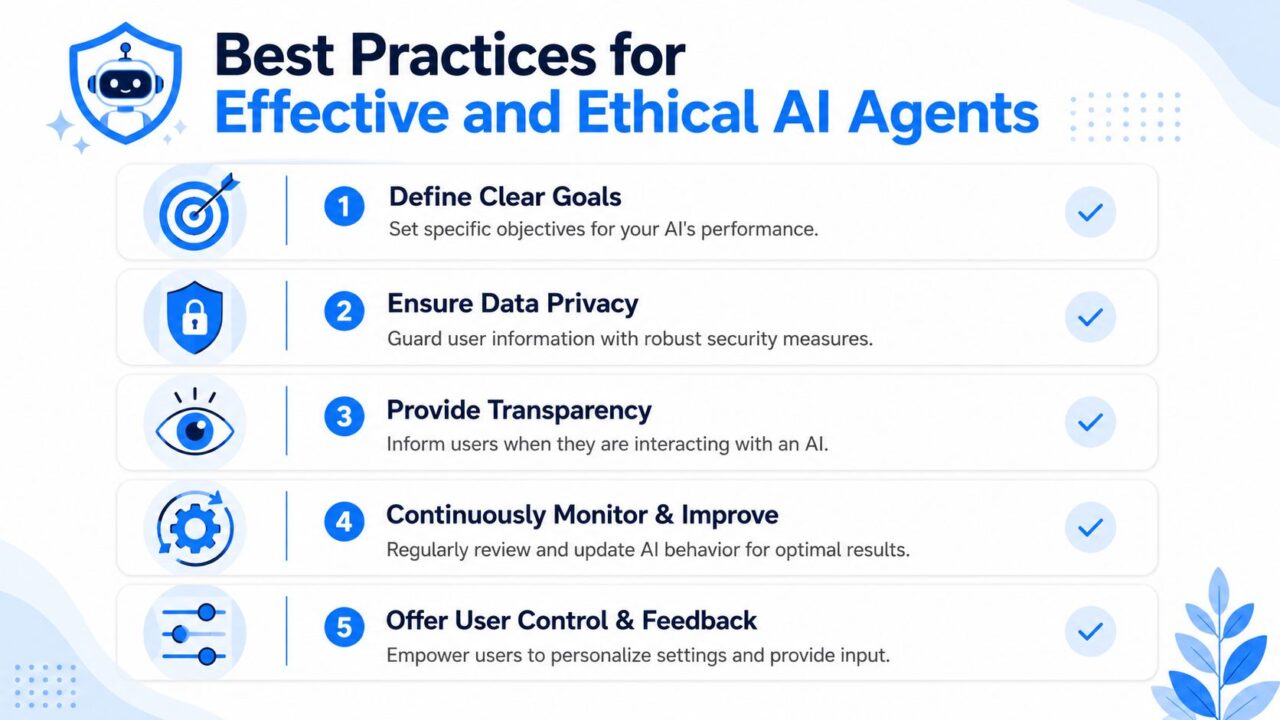
Personalized AI Agents Best Practices
That learning curve is exactly why rushed implementations often disappoint. Teams expect instant precision from weak data and vague design.
Personalization that feels helpful
Useful personalization answers a practical question faster. Creepy personalization reminds the customer that you’re watching everything.
A good test is relevance. If the context helps the person decide, solve, or move forward, it usually earns its place. If it only proves that the system knows a lot about them, it tends to backfire.
Examples of healthy personalization include:
- Product context: Recommending compatible items after someone shows clear interest in a category
- Journey context: Recognizing whether the user is still researching or ready to buy
- Service context: Offering answers based on current account status or recent support activity
Privacy and transparency that build trust
People should know when they’re talking to an AI system. They should also understand, in plain language, what the system can do and when a human can step in.
That means being explicit about boundaries. Don’t imply certainty where the system is estimating. Don’t hide escalation paths. Don’t collect more personal data than the use case requires.
Operating principle: Use enough data to be useful, not so much that the interaction feels invasive.
It also helps to limit the agent’s action rights. Reading from approved systems is one thing. Taking consequential actions without safeguards is another.
Measurement that follows business outcomes
Response speed is easy to track. It’s also a weak success metric on its own. A fast answer that doesn’t solve the problem is still a poor outcome.
Measure the agent against business goals like:
- Lead quality: Are better-fit prospects reaching sales?
- Conversion movement: Are more buyers completing high-intent journeys?
- Resolution quality: Are repetitive support requests being closed cleanly?
- Escalation health: Are human handoffs arriving with enough context to save time?
Design details that improve performance
A lot of agent quality comes from specification discipline. Addy Osmani’s review of more than 2,500 agent configuration files emphasizes six core areas for strong specs: commands, plan, model or architecture, tools, design for agent experience, and quality control in this analysis of good specs.
That sounds technical, but the practical lesson is simple. If you want reliable output, define the job clearly. Give the agent explicit actions, boundaries, and evaluation rules. Vague setup produces vague behavior.
Your First Steps to Adopting AI Agents
Most businesses don’t need a grand AI strategy document to get started. They need one strong use case and a realistic launch path. That’s enough to begin learning from live customer behavior.
The urgency is already there. According to Envive, 81% of customers prefer AI-powered self-service before contacting a human. That doesn’t mean people never want a person. It means they want quick answers first, especially when the issue is straightforward.
Start with one problem worth solving
Pick a use case with clear business value. Good starting points include pre-purchase product questions, abandoned interest recovery, top sales objections, appointment booking, or repetitive order-status requests.
The narrower the first use case, the better. You want to learn where users phrase things differently, where your data is weak, and where a human handoff should happen.
Launch small and measure honestly
The first version doesn’t need to be ambitious. It needs to be useful. Build AI agents around one conversation flow, watch the transcripts, review where it succeeds and fails, and tighten the logic.
Personalized AI Agents Chatbot Marketing
What matters most at this stage is operational feedback. Are customers getting to answers faster? Are more conversations reaching a productive next step? Is your team spending less time on repetitive exchanges?
Personalized AI agents don’t need to begin as a massive transformation project. They can start as one well-defined system that improves one high-friction conversation. Then you expand from proof, not from theory.
If you’re ready to turn customer conversations into a practical growth channel, Clepher gives teams a fast way to build and launch AI-powered chat experiences across your website, Facebook, Messenger, WhatsApp, and Instagram Direct Message. It’s a strong fit for businesses that want to go from idea to live automation without a heavy development cycle.
Related Posts
8 Promo Code Examples for Smarter Campaigns
October 20, 2026Revenue Optimization: A Practical Playbook for Growth
October 19, 202610 Lead Capture Software Tools Compared for 2026
October 18, 2026
Founder Clepher