
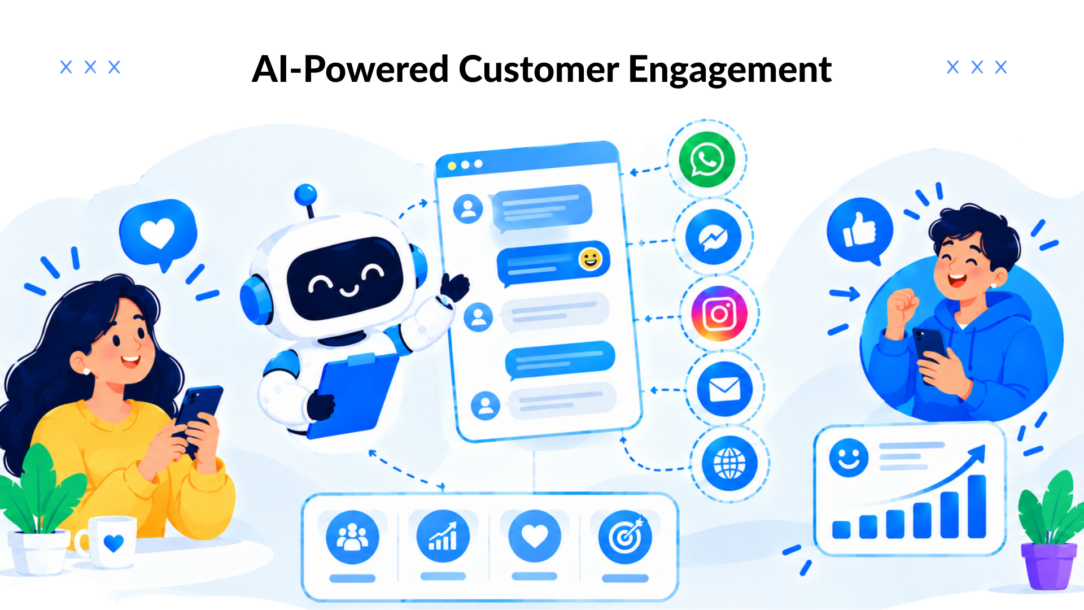
A customer sends a message on WhatsApp because a product arrived damaged. The bot replies instantly, asks for the order number, and confirms the purchase. Five minutes later, the customer switches to web chat, explains the problem again, and gets another request for the same order number. A human agent eventually joins the conversation, but starts with no useful history.
That experience captures the core challenge of AI-powered customer engagement. Customers don’t judge automation by response speed alone. They judge whether the business remembers what they said, understands what they need, and resolves the issue without creating more work.
What AI-Powered Customer Engagement Actually Is
AI-powered customer engagement is the use of artificial intelligence to manage and improve conversations with prospects and customers across channels such as websites, Messenger, WhatsApp, and social direct messages. The system interprets language, identifies intent, retrieves relevant information, responds conversationally, and passes the interaction to a human when automation reaches its limit.
The important distinction is between a reply generator and an engagement system. A reply generator answers the latest message. An engagement system connects that message to the customer’s identity, previous conversations, purchase history, preferences, and current stage in the buying or support journey.
Consider an e-commerce customer asking, “Can I change the delivery address?” A basic bot might return a generic shipping policy. A stronger system recognizes the customer, identifies the relevant order, checks whether fulfillment has started, explains what options remain, and escalates the request if an address change requires manual approval.
Practical rule: The customer shouldn’t have to understand which department, channel, or automation flow owns the problem. Your system should carry the context for them.
The four operating components
- Unified customer identity: The system associates conversations with a known profile instead of treating every message as a new interaction.
- Conversational AI: Natural-language processing helps the system interpret questions expressed in different ways, including incomplete or informal messages.
- Contextual personalization is crucial for understanding customer needs and enhancing their experience. The response reflects the customer’s product, account, prior action, or stated preference rather than relying on a one-size-fits-all script.
- Continuous learning is vital for transforming customer interactions and enhancing overall engagement. Teams review failed answers, fallback events, and escalations to improve intents, content, routing, and business rules.
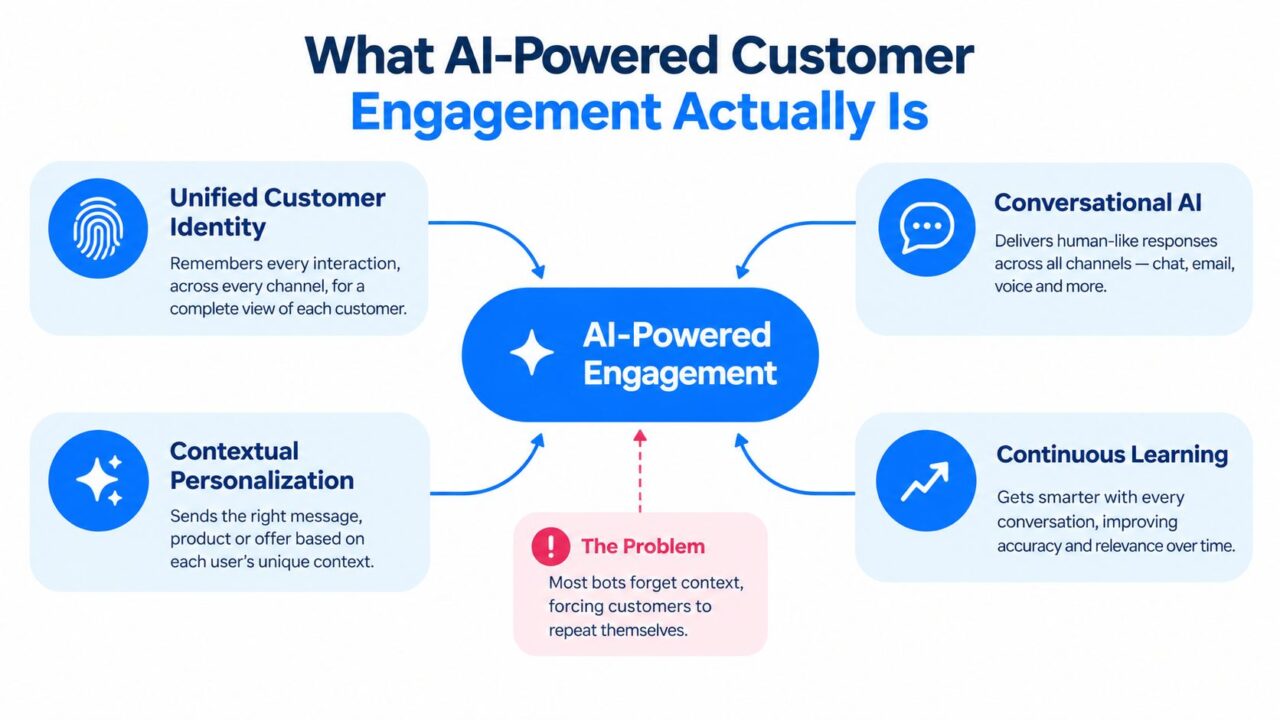
AI Powered Customer Engagement Infographic
This model turns support from a reactive queue into a hybrid relationship layer. AI handles repetitive first contact and straightforward requests, while people manage exceptions, sensitive situations, negotiation, and high-value conversations. The objective isn’t to remove human involvement. It’s to reserve human attention for the interactions where judgment and empathy matter most.
The shift is already visible in customer service operations. IBM’s reported findings on generative AI deployment state that 54% of organizations had deployed generative AI in one to four customer service use cases in 2024. Among organizations that had used conversational AI in customer service for at least three years, 89% were already using generative AI to answer customer queries directly. Organizations using generative AI also reported higher customer satisfaction on average than organizations that weren’t using it.
For teams evaluating conversational AI for customer engagement, the useful question isn’t “Can the bot talk?” It’s “Can the system move a customer from question to resolution while preserving the relationship?”
How Customers Expect Instant Answers Now
Customers increasingly begin with a question, not a phone call. They might ask about availability in a website widget, send a delivery query through WhatsApp, respond to a Messenger ad, or continue a product conversation through Instagram Direct Message. The channel changes, but the expectation remains consistent: the business should recognize the request and respond without unnecessary delay.
Twilio’s 2026 survey found that nearly 87% of organizations said customers want more self-service options, while 83% said customers want more AI-powered customer service solutions. The same Twilio research on conversational AI expectations found that 39% of consumers wouldn’t wait at all for an AI agent, compared with 88% who would wait for a human. Consumers were willing to wait up to 8.5 minutes for a human, but only 4.3 minutes for AI.
These figures point to a subtle but important distinction. Customers expect AI to be immediate because they assume software is always available. They tolerate a human delay more readily because they associate human support with judgment, effort, and the possibility of a better answer.
Speed creates the first impression
A slow bot feels broken. A fast bot that sends irrelevant answers feels careless. Both damage confidence, but the second failure is harder to repair because it creates the impression that the brand has automated the customer without actually listening.
A responsive experience should therefore do three things:
- Acknowledge the request clearly, without pretending to understand more than the system does.
- Use available context, such as the current page, previous message, order status, or account information.
- Offer a meaningful next action, whether that’s a direct answer, a guided choice, or a human handoff, to improve customer interactions.
A customer asking about a return shouldn’t receive five buttons for unrelated topics. The flow should identify the likely intent, ask only for missing information, and provide the next step in the same conversation.
Availability must follow the customer journey
Marketing, sales, and support teams often deploy separate tools for separate channels. That division may make sense internally, but customers experience it as fragmentation. A person who clicked a product ad, asked a question in Messenger, and later opened the website is still one person, not three unrelated leads.
Design the experience around customer jobs rather than channel ownership:
- Research: Answer comparison questions, explain features, and recommend the next useful resource.
- Purchase: A critical touchpoint in the customer relationship that can be enhanced through AI in customer engagement. Clarify pricing, availability, delivery, eligibility, or payment steps.
- Onboarding: Guide setup, identify blockers, and connect the customer with help.
- Support: Diagnose the issue, retrieve relevant information, and escalate with a complete summary.
- Retention: Detect dissatisfaction, provide useful follow-up, and avoid sending irrelevant promotions.
This is why automation without context creates frustration. It satisfies the internal requirement to respond, but not the customer’s requirement to make progress.
Where AI Engagement Works Best
The strongest deployment depends on the business model and the type of conversation customers already want to have. An e-commerce brand, a SaaS company, and a local service provider can all use conversational AI, but they shouldn’t build the same flow.
E-commerce
For an online retailer, the most valuable conversations often happen after the sale. Customers ask about delivery, returns, exchanges, product care, order changes, and stock availability. These questions are repetitive enough for automation, but specific enough that generic answers create friction.
A useful flow can identify the order, explain the current status, collect the reason for a return, and route exceptions to a support agent. Product recommendations can also work well when they follow an expressed need, such as recommending an alternative size after a customer reports a fit issue. That is more relevant than broadcasting the same promotion to every subscriber.
SaaS
SaaS engagement should connect conversation to activation. A new user might ask how to import data, invite a colleague, configure an integration, or understand a feature. An AI assistant can provide the relevant guide, ask what the user is trying to accomplish, and identify whether the problem is instructional, technical, or account-related, thereby transforming customer engagement.
The trade-off is accuracy. A confident but outdated answer can create more support work than no answer. SaaS teams should connect the assistant to a controlled knowledge base, show users when an answer depends on account permissions, and make escalation easy when the product state cannot be inspected automatically.
Local services
A local business usually needs fewer complex workflows, but each lead can carry more immediate commercial value. A salon, clinic, home-service provider, or fitness studio can use conversational flows to answer availability questions, capture contact details, qualify the request, and book an appointment.
The best experience feels like a helpful receptionist, not a campaign database. If someone asks about a service on Instagram, the flow should answer the question and move naturally toward booking. It shouldn’t force the person through a long form before providing basic information.
Conversational commerce is particularly useful for practical actions that enhance customer interactions. A Bain and Meta survey of users in India highlights the importance of ai in customer engagement. found that 50% of surveyed users strongly preferred to transact through conversational journeys, especially for frequent tasks such as checking bank statements, getting travel details, paying utility bills, and booking LPG cylinders, to enhance customer experience.
The common thread is convenience. AI engagement works best when the conversation removes steps from a task customers already want to complete.
Implementing AI Customer Support That Resolves Issues
A successful support bot starts with service design, not a model selection meeting. Before choosing a platform, document what customers ask, which systems contain the answer, what the bot can safely do, and when a person must take over.
Start with the operational map
Build an intent inventory from support tickets, live chat transcripts, search queries, sales questions, and social messages. Group requests by customer outcome rather than internal department. “Where is my order?” and “My delivery is late” may belong to different operational paths, even though both mention delivery.
Then establish a reliable knowledge base. Assign an owner to each answer, define how updates are approved, and remove conflicting versions of policies. The assistant can’t create trust from inconsistent source material.
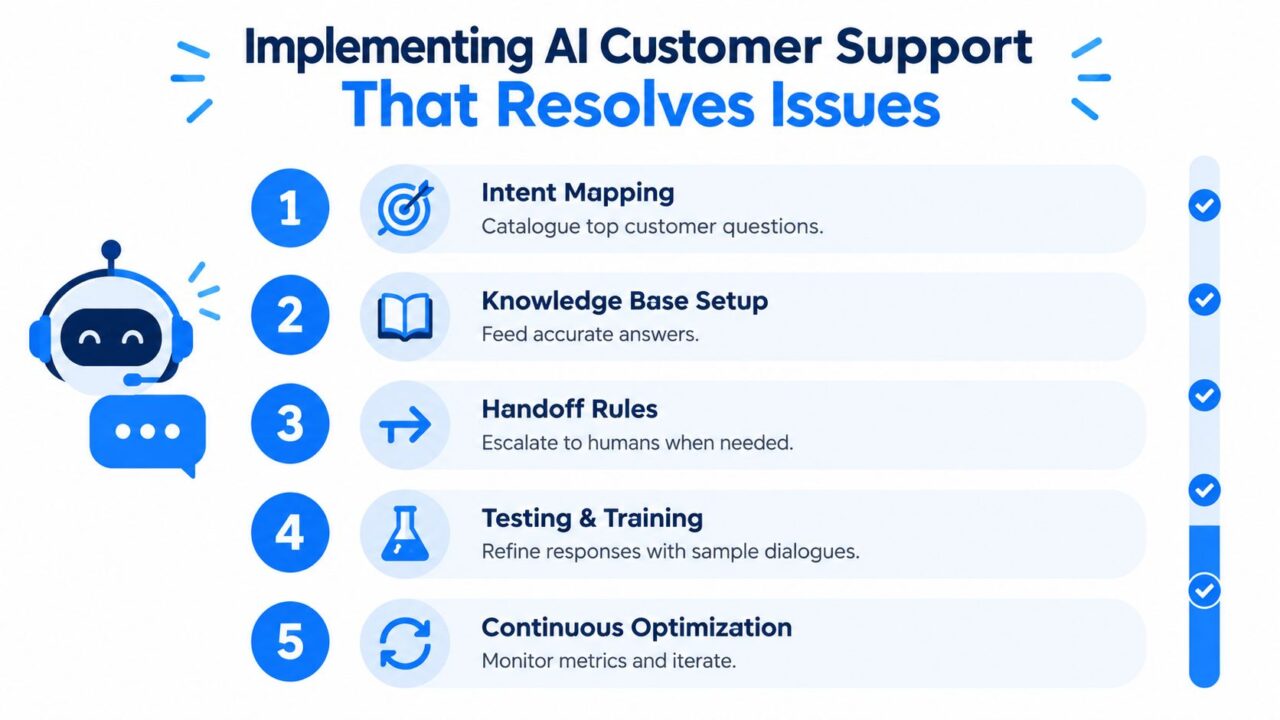
AI Powered Customer Engagement AI Implementation
Design the handoff before launch
A handoff shouldn’t restart the conversation. Pass the customer’s intent, collected details, relevant account information, attempted steps, and sentiment signals to the human agent. The agent should see a concise summary and the reason for escalation, not a blank ticket.
Create explicit rules for:
- Sensitive requests: Account security, payment disputes, personal data, and complaints may need human review.
- Low-confidence requests: Escalate when the system can’t distinguish between plausible intents.
- Repeated failure: A second fallback or repeated correction is a strong signal that the flow isn’t helping.
- Customer preference: Let people request a human without making them argue with the bot.
- Business priority: Route high-value prospects, churn risks, or urgent service issues according to defined rules.
Measure resolution, not activity
Track the metrics that explain whether the system improves the customer experience:
- Containment: The share of conversations resolved without human intervention.
- Deflection: The share of contacts moved away from a human queue, with care taken to distinguish avoidance from resolution.
- Escalation: How often the system correctly routes a conversation to a person.
- Fallback: How often the system fails to identify or answer an intent.
- Response latency: The time between a customer message and a useful response.
Chatbot analytics guidance from Langfuse recommends measuring containment, deflection, escalation, fallback, and response latency because these metrics connect directly to support quality. Low latency supports retention, while high fallback or human-takeover rates can reveal weak intent coverage or inaccurate answers. Practical guidance suggests that text responses should arrive within 1 to 3 seconds to feel responsive, especially in AI customer engagement scenarios.
Test with real customer language, including typos, incomplete questions, mixed intents, and emotional messages, to enhance customer interactions. Review failed conversations weekly. A flow isn’t finished when it launches. It’s finished when the team can explain why it failed, fix the underlying cause, and verify that the correction works across every connected channel.
Teams evaluating AI customer service automation should treat context transfer as a launch requirement, not a future enhancement.
The Hidden Challenge of Trust and Context Continuity
A customer starts with a question in Messenger, shares an order number, and explains what has already gone wrong. After switching to web chat, the first request is for the same order number. The response may arrive quickly, yet the experience feels careless because the customer has to rebuild the conversation.
Continuity earns trust. A short delay is often acceptable when the next agent or channel already knows the order, troubleshooting steps, and desired outcome. Fast replies that ignore previous context create more work and make the business appear disconnected.
Recent research found that only 7% of customers rarely or never have to repeat themselves when switching channels, while 68% say complete resolution matters more than speed. The same research found that 75% report a fast AI response that still left them frustrated, according to research on frustration with AI customer service.
These findings change how teams should interpret engagement results. A high deflection rate can hide abandoned conversations, repeat contacts, or public complaints. A lower containment rate may reflect a healthier system when the assistant recognizes uncertainty and transfers the issue to an informed agent.
Build a continuity layer
A transcript alone does not give the next channel or agent usable context. Preserve structured facts such as:
- The customer’s identity and consent status.
- The original reason for contact.
- Products, orders, subscriptions, or appointments involved.
- Information the customer has already provided.
- Actions the system has already taken.
- The desired resolution and any unresolved constraints must be understood to improve customer relationship management.
Use a shared conversation ID or customer record across channels where consent and integration rules allow it. Teams can learn how a context-awareness layer preserves structured facts across channels before designing the handoff. If a customer moves from Messenger to web chat, the second channel should receive a useful summary or request a secure handoff, rather than ask the customer to start again.
A transcript tells an agent what was said. A context record tells the agent what matters.
Treat trust as a design constraint
Personalization helps when it reduces effort, but it can feel intrusive when the business reveals information the customer did not expect it to have. Use customer data to improve the task, explain why a question is necessary, collect only what the workflow requires, and provide a clear route to a human.
Data readiness remains a practical barrier. Adobe’s 2026 customer engagement research found that only 44% of organizations said their data quality and accessibility were adequate for AI, while roughly half said data unification and structure limited their ability to advance AI initiatives. The same research states that 58% of consumers were only somewhat or not at all comfortable using AI tools to engage with brands.
Trust controls should include clear disclosure when a customer is speaking with AI, permission-aware data access, retention rules, human review for sensitive cases, and testing for biased or unsafe outcomes. The system should make fewer promises and deliver more complete resolutions.
How Clepher Can Centralize Your Engagement Efforts
A unified engagement setup connects marketing, sales, and support around the same customer conversation. Instead of running an isolated website bot, a separate Messenger flow, and disconnected Instagram campaigns, teams can design journeys that preserve audience information and route people toward the next appropriate action.
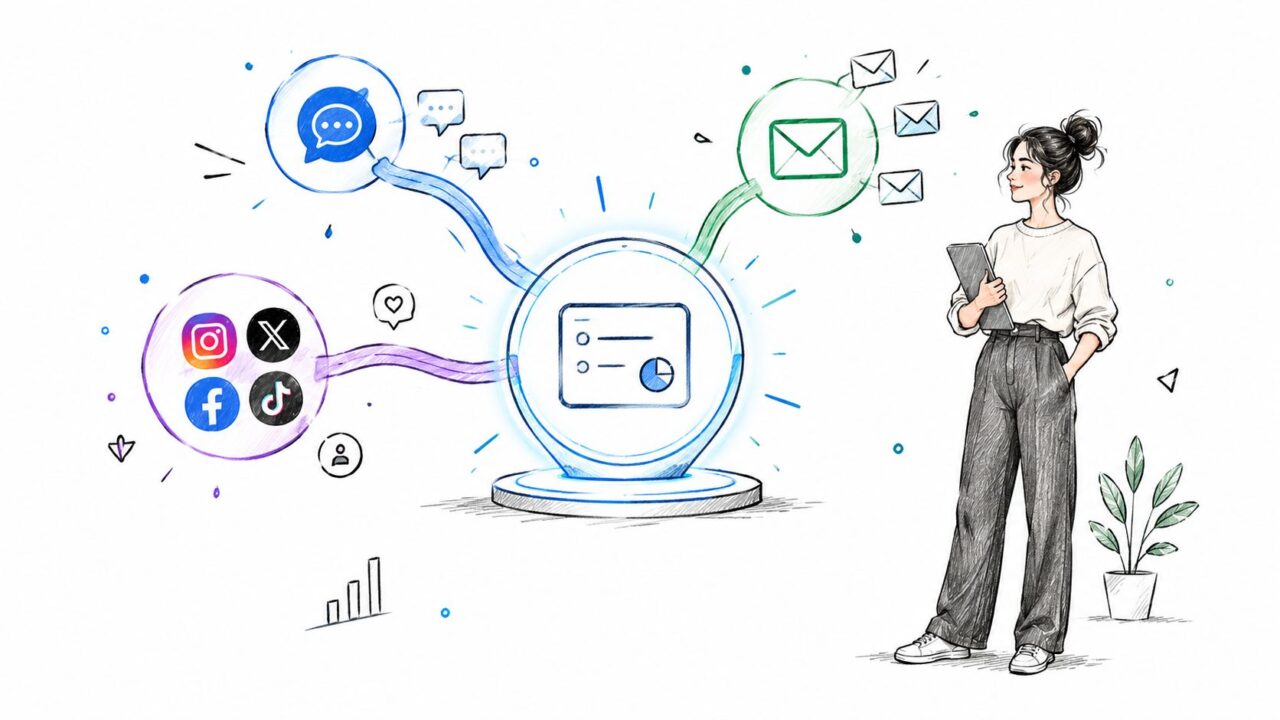
AI Powered Customer Engagement Marketing Automation
Clepher provides a no-code builder for conversational flows across websites, Facebook, Messenger, WhatsApp, and Instagram Direct Message. Teams can use drag-and-drop logic to build lead capture, qualification, onboarding, support, promotional, and recovery journeys without asking developers to hard-code every branch.
The useful strategic feature is centralization. Segments, tags, conditions, personalization fields, personas, live chat, and analytics can support different experiences for new visitors, existing customers, abandoned prospects, and people requesting help. A retailer might send a product recommendation after a customer asks about fit. A course creator might guide a subscriber toward the right lesson. A local provider might capture an appointment request from a social conversation and pass the details into its wider workflow.
The platform also supports A/B testing, random path distribution, typing indicators, GDPR tools, and connections to email and SMS workflows through integrations. Those capabilities matter only when they serve a clear customer outcome. Testing a welcome message is useful. Testing a complex escalation flow without reviewing whether the customer reached resolution isn’t.
A practical rollout starts with one high-volume intent, one supported channel, and one defined handoff. Measure where customers abandon the flow, which questions trigger fallback, and whether agents receive enough context to continue naturally. Expand only after the first workflow demonstrates reliable resolution.
The next layer is coordinated nurturing and measurement. AI agents can help qualify leads, answer routine questions, recover interrupted purchases, and keep conversations moving, while human teams retain ownership of sensitive or commercially important interactions.
The right platform won’t compensate for fragmented data, weak escalation rules, or an unmaintained knowledge base. It can, however, give your team one operating environment for building, testing, measuring, and improving conversations across the channels customers already use.
Clepher gives businesses no-code tools to build AI-assisted conversations, capture and qualify leads, support customers, and coordinate messaging across web chat, Messenger, WhatsApp, and Instagram. Visit Clepher to centralize your engagement workflows and start with one customer journey where better context can produce a more complete resolution.
