
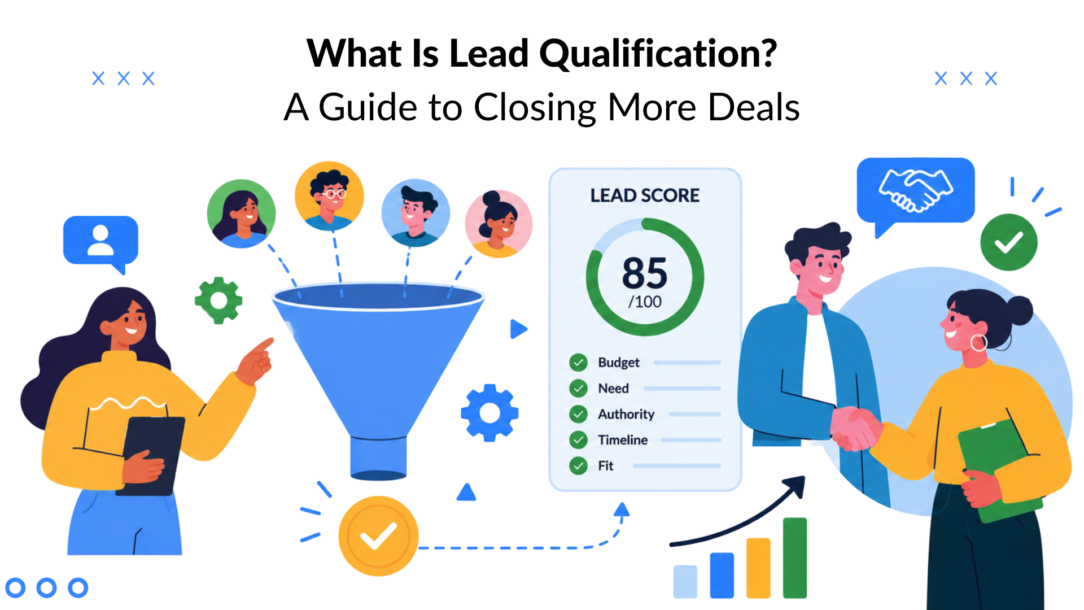
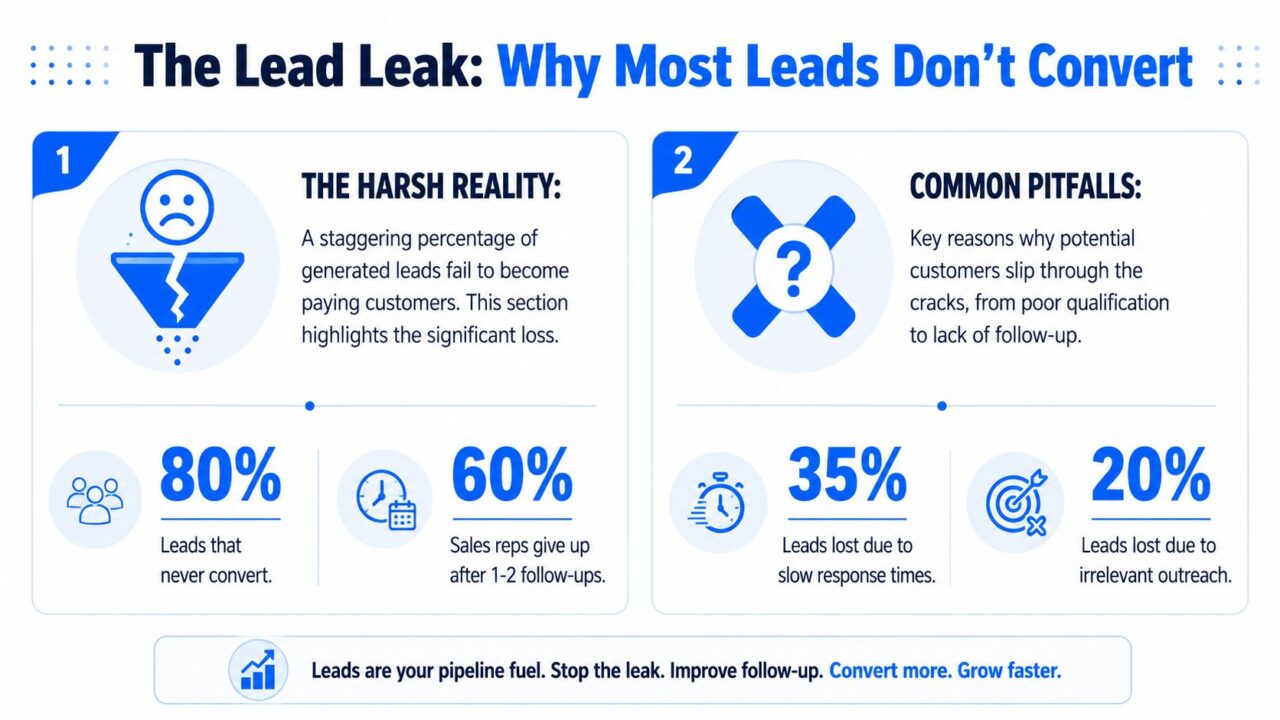
Approximately 79% of leads never convert into sales, largely because teams nurture the wrong people or qualify them too weakly, according to Martal’s roundup citing Salesforce and MarketingSherpa. That number changes the conversation. The problem usually isn’t “we need more leads.” It’s “we’re letting too many low-fit, low-intent leads enter a process built for buyers.”
That’s why lead qualification matters so much.
If you’ve ever watched sales complain that marketing sends junk while marketing complains that sales ignores inbound, you’ve already seen what poor qualification does. It clogs calendars, inflates pipeline with false hope, and hides valuable opportunities inside a pile of noise.
A strong qualification process fixes that. It tells you who deserves fast follow-up, who needs nurturing, and who should be disqualified early so your team can stop wasting expensive human time.
Why Most of Your Leads Are Going Nowhere
The hardest truth in lead gen is simple. Most leads were never close to buying in the first place.
Lead qualification is the filter that separates curiosity from commercial intent. Without it, every ebook download, chatbot interaction, contact form, and ad click gets treated like pipeline. That creates two problems at once. Sales spends time on dead ends, and real buyers wait too long for a relevant response.
Lead Qualification – Lead Leak
Lead volume is not the same as lead quality
A bigger top of funnel feels productive. It isn’t always profitable.
Teams often celebrate raw inquiries because they’re easy to count. But if your routing rules, forms, SDR process, and CRM stages don’t distinguish buyer fit from casual interest, more leads just means more work. Not more revenue.
That’s one reason a lot of growing teams eventually rethink their acquisition model. If you’re trying to improve lead quality upstream as well as downstream, this lead generation outsourcing guide is useful because it frames outsourcing around process quality, not just list building.
Practical rule: If sales keeps saying “these leads aren’t real,” don’t respond with more volume. Fix the qualification logic first.
What weak qualification looks like in practice
Poor qualification rarely shows up as one obvious failure. It usually appears as a pattern:
- Forms collect too little context so reps can’t tell whether the account is a fit.
- Every inquiry gets the same treatment even though a pricing-page visitor and a giveaway entrant are not equally valuable.
- Sales accepts weak leads by default because there’s no shared standard for what qualifies.
- Marketing optimizes for submissions instead of downstream outcomes like opportunities and wins.
A good process creates a cleaner pipeline. It also creates focus. The point isn’t to reject people aggressively for the sake of it. The point is to route each lead to the next best action.
Some should go straight to sales. Some should enter nurture. Some should get product education. Some should be disqualified quickly and respectfully.
That’s how lead qualification becomes a revenue lever instead of a CRM checkbox.
What Is Lead Qualification Really
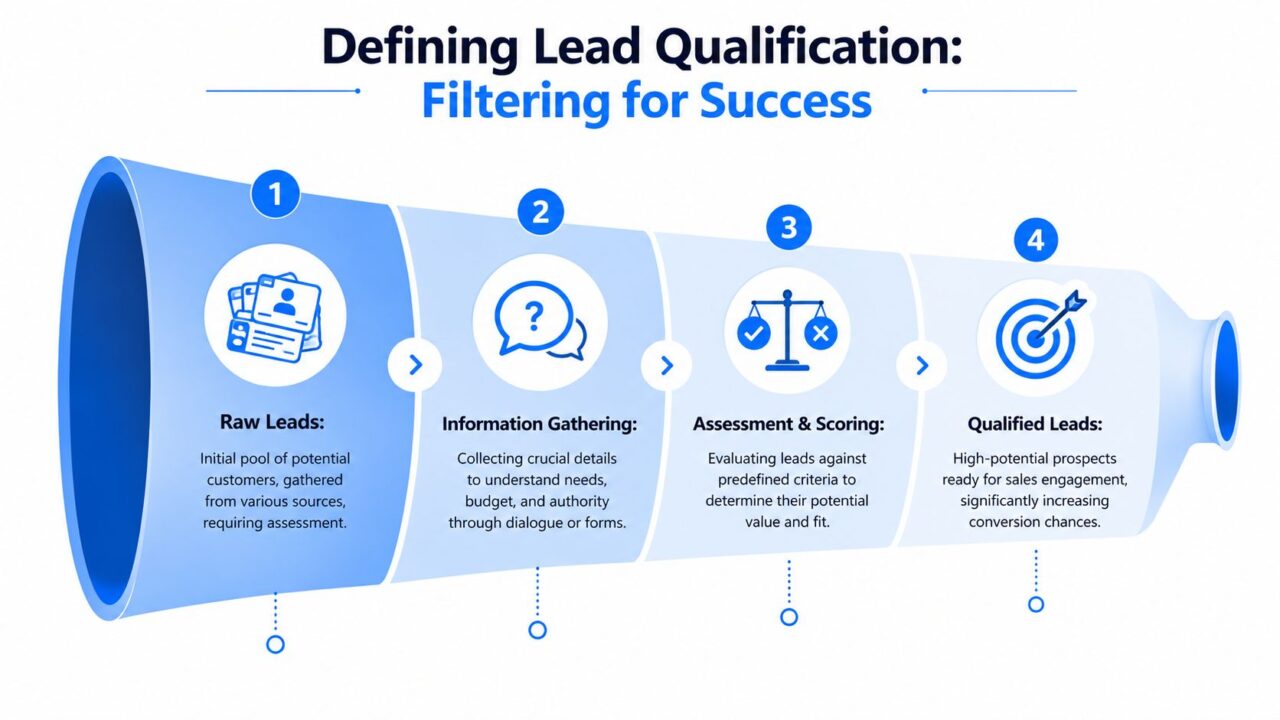
At its core, what is lead qualification really asking? It’s asking whether a person or account is worth a salesperson’s time right now.
The simplest way to think about it is as a gatekeeper. Not a rude one. A useful one. It checks whether the lead belongs in a live sales conversation, a nurture path, or nowhere near your pipeline yet.
Lead Qualification – Lead Funnel
Fit and intent decide everything
In practice, qualification comes down to two signals.
Fit asks whether the lead matches the kind of customer your business can serve well. That usually includes things like business model, company size, role, use case, and purchase capacity.
Intent asks whether they’re behaving like someone moving toward a decision. That includes meaningful actions such as repeat site visits, content engagement, demo requests, pricing page activity, or direct questions that reveal urgency.
Salesforce’s guidance makes the core standard even clearer. If a prospect can’t afford the offering, or the product can’t meet their needs, they should be disqualified, regardless of other signals, as explained in Salesforce’s overview of lead qualification.
Qualification is shared work, not a sales-only task
Marketing owns the early signals. Sales confirms the buying reality.
When those two teams work from different definitions, MQLs become a vanity metric. Marketing says the lead is warm because it downloaded something. Sales says it’s cold because the person has no authority, no budget, and no active problem.
That’s why qualification needs shared criteria and shared language. If your team wants a practical companion resource on that front, EmailScout’s article on how to close more deals with qualified prospects is a good example of qualification tied directly to deal outcomes.
A qualified lead isn’t just someone who raised a hand. It’s someone whose context makes a sales conversation commercially plausible.
What good qualification does for each team
For marketing, qualification proves that campaigns are producing leads with real sales potential.
For sales, it cuts out the false positives that waste follow-up time.
For operations, it creates a system that can be measured and improved.
The best teams don’t ask, “Did we capture the lead?” They ask, “Did we learn enough to make the right next move?”
Popular Lead Qualification Frameworks Explained
Frameworks help reps ask better questions in a consistent order. They matter because qualification breaks down when every seller improvises.
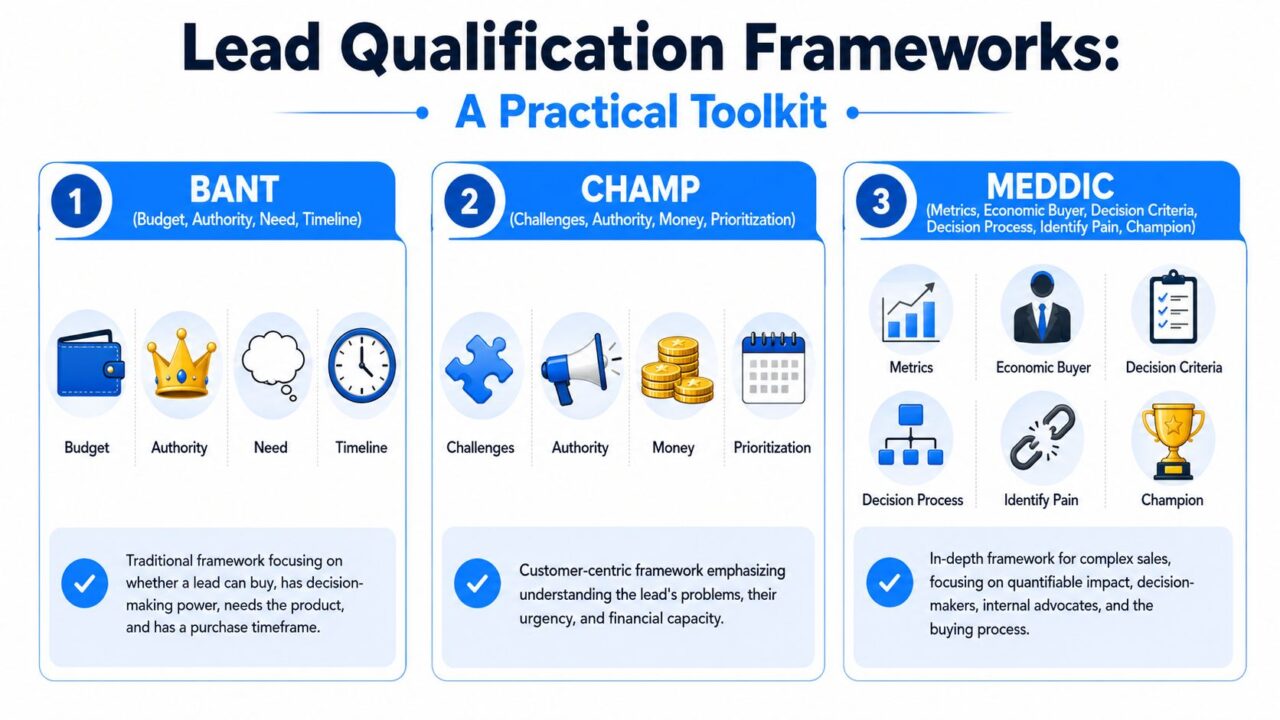
According to UserGems’ guide to lead qualification, BANT, MEDDIC, CHAMP, and ANUM give teams structured, open-ended ways to uncover four critical elements: Budget, Authority, Needs, and Timing.
Lead Qualification Frameworks
BANT for fast early sorting
BANT is the classic framework:
- Budget asks if they can pay for the solution.
- Authority checks whether they can approve or influence the purchase.
- Need identifies whether there’s a real problem to solve.
- Timeline tells you whether this is active demand or vague future interest.
Best for: straightforward sales motions, short cycles, and quick inbound triage.
BANT is useful because it’s simple. It’s also limited. If reps use it like a script instead of a conversation, they can sound transactional and miss the deeper problem behind the inquiry.
CHAMP for pain-first qualification
CHAMP shifts the order and tone:
- Challenges come first, so the conversation starts with the buyer’s problem.
- Authority still matters, but it doesn’t lead the exchange.
- Money tests economic realism.
- Prioritization asks whether this problem is important enough to act on now.
Best for: teams that want discovery to feel more consultative, especially in mid-market motions.
CHAMP often works better than BANT when buyers don’t want to discuss budget or authority at the start. Starting with the challenge tends to lower friction.
MEDDIC for complex buying groups
MEDDIC goes deeper. It focuses on:
- Metrics
- Economic Buyer
- Decision Criteria
- Decision Process
- Identify Pain
- Champion
Best for: complex B2B deals where multiple stakeholders, procurement steps, and internal advocacy all affect the outcome.
This framework is heavier, and that’s the trade-off. It gives you stronger deal visibility, but it requires disciplined sellers and a sales process mature enough to use the information.
Use the simplest framework that matches your sales motion. Overbuilding qualification too early creates admin work without improving decisions.
ANUM when authority comes first
ANUM is a useful variation when access to decision-makers is a major constraint.
It prioritizes authority earlier in the process, then moves into need, urgency, and money. That makes sense when your reps are often talking to users, researchers, or junior contacts who can’t move a deal forward.
If you want another practical breakdown of when each model fits, hireSDR.io’s sales qualification guide is worth reviewing.
Here’s the main takeaway. Don’t pick a framework because the acronym is popular. Pick one because it helps your team ask the right questions for the deals you sell.
Building Your Own Lead Scoring Model
Frameworks help people qualify leads. Lead scoring helps systems do it at scale.
According to Calendly’s explanation of lead qualification and scoring, effective scoring assigns points to both demographic data and behavioral actions, then sets a threshold that moves a lead from MQL to SQL.
That matters because scoring turns opinion into process. Instead of debating whether a lead “feels good,” your team can evaluate the same attributes the same way every time.
Start with fit points and intent points
A practical model usually includes two categories.
Fit points reflect who the lead is. Think job title, company type, industry, team size, or region.
Intent points reflect what the lead does. Think pricing page visits, email clicks, content downloads, demo requests, or replies to outreach.
If you only score fit, you’ll prioritize accounts that match your ICP but show no buying behavior. If you only score intent, you’ll chase active people who may never be good customers.
A sample lead scoring model
Below is a simple example you can adapt.
| Attribute / Behavior | Category | Points |
|---|---|---|
| Decision-maker job title | Demographic | 20 |
| Target industry match | Demographic | 15 |
| Business email | Demographic | 10 |
| Viewed pricing page | Behavioral | 15 |
| Downloaded a case study | Behavioral | 20 |
| Requested a demo | Behavioral | 30 |
You don’t need a complex score on day one. You need a score your team can explain.
Turn scores into routing rules
A scoring model only matters if it triggers action.
RevenueHero’s guidance gives a practical threshold model: 80+ points routes a lead directly to an Account Executive, while 50 to 79 points sends the lead to an SDR for a qualification call, as outlined in RevenueHero’s lead qualification guide. That split is useful because it ties score to staffing, not just labeling.
For many teams, a working model looks like this:
- High score: Route immediately to sales for direct follow-up.
- Mid-range score: Send to SDR or inside sales for verification.
- Low score: Keep in nurture and watch for stronger intent.
- Disqualified: Remove from active sales routing if core fit is missing.
What works and what doesn’t
What works:
- Use closed-won patterns to decide which attributes deserve points.
- Review rejected SQLs so the model learns from bad handoffs.
- Keep criteria visible in your CRM and automation platform.
What doesn’t:
- Scoring everything just because you can track it.
- Assigning arbitrary values with no relationship to actual outcomes.
- Letting the model sit untouched while your product, market, or sales motion changes.
If you want a practical framework for building and auditing the model itself, Clepher’s article on lead scoring best practices is a useful reference.
The MQL to SQL Handoff Process That Works
A lead becomes an MQL when marketing has enough evidence that it deserves sales attention. It becomes an SQL when sales confirms there’s a real opportunity worth working.
That sounds clean. In most companies, it isn’t.
The handoff breaks when marketing and sales treat stages as labels instead of operational commitments. A lead hits the score threshold, gets pushed into the CRM, and then sits untouched because the assigned rep doesn’t trust the source, doesn’t understand the context, or doesn’t know what qualified it in the first place.
What the journey should look like
A healthy handoff follows a simple story.
Marketing captures the lead, enriches the record, tracks behavior, and nurtures until the lead reaches the agreed threshold. At that point, the system routes it to sales with the supporting context attached. Sales reviews the lead, accepts or rejects it, and records why. This is easiest to manage when both teams work from the same lead qualification criteria instead of relying on individual judgment call by call.
That last step is often where operations falter. Rejection reasons are often missing, vague, or ignored. Without a shared lead qualification checklist, every rejected lead becomes a one-off argument instead of a data point you can learn from.
Sales should never reject a lead with “bad fit” if no one defined fit in a shared way. A simple qualification checklist, agreed on by both teams, turns “bad fit” into something specific, like wrong company size or no budget authority. That is what separates sales leads that get a fair review from sales-qualified leads that get dropped without anyone understanding why.
Build the handoff around explicit triggers
You need a few operational rules:
- Define the trigger clearly so everyone knows when an MQL becomes sales-ready.
- Attach the evidence such as score, activity history, source, and qualification notes.
- Set a response expectation so accepted leads get quick follow-up.
- Create reject reasons that are specific enough to improve the model.
A shared lead dictionary helps more than is often realized. If marketing says “high intent” but sales interprets that differently, your reporting becomes fiction.
Automation should carry context, not just status
The best handoffs happen inside the CRM and routing workflows, not in Slack threads and guesswork.
When a lead changes stage, the system should also pass along the qualification context: what pages were viewed, what the person asked for, what criteria they matched, and whether the lead still needs discovery on budget, authority, or timing.
That’s also where a clear process like how to qualify leads in sales becomes helpful. It gives teams a concrete standard for what sales is expected to verify after marketing has done the first layer of qualification.
If you want fewer lead disputes, don’t just optimize scoring. Optimize the handoff.
Automating Lead Qualification with AI Chatbots
Static forms capture answers. Conversational systems capture intent.
That’s the biggest shift in modern qualification. Many teams still treat qualification like a one-time gate at form fill. But Default’s analysis of lead qualification points out that most content still frames it as a static checklist, even though qualification should evolve as intent signals change. That’s where conversational AI becomes useful. Real-time chat can surface urgency, authority, and buying context that forms often miss.
Lead Qualification Clepher Chatbot
What AI chatbots do better than forms
A form asks everyone the same fixed questions. A chatbot can branch.
If someone lands on your pricing page, the bot can ask what they’re trying to solve, who the solution is for, and when they want to implement. If the visitor gives strong signals, the workflow can route them toward booking a meeting. If the signals are weaker, the same conversation can send them to a guide, offer a use-case page, or tag them for nurturing. This kind of branching turns the lead qualification process into something that happens automatically, before a sales rep ever has to get involved.
That dynamic approach is especially useful for gray-area leads. Some people look weak on paper but reveal urgency in conversation. Others look promising from firmographic data and then make it obvious they’re only researching. A chatbot catches this distinction in real time, sorting sales-qualified leads from marketing-qualified leads based on what people actually say, not just what a form field implies. That separation matters for keeping sales and marketing aligned, since it means a sales team spends its time on conversations that are already warm instead of chasing every submission down the sales cycle from scratch.
A practical chatbot qualification flow
A good qualification bot doesn’t interrogate. It sequences a few high-value questions in natural language.
For example:
- Entry point: Visitor opens the pricing page or lead capture widget.
- Question one: Ask what they want help with.
- Question two: Ask about business type, role, or company context.
- Question three: Ask about timeline or urgency.
- Decision layer: Apply your fit and intent rules.
- Outcome: Route to sales, nurture, support content, or a later follow-up path.
Used this way, a chatbot becomes the first qualification layer, not just a capture tool. One option is Clepher’s chatbot for lead generation, which supports conversational flows across website and messaging channels and can pass captured qualification data into the rest of your stack.
The best automation doesn’t replace sales judgment. It removes low-value manual work so sales can spend time where judgment actually matters.
Dynamic re-qualification is the real advantage
The more interesting use case isn’t the first conversation. It’s what happens after.
A lead that looked weak last week may return to the site, engage with pricing, ask about implementation, or respond to a campaign with a more urgent question. A conversational system can treat that as a fresh qualification event instead of forcing the lead to start over.
That’s where automation becomes revenue-focused instead of merely efficient.
If your current process still depends on one form submission and one SDR review, you’re likely missing the moments when buyer intent changes.
Measure What Matters and Avoid Common Mistakes
Lead qualification only helps if you can see whether it’s improving the funnel. The key metrics are straightforward. According to Cubeo’s overview of lead qualification metrics, the critical KPIs are MQL-to-SQL conversion rate, lead response time, lead-to-opportunity rate, lead velocity rate, and win rate of qualified leads.
The dashboard worth watching
Use those metrics as an operating dashboard:
- MQL-to-SQL conversion rate tells you whether marketing is sending leads sales agrees are viable.
- Lead response time shows whether strong leads are getting fast follow-up.
- Lead-to-opportunity rate reveals whether qualification is producing real pipeline, not just accepted leads.
- Lead velocity rate helps you see whether leads are moving through the funnel efficiently.
- Win rate of qualified leads is the clearest test of whether your qualification standard is producing deals that can close.
Mistakes that quietly damage performance
Most qualification problems come from a short list of avoidable issues:
- Scoring without disqualifiers so low-fit leads keep slipping through.
- No sales feedback loop so rejected leads never improve the model.
- Too many required form fields, which lowers conversion before qualification even starts.
- Treating qualification as one-and-done instead of updating lead status when intent changes.
- Routing leads without context, so reps receive names, not usable buying signals.
The simplest takeaway is also the most important. Lead qualification is not admin work. It’s one of the clearest ways to protect sales time, improve pipeline quality, and create a better buying experience.
Start with a basic framework. Add a scoring model. Automate the handoff. Then measure what happens and refine it.
If you want to put that into practice, Clepher can help you turn lead qualification into a live conversational workflow instead of a static form process. Use it to capture signals in real time, route higher-intent leads faster, and keep lower-intent leads engaged until they’re ready for sales.

Related Posts
Customer Journey Automation: The Practical Guide
October 10, 2026Lead Qualification Marketing: A Practical 2026 Guide
October 9, 2026Customer Experience Optimization Playbook
October 8, 2026
Founder Clepher