
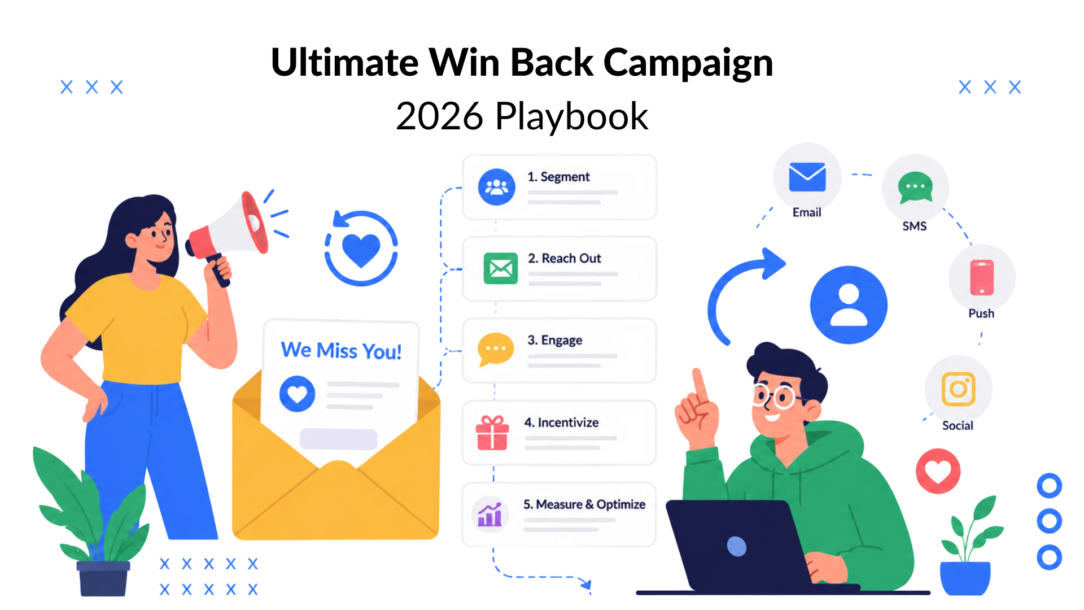
A win-back campaign can return 26% of past customers, with reacquired buyers producing $485,400 in first-year revenue for SMBs, while campaigns under $5,000 can average a 182x ROI. That makes win-back one of the highest-impact retention levers available to e-commerce and DTC brands.
Many teams still treat dormant customers as a passive audience. They keep spending on acquisition while buyers who already know the product sit untouched in the CRM. The stronger approach is a bounded recovery program that combines behavioral timing, segmentation, conversational automation, and clear rules for when outreach ends.
The distinction between customer engagement and disengagement matters for improving open rates. A generic “we miss you” email followed by a discount might recover a few orders, but it won’t tell you why customers left, which channel reaches them, or whether the revenue survives beyond the first purchase. A properly designed win-back campaign does all three.
Why Win-Back Campaigns Are Your Highest-ROI Retention Lever
A 2023 benchmark found that effective re-engagement can significantly increase customer retention. 26% of past customers returned through win-back campaigns. Among those reactivated buyers, 49% generated about the same revenue after reactivation as during their first customer lifetime, 47% generated more, and only 4% generated less. (Customer Win-Back Benchmark Study 2023 highlights the importance of email addresses in effective outreach.)
For a DTC brand, that changes the allocation decision. The acquisition team may be preparing another paid social push while retention sends occasional promotions to the full list. A bounded win-back program gives prior buyers a defined recovery path instead of leaving them inside generic broadcasts. These customers already completed checkout, experienced the product, and generated behavioral data that can shape the next message.
The revenue case is equally clear. The benchmark reported that an average win-back campaign generated $242,700 in first-year revenue for SMBs. Reacquired customers stayed an average of two years, bringing total campaign revenue to $485,400.
Win Back Campaign Lifetime Value
Why the economics are different
Win-back starts with permission, customer history, product familiarity, and stored behavioral data. A message can reference a previous category purchase, canceled plan, support issue, or feature the customer used regularly. That context gives the outreach a specific job beyond asking for another order.
The program also needs boundaries. Set an eligibility window, define the channels and message sequence, then stop outreach when the customer purchases, opts out, shows no engagement after the final attempt, or reaches a suppression rule. This protects deliverability and keeps win-back from becoming an endless nurture stream.
The efficiency difference in our re-engagement strategy is notable. Campaigns costing over $5,000 averaged a 32x ROI, while campaigns under $5,000 averaged a 182x ROI, according to the same benchmark. The figure is a benchmark, not a forecast, so evaluate each program using incentive cost, media cost, platform cost, returns, and downstream revenue.
A modest immediate conversion rate can still support the program if reactivated buyers continue purchasing. Measure incremental revenue separately from broad retention activity, and connect the recovery flow with customer loyalty programs can be enhanced through personalized win-back campaigns, so returning buyers have a clear reason to remain active.
Practical rule: Treat dormant customers as a recoverable revenue pool, with explicit entry and exit criteria, rather than as a permanently lost audience.
Segmenting Dormant Audiences and Choosing Channels
A dormant audience is a status, not a segment. Two customers may have gone quiet on the same day, yet one could be a high-value subscriber who canceled after a product problem, while the other is a one-time buyer who never developed a repeat habit.
Start with a working audience record that combines:
- Recency: Compare the last purchase or activity date with the customer’s normal buying interval.
- Value: Include prior order value, contribution margin, subscription value, and purchase frequency.
- Category: Identify the products, plans, or features connected to the customer’s previous engagement.
- Intent signals: Track recent clicks, product views, cart abandonment, support conversations, and cancellation behavior.
- Reason for inactivity: Separate price concerns, product fit, technical friction, timing, and involuntary payment failure.
A subscription customer who canceled because a feature was missing shouldn’t receive the same offer as someone whose payment method failed. The first needs proof that the product changed. The second needs a frictionless billing recovery path, not a discount.
Build the segments inside the CRM or customer data platform, then sync tags into your conversational tool. A clean structure might include dormant_high_value, canceled_feature_gap, Recent_cart_intent for a winback campaign., and payment_recovery. That makes channel routing and suppression easier to manage. Teams refining social audiences can apply the same logic described in this guide to Audience segmentation for Instagram growth can enhance email marketing efforts., particularly when behavioral signals need to translate into platform-specific groups.
Match the audience to the message
| Segment | Recommended Channels | Message Tone | Incentive Type |
|---|---|---|---|
| Recent repeat buyer | Email, SMS | Familiar and helpful | Product reminder, modest benefit in a win-back email. |
| High-LTV subscription churner | Email, personal outreach, Messenger | Consultative and specific | Plan flexibility, feature update, service recovery |
| One-time e-commerce buyer | Email, Instagram, retargeting | Clear and product-led | Relevant offer or category reminder |
| Recent cart abandoner who went inactive | Email, SMS | Direct and low-friction | Saved cart, shipping information, limited incentive |
| Customer with payment failure | Email, SMS, in-app message | Urgent but reassuring | Payment update path, no discount required |
| Customer who cited a product issue | Email, Messenger, support follow-up should include personalized content for re-engagement. | Accountable and transparent | Fix explanation, upgrade, or service remedy |
The channel should reflect consent and prior engagement, not marketer preference. SMS can be effective for new customers who have opted in and shown high intent, but it can feel intrusive for low-value or weakly engaged audiences. Instagram Direct or Messenger may suit brands whose customers already ask questions there, while email remains useful for longer explanations, product comparisons, and feature announcements.
For deeper implementation guidance, use a documented customer segmentation strategy that defines field ownership, tag naming, refresh rules, and suppression logic. The goal isn’t to create dozens of micro-segments. It’s to create enough distinction that the message answers the customer’s likely reason for leaving.
Building Multi-Channel Conversational Win-Back Flows
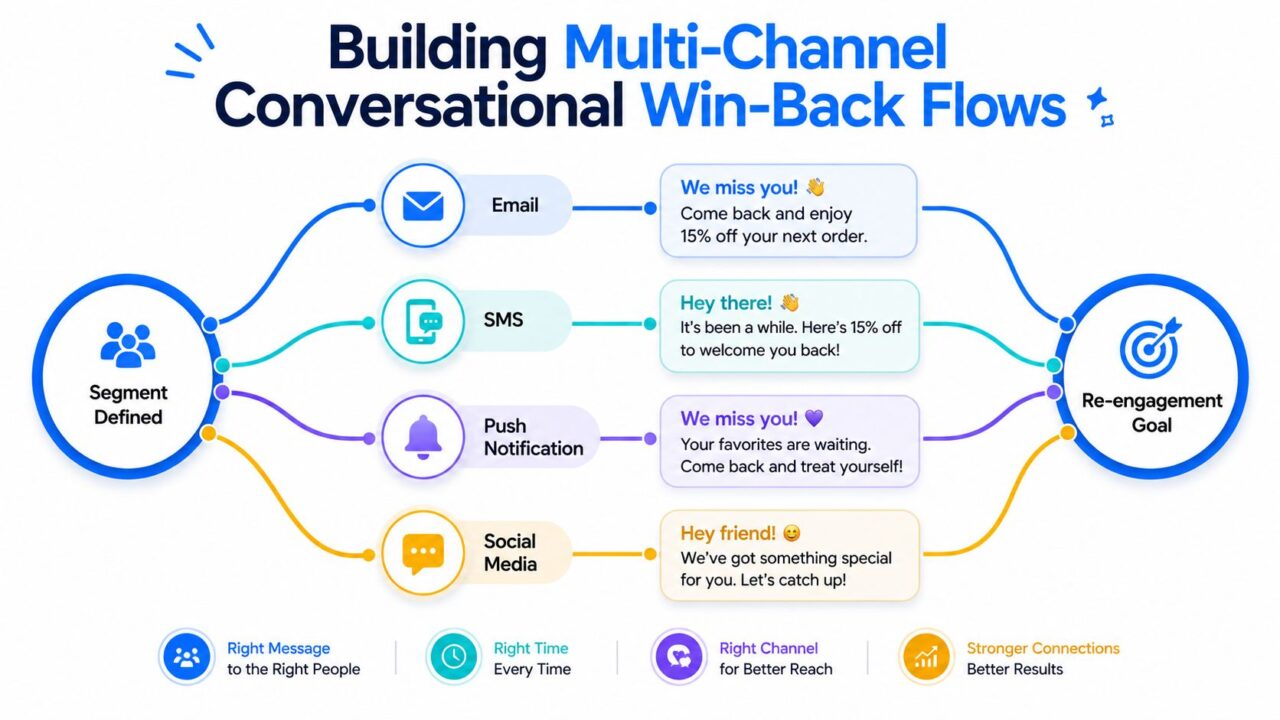
A broadcast announces. A conversational flow responds.
The difference becomes important when a customer clicks because they have a question, replies with an objection, or says they left for a reason your original segment didn’t capture, impacting your ability to win them back. Your automation should recognize that signal and route the person into a more relevant path instead of continuing the original sequence.
Win Back Campaign Marketing Strategy
Start with one decision tree
Build the flow around a small number of meaningful branches:
- Trigger: Send a win-back email to re-engage lapsed customers. The customer reaches the inactivity threshold, cancels, abandons a cart, or experiences a failed payment.
- Eligibility check: Confirm consent, active status, open support tickets, recent purchase activity, and existing suppression flags.
- First message: Send the least aggressive message that could solve the likely problem.
- Response branch: Separate clickers, responders, new customers, and non-responders to enhance email deliverability.
- Resolution path: Implement a win-back strategy for better customer recovery. Route interested customers to checkout, account recovery, product education, support, or a human conversation.
- Exit condition: Stop the win-back sequence after conversion, unsubscribe, invalid consent, or the defined non-response limit.
A useful conversational flow might look like this:
- Opening: “We noticed you haven’t visited recently. Would you like to see what’s changed?”
- Choice: “Show me the updates” or “I’m not interested.”
- Update path: Present the feature, product, or category most connected to prior behavior.
- Objection path: Offer choices such as “Too expensive,” “Not using it,” or “Something didn’t work.”
- Resolution: Send the relevant answer, offer a plan adjustment, or hand the conversation to support.
- Confirmation: Record the response and remove the customer from unrelated promotional paths.
Typing indicators, first-name personalization, category-specific recommendations, and short reply options can make the experience feel less like a campaign. They only help when the underlying data is accurate. A wrong product reference or an offer that ignores a cancellation reason damages trust faster than a plain message would.
Use channel-specific jobs
Email can carry the full explanation. SMS should handle a concise reminder or a high-intent action. Push notifications can bring an active app user back to a relevant feature. Messenger, WhatsApp, and Instagram Direct can support questions, product discovery, and human escalation.
Don’t send every channel at once. A practical sequence might begin with email to existing customers, use an opted-in SMS reminder after a meaningful interaction, and reserve a direct-message path for people who reply or engage socially. If a customer purchases through one channel, suppress all remaining recovery messages immediately.
A no-code conversational platform such as Clepher can support flows with tags, conditions, personalization fields, typing indicators, random path distribution, and integrations that pass responses into email or SMS systems. Teams can use those capabilities to keep the conversation state synchronized with the CRM rather than operating isolated channel lists. A broader multi-channel marketing strategy can help define how those handoffs fit into acquisition, support, and post-purchase journeys.
Consent records need to travel with the customer. Store the channel permission, source, timestamp, opt-out status, and last interaction. When someone responds negatively or unsubscribes, the flow should update the suppression state everywhere, not just inside the channel that received the response.
Timing Science and Trigger Logic That Works
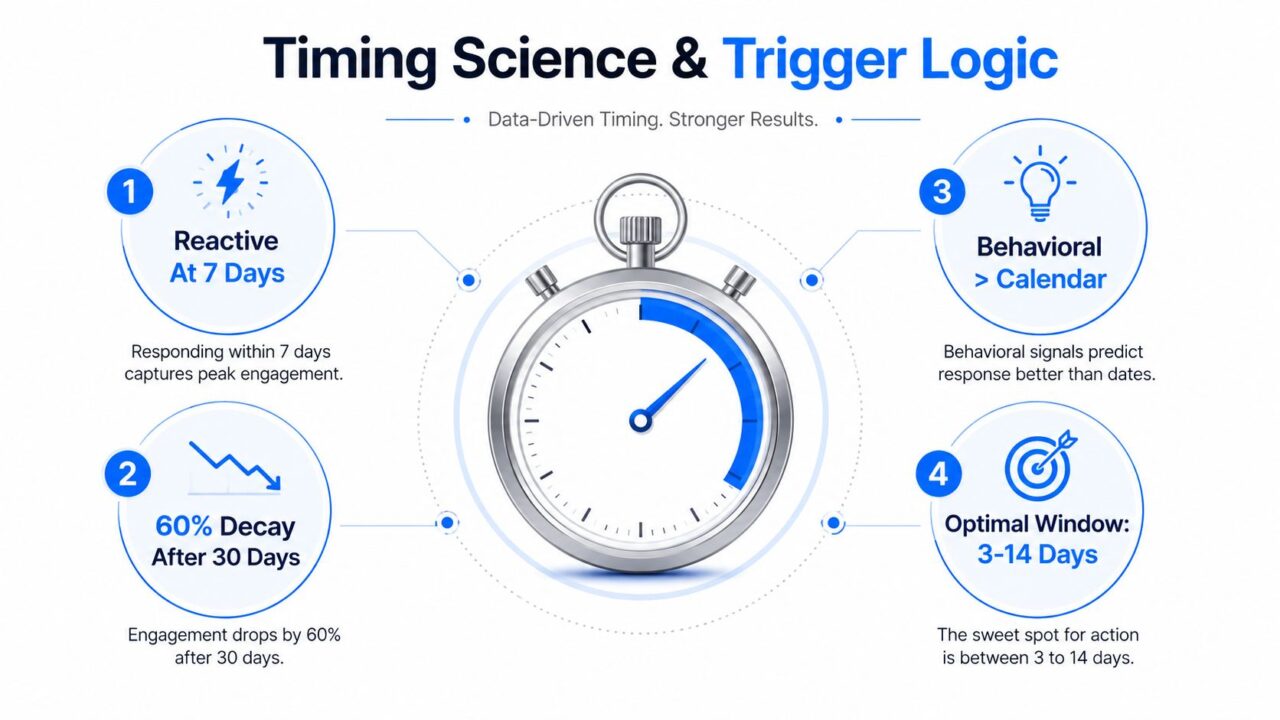
Timing is the first major win-back decision because customer memory and purchase intent fade. One benchmark summary reported approximately 40% success at a 30-day lapse, 25% at 60 days, 12% at 90 days, and below 5% after 180 days. (Win-back statistics benchmark summary)
The exact curve varies by category, but the direction is useful for campaign design. A customer who usually buys on a recurring schedule should enter recovery before the relationship becomes cold, while the brand still has relevant behavioral context.
Use the customer’s own cadence as the trigger. One industry guide recommends starting at 1.5 to 2 times their average purchase interval without another purchase. For a brand with a strong customer base, strategies to win them back are essential. 60-day repurchase cycle, placing the trigger around Day 90 is crucial for sending a win-back email to lapsed customers. The same guide reports that waiting beyond 180 days can reduce recovery rates by 50% to 70%. (E-commerce win-back timing guide)
Win Back Campaign Timing Science
Build timing around behavior
Calendar triggers are simple to configure, but they miss customer context. Set separate rules for email marketing targeting different segments in the winback strategy.
- Repeat-purchase products: Trigger after the expected replenishment interval has passed.
- Subscriptions: Trigger after cancellation, failed payment, or a sustained usage decline to re-engage lapsed customers.
- Seasonal products: Compare activity with the relevant buying season rather than labeling an off-season quiet period as churn.
- High-consideration purchases: Combine elapsed time with browsing, saved-item, and product-education signals.
- Service businesses can utilize strategies to win back existing customers. Trigger after the expected renewal, booking, or reorder window.
One staged framework recommends a gentle reintroduction at 30 to 45 days, a value-focused touch at 45 to 60 days, a stronger incentive at 60 to 75 days, and a final-chance message at 75 to 90 days. The complete sequence generally spans 8 to 12 weeks with 4 to 5 touchpoints. (Win-back campaign timing framework)
Treat those stages as control points, not a fixed script. A click on the first message can shorten the path to a human response or purchase, improving overall email deliverability. Silence across every channel should not trigger progressively larger discounts. Track re-purchase latency, then adjust the trigger window around the point when responsive customers return.
Timing principle: Reach out when the customer is late for their normal behavior, not simply when a marketer has a free slot on the calendar.
A bounded flow also needs a clear decision after each response window: continue, route the conversation to a person, suppress the customer, or record the program outcome for lifetime-value analysis.
Stopping Outreach Before It Damages Deliverability
A win-back flow needs a defined endpoint before the first message is sent. Repeated outreach to back customers who never engage can raise complaints, bounces, spam-trap risk, and list pollution, making it harder for active customers to receive future campaigns in their inbox.
Current retention guidance commonly uses 3 to 4 attempts to win back customers can significantly improve engagement rates. or 90 to 180 days of inactivity as suppression ranges. (Win-back retention playbook) These thresholds should reflect consent quality, engagement history, and the customer’s purchase cycle. Set the rule for email deliverability before launch, then apply it consistently across email, messaging, and other approved channels.
Create explicit exit criteria
End the sequence when one of these conditions is met:
- Conversion: The customer purchases, renews, reactivates, or completes the intended action.
- Negative intent: The customer unsubscribes, opts out, or asks to stop receiving messages.
- Channel failure: An address hard-bounces, a number becomes undeliverable, or consent is invalid.
- Support escalation: A complaint or unresolved issue requires a human response.
- No response: The customer receives the allowed touchpoints without a meaningful engagement signal.
- Poor economics: Incentive and delivery costs exceed the margin from recovered customers in our winback strategy.
An open does not prove reactivation. Privacy features and automated scanning can produce noisy open data, so clicks, replies, purchases, renewals, and product usage should carry more weight. Review the message against practical examples of spam messages before launch. Repeated urgency, vague claims, misleading subject lines, and aggressive frequency can make a legitimate offer feel unwanted.
Track deliverability alongside revenue, rather than leaving sender health in a technical dashboard that retention teams rarely review. A bounded program should also record its outcome, including the exit reason, channel, offer, and whether a human follow-up was required.
Protect the rest of the list
Suppression improves list quality beyond the win-back audience. Removing persistent non-responders reduces low-quality recipients in future sends, which makes engagement reporting easier to interpret and supports consent expectations.
Keep each customer in the CRM with a suppression reason for service, legal, and analysis needs. Do not continue promotional outreach after suppression. If the customer later returns through a new permission event, evaluate eligibility from the beginning instead of automatically restarting the old flow.
Testing, Measuring, and Scaling Win-Back Programs
Campaign economics are covered earlier. This section focuses on measuring incremental lift once the program is running, protecting margin, and deciding which recovery paths deserve wider rollout.
Raw reactivation counts can mislead. Some dormant customers would have returned without a message, while a discount can produce an order with little or no margin. Measure incremental value, response quality, and channel health together.
Use a randomized holdout at the audience level. Assign eligible customers to treatment or control, then track both groups through the same observation window. The outcome difference estimates incremental lift more reliably than counting every purchase after a send. This intent-to-treat approach is outlined in a practical winback strategy and reactivation measurement playbook.
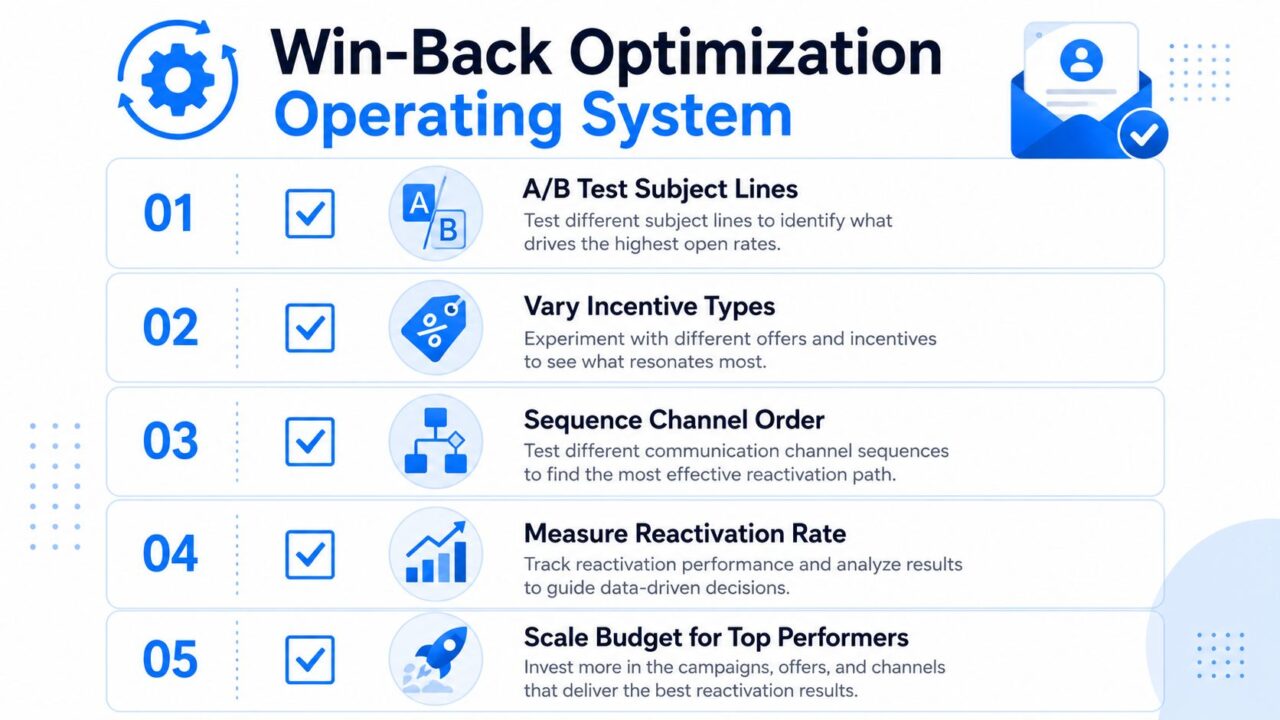
Win Back Campaign Optimization Process
Test the decisions that change margin
A/B testing should isolate one meaningful decision at a time. Useful tests include:
- Subject line: Relationship reminder versus product update.
- Offer structure: Discount versus non-discount benefit.
- Message order: Email first versus direct message first, where consent supports both.
- Copy angle: Focus on the benefits of re-engagement in your winback campaign. Product value, service recovery, feature improvement, or seasonal relevance.
- Timing: Earlier intervention versus a later point in the customer’s normal buying cycle.
- Conversation path: Open-ended reply versus structured response buttons.
Do not judge a variant only by opens or clicks. Track reactivation rate, reactivation MRR for subscription businesses, revenue per eligible customer, and incremental margin by segment after incentive cost and returns. Time-to-event measures, including repurchase latency and survival curves, show whether a variant brings customers back sooner or keeps them active longer.
Record the outcome at the customer level. Include treatment or control assignment, channel, offer, response type, purchase, repeat activity, exit reason, and whether human follow-up was needed. Those fields make it possible to compare paths after the initial order, not just report campaign totals.
Deliverability needs its own panel. Monitor authentication pass rates, spam complaints, bounce classes, and spam-trap hits alongside conversion data. The reactivation measurement playbook also recommends reviewing these signals. A message that performs well with a small engaged subset while the wider audience deteriorates is not a successful program.
Turn the pilot into an operating system
Start with a focused segment rather than every dormant contact. Before the first send, define the eligibility rule, holdout allocation, channel permissions, incentive ceiling, exit criteria, and dashboard fields. A bounded program needs a clear end state, such as purchase, qualified reply, suppression, or no response after the permitted sequence.
After the first test cycle, remove variants that create poor margin or weak-quality reactivation. In the next cycle, compare the strongest message with a meaningful alternative, then assess downstream value rather than immediate order volume. Distribute conversational paths randomly so anecdotal replies do not determine which flow the team expands.
A practical scaling checklist looks like this:
- Validate data: Confirm purchase intervals, cancellation reasons, consent, and suppression states.
- Launch one segment: Choose a group with clear intent and a measurable recovery action to win back customers effectively.
- Hold out a control: Preserve a randomized comparison group.
- Review economics: Calculate incremental margin after offers, returns, and channel costs.
- Check quality: Compare reactivation MRR, repeat activity, and latency, not just first orders.
- Protect reach: Suppress non-responders and investigate complaint or bounce changes.
- Scale selectively to enhance open rates and improve customer engagement. Expand only segments and paths that produce durable incremental value.
A win-back program becomes a retention engine when the team can identify the customer, match the message and channel to the recovery opportunity, and stop outreach at a defined point. Clepher provides a no-code environment for conversational flows across website chat, Messenger, WhatsApp, and Instagram Direct, with segmentation, conditions, analytics, and integrations for email and SMS handoffs. Visit Clepher to configure a bounded reactivation flow, connect it to the existing stack, and test recovery paths with revenue and deliverability controls.
Related Posts
Automated Checkout Bot: Build and Launch Guide
October 7, 2026AI Agent Framework: Architecture, Tools, and Use Cases
October 6, 2026Master Lead Generation Automation for Business Growth
October 5, 2026
Founder Clepher