
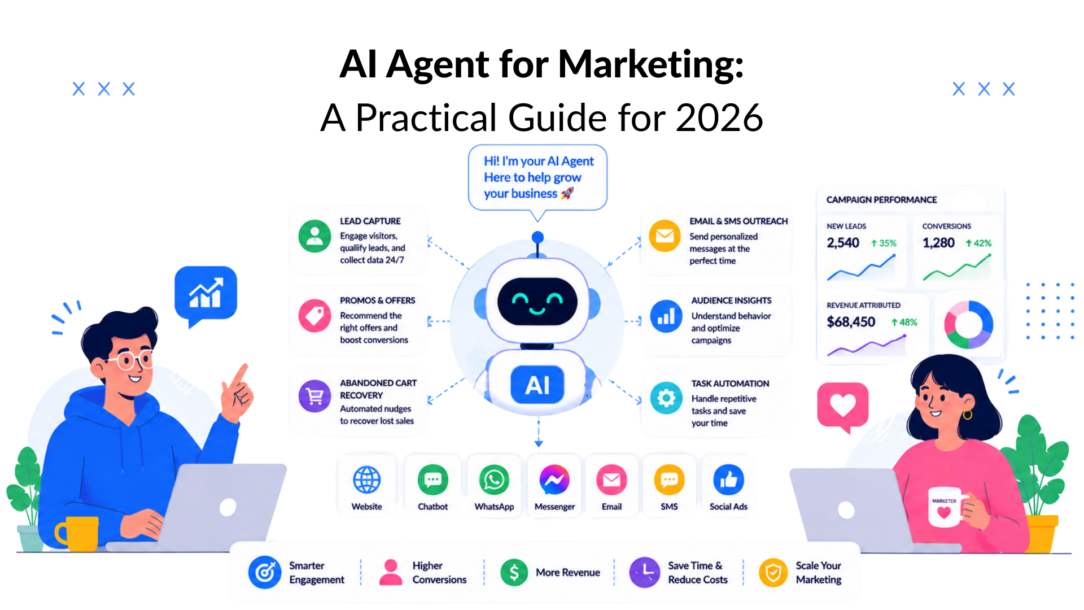
You’re staring at the same problem a lot of growth teams are staring at right now. A visitor lands on a pricing page, scrolls, hesitates, and disappears. The form on the page stays empty, the inbox stays quiet, and the sale that should’ve been warm goes cold.
An AI agent for marketing changes that moment. Instead of waiting for someone to come back on their own, it watches the signal, decides what matters, and opens the right conversation in the right channel. That’s the practical shift, from passive capture to active engagement, and it’s why agents are moving from novelty to workflow infrastructure across website chat, Messenger, Instagram DMs, WhatsApp, and email handoffs.
The Moment an AI Agent Earns Its Place
A DTC founder usually sees the gap after the fact. Traffic looked healthy, the product page held attention, the checkout flow seemed fine, then analytics show a clean bounce and the opportunity is gone.
An AI marketing agent earns its place when it reacts before that moment turns into lost revenue. A visitor clicks pricing, hesitates, and starts to leave. The agent can use that live behavioral signal to open a chat on-site, send a Messenger follow-up if the visitor already opted in, or route the person into Instagram DM if that was the first channel they used.
Why the timing matters
The difference is timing plus context. Batch email waits for a schedule, while an agent can act on page views, cart events, or message replies as they happen, leveraging agentic AI for enhanced responsiveness. That matters because the buying window does not wait for your nightly sync.
Practical rule: If the agent cannot see the signal while the buyer is still active, it is usually too late for the agent to carry the conversation effectively, especially when using best AI agents.
Owned channels are where this pays off. A good agent does not flood people with more messages. It takes one live signal, decides whether the visitor needs a product answer, a lead handoff, or a reminder, then moves the outcome into something measurable.
For a broader technical backdrop on agent design and workflow thinking, artificial intelligence advice is a useful companion read, especially if you are comparing agent patterns across tools. For a product-level framing of the category, What Are AI Agents? stays close to how these systems are described in practice.
What an AI Marketing Agent Is
AI Agent for Marketing Comparison
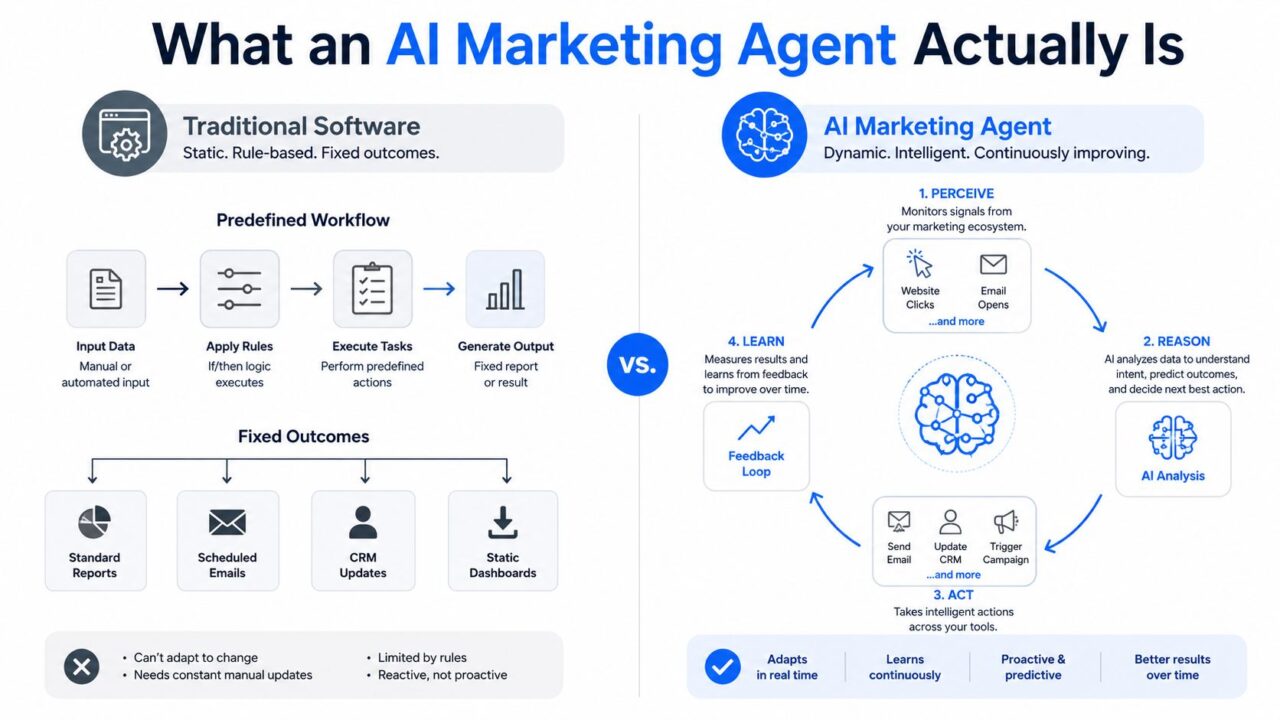
An AI marketing agent is software that picks up a customer signal, decides the next best action, and carries it out in a channel. That is different from a chatbot that only follows a decision tree. It is also different from legacy automation that runs because a clock says it is time.
Three things separate agents from older tools
Inputs. Rule-based bots mostly depend on whatever the user types into a fixed script. Traditional automation depends on scheduled lists, fixed triggers, or batch updates. An agent can work from live behavioral signals, profile data, and message history, then combine those inputs before acting.
Decisioning. A chatbot asks, “Which branch of this tree am I on?” A marketing automation system asks, “Did the workflow trigger?” An agent asks, “What should happen now, given the person’s intent, consent, and channel?”
Execution. Old tools often stop at a recommendation or canned response. An agent sends the message, updates the CRM, tags the contact, or escalates to a human when the rules say it should.
The cleanest way to see the difference is to compare them on the same job. A rule-based bot can answer FAQs. A scheduled email platform can drip content effectively, utilizing AI tools for maximum impact. An agent can notice intent, choose a response, and move the customer to the next step without waiting for a marketer to intervene every time.
For practical product selection, look for platforms that separate reasoning from execution. That is the same logic covered in Clepher’s AI agent overview, and it is the line between a chatbot demo and a working revenue workflow. For a broader technical backdrop on agent design and workflow thinking, Artificial Intelligence Advice is a useful companion read, especially if you are comparing agent patterns across tools.
An agent is only useful when it can connect signal, decision, and action without turning every interaction into a manual task for the team.
Why Adoption Is Accelerating and What That Means for You
AI Agent for Marketing AI Adoption Statistics
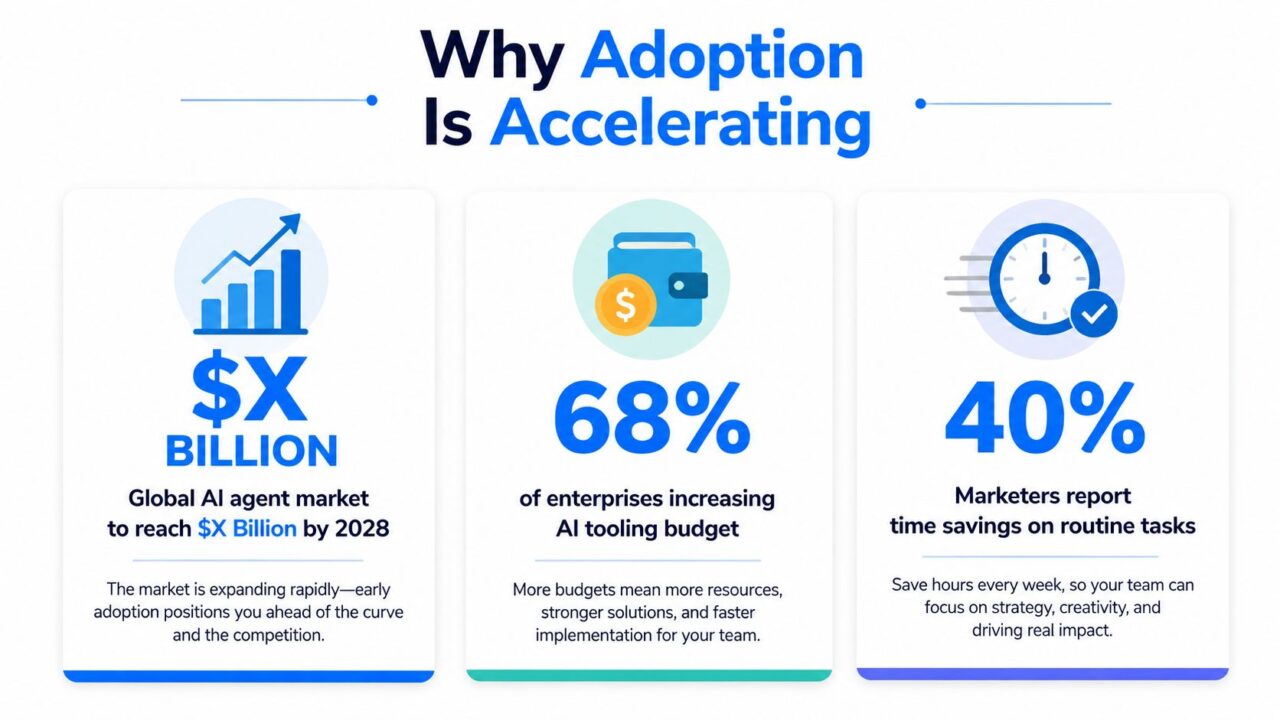
The category is moving fast because teams can already see the operational payoff. One 2026 industry synthesis says 87% of marketers now use generative AI in at least one workflow, up from 51% in 2024, and 34% of enterprise marketing teams are already running at least one autonomous AI agent in production, more than double the 14% reported in late 2025. The same source says that the best AI agent can significantly improve customer engagement. 79% of companies across business functions report adopting AI agents, and about 40% of enterprise applications are expected to embed task-specific agents by 2026. Those are not abstract trend lines; they’re budget and workflow decisions in motion. Source data on AI agent adoption in marketing
What the market pressure looks like
The market itself is expanding at venture scale. Grand View Research estimates the global AI agents market at USD 7.63 billion in 2025 and projects USD 182.97 billion by 2033, a 49.6% CAGR from 2026 to 2033. Another market summary puts it at USD 5.43 billion in 2024 with a forecast of USD 47.1 billion by 2033. A separate 2026 review says the U.S. holds 40.1% of AI-agent revenue share while leveraging content creation for better brand voice. Asia Pacific is the fastest-growing region. Market outlook for AI agents
That growth shows up inside marketing budgets too. One 2026 source says the median monthly AI-tool spend has reached USD 3,400, and 88% of executives are increasing AI budgets because of agents. The practical takeaway is simple. Teams are no longer debating whether AI belongs in the stack; they’re deciding which workflows deserve it first.
The wrong way to buy an agent is to start with a vision deck. The right way is to start with a live workflow, one clean data source, and a guardrail that keeps the system from causing cleanup work.
A mid-sized ecommerce brand feels this as faster campaign iteration, more relevant outreach, and fewer handoffs between point tools. Agencies feel it as less repetitive client ops. The catch is readiness. Agents only help when the data is live, the consent model is clear, and the execution layer can be controlled.
If you want a directory-style place to compare categories and vendors before you commit, browse 2026 AI directories is a useful starting point for scanning, not just feature hunting.
Five Use Cases That Move Revenue
The easiest way to judge an agent is to trace one customer journey from trigger to outcome. If it can’t move the user toward a sale, a booked call, or a cleaner handoff, it’s not doing revenue work, which is crucial for AI agents in marketing.
Lead capture, qualification, onboarding, promos, recovery
Lead capture starts when a visitor asks a product question in on-site chat or comments on a social post. The agent answers the obvious question, then offers the next step, like email capture or a routing question. If the visitor shows high intent, the agent can tag the contact and send it to sales instead of leaving it in a generic inbox.
Qualification works the same way, but with more filtering. The agent can ask about budget, use case, or timeline in Messenger or WhatsApp, then route the person to a rep or calendar link only if the answers fit the campaign rules. That saves your team from treating every reply like a hot lead.
Onboarding with AI tools can streamline the process and enhance customer engagement. is where the agent stops being a front-door tool and starts acting like a guide. A new subscriber can get a sequence of short prompts through email or direct message that nudges them through setup, first purchase, or account activation. The point is to reduce drop-off before the user disappears into silence.
Promos can be enhanced by AI agents in marketing to better align with customer preferences and increase engagement. work best when they’re triggered by behavior, not by a broad broadcast list. A tagged customer who viewed a category but didn’t buy can get a different offer than a repeat buyer or dormant subscriber. That’s where the internal logic matters more than the copy.
Recovery handles abandoned carts and unfinished checkouts with personalized follow-up. The agent can wait for a live signal, then send the right reminder through the right channel instead of blasting everyone with the same recovery email.
For a broader conversational-commerce angle, scaling sales with conversational AI is a helpful comparison point, especially if your team sells through DMs or chat-based funnels.
For teams that want a tighter breakdown of how personalization connects to outcomes, personalized AI agents are the right internal reference point.
A revenue-useful agent doesn’t just answer faster; it also understands the brand voice and enhances customer engagement. It changes the next action, and that next action has to be tied to a funnel metric you already track.
| Use case | Trigger | Agent action | Channel | The outcome to watch is how well the agentic AI enhances customer interactions across channels. |
|---|---|---|---|---|
| Lead capture | Pricing page visit, comment, or chat start | Starts conversation and tags intent | Website chat, Messenger, Instagram DM | More qualified conversations |
| Qualification | Form fill, reply, or keyword match | Asks filtering questions and routes | DM, website chat | Better sales handoff quality |
| Onboarding | New signup or first purchase | Sends guided next steps | Email, DM, SMS | Faster activation |
| Promos | Category view, tag, or repeat visit | Selects segmented offer | Email, WhatsApp, DM | Higher offer relevance |
| Recovery | Cart abandonment or stalled checkout | Sends personalized reminder | Email, SMS, chat | Recovered revenue |
Building Your First Agent in Clepher
The fastest way to ship a useful agent is to build one that does a narrow job well. In practice, that usually means one capture flow, one qualification flow, and one handoff path. For a platform example, Clepher’s no-code AI agent builder shows the sort of stack marketers use when they want to build without waiting on engineering.
A practical build sequence
Start by connecting the channels you use, like a Facebook Page and Instagram account. Then design a conversational Flow in the visual builder so the agent can respond to common intent signals without branching into chaos. Add capture widgets on high-intent pages, especially pricing, product detail, and checkout-adjacent pages.
Next, layer in segmentation tags, custom fields, and conditions. Those are what let the agent treat a first-time visitor differently from a returning customer. AI keywords and personas can help with routing, but only if they map to real campaign logic, not vague labels your team won’t maintain.
Then test distribution. A/B testing and random path allocation matter because they let you compare flows without engineering help or spreadsheet guesswork. If one branch produces more qualified conversations and fewer dead-end replies, you keep it. If it doesn’t, you retire it.
The stack shouldn’t stop at the chat layer but should incorporate AI tools for comprehensive customer engagement. Native handoffs to email and SMS matter because not every conversation should end where it starts. Clepher also connects to 5,000+ apps through Zapier, Make, n8n, and Pabbly, which means you can push tags, leads, and outcomes into the rest of your systems instead of trapping them in a chatbot silo.
Build the conversation first, then build the handoff. Teams get into trouble when they launch a smart-sounding agent that has nowhere clean to send the outcome.
If you’re using an AI agent for marketing in ecommerce, the highest path is usually product question capture, lead routing, and abandoned-cart recovery. If you’re an agency, the same build pattern can support client-specific offers and qualification rules without rewriting the entire flow.
Guardrails That Keep Agents Safe to Run
A useful agent is a policy-constrained executor, not an open-ended assistant that can improvise inside customer conversations. Salesforce’s configuration model – role, knowledge, actions, guardrails, and channels – is a good mental model because it forces you to define what the agent can know, do, and refuse before it ever touches a live lead.
What to automate and what to hold back
Safe to run autonomously: greetings, FAQ answers, tagging, simple routing, and basic content suggestions. These tasks are low-risk and easy to audit.
Needs human approval: discounts above a threshold, refund flows, sensitive re-engagement, and any message that changes commercial terms. A human should review these because the downside of a bad send is bigger than the time saved.
Off-limits: legal claims, custom contract terms, and anything that creates compliance exposure if interpreted incorrectly. Those should stay with people.
GDPR matters here too. Consent capture and data minimization aren’t nice-to-haves; they’re operational requirements. That means the agent should only see the data it needs, only message on allowed channels, and only act when the customer’s permission supports that action.
A clean policy layer
The safest pattern is to separate reasoning from execution, particularly when integrating agentic AI into marketing strategies. The model proposes an action, a rules layer checks consent and campaign fit, and then the workflow engine sends or escalates. That keeps the audit trail clear and makes it easier to tune autonomy over time.
If a marketer can’t explain why the agent sent a message, the agent had too much freedom.
For teams managing website chat, Messenger, Instagram DMs, WhatsApp, and SMS, this also avoids channel mismatch. A fast reply on one channel might be harmless. The same reply on another channel might violate consent expectations or just feel intrusive.
Measuring Whether the Agent Is Actually Working
Attribution is where most agent rollouts stall. The fix is to measure the conversation and the business outcome separately, then connect them with a clean benchmark.
A simple measurement template
Track conversation metrics first. That includes response rate, completion rate, and opt-out rate. Those tell you whether the agent is getting people through the flow or irritating them out of it.
Then track business metrics. For a website chat agent, that might be qualified leads booked. For a cart-recovery agent, it’s recovered revenue. For onboarding, it can be activation or repeat purchase lift. The metric has to match the channel and the job, especially when using AI tools to optimize marketing strategies.
Use control groups or random path distribution so you can compare the agent’s outcome with a non-agent path. That’s the cleanest way to separate real lift from automation noise. If you don’t control for the offer and timing, you’ll end up crediting the agent for changes it didn’t cause.
Weekly dashboard rule: Review conversation quality, revenue outcome, and failure points in the same meeting, or the team will optimize one while breaking the others.
| Channel | Conversation metric | Business metric | Benchmark source |
|---|---|---|---|
| Website chat | Response rate, completion rate | Qualified leads booked | Pre-launch baseline from site chat and CRM |
| Messenger | Opt-out rate, reply depth | Revenue from routed conversations | Pre-launch baseline from messaging history using AI tools for better customer engagement. |
| Instagram DMs | Reply rate, completion rate | Qualified conversations or sales handoff | Pre-launch baseline from DM history |
| Completion rate, opt-out rate | Recovered revenue or booked calls | Pre-launch baseline from campaign history | |
| Email handoff | Click-to-reply rate | Repeat purchase or conversion lift | Pre-launch baseline from email performance |
The weekly review doesn’t need to be fancy. It needs to answer three questions. Did the agent keep people engaged? Did it move the pipeline or revenue metric? Did any branch create cleanup work that outweighed the gain from using AI tools for content creation and customer engagement?
Common Questions Before You Ship an Agent
If you want to put an AI agent for marketing into live use without building a brittle one-off, Clepher gives you the no-code flows, segmentation, guardrails, and channel handoffs to do that in one place. Visit Clepher if you’re ready to turn website chat and social DMs into a revenue workflow instead of another inbox to babysit.
Related Posts
What Is Lead Scoring and How It Drives Real Sales Results
October 16, 2026AI with Personality: How Chatbots Build Real Connections
October 14, 2026
Founder Clepher