
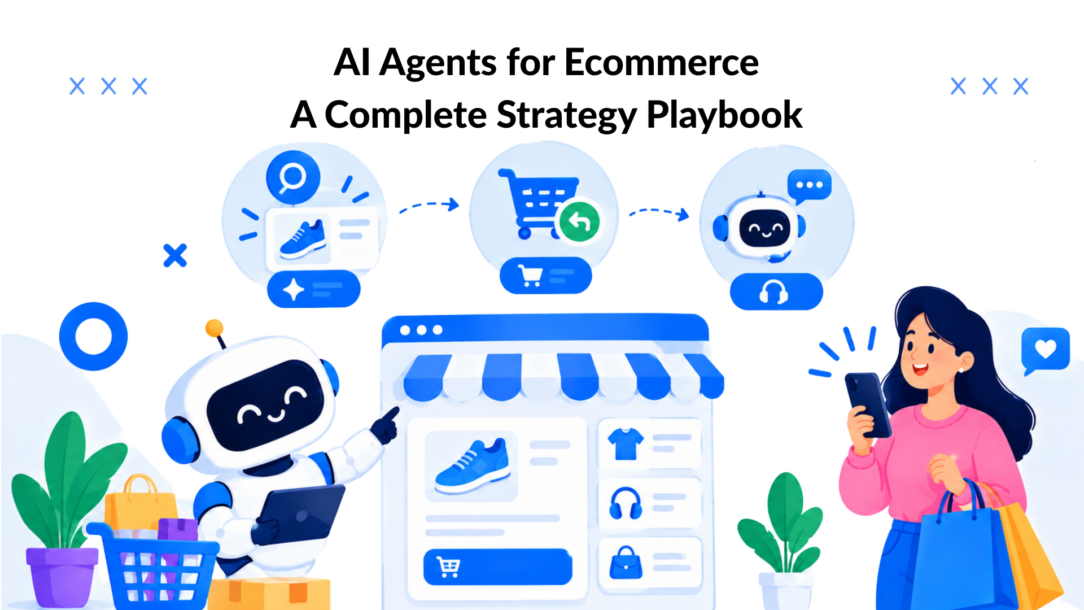
AI-assisted shopping is already far beyond a niche experiment. A consumer study found that 61% of respondents had used general-purpose AI tools such as ChatGPT or Gemini while shopping online, while 57% had used a shopping-specific AI assistant in the past 6 to 9 months. (Bloomreach) The commercial question is no longer whether shoppers will ask AI for help. It’s whether your product data, payment systems, and operating controls are ready when an agent recommends your store.
AI agents for ecommerce can help customers choose products, recover abandoned carts, answer order questions, and support repeat purchases. But an agent that only produces polished replies is still a chat widget. Revenue appears when the system can use trusted catalog data, take approved actions through connected tools, and know when a person must take over.
What AI Agents for Ecommerce Actually Do
An AI ecommerce agent is like a well-trained sales associate on a busy store floor. It knows the products, remembers what a shopper has already asked, checks current availability, and guides the customer toward a sensible choice. If the request becomes unusual or risky, it hands the conversation to a human instead of improvising.
A conventional chatbot often follows a narrow script. It may answer a frequently asked question or route a visitor to a page. An AI agent works toward an outcome, such as finding a suitable product, adding it to a cart, recovering an unfinished order, or resolving a delivery problem. The difference is action, not merely conversation.
For a practical introduction to the broader concept, see this guide to what AI agents are. In ecommerce, the agent’s usefulness depends on the systems behind it. It needs access to product information, customer context, order events, and approved workflows.
The five jobs agents handle
Modern stores can assign an agent to several distinct jobs:
- Guided product discovery: Translate a natural request into filters, then return relevant products.
- Cross-sell and upsell: Identify compatible or useful additions without recommending incompatible items.
- Abandoned-cart recovery: Contact shoppers about items they left behind and answer the objection that stopped checkout.
- Customer support: Handle routine questions about order status, returns, shipping, and product use.
- Post-purchase follow-up: Check whether the customer received the product, collect feedback, and support replenishment.
A shopper might ask for a waterproof jacket suitable for cycling, a particular height, and a defined budget. The agent should turn those preferences into catalog queries, confirm inventory and sizing, and explain why the shortlist fits. It shouldn’t invent a material, promise delivery, or claim a discount that the store hasn’t authorized.
Practical rule: Treat the agent as a staff member with system access, not as a floating answer box.
The same principle applies before launch. If your team needs to convert product URLs into landing pages, those pages and their underlying product information should remain consistent with the catalog the agent uses. A strong language model can’t compensate for contradictory prices, missing attributes, or stale stock.
Why AI Agents Are Becoming a Real Revenue Channel
The market is moving because shoppers are changing how they research products. Deloitte projects that 25% of global ecommerce sales will be enabled by AI agents by 2030, and that 55% of digital consumers will begin product research using large language model platforms by then. (Deloitte)
Those projections describe a change in the first stage of the buying journey. A customer may ask an assistant to compare products, eliminate options that don’t meet a budget, and recommend a short list before visiting a retailer. The brand may still complete the transaction, but the discovery layer increasingly sits outside the traditional search results page.
The category is attracting sustained investment
Independent market research estimates the global AI shopping assistant market at USD 3.36 billion in 2024, with a projection of USD 28.54 billion by 2033 and a 26.9% CAGR from 2025 to 2033. A separate study estimates USD 4.26 billion in 2025, expanding to USD 36.38 billion by 2034 at a 26.8% CAGR. (Smartsupp)
The exact estimates differ because market definitions and research methods differ. The direction is consistent. Retail and ecommerce represent the dominant end-use context, which points to demand for product discovery, guided selling, and automated customer interaction rather than generic workplace automation.
For operators, three practical forces matter:
- Customer tolerance is rising: Shoppers already use general-purpose and shopping-specific AI tools during research.
- Implementation is becoming more accessible: Teams can connect agents to existing commerce, CRM, and support systems instead of rebuilding every workflow.
- The value is measurable: A product recommendation, recovered cart, or resolved support request can be tied to a commercial event.
The strongest early opportunity often sits with mid-market direct-to-consumer brands and marketplaces carrying complex catalogs. These businesses frequently need personalized assistance beyond what their teams can provide manually, while their product, order, and support workflows can often be isolated for a controlled pilot. A sales-focused AI agent resource can help teams think through qualification and conversion workflows, but the commercial case still depends on clean data and carefully defined permissions.
Five High-Impact Use Cases Worth Launching First
Not every ecommerce workflow deserves autonomy on day one. Product discovery usually offers a safer starting point than payment execution because the agent can narrow choices while leaving the final purchase decision with the customer. Cart recovery and routine support can also produce clear operational signals without giving the system unlimited authority.
| Use Case | Agent’s Job | Concrete Example | Data Required |
|---|---|---|---|
| Product discovery | Match shopper needs to eligible products | Recommend three rain jackets for a tall cyclist within a stated budget | Product attributes, sizes, fit guidance, price, stock |
| Cross-sell and upsell | Suggest relevant additions | Recommend camera lenses compatible with the purchased mount and budget | Compatibility data, order history, product relationships |
| Cart recovery | Address hesitation and bring the shopper back | Send a message about the exact abandoned items and an approved incentive | Cart contents, consent status, price, promotion rules |
| Support deflection | Resolve routine questions | Provide an order update or return-label instruction without opening a ticket | Order events, shipping data, return policy, customer identity |
| Post-purchase follow-up | Support adoption and repeat buying | Ask about product use after delivery and surface a reorder path | Delivery status, product lifecycle, feedback, reorder logic |
Product discovery and selling assistance
A shopper might type, “I need a rain jacket for a 6-foot cyclist under $150.” The agent should translate that request into structured filters, verify available sizes, and explain the trade-offs among the remaining products. It needs detailed attributes and current inventory, not just marketing copy. Launch effort is moderate because the catalog must be mapped before the conversation can be trusted.
Cross-selling requires stronger relationship logic. After a camera purchase, the agent can suggest lenses only if it knows the camera’s mount type, the customer’s budget, and whether the recommendation is compatible. This workflow often takes more preparation than a simple FAQ assistant because an attractive but incompatible recommendation damages trust.
Recovery, support, and retention
Cart recovery works best when the message answers a real objection. The agent can reference the items left behind, clarify shipping or returns, and offer only an incentive that the promotion system authorizes. Teams can use web chat, email, or permission-based messaging channels, but consent and timing rules must be connected before launch.
Routine support is usually quicker to implement. “Where is my order?” and “How do I get a return label?” have clear data sources and defined answers. Teams exploring automation tools for selling products should compare the available integrations, approval controls, and reporting rather than focusing only on the conversation interface. Broader chatbot use cases can provide ideas, but each workflow still needs a specific owner and success measure.
Post-purchase follow-up requires a different tone. The agent should check delivery, help the customer use the product, collect useful feedback, and offer a reorder only when the product and timing make sense. This job can strengthen retention, but it shouldn’t turn every customer message into a promotion.
The Hidden Blockers That Decide If Agents Work
Many ecommerce teams start with the model and end with the catalog. That order is backwards. An agent can write a confident recommendation while using a duplicate SKU, a stale inventory record, or an attribute that means something different across product categories.
Think of the catalog as the agent’s brain and payment authorization as its hands. If the brain contains contradictory information, the agent recommends the wrong product. If the hands can’t complete an approved transaction, the customer meets an unnecessary manual handoff at the most sensitive point.
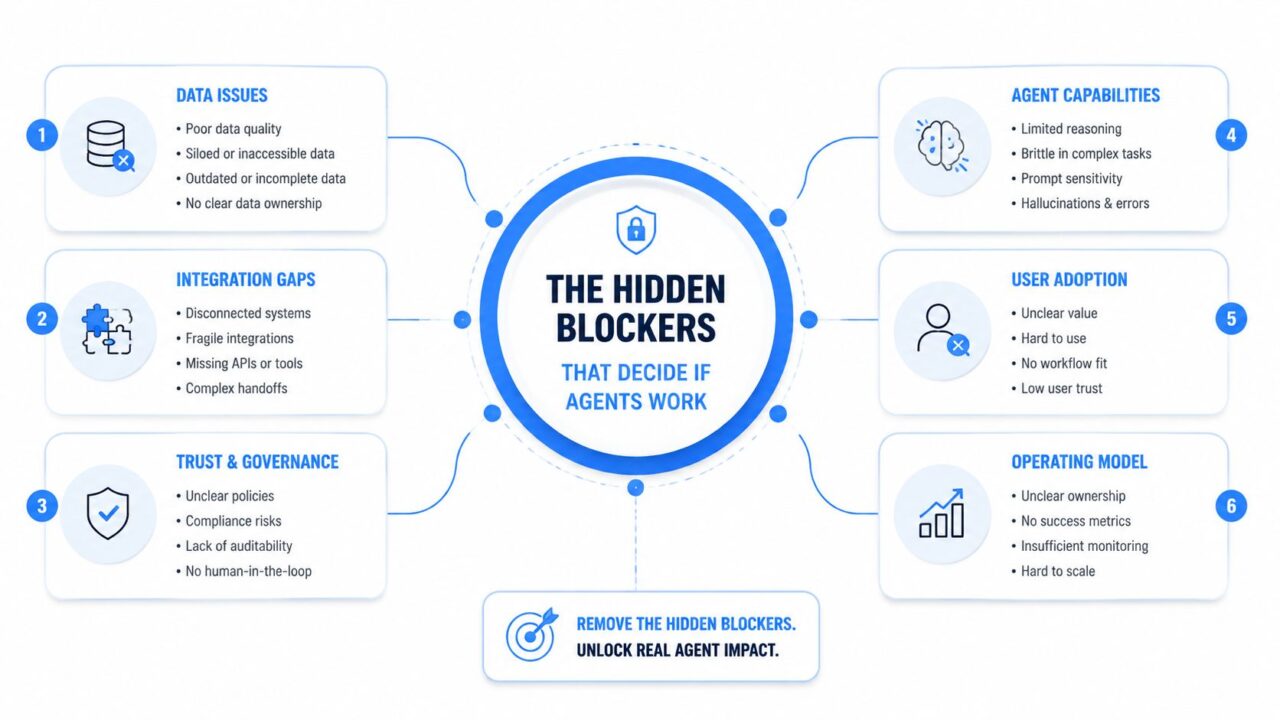
AI Agents for Ecommerce Blocker Diagram
Data readiness comes before personalization
Recent readiness research reports that 40% of ecommerce businesses are still standardizing product pages for agentic AI, while 33% haven’t started. The same research reports that 56% cite data trust and quality as their top challenge, and 46% say their data isn’t actionable. (Digital Applied)
An agent needs more than descriptions. It needs consistent names, variant identifiers, prices, availability, shipping rules, customer history, order events, and returns data. It also needs a clear answer when those sources disagree. Without validation, personalization becomes guesswork with a friendly tone.
Payment creates a separate barrier. Independent 2026 reporting identifies payment authorization, digital identity, security, and consumer trust as critical blockers for agent-initiated transactions. Existing payment and identity frameworks aren’t consistently designed for autonomous purchases, so an agent may be able to discover and recommend products while still requiring a human-controlled checkout step. (GlobeNewswire)
Other blockers include missing consent flags, weak escalation routes, incomplete analytics, and disconnected helpdesk records. Fix these foundations before expanding the agent’s authority.
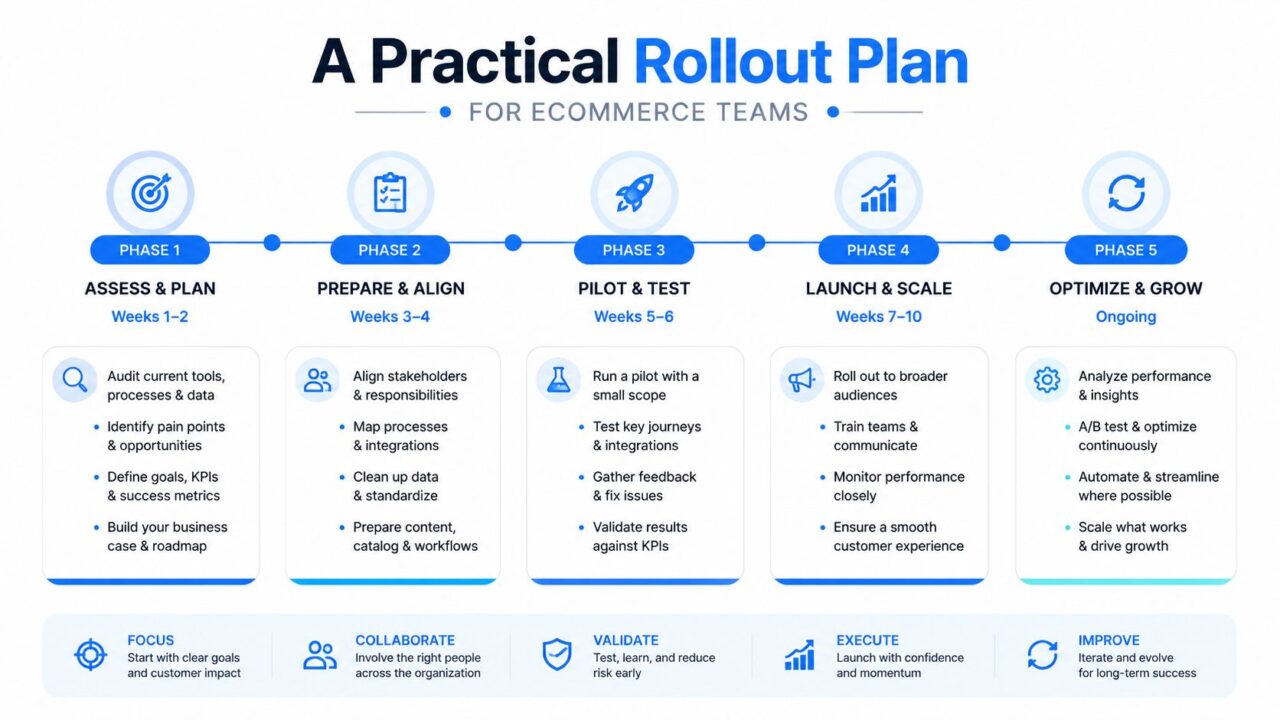
A Practical Rollout Plan for Ecommerce Teams
Start with a contained workflow, not a promise to automate the entire customer journey. A narrow pilot gives your team a way to test data quality, customer reactions, failure modes, and attribution before the agent touches higher-risk decisions.
-
Choose one commercial job. Select product discovery or cart recovery, then define the exact action the agent may take. Keep the first deployment on one surface, such as the storefront or an approved messaging channel.
-
Audit the inputs. Review catalog completeness, variant structure, inventory accuracy, pricing, consent records, order events, and payment scope. If the agent can’t reliably answer basic product or order questions, adding more channels won’t solve the problem.
-
Connect existing systems. Use a no-code or low-code layer where possible so the agent can work with the commerce platform, CRM, helpdesk, and messaging tools already in use. Clepher is one example of a platform that provides conversational flows, AI agents, live chat, segmentation, analytics, and integrations for customer-facing automation.
AI Agents for Ecommerce Rollout Plan
- Run a controlled cohort. Compare agent-influenced sessions with a suitable holdout during the test period. Keep the scope stable so your team can identify whether the workflow affected conversion, recovery, support workload, or customer satisfaction.
A rollout also needs an operational review, not just a launch date. MerchantBench simulates 365 days of order-level operations using 98,843 real product records and 26 tools, and its best LLM configuration reached only 27.3% of the mean final net assets achieved by human participants. (MerchantBench) That result is a warning against unrestricted, long-horizon planning. Use state validation, deterministic rules, and human approval for consequential actions.
SupportAgentBench evaluates 24 LLMs across 162 grounded, multi-turn ecommerce support conversations, including resolution quality, escalation calibration, adversarial safety, policy adherence, and cost tier. (SupportAgentBench) Your test plan should measure those dimensions, not just whether an answer sounds accurate.
- Formalize governance before expansion. Document escalation rules, owners, approval boundaries, retraining procedures, and reporting. Expand from one proven workflow to adjacent use cases only after the controls work consistently.
Metrics That Prove AI Agents Are Working
Engagement metrics can make an agent look busy without proving commercial value. A high conversation count doesn’t tell you whether shoppers found the right product, completed checkout, or received an accurate resolution.
Choose metrics according to the job the agent performs. Keep a baseline for comparable non-agent sessions, and separate assisted orders from orders that the agent merely touched. That distinction helps your team avoid claiming credit for purchases that would likely have happened anyway.
| Use Case | Primary KPIs | Guardrail Metric |
|---|---|---|
| Cart recovery | Recovered-cart rate, revenue recovered per nudge, time from abandonment to outreach | Unsubscribe rate, complaint rate, human handoff rate |
| Product discovery | Assisted conversion rate, average order value, recommendation attach rate | Incorrect recommendation rate, escalation rate |
| Cross-sell and upsell | Recommended-item attach rate, average order value, revenue per assisted session | Return rate for recommended items |
| Support deflection | First-contact resolution, self-service deflection rate, post-interaction CSAT | Escalation accuracy and policy violations |
| Post-purchase follow-up | Feedback completion, repeat-purchase activity, reorder-link use | Negative feedback and inappropriate outreach |
Match the dashboard to the workflow
For cart recovery, measure whether the nudge brought back a customer and how much revenue each outreach generated. Online cart abandonment is almost 70%, according to research cited in an ecommerce study, which makes unfinished purchases a substantial pool for recovery workflows. (AIS Electronic Library) The agent still needs to avoid excessive messaging and should explain shipping, sizing, or returns when those issues caused the hesitation.
For discovery and cross-sell, compare conversion and order value for sessions where the agent helped with a baseline group. Track whether suggested items are attached to orders, then examine returns and complaints. A recommendation that raises order value but creates avoidable returns isn’t a healthy result.
Support teams should review resolution quality alongside deflection. A deflected conversation that leaves the customer confused just moves the cost to a later contact. Review a sample of conversations weekly, especially those involving returns, discounts, delivery exceptions, and ambiguous requests.
Measurement principle: The agent should earn credit for a business outcome, not for producing more messages.
Best Practices for Safe, Scalable AI Agents
Governance belongs in the product design, not at the end of a compliance checklist. Decide who owns the agent, which actions it may perform, which information it can access, and which decisions require human approval before customers encounter it.
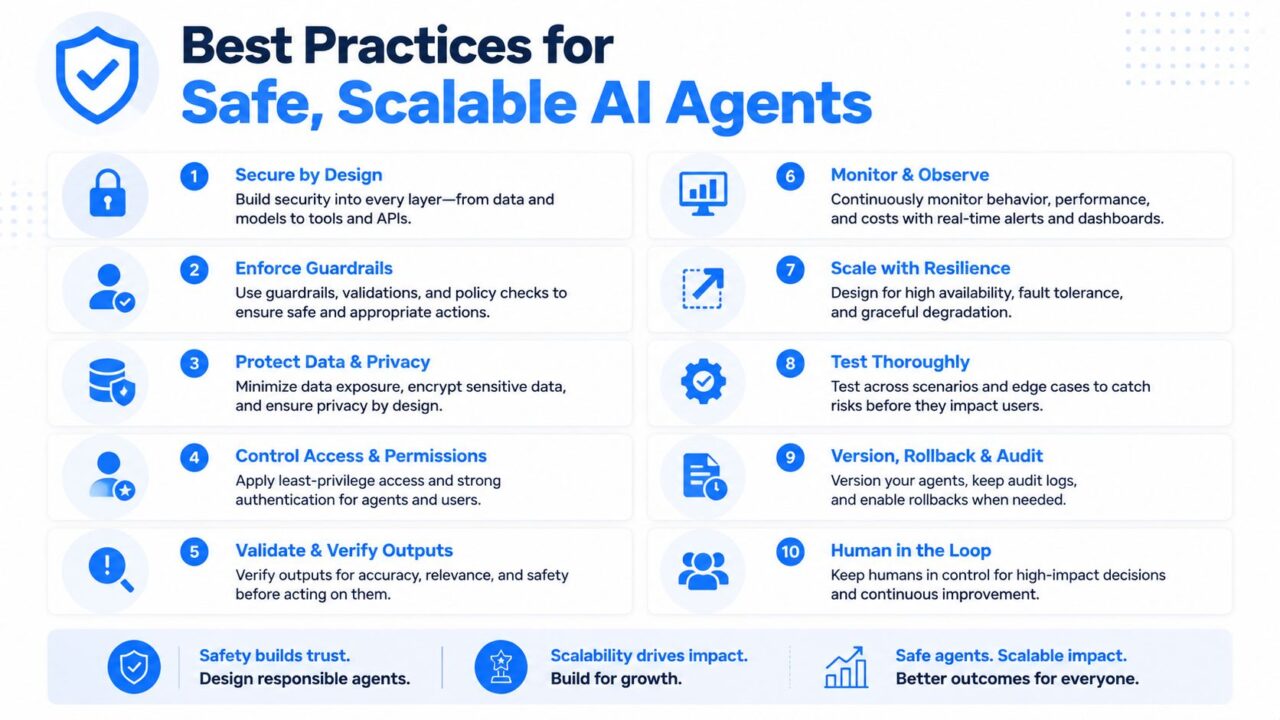
AI Agents for Ecommerce Best Practices
Build a risk-based operating policy
Use this first-week checklist to turn broad principles into working controls:
- Assign ownership: Name the person responsible for policy, performance, incidents, and release approval.
- Define permissions: Separate read access from actions such as refunds, discounts, substitutions, address changes, and payment retries.
- Create escalation rules: Route safety concerns, low-confidence recommendations, sensitive data requests, and unusual returns to trained staff.
- Maintain a policy library: Keep product rules, promotions, shipping promises, and return instructions current and versioned.
- Log changes: Record model, prompt, catalog, integration, and policy changes so your team can trace performance shifts.
- Test failure modes: Include missing attributes, stale inventory, incomplete customer records, ambiguous requests, prompt injection, and attempts to expose private information.
- Protect customer data: Limit collection, use role-based access, encrypt stored information, apply retention rules, and review vendor agreements.
- Provide context at handoff: Give human agents the conversation, customer history, relevant order events, and the proposed resolution.
- Monitor business effects: Review accuracy, containment, escalations, negative feedback, discriminatory recommendations, and unexpected effects across customer groups.
- Keep a fallback: Offer an obvious human contact path and a manual process for outages or integration failures.
The agent should acknowledge uncertainty instead of filling gaps with invented specifications. It mustn’t bypass authorization controls because a customer sounds urgent, and it shouldn’t promise an outcome that the connected system hasn’t confirmed.
Scale workflows, not autonomy
Autonomous checkout deserves special caution. Payment authorization and digital identity remain infrastructure concerns, and customer trust can fall quickly when an agent acts without a clear permission boundary. Start with assisted discovery or support, then reuse proven controls for retention and cross-sell rather than granting every channel the ability to transact.
Around 43.6% of brands already use AI agents in at least one major ecommerce area, while 26% say they’ve expanded agents across multiple touchpoints. The same report identifies product discovery as the highest-ROI area at 82.4%, followed by support at 73.1% and post-purchase interactions at 68.3%. (Salesmate) Those findings support a practical sequence: begin where the customer value is visible and the risk is contained, then expand after measurement and escalation work.
Operator’s advice: Prove one workflow, standardize its controls, and only then give the same agent more responsibility.
Clepher provides no-code conversational flows, AI agents, live chat, segmentation, analytics, and integrations for marketing, sales, support, and ecommerce workflows. Visit Clepher to connect customer conversations with product assistance, order tracking, FAQ automation, and lost-sale recovery in a controlled rollout.

Related Posts
10 Lead Capture Software Tools Compared for 2026
October 18, 2026WhatsApp Chatbot for Ecommerce: A Practical 2026 Guide
October 17, 2026What Is Lead Scoring and How It Drives Real Sales Results
October 16, 2026
Founder Clepher