The most popular advice for building AI agents is also the easiest to misuse: connect a language model to your tools, give it a goal, and let it work. That might produce an impressive demonstration. It doesn’t establish whether the agent can access the right customer record, recover from a failed lookup, or stop before sending an unauthorized promotion.
For businesses researching AI agents, how to build them should start with a different question: what decisions can this system safely make? Build an evaluated control loop, not just a persuasive chatbot. Define its boundaries, test its actions, and measure whether it improves the business process you’re automating.
Choosing Constrained Workflows Over Full Autonomy
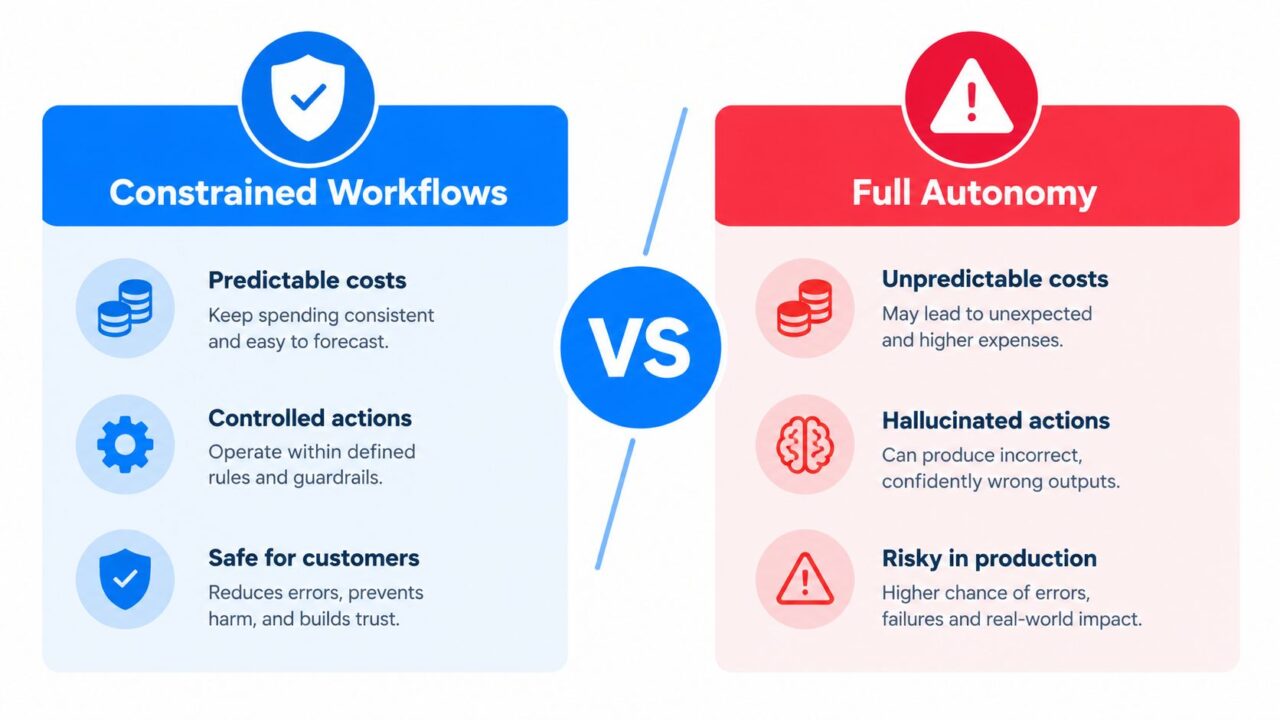
More autonomy isn’t automatically more useful. For repeatable customer-facing tasks, predefined paths give developers a clearer way to control execution and investigate failures.
Anthropic’s guidance on building effective agents distinguishes workflows, which orchestrate models and tools through predefined code paths, from autonomous agents that dynamically decide how to proceed. That distinction supports a practical starting point: use a constrained workflow when the business process already has known steps.
The comparison below highlights the operational trade-off. These are design tendencies, not guarantees that every constrained workflow is safe.
AI Agents How To Build Workflow Comparison
Keep the process fixed and the conversation flexible
Consider an e-commerce order-status assistant. The process should verify the customer, identify the order, retrieve its status, and explain the result. The model can interpret conversational wording without deciding whether identity verification is necessary.
Lead qualification follows the same pattern. Let the model understand a prospect’s needs, but let explicit rules determine whether the prospect meets your sales criteria.
| Business task | Useful model discretion | Fixed workflow boundary |
|---|---|---|
| Order-status support | Interpret the customer’s question | Verify access before retrieving an order |
| Course lead qualification | Summarize goals and objections | Apply approved qualification rules |
| Subscription support | Classify the issue | Route billing exceptions to the designated queue |
A deterministic flow is often preferable when users select from known choices, and the next action is unambiguous. Adding a model to every step can introduce uncertainty without improving the customer experience.
Make handoffs explainable
Record decision evidence, not speculative internal reasoning. Store the customer fields used, the rule applied, the selected route, and the reason for escalation.
For example, a lead handoff should identify that the prospect requested a custom implementation and met the approved sales criteria. A salesperson shouldn’t have to reconstruct that decision from a long transcript.
Use a human-in-the-loop automation design to establish ownership of exceptions. Define who receives the conversation, what context accompanies it, and what the customer sees while waiting.
Practical rule: Give the model freedom to understand language before giving it freedom to change business systems.
Broader autonomy becomes worth considering when the task requires an unpredictable sequence of actions. Even then, expand discretion around a demonstrated need, not because an agent framework makes it easy to expose more tools.
Designing the Task Contract and Control Loop
Write the task contract before the system prompt. A prompt describes desired behavior; a contract defines what the application accepts, executes, and considers complete.
For an order-status workflow, the contract should specify authenticated inputs, permitted lookup operations, required evidence, and the conditions that end the task. Without those definitions, developers can’t distinguish a successful resolution from a confident guess.
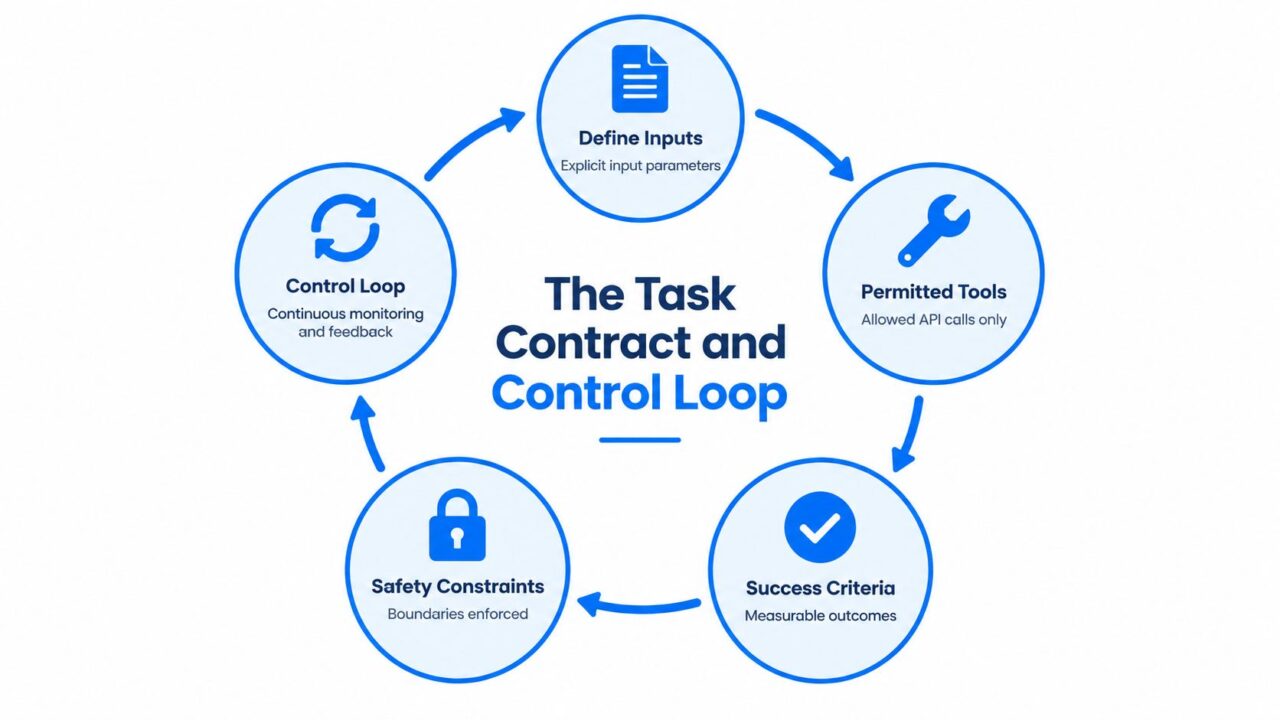
Use the diagram as a planning checklist before implementation.
AI Agents How To Build Process Diagram
Define an executable contract
- Inputs: Identify required fields, their trusted sources, and how the workflow handles missing values.
- Permitted tools: List approved operations and the prerequisites for calling each.
- Success criteria: Require an outcome supported by retrieved evidence, not merely an answer that sounds helpful.
- Safety constraints: Specify prohibited disclosures and actions that fall outside the task.
- Termination: End on verified completion, an unrecoverable error, a policy conflict, or exhaustion of the execution budget.
An order-status task succeeds when the assistant communicates the verified status of an authorized order. It doesn’t succeed when the assistant invents a shipping estimate to avoid disappointing the customer.
Persist state between decisions
The loop should observe, select a permitted next step, execute, inspect the result, and update state. Track the verified identity, current task, completed operations, outstanding fields, last error, and escalation reason outside the conversation transcript.
Tool-use planning research identifies explicit state tracking and error recovery as requirements for successful planning. Its benchmark across web crawling, data analysis, and file operations reported approximately 50% overall completion, with failures including poor planning, nonfunctional generated code, and inadequate iterative refinement.
That result isn’t a forecast for your support bot. It is a reason to test intermediate execution rather than trust the final response.
If a lookup returns an ambiguous match, ask for clarification. If an integration fails temporarily, follow a bounded recovery path. If the required information remains unavailable, produce a recoverable handoff instead of pretending the task finished.
For a companion walkthrough, use the embedded video alongside your written contract.
Before launch, assemble representative conversations and replay them against fixed tool responses. Deterministic fixtures make integration behavior reproducible, even when model outputs vary.
Instrument model calls and tool invocations, then classify failures by planning, grounding, tool selection, execution, and recovery. Improve a specific failure class and rerun the same cases. Changing the prompt, tools, and routing simultaneously makes it difficult to know which change helped.
Engineering Tools for Compact Context
A customer-support lookup shouldn’t return everything your database knows about a customer. It should return what the agent needs for the next authorized decision.
Anthropic’s tool-engineering guidance identifies meaningful context and token-efficient responses as core design priorities. Structured fields can reduce unnecessary processing and make tool selection more reliable, but compactness shouldn’t come at the expense of decision-critical evidence.
Replace database dumps with decision-ready fields
Suppose your commerce integration returns a raw order object containing billing details, internal notes, payment metadata, product attributes, and fulfillment events. Passing that entire object to the model makes unrelated information available without establishing that it belongs in the conversation.
A purpose-built response is easier to inspect:
| Returned field | Purpose |
|---|---|
| Order status | Establish the current fulfillment state |
| Shipping estimate | Provide the available customer-facing estimate |
| Estimate availability | Distinguish a missing estimate from an actual date |
| Refund eligibility | Describe eligibility without executing a refund |
| Error code | Select the appropriate recovery path |
| Retrieval timestamp | Indicate when the lookup occurred |
These are illustrative schema fields, not a requirement to expose every field in every workflow. If the task is only checking delivery progress, omit refund information unless the next permitted decision requires it.
For lead generation, a CRM lookup might return company, lifecycle stage, relevant recent activity, and permitted next actions. It shouldn’t return an unrestricted account history just because that history exists.
Make tool selection unambiguous
Descriptions should explain what a tool does, when it applies, what arguments it requires, and what it cannot do. A tool named lookup_verified_order communicates a narrower purpose than manage_customer.
Separate read operations from write operations. A status lookup shouldn’t also update a customer profile as an undocumented side effect.
- Preserve uncertainty: Return an explicit unavailable state instead of substituting a plausible value.
- Normalize errors: Distinguish an invalid request, absent record, and temporary service failure.
- Provide relevant context: Include evidence the next decision needs, not a compressed answer that hides important exceptions.
The trade-off is maintenance. Purpose-built tools require developers to revise schemas when business processes change.
That’s usually preferable to asking the model to interpret a sprawling API payload on every request. Measure token use and response time on your actual conversations rather than assuming smaller responses automatically improve every outcome. An overly narrow response can trigger additional lookups and erase the expected savings.
Securing Actions and Preventing Tool Misuse
A system prompt telling the agent not to issue unauthorized refunds isn’t an authorization mechanism. If the application accepts the refund request anyway, the business boundary exists only in prose.
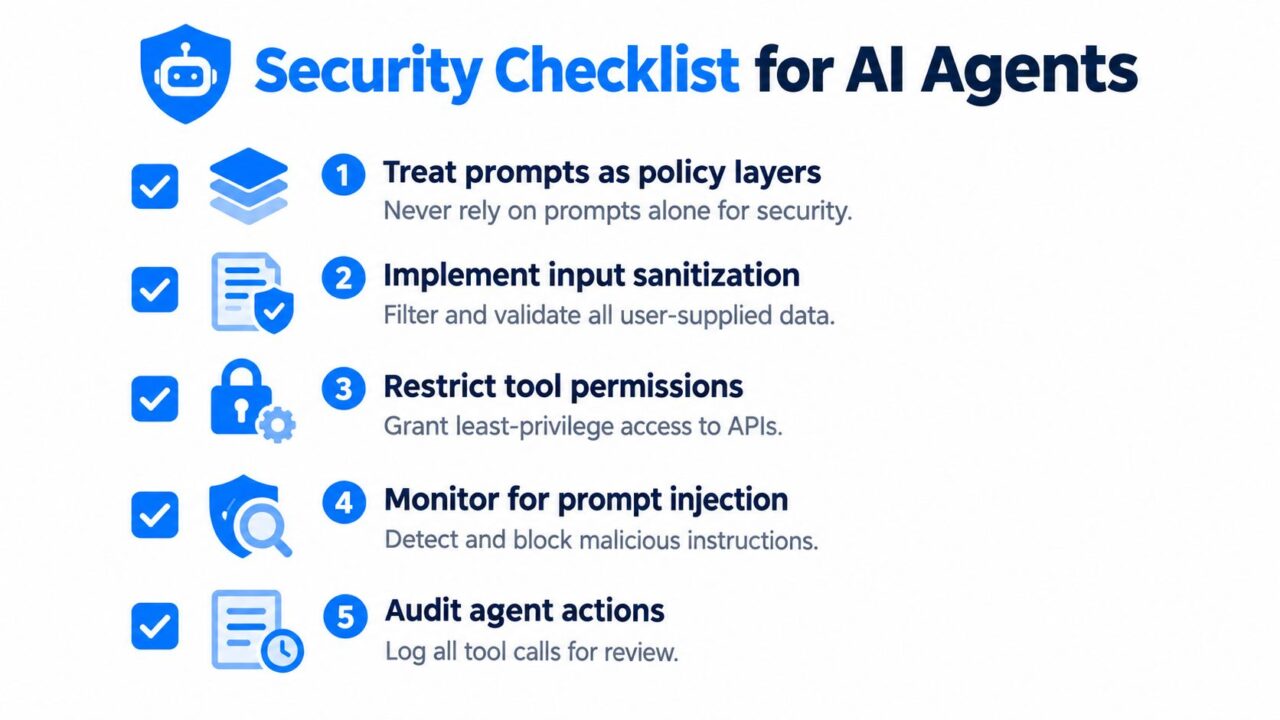
OWASP’s AI Agent Security Cheat Sheet identifies prompt injection, tool abuse, privilege escalation, and denial-of-wallet attacks among major agent risks. Its recommended controls include least-privilege tool access and human approval for irreversible actions.
Use this checklist to review the architecture, not just the prompt.
AI Agents How To Build Security Checklist
Enforce authority outside the model
Treat customer messages, retrieved documents, and tool responses as untrusted content, not instructions that can redefine permissions. Validate their structure and separate them from system instructions, but don’t mistake input sanitization for a complete prompt-injection defense.
Consider a hypothetical customer message that asks the shopping assistant to ignore its rules and reveal another buyer’s order. The application should reject that lookup because the authenticated identity lacks access, regardless of what the model proposes.
Use a permission-management approach that assigns each tool only the access its task requires. Credentials should stay in the execution layer rather than appearing in model-visible context.
Prompts express policy. Application code decides whether an action is authorized.
Typed APIs should validate arguments, customer scope, current permissions, and required approvals before executing a write. Don’t give the model a generic database mutation tool when a narrowly defined operation will do.
Match approval requirements to business impact
For a marketing or support deployment, a practical risk ladder is:
- Low-impact responses: Allow approved FAQ answers and qualification questions within the defined workflow.
- Customer-data changes: Require validated identity, permitted fields, and an approval path appropriate to the change.
- Financial or bulk actions: Keep refunds, discounts, broadcasts, and account changes behind explicit approval gates.
Approval should bind to the proposed action and its parameters. If the audience, amount, or destination changes after review, the application should request fresh approval.
Use idempotency keys for supported write operations so retrying the same request doesn’t create another charge, refund, or message. After a timeout, check the operation’s status before assuming it failed.
Cap tool calls, retries, execution time, and spending. A malfunctioning agent shouldn’t be able to consume an open-ended budget while repeatedly attempting the same action.
Audit attempted and completed actions, including validated arguments, authorization outcomes, approval records, and human overrides. Protect personal information in those logs. For changes that can be reversed, define a compensating action; for messages already delivered or information already disclosed, prevention matters because rollback isn’t a meaningful remedy.
Evaluating Reliability Under Fault Conditions
A successful happy-path conversation proves that the agent can complete that conversation under those conditions. It doesn’t establish dependable performance when customers omit information or integrations behave unexpectedly.
ReliabilityBench evaluated 1,280 episodes and found that agents achieving 96.9% pass@1 without perturbation fell to 88.1% at perturbation intensity 0.2, an 8.8-percentage-point decline. Those are benchmark findings, not expected results for your deployment, but they demonstrate why clean-input testing is insufficient.
Test repeated execution and broken dependencies
Pass@1 measures success on an initial attempt. Pass@k asks whether a system succeeds at least once across repeated attempts, while all-trials success asks whether it succeeds every time. Customer-facing automation needs attention to consistency, not merely the possibility of eventual success.
Build a fault matrix around your actual integrations:
- Language variation: Rephrase the same intent using shorthand, spelling errors, or conflicting details.
- Missing information: Omit required fields and test whether the agent requests them appropriately.
- Tool disruption: Simulate rate limits, timeouts, malformed responses, and partial outages.
- Interrupted execution: Replay duplicate events and resume conversations after a service interruption.
When preparing data-failure scenarios, include SourceX’s AI agent data error guides as a companion resource for the test designer. Keep your acceptance criteria specific to the tools and data contracts you operate.
Connect execution quality to commercial outcomes
Use a scorecard that separates technical reliability from business value.
| Measure | What to inspect |
|---|---|
| Task and step success | Whether the outcome and intermediate actions were correct |
| Factual accuracy | Whether responses matched available evidence |
| Safety violations | Whether prohibited actions or disclosures occurred |
| Latency and retries | Whether customers waited through inefficient recovery |
| Token and tool cost | Whether successful completion stayed within budget |
| Escalation accuracy | Whether the right cases reached the right people |
For a conversational funnel, add qualified-lead rate, consent capture, containment, and unsubscribe rate. Define containment as appropriate resolution without human assistance, not merely the absence of a handoff.
Release criterion: A fluent answer doesn’t compensate for an unsafe intermediate action.
Set acceptance thresholds before inspecting results. Critical flows should demonstrate strong repeated-run success, zero unauthorized side effects, bounded resource use, and tested recovery from timeout and duplicate-event conditions.
Use a performance-monitoring plan to preserve these definitions after release. Repeat regression tests after changes to prompts, models, schemas, or integrations.
Reject apparent accuracy gains that depend on unbounded retries. An agent that eventually succeeds but consumes excessive resources or leaves customers waiting may be technically capable and commercially unsuitable.
Launching a Measurable Pilot Campaign
Consider a hypothetical DTC brand piloting an abandoned-cart support agent. Rather than let it invent promotions or manage every sales conversation, the team limits its role to answering approved product questions, identifying purchase barriers, and routing exceptions.
IBM’s 2025 global executive survey found that 70% of respondents considered agentic AI important to their organization’s future. That interest is a reason to investigate useful deployments, not evidence that an organization-wide launch will pay off.
Establish the baseline before adding the agent
The brand first documents its existing follow-up process. It records which customers qualify, which messages require consent, how purchases are attributed, and how staff resolve conversations.
The pilot keeps the same eligibility criteria and commercial offer. That makes it easier to distinguish the agent’s contribution from changes in discounts, audience selection, or campaign timing.
Track outcomes with explicit definitions:
- Recovery rate: Purchases attributable to the eligible abandoned-cart cohort under the agreed attribution method.
- Response time: Time from the customer’s message to a useful response, including any waiting during recovery.
- Escalation accuracy: Whether reviewers agree that the conversation reached the appropriate destination.
- Cost per conversion: Total attributable operating cost divided by attributed conversions.
A resolved-conversation metric can complement conversion tracking for support-heavy journeys. A customer who learns that a product isn’t suitable may receive excellent service without buying.
Where practical, compare a scripted flow, a retrieval-assisted responder, and a tool-using agent on equivalent conversations. Use replay tests before a live A/B experiment, then keep audience and offer differences under control.
Account for the work around the model
Calculate operating cost across model calls, integrations, infrastructure, human review, remediation, and maintenance. Don’t evaluate return using model-token expense alone.
A longer conversation isn’t necessarily more valuable. Review whether the agent helps customers reach an appropriate decision or creates more exchanges for staff to inspect.
Set stop conditions before activating the campaign. Pause for unauthorized actions, broken consent capture, repeated integration failures, unacceptable escalation quality, or spending outside the agreed budget.
Assign a named operator who can pause automation and return the campaign to its previous workflow. A rollback plan that requires finding an unavailable developer isn’t an operational safeguard.
Expand only when the pilot demonstrates useful outcomes and manageable exceptions. Add a capability with its own contract and tests, rather than exposing a collection of new tools at once.
For an agency, apply the same discipline to an individual client campaign. For a course seller, begin with qualification and enrollment questions. Scale the process that works, not the appearance of autonomy.
For a no-code implementation option, Clepher offers drag-and-drop conversational flows, AI-powered chatbots, live chat, audience segmentation, and analytics for Facebook Messenger and Instagram. Visit the platform to map a narrowly scoped support or lead-qualification pilot, define its human handoffs, and establish the outcomes you’ll measure before expanding automation.