
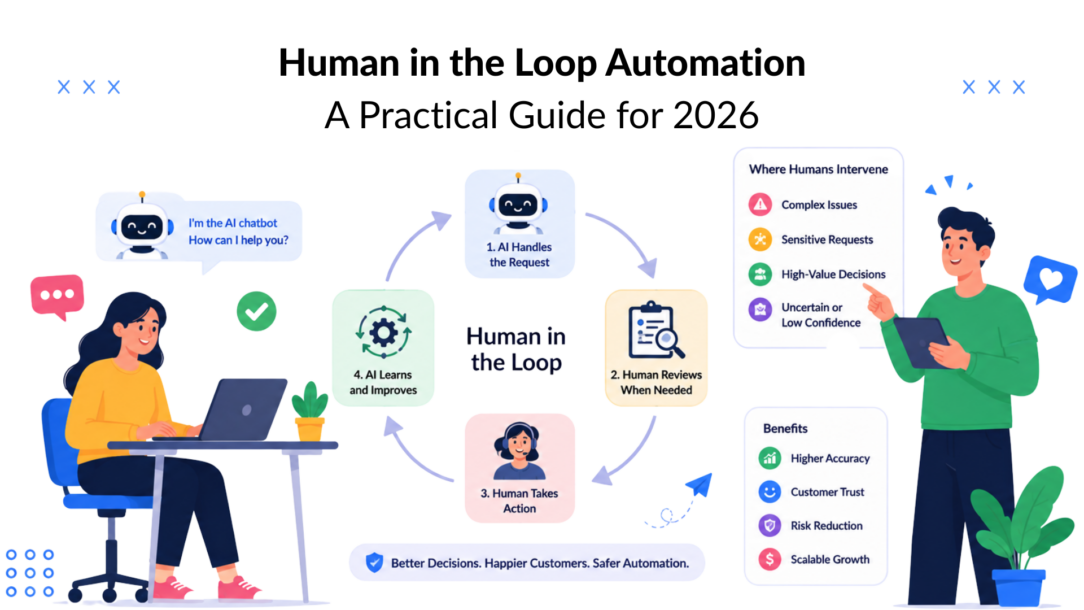
Your chatbot handles product questions, shipping updates, and routine order checks without help. Then a repeat customer types, “I need a refund because the replacement arrived damaged, but I still want to keep the original order.” The bot sees the word “refund,” sends a standard policy message, and repeats the same apology when the customer explains the situation again.
The problem isn’t that the AI made a wrong prediction. It lacks the customer’s full intent, order history, and authority to make an exception. By the time a support agent opens the conversation, the buyer is already close to abandoning checkout.
The agent checks the order ID, purchase history, delivery status, and refund eligibility in the CRM. They approve a partial refund, explain the next step in live chat, and keep the customer moving toward a purchase. That handoff is human-in-the-loop automation, a deliberate point where AI pauses, asks for help, or transfers control to a person.
When the Bot Gets It Wrong, and the Human Saves the Sale
A customer named Maya starts a conversation through a website chatbot after receiving a damaged replacement item. She isn’t asking for a generic refund. She wants the business to recognize that she has already contacted support, that the original order remains useful, and that a partial remedy would solve the problem.
The bot doesn’t see that context. Its intent classifier maps the message to a general refund flow, then retrieves the same policy script it would send to a first-time visitor. Maya clarifies the issue, but the chatbot continues apologizing and repeating the policy. The conversation becomes a loop rather than a service interaction.
The failure point is operational. The bot has access to the current message, but not enough usable context from the CRM fields that matter, such as order status, replacement status, customer value, previous contacts, and refund eligibility. It also has no permission to approve a judgment call.
A human agent enters the live chat after the escalation rule detects repeated misunderstanding. In the agent view, they can see the transcript, the order record, and the customer’s previous contact. The agent confirms the shipment, approves a partial refund, and explains that Maya can keep the original item. The customer completes the purchase instead of leaving frustrated, thanks to the automated system in place.
Practical rule: A human checkpoint should change the decision, not merely observe what the bot already decided.
Real-time agent assistance fits into the workflow. The point isn’t to send every conversation to a person. It’s to give a reviewer the context and authority needed to resolve the cases that automated scripts can’t handle safely.
A useful handoff answers four questions, including the role of human involvement in the process.
- Why did the conversation escalate? The reviewer should see the trigger, such as conflicting intents, repeated fallback messages, or a sensitive request.
- What does the customer need? The transcript should sit beside relevant CRM and order information.
- What can the reviewer do? Permissions should cover the actions required, whether that means issuing a refund, changing a subscription, or taking over the chat.
- What happens afterward? The decision should be logged so the team can improve the flow, guidance, or escalation rule.
HITL isn’t a bandage applied after an AI failure. It’s the operating design that determines where automation stops and human judgment begins.
What Human in the Loop Automation Actually Means
Human in the loop automation means an AI system handles routine volume while a person reviews, approves, corrects, or takes over selected decisions. The selection matters. A team that inserts a human into every message hasn’t designed an efficient HITL system. It has recreated manual work around an AI interface.
The underlying idea predates modern AI. Research on human machine systems in the 1940s and 1950s, including feedback-loop thinking associated with Norbert Wiener, established the principle that people should observe system behavior and intervene when necessary, as described in this historical overview of human machine control systems. Decision-support systems carried that approach into business management and military command scenarios in the 1960s and 1970s.
A customer chatbot makes the pattern easier to see. The AI handles “Where is my order?” automatically. A person becomes involved when the request combines a missing package, a prior failed delivery, and a demand for compensation.
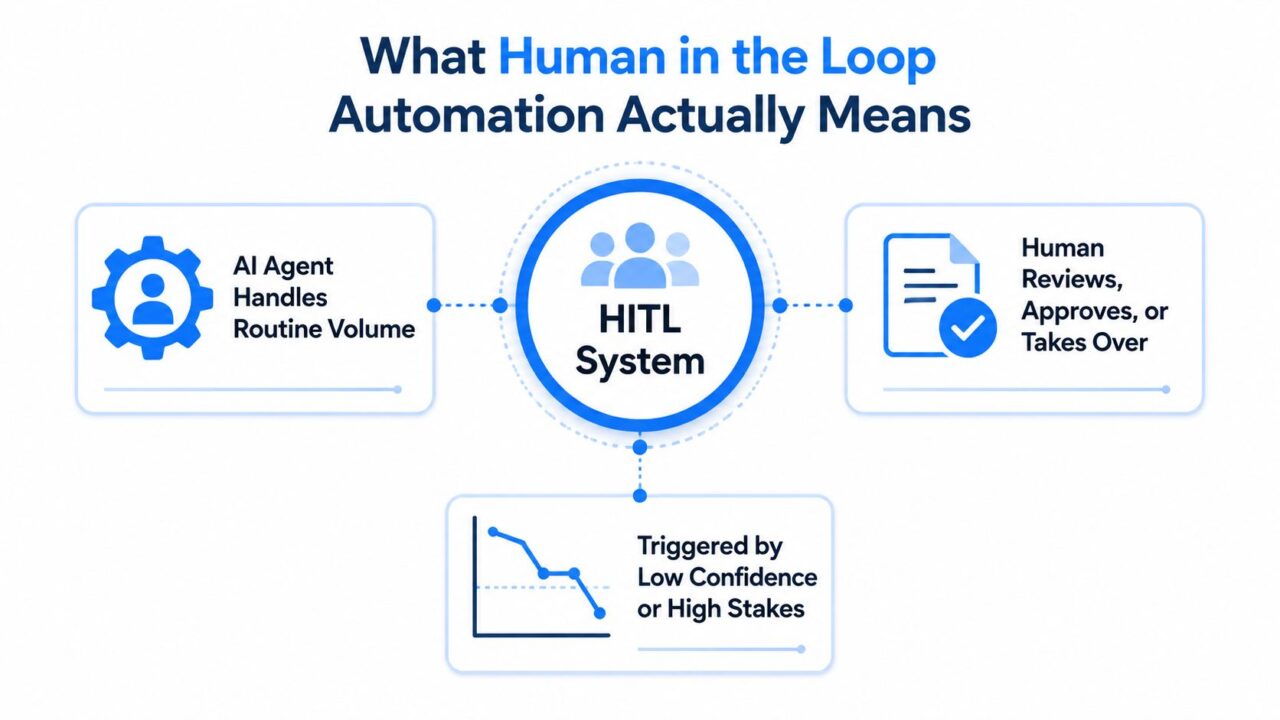
Human in the Loop Automation System
Three places to add the human
Before the AI replies, a pre-check. The system sends the draft to a reviewer before the customer sees it. This works for regulated offers, sensitive complaints, or high-value sales conversations. The trade-off is speed. Every review adds waiting time, so the pattern suits high-risk messages better than ordinary support.
During the reply, side-by-side confirmation. The bot drafts an answer while an agent watches the conversation and accepts, edits, or replaces it. This preserves conversational pace and gives the reviewer immediate control through human involvement. It also demands attention, which can create fatigue if agents must monitor too many chats.
After the reply, sampled review and override. The AI responds automatically, then a person checks selected conversations or investigates a trigger. This supports scale and quality monitoring, but it won’t prevent every bad message in real time.
Teams looking for a broader framework can use this human in the loop automation playbook from Sift AI to compare intervention patterns. Match the checkpoint to the consequence of failure, the information available to the reviewer, and the response time the customer expects.
How HITL Workflows Are Built Around AI Agents
A reliable workflow treats the human as one component in a chain, not as an emergency inbox. The chain begins with an inbound message and ends with an action, a record of the decision, and feedback that can improve future routing.
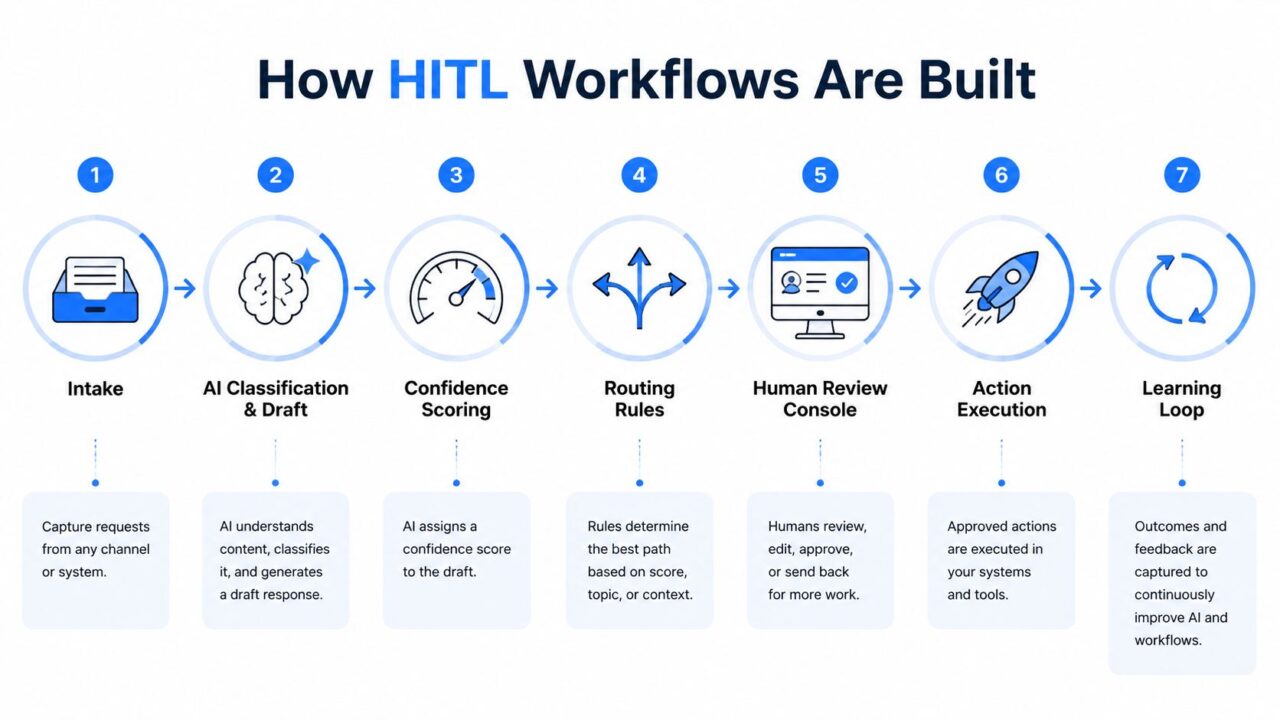
Human in the Loop Automation Workflow Diagram
A practical flow looks like this:
- Intake: Capture the message, channel, customer identity, conversation history, and relevant event data.
- AI classification and draft benefit from human feedback to ensure quality. Identify the likely intent and prepare a response or recommended action.
- Confidence scoring: Estimate whether the AI has enough information to proceed.
- Routing rules: Send routine cases forward, and route uncertainty, risk, or policy exceptions to the right queue.
- Human review console: Show the transcript, customer record, AI reasoning or rationale, proposed reply, and available actions.
- Action execution: Let the reviewer send the response, update the CRM, issue the approved remedy, or take over the conversation.
- Learning loop: Store the trigger, AI output, human decision, edit, and final outcome for later analysis.
The confidence threshold is the central control. It shouldn’t be the only control. A chatbot may have high confidence in a refund intent but still require review because the customer has a disputed charge, a legal complaint, or an unusual account history.
A confidence score answers “how sure is the model?” It doesn’t answer “should the business allow this action?”
Routing rules should also account for repeated fallback messages, contradictory customer statements, restricted topics, and actions that need explicit approval. Each queue needs a service-level expectation, an owner, and a fallback path when nobody responds.
For example, a marketing chatbot could allow automatic product recommendations but send discount requests involving an existing complaint to a sales or support queue. The reviewer sees the customer’s tags, campaign source, prior purchases, open tickets, and suggested reply, ensuring human oversight. They shouldn’t have to reconstruct the case from a transcript alone.
Teams designing support operations can also consult Mava’s community support automation guide, especially when they need to connect automated answers with escalation and community context. For foundational terminology, this guide to AI agents helps distinguish an agent that can perform actions from a simple chatbot that only returns text.
Where HITL Delivers the Most Value Across Teams
The right HITL pattern changes by team. Marketing usually tolerates review time before a campaign launches. Support needs fast intervention during a live customer problem. A conversational chatbot may need both, automatic handling for routine questions and immediate takeover for sensitive or ambiguous exchanges.
| Team | HITL Trigger | Human Action | Expected Outcome |
|---|---|---|---|
| Marketing | Brand-sensitive copy, unusual audience segments, or compliance flags | Approve, edit, or reject the message and audience logic | Safer campaigns with a consistent brand voice |
| Support | Complex ticket, refund exception, or low-confidence answer | Review customer history, authorize a remedy, or take over | Better resolution of cases that need judgment |
| Chatbots | Fallback intent, sensitive disclosure, repeated misunderstanding, or request for an agent | Join the conversation, clarify intent, and complete the action | Fewer loops and more useful customer interactions |
Marketing campaigns
A marketer can place a review gate before an AI-generated promotion reaches an audience. The reviewer checks claims, tone, offer terms, exclusions, and personalization fields. They can also inspect edge-case segments, such as customers with unresolved complaints or subscribers who recently canceled.
The trade-off is campaign velocity. A review step makes sense for a new offer or sensitive claim, but it can become wasteful if a team manually approves every routine variant. Sampled audits and clear approval rules preserve speed without surrendering control.
Customer support
Support teams benefit when the human action is explicit, enhancing the feedback loop. “Escalate difficult cases” is too vague. Better rules identify what the agent must do, such as verify account history, approve a remedy, explain a policy exception, or transfer a regulated issue.
The reviewer needs the right context and permissions. If they can only write a note but can’t update the order or subscription, the customer still waits for another handoff.
Conversational chatbots
Chatbots sit between marketing and support. They qualify leads, answer product questions, recover abandoned conversations, and sometimes receive sensitive disclosures. A fallback flow should preserve the transcript, identify the reason for escalation, and avoid making the customer repeat the story.
Use post-conversation review for quality trends, not as a substitute for live intervention. A sampled conversation can reveal that the bot’s wording is technically accurate but confusing, too promotional, or out of step with the brand.
Metrics That Tell You If HITL Is Working
HITL can look successful while hiding a slow queue and expensive manual work. Total messages deflected tells you how much the bot touched, not whether customers received better outcomes. Measure the entire path from automation to escalation to resolution.
A useful first dashboard combines operational, quality, and commercial indicators:
| KPI | What It Measures | Target Range | Cadence |
|---|---|---|---|
| Automation rate | Share of conversations completed without human action | Set a baseline, then improve by workflow | Weekly |
| Human takeover rate | Share requiring a person to intervene | Keep aligned with the intended escalation design | Weekly |
| Average review time per case can decrease with full automation of certain processes. | Reviewer effort for each handoff | Reduce unnecessary steps without shortening essential review | Daily and weekly |
| First-contact resolution | Whether the issue is solved in the initial interaction | Improve after better routing and context | Weekly |
| Escalation accuracy | Whether a handoff was actually needed | Increase agreement between routing and reviewer judgment | Weekly |
| CSAT after human touch | Customer response after intervention | Compare with automated resolutions and watch for declines | Weekly |
| Cost per resolved conversation | Labor and system cost for a completed case | Track by intent and channel | Monthly |
| Reviewer agreement with AI | How often reviewers accept or closely edit the draft | Use as a leading indicator of fit and drift | Weekly |
| Thirty-day retention can be improved with the help of an ai model. | Whether the interaction supports continued customer activity | Review by escalation type and customer segment | Monthly |
The brief provides no universal benchmark ranges for these KPIs, and teams shouldn’t invent targets that ignore their channel, staffing model, or risk level. In the first 90 days, establish a baseline for each metric, define a direction of improvement, and set an owner for every dashboard view.
Read the metrics as a system
A lower takeover rate isn’t automatically good. It may mean the AI handles routine requests better, or it may mean the escalation trigger is missing real failures. Pair takeover rate with escalation accuracy, repeat contacts, first-contact resolution, and CSAT.
Review time needs the same care. A short review can indicate a well-designed console, or it can indicate rubber-stamping. Sample the decisions and compare the agent’s action with the customer’s eventual outcome.
Evaluation should also move beyond a single accuracy score. A multi-stage evaluation framework for human-in-the-loop systems separates controlled mechanism testing, realistic field studies, and longitudinal audits. That approach helps reveal whether human intervention works only under test conditions or remains stable as conversations, policies, and customer behavior change.
Implementing HITL Inside No-Code Chatbot Platforms
Start with the conversation map, not the tool. List the intents your bot handles, the actions it can take, and the situations where a wrong answer creates customer, financial, or compliance risk.
For each intent, define what happens at three levels:
- Automatic handling: The bot has enough context and permission to respond or act.
- Human review: The bot can draft a useful response, but a person must approve or edit it.
- Immediate takeover: The topic is sensitive, ambiguous, or outside the bot’s authority.
A no-code flow in a platform such as Clepher can represent these states with conditions, tags, fields, fallback responses, and a live-agent handoff. The important design choice is the trigger. Use confidence signals where available, but also include explicit phrases such as “speak to a person,” repeated failed intents, flagged topics, and actions that require approval.
Build the handoff around context
The human review node should pass more than the latest message. Include:
- Conversation history: The reviewer needs the full exchange and the failed route.
- Customer data: Show CRM fields, tags, order details, subscription state, and prior tickets where permitted.
- AI recommendation with human feedback: Present the suggested answer or next action, but make editing easy.
- Reason for escalation: State whether the trigger was uncertainty, a policy topic, a repeated fallback, or a direct request.
- Available permissions: Make the permitted actions visible so the reviewer knows what they can complete.
Route the case to a shared inbox, a native agent view, or a team channel such as Slack. Connect the flow to the CRM, helpdesk, or CDP so the agent doesn’t have to search across disconnected systems. If the integration can’t carry history, the human step will feel like a transfer of work rather than an improvement.
Teams that want to compare no-code implementation patterns can review a no-code AI agent builder that incorporates machine learning for better performance, alongside other workflow tools. The platform matters less than the handoff contract: trigger, context, authority, response time, and logged outcome.
Train the people in the loop
Create examples of acceptable decisions and run calibration reviews before launch. Ask reviewers to explain why they approved, edited, or rejected a draft. When agents disagree, update the policy or intent definition rather than accepting inconsistent behavior.
Hold a weekly review of escalations. Retire handoffs that add no value, adjust rules that flood the queue, and feed meaningful corrections into the AI improvement process.
Governance, Privacy, and Scaling Without Bottlenecks
A human review step expands access to customer data, so governance must cover the entire path from intake to resolution. Start with role-based access. A marketing reviewer may need campaign and consent information but not full payment history. A support agent may need order details but not unrestricted access to unrelated customer records.
Every override and edit should produce an audit record. Log the original AI output, the human change, the reason for the decision, the reviewer identity, and the resulting action. This record supports quality investigations and helps the team see whether reviewers are correcting the same failure repeatedly.
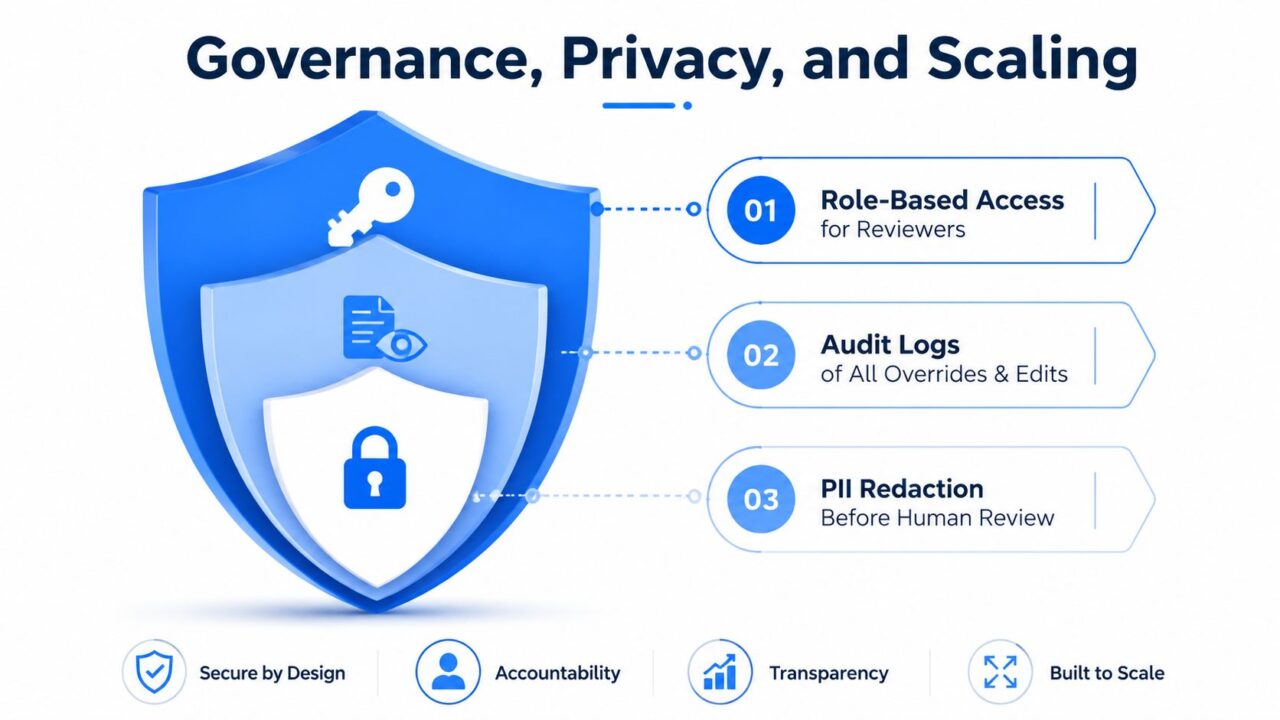
Human in the Loop Automation Data Security
Protect the customer before review
Redact unnecessary personally identifiable information before a transcript reaches a reviewer. Capture consent for recorded conversations, define who can access them, choose appropriate data residency arrangements, and set retention windows that match business and legal requirements.
The EU AI Act’s Article 14 requirements state that high-risk AI systems must support effective oversight by natural persons during use. The oversight must fit the system’s risks, autonomy, and context. Providers can build oversight measures into the system before market placement or identify measures for the deployer to implement.
For a practical policy checklist, teams can use this AI compliance playbook from Stimulead to organize access, documentation, monitoring, and accountability questions.
Scale the queue, not just the model
Reviewer fatigue creates its own quality problem. Rotate queues, cap review volume per agent, and use thresholds so people focus on the hardest cases. The plan notes propose routing only 10 to 20 percent of difficult cases to humans, but that range is an editorial design example, not a universal benchmark. The right share depends on risk, staffing, and the quality of the automated path.
A 2025 quantitative study describes automation proportion as a design variable that can be tuned to affect operator situation awareness, rather than treating “keep a human in the loop” as sufficient guidance. Read the study on automation proportion and human performance when deciding how much work a reviewer should actively monitor.
Before launch, verify:
- Access control: Can each role see and change only what it needs?
- Privacy: Are PII redaction, consent, residency, and retention rules documented?
- Escalation authority: Can the reviewer complete the required action?
- Auditability: Are edits, overrides, reasons, and outcomes stored?
- Queue health: Are ownership, service expectations, fallback routing, and throughput limits clear?
- Retirement rules: What evidence allows the team to remove a review gate?
- Expansion rules: What new path activates when volume or risk changes?
Avoiding HITL Pitfalls and Frequently Asked Questions
More reviewers don’t automatically produce safer automation. A tired or poorly trained reviewer can approve a weak answer, miss a privacy issue, or send a customer into another loop without adequate human input.
Three failures appear often:
- Rubber-stamping: Reviewers accept low-confidence drafts because the queue rewards speed. Use sampled audits, require a reason for sensitive approvals, and compare edits with outcomes.
- Over-escalation: The bot sends easy questions to people until the queue becomes the new bottleneck. Review the escalation accuracy metric and remove triggers that don’t change the decision.
- Voice drift: The bot follows an old policy or produces language that no longer matches the brand. Run calibration sessions, maintain approved guidance, and feed recurring edits back into prompts, rules, or training data.
A recent selective-escalation benchmark, HiL-Bench, frames the problem around asking for help at the right time. It covers 300 tasks across software engineering and text-to-SQL, with 1,131 blockers and an average of 3.8 blockers per task. Its Ask-F1 metric evaluates whether an agent asks targeted questions when information is missing, ambiguous, or contradictory, which is useful for detecting both silent failures and unnecessary questioning. See the feedback loop that enhances the review process. HiL-Bench benchmark for the evaluation design.
Frequently asked questions
A 2026 governance paper emphasizes that HITL reduces risk only when reviewers have real authority, context, and evidence, while an MIT study of early generative-AI work found that people still had to step in manually for exceptions. Those findings point to the central operational test: the human step must be decision-changing, visible, and measurable. A human added for ceremony only increases labor without improving the customer outcome.
If you want to add structured human handoffs to chatbot flows with human oversight, Clepher provides a no-code environment for building conversational automations with fallback responses, live-agent handoffs, customer fields, tags, and integrations across marketing and support workflows. Map your escalation triggers first, then use the platform to route only the conversations where human judgment can recover revenue, protect trust, or complete an action the bot shouldn’t own.

Related Posts
Chat Bot Responses That Convert: A Practical Guide
October 12, 202610 Broadcast Automation Software Platforms Compared
October 11, 2026Customer Journey Automation: The Practical Guide
October 10, 2026
Founder Clepher