
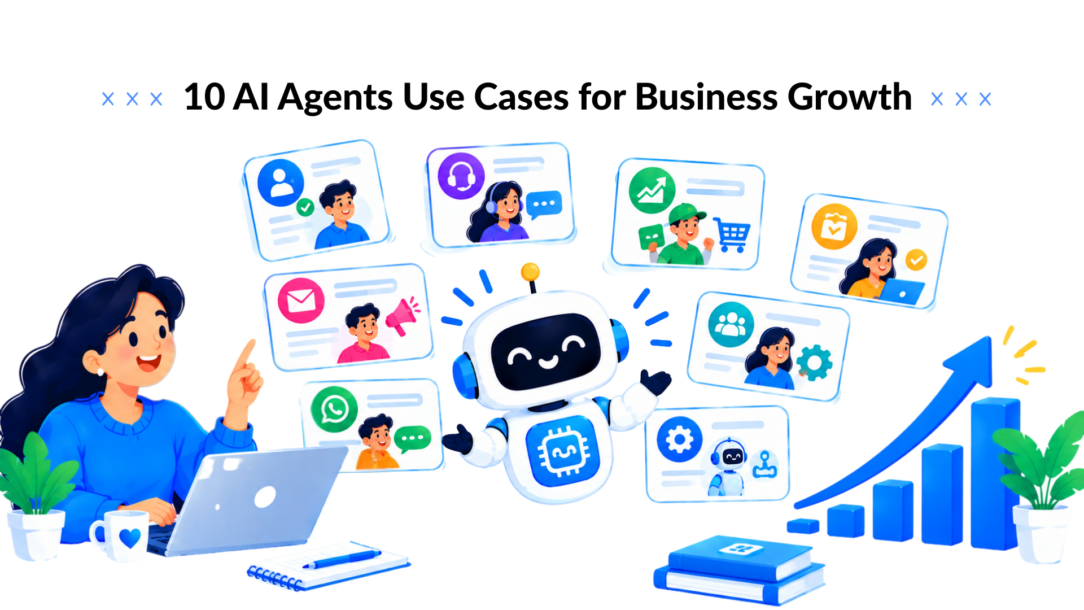
A visitor needs a product answer, a lead is ready to discuss a project, or a shopper reaches checkout and disappears. Your team can respond manually, but the delay often costs momentum. Useful AI agents do more than send a reply. They ask the next relevant question, use customer context, trigger a workflow, and hand off when human judgment matters.
The best AI agents use cases connect directly to revenue, retention, or delivery. This list focuses on practical workflows for e-commerce brands, SaaS companies, creators, agencies, and service teams. Each example considers customer experience, conversion or retention outcome, implementation effort, and measurable KPIs.
Clepher is the no-code platform used throughout these scenarios. Its Flows, AI keyword triggers, tags, segments, broadcasts, analytics, and integrations help teams turn conversational intent into action across website chat, Facebook Messenger, WhatsApp, and Instagram Direct Message. If you want to compare agent capabilities before building, browse Crescade agents.
1. Lead Qualification and Sales Acceleration
A lead qualification agent turns an open-ended conversation into a useful sales signal. It can ask about the buyer’s needs, budget range, timeline, company size, or biggest pain point, then route the conversation according to fit and urgency.
A SaaS company might use the agent to separate enterprise prospects from self-serve users before offering a demo. A digital agency can ask about the project scope and budget fit. An online course creator can identify students ready for a premium tier, while an e-commerce brand can qualify high-value shoppers for a personal consultation.
Start with three or four qualification questions, not an elaborate interview. Match the language to your brand, notify sales immediately when a high-intent lead qualifies, and apply tags such as “enterprise,” “needs consultation,” or “nurture.” Clepher’s AI agent for sales can support this conversational path without forcing every visitor through the same script.
Track qualified-lead rate, sales response time, booked calls, and progression by fit segment. Avoid scoring every answer with false precision. A clear routing rule and a fast human handoff usually create more value than a complicated scoring model.
For teams expanding prospect research, a lead scraper API can help populate approved sources, but outreach still needs consent, relevance, and brand-safe controls.
2. Abandoned Cart Recovery at Scale
An abandoned-cart agent responds when a shopper leaves products behind without completing payment. The useful version doesn’t send the same “complete your order” message to everyone. It references the actual products, recognizes whether the shopper is new or returning, and addresses likely friction through a conversation.
A fashion brand might remind a customer about a saved jacket through Instagram Direct Message. A subscription company can follow up with repeat buyers who abandoned renewal. A digital product seller might explain payment-plan options through WhatsApp, while a marketplace can reserve a high-value order for a short period and offer a relevant incentive.
Connect the cart event to a Clepher Flow, include product names and images, and test a restrained sequence. The first message can be a reminder, the next can answer a pricing or shipping concern, and the final message can provide genuine urgency. Abandoned-cart recovery works best when incentives reflect the actual barrier, such as free shipping or clearer returns, rather than automatic discounts.
Measure recovered orders, revenue per abandoned cart, incentive cost, and opt-outs by customer segment. Don’t train shoppers to wait for a discount if a product reminder or reassurance would have closed the sale.
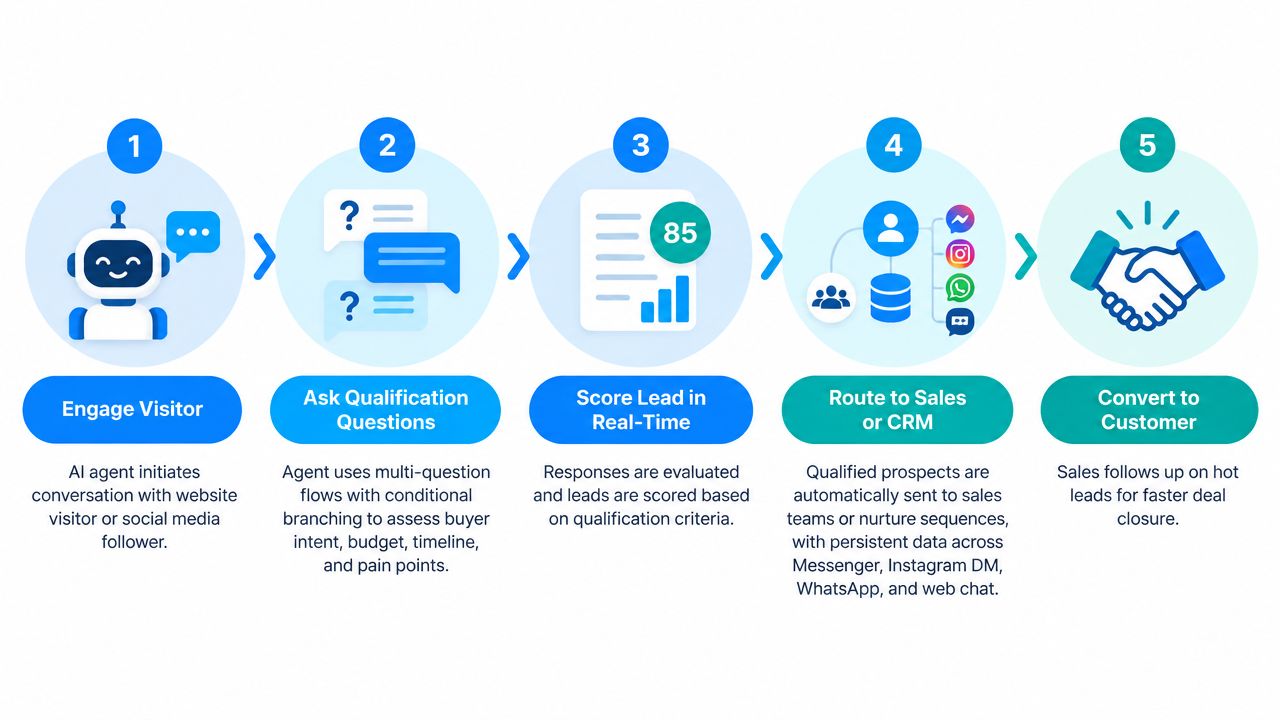
AI Agents Use Cases Sales Process
3. Customer Support and FAQ Automation
Support is one of the most established enterprise uses for intelligent agents. In a 2026 PwC survey, customer service and support was the most prevalent business function using agents, reported by 57% of respondents. The same survey found adoption across sales and marketing, IT and cybersecurity, finance, product development, supply chain, and legal or compliance work.
For a smaller team, the first agent should handle repetitive questions with clear answers. It can explain shipping policies, check order status, provide account guidance, or route a return request. A SaaS agent might answer billing and feature questions. A course business can guide students through platform access and escalate technical problems with the full conversation attached.
Build a knowledge base from the questions your team answers repeatedly. Set explicit escalation triggers for refunds, angry customers, account security, missing orders, and requests that require policy exceptions. Review escalated conversations every week and update the agent’s answers.
Practical rule: An agent should know when to stop. A transparent handoff protects trust better than a confident answer built on missing context.
Track first-response time, containment, escalation reasons, resolution time, customer satisfaction, and repeated contact. The goal isn’t to hide support demand. It’s to remove routine friction while giving human agents better context for the conversations that need judgment.
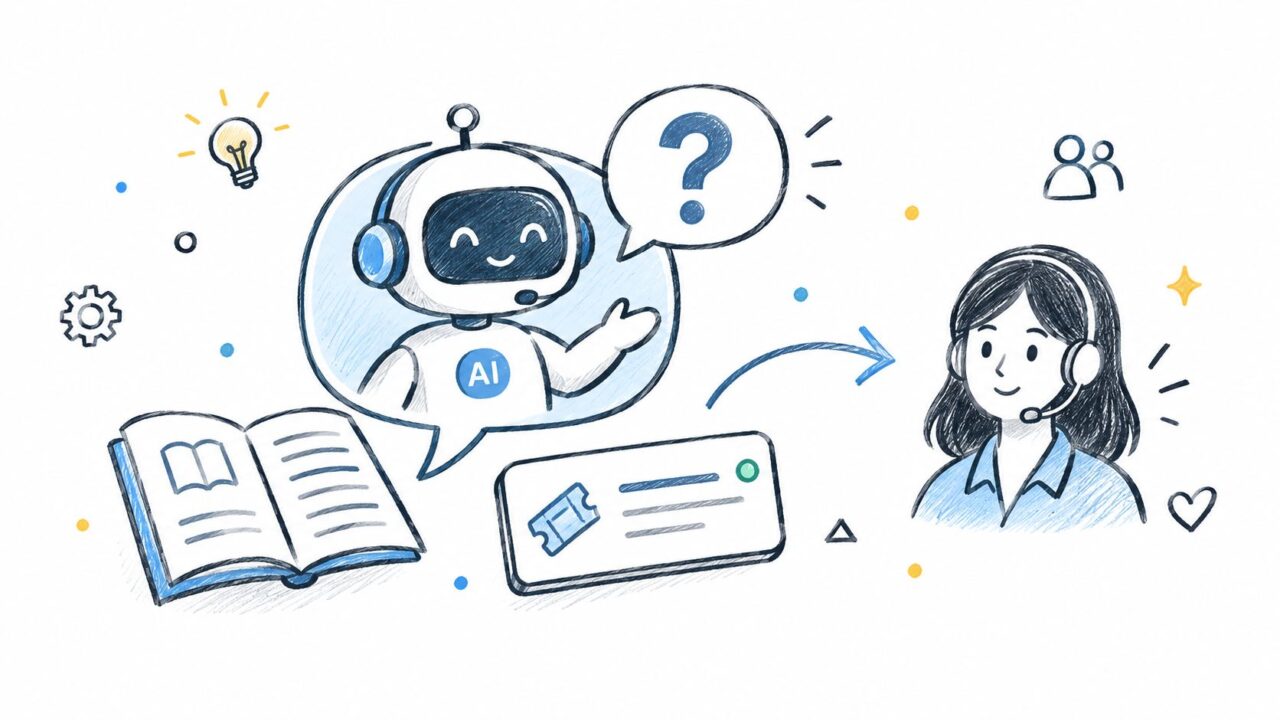
AI Agents Use Cases AI Support
4. Customer Onboarding and Product Adoption
An onboarding agent helps customers reach the first useful outcome instead of dropping them into a large documentation library. It can respond to completed actions, suggest the next step, provide a template, and recognize when a user is stuck.
For a SaaS product, useful milestones might include connecting an account, importing data, creating a first campaign, or inviting a teammate. A marketplace can guide a new seller through listing creation. A subscription service can explain how to use the first delivery, while a mobile app can introduce features in response to actual usage.
Map the product’s aha moments before writing messages. Then trigger short prompts after prerequisite actions. If a user has created a campaign but hasn’t invited collaborators, the agent can explain the collaboration feature with a relevant example. If a customer hasn’t completed setup, it can offer help instead of sending another generic tutorial.
Onboarding should feel like assistance, not surveillance. Use tags and conditions to avoid repeating messages, and make every prompt dismissible. Clepher Flows can connect educational content, live chat, and segmentation so a customer’s next message reflects their progress.
Track activation, completion of key milestones, feature adoption, support contacts during onboarding, and early cancellation signals. Review the points where customers stop progressing, then improve that step before adding more messages.
A visual example of conversational product guidance can help teams align on the experience:

AI Agents Use Cases AI Shopping
Product education can also appear inside a richer walkthrough when the customer needs more context:
5. Product Recommendations and Upsell Flows
Product recommendation agents earn attention by making a relevant suggestion at the right moment. They can combine stated preferences, purchase history, browsing behavior, and conversation context instead of relying only on a generic “customers also bought” module.
A fashion brand might ask about an upcoming occasion and recommend a coordinated item. A beauty retailer can use a conversational quiz to narrow shade choices. A SaaS company can suggest a higher tier after a user completes core features, while a subscription business can offer an add-on at renewal based on actual usage.
Keep the recommendation narrow. Two or three well-matched options are easier to evaluate than a catalogue dump. Explain why each option fits, show the relevant product detail, and let the customer ask follow-up questions. The agent should be able to say that a product isn’t suitable when the available data doesn’t support a recommendation.
Timing matters as much as product matching. Post-purchase is often a natural moment for accessories, while renewal is a logical point for upgrades or add-ons. Use tags for preferences and segments for lifecycle stage, but don’t infer sensitive attributes or make assumptions that could embarrass the customer.
Measure average order value, repeat purchase rate, attach rate, upgrade rate, and returns. A recommendation that raises short-term order value but increases returns or reduces trust isn’t a successful agent workflow.
6. Event Promotion and Attendance Driving
An event agent turns promotion into a sequence rather than a single announcement. It can invite the right segment, collect registration details inside a conversation, send reminders based on time zone, and follow up with people who registered but didn’t attend.
An online course creator can promote a masterclass to engaged followers. A SaaS company can invite trial users to a product webinar. An e-commerce brand can use targeted broadcasts for a flash sale, while a coach can identify high-intent prospects for a private workshop.
Start early with people who have already shown interest, then adjust message frequency by engagement. Make registration as close to one click as possible. A registrant should receive a clear confirmation, a reminder before the event, and a useful follow-up afterward. If someone misses the session, offer the replay or an alternative next step instead of treating the person as lost.
Clepher broadcasts, segments, tags, and conditional Flows can separate VIP audiences, new registrants, attendees, and no-shows. Use AI keyword triggers to capture replies such as “agenda,” “price,” or “replay,” then send the relevant answer or escalate a sales question.
Track registrations, attendance, no-show recovery, replies, qualified conversations, and revenue attributed to the event. Don’t optimize only for registrations. A smaller audience with stronger intent can produce better delivery and sales outcomes than a large list of passive sign-ups.
7. Feedback Collection and Net Promoter Score Management
Feedback agents ask customers for a response while the experience is still fresh. The trigger might be a completed purchase, a resolved support conversation, a newly used feature, or a meaningful milestone in a service relationship.
A SaaS company can ask whether a customer achieved the intended result, then capture a feature request when the answer is negative. A service business can invite satisfied customers to share a testimonial. An e-commerce brand can identify delivery problems before they become public reviews, while a subscription company can monitor dissatisfaction before renewal.
Keep the first question simple. If you use an NPS workflow, ask the rating first and follow up based on the response. A promoter can receive a low-friction testimonial invitation. A passive customer can be asked what would make the experience more valuable. A detractor should get a specific question and a clear path to a human owner.
Don’t promise that every complaint will be fixed immediately. The agent’s job is to capture the signal accurately, acknowledge it, and route it to someone accountable. Apply tags for sentiment, product area, urgency, and customer value so the team can identify patterns.
Measure response rate, detractor resolution time, testimonial submissions, recurring issue categories, and retention by feedback segment. Feed recurring complaints to product and operations teams. Feedback becomes useful when it changes decisions, not when it merely fills a dashboard.
8. Loyalty Program Promotion and Reward Management
A loyalty agent makes rewards available where customers already communicate. Instead of sending shoppers to a separate portal, it can answer points questions, explain tiers, surface eligible rewards, and complete a claim through chat.
An e-commerce brand can remind a returning buyer how close they are to a reward. A subscription business can use points during renewal to reinforce continuity. A marketplace can give repeat buyers access to member offers, while a restaurant can connect reward updates to a mobile wallet experience.
Use behavior to determine the offer. Frequent buyers may value points and tier progression. New customers may respond better to a clear first reward. Show progress in plain language, such as “You’re close to free shipping,” but only when the underlying account data is accurate.
Build expiration and milestone messages into the Flow. Let customers claim rewards without unnecessary steps, and distinguish promotional messages from transactional account updates. Provide an obvious opt-out route, especially when broadcasts and reminders share the same channel.
Track repeat purchase rate, redemption, reward cost, time between orders, renewal behavior, and opt-outs. A loyalty program can lose money if rewards subsidize purchases customers would have made anyway. Compare behavior across meaningful segments before expanding the offer.
9. Lead Nurturing and Drip Campaigns
Not every qualified lead is ready for a sales call. A nurturing agent keeps the conversation useful by delivering education, examples, objections handling, and a timely invitation to act.
A SaaS company can explain a workflow over several messages before asking for a trial. An agency can share relevant project guidance before a strategy call. A coach can teach a method before presenting a program, while a subscription brand can demonstrate product value before making an offer.
Map the journey from awareness to consideration to decision. Then vary the message type. One message can answer a common objection, another can share a relevant customer outcome without inventing a case study, and a later message can ask whether the prospect wants help choosing an option.
Clepher’s lead nurturing best practices can inform the sequence, while tags and conditions keep it responsive to behavior. Exit the sequence as soon as the prospect books, buys, requests support, or asks for a human. Continuing to send nurture content after conversion makes the brand look disconnected.
Track reply rate, progression between segments, booked calls, trials, purchases, unsubscribes, and time to conversion. Review performance by acquisition source and persona. A sequence that works for an Instagram follower may not fit a prospect who arrived through an enterprise landing page.
10. SMS and Multi-Channel Campaign Orchestration
Customers rarely follow a clean channel plan. They may discover a brand on Instagram, ask a question in Messenger, receive a purchase reminder through WhatsApp, and expect an SMS when an order needs attention. A multi-channel agent keeps those interactions connected.
An e-commerce brand can use SMS for a time-sensitive promotion, Messenger for education, and email for detailed product information. A B2B SaaS company might combine Messenger onboarding with email documentation. A coaching business can use WhatsApp for personal conversation and SMS for an appointment reminder.
The channel should match the job. Use SMS for urgent or transactional moments, such as payment reminders or shipment alerts. Use Messenger and WhatsApp for two-way conversation, and email for longer-form material. Let customers choose preferences and honor opt-outs across the entire system.
Clepher can organize audiences with tags and segments, trigger responses with AI keywords, and connect conversational Flows to integrations. Design a fallback path rather than blasting the same message everywhere. For example, an unopened Messenger broadcast might trigger an eligibility check for another channel, but only when consent and frequency rules allow it.
Measure revenue by channel, assisted conversions, response time, unsubscribe rate, and overlap between channels. Multi-channel orchestration isn’t about using every channel. It’s about reducing duplication while giving customers a coherent experience.
11. Agency Client Workflow Automation
Agencies can use AI agents to standardize intake without making every prospect or client feel processed. The agent can qualify a new inquiry, gather project requirements, answer recurring questions, apply routing tags, and pass a complete brief to the right account owner.
A digital agency might ask about services needed, budget fit, launch timing, target audience, and existing assets before a strategy call. A service team can route support questions to the relevant account manager. An agency can also promote a new service only to client segments that are likely to benefit from it.
Start with a reusable base Flow, then customize the questions and tone for each client. Keep qualification, project intake, and support paths separate. This prevents a prospect’s sales answers from getting mixed with delivery requests and makes analytics easier to interpret.
The best agency automation feels consistent to the client and flexible to the account team.
Define the human handoff before launch. Decide which answers require an account manager, which fields must be completed before a call, and where the agent can safely answer without approval. Connect captured fields to the existing sales and delivery stack through Clepher integrations, then review conversations by account to improve routing.
Track qualified inquiries, completed briefs, booked calls, response time, handoff accuracy, and delivery-team rework. For agencies, the main benefit isn’t just more leads. It’s a cleaner transition from marketing conversation to profitable, well-scoped work.
AI Agent Use Cases: 11-Point Comparison
| Use Case | Implementation Complexity 🔄 | Resource Requirements ⚡ | Expected Outcomes ⭐📊 | Ideal Use Cases 💡 | Key Advantages ⭐ |
|---|---|---|---|---|---|
| Lead Qualification and Sales Acceleration | Medium, multi-step flows, routing, scoring | CRM + messaging channels + analytics; ongoing refinement | 40–60% ↑ qualified leads; 25–35% faster sales cycles | E‑commerce high-AOV, SaaS enterprise demos, agency client pre-screening | 24/7 qualification, faster handoffs to sales, higher lead quality |
| Abandoned Cart Recovery at Scale | Medium–High, e‑commerce integration, dynamic logic | Shopify/WooCommerce integration, product data, incentive rules | 10–15% recovered revenue; 15–30% cart recovery vs email | Fashion, subscriptions, digital goods, marketplaces | Fast, personalized recovery with one-click checkout and targeted incentives |
| Customer Support and FAQ Automation | High, NLU, KB integration, escalation flows | Knowledge base, order APIs, multilingual content, monitoring | Resolves 40–60% queries; ~30% support cost savings | E‑commerce shipping/billing, SaaS support, course platforms | Instant 24/7 answers, reduced ticket volume, consistent responses |
| Customer Onboarding and Product Adoption | Medium, analytics triggers, behavioral flows | Product analytics, tutorial content, in-product messaging | 25–40% reduction in early churn; 20–30% ↑ LTV | SaaS onboarding, mobile apps, subscription activation | Shortens time-to-value, increases feature adoption and retention |
| Product Recommendations and Upsell Flows | Medium, catalog sync + personalization engine | Quality product catalog, recommendation engine, tagging | 15–25% ↑ average order value | Fashion cross-sell, SaaS tier upgrades, beauty, subscription add‑ons | Personalized, conversational upsells that increase AOV |
| Event Promotion and Attendance Driving | Low–Medium, broadcast + registration capture | Subscriber base, webinar integrations (Zoom/Calendly), segmentation | 50–70% registration; 70–80% attendance (typical) | Webinars, masterclasses, flash sales, workshops | High registration/attendance rates, lower cost vs paid ads |
| Feedback Collection and NPS Management | Low–Medium, trigger surveys + sentiment analysis | Survey flows, sentiment tools, escalation paths, review integrations | 3–5x survey responses; 15–25% churn reduction; ↑ referrals | Post-purchase, post-support, milestone feedback | Higher response rates, real-time insights, automated detractor escalation |
| Loyalty Program Promotion and Reward Management | Medium, points tracking + real-time balances | Loyalty system integration, redemption UX, tier notifications | 20–35% ↑ repeat purchases; 25–40% ↑ LTV | E‑commerce loyalty tiers, subscription retention, restaurants | In-chat balance & redemption, drives repeat behavior and stickiness |
| Lead Nurturing and Drip Campaigns | Medium, multi-message branching & timing optimization | Content strategy, segmentation, omnichannel integrations | 30–50% better prospect→customer conversion; 2–3x lower CPA | SaaS prospect warming, agencies, coaches, subscription funnels | Sustained conversational engagement with higher open/click rates |
| SMS and Multi-Channel Campaign Orchestration | High, cross-channel sync, compliance, preference mgmt | Native channel integrations, consent management, SMS budget | 2–3x campaign ROI; 40–50% lower CAC; 30–40% ↑ effectiveness | Urgent promos, onboarding orchestration, multi-touch campaigns | Unified customer view, intelligent channel switching, higher ROI |
| Agency Client Workflow Automation | Medium, reusable templates + account customization | CRM/project tool integrations, per-client prompts & permissions | Improves intake efficiency and response speed (qualitative) | Agencies qualifying clients, intake, routing, client comms | Standardizes intake, reusable flows, faster prospect handling |
Choose the First Workflow Worth Automating
The strongest AI agent use case isn’t necessarily the most advanced one. It’s the workflow where customers already ask repetitive questions, staff spend time on predictable coordination, and the business can define what a successful outcome looks like.
Start with one workflow that has clear demand, measurable friction, and a safe human handoff. Abandoned-cart recovery is a practical choice for an e-commerce team with visible checkout drop-off. Lead qualification fits a company that receives inquiries but spends too much time sorting them. FAQ support makes sense when the same questions consume the support queue. Onboarding is a strong candidate when users sign up but fail to reach the product’s first useful outcome.
Before building, write five decisions down:
- Trigger: Identify the event that starts the Flow, such as a cart abandonment, keyword, signup, purchase, or support request.
- Conversational goal: Define the next action, such as completing an order, booking a call, solving a question, or reaching an activation milestone.
- Data fields: Choose only the context the agent needs, including product, customer segment, account status, budget, or event registration.
- Escalation rule: Specify when a human must take over, especially for refunds, sensitive data, complaints, exceptions, or unclear intent.
- Primary KPI: Select one main outcome, then add supporting measures such as response time, opt-outs, resolution quality, or handoff accuracy.
Keep the first version narrow. A lead agent doesn’t need to qualify every possible customer type on launch day. A support agent doesn’t need to answer every policy question. Limit the scope, prepare approved answers, connect the required integration, and make the human route visible.
Evaluation should be multidimensional. Enterprise benchmark guidance recommends tracking precision, efficiency, safety, tool-call behavior, cost, runtime, and artifact quality, rather than relying on one success score. For a marketing Flow, that means reviewing task completion, trajectory accuracy, token or usage cost where available, latency, and policy violations separately. A conversation can end with a conversion while still exposing a privacy or routing problem.
Use Clepher analytics and conversation reviews to find those failure modes. Launch the focused version, review outcomes and transcripts, then A/B test one variable. Change the opening question, incentive, reminder timing, or handoff wording, but don’t change everything at once.
Expand only after the first workflow proves useful. Add another segment, channel, or integration when the team can explain what improved and why. A controlled agent that reliably completes one revenue or retention task is more valuable than an ambitious assistant nobody trusts.
Clepher provides a no-code way to build AI-powered conversational Flows for marketing, sales, support, lead qualification, promotions, onboarding, and lost-sale recovery across website chat, Facebook Messenger, WhatsApp, and Instagram Direct Message. Visit Clepher to connect those AI agent use cases with tags, segments, broadcasts, analytics, and integrations, then start with the workflow where your team can measure a clear result.
