
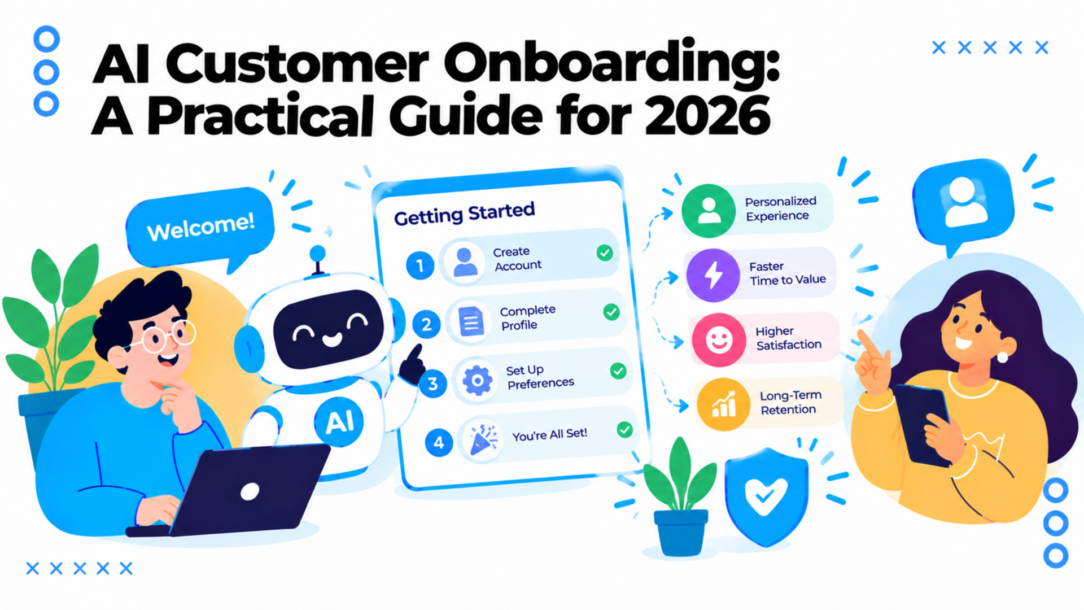
A shopper messages a brand’s Facebook page at 11 p.m. to ask whether a jacket runs small. Nobody on the team is awake, and a welcome email won’t answer the question. A well-designed AI flow can respond, ask what fit the shopper prefers, offer sizing guidance, and pass the conversation to a person if the answer needs judgment.
That’s the practical job of AI customer onboarding: a conversational agent welcomes a new customer, asks a few useful questions, answers routine queries, guides them to a first win, and hands off what it can’t handle. It’s not a replacement for human onboarding. It takes repetitive work off the team so people can focus on the high-stakes moments.
What AI Customer Onboarding Means in Practice
Think of a hotel. A printed welcome card that gives every guest the same information is rules-based onboarding. A concierge who remembers your preferences and recommends the right next step is closer to AI onboarding. A manager who personally greets a VIP guest represents manual onboarding.
| Approach | How a new customer is guided | Personalization | Human effort | Best fit |
|---|---|---|---|---|
| Manual onboarding | Account managers run calls, demos, and emails | High, but limited by staff hours | Very high | Enterprise or high-value accounts |
| Rules-based drip | Fixed message sequence triggered by sign-up | Low, same path for each segment | Medium | Simple products with one main path |
| AI-powered onboarding | Conversational agent asks questions, adapts the next step, and answers in chat | High, adapts to each answer | Low for routine tasks, humans on exceptions | E-commerce, SaaS, courses, and local services with many paths |
Where AI Onboarding Fits Between Email Sequences and Human Support
The differences matter most when customers arrive with different goals. A fixed email sequence can explain the same setup steps to everyone, but it can’t easily respond when one person wants a product recommendation and another needs account support. A person can handle both, but routing every routine question to staff makes the process harder to scale.
AI onboarding sits between those approaches. It can use an answer or a customer’s stated intent to choose the next prompt, while rules still handle predictable triggers and people step in when the conversation becomes sensitive, complicated, or uncertain.
The approach has moved beyond technology pilots as a business idea. In McKinsey’s 2024 Global Survey on AI, 65% of respondents said their organizations were regularly using generative AI in at least one business function, while 72% said their organizations had adopted AI; marketing and sales, product and service development, and IT were among the common areas of use, according to McKinsey’s 2024 Global Survey on AI. Those figures describe organizational adoption, not proof that a particular onboarding flow improves activation or retention.
Practical rule: Automate the repeatable middle of the journey. Keep a person easy to reach when the customer needs judgment, reassurance, or an exception.
How an AI Onboarding Flow Moves a Customer Forward
A useful flow doesn’t just say welcome. It moves a person from their reason for arriving to a specific next step, then checks whether that step worked.
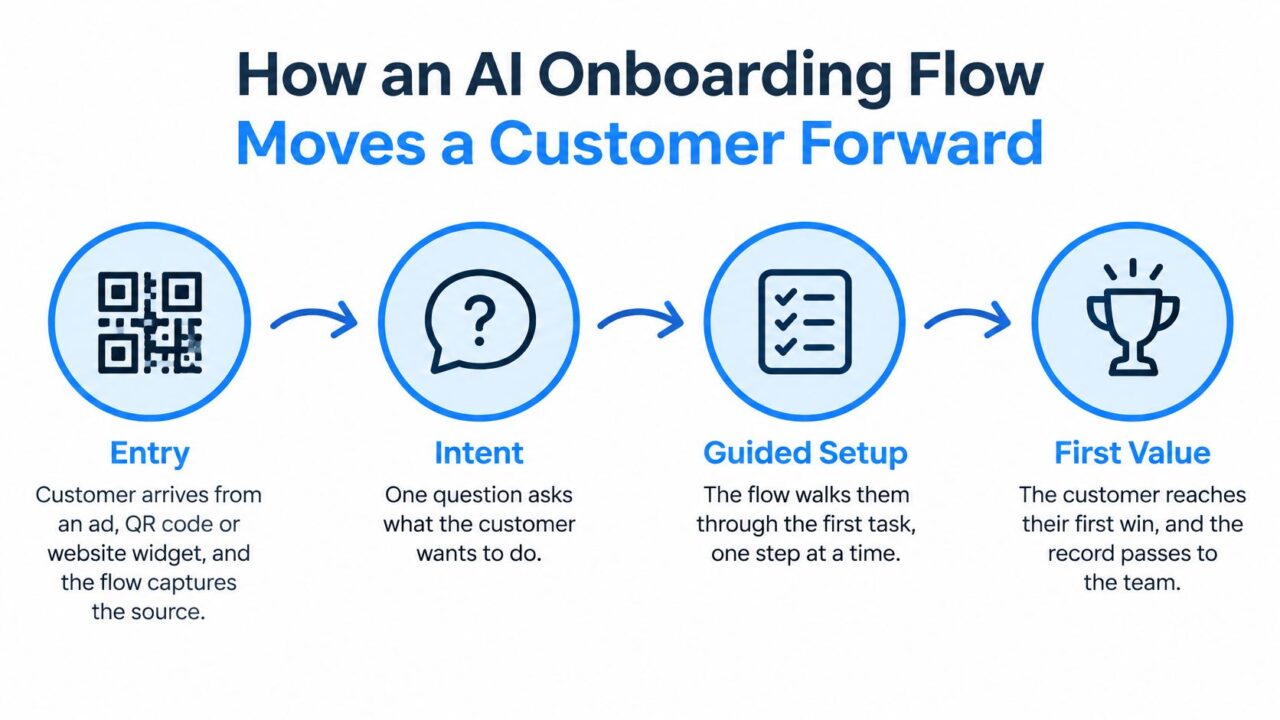
AI Customer Onboarding Process Flow
- Entry: The customer arrives from an ad, QR code, or website widget, and the flow records the source so the conversation has context.
- Intent: One question asks whether the customer wants to buy, learn, get help, or book, keeping the opening focused.
- Branch: A shopper gets product guidance, a lead gets clear qualification expectations, and an existing customer sees support and escalation options.
- Guide: The agent offers one relevant setup instruction or recommendation at a time, so the customer can act instead of scanning a wall of directions.
- Confirm: The flow checks whether the first-value event happened, such as a product match or connected integration.
- Remind or hand off: It sends a reminder only if the milestone is missed, or routes the conversation to a person when the customer needs more help.
Design the Conversation Flow Before You Build It
A Messenger coffee brand, for example, could ask whether someone is shopping for themselves or buying a gift. A self-purchaser might get help choosing beans by roast and brewing method; a gift buyer could see a short set of gift-ready options. If neither path answers the question, the flow should offer a human rather than keep guessing.
Before building branches, prepare the answers the agent is allowed to give. List the 20 questions customers ask most often before buying or getting started, then write a short, approved answer for each. Questions about sizing, shipping, refunds, setup, compatibility, and account access often reveal where customers get stuck. When the agent falls back repeatedly on the same topic, check whether the answer is missing or unclear before changing the model.
The flow also needs a deliberate trust layer. In a 2025 ETH Zurich study, 85.2% of participants engaged with at least some onboarding activity; greater guidance depth improved perceived ease of use, while greater topic breadth improved trust and perceptions of the conversational agent, according to the ETH Zurich study of conversational-agent onboarding. In practice, cover the agent’s capabilities, limits, data practices, and recovery options without making every exchange feel like a policy notice.
For a useful test of where customers struggle, teams can find friction in user onboarding by watching where users pause, abandon a task, or ask the same question. Then translate those observations into shorter prompts and clearer recovery paths. For conversation structures that make those decisions easier to map, see this chatbot conversation flow example.
Benefits Backed by Numbers, and Where the Evidence Is Thin
The strongest published case for AI in customer-facing work is operational. In Salesforce’s 2024 State of Service findings, 93% of service professionals at organizations using AI said the technology saved them time, agents spent 39% of their working time directly servicing customers, and 88% of agents at AI-using organizations considered building customer relationships a key responsibility, compared with 75% at organizations without AI. Routine answers get handled, and staff attention shifts toward the conversations that need judgment.
For an onboarding team, that supports a practical case for:
- Faster replies after hours: A conversational flow can answer approved routine questions when staff isn’t available.
- Fewer repeated questions: The agent collects known details once and reuses them, so a new customer doesn’t repeat intake.
- More staff capacity for complex cases: Routine answers run on their own while people handle exceptions and relationship-building.
- Consistent guidance across channels: One knowledge base keeps answers aligned across Messenger, Instagram, WhatsApp, and web chat.
The caveat is scope. Those figures describe service organizations broadly, and onboarding is only part of that picture. They measure reported AI use and time saved, and they say nothing about whether your activation rate, conversion, or retention will move. Treat them as a reason to run the test, not as a predicted result.
Time saved on routine work is the cheapest claim to verify. Give the current process a two-week baseline, then compare time-to-first-value and staff hours per new customer after launch. Keep the same definitions and scope on both sides of the comparison, or a faster number may only mean you changed who and what you counted.
A conversion lift needs its own test. If the new flow increases purchases but pushes more people to abandon the chat, the headline number hides a usability problem. Score the trust layer alongside the commercial one: whether customers were told they were talking to AI, how often the flow handed off to a person cleanly, and whether customers stayed engaged after that handoff. The onboarding metrics section below lays out what to track together so a single attractive number doesn’t stand in for the whole customer journey.
Use Cases for Shops, SaaS Teams and Course Creators
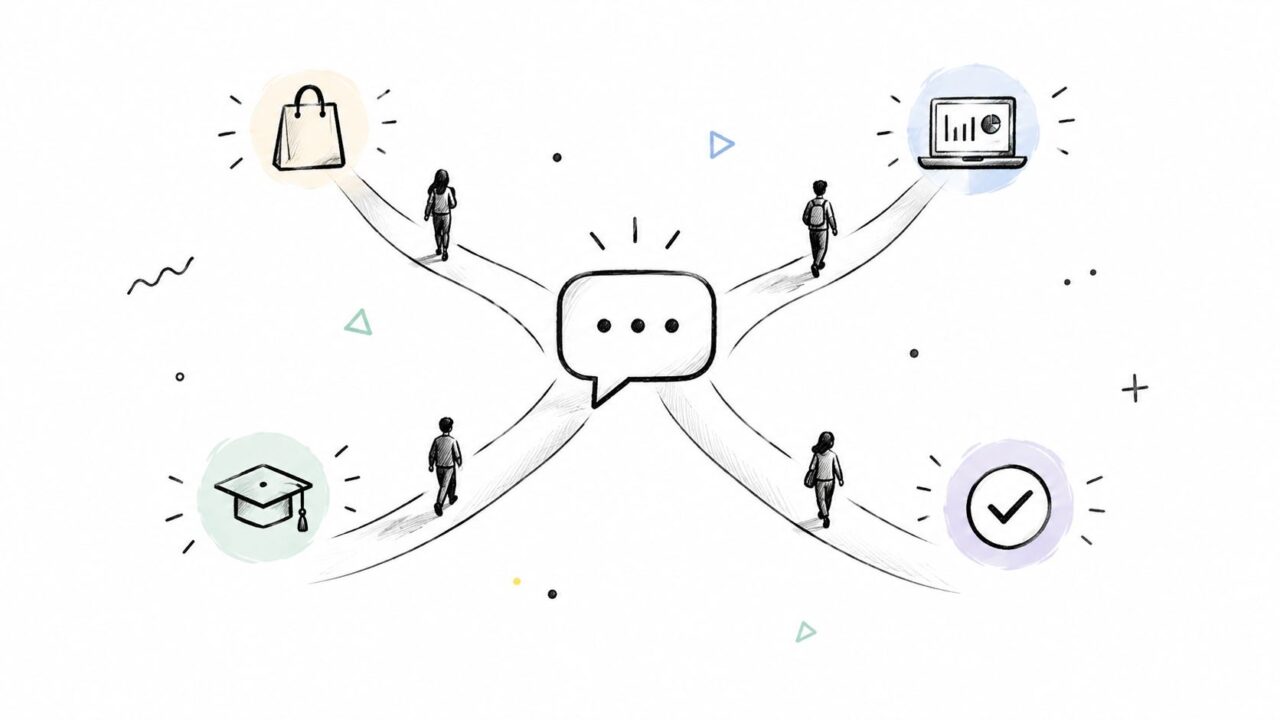
A well-built flow starts with a real customer trigger and ends at a milestone the business can recognize. The questions should be short, and every answer should change what happens next.
AI Customer Onboarding Communication Hub
E-commerce: A visitor opens a chat while browsing a DTC skincare brand. The flow asks whether they’re shopping for themselves or a gift, stores the answer as a segment, and shows a matching routine; the first-value milestone could be a completed product match. After purchase, the brand can send a reorder reminder based on the customer’s product choice, rather than putting everyone on the same follow-up path.
SaaS: A new user signs in to a project tool. The flow asks about their role, then sends an operations lead to an integration checklist and a designer to a template tour. The milestone is the first connected integration, recorded as an event so the team can see whether the user reached the action that matters.
Course creator: A student joins a coach’s program. The flow sends a link to lesson one and its worksheet, then checks whether the student watched the lesson and downloaded the file. It nudges only students who stall, so people who’ve already completed the task don’t receive an irrelevant reminder.
Local business: A salon promotes a seasonal service on social media. The chat asks which service the visitor wants, checks the relevant appointment details, and offers a booking option. The milestone is a booked appointment, not merely a completed chat.
Agencies managing Facebook and Instagram accounts for clients can clone a flow template for each client while keeping tags and customer records separate. That makes it easier to reuse a proven structure without mixing audiences or sending one client’s follow-up to another client’s customers.
The same logic applies across product categories: personalize the next step, not every line of the conversation. McKinsey-cited research reports that 71% of consumers expect personalized interactions and 76% become frustrated when brands fail to provide them, according to this summary of personalization statistics. Treat that as a reason to make relevant choices available, not permission to collect everything a customer might reveal.
Here’s a short video to help teams think through practical onboarding conversations:
Collect only information that changes the next step. If the answer won’t change the recommendation, routing, or follow-up, the question probably doesn’t belong in the flow.
Metrics That Show Onboarding Is Working
Message volume and automation rate can make a dashboard look busy without showing whether customers reached a useful outcome. Track the customer’s progress, the work the flow absorbs, and the moments when it needs a person.
A 2026 synthesis citing a Forrester 2024 Total Economic Impact study reports a 47% average reduction in time-to-first-value across ten enterprise software companies using AI onboarding compared with manual or rules-based processes. It also cites a McKinsey estimate that AI can handle 50–70% of routine onboarding task volume, including data collection, status updates, scheduling, and guided configuration, as summarized in this AI onboarding automation synthesis. The time-to-value finding is enterprise evidence, so use your own baseline first and treat that reduction as a stretch goal, not a promise.
| Metric | How to define it | What it signals | Starting reference |
|---|---|---|---|
| Time-to-first-value | Time from sign-up or first message to the first value event | Speed of getting the customer to a win | Baseline first, then aim for the 47% enterprise reduction as a stretch goal |
| Flow completion rate | Share of customers who finish the onboarding flow | Whether the flow is short and relevant enough | Set during a two-week baseline |
| Fallback rate | Share of messages the agent can’t answer confidently | Gaps in the knowledge base or flow design | Set during a two-week baseline |
| Human handoff rate | Share of conversations passed to a person | Whether escalation triggers are too broad or too narrow | Review by intent and channel |
| Qualified-lead rate | Share of new contacts meeting your qualification rule | Quality of lead capture | Set during a two-week baseline |
| Day-30 and day-90 retention | Share of customers still active at each milestone | Long-term value of onboarding | 76% day-90 with structured onboarding vs. 52% without, in a compiled analysis |
Define first value as an observable event, not a vague feeling. For a shop, it might be a completed product match or first purchase; for SaaS, a connected integration; for a service business, a resolved support issue or booked appointment. The event should exist in your analytics or customer record, so the team can tell whether the person reached it without manually reading every conversation.
Structured onboarding has also been linked to stronger early retention: a compiled analysis reports 76% 90-day retention for customers receiving structured onboarding, compared with 52% without it, in this customer retention statistics analysis. That comparison is a reason to measure retention alongside completion, not a guarantee that adding a chatbot will create the same result.
Measure the whole path: A completion rate can rise while a flow gets worse if it stops asking useful questions. Read it with first-value time, fallback and handoff rates, qualified leads, and retention.
A/B test one part of the experience at a time: question count, progressive profiling, fallback wording, or when the agent offers a person. Use stable event definitions and review results by intent and channel. For a broader framework on choosing customer-success measurements, use these client success metrics.
Trust, Disclosure and Privacy Guardrails
Trust problems show up as onboarding problems. A customer who cannot tell whether they are speaking with a person, cannot correct a wrong answer, or cannot reach a human may abandon the flow before it delivers any value. In PwC’s 2025 Customer Experience Survey, 58% of consumers said they were only somewhat or not at all comfortable using AI tools to engage with brands, which makes disclosure and an easy human route part of activation performance rather than a compliance afterthought.
Build these controls into the flow from the start:
- Disclose the agent: Say in the first message that the customer is interacting with AI, and state what it can and cannot do.
- Ask before collecting: Request consent for each data field and give a plain-language reason. If you need a customer’s product preference to make a recommendation, say so.
- Escalate on clear signals: Route refund or billing disputes, eligibility or health questions, repeated fallbacks, and visible frustration to a person.
- Keep a human route visible: Offer a low-friction way to reach someone at every stage, not only after the agent fails.
Measure Trust, Limit Data and Keep Humans in the Loop
Treat these controls as measurable, like any other part of the flow. Count how often customers ask for a person, how often they correct the agent, and whether they drop off right after the disclosure message. A spike at that point usually means the wording overpromises or the human option is hard to find.
Sensitive data deserves the same discipline. Collect only what the next step needs, keep it only as long as the workflow requires, and let customers access, correct, withdraw consent for, or delete stored information. In Cisco’s 2025 privacy research, 64% of respondents worried about inadvertently exposing sensitive information, and nearly half said they had entered personal or non-public data into generative-AI tools. That is a practical reason to design forms and prompts that never invite more disclosure than the task requires.
A chatbot can explain product requirements, collect preliminary details, and route a customer to the right team. Decisions with significant effects belong to people. Under GDPR Article 22, people have a right not to be subject to certain decisions based solely on automated processing when those decisions produce legal or similarly significant effects. An agent can explain credit requirements, but a human should review a decision to deny credit; high-risk processing may also require a Data Protection Impact Assessment. Adapt the consent, escalation, and deletion process to the channels and records your business uses, with this GDPR consent-management guidance as a practical starting point.
Choose Your Path, Avoid Costly Mistakes and Launch in 30 Days
Choose the implementation path that matches the complexity of the journey and the systems your team already maintains. A lightweight flow is usually the sensible starting point when the customer path is conversational, and the first milestone is clear.
| Path | What you build | Launch effort | Best for |
|---|---|---|---|
| No-code chatbot platform | Drag-and-drop flows, AI-powered replies, tags, and app integrations (for example, Clepher) | Days, with no engineering needed | Small and mid-sized teams running onboarding on Messenger, Instagram, or a website chat widget |
| CRM or help-desk native onboarding | Journeys and automations inside a system you already use | Weeks, depending on CRM setup | Teams already standardized on one CRM with simple onboarding paths |
| Custom AI agent on a language-model API | Own conversation logic, data pipeline, and interface | Months, with engineering and QA | Products with complex logic, strict data residency, or deep in-app guidance |
A no-code platform makes sense when you want to build and test conversational paths without waiting on a product release. Clepher offers drag-and-drop flows, an OpenAI/ChatGPT integration, tags, segments, custom fields, A/B split testing, and native connections to 50+ apps. It can fit a team onboarding customers through social messaging or website chat, while a CRM-native journey may be a better fit when the entire customer handoff already lives inside one system.
Custom agents offer more control over logic and data architecture, but they require engineering and quality assurance. Don’t choose that route just because it sounds more advanced. Start with the simplest setup that can reliably guide the customer, record the milestone, and bring a person in when needed.
Common pitfalls and the practical fix
- Automating before defining first value: Choose the customer milestone before designing the bot.
- Asking too much up front: Cap the flow at one question per exchange.
- Using one generic flow for every intent: Branch by what the customer wants to do.
- Hiding the human handoff: Add a visible button or option to reach a person at every stage.
- Collecting data by default: Ask only for information that changes the next step.
- Keeping no fallback log: Review unanswered messages weekly and add approved answers where the same gaps recur.
- Skipping the comparison test: Run a 50/50 split against the existing welcome sequence, with the same milestone and measurement rules for both groups.
A 30-day launch plan
- Pick one channel and one intent. For example, start with product discovery in Messenger rather than trying to automate every customer conversation at once.
- Define the first-value event and record the baseline. Decide what counts as a customer win, then measure the current time to that event and staff effort before changing the flow.
- Build the minimum useful journey. Use one question, one guidance step, a clear AI disclosure, a visible handoff, and one reminder only if the customer misses the milestone.
- Run the 50/50 test and review weekly. Check fallbacks and handoffs, then look at whether customers reached the milestone and how long it took.
At day 30, expand the flow if time-to-first-value improves and handoffs remain sensible. If customers are getting stuck, fix the knowledge gaps behind the fallbacks before adding more branches or questions. Then send a targeted Messenger broadcast to customers who stalled, with a direct next step that helps them finish.
Set up one customer path in Clepher, define its first-value milestone, and test it against your current welcome sequence. Visit Clepher to build conversational flows, connect customer data, and give new customers a clear route from first message to first win.
