
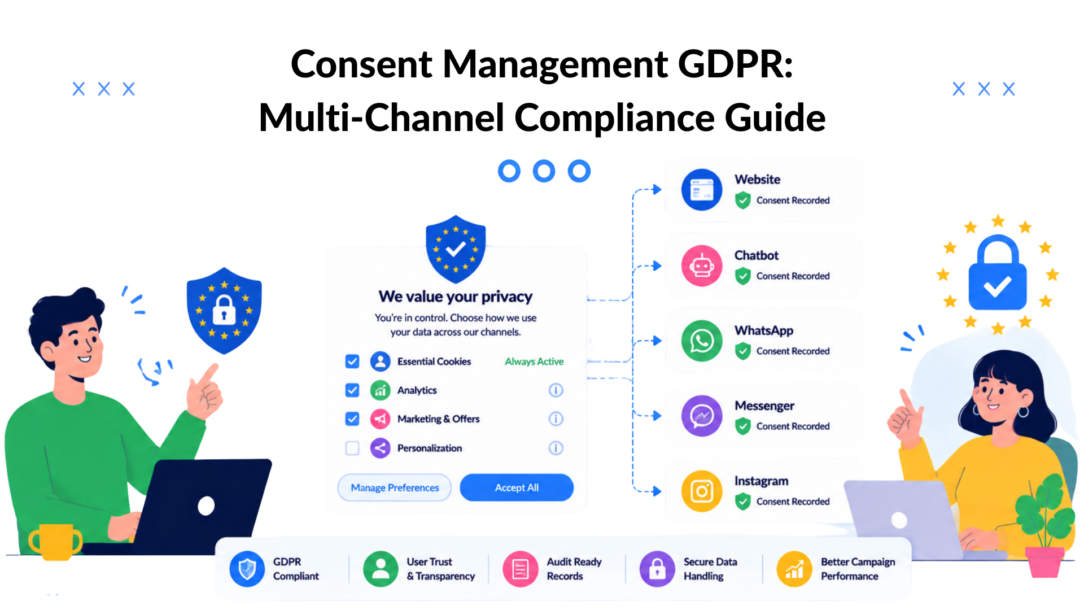
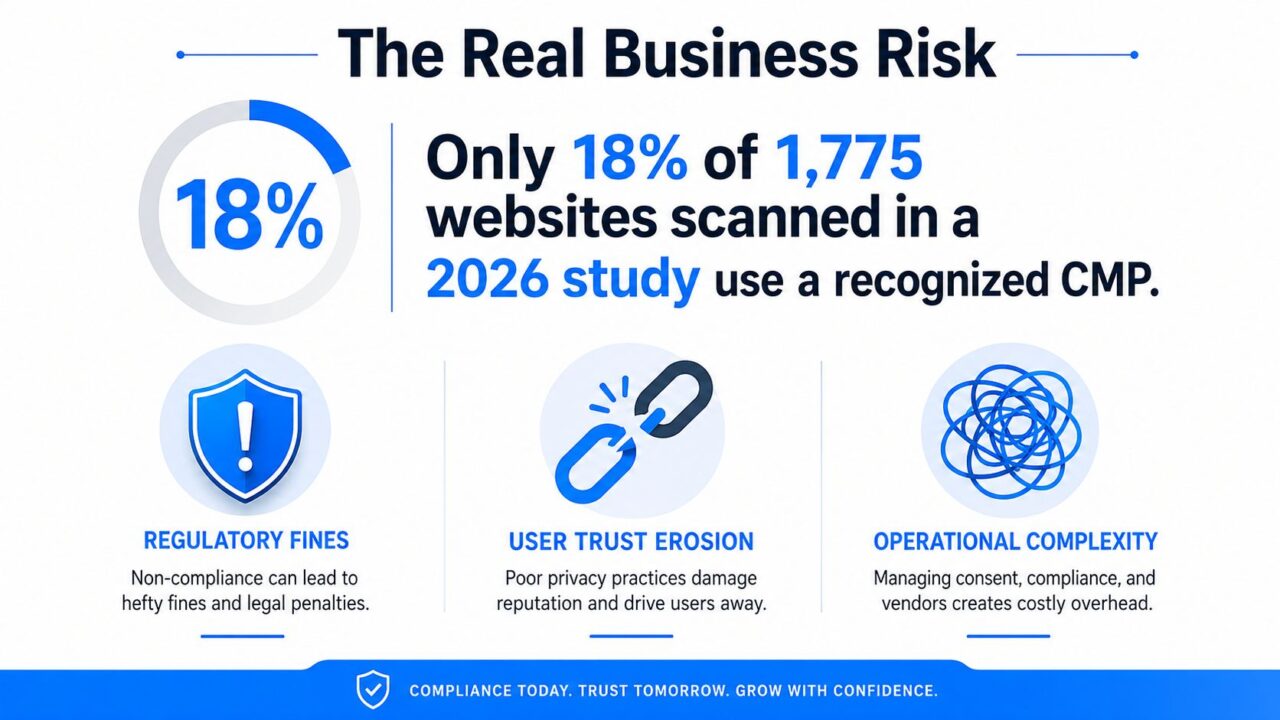
Across 1,775 websites scanned in 2026, only 18% used a recognized consent management platform, while 30% still fired a tracker before any consent was given. Regulators in the EU and UK have also issued more than 2,500 GDPR fines totaling over €7.1 billion highlight the importance of adhering to data protection authorities. since 2018, so consent management is now a live operational risk, not a footer detail.
That’s the uncomfortable part of GDPR consent management: many teams still treat it like a cookie banner project. In production, it’s really a system that has to capture valid choices, block tracking until permission exists, preserve evidence, and keep working across websites, chatbots, and messaging apps.
Why Consent Management Is a Real Business Risk Right Now
The numbers alone should change how marketers think about consent. In a large 2026 scan of 1,775 websites, researchers found that only user consent about 18% used a recognized consent management platform, which means 82% had no detectable CMP at all, and 30% still triggered a tracker before consent. That’s not a marginal gap, it’s a broad compliance failure across the web, and it shows up in exactly the places teams assume are “handled.” The same enforcement environment has produced more than 2,500 GDPR fines totaling over €7.1 billion since 2018, with roughly €1.2 billion issued in 2025 alone, according to privacy and GDPR enforcement statistics.
A single enforcement case makes the business reality clearer. The largest GDPR fine so far was €1.2 billion, issued by Ireland’s Data Protection Commission to Meta in 2023 for unlawful EU-US data transfers. That case wasn’t about a sloppy banner, but it shows how regulators treat privacy failures as board-level risk, not a minor web-ops issue.
Consent Management GDPR Business Risk
Practical rule: If your team can’t prove consent decisions, it should assume the consent flow is weak until the logs and tag behavior say otherwise, jeopardizing GDPR compliance.
There’s also a timing problem. The average complaint investigation timeline is 14 months across EU authorities, which means a broken flow can sit under scrutiny for a long time before it’s resolved. That length of exposure is why compliance teams now treat consent as an operating control, not a one-time launch task, a view that lines up well with global compliance guidelines when you’re trying to align marketing, legal, and engineering on the same standard.
A useful way to think about this is simple. Consent management is no longer about whether you have a banner; it’s about whether your whole stack behaves lawfully when a user says yes, no, or changes their mind later. By the end of this guide, you should know how to make that work across websites and conversational channels for data processing, not just on cookie popups.
What Makes GDPR Consent Actually Valid
Valid GDPR consent has five parts, and each one has an operational meaning. It must be freely given, specific, informed, unambiguous, and provable. If any one of those breaks, the flow looks polite but doesn’t hold up well in practice, especially when someone audits your records or tests your tag behavior.
The five requirements in plain English
Freely given means the person had a real choice. No pre-ticked boxes, no bundled acceptance, and no setup that makes rejection harder than acceptance. If “accept all” is obvious and “decline” is hidden, the choice architecture is already off.
Specific means one purpose at a time. A newsletter signup that mixes marketing consent with acceptance of shipping terms fails that test because the user isn’t choosing separately between unrelated processing purposes. The European Data Protection Board guidance on consent makes this separation central, and the practical effect is that each purpose needs its own choice point. A helpful reference on express consent in SMS and digital flows shows the same logic in a messaging context.
Informed means users know who’s asking, what data is involved, and why you want it. A vague “we may use your data to improve your experience” won’t give a marketer enough room to stand on, because the request has to stand on its own and explain the organization’s identity and purpose.
Consent isn’t valid because a box exists. It’s valid because the user understood the request and took a clear action on a specific purpose.
Unambiguous means active affirmation. Silence, inactivity, scrolling, or merely closing a banner don’t count as consent. The action has to be clear enough that you’d be comfortable showing it to a regulator without editorializing.
Provable means you can demonstrate what happened. A consent record should behave like an event log, not a mutable profile field. At capture time, store the exact notice version, timestamp, data subject identifier, purpose list, capture channel, and age-verification status, then append future changes instead of overwriting the old record. That immutable design matters because if historical wording disappears, you can’t prove what the person saw when they clicked.
The last piece is withdrawal. GDPR requires that withdrawing consent be as easy as giving it, and the cleanest example is a one-click unsubscribe in a newsletter footer that stops promotional sends immediately and logs the withdrawal event. For anyone building a marketing stack, that’s the test, not whether the opt-in form looked compliant on launch day.
Building a Compliant Consent Layer on Your Website
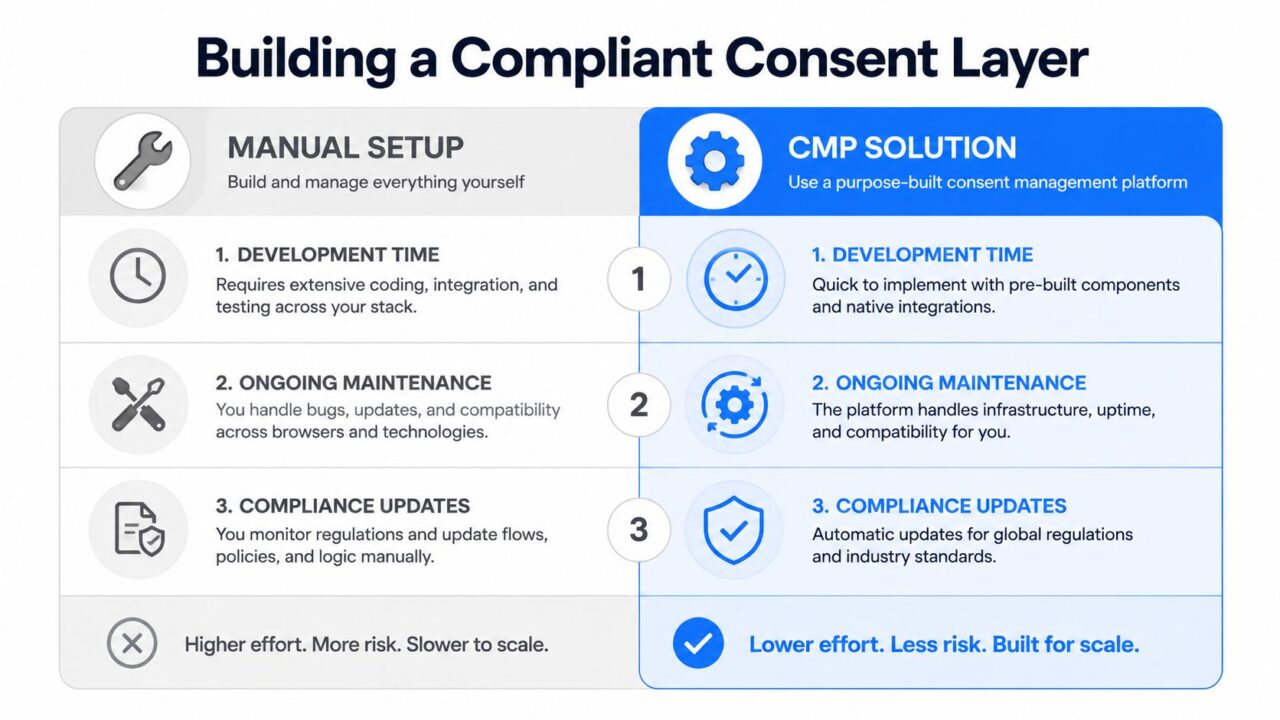
A compliant website flow starts with a recognizable CMP, not a custom modal built during a sprint. The reason is operational, not aesthetic. Websites change constantly, tag managers keep accumulating scripts, and manual setups drift as soon as a new pixel, widget, or analytics tool gets added.
Consent Management GDPR Comparison Chart
What the banner has to do
The banner itself needs granular, purpose-based choices. That means separate controls for analytics, marketing, advertising, and other non-essential purposes, with a visible reject path that doesn’t feel like a scavenger hunt. A design that makes accept easy and reject awkward is exactly the kind of pattern regulators keep looking for.
You also need to stop tracking before consent. If a tag fires early, the rest of the flow is just decoration. The 2026 scan mentioned earlier found that 30% of sites still fired a tracker before consent, which is why CMP selection matters less than CMP behavior. You want the tool to hold tags until the consent state is known.
A second layer is the technical encoding. For advertising and tracking, the IAB Europe Transparency and Consent Framework is the de facto technical layer across major markets. Its consent string stores metadata plus standardized purpose and vendor permissions in a compact bitfield, so downstream tags can read the decision and behave accordingly for GDPR compliance. That only works if your UI categories match the encoded model; otherwise, tags can fire in ways that don’t match the user’s actual choice, which creates both compliance risk and messy measurement.
Operational rule: If your category labels in the banner don’t match the consent state your tags consume, you’re creating a split brain between legal intent and technical execution.
A practical setup checklist
- Choose a CMP that can block non-essential scripts before permission.
- Map every purpose related to personal data processing into a clear category; don’t lump analytics and marketing together for data processing transparency.
- Test tag firing with a clean browser session and no prior consent.
- Check the reject path on mobile and desktop, because UX usually breaks there first.
- Verify logs capture the banner version and selected categories.
- Review changes whenever a new tracking tool gets added.
If you’re comparing approaches, a manual banner can work for a tiny site with almost no third-party tracking. In real production stacks, though, a dedicated CMP is what keeps the consent decision aligned with actual script behavior over time.
Designing Consent UX for Chatbots and Messaging Apps
Consent gets harder once the conversation starts inside a chat window. There’s no banner to lean on in Messenger, WhatsApp, Instagram DM, or a website bot, so the consent request has to live naturally inside the flow itself. The user experience can still feel conversational, but the legal function stays the same.
A strong pattern is to place consent as a checkpoint right after the initial greeting and before any non-essential messages go out. The wording should be simple and scoped to one purpose, for example marketing updates, order support, or lead qualification. If you ask for more than one thing at once, the user can’t make a clean choice.
How to structure the conversation
Use short language and make the choice explicit. The bot should identify the business, state the purpose, and offer a clear way to continue without opting in. That can be a button tap or a short reply, but it needs to be active, unambiguous, and easy to understand.
The logging side matters just as much. At capture time, save the exact notice version shown, a precise timestamp, the data subject identifier, the consented purposes, the capture channel, and any age-verification status. That record should be appended, not rewritten, because if a later campaign update replaces the original wording, you’ve lost the evidence of what the user saw.
A good withdrawal path should also live in the same channel. If a user replies stop, that should trigger the same suppression and logging behavior as a button tap. Anything more complex than that creates friction, and friction is usually where consent handling starts to drift.
For teams building this kind of flow, understanding privacy law is crucial. A legal chatbot approach is useful when it’s designed to surface choices instead of hiding them in legal copy. If you want to see how the interaction layer is typically structured, the Clepher guide on designing a chatbot flow is a practical reference point.
What works in production
- Short prompts: Ask for one purpose only, then move on.
- Button-based choices: Use tap actions when the channel supports them.
- Visible opt-out: Put the stop path in the same thread, not in a privacy policy.
- Immutable logging is essential for data protection authorities to verify user consent. Save the conversation event as evidence, not as a note.
- Channel-specific wording: Don’t paste website banner text into chat.
The conversation should feel human, but the compliance model still needs to be machine-readable. That’s the difference between a friendly bot and a defensible consent flow.
Multi-Channel Consent Compliance Checklist and Real Wording Examples
The fastest way to clean up consent is to standardize the wording by channel and check each system against the same logic. Website banners, chatbot prompts, WhatsApp broadcasts, Messenger flows, and Instagram DM campaigns all need the same core idea, but the delivery has to fit the medium.
Use wording that is direct and purpose-specific. For a newsletter opt-in, something like “I want to receive product updates and promotional emails from [brand name]” is much cleaner than “I agree to receive communications.” The first sentence tells people what they’re opting into, while the second one leaves too much room for interpretation.
Channel by channel checklist
Website banner
- Separate essential from non-essential purposes.
- Give users a visible reject path to enhance their data privacy rights.
- Log the banner version and purpose choices.
- Block trackers until consent is stored.
Chatbot flow
- Ask for one purpose at a time.
- Put the consent request after a plain-language greeting.
- Capture the exact wording shown.
- Store a withdrawal path in the thread.
Messenger and WhatsApp
- State who’s sending messages and why.
- Include a simple opt-out instruction in the conversation.
- Keep the consent log tied to the phone or channel identifier.
- Avoid bundling marketing with support or order updates.
Instagram DM
- Make the permission request explicit before recurring outreach.
- Timestamp the choice.
- Save the consent version and channel metadata.
- Give the user a clear way to stop future messages to respect their data privacy preferences.
If your team handles consent evidence manually, data privacy refresh cadence becomes a real problem. The GDPR doesn’t set a fixed time limit, the ICO says organizations should keep evidence for as long as they’re still processing on the basis of consent, and the IAPP notes that consent can degrade over time and should be refreshed at appropriate intervals, so the policy has to be operational, not theoretical. That gap is why many teams build a reminder or re-prompt rule into their lifecycle rather than assuming old permission lasts forever. For a channel handoff example, the flow from Messenger to WhatsApp is a good way to think about keeping the user choice intact when the thread moves.
Keep the wording short, then let the record do the compliance work.
A practical reference sheet should give your team copy they can use immediately and a rule for when to refresh stale permission. That saves everyone from improvising a different consent pattern every time a campaign moves to a new channel.
Implementing Consent Management with Clepher
Clepher fits this use case because the consent step stays inside the same no-code environment used to build the bot flow. You can design the conversation with drag-and-drop, launch capture widgets that turn visitors into subscribers, and keep consent-related actions attached to the message journey instead of splitting them across separate tools.
The part that matters most is what happens after the user taps yes or no. Clepher’s GDPR tools are built to handle consent logging, preference management, and withdrawal in the same platform, so consent events do not drift into a spreadsheet problem later. Learn more about permission management to see how consent events are captured and stored. For teams that already use email or SMS, the platform also connects natively with 50+ apps that process personal data and extends to 5,000+ more through Zapier, Make, n8n, or Pabbly.
What the flow looks like
A marketer can publish a bot on the website or a social channel, ask for a specific permission, and then send a broadcast only to people who opted in for that purpose. If someone withdraws consent, the preference update can be reflected before the next send instead of after it. That is the operational difference between a consent-aware system and a messaging tool with a privacy checkbox bolted on.
Clepher’s permission management can also sit alongside the rest of the audience model. That matters when you are segmenting users by source, channel, or message intent, because the consent state has to travel with the contact record. If it does not, one platform shows an opt-out while another still treats the user as active.
The strongest setups do not rely on memory or manual cleanup. They record the choice at the moment it is made, then keep that choice available to the rest of the stack when a campaign, handoff, or broadcast runs later.
If your current process uses separate forms, spreadsheets, and ad hoc reminders, the risk is operational as well as legal. Every extra handoff creates another place where consent can fall out of sync with what the user chose.
Frequently Asked Questions About Consent Management
Key Takeaways and Your Next Step
Consent management under GDPR isn’t a banner problem; it’s an evidence problem. The five requirements – freely given, specific, informed, unambiguous, and provable – only work if your UX, logs, and tag behavior all line up. If one channel is clean and another isn’t, the gap still counts.
The practical checklist is straightforward. Make sure every consent request stands on its own, tie each purpose to a clear choice, block non-essential tracking until permission exists, preserve an immutable log of what was shown, and give users a withdrawal path that’s just as simple as the opt-in. That applies on websites, in chatbots, and in messaging apps.
The bigger shift is mindset. Consent is an ongoing governance function, not a one-time launch task, because users change their minds, privacy copy changes, and channels keep expanding. Teams that treat it like a living control tend to catch problems early, while teams that treat it like a banner tend to find out during an audit.
If you’re ready to make the flow easier to maintain, review the checklist in this guide, compare it against your current website and conversational journeys, and fix the weak spots before your next campaign goes live. A tool like Clepher can help you build the conversational side with consent logging and permission management in one place.
If you want to tighten your consent flows across websites, chatbots, Messenger, WhatsApp, and Instagram DM, visit Clepher and use it to build the consent capture, logging, and withdrawal steps into the same no-code flow. It’s a practical way to keep permission state attached to every message journey instead of trying to reconcile it after the fact.

Related Posts
Chat Bot Responses That Convert: A Practical Guide
October 12, 202610 Broadcast Automation Software Platforms Compared
October 11, 2026Customer Journey Automation: The Practical Guide
October 10, 2026
Founder Clepher