
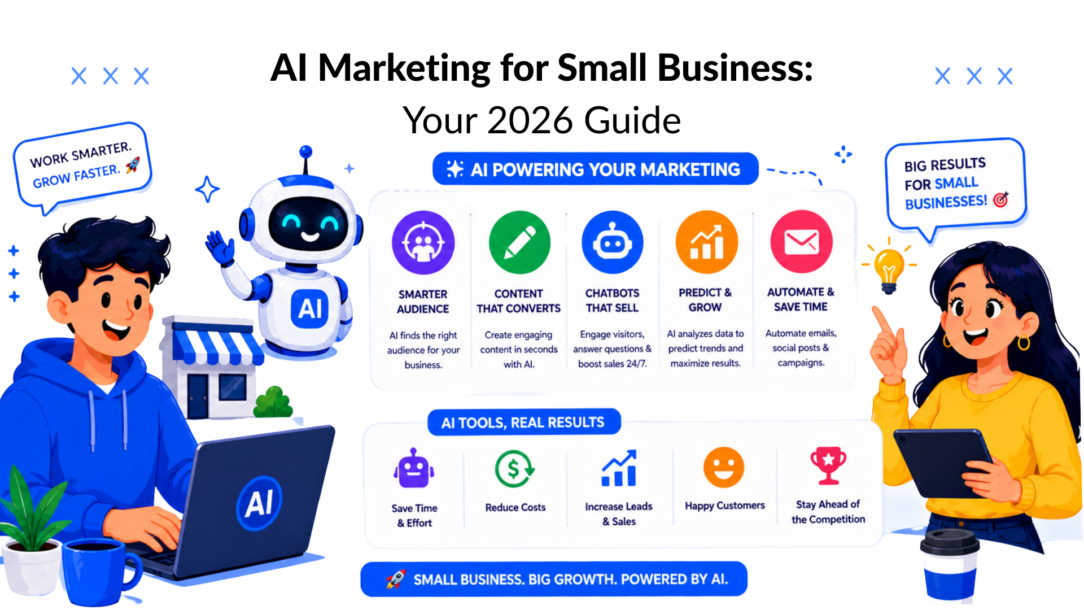
Why AI Marketing is No Longer Optional for Small Businesses
The pressure on small businesses comes from three directions at once. Customers expect fast replies. Marketing channels keep multiplying. Your time is limited.
That’s why AI has moved from “interesting” to “practical.” When more small businesses adopt it and start using it every day, the competitive gap changes. The business that responds first, follows up consistently, and personalizes outreach usually gets the sale.
AI Marketing for Small Business
What this looks like in real life
Without AI, a local gym owner might do all of this manually:
- Reply to DMs one by one: Answering the same pricing and class questions over and over.
- Sort leads by instinct: Guessing who’s serious and who’s just browsing.
- Send follow-ups late: Reaching out after interest has cooled.
- Forget repeatable tasks: Missing simple chances to recover abandoned inquiries.
With AI, that same owner can set up a system that replies instantly, asks qualifying questions, tags leads by interest, and sends relevant follow-ups automatically.
That doesn’t replace strategy. It creates room for strategy.
Practical rule: If a marketing task happens repeatedly and follows a pattern, AI can probably help automate it.
Why small businesses feel the impact faster
Large companies often bury simple wins inside layers of process. Small businesses don’t. If you save time on lead qualification or improve follow-up speed, you feel it right away in your schedule and sales pipeline.
That’s one reason AI marketing for small businesses works so well when it starts with one bottleneck. Not ten. One.
Good starting points include:
- Missed leads: People message you, then disappear.
- Slow response times: Prospects move on before you reply.
- Manual follow-up: You know you should do it, but the day gets away from you.
- Fragmented tools: Your ads, chat, email, and CRM don’t talk to each other.
If you want a simple primer before building anything, this guide on how to use AI for marketing is a useful next read.
Understanding AI Marketing Beyond the Buzzwords
Most confusion starts with the term AI itself. People hear it and picture a robot making big decisions on its own. In small business marketing, that’s usually not what’s happening.
A better analogy is this: AI is like hiring a fast junior assistant who never gets tired, can review a huge amount of customer behavior quickly, and gets better when you give it feedback.
What AI actually does in marketing
In practice, AI helps with tasks like:
- Recognizing patterns: Spotting which leads look more likely to buy.
- Writing first drafts: Creating message ideas, subject lines, or ad copy for you to edit.
- Responding to common questions: Handling routine inquiries through chat.
- Choosing timing: Sending emails when each person is more likely to engage.
- Routing people: Moving a customer toward a purchase, support answer, or human handoff.
That’s much easier to understand than abstract technical language because it maps to work you already do.
Two terms that matter
You don’t need to become technical, but two concepts help.
Natural language processing
This is the part that helps software understand everyday human language.
If a prospect types “Do you ship internationally?” and another writes “Can I order outside the US?”, a good AI system can recognize that both people are asking roughly the same thing. That’s what makes chatbots and AI assistants feel useful instead of rigid.
For a small business, natural language processing matters when you want faster conversations without forcing customers into awkward menus.
Machine learning
AI is most useful when it handles the repetitive parts of judgment, not when it replaces your business judgment.
What AI is not
It helps to clear away a few myths.
| Myth | Reality |
|---|---|
| AI runs your marketing for you | AI supports decisions and automates workflows, but you still set the offer, audience, and goals. |
| You need a big budget | Many small businesses start with one workflow, like chat replies or email follow-up. |
| It’s only for online brands | Local businesses, service firms, agencies, and coaches can all use it in lead capture and customer communication. |
| It has to be perfect from day one | Most AI marketing improves through testing, editing, and iteration. |
The smartest way to think about it
Don’t ask, “How do I use AI everywhere?”
Ask:
- Where are leads getting stuck?
- Which conversations repeat most often?
- What task takes time but follows a pattern?
- What would I automate first if I had a reliable assistant?
Those questions lead to better decisions than chasing features.
Four Core AI Marketing Applications to Drive Growth
Small businesses don’t need every AI use case. They need the few that connect directly to leads, sales, and saved time.
The most practical applications usually fall into four groups.
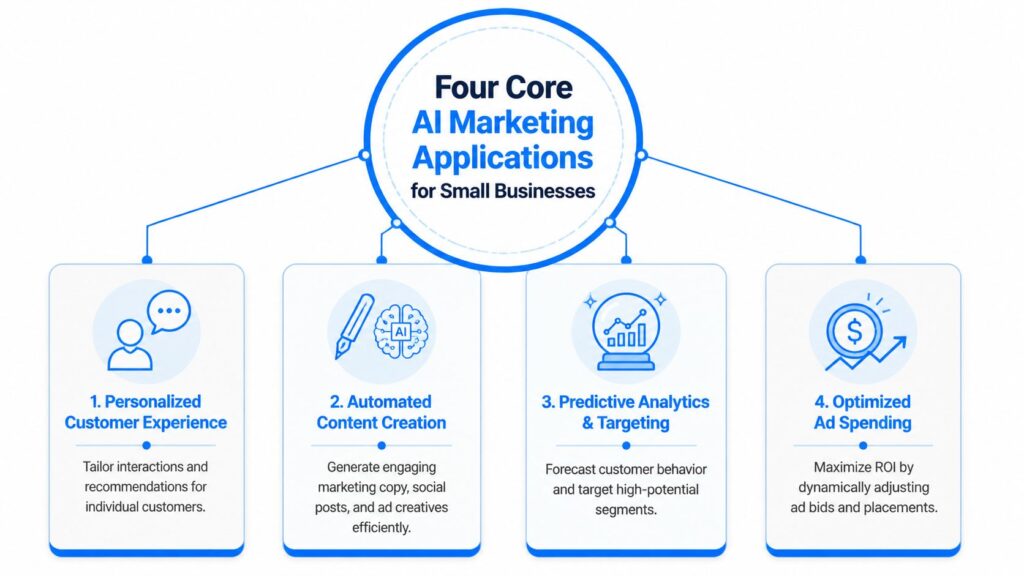
AI Marketing for Small Business Marketing Strategies
AI chat and lead capture
Chat is often the first place where AI creates obvious value. A customer clicks an ad, lands on your site, opens Instagram, or sends a Messenger question. If nobody answers quickly, interest fades.
An AI chat flow can do the first layer of work immediately:
- Answer common questions: Pricing, hours, shipping, availability.
- Ask qualifying questions: Budget, timeline, need, product interest.
- Collect contact details: Email, phone, preferred channel.
- Route the conversation: Sales, support, booking, or human help.
Lead capture isn’t just about gathering names; it’s about separating curiosity from buying intent.
AI-powered lead scoring adds another layer. According to Salesforce’s overview of AI for small business marketing, AI lead scoring analyzes signals such as website interactions, social media activity, and engagement patterns. In conversational workflows, that means the system can learn which answers, actions, and paths tend to produce stronger leads.
If you want a broader perspective on conversational capture, Orbit AI lead capture solutions offer a useful look at how AI can support lead generation flows.
Personalization that goes beyond first names
A lot of small businesses hear “personalization” and think of adding “Hi Sarah” to an email. That’s not its true value.
Useful AI personalization changes the message, offer, or path based on behavior.
A skincare brand might guide new visitors differently depending on whether they ask about acne, dryness, or sensitive skin. A service business might send one follow-up to people who requested pricing and a different one to people who asked about turnaround time. An online coach might show one path for beginners and another for advanced buyers.
The point is relevance. Customers don’t want more messages. They want messages that fit what they’re trying to do.
Smarter ad and audience optimization
Paid ads create two common problems for small businesses. First, they attract mixed-quality traffic. Second, they create more follow-up work than the team can handle.
AI helps by tightening the gap between click and qualification.
Here’s a simple breakdown:
| Ad challenge | How AI helps |
|---|---|
| Too many low-intent clicks | It can support tighter targeting and better downstream qualification. |
| Same message for everyone | It can tailor follow-up paths by interest or behavior. |
| Leads go cold after the click | It can trigger immediate responses in chat or email. |
| Manual testing is slow | It can speed up testing of copy, creative angles, and sequences. |
AI marketing for small businesses offers more than ad management. The ad is only the entry point. The true gain comes from what happens after someone responds.
Email optimization and follow-up timing
Email still matters because it gives you a direct channel you own. The challenge is that blanket scheduling often misses the moment when people are most likely to engage.
According to the U.S. Chamber’s discussion of AI tools for small business marketing, AI-driven email marketing tools analyze individual engagement patterns to determine better send times and content strategies. That same source notes that behavioral personalization in abandoned cart sequences can achieve 37% recovery rate improvement.
That’s a good example of why timing and behavior matter together. A cart reminder sent at the wrong moment with generic copy can be ignored. A behavior-based reminder that fits the customer’s pattern has a better chance of bringing them back.
A practical email sequence example
A small online store could use AI to shape follow-up like this:
-
Customer views a product twice
The system identifies repeated interest. -
Customer adds to cart but leaves
AI triggers an abandoned cart sequence. -
Message timing adjusts based on user behavior
One shopper tends to open in the morning. Another engages at night. -
Content reflects interest
The message highlights the exact product category they browsed. -
Responses feed future decisions
Opens, clicks, and purchases improve future timing and content choices.
For businesses juggling several channels, a platform that combines chat, segmentation, and automation can reduce switching between tools. AI marketing automation tools are worth evaluating through that lens.
Building Your First AI Campaign with Clepher
Theory is useful. A live campaign is better.
Let’s use a simple scenario. A small e-commerce brand sells premium water bottles through Facebook and Instagram. The owner is getting comments on posts and some ad traffic, but most interested shoppers never turn into leads. Messages arrive at random times, replies are inconsistent, and email follow-up happens only when there’s spare time.
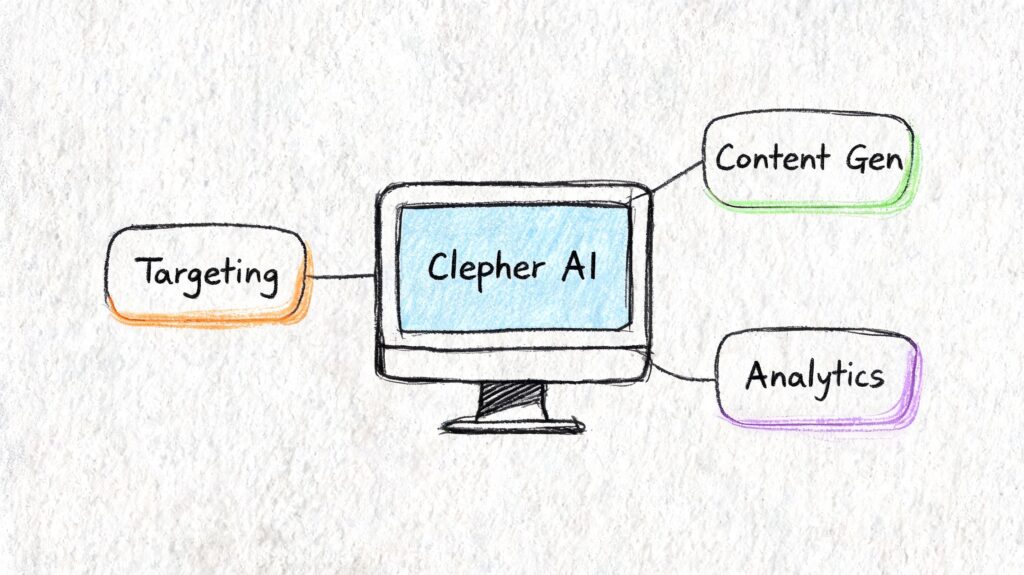
AI Marketing for Small Business Clepher AI
Start with one campaign goal
The goal isn’t “use AI.” The goal is to turn social engagement into qualified leads and sales conversations.
That keeps the build focused.
A practical first campaign might work like this:
- Someone comments on a Facebook post about a new bottle color.
- They automatically get a message in Messenger.
- The conversation asks a few short questions.
- Based on the replies, the person gets tagged by intent or product interest.
- Qualified leads get a follow-up sequence or handoff.
A unified setup offers assistance. Instead of using one tool for comments, another for chatbot flows, another for tagging, and another for follow-up, the owner can build the journey in one place.
Build the conversation flow
Inside a no-code chatbot platform such as Clepher, the owner can create a drag-and-drop flow rather than writing custom code. The flow doesn’t need to be complicated.
A clean version might look like this:
-
Trigger
When someone comments on a specific post, start the flow. -
Opening message
Thank them and offer help choosing the right product or offer. -
Question one
Ask what they care about most, such as design, durability, or gifting. -
Question two
Ask whether they want a discount, product recommendation, or bundle details. -
Contact capture
Request an email or prompt them to continue in chat. -
Tagging
Apply tags like “gift buyer,” “bundle interest,” or “high intent.” -
Next step
Send a customized message, coupon, or product guide.
That structure is simple enough to launch quickly and strong enough to produce usable data.
Keep the first flow short. If your chatbot asks too many questions before delivering value, people drop off.
Use chat behavior for lead qualification
Lead qualification is where AI becomes especially practical. Salesforce notes that AI-powered lead scoring can analyze signals across behavior and engagement, and in conversational flows, which means chat interactions become useful data rather than dead-end messages.
For this water bottle brand, stronger buying signals might include:
- Repeated product questions: The shopper asks about material, shipping, or bundle options.
- Offer engagement: They click a discount button or ask for a recommendation.
- Deeper path completion: They finish the flow instead of dropping after the first message.
- Timing signals: They respond quickly and continue the conversation.
A casual browser may ask one vague question and leave. A stronger prospect usually reveals intent through actions.
That’s the practical difference between “we got messages” and “we identified qualified leads.”
Connect the chatbot to the rest of your marketing
A campaign only works if the data goes somewhere useful.
Once a lead is tagged, the owner can push that information into the rest of the stack. For example:
- Email list sync: Add “bundle interest” leads to Mailchimp through an automation connector.
- CRM update: Send contact details and tags into a sales or customer database.
- Retargeting prep: Segment audiences based on chat intent for future campaigns.
- Support routing: Flag product questions that need human help.
This video gives a clearer picture of how conversational automation works in practice:
Launch, then improve one step at a time
Most owners overcomplicate the first build. They try to automate every scenario up front. That usually creates a bloated flow.
A better rollout looks like this:
| First week focus | What to review |
|---|---|
| Trigger performance | Are people entering the flow from the right posts or ads? |
| Drop-off point | Which question causes the biggest loss of engagement? |
| Tag quality | Do your tags reflect actual buyer intent? |
| Handoff readiness | Which replies should go to a human instead of automation? |
The first live version should answer one business problem well. After that, you can add abandoned cart recovery, post-purchase follow-up, or support triage.
That’s how AI marketing for small businesses becomes manageable. You don’t build an AI department. You build one useful campaign, then improve it.
Measuring Your AI Marketing Success and ROI
Many small businesses encounter a common challenge. They can see activity, but they can’t prove business impact.
That gap is common. As noted in Mastercard’s discussion of AI use for small businesses, many small businesses struggle to connect chatbots, email campaigns, and lead scoring to actual sales outcomes. The problem usually isn’t a lack of effort. It’s a weak measurement.
Stop reporting vanity metrics
A lot of dashboards make you feel productive without telling you anything useful.
For example, these can be interesting but incomplete:
- Chat starts
- Messages sent
- Email opens
- Button clicks
- Flow entries
Those metrics matter only if they connect to a commercial outcome.
A better question is: did this workflow create revenue, save team time, or improve lead quality?
Track business-first KPIs
For AI marketing, the most helpful metrics usually sit closer to money and labor.
For lead generation
- Qualified leads created by the workflow
- Lead-to-sale conversion rate
- Sales conversations booked from chat
- Cost per qualified lead
For support and automation
- Human hours saved on repetitive replies
- Conversations resolved without staff involvement
- Escalations sent to a person
- Response speed improvements
For retention and follow-up
- Recovered carts
- Repeat purchases from automated sequences
- Offer uptake by segment
- Revenue tied to specific flow paths
Don’t ask whether the bot was “busy.” Ask whether it moved someone closer to purchase or freed your team for higher-value work.
Use attribution that matches the customer journey
A customer might click a Facebook ad, ask a question in Messenger, join your email list, and buy later from a follow-up message. If you only credit the last step, you’ll underestimate what AI contributed.
That’s why attribution matters. You need a consistent way to see which touchpoints assisted the sale. This guide to marketing attribution is helpful if you want a practical model for multi-touch journeys.
A straightforward framework looks like this:
-
Define the entry point
Ad, comment trigger, website widget, or DM. -
Track the key action
Qualified lead, booked call, sale, or recovered cart. -
Map assisted steps
Chat interaction, email follow-up, broadcast, or retargeting touch. -
Review by path
Which conversation paths produce customers?
When you do that, AI stops being a vague productivity tool and becomes a measurable part of your revenue process.
Common Pitfalls and How to Avoid Them
AI marketing works well when the system is designed around customer behavior. It creates frustration when owners automate too much, expect instant perfection, or bolt together too many separate tools.
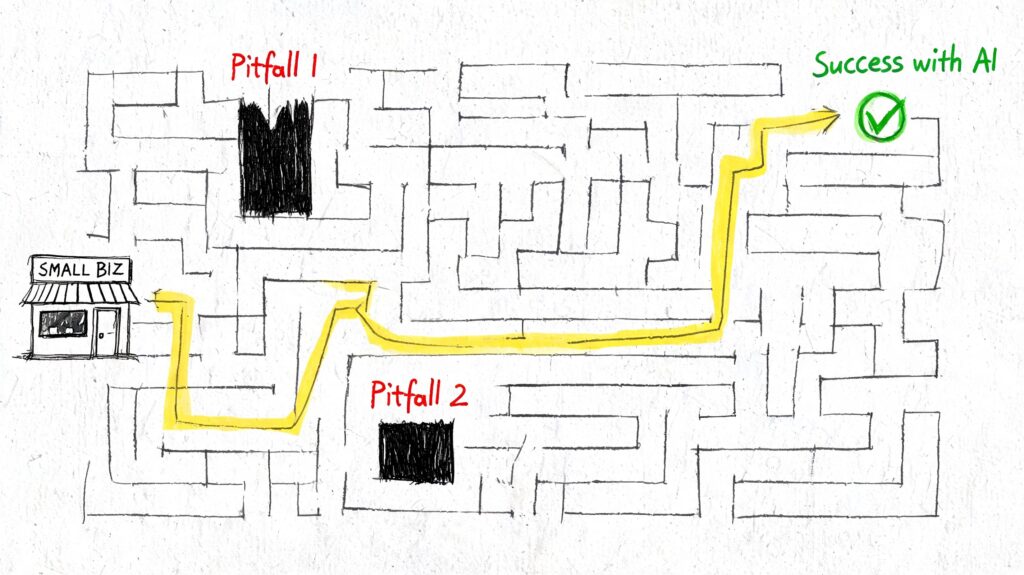
AI Marketing for Small Business Maze Strategy
Over-automation without a human escape route
One of the least discussed issues is the handoff from AI to a human. According to the Connected Commerce Council’s discussion of AI and small businesses, automation benefits get plenty of attention, but the question of when and how to transition from chatbot to person is still underexplored.
That matters because customers can usually tell when a bot is helping and when a bot is blocking them.
Set clear handoff triggers such as:
- High-friction questions: Billing issues, complaints, custom requests.
- Purchase-risk moments: A buyer signals hesitation or confusion before purchase.
- Repeated misunderstanding: The bot fails to answer after a couple of attempts.
- VIP or high-intent signals: Someone wants a quote, demo, or bulk order.
If the automation can’t move the conversation forward, it should route the person to someone who can.
Treating AI like magic
AI is powerful, but it still needs structure. A weak offer, confusing message, or broken funnel won’t become strong just because AI is layered on top.
Common expectation problems look like this:
| Mistake | Better approach |
|---|---|
| Launching with no clear goal | Start with one result, such as more qualified leads or faster response time. |
| Building a giant flow first | Launch a short version and improve it after seeing behavior. |
| Using generic prompts and copy | Edit outputs to match your brand, offer, and audience. |
| Ignoring review cycles | Check conversations regularly and update weak paths. |
Forgetting privacy and compliance
If you’re collecting emails, phone numbers, or customer messages, privacy matters. Small businesses sometimes focus so much on automation that they forget consent, data handling, and customer expectations.
Use tools that support permission-based marketing and make opt-ins clear. Keep your data collection limited to what you need for the next step in the customer journey.
Creating a patchwork stack
Many AI projects don’t fail because the idea is bad. They fail because the system becomes messy.
One tool captures leads. Another sends emails. Another manages DMs. Another stores customer notes. Soon, nobody knows which data is current, which automation fired, or where the customer is in the journey.
The more channels you use, the more valuable a unified view becomes.
That’s why simplicity often wins. One connected workflow is easier to manage than five disconnected automations.
Your Next Step into AI-Powered Marketing
AI has become practical for small businesses because it solves ordinary problems. Missed messages. Slow follow-up. Weak lead qualification. Inconsistent customer communication. Those are real issues, and they affect revenue.
The smartest way to start is small. Pick one campaign with one goal and one customer path. For many businesses, that means turning social messages, website visitors, or product inquiries into qualified leads automatically.
If you’re comparing your options, this roundup on Essential AI marketing technology can help you understand the kinds of tools small businesses are using across content, automation, and analytics.
The important part isn’t using AI everywhere. It’s using it where it removes friction and produces a clear business result.
Start with a short checklist:
- Choose one use case: Lead capture, follow-up, support triage, or cart recovery.
- Set one success metric: Qualified leads, booked calls, recovered sales, or time saved.
- Build one workflow: Keep it short and easy to review.
- Add human handoff rules: Make sure customers can reach a person when needed.
- Improve from real data: Edit the flow based on actual conversations.
That’s how AI marketing for small businesses becomes manageable. It stops feeling like a trend and starts working like a system.
If you want to turn Facebook, Instagram, WhatsApp, Messenger, and website conversations into a measurable marketing workflow, explore Clepher and start with a simple lead capture or follow-up flow.
Related Posts
10 Lead Capture Software Tools Compared for 2026
October 18, 2026WhatsApp Chatbot for Ecommerce: A Practical 2026 Guide
October 17, 2026What Is Lead Scoring and How It Drives Real Sales Results
October 16, 2026
Founder Clepher