
Black Friday still pulls enormous demand online, but volume alone is no advantage if your message looks like everyone else’s. More brands are sending discounts through the same channels at the same time, so the real question is not whether you have an offer. It is whether your offer reaches the right person, in the right format, at the right moment.
Message performance comes from orchestration. Timing, audience selection, channel choice, and follow-up determine whether a “20% off” promotion drives revenue or disappears in a crowded inbox. Strong Black Friday programs are built as coordinated sequences across SMS, email, on-site chat, Instagram, and Messenger, with each channel doing a specific job.
That matters because buyer intent shifts fast during Black Friday week.
A practical plan covers the full journey. VIP shoppers need early access. New visitors need a fast reason to act. Cart abandoners need a reminder that removes friction, not another generic discount. If someone clicks an SMS, ignores the landing page, then opens your email six hours later, your system should respond to that behavior instead of restarting the conversation from zero.
That is the angle of this guide. These examples are not just message templates. They show how to run each Black Friday message across multiple channels, and how to connect those touchpoints inside an automation platform like Clepher so email, SMS, and conversational AI work together instead of competing for attention. If you need inspiration for mobile copy, these text message examples for promotional campaigns are a useful reference point before you build the full sequence.
1. Urgency-Driven SMS Flash Deal
SMS gets opened fast, which is exactly why it earns a place in a Black Friday plan built around short buying windows and quick follow-up. The format is simple. A strong offer, a hard deadline, and one clear tap target.
Use it for limited inventory, short flash promos, or same-day revenue pushes. It fits mobile behavior because shoppers make quick decisions on their phones, especially during Black Friday when attention is split across dozens of promotions.
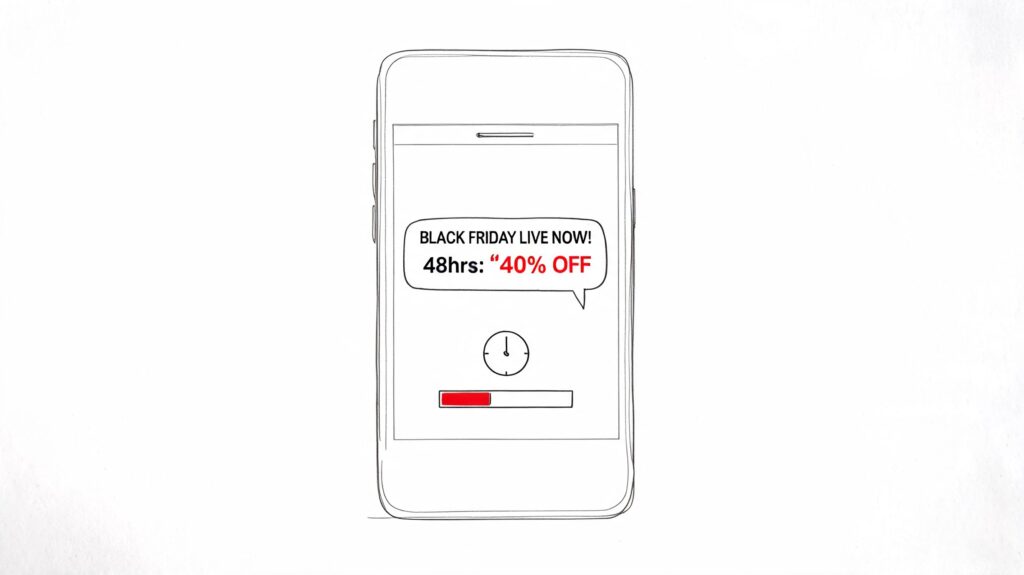
Black Friday Message Promotion Notification
The structure should stay tight:
- Lead with the offer: “Black Friday flash sale. 40% OFF everything.”
- State the cutoff: “Ends tonight.”
- Give one action: “Tap to shop.”
That format works because SMS has very little room for hesitation. Extra explanation lowers response. So do multiple offers competing inside the same text.
What to send
Try a copy like this:
Practical rule: If your SMS needs a second sentence to explain the deal, the deal is too complex for a flash campaign.
- For recent buyers: “VIP flash drop. Your Black Friday deal is live now. Shop before midnight.”
- For browsers: “Still deciding? Our Black Friday flash sale ends tonight. Tap for top picks.”
- For cart abandoners: “Your items are still in the cart. Black Friday pricing ends soon.”
Use these text message examples to shape the copy, then connect the SMS to the rest of your flow inside Clepher. If someone clicks but does not buy, send them into the next step based on behavior, not a generic resend. A click can trigger an email reminder with the same deadline. A reply can route into conversational support if a blocker is sizing, shipping, or stock.
That is the part many teams miss. SMS drives urgency, but urgency alone does not resolve objections.
Keep the mechanics disciplined. One link. One audience goal. One expiration point. Skip product lists, extra coupon codes, and emoji clutter. The job of this message is to create immediate action, then let your automation platform handle the next best touch across SMS, email, or chat.
2. Conversational AI Chat Widget Offer
Shoppers bounce fast during Black Friday. A generic pop-up wastes that visit. A chat widget gives you a better option: ask one useful question, sort intent, and present the right offer without forcing the visitor to hunt.
That matters because Black Friday traffic is noisy. Some visitors want the cheapest entry point, while others are looking for more information to make a decision. They might need help choosing between products, checking delivery timing, or confirming that the promotion is legitimate. A Black Friday sale is the perfect opportunity to engage, but one static banner cannot handle all of that well.
By using a dynamic chat widget, you can respond to these needs directly, keeping shoppers engaged and guiding them towards the best deals for 2026. Whether it’s about price or product details, offering personalized assistance on your site ensures you don’t lose valuable leads during the peak of the Black Friday sale.
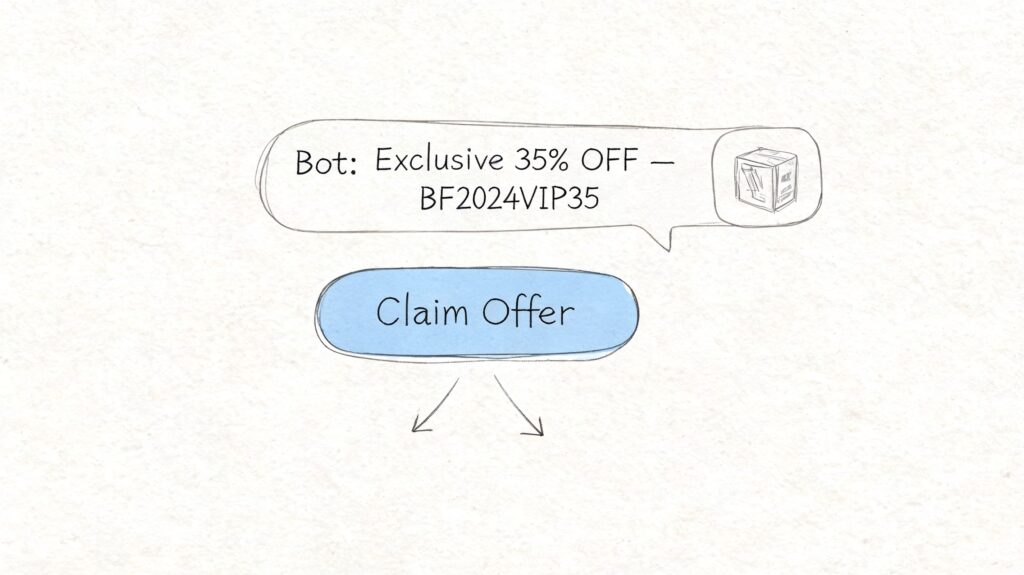
Black Friday Message Discount Offer
Use the opening message to classify intent, not to collect trivia. Three prompts are enough:
- “Shopping for yourself or a gift?”
- “Want the best deal or the best bundle?”
- “First order or returning customer?”
Those answers give you immediate routing logic inside a website chat widget. First-time visitors can see a starter offer plus two bestsellers. Returning customers can skip the intro and go straight to bundles, loyalty perks, or reorder shortcuts. High-intent visitors on a product or cart page should get direct help with comparison, stock, shipping, or checkout friction.
Keep the flow short. Reveal value by the second or third interaction. Typing indicators and quick replies help, but the primary performance gain comes from reducing decisions. If the bot asks too much before showing the offer, visitors treat it like a survey and leave.
The practical rule is simple.
A Black Friday chat widget should sort intent, answer objections, and move the shopper to the next action.
Page context should change the script. Homepage traffic may need orientation. Product-page traffic usually needs proof, fit, or urgency. Cart-page traffic needs reassurance and a fast path to purchase. In Clepher, that means triggering different chat entries by URL, referral source, or on-site behavior, then syncing those responses into a follow-up email or SMS. If a shopper asks about sizing and leaves, send sizing-focused follow-up. If they click an offer but hesitate at checkout, route them into recovery instead of blasting the same discount again.
Trust messaging also matters more than many ecommerce teams expect during Black Friday. Fraud concerns rise with promotional traffic, especially for expensive products and unfamiliar brands. The risk is outlined in this piece on Black Friday as a hacker’s paradise. Add one reassurance step, such as “Need help verifying this offer or checkout link?” and link to your support or policy page. That reduces hesitation for cautious buyers without slowing down confident ones.
One more operational detail. If your chat flow captures email before handing off a code or bundle, make sure those follow-ups reach the inbox. Use basic deliverability checks and review guidance on how to stop email from going to spam in Gmail before traffic spikes.
The mistake here is leading with the coupon for every visitor. Product fit often comes first. Let the chat qualify, then present the offer across chat, email, or SMS based on what the shopper signaled.
3. Email Countdown Timer Campaign
Cart abandonment emails average far higher engagement than standard promotional sends, and the same principle applies to Black Friday. Relevance beats volume. A countdown timer works only when the email gives one clear reason to act before the deadline.
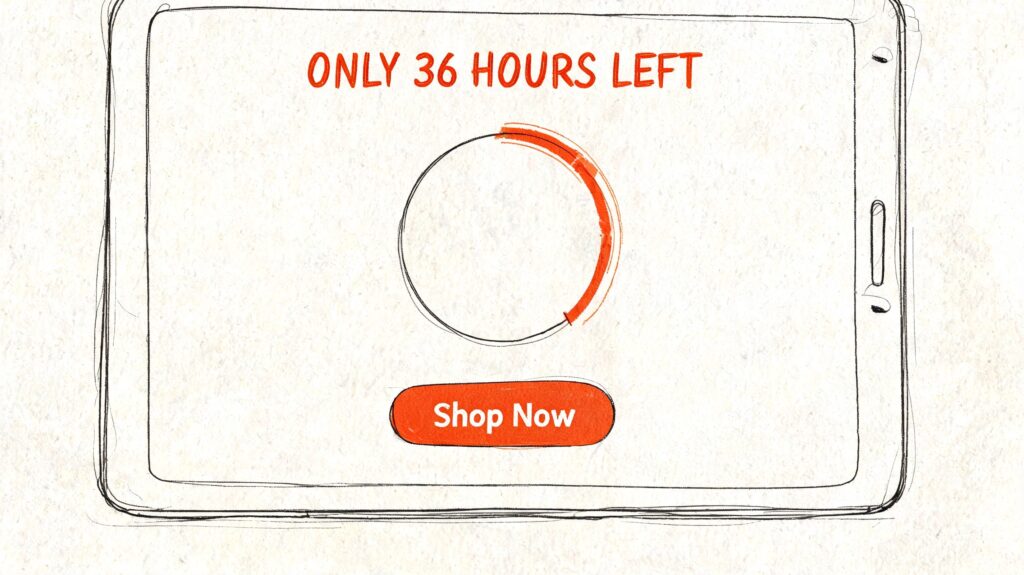
Black Friday Message Countdown Timer
The mistake I see every year is treating the timer as the message. It is not. The timer supports the message. If the offer is fuzzy, the clock only adds pressure without adding clarity.
Build the campaign around a single decision. Buy now, claim early access, secure the bundle, or shop the category before stock tightens. Keep the email focused enough that a shopper can understand the offer in a few seconds on mobile.
A practical structure looks like this:
- Top: Specific sale headline and countdown timer
- Middle: One buying trigger, such as a bestseller, limited bundle, or deadline-based perk
- Bottom: One primary CTA, plus one secondary CTA for category browsers
Segmentation matters here because a timer amplifies intent that already exists. It rarely creates intent from scratch. VIP customers respond to early access or first pick of inventory. Lapsed buyers need a reason to return, such as a category they previously viewed or a stronger value bundle. Repeat buyers often convert better on curated picks than storewide discount language.
In Clepher, set this up as a coordinated sequence instead of a standalone send. Trigger the first email when the sale opens, follow with an SMS reminder only for non-openers or high-intent clickers, and use conversational AI to handle product questions from people who click through but hesitate. That is the primary advantage of a multi-channel Black Friday message strategy. Email carries the detail, SMS handles deadline pressure, and chat removes purchase friction before the timer runs out.
Timing matters too. One launch email is rarely enough during a crowded promotional weekend. A stronger sequence usually includes launch, midpoint reminder, and final-hours message, with each send changing the angle instead of repeating the same creative. The trade-off is fatigue. If the list is cold or poorly segmented, extra sends can hurt more than they help.
If inbox placement is a concern, clean your list and review subject line patterns before launch. This guide on how to stop email from going to spam in Gmail is worth reviewing before you schedule your Black Friday sequence.
Creative production also becomes a bottleneck quickly during the holiday week. If your team needs supporting motion assets for the countdown push, use tools that generate AI-powered reels for social cutdowns tied to the same offer and deadline.
Weak timer emails say, “Big savings inside.” Strong ones say exactly what ends, who it is for, and what the shopper should do now.
4. Instagram Story Reels Call-to-Action Series
Instagram is where visual momentum does the selling. Not polished brand language. Momentum. A strong Black Friday Story or Reel sequence makes the offer feel active, social, and current.
Brands like Fashion Nova, Glossier, and Kylie Cosmetics use this format well because they understand what Stories are for. They’re not mini landing pages. They’re attention resets. Every frame should either show the product, showcase the deal, or move the viewer into DM. This is the time to showcase your Black Friday quotes and catchy Black Friday phrases that spark excitement and action.
Catchy phrases like “Get it before it’s gone!” or “Biggest deals of the year, just for you!” drive urgency and make the Black Friday sale feel like a limited-time opportunity. Use each frame to not only show your product but also to connect the offer with the current Black Friday momentum — keeping it social, interactive, and irresistible.
What the sequence should look like
A practical sequence across the day might include:
- Frame 1: Sale headline and countdown sticker
- Frame 2: Fast product close-up
- Frame 3: Social proof, bestsellers, or gift angle
- Frame 4: “DM us for your code” or “Reply DEAL.”
Use Instagram’s native countdown sticker rather than designing a fake one. Native tools feel more immediate and often pull better interaction because users already know how to engage with them.
Then connect replies to an automated DM flow. That’s where social attention becomes commerce. Someone taps a Story, sends a keyword, and gets routed into a personalized offer or product recommendation path.
Short video earns attention. DMs close the loop.
If you need more volume from your creative process, AI-assisted production can help you cut and repurpose Story-friendly content quickly. A tool like an AI reel generator for social campaigns can speed up creative output, especially when you need multiple variants during Black Friday weekend.
What usually underperforms is posting one Story in the morning and assuming the audience saw it. On Black Friday, recency matters. Repeat the message with different creative angles so people catch it when they’re browsing.
5. Abandoned Cart Recovery via Messenger
Nearly 7 in 10 online shopping carts are abandoned. During Black Friday, that drop-off usually comes from speed, distraction, or one unresolved objection. Messenger and Instagram DMs are useful recovery channels because they let you respond in the same thread where hesitation can be resolved fast.
The message has one job. Get the shopper back to checkout or surface the reason they stopped.
That means the recovery flow should match the likely cause of abandonment. Price hesitation needs urgency or a small incentive. Product doubt needs reassurance. Practical blockers like shipping, sizing, or delivery dates need answers. If you run this through Clepher, set the automation so email, SMS, and Messenger each handle a different part of the recovery path instead of sending the same reminder three times.
Effective sequence logic
Use a short Messenger sequence with a clear purpose at each step:
- First message: Remind them what they left behind and link directly to their cart
- Second message: Address the most likely blocker, such as stock risk, delivery timing, or returns
- Third message: Invite a reply for help, product advice, or checkout support
The timing framework in shopping cart abandonment recovery strategies is a good starting point. What matters more in practice is suppression logic. Stop the sequence the moment a purchase happens. If the shopper replies, switch from automation to conversation. A Black Friday message performs better when it answers a question than when it repeats a discount.
Keep the copy specific. “Your cart is waiting” is weak. “Your size in the black fleece is still available” is better because it restores context and adds a reason to act. In Messenger, specificity usually beats cleverness.
One more point matters on Black Friday weekend. Recovery through chat works best when it is connected to the rest of your automation stack. If someone ignores the DM but clicks from email, Clepher should update the profile, suppress duplicate nudges, and trigger the next best message in another channel. That is how a cart recovery sequence becomes a coordinated system instead of a pile of reminders.
What underperforms is a generic follow-up with no product detail, no reply path, and no stop rules. Show the item. State the offer. Remove the friction.
6. SMS Plus Chat Hybrid Early Access VIP Campaign
Early access works because it changes the frame. Instead of shouting the same black friday message to everyone, you give your best customers a reason to feel recognized.
This is especially effective for brands with repeat purchase patterns, membership tiers, or loyal category buyers. Nike, Sephora, and similar brands have trained customers to expect priority access. The psychology is simple. Access can be as motivating as discount size.
Two channels, two jobs
Use SMS for the alert and chat for the experience.
SMS should do one thing well: announce that VIP access is open or about to close. Chat should handle everything richer than that, including:
- product recommendations
- personalized codes
- collection links
- support questions
- bundle guidance
The mistake I see most often is giving VIPs the same message as everyone else, with “exclusive” added to the subject line. Real VIP messaging should change at least one of these elements:
- Timing
- Product selection
- Offer type
- Support priority
If someone clicks the SMS and enters chat, use tags or purchase history to branch the conversation. Recent skincare buyers shouldn’t see the same product path as someone who only buys accessories.
Field note: VIP campaigns fail when the perk feels recycled. If your loyal customers can get the same deal two hours later in a public post, don’t call it early access.
This format also protects your email list from overload. Instead of forcing every high-intent buyer through inbox triage, you can use SMS to trigger immediate action and use chat to personalize the path. That’s a cleaner customer experience during a crowded weekend.
7. Interactive Spin-to-Win Wheel in Chat
Gamified offers can work on Black Friday, but only when the wheel supports your economics instead of undermining them. Too many brands treat spin-to-win like a novelty pop-up. Then they wonder why margins collapse or bargain hunters vanish after one purchase.
The strongest use case is lead capture plus controlled discount distribution. Put the wheel inside a chat flow or website widget, collect consent first, and make the next step clear. The game should feed your retention system, not sit outside it.
Lead with a simple promise: spin for your Black Friday offer. After the win, move immediately into redemption. Don’t leave people holding a code with no guidance.
Later in the flow, a short demo or explainer can help teams visualize the mechanic in practice:
Where the wheel fits best
This works well for:
- first-time visitors who need a reason to opt in
- returning visitors who haven’t purchased
- cart abandoners who need a final push
- list growth campaigns ahead of the main Black Friday launch
One caution is more significant than frequently understood. If you promise randomness, the outcomes need to feel fair and coherent. A luxury brand giving away aggressive discounts to cold traffic can train the wrong behavior fast.
A more stable setup is to vary the price type rather than relying only on deeper and deeper percentage discounts. You can mix:
- free shipping
- bundle offers
- gift-with-purchase
- category-specific offers
- early access passes
What doesn’t work is letting the wheel become the brand. If the game is more memorable than the product offer, you’ve attracted curiosity, not buying intent.
8. User-Generated Content Hashtag Campaign with Bot Aggregation
Most Black Friday messaging is discount-first. That’s fine for conversion, but weak for trust. User-generated content gives your sales a different kind of proof. Shoppers see real people using the product, not just your brand repeating that it’s worth buying.
A hashtag campaign can do more than collect mentions. If you feed approved UGC into automated chat flows, the black friday message becomes more believable. Someone asks about fit, quality, or gifting, and the bot can surface relevant customer photos or clips instead of just pushing product cards.
Make social proof usable
The sequence is straightforward:
- ask customers to tag the brand or use the sale hashtag
- review and approve content
- map the best assets to product questions in chat
- surface those assets in DMs, website widgets, or Messenger replies
For some brands, there’s also room for a contrarian angle. Sustainable or anti-Black Friday messaging remains underused, even though brands like Palava and broader Green Friday campaigns show there’s an appetite for alternatives to pure discount noise. This roundup of alternatives to Black Friday is useful if your audience cares about lower-waste purchasing or “imperfect but functional” collections.
That approach won’t fit every brand. But if you already attract value-driven or eco-conscious buyers, UGC can support a message built around durability, mindful purchasing, or limited overconsumption.
Customers trust customer language. Your bot should use it when it helps the sale.
What usually fails is running a hashtag push with no reward, no moderation, and no plan for reuse. If you collect UGC, put it to work in your automated flows while the buying intent is still high.
8-Channel Black Friday Message Comparison
| Campaign / Format | Implementation 🔄 (Complexity) | Resources ⚡ (Effort & Tools) | Expected Outcomes 📊 (Impact) | Ideal Use Cases 💡 | Key Advantages ⭐ |
|---|---|---|---|---|---|
| Urgency-Driven SMS Flash Deal (SMS/Text Message) | Low–Medium 🔄: simple template + scheduling; needs inventory sync | Low ⚡: SMS provider, list segmentation, Clepher SMS integration | High 📊: immediate opens (98%+) and short-term conversion spike | Mobile-first audiences, flash clearance, time-limited promos | High open rate, direct CTA, easy A/B tests ⭐ |
| Conversational AI Chat Widget Offer (Website Chat Widget) | Medium–High 🔄: design flows, AI keywords, dynamic discount generation | Medium ⚡: chat platform (Clepher), flow design, integration with checkout | High 📊: converts browsers to qualified leads; improved onsite conversion | On-site personalization, product discovery, lead capture | Real-time personalization and data capture; qualifies leads ⭐ |
| Email Countdown Timer Campaign (Email Marketing) | Medium 🔄: template dev, AMP support optional, fallback handling | Medium ⚡: ESP (Klaviyo/etc), dynamic timer asset, dev/design | Medium–High 📊: CTR lift (~20–30%); good attribution via codes | Segmented lists, VIP blasts, and broad audience Black Friday sends | Dynamic urgency visuals and personalized codes for tracking ⭐ |
| Instagram Story/Reels Call-to-Action Series (Social) | Medium 🔄: high content cadence, platform-specific assets and stickers | Medium–High ⚡: video/photo production, social managers, possible ad spend | High 📊: strong engagement and traffic spikes; awareness boost | Visual brands, influencer-driven promotions, and mobile engagement | High engagement, interactive stickers, and DM CTAs link to commerce ⭐ |
| Abandoned Cart Recovery via Messenger (Messenger/IG DM) | Medium 🔄: event triggers + multi-step automation; Meta approvals needed | Low–Medium ⚡: e‑commerce integration, Clepher bot, message templates | High 📊: high open rates (45–60%); recovers abandoned revenue efficiently | Cart abandoners, mid‑to‑high AOV transactions, timely recoveries | Conversational recovery with high open rates and low CAC ⭐ |
| SMS + Chat Hybrid Early Access VIP Campaign (Multi-channel) | High 🔄: multi-channel orchestration and tiered segmentation | High ⚡: SMS + chat systems, CRM data, inventory coordination | High 📊: strong uplift in AOV/LTV from VIP cohorts | Loyalty programs, tiered early access, and high‑value customers | Creates exclusivity → loyalty and higher spend per customer ⭐ |
| Interactive Spin-to-Win Wheel in Chat (Gamified) | High 🔄: custom interactive UI, randomization, backend code generation | High ⚡: development, animation/UX, discount code system, compliance checks | High 📊: large opt-ins and engagement; AOV lift but margin risk | List growth, viral promotions, incentives to opt-in | Gamification drives opt‑ins, shareability, and memorable UX ⭐ |
| UGC Hashtag Campaign with Bot Aggregation (Social + Chat Bot) | Medium–High 🔄: hashtag tracking, moderation, bot integration | Medium ⚡: social monitoring APIs, moderation team, Clepher flows | Medium–High 📊: increased trust, organic reach, higher conversion via social proof | Community-driven brands, authenticity-led campaigns | Authentic social proof, low-cost content and network effects ⭐ |
Your Black Friday Playbook From Messages to Automation
Black Friday inboxes, feeds, and message threads fill up fast. Response usually goes to brands that match the channel to the moment instead of repeating the same offer everywhere.
A strong black friday message starts with channel roles. SMS handles speed and urgency. Email carries the full offer, exclusions, and product depth. Instagram pulls in attention at the top of the funnel. Chat handles hesitation, product questions, and last-minute friction before purchase. The work is not about writing one great line. The work is building the sequence and the handoff between those channels.
That is the practical shift behind this playbook. Each message type in this guide maps to a job, then to an automation step. A flash deal can trigger an SMS burst, a non-click follow-up, and a chat prompt on-site. A cart abandonment flow can start in Messenger, then route high-intent shoppers to a live rep or AI assistant based on cart value or product category. With a platform like Clepher, those paths can sit in one operating system instead of being split across disconnected tools.
Start with two flows, not eight.
The fastest setup for many teams is one demand-generation campaign and one recovery campaign. For example, pair an Instagram Story to a DM entry point with an abandoned cart Messenger flow. Or pair an email countdown campaign with an SMS alert for subscribers who clicked but did not buy. That gives you enough signal to learn which offer, channel, and timing combination moves revenue without creating operational clutter.
Trade-offs matter here. SMS gets attention quickly, but overuse creates opt-outs. Email gives you room to explain bundles, shipping cutoffs, and tiered discounts, but slower engagement can blunt urgency. Conversational AI reduces support load and speeds response time, but it needs tight prompt design, clear escalation rules, and approved offer logic before traffic spikes. Good Black Friday execution comes from choosing where each channel earns its keep.
Trust also needs a place in the workflow. Delivery deadlines, return policy reminders, payment security, stock alerts, and fast answers to product questions can outperform another discount reminder for shoppers who are close to buying. During peak sale periods, operational messaging often separates a one-time conversion from a customer who comes back after Cyber Monday.
Clepher fits this setup because it connects website chat, Messenger, WhatsApp, Instagram DM, broadcasts, segmentation, and automation flows in one place. That gives teams a cleaner way to set triggers, route conversations, and keep sale logic consistent across channels. It also reduces the common Black Friday problem of one team running email, another running SMS, and support trying to catch up manually in chat.
Creative production still matters, especially for Stories, Reels, and short promotional assets that need multiple versions in a short window. Resources like ClipCreator.ai’s AI tools for social media can help teams produce enough variation to support testing without slowing down campaign launch.
The goal is a message system that reacts to buyer intent quickly, with fewer wasted sends and fewer dead ends.
If you want to turn these ideas into live campaigns, Clepher can help you build automated Black Friday flows across your website, Facebook Messenger, WhatsApp, and Instagram DMs, then connect those conversations to your wider email and SMS strategy.
Related Posts
Client Account Management: A Practical Playbook
October 13, 2026Chat Bot Responses That Convert: A Practical Guide
October 12, 202610 Broadcast Automation Software Platforms Compared
October 11, 2026
Founder Clepher