
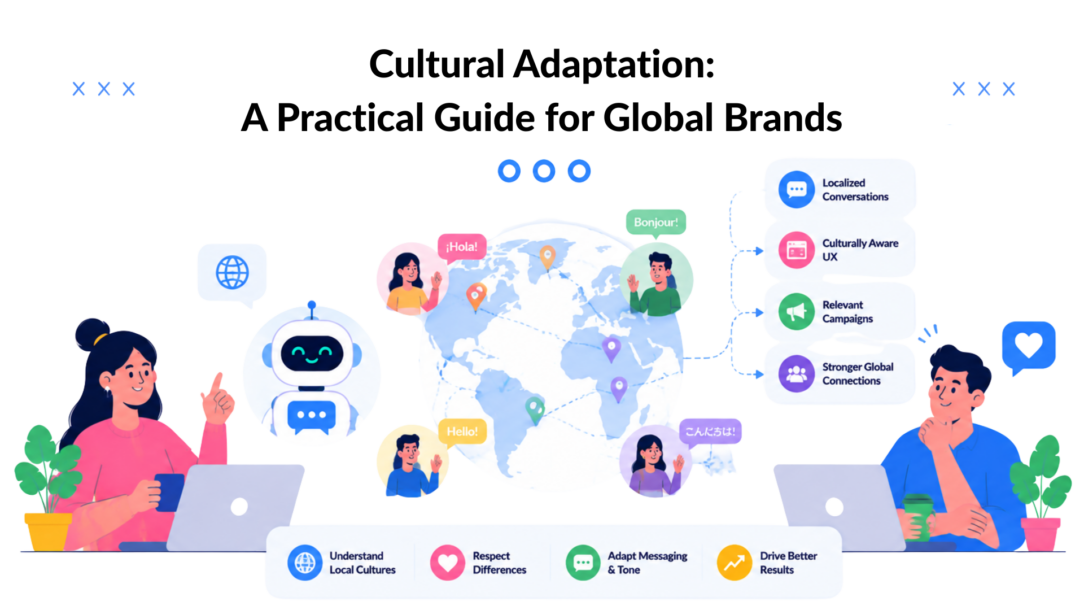
You know the moment. The campaign crushed it at home, the landing page looked polished, the chatbot was ready, and then the same launch in another market just sat there. No replies, weak click-through, confused comments, maybe even a few annoyed messages from people who felt like the brand hadn’t bothered to learn how they speak, buy, or trust.
That’s where cultural adaptation stops being a buzzword and becomes an operating problem. The brands that get it right don’t just “translate” assets. They reshape the message, the flow, and the proof so the experience feels native enough to earn attention. When they get it wrong, they waste spend, slow down adoption, and sometimes damage the brand before the market has a chance to warm up.
A useful way to think about the stakes is simple. If you want stronger engagement, better trust, and cleaner conversion, you need to treat adaptation as part of the build, not a final polish. If you skip it, you end up forcing people in the new market to do the work your team should’ve done. For a fun example of what it looks like when cultural details matter, even outside marketing, a city experience like the Manchester dumpling trail shows how local context changes what people notice and enjoy.
If you’re trying to expand into new regions and want the commercial side of this conversation, the question isn’t whether to adapt. It’s how much, where, and how you’ll know it worked. That’s the same question teams face when they build for market penetration, and it shows up everywhere from ad creative to onboarding flows.
Why Your Global Campaign Flopped in That Market
The campaign looked safe in the dashboard. The hero video was clean, the copy was on-brand, and the team had already approved the global rollout. Then the numbers told the truth. In one market, people scrolled past it like it wasn’t there. In another, the comments made it obvious that the tone felt off, the visuals missed local cues, and the offer didn’t match how buyers there make decisions.
That kind of miss usually isn’t about bad creative; it often stems from ignoring cultural backgrounds. It’s about a brand assuming its home market logic will travel untouched. Teams often keep the same headline, same imagery, same CTA, then wonder why the message lands flat abroad due to a lack of cultural context. The fix isn’t to reinvent the brand every time. It’s to change the parts that signal, “we understand you here.”
What usually breaks first
The failure often shows up in the smallest details. A phrase that sounds confident in one market can read as pushy in another. An image that feels aspirational in one region can feel overly individualistic, overly casual, or just irrelevant elsewhere. Even the timing and channel behavior can be wrong, because people don’t always respond to the same level of urgency or the same trust signals.
Practical rule: If a campaign only works when people are willing to interpret it generously, it’s too dependent on your home culture.
The sharper brands don’t start from abstract theory. They start by asking whether the asset changes behavior where it matters, in the click, the reply, the demo request, or the purchase. That’s why a campaign can still be beautiful and still fail if it doesn’t resonate with the new cultural values.
A smarter path is to treat every new market like a different operating environment, not just a different translation job. You adjust the message, yes, but you also adjust the assumptions underneath it. That’s how adaptation becomes a lever for relevance instead of a cosmetic layer on top of the same old thinking.
What Cultural Adaptation Actually Means
Cultural adaptation is the deliberate reshaping of messaging, design, and behavior to enhance fit with the norms, values, and expectations of a target culture. It sits above translation, localization, and transcreation, because the question isn’t just “are the words right?” It’s “does this feel right to people here?”
A restaurant analogy makes this easier to hold onto. You can translate the menu perfectly and still serve the wrong portion size, the wrong pacing, or the wrong dining experience. If the meal format doesn’t match local habits, the food may be technically correct and commercially wrong at the same time.
Translation, localization, transcreation
Translation changes words. It keeps the meaning as close as possible.
Localization adjusts format, units, conventions, and practical details.
Transcreation rewrites creative so it carries the same emotional force in a different market.
Cultural adaptation uses all three, but it asks for more. It asks whether the offer, the flow, and the expectations around the offer fit the audience’s reality. In a chatbot, that could mean changing formality, emoji use, and the order of questions. In a landing page, it could mean changing visuals, proof points, or the CTA shape.
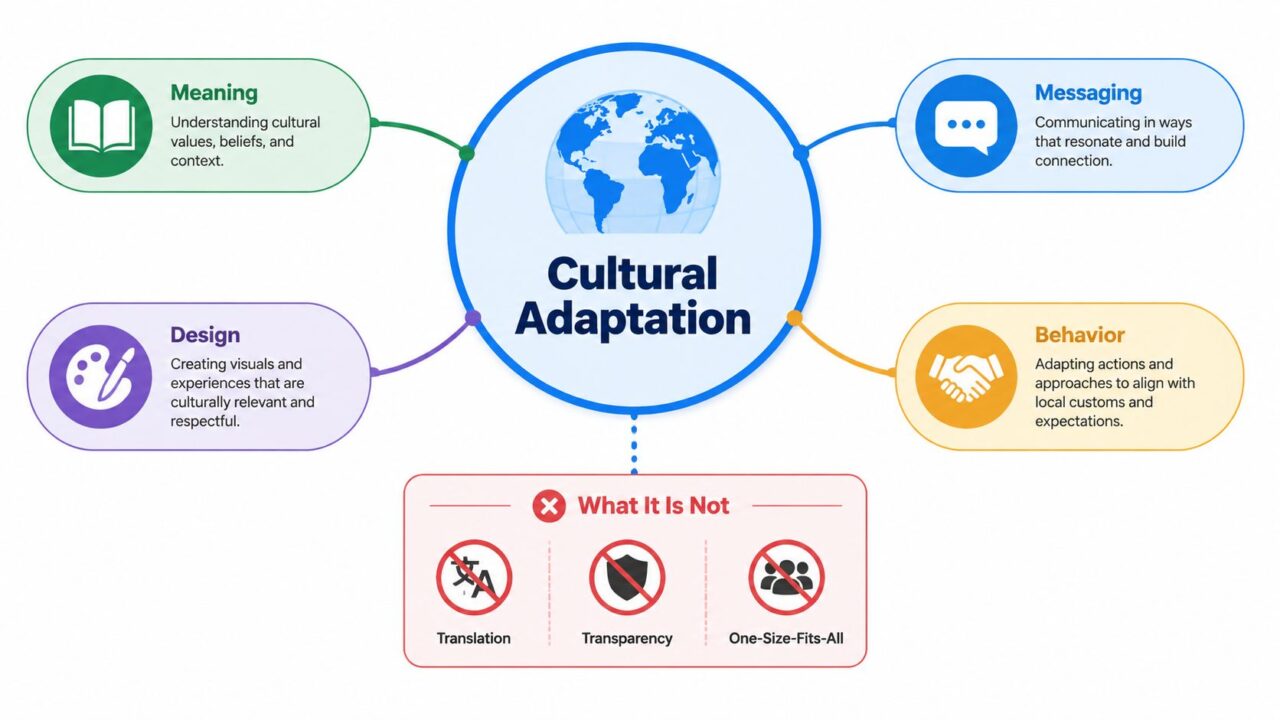
Cultural Adaptation Diagram
Working definition: If your asset still feels like it was built for your home market first, it hasn’t been culturally adapted yet.
The temptation is to treat adaptation as a final pass on copy. That’s too narrow. If you want the market to respond naturally, you need to adapt the experience to be culturally relevant, not just the sentence structure. That’s the difference between a brand that merely shows up and one that feels locally fluent.
The Four Drivers Behind Every Adaptation Decision
Teams make adaptation decisions too narrowly. They see a language problem and solve only for language. Or they see a design issue and forget that trust rules and behavior norms may be the obstacle. The better move is to run every asset through four lenses at once.
Linguistic fit
This is more than vocabulary. It includes tone, formality, idioms, and whether your wording sounds natural in the local context. A playful line can feel charming in one market and unserious in another. In chatbot replies, even emoji density can matter because what feels warm in one place may feel sloppy or unprofessional elsewhere.
Visual fit
Visual adaptation covers imagery, color symbolism, hierarchy, and layout expectations. A clean page can still miss if the visuals signal the wrong status cues or cultural references. A model choice, a gesture, or even the amount of whitespace can change how credible the brand feels.
Behavioral fit
Many launches slip here. People don’t all want to interact the same way, at the same pace, or with the same level of directness. Some markets expect a more guided experience. Others want faster proof, fewer steps, or a different handoff path. If your flow assumes a US-style purchase journey, don’t be surprised when it underperforms elsewhere.
Legal fit
Legal adaptation isn’t glamorous, but it matters. Disclosure rules, privacy expectations, and content restrictions vary by region. If the promotion or chatbot flow ignores those boundaries, the problem isn’t just poor performance. It’s avoidable risk.
| Dimensions of the cultural adaptation process | What it covers in the context of cultural backgrounds. | Example of a miss |
|---|---|---|
| Linguistic | Tone, formality, idioms | A chatbot sounds too casual for a market that expects deference |
| Visual | Color, imagery, and layout must reflect the cultural norms of the target audience. | A CTA design reads as cluttered or immature |
| Behavioral | Interaction patterns, trust signals | Asking for commitment too early in the flow |
| Legal | Disclosure, privacy, restrictions | Running a promo without local compliance checks |
The simplest checklist is this. If you only translated the text, you probably didn’t adapt enough. If you changed the visuals but not the interaction pattern, you may still be off. Cultural adaptation works when all four drivers point in the same direction.
Standardize, Localize, or Somewhere in Between
Global teams love a binary debate, but the decision is usually more nuanced. Standardization gives you speed, lower production complexity, and a single brand spine. Localization gives you relevance, stronger market fit, and often better commercial performance, but it also raises operational overhead and consistency risk.
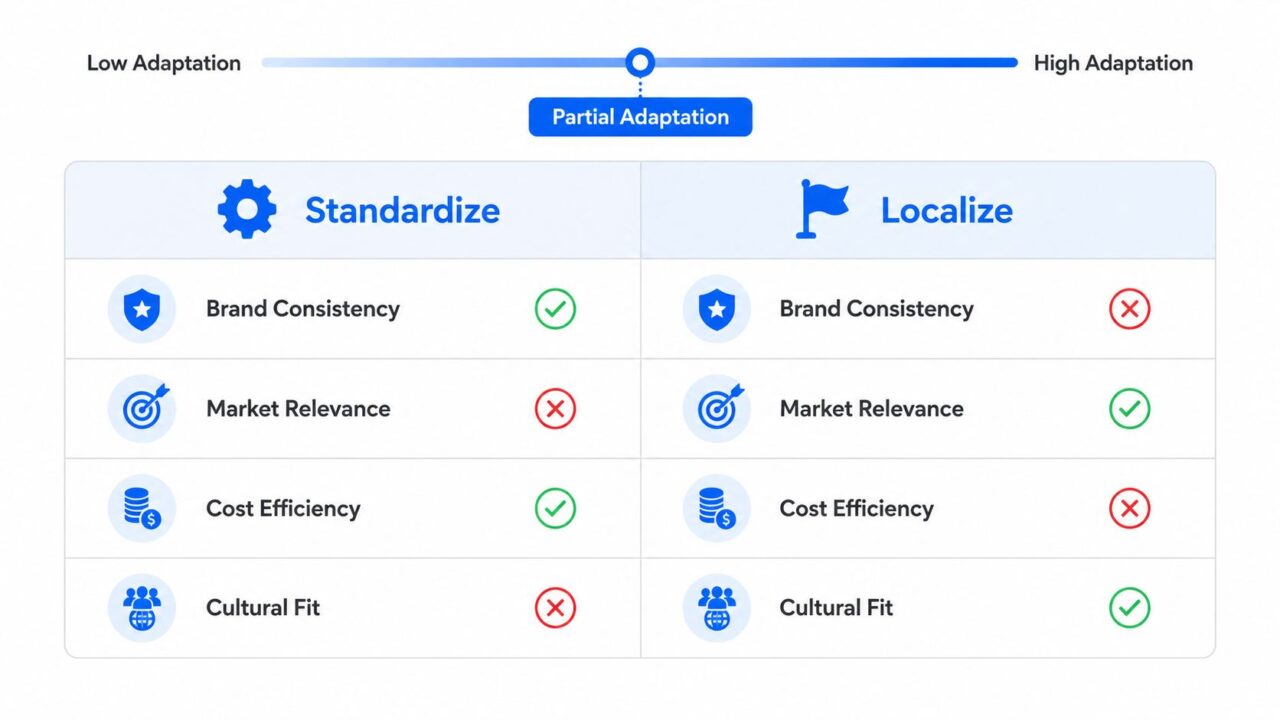
Cultural Adaptation Strategy Comparison
The middle path most teams actually win with
The strongest global brands usually keep a consistent brand spine, then adapt the message, proof, and channel behavior around it. The promise stays recognizable. The evidence changes with the market. That means the offer can stay coherent while the examples, visuals, and delivery path feel local.
A review of global branding strategies notes that adapting the product, price, and promotion mix across cultures changes market performance, while the SRC framework recommends defining the problem in the home culture, redefining it in the foreign culture, isolating self-reference bias, and then solving for the foreign market. That’s a good reminder that the instinct to “do what worked here” is often the thing that gets in the way. The SRC framework in international branding
A later analysis of advertising research found that adapting cultural values in ads can work, but the effect isn’t dependable, which is why testing matters more than assumptions. In practice, that means you don’t guess whether a local metaphor will help; you integrate the new culture’s nuances. You launch it against a baseline and watch actual behavior. Experimental research on cultural values in advertising
A useful rule of thumb is this. Standardize the brand promise, localize the proof, and test the rest. That gives your team enough structure to stay efficient, without locking you into one market’s logic everywhere else.
| Dimension | Standardization | Localization |
|---|---|---|
| Brand consistency | Strong | Requires guardrails |
| Market relevance | Lower | Stronger |
| Cost efficiency | Better | Weaker at first |
| Cultural fit | Limited | Higher |
If you need a practical segmentation lens, the logic behind geographic segmentation is part of why this trade-off matters. Different regions don’t just speak differently; they often buy differently too.
The Five-Stage Adaptation Pipeline
Strong adaptation usually isn’t a creative epiphany. It’s a process of acculturation. The teams that do this well move through a pipeline that starts with listening and ends with refinement, not rollout theater.
Stage 1: Information gathering
Start with interviews, surveys, market scans, and direct observation. The output should be a culture brief that names what matters, what might offend, what builds trust, and what slows decisions down. The failure mode here is assuming you already know the market because you’ve sold in a neighboring one.
Stage 2: Preliminary design
Build a first adapted version of the ad, flow, or UX pattern. Keep the core mechanism intact, but change the surface and delivery features. That might mean different copy tone, a different question order, or a different visual hierarchy.
Stage 3: Pilot testing
Teams save themselves from expensive mistakes. Show the adapted asset to a small local audience and watch for friction, hesitation, and confusion. Low engagement often appears before anyone says, “this feels wrong.”
Stage 4: Implementation
Roll out only after the pilot version has shown it can hold attention and produce the intended action. If the first version was acceptable but not yet strong, don’t force scale too early. The goal is to launch something that still feels complete to the target audience.
Stage 5: Feedback and refinement
After launch, keep a loop open with users, sales teams, and support teams. If the market keeps asking the same questions, the adaptation still isn’t finished. The signal you want is not just usage, but clarity.
Practical rule: If you don’t test the local version with actual users, you’re not adapting, you’re guessing.
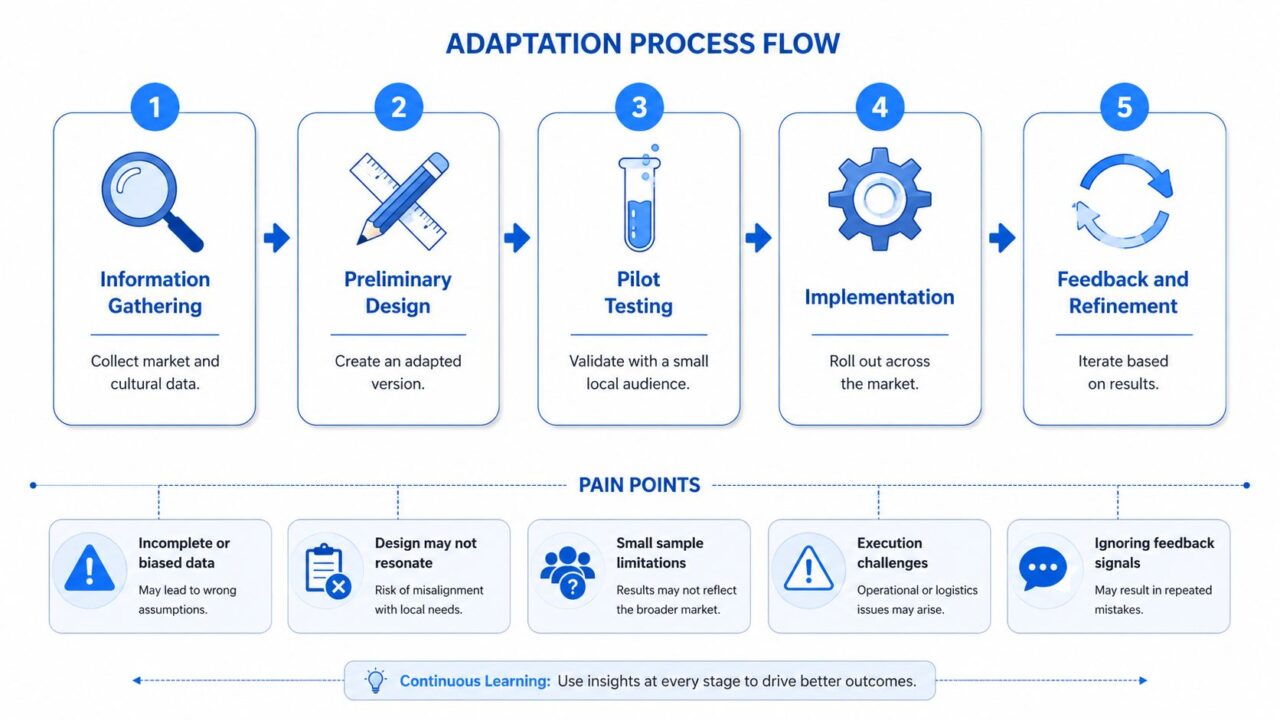
Cultural Adaptation Process Flow
The important part is that the pipeline doesn’t belong only to researchers. A growth lead can run it, a product manager can run it, and a chatbot builder can run it. The structure is what keeps adaptation from turning into random edits.
Three Cultural Adaptation Stories and What They Teach
A global fashion brand once ran the same hero video everywhere and saw engagement collapse in two markets. The fix wasn’t a full rebrand. They recut the opening scene to better reflect local fashion norms and changed the casting so the viewer could see themselves in the story. That’s the pattern to notice. The issue was not quality. It was recognition of the importance of integrating into a new culture.
A DTC skincare company rewrote its chatbot welcome flow for Japan and changed three things at once. It dropped emojis, used more polite formality, and asked about skin concerns before recommending products. The result was stronger qualification because the flow matched the way buyers expected to be treated. The lesson is simple. A chatbot isn’t just a response engine, it’s a cultural interface.
A SaaS onboarding flow redesigned for Brazil changed the order of screens, added a WhatsApp handoff option, and replaced a US-centric progress bar with one that celebrated micro-wins. That sounds small, but onboarding is built from small decisions. If the sequence feels awkward, users feel it immediately.
What the three stories have in common
- They changed behavior, not just language, to better align with cultural norms. The copy mattered, but the interaction pattern mattered just as much.
- They respected local expectations. Each team adjusted the experience to match what users there were comfortable with.
- They kept the core offer intact. None of these moves required abandoning the brand or product.
The best takeaway is that adaptation shows up in specific, operational choices. It’s the order of the questions, the tone of the greeting, the first visual people see, and the handoff path when they’re ready to talk to a human. If those details feel native, the rest of the funnel has a better chance.
Building a Culturally Adaptive Chatbot Flow
A chatbot is one of the easiest places to see cultural adaptation fail, because the mistakes are immediate. The bot sounds too stiff, too familiar, too salesy, or too automated for the market it’s talking to. Fixing that takes more than swapping a few phrases.
Use personas, conditions, and fields together
Set a persona for each market or audience so tone, formality, and emoji density are intentional. Use conditions to branch based on language, region, or previous behavior. Store local preferences in custom fields, things like formality level, preferred channel, or payment context, so the bot can remember what matters later.
Then use tags and segments to control follow-up behavior. That matters because cultural adaptation doesn’t end when the first message is sent. It continues in the broadcast cadence, the quiet hours, and the way the follow-up reads after someone clicks.
The bot should feel like it knows the local context before it asks for the sale.
A practical flow pattern
A Spanish-speaking visitor enters the site. The bot switches to a warmer persona, drops aggressive discount language, and opens with a question that feels natural in that market. If the user shows high intent, the flow routes them to a human closer instead of forcing the bot to keep selling, enhancing the user experience. That’s not a gimmick. It’s a trust decision rooted in cultural context.
The same pattern works across markets when the rules are clear:
- Persona: controls tone, politeness, and emoji use.
- Conditions: route the right version to the right audience.
- Custom fields: preserve local preferences that affect follow-up.
- Tags and segments: keep broadcasts aligned with regional norms.
If you’re adapting an automation for personal communication, the logic behind personalization in marketing is especially useful here. The point isn’t to make the bot clever. It’s to make it appropriate enough that people keep talking.
That’s the advantage of a culturally adaptive chatbot flow. It can qualify leads without sounding like it was written in one market and forced everywhere else.
Your Adaptation Checklist and What to Measure
A good adaptation checklist should be short enough to use and strict enough to catch missed details. Start with the four drivers, then check whether the five-stage pipeline happened, then confirm that the chatbot or campaign still feels locally credible.
Quick checklist
- Linguistic: Does the tone match the market, not just the language?
- Visual: Do the images, layout, and hierarchy feel familiar enough?
- Behavioral: Does the flow respect local interaction habits?
- Legal: Did you check disclosure, privacy, and content rules?
- Research: Did you gather local input before launch?
- Pilot: Did real users test the adapted version?
- Refinement: Did you fix the friction before scaling?
- Follow-up: Did the broadcast or nurture path respect local norms?
The metrics should map to behavior, not vanity. Track engagement signals like reply rate and time-to-first-message, quality signals like qualified leads and conversion, and trust signals like opt-in rate and unsubscribe rate. If the adapted version gets attention but loses trust, you haven’t solved the problem; you’ve just moved it.
A framework for structured adaptation and personalization is useful here because cultural fit and message relevance often work together, not separately. The practical goal is to make the experience feel suitable without making the brand feel fragmented. How personalization supports marketing performance
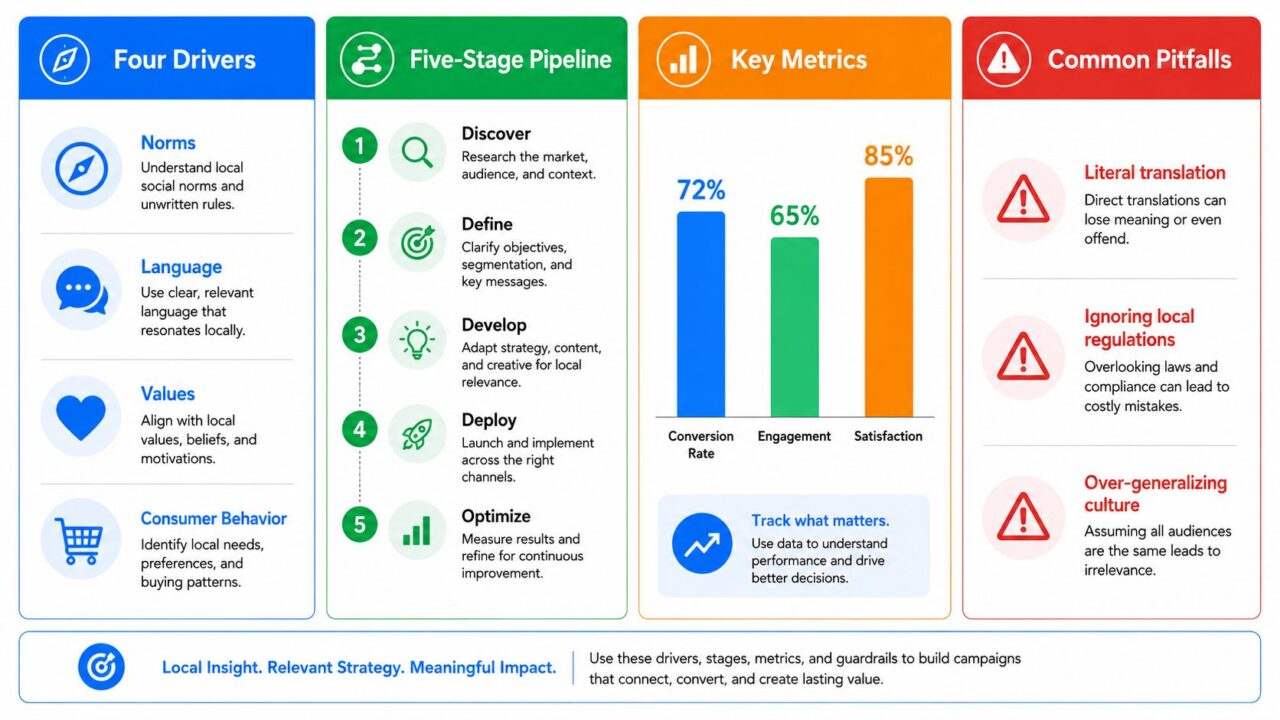
Cultural Adaptation Marketing Framework
One scaling mistake shows up constantly. Teams assume the first market’s adaptation pattern will work for the next one. It rarely does without testing, because what counts as trustworthy, clear, or persuasive changes by region. Start with one market, run the full pipeline, and expand only after the metrics move in the right direction.
If you want to build culturally adaptive chatbot flows, segment audiences cleanly, and test local versions without piling on more manual work, explore the adaptation process. Clepher. It gives teams a practical way to shape personas, conditions, and personalization around real market behavior instead of guessing. If you’re ready to make your next launch feel native from the first message, start there.

Related Posts
Chat Bot Responses That Convert: A Practical Guide
October 12, 202610 Broadcast Automation Software Platforms Compared
October 11, 2026Customer Journey Automation: The Practical Guide
October 10, 2026
Founder Clepher