
Data-driven businesses are 23x more likely to acquire new customers than their competitors, according to McKinsey, as quoted by Nextiva’s overview of conversation analytics. That number changes how most owners should think about customer chats, DMs, and chatbot logs.
Many small and midsize businesses already sit on a steady stream of customer language. Instagram replies. Website chat questions. WhatsApp support threads. Facebook Messenger objections before a sale. Post-purchase complaints. Refund requests. Requests for sizing help, delivery updates, pricing details, and product comparisons.
Teams often treat those conversations as one-off tasks. Answer the message. Close the ticket. Move on.
That’s the blind spot.
When you don’t study your conversations as a group, you miss patterns hiding in plain sight. You don’t notice that buyers keep asking the same pre-sale question. You don’t catch that a product name creates confusion. You don’t see that your bot handles easy questions well, but stumbles when someone’s ready to buy.
Why Your Customer Conversations Are a Goldmine
A lot of businesses work hard to collect analytics from ads, email, and site traffic, but ignore conversation data — the words customers say directly. That’s a mistake, because conversations usually reveal intent more clearly than clicks do.
A click tells you someone noticed something. A message often tells you why they hesitated, what they want, and what might make them buy. This is why businesses need to analyze customer interactions, not just surface-level metrics. Conversational AI tools generate this data constantly, but without conversation intelligence built in, most of it goes unused. The right analytics solution turns these data-driven interactions into something your team can actually act on.
Where the hidden value sits
If you run an e-commerce store, your DMs might contain:
- Purchase objections like shipping worries, sizing uncertainty, or coupon questions
- Product feedback about quality, color, packaging, or missing information
- Sales signals such as “Do you restock this?” or “Which option is best for beginners?”
If you run a SaaS product, your chat logs might reveal:
- Onboarding friction where users get stuck during setup
- Feature confusion when people can’t tell what your plan includes
- Retention risk when frustrated users repeat the same complaint
If you manage client campaigns, comment threads, and ad messages can show:
- Message-market fit gaps when prospects misunderstand the offer
- Competitor mentions that expose what buyers compare you against
- Lead quality clues based on the questions serious buyers ask before booking
Why teams miss it
Most businesses already know they should listen to customers. What they don’t have is a reliable system for turning messy conversations into useful patterns.
That’s where many teams get stuck. They collect feedback in fragments. One person checks Messenger. Another answers Instagram DMs. A support rep handles website chat. Nobody steps back and asks, “What are people telling us again and again?”
Practical rule: If customers keep typing the same question, your business has a pattern, not a one-off issue.
This is why informal reading isn’t enough. You need a way to organize and learn from what customers say at scale. If your team is still gathering feedback manually, this guide on how to collect customer feedback is a useful starting point before you layer in analytics.
The business payoff
Conversation analytics matters because it turns customer language into structured insight. Instead of guessing what buyers want, you can identify recurring complaints, purchase signals, confusion points, and service problems from the conversations you already have.
For a small business, that can lead to sharper offers, better chatbot flows, faster support, and more qualified leads for your sales team. For a growing team, a conversation analytics solution creates a repeatable way to improve both marketing and service without needing a data science background.
You don’t need a Google Cloud-scale setup to start. Even basic tools that let you use conversational analytics on real-time conversation data can surface patterns worth acting on right away.
What Is Conversation Analytics Really
Conversation analytics is the process of turning unstructured customer conversations into organized, searchable insights.
The easiest way to think about it is this. Your business already receives a pile of customer letters every day, except they arrive as chats, DMs, emails, comments, and calls. Left alone, that pile is messy. A conversation analytics platform sorts the pile, labels it, and helps you find patterns inside it.
It doesn’t just store messages. It helps you understand what those messages mean — whether you’re running this on Google Cloud or a simpler setup.
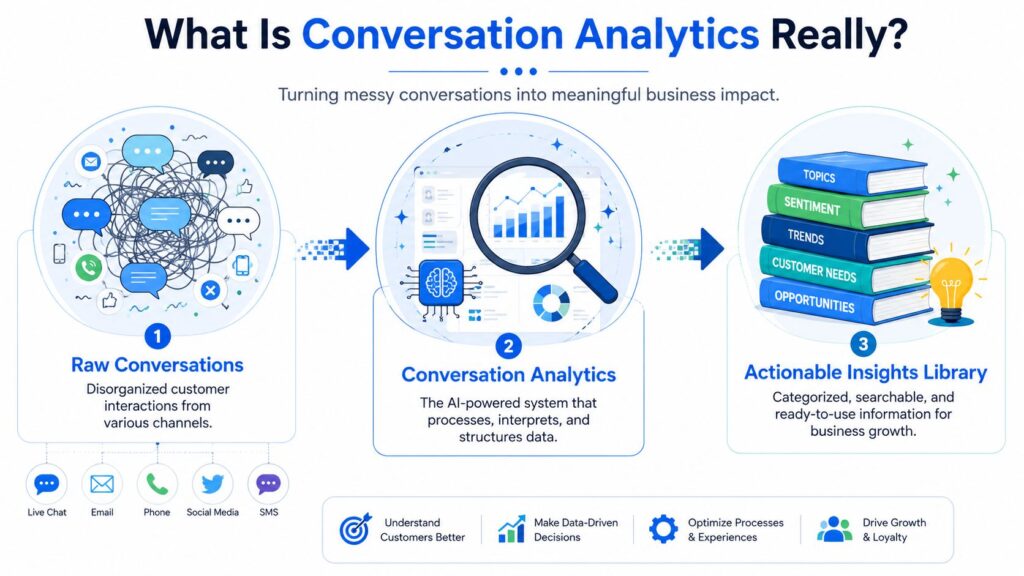
Conversation Analytics Process Flow
The simple version of how it works
At a practical level, conversation analytics looks at customer interactions and asks questions like:
- What is this person talking about
- How do they feel
- What are they trying to do
- Which products, people, or competitors are they mentioning
- Does this pattern show up often
That’s where technical terms like NLP, or natural language processing, enter the picture. NLP sounds intimidating, but the idea is simple. It helps software read language in a way that’s closer to how a person would read it.
A basic keyword search might spot the word “refund.” NLP tries to understand whether the customer is asking for one, warning they might want one, or comparing your policy to someone else’s.
Why did this become such a big category
Older review methods were limited. Managers might sample a small slice of interactions and hope that the sample reflects reality. Modern platforms changed that. As NiCE explains in its guide to conversational analytics, the field moved from sampling a tiny fraction of interactions to analyzing large volumes of calls, chats, and messages, and some vendors now market coverage of 100% of calls.
That shift matters because patterns often hide outside the small sample.
If you only review a few conversations, you might miss that dozens of customers struggled with the same promo code over the weekend. If you analyze all your chatbot logs and DMs, the pattern becomes hard to ignore.
When every conversation becomes searchable, customer language stops being noise and starts becoming evidence.
What conversation analytics is not
It isn’t just “social listening,” and it isn’t only for giant contact centers.
It’s broader than reading online mentions, because it includes direct customer interactions across channels. And it’s no longer reserved for enterprise teams reviewing call recordings. Small businesses can apply the same thinking to website chat, Messenger, Instagram Direct, WhatsApp, and support inboxes.
That’s especially relevant if your business already uses chat-based selling. If you want the broader context around this shift, Clepher’s guide to conversational marketing helps connect the dots between live messaging and revenue.
A practical definition for business owners
For a business owner, a useful definition is this:
Conversation analytics helps you find repeatable patterns in customer messages so you can improve marketing, sales, and support decisions.
That could mean spotting the most common pre-sale question. It could mean learning which customer complaints appear after a campaign launches. It could mean finding where your chatbot loses momentum in a buying conversation.
The important part is that customer conversations stop living as isolated interactions. They become a usable business asset.
The Core Metrics That Drive Growth
Once people understand the concept, the next question is usually, “What should I measure?”
The answer isn’t “everything.” Good conversation analytics focuses on the signals that help you make a decision. You’re not building a museum of customer messages. You’re looking for clues that tell you what to fix, what to promote, and where buyers get stuck.
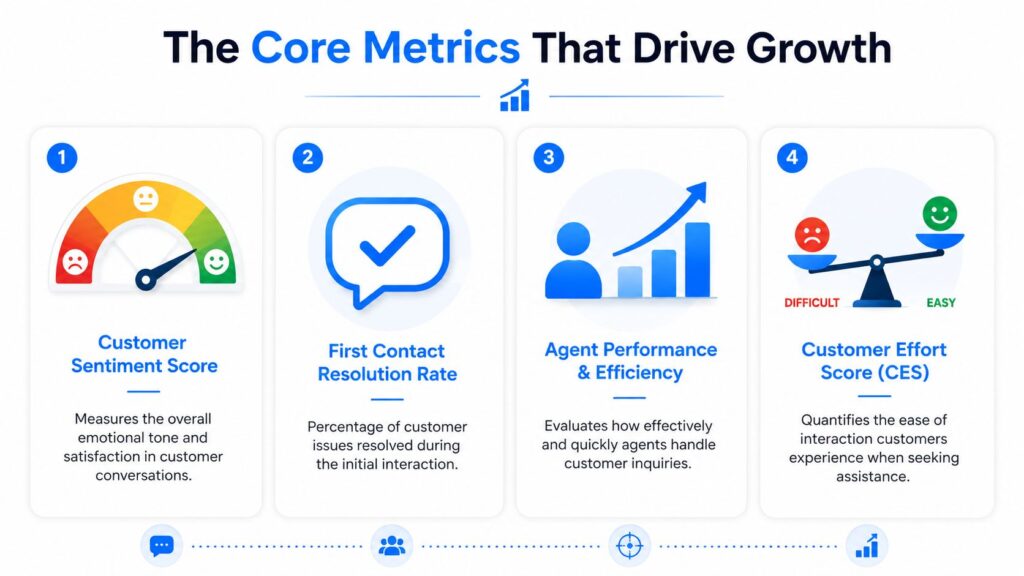
Conversation Analytics Core Metrics
Four signals worth watching first
| Metric | What does it tell you | Business use |
|---|---|---|
| Sentiment | Whether the tone is positive, neutral, or frustrated | Spot service issues and buying hesitation |
| Intent | What the customer is trying to do | Separate buyers, support requests, and complaints |
| Topics | What people keep talking about | Find recurring questions, issues, and interests |
| Entities | Which product, staff member, competitor, or location is mentioned | Tie feedback to a specific part of the business |
Sentiment shows emotional friction
Sentiment analysis helps you gauge whether conversations feel positive, uncertain, or negative. That matters because emotion often points to urgency.
A neutral question like “When will this ship?” isn’t the same as “I’ve asked twice and still have no update.” Both are about shipping. Only one signals escalating frustration.
For marketers, sentiment can reveal whether ad-driven leads arrive curious or skeptical. For support teams, it highlights where routine questions become damaging experiences.
Intent tells you what action the customer wants
Intent recognition is one of the most practical tools in conversation analytics because it answers a simple business question: Why is this person here?
Someone might open a chat to:
- Buy a product
- Compare plans
- Track an order
- Complain about a problem
- Ask for a refund
- Book a consultation
Those are not the same conversations, and they shouldn’t trigger the same response.
When you identify intent early, you can route people better, trigger the right follow-up, and avoid generic replies that slow the sale.
Topics reveal the patterns behind the workload
Topic analysis groups conversations around recurring themes. This is often where the biggest insights emerge.
You may discover that “discount code,” “shipping time,” and “size guide” dominate pre-purchase DMs. That tells you your store might need clearer messaging on product pages, better flow prompts in your chatbot, or a stronger automated answer sequence.
If the top topic in support is “account setup,” that’s not just support data. It’s a product and onboarding problem.
A spike in one topic rarely means “customers are talking more.” It usually means something in the business changed.
Why one score isn’t enough
Single-score thinking creates sloppy decisions. A conversation marked “negative” doesn’t tell you enough on its own. Negative about what? Which product? Which staff interaction? Which step in the customer journey?
That’s why better systems combine layers. As Zonka Feedback’s guide to conversational analytics notes, effective systems use thematic analysis, experience signals such as sentiment, effort, urgency, churn risk, and emotion, plus entity recognition for products, staff, competitors, and locations.
That combination gives you a clearer root cause.
For example:
- Negative sentiment + shipping topic suggests a delivery issue
- High effort + onboarding topic suggests setup confusion
- Competitor mention + pricing intent suggests comparison shopping
- Positive sentiment + product mention can uncover testimonials or upsell opportunities
A practical starting scorecard
If you’re new to conversation analytics, start with a lightweight scorecard:
- Top recurring topics this week
- Most common buying intents
- Most common support intents
- Conversations with strong negative sentiment
- Repeated mentions of one product or offer
- Bot fallback moments where customers ask something your flow can’t handle
That’s enough to start making better business decisions without drowning in dashboards.
Real-World Examples from Businesses Like Yours
The value of conversation analytics becomes obvious when you apply it to ordinary business situations. Not enterprise call centers. Not giant BI teams. Just real businesses reading the signals already sitting in their message history.
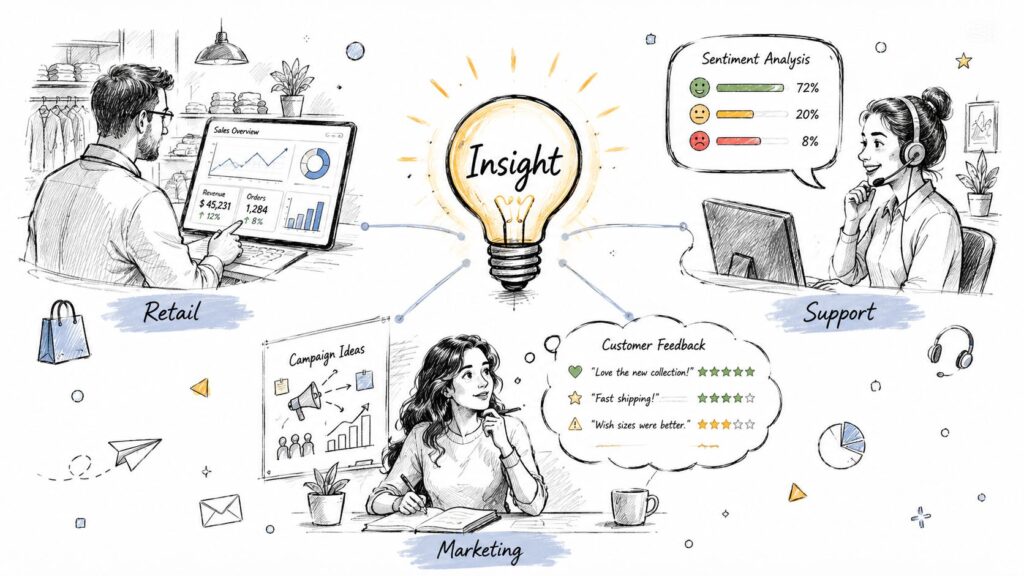
Conversation Analytics Data Insights
An ecommerce store catches a sales problem early
A growing online store runs a weekend promotion and sees a rush of Instagram DMs and website chat messages. At first glance, the team thinks volume is a good sign.
Then they review the conversation topics and notice one phrase appearing again and again: the discount code isn’t working.
Without conversation analytics, this kind of issue can hide in separate inboxes. One rep fixes a few manually. Another apologizes in DMs. A third tells people to try again later. The owner doesn’t realize the pattern until sales underperform.
With topic tracking in place, the store sees the pattern quickly. The team fixes the code, updates the chat flow with a clear answer, and posts a short clarification in social channels. The lesson isn’t technical. It’s operational. Customer conversations exposed a revenue problem faster than sales reports alone could.
A marketing agency sharpens campaign messaging
An agency managing paid social for clients often receives comments and direct messages that seem messy on the surface. But those comments contain valuable language from actual prospects.
One client’s campaign attracts repeated mentions of a rival brand. Prospects ask whether the offer is cheaper, easier, or more flexible than the competitor’s. Instead of treating those comments as random noise, the agency groups competitor mentions and related buying questions.
That gives the team a sharper message strategy. They can rewrite ad copy, landing page text, and chatbot responses around the actual comparisons buyers already make.
In this context, conversation analytics overlaps with workflow design. If your team is building AI-assisted experiences, resources like Ekipa AI’s guide to accelerate AI transformation with custom chat can help frame how custom conversational systems support marketing and support operations.
A SaaS company improves onboarding
A software company offers self-serve trials and relies on live chat plus in-app messaging to support new users. Sign-ups come in steadily, but support conversations show the same kind of confusion from new accounts.
Users keep asking where to connect their first integration, how to invite teammates, and what to do after setup.
When the company reviews onboarding chats as a group, the pattern is clear. New users aren’t failing because the product lacks value. They’re failing because the first few steps feel unclear.
So the team adjusts onboarding in three places:
- They rewrite the welcome message to explain the first action plainly
- They add guided bot prompts for common setup questions
- They tag onboarding confusion so the product team can monitor whether changes reduce friction
That kind of insight is especially useful for subscription businesses because onboarding questions often predict later churn risk. The words customers use in week one can tell you whether your product experience is setting them up to succeed.
A local business learns what customers really ask
A service business running promotions through Facebook and Instagram might think its biggest challenge is lead volume. But once it reviews conversation logs, it may discover the underlying issue is lead quality.
Potential customers ask about service areas, appointment timing, pricing rules, and availability. Those questions can be grouped and used to improve lead forms, ad creatives, and bot qualifiers.
Customer conversations often answer a better question than “How many leads did we get?” They answer “What kind of lead contacted us, and what did they need before they were ready?”
That’s why conversation analytics is so useful for small and midsize businesses. It doesn’t require massive complexity to create value. It just requires paying attention to patterns your team already has access to.
A Simple Roadmap to Implementing Conversation Analytics
Many teams don’t need a complicated data project. They need a clean way to capture conversations, turn them into signals, and use those signals in daily operations.
A practical setup usually follows four stages. As Improvado describes in its conversation analytics software guide, the standard pipeline is capture, transcription, analysis, and integration.
Capture the conversations you already own
Start with the channels where your business already talks to customers.
For many small and midsize businesses, that means:
- Website chat
- Instagram Direct
- Facebook Messenger
- Support inboxes
- Comment replies that turn into private messages
Don’t start by chasing every source. Start where the highest-value conversations happen. For an ecommerce brand, that may be pre-sale DMs and post-purchase support chat. For a SaaS company, it may be onboarding chat and support tickets.
Turn raw messages into readable data
If the channel is text-based, you already have a usable starting point. If the channel is voice, transcription converts speech into text so it can be analyzed consistently.
The key point for non-technical teams is that you don’t need to build this layer yourself. Modern tools handle the heavy lifting. Your job is to make sure the right conversations enter the system cleanly and consistently.
A good habit here is to label conversation sources clearly. A message from Instagram has a different context than a support form submission or a retention chat.
Analyze for business questions, not curiosity
Many projects drift when teams start measuring because they can, not because they know what decision the metric should support.
Pick a short list of questions first:
- Why do buyers hesitate before purchase
- Which support issues repeat most often
- Where does the bot fail to answer clearly
- Which products trigger the most confusion
- Which messages signal high buying intent
Then map your analytics to those questions. Look at intent, sentiment, recurring topics, and entity mentions tied to products or competitors.
Field note: If an insight doesn’t help you change a page, message, flow, offer, or handoff, it’s probably not a priority metric yet.
Integrate insights into action
This is the part that separates interesting dashboards from real business value.
Once you identify a pattern, push it back into the systems your team uses. That might mean:
- Tagging leads in your CRM based on buying intent
- Starting a follow-up sequence when someone asks a pricing question
- Routing high-frustration messages to a human faster
- Updating chatbot flows when fallback questions repeat
- Alerting marketing teams when one offer creates unusual confusion
A simple implementation loop looks like this:
| Stage | What happens | What the business gets |
|---|---|---|
| Capture | Gather chats, DMs, emails, or calls | One place to review conversation activity |
| Transcription | Convert audio to text when needed | Searchable records |
| Analysis | Detect sentiment, intent, topics, and entities | Clear patterns and problem areas |
| Integration | Sync insights to CRM, support, or campaign tools | Faster follow-up and smarter automation |
This approach keeps conversation analytics grounded in operations. You’re not “doing AI.” You’re building a better feedback loop around customer language.
Track and Optimize Conversations with Clepher
For businesses already using chat to market, sell, and support, the easiest path is often to work inside the platform where those conversations already happen. One option is Clepher’s conversational marketing platform, which combines chatbot flows, AI keyword triggers, live chat, tagging, segmentation, and analytics across channels such as website chat, Messenger, WhatsApp, and Instagram Direct.
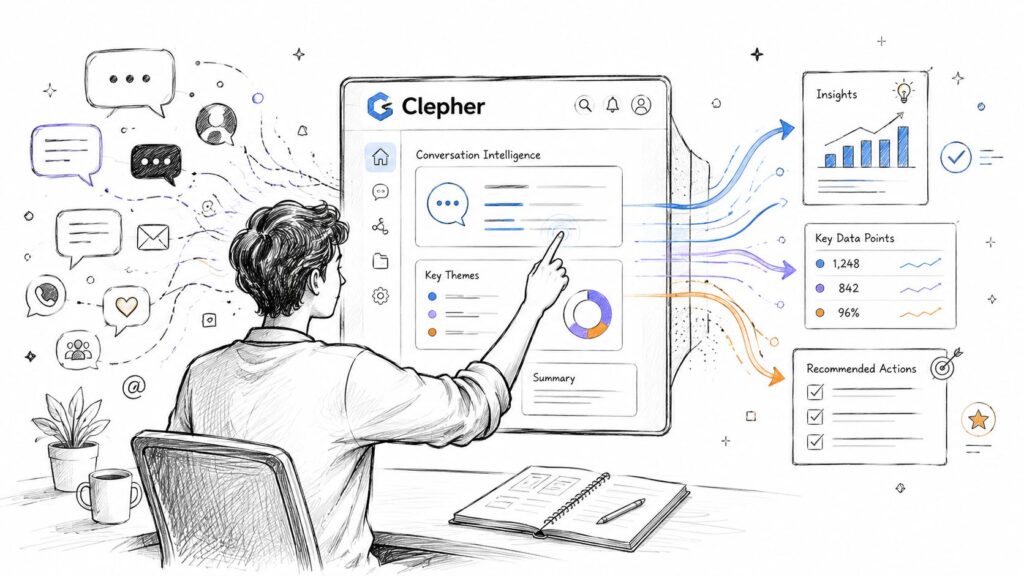
Conversation Analytics Data Analysis
What makes that useful in practice is not the label “analytics.” It’s the ability to connect insight to action without exporting everything into a separate reporting project.
Where the platform helps
A few examples make this concrete:
- AI keyword triggers can surface common buying or support themes from incoming messages
- Tags and segments let teams group people based on what they asked, wanted, or struggled with
- Flows and conditions help you respond differently to price questions, support issues, or lead qualification
- A/B testing and random path distribution help teams compare different conversation paths and improve outcomes over time
- Live chat and handoffs make it easier to move complex or high-intent conversations to a human
For a marketer, that means recurring customer language can shape campaigns and follow-up. For a support team, repeated questions can become automated answers. For a sales-focused business, intent signals can help separate casual browsers from ready-to-buy leads.
What to optimize first
If you’re using chatbot and messaging data alongside speech analytics, start with the points closest to revenue or friction:
- Lead capture conversations that end too early
- Pre-sale questions that show hesitation
- Fallback responses where the bot doesn’t understand customer needs
- Support conversations that repeat the same issue, signaling gaps in agent performance
- Promotional flows that attract clicks but produce confused replies
That gives you a manageable testing loop. Review conversations, identify a pattern using machine learning where useful, adjust the flow, watch the next batch of conversational data, and refine again.
Conversation analytics becomes much easier when it lives close to the channel, the audience, and the automation rules your team already uses. The right analytics tools tie this directly back to customer experience, not just raw conversation volume.
If you want to turn your customer chats, DMs, and bot conversations into useful marketing and support insight, Clepher gives you a practical place to start. You can capture conversations across key channels, organize them with tags and segments, and use what customers are already saying to improve flows, follow-up, and conversion paths.
Related Posts
Automated Checkout Bot: Build and Launch Guide
October 7, 2026AI Agent Framework: Architecture, Tools, and Use Cases
October 6, 2026Master Lead Generation Automation for Business Growth
October 5, 2026
Founder Clepher