
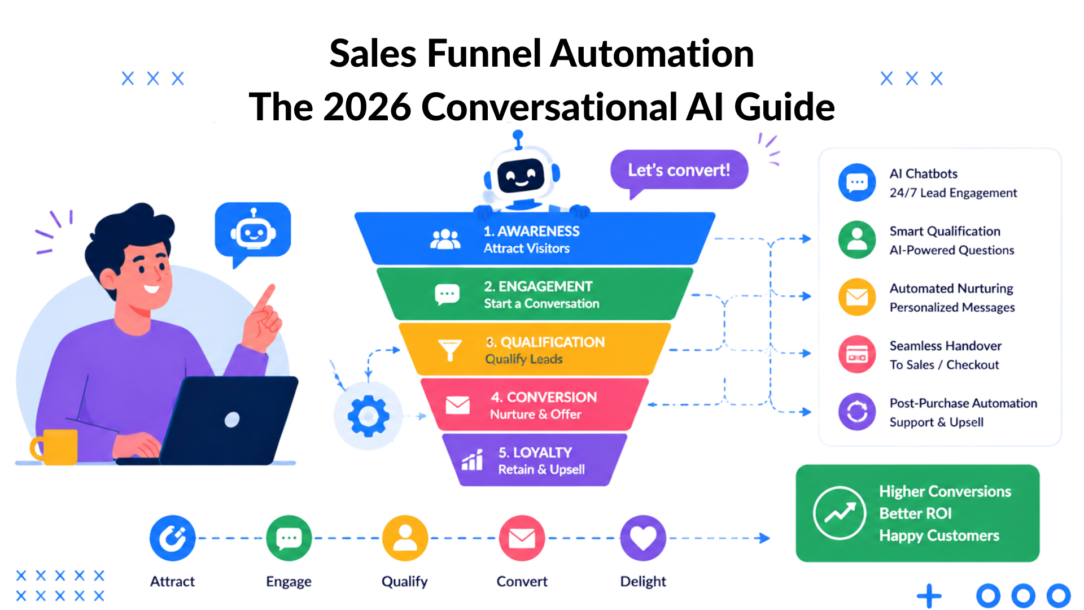
By 2026, AI-powered automation is projected to handle 60% of all sales-related tasks, according to Data Insights Market research on sales funnel software. That statistic changes how you should think about sales funnel automation.
Most businesses still treat the funnel like an email machine. A visitor downloads a lead magnet, gets added to a list, and waits for a drip campaign. Meanwhile, direct buying conversations are happening somewhere else. It’s in Instagram DMs, WhatsApp, Messenger, and website chat, where prospects ask, “Do you ship internationally?”, “Does this integrate with HubSpot?”, or “Can I book for next week?”
If those questions sit unanswered, the funnel isn’t underperforming. It’s leaking.
Modern sales funnel automation works best when conversation becomes the operating layer of the funnel. Email still matters. CRM still matters. But the system that catches intent fastest is usually chat, not a form fill.
Why Your Old Funnel Is Leaking Money
Buyers rarely follow the path your automation builder assumes in the lead generation pipeline.
A shopper can tap an Instagram ad, browse two products, ask about shipping in DMs, leave, return from a retargeting email, then open site chat to ask whether the item will arrive before Friday. A SaaS buyer does the same thing in a different wrapper. They read a case study, visit pricing, ask about integrations in chat, go quiet, then reply to an email three days later with a security question.
Old funnel setups miss the middle of that journey. They capture the form fill and the email click, but they lose the conversation where purchase intent is revealed.
That gap costs money.
The problem is not just slow follow-up. It is conversational leakage. Questions in Instagram, Messenger, WhatsApp, and website chat sit outside the funnel logic, so high-intent prospects drift away without being tagged, routed, or answered. Traditional email-first guides barely address this, even though these micro-conversations often decide whether someone buys now, later, or never.
Where traditional funnels break
Classic automation usually breaks in four places:
- Email gets treated as the whole funnel: Teams build polished nurture sequences while social DMs and live chat inboxes fill up with pre-purchase questions.
- High-intent messages get mislabeled: “Do you ship to Canada?” and “Does this connect to Salesforce?” are buying signals. Many teams treat them like low-priority support, which can hinder effective lead generation.
- Manual response times kill momentum: A buyer asking about price, timing, or fit is evaluating options in real time. A reply tomorrow is often the same as no reply.
- Conversation data stays siloed: Marketing sees opens, clicks, and attribution reports. Sales and support hold the actual objections in separate inboxes. No one gets a full picture of intent.
I see this constantly with first-time automation builds. The business already has traffic, ads, and email flows. Revenue still stalls because nobody designed a system for the questions buyers ask before they are ready to fill out a form.
Buyers do not experience your funnel as neat stages. They experience a series of response moments, and each missed moment increases the chance they buy somewhere else.
What modern sales funnel automation looks like
A stronger funnel treats conversation as an active conversion channel in the sales process, not a side inbox.
For e-commerce, that means your abandoned cart system should not stop at an email reminder. If a customer replies in site chat asking about sizing, returns, bundle discounts, or delivery windows, automation should answer the common question, capture the product context, and escalate to a human when the question affects conversion. That is how you recover revenue that never shows up in a standard email report.
For SaaS, the same principle applies on higher-value deals. A pricing-page visitor who asks, “Can your tool handle multiple workspaces?” is not browsing casually. A good workflow qualifies company size, routes enterprise questions to sales, and sends smaller accounts toward a self-serve trial. You save rep time and respond faster where speed matters.
The shift is practical. Email still has a job. CRM stages still matter. But if your funnel ignores DM threads, chat transcripts, and social replies, it is measuring activity while missing intent.
Your old funnel is leaking money because it was built for clicks and form fills. Buyers now reveal intent in conversation first, influencing the sales automation strategy.
Mapping Your Conversational Sales Funnel
Seven out of ten funnel maps I review have the same blind spot. They track page views, form fills, and email clicks, but they do not map the conversations that decide the sale.
That gap matters because conversational leakage rarely shows up in a standard sales funnel report. A prospect asks a pricing question in live chat, a shopper replies to an Instagram Story, or a lead sends a DM after seeing a retargeting ad. If no one has mapped what should happen next, intent leaks out of the funnel.
Before you choose an AI sales funnel builder or start building automation rules, map those moments first. Most funnel automation tools are built to handle traffic you already understand, not the questions that actually decide whether someone buys.
For a skincare e-commerce brand on Instagram, the starting question is not “How do we automate follow-up?” The better question is “What does a first-time buyer ask in DMs before they trust us enough to order?” For SaaS, it is usually “What does a trial lead ask in chat right before they decide whether this fits their team?” Answering that first is what separates a real automated sales funnel from one that just moves people through stages without closing the trust gap. This is also where AI agents earn their place, not as a blanket replacement for humans, but as the layer that catches those specific conversational moments a sales funnel builder alone won’t map.
Sales Funnel Automation
As noted earlier, the market is shifting toward AI-supported funnel software. The practical takeaway is simpler than the headline. Businesses are putting more budget into systems that can respond in real time, because buyers now reveal intent in chat, DMs, and on-site messages long before they complete a form.
Turn funnel stages into conversation stages
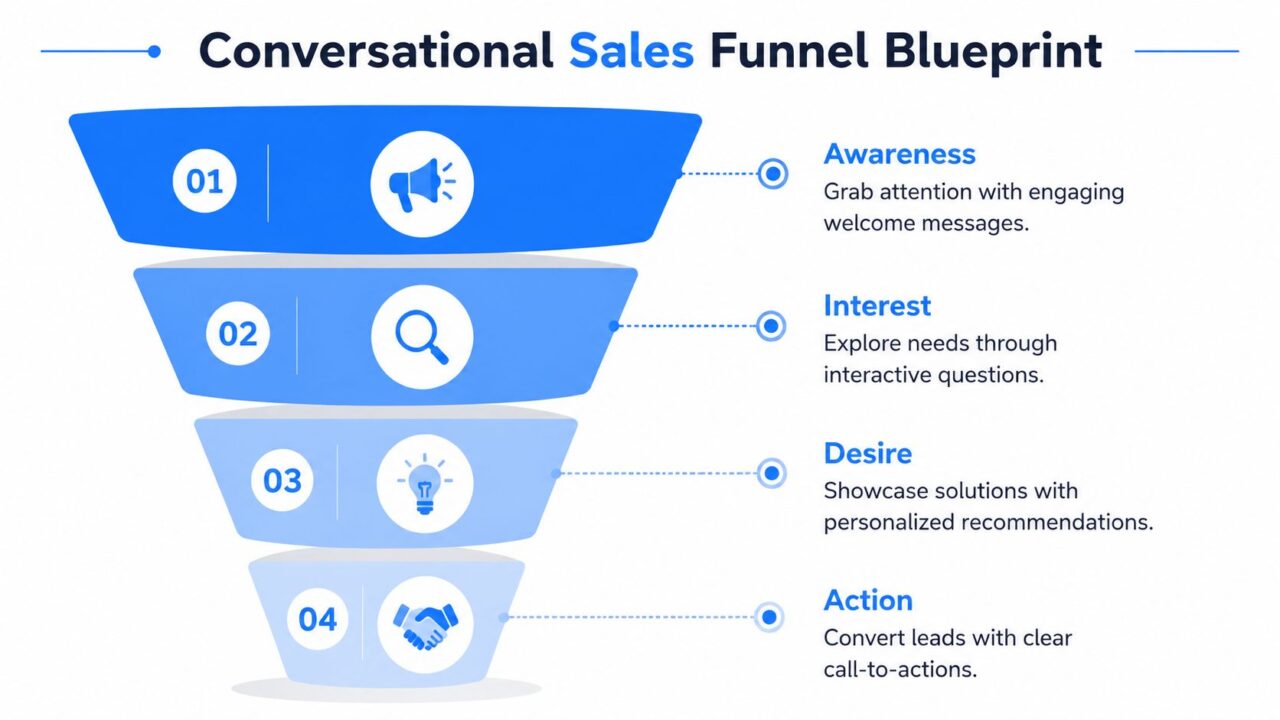
A useful conversational funnel still follows the familiar four stages. The difference is that each stage needs a message goal, a buyer signal, and one next step.
| Stage | What the buyer is thinking | What your automation should do |
|---|---|---|
| Awareness | What is this? | Open with context tied to the ad, social post, referral source, or page they came from |
| Interest | Is this relevant to me? | Ask short qualifying questions that sort people by need, urgency, or fit |
| Desire | Will this solve my problem? | Give the right proof, recommendation, or objection handling based on what they already said |
| Action | Should I buy or book now? | Reduce friction with a direct CTA, checkout link, booking link, or human handoff |
The map should be channel-aware. An email subscriber behaves differently from someone who opens with a DM. A chat visitor on your pricing page is usually closer to a decision than a casual social follower. If you treat every conversation the same, your automation either pushes too early or stalls after interest.
Use a real message map
Take a DTC coffee subscription brand.
At awareness, someone taps an Instagram Story and enters a DM flow. “Thanks for messaging us” wastes the click. “Want help choosing bold, medium, or decaf?” gives the buyer an easy first step and gives the system useful data.
At interest, the automation should collect details that affect conversion:
- Taste preference: Tailor recommendations in the sales process based on buyer preferences. “Do you like chocolatey, fruity, or balanced roasts?”
- Buying context: “Is this for you or are you sending a gift?”
- Timing: “Are you ordering this week or comparing options?”
At desire, the system should respond with proof and product logic, not generic copy. If the person selects “gift,” show a bundle, delivery timing, and gift-friendly packaging details. If they select “for me,” show refill cadence, subscriber savings, and the roast that matches their taste choice.
At action, give them the shortest path to purchase. Send the exact product link. Reopen the cart with the selected variant. Offer a human reply if the question is unusual.
That is what a map is for. It prevents dead-end conversations.
Script the questions before you build anything
I usually write the message map in a simple grid before touching the automation platform. One column for buyer questions. One for the answer. One for the next action. One for whether AI can handle it alone or should route to a person.
For e-commerce, the recurring questions are usually:
- Product fit: “Which one should I buy?”
- Logistics: “How fast can this arrive?”
- Risk: “What if I need to return it?”
For SaaS, the pattern changes:
- Use case: “Will this work for my team size or workflow?”
- Setup: “Does it connect with the tools we already use?”
- Commercial intent: “Should I start a trial, book a demo, or talk to sales?”
This step saves rework later. It also exposes where conversational leakage is happening. If buyers keep asking the same pre-purchase question in chat or DMs, that is not random support traffic. It is a conversion bottleneck you have not automated yet.
If you need a practical model for documenting these paths, a marketing automation workflow template can help you lay out triggers, replies, branches, and handoff rules before you build them inside your tools.
A good map does one job well. It makes sure every buyer question has a planned response from a sales rep, a clear owner, and a next step that moves the sale forward.
Building Your Core Automation Flows
Once the map is clear, build flows around buyer intent, not around channels.
That’s where many first funnels in the sales process go sideways. Teams create a chatbot that acts like a menu tree, or an email sequence that ignores what the person already asked in chat. Good sales funnel automation connects context across touchpoints and moves the buyer one step forward.
The easiest way to think about this is to build three core flows first: one for e-commerce, one for SaaS, and one for appointment-based local businesses.
Sales Funnel Automation Chatbot Marketing
Flow one for e-commerce
An e-commerce flow should recover hesitation, not just recover carts.
Say a customer views a product twice, adds it to cart, then messages on Messenger: “What’s your return policy?” That’s not a support interruption. It’s a late-stage buying question.
A workable flow looks like this:
- Open with relevance: “Happy to help. Are you asking about returns before placing an order or after delivery?”
- Branch by intent: If “before placing an order,” answer returns clearly and immediately.
- Reinforce confidence: Show the product link again with one concise benefit.
- Offer action: “Want me to send you straight back to checkout?”
Sample copy:
- If user asks about shipping: “We can help with shipping details. Are you ordering locally or internationally?”
- If user asks about sizing: “Tell me your usual size and fit preference. I’ll point you to the closest match.”
- If user hesitates: “If you want, I can show the most popular option for first-time buyers.”
The point isn’t to sound clever. It’s to shorten the path between question and purchase.
Flow two for SaaS
SaaS buyers usually need qualification and routing.
If someone starts a free trial and visits the pricing page, the automation should do more than send a generic onboarding email. It should ask what they’re trying to achieve and whether they need help evaluating fit.
A practical SaaS flow can look like this:
| Trigger | Automated response | Next move |
|---|---|---|
| Trial signup | Welcome message with one setup question | Tag by use case |
| Pricing page visit | Ask if they’re comparing plans or looking for a feature | Route by buying intent |
| Integration question | Provide supported options | Escalate if the pipeline is complex and requires additional sales team resources. |
| Repeated product visits | Offer demo or human chat | Move to sales queue |
Example copy:
- “What are you mainly trying to do first? Capture leads, qualify inbound, or support onboarding?”
- “Are you evaluating for yourself or for a team?”
- “If integration is the blocker, tell me the tools you already use, and I’ll point you in the right direction.”
If you want to see what a visual logic setup can look like, a marketing automation workflow example helps make the branching structure more concrete.
Flow three for local service businesses
Local funnels should optimize for booking speed.
A dental clinic, med spa, gym, or home service business doesn’t need long nurture logic at the point of inquiry. It needs a clean path to appointment intent.
A useful flow:
- Greeting: “Are you looking to book, ask a question, or check availability?”
- Qualification: “New customer or existing?”
- Intent capture: “What service are you interested in?”
- Booking nudge: “Want to see the next available slot?”
Sales funnel automation often surpasses manual handling in such cases. A customer who messages after hours still gets guided toward a booking path instead of waiting until morning.
The first version of your flow should be narrow. Solve the top three buying questions first. Add complexity only after you see real conversations.
Don’t skip nurture just because chat is working
Conversation gets the lead moving. Nurture closes the gap when they’re not ready yet.
A proven methodology uses a 7-touch sequence over 10 days with Day 0 lead magnet delivery, Day 1 brand narrative, Day 2 tactical tip, Day 4 case study, Day 6 objection handling, Day 8 offer with bonus, and Day 10 scarcity close. That approach is designed to produce approximately 30% nurture-to-sale conversion, according to Growtoria’s automated funnel methodology.
That sequence works well when paired with conversational triggers. Someone asks in chat but doesn’t buy. Tag them by interest. Then send the right follow-up sequence instead of dropping them into a generic newsletter.
What works and what usually fails
What works:
- Short questions: Buyers answer quick prompts more often than long forms.
- Clear branching: Pricing question, shipping question, and fit question should not go down the same path.
- Visible handoff points: If someone shows buying intent or complexity, route them to a person.
What fails:
- Fake human tone: Enhance engagement in the sales process with a more relatable approach. Buyers notice when “personalized” copy is just canned text.
- Over-qualification early: Don’t interrogate a warm lead before answering the question they came with.
- One-path automation: A single linear flow can’t handle modern buyer behavior across chat and DM.
Connecting Your Funnel to Your Tech Stack
A conversational funnel that isn’t connected to anything becomes another inbox to manage.
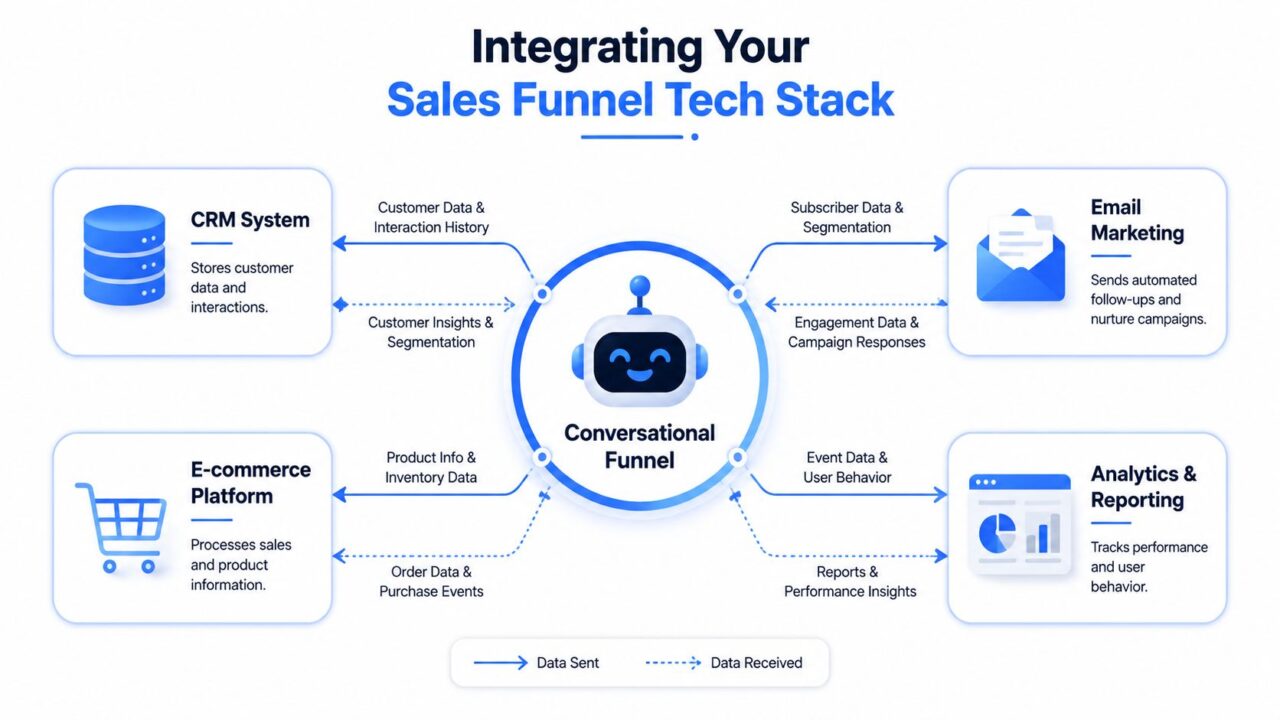
The goal is simple. When a buyer says something useful, that information should move automatically to the systems that need it. Sales should see it in the CRM. Marketing should be able to trigger follow-up. Operations should know what happened after purchase or booking.
Sales Funnel Automation Tech Stack
The four connections that matter most
Think in simple integration recipes.
- Chat to CRM: Leverage an AI-powered funnel for better integration. When someone shares email, phone, company, or buying intent in a conversation, create or update the contact record.
- Chat to email platform: If a prospect asks about a feature but isn’t ready to buy, enroll them in the right nurture path.
- Chat to e-commerce platform: If a shopper asks about a product, cart, or shipping, sync that context with order and customer data.
- Chat to analytics: Log the trigger, response path, and outcome so you can see which conversations produce revenue.
For CRM structure ideas, a CRM and ticketing system reference is useful when deciding what data should become a lead record versus a support case.
A practical setup for different business models
A SaaS company might wire it like this:
| Event in conversation | System action | Why it matters |
|---|---|---|
| Prospect asks about integrations | Create CRM note and apply integration-interest tag | Sales sees technical buying signals |
| Trial user requests pricing help | Add to sales queue and trigger tailored email | Marketing and sales stay aligned |
| User says “team of 20” | Update contact properties in the sales team database. | Qualification improves routing |
An e-commerce brand might use a different pattern:
- Product question: Pull product details into the chat flow
- Abandoned cart question: Trigger reminder and save cart context
- Shipping objection: Record objection type for later reporting
Native integrations first, bridges second
If your platform offers a native integration to HubSpot, Salesforce, Shopify, Klaviyo, or Stripe, start there. Native sync tends to be cleaner and easier to maintain.
Use Zapier, Make, or n8n when:
- You need custom field mapping
- You want multi-step logic across apps
- Your existing stack doesn’t have a direct connector to the sales automation tool.
Clepher is one option in this category. It’s built for AI-powered chat automation across website chat, Facebook, Messenger, WhatsApp, and Instagram Direct, and it connects with external tools through native integrations and automation bridges.
A disconnected funnel creates duplicate work. An integrated funnel creates shared context.
What to pass between tools
Keep the data model lean at first.
Pass:
- Identity data: name, email, phone
- Intent data: product interest, feature interest, service requested
- Behavior data: pricing question, return-policy question, booking request
- Lifecycle data: new lead, warm lead, qualified, customer
Skip the urge to sync everything. Teams generally do not require every button click in the CRM. They need the signals that help someone follow up intelligently.
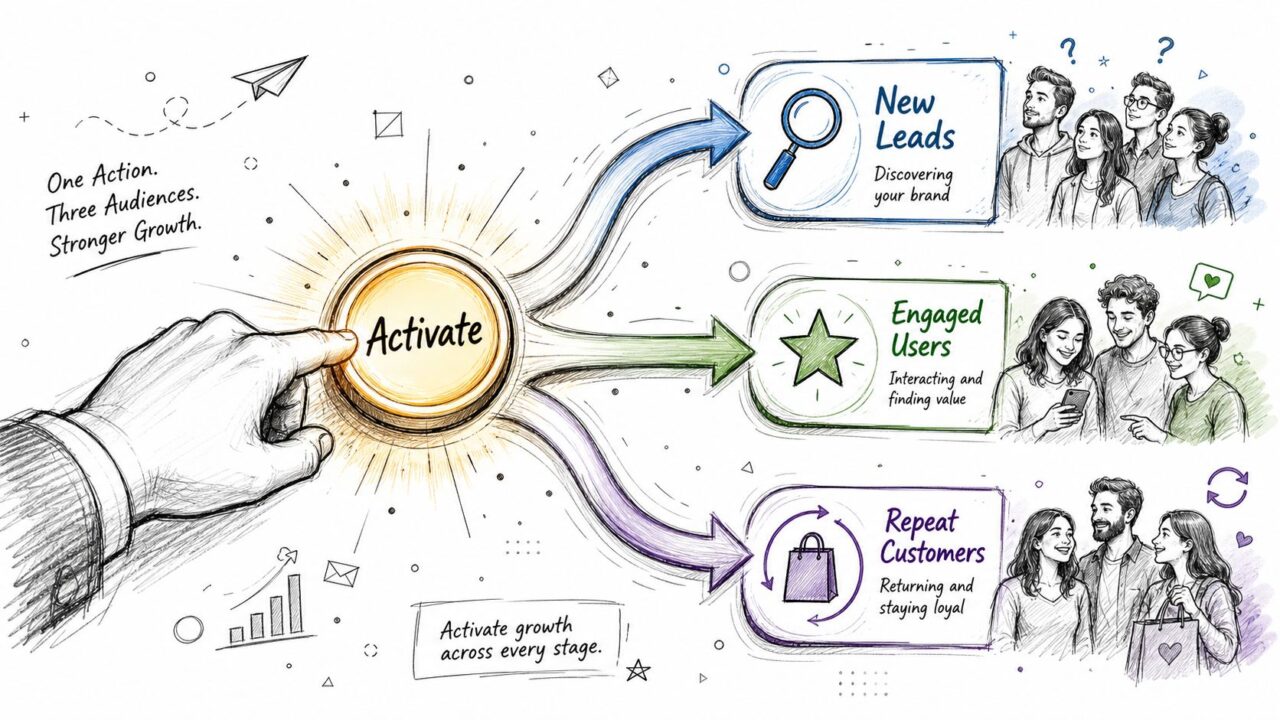
Activating Triggers and Segmenting Your Audience
Sales funnel automation starts to feel smart.
Basic automations react to words. Better automations react to behavior. The difference matters because keywords tell you what someone said once, while behavior tells you what they keep doing.
For high-intent leads, speed is critical. The benchmark for Time to First Touch is under 5 minutes, because delays beyond that reduce conversion probability, according to Bizaigpt’s benchmark on sales funnel automation response speed.
Sales Funnel Automation Audience Growth
Keyword triggers are fine, but limited
A keyword trigger is straightforward.
If someone types “pricing,” show pricing options. If they type “shipping,” show delivery details. This works for obvious intents and reduces repetitive support load.
But it also has limits:
- No context: “Pricing” from a cold visitor means something different than “pricing” from a repeat visitor.
- No urgency scoring: It doesn’t tell you whether the person is browsing or about to buy.
- Easy to miss phrasing: Buyers don’t all ask the same way.
Behavioral triggers are where conversion improves
Behavioral triggers use patterns.
A SaaS buyer visits your pricing page twice in one day, then opens a product email and returns to the demo page. That’s not casual interest. Your automation should respond accordingly.
An e-commerce shopper views one product multiple times, asks about shipping, then exits. That’s a strong moment to trigger a DM or on-site message with a direct checkout path or FAQ shortcut.
Here’s the before-and-after difference:
| Scenario | Generic experience | Segmented experience |
|---|---|---|
| SaaS pricing visitor | Gets a standard newsletter | Gets a message asking whether they’re comparing plans or evaluating for a team |
| Shopper asks about delivery | Gets a canned help article | Gets shipping details tied to the product and a checkout prompt |
| Local service lead checks availability | Gets a broad welcome message | Gets offered booking options based on service interest |
Segment by intent, not just demographics
Tags should reflect what helps you sell and support better.
Useful segments include:
- High-intent lead: visited pricing, asked a buying question, or requested a booking
- Feature-specific interest: asked about one capability repeatedly
- Objection type: pricing, shipping, setup, returns, integration
- Lifecycle stage: new subscriber, warm prospect, qualified lead, customer
Field note: The best segmentation usually comes from answers and actions combined. One without the other gives you a partial picture.
When segmentation is done well, follow-up feels relevant. When it’s done poorly, automation feels like surveillance or spam.
Measuring and Optimizing Funnel Performance
Teams often drown in metrics because they track everything except the numbers that tell them where the leak is.
A conversational funnel doesn’t need a giant dashboard to start. It needs a short scorecard that helps you answer one question. Where are buyers getting stuck?
To avoid overload, teams should track 5 to 7 key metrics, especially lead-to-MQL conversion rate, MQL-to-SQL conversion rate, overall sales funnel conversion rates, and time-to-close, according to Dashly’s guide to sales funnel metrics.
The metrics that actually help you improve
Start with a tight set:
- Lead-to-MQL conversion rate: Shows whether your top-of-funnel targeting and initial qualification are working.
- MQL-to-SQL conversion rate: Tells you whether the leads your automation passes to sales are sales-ready.
- Overall funnel conversion rate: Gives you the broad health check. Useful, but not enough on its own.
- Time-to-close: Reveals whether automated leads move faster or stall longer.
- Conversation completion rate: A practical conversational metric. Are people finishing key flows or dropping midway?
- Human handoff rate: Helps you see whether the bot is answering enough or escalating too much.
- Stage-specific drop-off notes: Not glamorous, but often the most useful. Log where people abandon and what they asked right before that.
If you want more visibility into message-level performance, conversation analytics tooling can help connect chat activity to actual outcomes instead of just engagement noise.
One A B test per metric is enough to start
You don’t need a testing lab. You need disciplined small experiments to optimize the automated sales funnel.
Try these:
- Lead-to-MQL rate: Test a direct qualifying question versus a softer guided prompt.
- MQL-to-SQL rate: Test immediate booking CTA versus “talk to an expert” wording.
- Overall conversion rate: Test button-based quick replies against open text replies.
- Time-to-close: Test immediate handoff after pricing questions versus delayed nurture.
- Conversation completion rate: Test shorter paths versus deeper branching.
- Human handoff rate: Test a stricter handoff threshold for complex objections.
- Drop-off points: Test whether the first message should ask or answer.
Fix stall points fast
A lot of funnel problems look like messaging problems when they’re really routing problems.
If buyers drop after asking about pricing, your answer may be too vague. If they drop after a product recommendation, the recommendation may be too broad. If they reach a human and disappear, the handoff may be too slow or too repetitive.
The right dashboard should make one action obvious. If it only gives you more charts, it’s not helping.
The best optimization habit is simple. Review the funnel weekly, pick one leak, test one change, and keep the rest stable. That’s how sales funnel automation improves without turning into a science project.
If your business is selling through chat, DMs, and on-site conversations, Clepher is built for that workflow. It lets teams create AI-powered conversational flows, capture leads, segment audiences, and connect funnel conversations across website chat, Facebook, Messenger, WhatsApp, and Instagram Direct without heavy technical setup.
Related Posts
Automated Checkout Bot: Build and Launch Guide
October 7, 2026AI Agent Framework: Architecture, Tools, and Use Cases
October 6, 2026Master Lead Generation Automation for Business Growth
October 5, 2026
Founder Clepher