
78% of businesses have already deployed or are actively piloting voice AI, and 82% are seeing positive ROI within the first 12 months, with average ROI landing at 240% in a 2025 industry survey from Thoughtly. That’s the story behind conversational AI for business. It’s no longer a novelty layer on top of support, it’s a revenue and operations system that leaders are expected to justify with hard numbers.
The companies moving fastest aren’t treating this as a chatbot project. They’re using conversational AI to qualify demand, capture leads, route support, and reduce manual work in places where a human doesn’t need to type the same answer ten times a day. The survey also shows the top adoption driver is customer experience at 65%, followed by cost reduction at 58% and operational efficiency at 52%, while 42% say integration with existing systems is their biggest hurdle, which is exactly where businesses get stuck (Thoughtly).
If you’re a founder, marketer, or ops lead, the decision isn’t whether conversational AI exists. The decision is which workflow to automate first, how to prove it works, and how to avoid launching a shiny bot that nobody trusts. The playbook below is built for that decision.
Why Conversational AI Matters Now
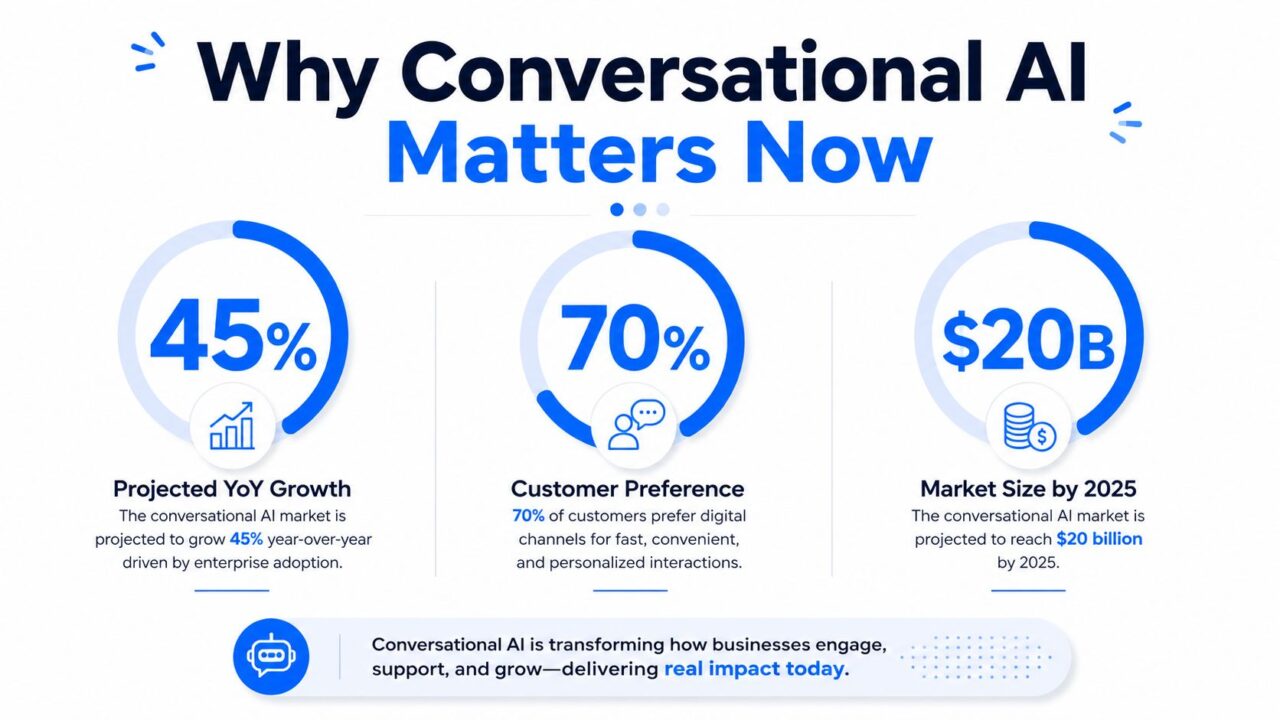
The market is telling you to treat conversational AI as part of the core stack, not a side experiment. Multiple 2025 to 2026 forecasts place the global conversational AI market in the USD 14.3–14.79 billion range for 2025, with projections rising to about USD 78.9–82.46 billion by 2033–2034, which implies roughly 21%–24% CAGR in the adoption of conversational AI solutions over the forecast period (Fortune Business Insights). Growth like that follows budget approval, platform investment, and repeated use across customer-facing workflows.
North America is leading adoption. One forecast puts the region at 35.10% of global market share in 2025, while another estimates 33.62% of global revenue in 2025 (Fortune Business Insights). For businesses, that points to deeper vendor maturity, more tooling around integration, and more pressure on teams to respond faster across web, messaging, and social channels.
Conversational AI for Business Market Statistics
What changed for buyers
Buyers are making a revenue case first. They want systems that qualify demand, capture leads, route requests, and reduce manual work before a human ever steps in. The same 2025 industry survey from Thoughtly shows that businesses are already evaluating voice AI on outcomes, and it also shows why adoption is accelerating: customer experience leads at 65%, followed by cost reduction at 58% and operational efficiency at 52%, while 42% cite integration with existing systems as their biggest hurdle.
That is the right frame for text-based conversational AI too. The winning teams are not asking whether a bot can answer FAQ. They are asking which workflow creates the fastest proof of ROI, where qualified demand is leaking today, and what can be automated without hurting trust.
Practical rule: Utilize AI tools to enhance efficiency. If a workflow cannot be tied to revenue, cost, or capacity, it is not your first automation candidate.
This article is built around that decision. You need a use-case map, an ROI model, a pilot pattern, and a vendor shortlist you can defend inside the business. If you cannot explain why the bot exists in one sentence, your team will not know what success looks like.
What Conversational AI Is
Conversational AI for Business AI Capabilities
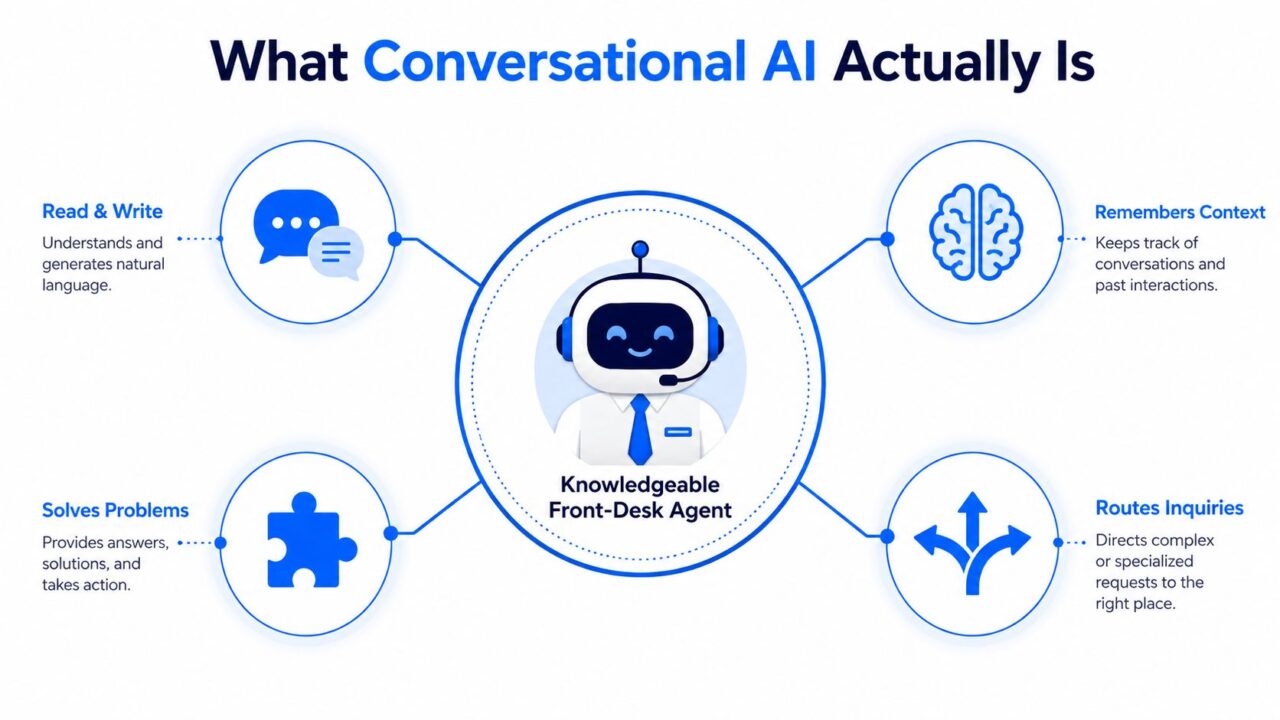
Conversational AI is a knowledgeable front-desk agent that reads, writes, remembers context, and routes people to the right place without forcing them through a keyword menu. It takes messy human input, interprets it, and returns a context-aware reply in milliseconds, which is the core difference between a real conversational system and a basic scripted widget (Netguru).
At the architecture level, enterprise conversational AI is a stack, not a single feature. It combines artificial intelligence and machine learning for improved performance. natural language processing, intent classification, entity extraction, dialogue-state tracking, response selection, and natural language generation to understand what the user wants and decide what happens next. That is why integration and data quality matter as much as model quality. A weak data layer gives you confident wrong answers, and those mistakes spread fast across sales and support.
Why this is different from old chatbots
Legacy chatbots were usually rule trees with a few prewritten branches. They worked when the question was predictable and the answer lived in a narrow FAQ. The moment a customer asked something slightly off-script, they broke.
Modern conversational AI handles ambiguity, partial information, and evolving context. It still serves simple FAQs, but its real value shows up when it qualifies a lead, triages support, or routes someone into the right workflow before a human has to decode the request. If you need a simple explainer to share internally, this overview of chatbot natural language processing is a useful reference point.
It is not about sounding human. It is about reducing friction fast enough that the customer does not notice the handoff machinery behind the scenes.
The buyer mistake is to ask, “Can it chat?” That question is too small. Ask whether it can interpret intent, preserve context, and hand off cleanly when the case gets complex. That is the difference between a novelty bot and a system that moves business work forward.
The Highest-Value Business Use Cases
The highest-value use cases are the ones that capture revenue before they cut cost. That means lead qualification, conversational intake, appointment scheduling, abandoned-cart recovery, and proactive outreach come before pure deflection. Support still matters, but it’s second-order value unless you’re drowning in repetitive tickets.
Start with revenue capture
A DTC brand should use conversational AI to catch shoppers who hesitate on size, shipping, or return policy. A bot that answers those objections in the moment can keep the conversation alive instead of letting the visitor bounce. In SaaS, the same logic applies to demo requests and trial signups. The bot should qualify company size, use case, and urgency before handing off to sales.
For agencies and service businesses, conversational intake is often the highest-impact move. A prospect arrives from Instagram, Messenger, or the website, asks a vague question, and disappears if they have to fill out a long form. A conversational flow can ask the minimum set of questions, route high-intent leads to a calendar, and tag the rest for follow-up.
Where automation pays off fastest
- Lead qualification: Filter out poor-fit leads before a human spends time on them.
- Appointment scheduling: Let prospects book without back-and-forth emails or missed calls.
- Abandoned-cart recovery: Answer objections at the exact point of hesitation.
- Proactive outreach using a virtual assistant can significantly improve engagement. Nudge inactive leads or returning visitors with a relevant prompt.
- Onboarding: Collect account details, goals, or setup inputs before a customer success rep or virtual assistant gets involved.
- Support deflection: Handle repetitive questions once the revenue workflows are stable.
For a local clinic, scheduling and intake are the obvious wins. For a coach or course seller, the better use case is qualifying interest and segmenting people by readiness to buy. For SaaS, onboarding can remove a lot of the friction that usually shows up after signup.
The rule is blunt. If a workflow affects conversion, qualification, or booking, it’s a strong candidate. If it just answers generic questions, it’s useful but not the first place I’d spend budget. The biggest ROI usually comes from the conversations that never became pipeline before, especially those enhanced by generative AI.
Quantifying the ROI You Can Realistically Expect
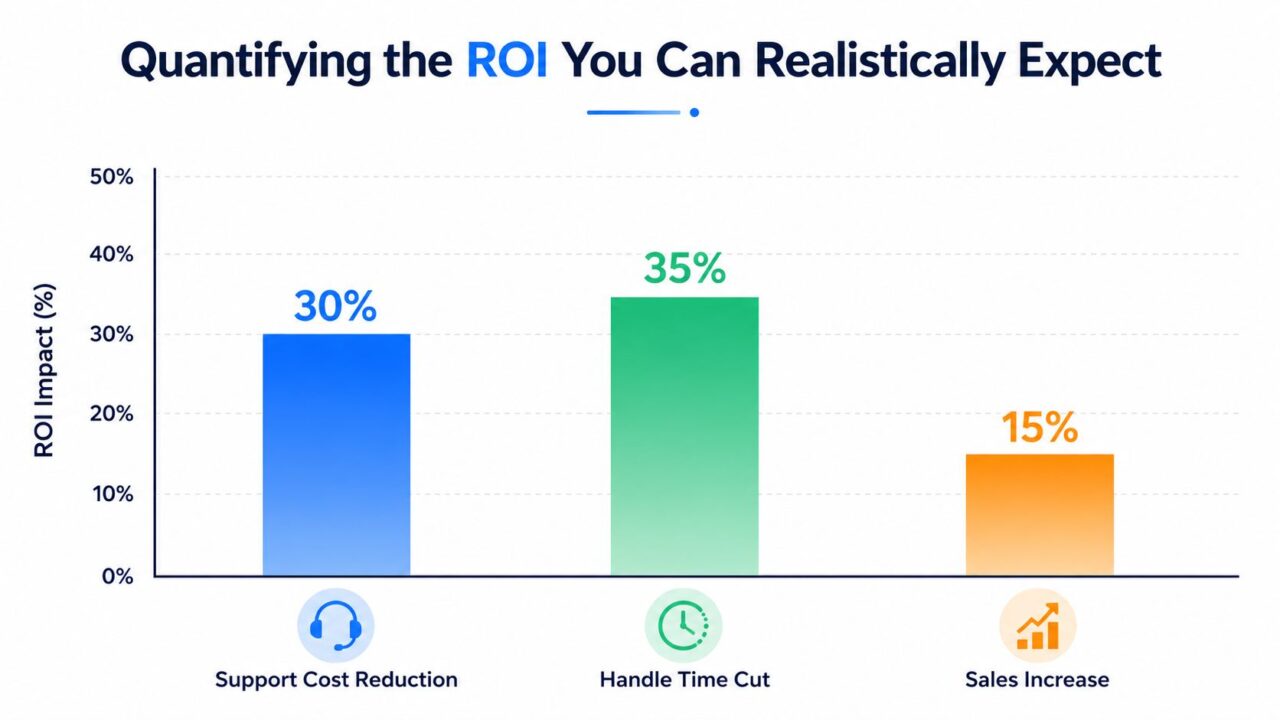
Use conservative math, or you’ll oversell the project and lose trust later. Verified industry summaries report that AI chatbots can handle up to 80% of routine inquiries and can reduce customer support costs by around 30% (IBM). Another 2026 statistics roundup cites McKinsey research that AI agents can reduce average handle time by 30% to 40% (Echocall). That’s enough to matter, but not enough to excuse sloppy measurement.
Revenue-side gains can be meaningful too. A peer-reviewed review on conversational commerce notes industry research summaries reporting advancements in generative AI. 67% increases in sales after chatbot implementation and e-commerce conversion lifts of up to 30% (PMC). Don’t use those numbers as promises. Use them as directional evidence that conversational AI can move more than cost per ticket.
Conversational AI for Business ROI Chart
A sane business model is straightforward:
- Support savings = routine contacts handled by the bot × cost per contact avoided.
- Capacity gains = reduced handle time × agent hours recovered.
- Revenue lift = additional qualified leads or completed purchases × average value per conversion.
That’s the model I’d show leadership. Not “AI will transform the customer journey.” Show them the current volume, the current handle time, and the one workflow where the bot can remove friction. If you’re not measuring against a single incumbent process, you’re guessing.
The cleanest ROI story comes from one workflow run side by side with the old process. That way, you can see whether the bot improves completion, conversion, or containment before you expand to a second use case. That’s how you avoid inflated claims and make the finance team less suspicious.
A Pilot-First Implementation Roadmap
Launch across the whole site, and you burn time, budget, and political capital. Start with one workflow, one channel, and one baseline metric. The goal is simple, prove revenue impact or operational lift fast enough that the next move is obvious.
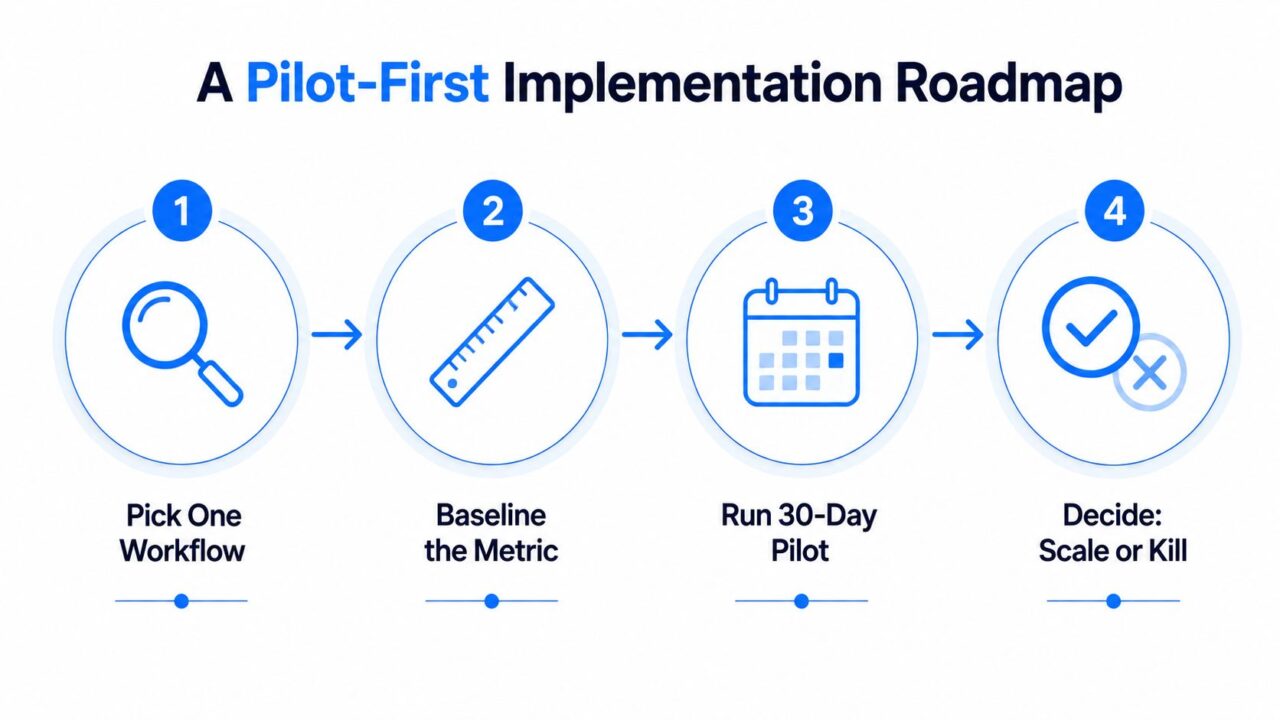
Conversational AI for Business Implementation Roadmap
The four-step path
- Pick one workflow. Choose a high-volume, repeatable conversation with a clear business outcome using a conversational AI tool. Lead qualification, booking, or order status are stronger starting points than broad support because they show whether conversational AI for business is capturing demand or just handling noise.
- Set the baseline. Record the current completion rate, response volume, deflection rate, containment rate, average handle time, and escalation rate before launch. Use the same measurement frame you will judge the pilot against later, so the before-and-after comparison is clean (Cloudtech).
- Run a 30-day pilot. Keep the scope tight and instrument transcripts, metadata, intent, sentiment, and resolution patterns with NLP tools so you can see where the flow works and where it breaks. Use the pilot to test whether the bot qualifies leads, completes transactions, or hands off cleanly, not whether it can answer everything (Cloudtech).
- Decide to scale or stop. If the bot improves the chosen metric and the handoff path is clean, expand it. If not, fix the workflow or stop spending on it.
Channel scoping matters too. Website chat is the easiest place to start because the traffic is already there. Once the workflow is stable, move to Messenger, Instagram DM, or WhatsApp if your audience already uses those channels. Don’t spread the same conversation logic across every channel on day one.
Practical rule: If you can’t explain the pilot in one sentence and measure it in one dashboard, the rollout is too broad.
A pilot-first approach also makes stakeholder buy-in easier. Leadership does not need a theory about AI. It needs proof that one workflow got faster, cheaper, or more profitable. Give them that first, then expand.
How to Choose the Right Platform
Buy the platform that fits the workflow you need. For conversational AI for business, that means weighting the decision around revenue capture first, then support routing. If the tool cannot qualify leads, route intent, and hand off cleanly, the rest is decoration.
Start with the platform comparison that matters most to your shortlist, then cut anything that does not support a real pilot. Review this best conversational AI platforms comparison before you issue an RFP, so you are evaluating against the right feature set instead of vendor demos.
Here is the shortlist framework I would use:
| Criterion | Why It Matters | What Good Looks Like | Watch Out For |
|---|---|---|---|
| Channel coverage | Your customers do not live in one inbox | Website, social DMs, and messaging channels in one system | Locked into a single channel |
| No-code builder | Faster iteration without dev bottlenecks | Drag-and-drop flow design | Heavy dependence on engineering |
| AI agent capabilities | Determines how much the bot can resolve | Intent handling, routing, and context awareness | A rules-only bot dressed up as AI |
| Native integrations | Prevents brittle manual work | CRM, helpdesk, email, and automation connectors | Few native connectors and weak API support |
| Segmentation and analytics | Lets you personalize and measure | Tags, fields, transcripts, and reporting | No useful segmentation or conversation data |
| Personalization | Improves conversion and handoff quality | Context-aware prompts and stored attributes | Generic replies that ignore history |
| Broadcasting | Useful for re-engagement and promotions | Controlled outbound messaging | Spammy tools with no audience logic |
| Compliance | Protects data and brand trust | GDPR tools and safe access controls | Weak governance or unclear data handling |
The test is whether the platform helps you capture demand, qualify it, and route it without friction. If a tool only looks good in a demo, it will slow your team down once real traffic hits. Pick the system that can run one tight workflow well, then expand from there.
A platform like Clepher fits the profile of a no-code chatbot and marketing suite for website chat, Facebook Messenger, Instagram Direct Message, and WhatsApp, with flows, live chat, segmentation, and broadcasts. I would still compare it against your own requirements, but that is the kind of capability mix to look for when the goal is revenue capture and support routing, not just a pretty widget.
Questions to ask in the RFP
- How fast can we launch one workflow?
- Which channels are native, and which need workarounds?
- What analytics do we get without extra tooling?
- How does the handoff to a human work?
- What breaks when volume grows?
Before issuing an RFP, make sure you have already narrowed the field. A clear shortlist saves time, keeps the team focused, and prevents you from buying a platform that cannot support the workflow you want to prove first.
If a vendor cannot answer those questions cleanly, keep looking. Pay-per-conversation pricing gets ugly at scale, thin integrations create manual work, and single-channel tools box you in fast. Those are future problems you can avoid now.
The KPIs That Prove It Works
Measure conversational AI in three layers or you’ll confuse activity with performance. At the model layer, track intent accuracy and latency. At the operational layer, track containment rate, deflection rate, and handle time. At the business layer, track CSAT, NPS, and ROI.
Start with baseline-setting before launch. Record average handle time, cost per interaction, CSAT, and escalation rate so any improvement after deployment can be tied to automation instead of channel mix changes or seasonal traffic swings. Without that baseline, leadership will question every gain you report.
What to look at first
- Intent accuracy: Are users routed to the right flow?
- Latency: Does the system respond fast enough to feel natural?
- Containment rate: How many conversations stay inside automation?
- Escalation rate: How often does the bot hand off to a human?
- CSAT and NPS: Do customers like the experience enough to keep using it?
Focus on the workflow first, then the scorecard, integrating machine learning for better insights. If the bot is meant to capture leads, qualifying the conversation and routing it correctly matters more than a high-volume dashboard. If it is meant to reduce support load, containment and escalation tell you whether the workflow is absorbing demand or just creating extra work. A simple pilot should prove one thing at a time, then you can expand with confidence.
Conversational analytics keeps the program from stagnating. Transcripts, metadata, sentiment, and resolution patterns show you which intents are safe to automate with AI tools, which need better copy, and which should escalate immediately. That is the loop that improves quarter after quarter. For a tighter reporting framework, keep this guide to chatbot KPI metrics handy. Use it to keep the bot accountable to business outcomes.
Reference implementation guidance from Cloudtech when you set your baseline, choose your first metrics, and review the analytics.
Common Pitfalls and What to Do This Week
The fastest way to fail is to automate too much at once. Teams also get burned when they skip baselines, ignore handoff design, treat the bot like a set-and-forget asset, or under-invest in conversation design. Every one of those mistakes is fixable.
The symptom and the fix
- No baseline: You can’t prove value. Fix: Measure one incumbent workflow before launch.
- Too many workflows: The bot feels unfocused and lacks the precision of a well-trained conversational AI solution. Fix: Cut scope to one high-volume use case that leverages machine learning.
- Poor handoff: Customers get stuck. Fix: Design the human escalation path before launch.
- Set and forget: Accuracy drifts. Fix: Review transcripts weekly and tune the flow.
- Weak conversation design: Users drop out early. Fix: Rewrite the prompts around the customer’s real language.
If you want a useful next step, audit one high-volume workflow in the next 48 hours using a conversational AI tool. Pull the top repeating questions, choose the one that ties most directly to revenue or capacity, and define the baseline metric you’ll use to judge it. That single decision will tell you more than another month of browsing vendor demos.
If you want to turn conversational AI into a real growth system instead of a loose collection of chat widgets, Clepher gives you the pieces to build, route, tag, and measure conversations across the channels your customers already use. Visit Clepher and map one workflow to a pilot you can launch, measure, and improve this month.
Related Posts
8 Promo Code Examples for Smarter Campaigns
October 20, 2026Revenue Optimization: A Practical Playbook for Growth
October 19, 202610 Lead Capture Software Tools Compared for 2026
October 18, 2026
Founder Clepher