

You’re halfway through a networking conversation when a phone notification steals the other person’s attention. You finish your sentence, they glance away, and the exchange lands in an awkward half-shrug. Nobody knows whether to ask another question, change the subject, or leave.
That pause isn’t proof that either person lacks charisma. It’s a conversation-flow failure with observable causes: response latency, available topic runway, and whether the listener is still mentally present. Human dialogue depends on people exchanging turns within recognizable timing windows, then giving each other enough material to continue.
The same pattern appears in a sales DM, a support chat, and a chatbot that asks three questions at once. Learning how to make conversation flow means treating dialogue as a system. You can watch for timing, narrow the next turn, confirm what was understood, and build recovery paths for the moments when people go quiet or change direction.
The Moment a Conversation Stalls
At the mixer, the problem usually starts before the silence. One person has been explaining how their team is changing its customer onboarding process. The other person was following along, but a notification interrupts their attention. When the speaker finishes, the listener has lost the thread, and the speaker has no clear cue for where to take it next.
Three variables determine whether that moment recovers.
- Response latency: How long does the listener take to acknowledge or respond?
- Topical runway: Did the last statement contain a detail that can support a follow-up?
- Listener availability: Is the other person still tracking, or has their attention moved elsewhere?
A conversation stalls when all three fail together. A delayed response feels worse when the previous message offered no obvious continuation. A strong topic can survive a pause, but only if the listener signals that they’re still engaged.
Flow is an exchange, not a performance
People often describe smooth speakers as confident, interesting, or naturally gifted. Those traits may help, but they don’t explain the mechanics. Flow comes from short turns, clear handoffs, responsive listening, and recoverable transitions.
A useful test is to inspect the last few exchanges rather than judge the whole interaction. Did one person answer and then stop? Did the other person ask a broad question with no context? Did a bot request several details before confirming any of them? Each failure leaves the next speaker with too many possible directions.
In human conversation, a small acknowledgment can restore coordination:
Practical rule: Before you add a new topic, prove that you received the current one.
In a DM, that might be, “That onboarding issue sounds familiar. The handoff between marketing and support usually causes it.” In a chatbot, it could be a brief confirmation followed by one focused question. Both responses reduce the burden on the other participant.
Planning prevents avoidable freezes
A little preparation also changes the quality of transitions. Research guidance from Berkeley’s Greater Good conversation tips highlights pre-conversation planning as a way to reduce awkward transitions, pauses, and filler words.
The preparation doesn’t need to become a script. Note the topic you want to discuss, one related observation, and one natural bridge. That gives you a runway without forcing the other person into an interview.
What Timing Tells Us About Flow
Conversation has a measurable timing signature. A major corpus study found that about 51 to 55 percent of turn transitions happen in under 200 milliseconds, while around 70 to 82 percent occur in under 500 milliseconds. The same research found that roughly 40 percent of transitions involve overlap, rather than a clean gap between speakers (conversation turn-taking research).
That overlap isn’t automatically rude. A quiet “right” or “mm” can arrive while someone is still speaking and communicate active attention. The risk comes when the overlap takes the floor away, ignores the speaker’s point, or forces them to restart.
Cross-linguistic research reinforces the point. In a study spanning 10 languages, mean floor-transfer offsets ranged from 7 milliseconds to 468 milliseconds, with an overall mean of 187 milliseconds and a median of 168 milliseconds (cross-linguistic turn-taking research). Speakers often prepare their next turn before the previous one ends because planning even a single word can take roughly 600 milliseconds, according to the same research summary.
Translate research into operating ranges
The research gives designers a useful baseline, but people don’t experience a 187-millisecond offset as a stopwatch reading. They experience a rhythm. A short pause can sound thoughtful. A longer one can sound like uncertainty, distraction, or a broken connection.
The following ranges are practical design heuristics, not additional findings from the corpus studies.
| Latency | What It Signals | Bot or DM Implication |
|---|---|---|
| Under 200 milliseconds | Immediate tracking, acknowledgment, or overlap | Use a short backchannel, typing cue, or confirmation when appropriate |
| 200 to 500 milliseconds | Normal rapid turn exchange | Keep responses concise and make the next turn easy to answer |
| 1 to 1.5 seconds | Thoughtful pause | Don’t interrupt. Let the person finish planning a response |
| Around 3 seconds | Possible uncertainty or loss of direction | Offer a focused prompt, example, or reflective restatement |
| Around 6 seconds | Likely flow breakdown | Provide a recovery option, topic branch, or human handoff |
The distinction between a productive pause and dead air matters. A person may pause while searching for the right word, especially after a complex question. A bot that sends nothing during a long process, however, gives the user no evidence that work is happening. A typing indicator or progress message can preserve the perceived connection without adding unnecessary text.
Build latency into the conversation budget
Bot authors should define what happens during silence instead of treating it as an edge case. A user who hasn’t typed anything may be thinking, distracted, or confused. Those states need different responses.
- Thinking: Keep the prompt visible and avoid piling on another question.
- Confusion: Restate the request using a concrete example.
- Disengagement: Offer an exit, restart, or human option.
The timing research explains why fast responses matter, but speed alone won’t fix a badly structured exchange. A bot can answer instantly and still create friction if each turn contains multiple requests. Smooth flow combines reasonable latency with narrow turns, visible acknowledgment, and an obvious next action.
Three Behaviors That Keep Dialogue Moving
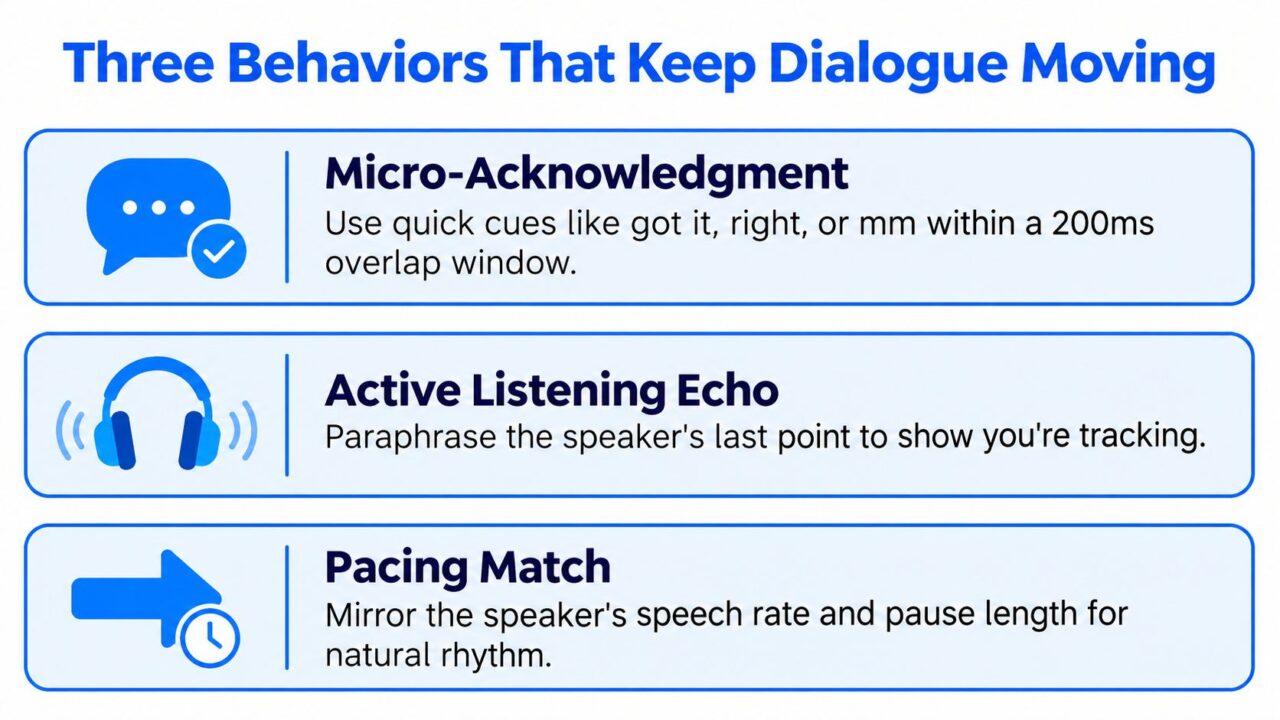
Three behaviors consistently make conversation easier to continue: micro-acknowledgment, additive continuation, and lightweight pivots. They work because they give the other person evidence that you heard them, provide more material to respond to, or signal a change without pretending the previous topic never happened.
How to Make Conversation Flow Dialogue Tips
Micro-acknowledgment
Use a small cue before you add substance. “Got it,” “right,” and “mm” tell the speaker that their message arrived. In spoken dialogue, these cues can overlap the speaker’s turn, but they shouldn’t compete with the main point.
A reusable script sounds like this:
“Right, I follow. The handoff is where things slowed down?”
The first phrase confirms attention. The second phrase reflects the detail and gives the speaker a manageable response.
In chat, micro-acknowledgment can be a short sentence, reaction, or context-specific emoji. “Got it, you’re comparing the two plans” is usually more useful than a thumbs-up on its own because it confirms what you understood.
Additive continuation
A continuation keeps the topic alive by adding a relevant detail and leaving room for the other person. End with a hook rather than a conclusion.
- “The surprising part was how quickly support noticed the issue. What happened on your side?”
- “I tried a similar onboarding change last month, and the unexpected bottleneck was training.”
- “That reminds me of a campaign where the replies improved after we simplified the first message.”
The continuation shouldn’t become a monologue. One observation, followed by one focused invitation, gives the other person both context and control.
For a DM, write: “That checkout problem sounds like the tracking issue we found in our store. We fixed it by checking the event after each step. Is your drop-off happening before or after payment?”
Lightweight pivots
A pivot works when it acknowledges the current thread before opening another. “Speaking of which,” “that reminds me,” and “before I forget” help listeners update their expectations.
A bot can use the same structure through a contextual transition template:
“Thanks, I’ve noted your preferred color. Speaking of delivery, when do you need the item?”
That sentence moves from product preference to fulfillment without making the user repeat their original request. Use a pivot when the new subject is relevant. Use a direct topic change when it isn’t, and label it clearly.
Review your last five messages and ask one question: Did each message acknowledge, extend, or cleanly redirect the exchange?
Designing Flow Inside a Chatbot
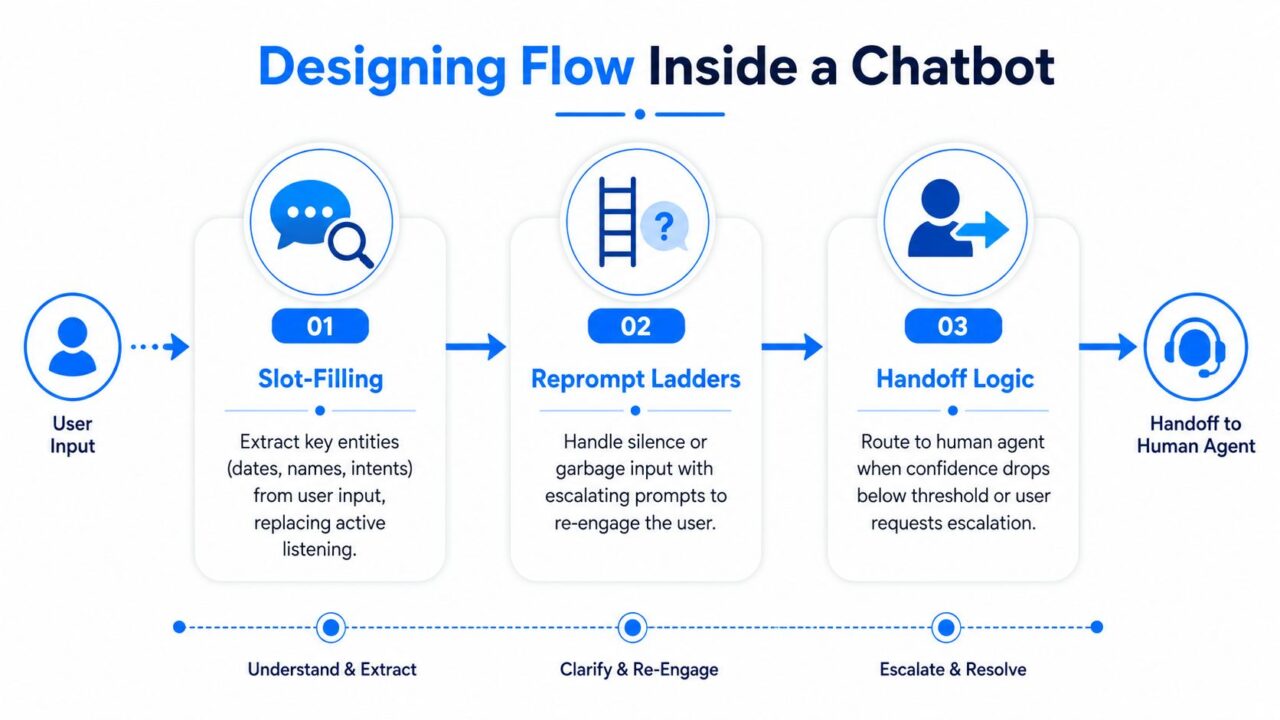
A chatbot doesn’t listen in the human sense, so it needs system behaviors that perform the same coordination work. Slot-filling captures the information a person would normally gather through attentive listening. Reprompt ladders handle silence and unclear input. Handoff logic protects the experience when the system’s confidence drops.
How to Make Conversation Flow Chatbot Design
Consider a product-recommendation bot. The user wants a jacket, but the bot needs to learn the use case, size, and preferred color. A high-flow design doesn’t ask for all three at once.
Use one narrow turn at a time
The bot can move through this sequence:
- Greeting: “I can help you find a jacket.”
- Qualification: “Will you wear it mainly for commuting, hiking, or everyday use?”
- Slot capture: Store the selected use case, then ask for size.
- Confirmation: “You’re looking for a medium everyday jacket in black. Is that right?”
- Recommendation: Present a small set of relevant options.
- Escalation: Offer an agent when the user requests help or the system can no longer interpret the request reliably.
The conversation-flow UX reference recommends defining required slots and validation rules, accepting slots in any order without asking for information again, and using a reprompt ladder that moves from hints to examples and then a strategy change.
The exact delay values in a production flow should come from your channel and audience data. A designer might define stages such as an initial wait, a later example prompt, and a final handoff, but those values should be tested rather than treated as universal human timing rules.
Map human behaviors to system actions
- Micro-acknowledgment becomes an encouragement event: “Got it, I’ve saved black.”
- Active listening becomes entity recognition: Extract “medium” even if the user provides it while answering a different question.
- Additive continuation becomes confirmation logic: Summarize captured slots before moving to a recommendation.
- Lightweight pivot becomes a contextual transition: Move from product fit to delivery without restarting the flow.
A transition node can be represented like this:
{
  "id": "confirm_product_preferences",
  "type": "confirmation",
  "required_slots": ["use_case", "size", "color"],
  "message": "I have {{size}} for {{use_case}} in {{color}}. Is that correct?",
  "on_confirm": "recommend_products",
  "on_correction": "collect_missing_or_changed_slot",
  "on_unknown": "reprompt_with_examples",
  "on_escalation_request": "handoff_to_agent"
}
The node stays narrow because it confirms one coherent group of information. It also supports correction, which matters because users often change direction mid-task.
Teams building or revising an automated experience can compare implementation approaches in resources covering chatbot development services in 2026, then map the chosen architecture to Clepher’s chatbot design workflow. The design choice should follow the conversation requirements, including channel, data, recovery paths, and human ownership.
Adapting the Same Patterns Across Channels
The underlying conversation can stay the same while the surface behavior changes. Booking a haircut requires a greeting, a service choice, a time preference, confirmation, and a recovery path whether the exchange happens face to face, in Instagram Direct Message, or inside a website chat widget.
The mistake is copying the same script into every channel. A person can use eye contact and a small “mm” in person. An Instagram user may respond hours later, so the flow needs context in every message. A website widget can show typing feedback and quick replies, but it shouldn’t force visitors through a long form before they know what happens next.
| Beat | In-Person | Instagram DM | Website Chat |
|---|---|---|---|
| Greet | Eye contact and “Hi, how can I help?” | “Hi, thanks for messaging. Are you booking a cut or color?” | Welcome message with service buttons |
| Qualify | Ask one question and use a backchannel | Mirror the user’s wording and ask one focused question | Use quick replies for common services |
| Confirm | Repeat the service and preferred time aloud | Summarize the selected service before checking availability | Show a compact confirmation card |
| Recover | “Take your time. Would morning or afternoon be easier?” | “Still looking for an appointment? I can check the options again.” | Offer examples, restart, or live assistance |
Treat latency as a channel property
In person, a rapid response can show attention, but constant interruption damages the speaker’s control of the floor. In a DM, an immediate answer isn’t always necessary, but a reply should preserve the previous context. In a widget, a typing indicator acts as a backchannel, especially when the system needs time to retrieve availability.
The recovery script should match the channel’s rhythm:
- In person: “I didn’t catch the time preference. Do you prefer morning or afternoon?”
- Instagram DM: “I’ve got the haircut request. When you’re ready, send your preferred day and I’ll check availability.”
- Website chat: “Choose a day below, or type a date if you already have one in mind.”
A name field can support natural mirroring in a widget, while an Instagram conversation may use the user’s own capitalization or phrasing to avoid sounding canned. The core design remains stable, but the encouragement cue, wait behavior, and recovery language change.
For businesses coordinating conversations across messaging and support surfaces, omnichannel customer engagement offers a useful framework for preserving context instead of treating each channel as an isolated conversation.
Why Asking More Questions Can Backfire
“Always ask a follow-up question” is useful advice until it turns every exchange into an intake form. Questions create movement only when the other person has enough space to answer and receives some evidence that you’re contributing too.
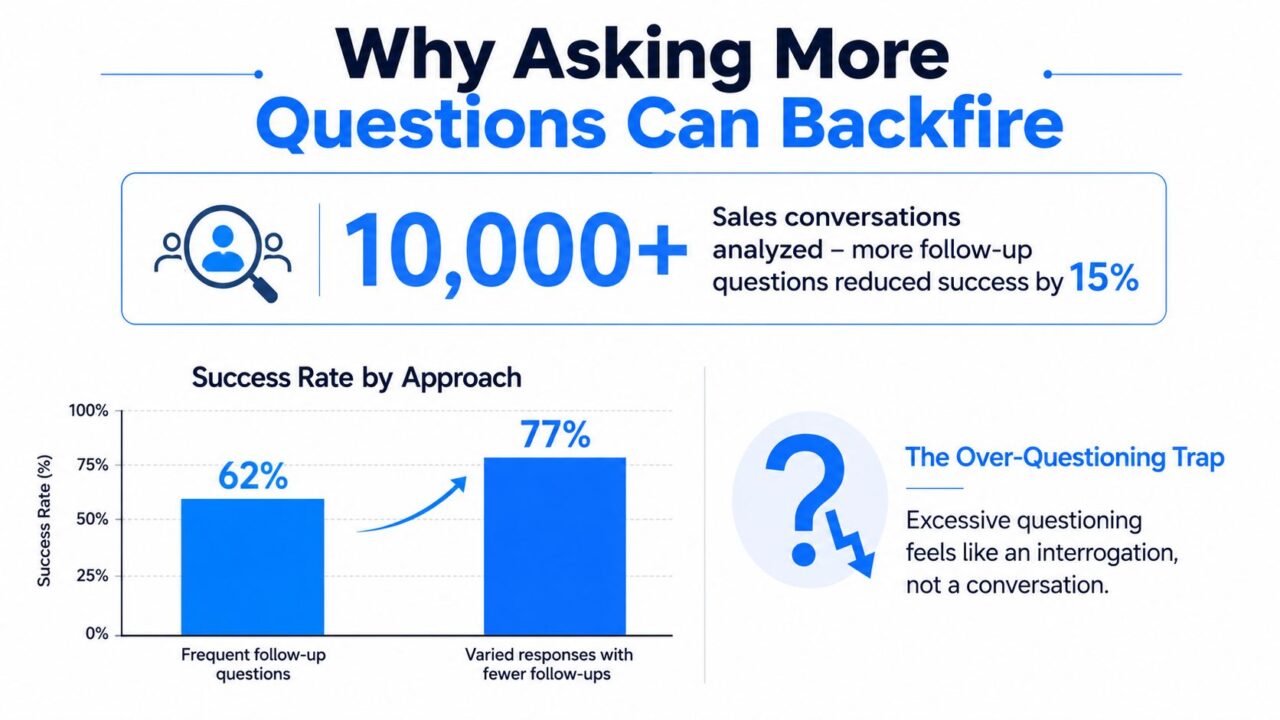
Sales data cited by Gong complicates the question-heavy script. Sellers who won deals asked 15 to 16 questions per call, while sellers who lost deals asked about 20 questions. The same source recommends a short two-second pause before responding to reduce interruptions and keep the buyer engaged (Gong’s talk-to-listen analysis).
The lesson isn’t that questions are harmful. It’s that question count isn’t a proxy for conversational quality. Too many questions can make a prospect feel examined, especially when the seller never shares a relevant observation or demonstrates understanding.
Replace interrogation with alternation
Use one question, then add one useful statement. The statement might reveal a relevant experience, summarize what you heard, or explain why the answer matters.
Rigid DM:
“What platform do you use? How many leads do you get? What’s your conversion rate? What have you tried? What’s your budget?”
Balanced DM:
“What platform are you using for lead capture? I’ve seen teams lose momentum when the form and follow-up live in separate tools. If that’s happening for you, I can show a simpler path. How are new leads handled after they submit?”
The second version still qualifies the prospect, but it creates shared context. The recipient can answer the question, react to the observation, or explain a different problem.
A validated assessment of conversational skills identifies asking questions, giving positive feedback, and balancing speaking time as measurable behaviors. It also scores interruptions negatively, with zero interruptions receiving the highest score and four or more receiving the lowest (validated conversational-skills assessment). In practice, alternate inquiry with acknowledgment, and let the other person complete a thought before you introduce the next branch.
How to Make Conversation Flow Sales Statistics
Fixing Broken Flow in Real Time
Flow breaks in recognizable ways. The person gives a one-word answer, the topic changes abruptly, someone interrupts, or a bot reaches a point where it can’t interpret the request. Each failure needs a different repair, not another generic follow-up question.
Repair dead ends
When someone says “I don’t know,” don’t force them to produce certainty. Add a context anchor or lower the difficulty.
- “That’s fair. If you had to guess, what feels most likely?”
- “No problem. The last detail you mentioned was the delivery delay. Was that the main frustration?”
- “I’ve had the same problem with unclear tracking updates. What part was hardest to resolve?”
A one-word reply often means the question was too broad, the timing was poor, or the person has no reason to invest more effort. A specific choice or brief observation gives them an easier entry point.
Signal topic changes
A clean bridge protects both threads:
- “Speaking of which, I want to ask about your launch.”
- “That reminds me, there’s one detail from the earlier issue we should confirm.”
- “On a completely different note, are you still considering the new supplier?”
If the original topic matters, record it before pivoting. A bot can save the unresolved slot and return to it later. A human can say, “I want to come back to the delivery question after this.”
Hold and return after interruptions
Use the hold-and-return pattern:
“Hang on, I want to come back to that.”
Then return explicitly: “You were explaining why the first campaign stalled.” This simple move prevents useful information from disappearing when a new thought or interruption takes over.
For website chat, a confidence-score drop should trigger a handoff message that preserves the transcript: “I’m bringing in a team member so you won’t need to repeat what you’ve already shared.” Teams evaluating live support workflows can also review real-time agent assistance as part of their handoff design.
Keep an operator checklist
Use this as a quick audit after a stalled exchange:
- Acknowledge: Did the response show that the last message was received?
- Echo: Did it reflect the important detail?
- Narrow: Did it ask only one focused question?
- Pace: Did the response match the channel’s expected rhythm?
- Pause: Did the speaker get room to finish?
- Extend: Did the message add useful topical runway?
- Bridge: Did a topic change include a linking phrase?
- Recover: Is there a hint or example for unclear input?
- Confirm: Were captured details summarized before progression?
- Handoff: Can a human take over without making the customer repeat everything?
Conversation flow improves when people and systems stop treating awkwardness as a mystery. Measure the pause, reduce the number of decisions in each turn, and design the next response before the current one becomes a dead end.
Clepher helps teams build structured conversational Flows for marketing, sales, and support across website chat, Messenger, WhatsApp, and Instagram Direct Message, with live-chat handoffs that preserve continuity. Visit Clepher to turn these timing, confirmation, and recovery patterns into practical automated conversations.

Related Posts
10 Lead Capture Software Tools Compared for 2026
October 18, 2026WhatsApp Chatbot for Ecommerce: A Practical 2026 Guide
October 17, 2026What Is Lead Scoring and How It Drives Real Sales Results
October 16, 2026
Founder Clepher