
A conversational commerce platform isn’t a side tool anymore. It’s becoming part of the storefront.
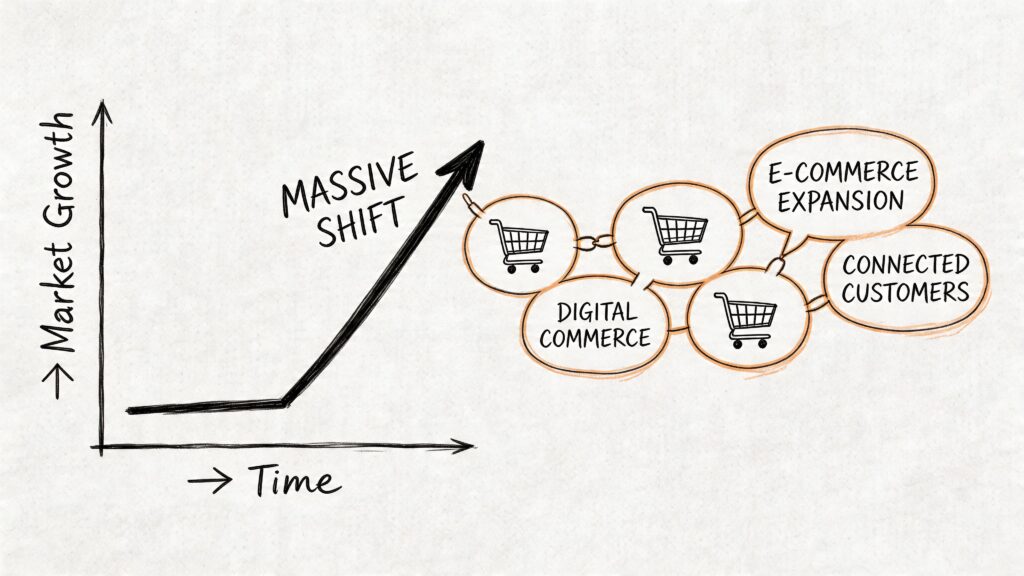
The fastest way to understand the shift is the market itself. The global conversational commerce market was valued at US$7.6 billion in 2024 and is projected to reach US$34.4 billion by 2034, growing at a 16.3% CAGR, according to Electro IQ’s conversational commerce statistics. That kind of expansion usually signals a change in buying behavior, not a passing software trend.
Customers already message brands when they have a question, hesitate at checkout, need reassurance, or want a quick answer before buying. The businesses that win are the ones that turn those moments into structured conversations instead of leaving them to chance.
The Unstoppable Shift to Conversational Shopping
Messaging has changed what buyers expect from online commerce. They don’t want to fill out a form, wait for an email, and then restart the buying process somewhere else. They want to ask, get an answer, and keep moving.
That’s why conversational shopping keeps gaining ground. The old model treated the website like a static catalog and customer support like a separate function. A conversational commerce platform blends those roles. Chatbots, assistants, product discovery, objection handling, lead capture, support, and even purchase recovery can happen in one thread. This seamless shopping experience allows buyers to interact naturally, getting the answers they need in real-time.
The benefits of conversational commerce are clear: it reduces friction, speeds up decision-making, and keeps customers engaged throughout the buying journey. With AI-powered systems, businesses can provide personalized and efficient customer interactions, turning casual inquiries into successful sales.
Conversational Commerce Platform Market Growth
Why this shift matters now
The market growth tells only part of the story. What matters more in practice is the operating model behind it. Brands are moving conversations into channels customers already use every day, such as WhatsApp, Messenger, Instagram DM, and on-site chat. That cuts friction at the exact moment when intent is highest.
For e-commerce teams, this means fewer dead ends between browsing and buying. For agencies, it means campaigns can generate leads and move them into qualification without relying on a manual handoff. For coaches, creators, and service businesses, it means interest can turn into booked calls or paid offers inside a guided exchange instead of a leaky funnel.
Buyers don’t separate marketing, sales, and support the way internal teams do. They just want the next useful answer. Conversational commerce experiences unify all stages of the customer journey into a seamless flow.
By integrating messaging apps like WhatsApp, Messenger, and Instagram DM, brands can create personalized product recommendations and engage customers more effectively. This helps streamline the entire process, ensuring customers are continuously engaged and supported. Moreover, the data collected from these conversational data points can further optimize customer engagement, enhancing every interaction along the way.
What businesses get wrong
Many teams still treat chat as a support add-on. That limits the upside.
A stronger approach is to treat conversation as a revenue path. That means using it to:
- Recover hesitation: Answer pre-purchase questions before the shopper bounces.
- Qualify intent: Ask a few smart questions instead of sending every lead to the same page.
- Reduce channel switching: Keep the buyer in the conversation instead of forcing extra clicks.
- Create continuity: Carry the same context from promotion to purchase to post-sale support.
Once a business starts thinking this way, conversational commerce stops looking like automation for automation’s sake. It starts looking like a practical way to capture demand that already exists.
What Exactly Is a Conversational Commerce Platform
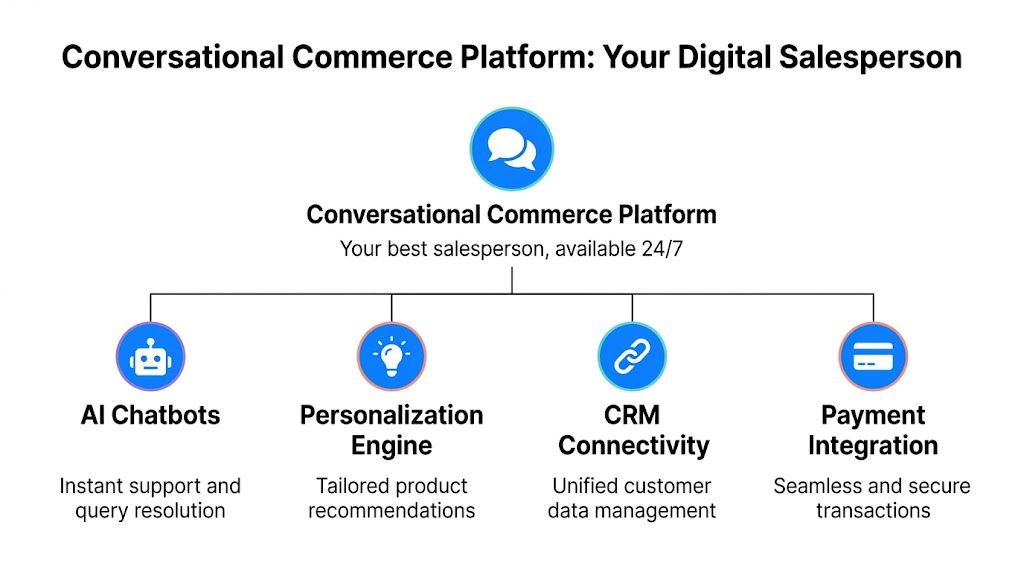
Think of a conversational commerce platform as your digital sales team in software form. It combines the responsiveness of live chat, the consistency of automation, and the context of your store and CRM data.
A basic chatbot can answer a few scripted questions. A real platform does more than talk. It understands intent, keeps context across multiple turns, and connects to the systems that let it do something useful.
Conversational Commerce Platform Components
The difference between a bot and a platform
The easiest way to spot the difference is to ask one question. Can it take action based on real business data?
If the answer is no, you likely have a glorified FAQ widget. If the answer is yes, you have something much closer to a conversational commerce platform.
That action layer matters because modern implementations rely on a layered architecture often described as CALM, which blends NLP with structured workflows. When generative responses are grounded in real-time business data through RAG, this setup can reach 85-95% query resolution rates in e-commerce, according to TBlocks on conversational commerce architecture.
The core layers that make it work
A useful platform usually has four parts working together:
- Intent understanding: The AI interprets what the customer is trying to do, even when they don’t use exact keywords.
- Dialogue management: The system remembers where the conversation is and doesn’t force the user to repeat themselves.
- Business integrations: Product catalog, inventory, order data, CRM, and payment connections supply the facts the bot needs.
- Workflow logic: Rules, branches, tags, and triggers turn free-form chat into guided business outcomes.
That last point matters more than people think. Good conversational experiences aren’t just generated. They are designed.
Why channel coverage matters
A conversation rarely lives in one place anymore. A prospect might reply to an Instagram story, click to a site widget, and later continue on Messenger or WhatsApp. If your stack can’t support that, context gets fragmented and the customer feels it immediately.
If you’re comparing channel strategy across tools, this guide to a multi-channel messaging platform is useful because it frames the operational side of managing conversations across different touchpoints.
One example of this category is Clepher’s conversational marketing platform, which combines a no-code builder with messaging across website chat, Facebook, Messenger, WhatsApp, and Instagram DM. That kind of setup is what separates a platform from a single-purpose bot.
A platform earns its keep when it can answer, route, personalize, and update systems without breaking the customer journey.
The Business Case ROI and Tangible Benefits
Many teams don’t need another engagement tool. They need a clearer path from conversation to revenue.
That’s the strongest case for a conversational commerce platform. The upside isn’t abstract. It shows up in conversion performance, recovered sales, and the amount of manual work your team no longer has to do.
Revenue impact
The revenue case is straightforward. Businesses using conversational commerce have seen chatbot-powered websites produce a 23% boost in conversion rates, and brands using AI sales agents report an average 67% increase in sales conversions, based on Experro’s conversational commerce statistics and market size analysis. The same source notes benchmark revenue per conversation of $3 to $8.
That changes how you should evaluate chat. It shouldn’t sit in the budget as a support tool only. It belongs in the same discussion as paid traffic, landing page optimization, and conversion rate improvement.
Cost and efficiency gains
Operational efficiency matters too. If your team answers the same pre-sale and post-sale questions every day, you already know how expensive repetitive support can become. A conversational AI platform that handles common intent automatically gives human agents more time for escalations, edge cases, and higher-value customer conversations.
In practice, this means fewer missed leads outside business hours, faster first responses, and less dependence on inbox triage. Even small teams can maintain a consistent front line when demand spikes. LivePerson’s conversational approach exemplifies how automation can complement human interaction to improve overall support and sales processes. This is a key factor in the future of conversational commerce, where AI and automation create smoother, more efficient customer journeys.
Here’s where the ROI usually becomes visible first:
| Outcome | What changes in practice |
|---|---|
| More conversions | Shoppers get immediate answers instead of leaving to “think about it” |
| Higher throughput | One flow can handle many simultaneous conversations |
| Fewer manual handoffs | Tags, qualification answers, and customer details move into downstream systems |
| Better use of staff time | Humans focus on nuanced sales and service moments |
Customer experience compounds the return
The less obvious benefit is consistency. A buyer who gets instant product help at night, a cart reminder the next day, and a quick status answer after purchase experiences one connected brand, not three separate departments.
That consistency drives repeatability. It makes campaigns easier to scale because the business isn’t depending on someone manually replying fast enough.
- For DTC brands: Product questions, recommendation flows, and cart recovery can run continuously.
- For agencies: Conversations become attributable outcomes, not vague “engagement.”
- For service businesses: Leads can be screened before anyone on the team gets involved.
The best ROI from conversational commerce comes when the system handles both intent and follow-through.
Anatomy of a Powerful Conversational Platform
Not every conversational commerce platform deserves to be part of your sales stack. Some are good at answering simple questions. Fewer are built to drive qualified leads, recover revenue, and support ongoing optimization.
The difference comes down to the capabilities you can use.
Conversational Commerce Platform Mind Map
Start with the builder
If marketing or e-commerce teams need a developer every time they want to launch a flow, the platform will slow down adoption.
A strong setup starts with a no-code or low-code builder that lets teams create branching paths, conditions, message sequences, capture widgets, and follow-up logic without waiting on engineering. This matters most when campaigns change fast. Seasonal promotions, stock shifts, lead magnets, onboarding sequences, and cart recovery flows all require iteration.
What works well:
- Drag-and-drop flow creation: Faster launch cycles for marketers and agencies.
- Keyword and trigger logic: Customers can enter from replies, DMs, buttons, or site behavior.
- Branching paths: Different responses based on answers, segments, or intent.
What usually fails is rigid scripting. If every path has to be manually hard-coded, you won’t test enough and you won’t adapt quickly.
Segmentation and personalization do the heavy lifting
The most effective platforms don’t treat every subscriber the same. They let you tag users, store custom fields, use conditions, and personalize messages based on previous actions or known attributes.
That matters because a first-time visitor, a returning customer, and a high-intent lead shouldn’t receive the same conversation.
A practical setup should support:
- Audience tags: For intent, lifecycle stage, or offer interest.
- Custom and global fields: For names, order details, preferences, campaign source, or qualification answers.
- Conditional logic: To send different paths based on what the platform already knows.
- Broadcast controls: So campaigns go only to the right segments.
Integrations and analytics separate serious tools from isolated tools
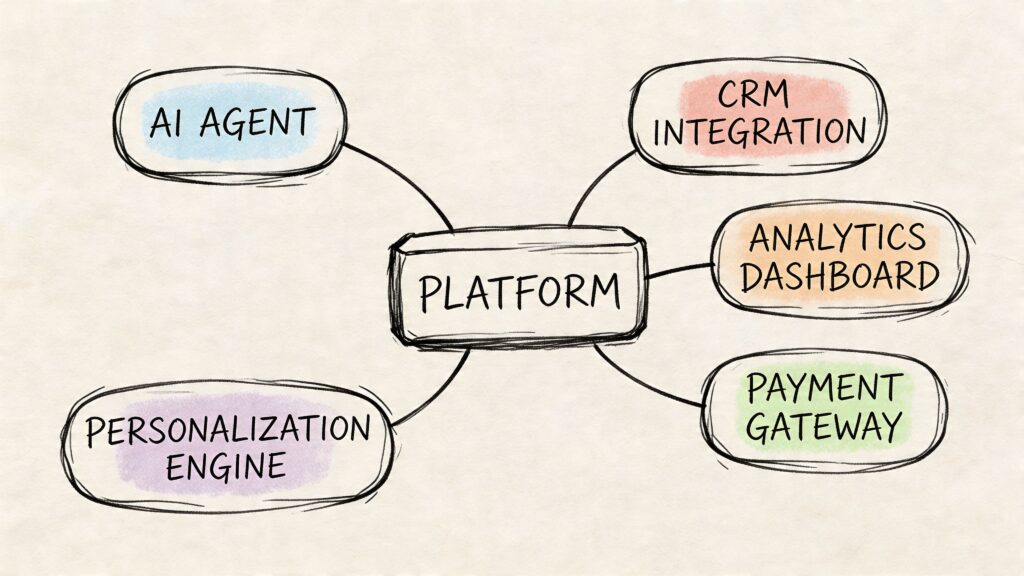
The integration layer is where the platform becomes operationally valuable. According to Nomtek’s analysis of conversational AI for ecommerce, platforms with 50+ native or Zapier-style integrations can achieve 3-4x faster lead qualification. The same analysis highlights analytics targets such as intent resolution above 90% and cart recovery up to 40% via proactive messaging.
Those aren’t vanity metrics. They tell you whether the platform is helping people move forward or just generating chat volume.
A practical shortlist should include:
- Commerce integrations: Shopify, WooCommerce, payment tools, and order systems
- CRM sync: To push lead data and conversation outcomes into follow-up workflows
- Analytics dashboards: To track drop-offs, flow completion, intent resolution, and conversions
- A/B testing: To compare prompts, message timing, offers, and button structures
For teams assessing implementation styles, examples from agencies building AI Chat Bots can be useful because they show how conversational automation gets applied in client delivery, not just software demos.
One platform example in practice
A tool like Clepher fits this model because it includes a drag-and-drop flow builder, AI keyword triggers, segmentation, analytics, A/B testing, and broad app connectivity. Those features are useful only when they’re tied to outcomes like lead capture, sales recovery, onboarding, and campaign targeting.
If a platform can’t connect conversations to the rest of your stack, it becomes one more inbox instead of a growth system.
Real-World Workflows That Drive Sales and Leads
Good conversational commerce doesn’t start with a giant automation map. It starts with one workflow tied to one business outcome.
The highest-performing implementations usually begin where intent is already strong. That means abandoned carts, product questions, quote requests, demo inquiries, application funnels, and appointment booking.
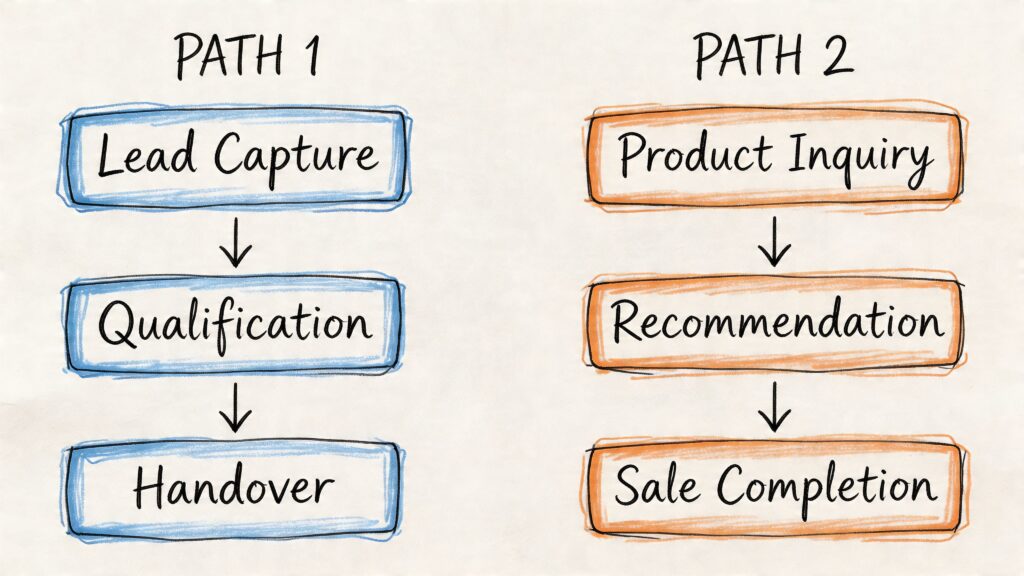
Conversational Commerce Platform Sales Workflow
Workflow one for e-commerce cart recovery on Instagram
A shopper views products, adds one to the cart, then leaves. That doesn’t always mean lost intent. It often means distraction, hesitation, or one unanswered question.
A practical cart recovery flow on Instagram or another messaging channel looks like this:
-
Trigger the flow
The trigger comes from cart abandonment behavior or a user who clicked through from a campaign and stopped before checkout completion.
-
Wait briefly before the first message
You don’t want the message to feel aggressive. The goal is to reopen the buying conversation while the product is still top of mind.
-
Send a helpful reminder
The best first message isn’t pushy. It acknowledges the unfinished order and offers help.
Example:
- Reminder message: “You left something in your cart. Want the checkout link or have a quick question before you finish?”
- Quick replies: “Return to checkout” / “Ask a question.”
-
Handle objection paths
Conversational design excels over email. If the user asks about shipping, sizing, product fit, or availability, the flow should route them to the right answer or a human handoff.
-
Follow up with a second nudge if needed
If they engage but don’t purchase, a second message can offer reassurance, urgency, or a simple incentive if that fits the brand.
This category matters because businesses with strong integration and analytics layers can recover carts through proactive interventions informed by conversation data. If you want to see how platforms apply this specifically for stores, Clepher outlines that use case on its conversational AI for e-commerce page.
What makes that flow work
The message is only one part of the system. The rest is orchestration.
What works:
- Fast path back to checkout: Don’t make the customer search again.
- Question handling inside the flow: Let them resolve doubt without leaving chat.
- Clear buttons: Reduce typing effort.
- Segment tagging: Mark users by objection type for future campaigns.
What doesn’t work:
- Generic “you forgot something” blasts: They feel robotic and often ignore the reason for hesitation.
- Too many follow-ups: Recovery quickly turns into annoyance.
- No live escalation path: Some buyers need a person for the final push.
A simple walkthrough helps visualize how these conversations can be structured in practice:
Workflow two for agencies, coaches, and service businesses
Lead qualification is where many businesses waste the most time. Every inquiry gets the same response, the team chases weak leads, and scheduling becomes a bottleneck.
A better workflow turns chat into a screening layer.
A practical qualification sequence
A website visitor opens chat after reading a service page. The platform can ask a short sequence, such as:
- Service interest: What are you looking for help with?
- Timeline: How soon do you want to start?
- Business type or use case: Useful for routing to the right offer
- Budget range or readiness indicator: To separate active buyers from early researchers
Based on those answers, the system can tag the lead, assign a segment, and choose the next action.
That next action might be:
| Lead type | Next step |
|---|---|
| High intent | Offer a booking link or calendar handoff |
| Needs nurturing | Send a resource, case example, or follow-up sequence |
| Poor fit | Route to a lighter offer, FAQ path, or contact form |
| Urgent support | Escalate to a human |
Why this workflow saves so much time
The team doesn’t need to manually ask the same qualifying questions all day. Sales calls become cleaner because the basics are already collected. Agencies can use the same core structure across multiple clients and customize only the branches, offers, and tags.
A strong qualification flow should filter, route, and prepare the handoff. It shouldn’t just capture a name and email.
The common mistake is overbuilding. Businesses often try to collect everything upfront. In reality, a short path usually converts better than a long interrogation. Ask only what changes the next step.
How to Choose and Implement Your Platform
Choosing a conversational commerce platform isn’t about ticking off the biggest feature list. It’s about finding the system your team will use, trust, and improve over time.
Some tools look impressive in demos and fall apart in daily operations. Others look simple but fit neatly into the way your team already sells and supports customers.
The evaluation checklist that matters
Start with fit, not novelty.
Ask these questions before you commit:
-
Can non-technical teams build and edit flows?
If every change requires outside help, momentum dies fast. -
Does it support the channels your customers already use?
Website chat alone may be enough for some businesses. Social-first brands usually need Instagram, Messenger, or WhatsApp support as well. -
Can it connect to your stack cleanly?
Product data, lead records, order details, customer status, and campaign tags should move without manual copying. -
Are analytics tied to decisions?
You need to see where users drop off, which paths convert, and when human handoffs happen. -
How does it handle governance?
This is the point many teams skip. According to Insider One’s review of conversational commerce platforms, failures often come from unclear rules around bot authority, consent logging, and human handoffs, not poor UX.
That last point deserves extra attention.
Governance is not a legal footnote
When a bot moves from answering to acting, the stakes rise. Changing an order, applying an exception, sending an offer, updating customer data, or escalating a dispute all require clear boundaries.
You need defined rules for:
- What the bot can answer
- What the bot can recommend
- What the bot can change or submit
- When a human must take over
- How consent and interaction history are logged
If you’re handling support and sales in one place, this becomes even more important. A connected workspace such as Clepher’s CRM and ticketing system is useful when it helps teams see the customer record, the conversation context, and the handoff trail in one flow.
The safest automation is the one with clear boundaries, visible logs, and an obvious path to a human.
A simple implementation path
Most businesses should launch with one narrow use case first.
Step one define the first goal
Pick a problem that is already costing money or time.
Good starting points include:
- Abandoned cart recovery
- Lead qualification
- FAQ deflection for repetitive support
- Post-purchase order updates
- Appointment booking
Avoid broad goals like “improve engagement.” Choose something the team can observe directly in sales, service load, or response speed.
Step two build one high-impact flow
Map the shortest useful conversation.
Don’t try to automate every edge case on day one. Build the main path, the common objections, and the human handoff. Include tags and fields so the data becomes usable later.
A practical first workflow usually needs:
| Component | Why it matters |
|---|---|
| Entry trigger | Defines who enters and when |
| Primary prompt | Starts the conversation with clarity |
| Branch logic | Handles the most common reply paths |
| Capture fields | Stores key details for follow-up |
| Escalation rule | Protects customer experience when automation isn’t enough |
Step three launch and iterate
Once the flow is live, don’t judge it by whether it feels clever. Judge it by whether users progress.
Review transcripts, drop-off points, repeated objections, and handoff reasons. Tighten prompts. Remove unnecessary questions. Test different buttons and timing. Keep the workflow useful, not elaborate.
That discipline is what turns a conversational commerce platform into an operating advantage instead of a forgotten automation project.
Conversational Commerce Frequently Asked Questions
Is a conversational commerce platform only for large enterprises
No. Smaller brands often benefit faster because they have less room for slow response times and manual lead handling. A lean team can use chat automation to stay responsive across site and social channels without adding headcount immediately.
The key is choosing a platform that doesn’t require heavy technical setup for every change.
How is this different from the free chatbot on my website
A basic chatbot usually handles a narrow FAQ script. A conversational commerce platform does more. It can route people by intent, store lead data, personalize replies, trigger follow-ups, and connect to other business systems.
The practical difference is outcome. A simple bot answers. A platform can answer, qualify, recover, tag, escalate, and continue the journey.
How much time does it take to manage
Initial setup takes focused work because someone has to define flows, handoff rules, and message logic. Ongoing management is usually lighter than the manual work it replaces.
Teams spend their time reviewing conversations, improving prompts, updating flows, and adjusting campaigns instead of answering the same repetitive questions all day.
Which businesses get the most value first
Businesses with repeat questions, longer buying cycles, or strong social and website traffic usually see value quickly.
That includes:
- E-commerce brands: Product questions, cart recovery, order support
- Agencies: Lead qualification, client campaign automation, inbox triage
- Coaches and creators: DM funnels, application screening, booking flows
- SaaS teams: Onboarding prompts, support deflection, trial conversion guidance
- Local businesses: Promotions, lead capture, appointment requests
Do customers get frustrated talking to bots
They do when the bot is vague, repetitive, or blocks access to a human. They usually don’t when the conversation is fast, relevant, and helpful.
The standard should be simple. If the bot can solve the issue cleanly, automate it. If the issue is sensitive, unusual, or high-stakes, hand it off quickly.
What’s the biggest implementation mistake
Trying to automate everything at once.
The businesses that get traction usually start with one commercially important flow, prove it works, then expand from there. That’s easier to manage, easier to measure, and much easier for the team to trust.
Your Next Conversation Is Your Next Sale
A conversational commerce platform works best when you treat it like part of your revenue system, not a chatbot widget sitting off to the side. The value comes from practical execution. Clear workflows, strong integrations, useful segmentation, measurable analytics, and disciplined handoffs.
The opportunity is straightforward. Buyers already ask questions in chat. They already hesitate, compare, and abandon. A better conversational setup gives them a faster path to clarity and gives your team a more scalable way to sell and support.
Start small. Pick one workflow that affects revenue or response load. Launch it. Review what people say. Improve from there.
If you’re ready to turn website visitors, social DMs, and support conversations into structured sales and lead workflows, Clepher is one option to explore. It gives teams a no-code way to build conversational flows across web chat, Facebook, Messenger, WhatsApp, and Instagram DM, with segmentation, analytics, and integrations that support real operating use cases instead of one-off bot experiments.
Related Posts
Customer Journey Automation: The Practical Guide
October 10, 2026Lead Qualification Marketing: A Practical 2026 Guide
October 9, 2026Customer Experience Optimization Playbook
October 8, 2026
Founder Clepher