
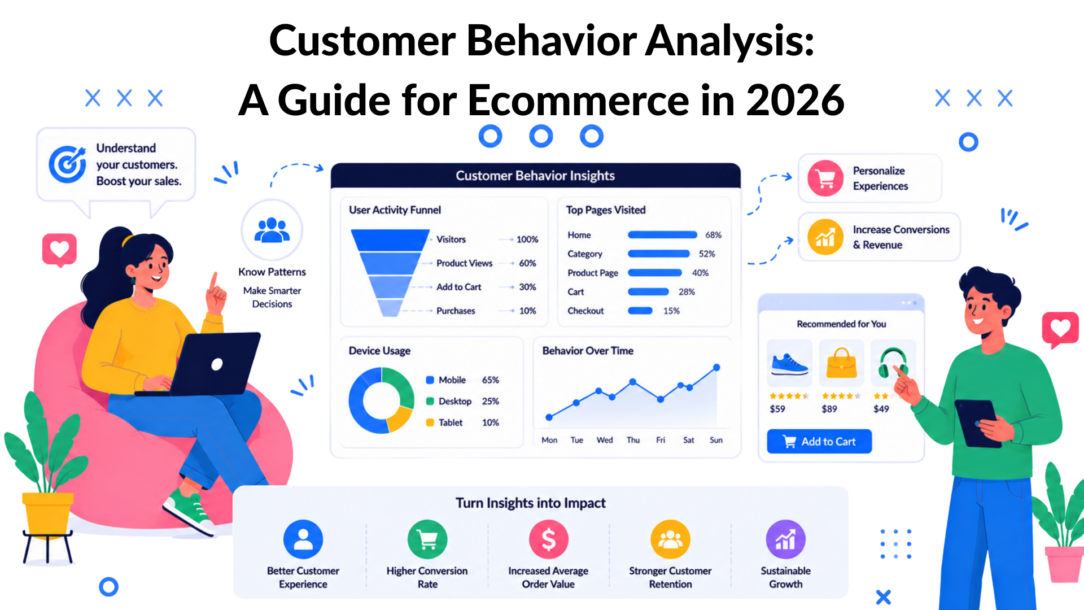
Most brands already collect more customer data than they can use. The problem isn’t volume. It’s that they still read behavior in fragments: web analytics in one tab, purchase history in another, support conversations somewhere else, and chat logs ignored entirely.
That leaves money on the table.
Customer behavior analysis becomes useful when it stops being a reporting exercise and starts answering commercial questions. Why do first-time visitors ask about shipping but never buy? Why do repeat customers return through Instagram DMs instead of email? Why does a chatbot complete one product recommendation flow but lose people when it asks for size or budget?
Those are revenue questions. They sit much closer to sales, retention, and customer lifetime value than a generic dashboard ever will.
Why Customer Behavior Is Your Biggest Untapped Asset
Organizations often have ample data. What they lack is decision-ready insight.
A store can see traffic sources, session duration, bounce rates, conversion funnels, purchase history, order frequency, social activity, and customer service interactions. Qualtrics notes that effective customer behavior analysis can pull from all of those sources across the full journey, not only at the moment of sale, which is why it has become an operational discipline for optimizing marketing, product updates, loyalty, and support (Qualtrics on customer behavior analysis).
That matters because broad averages hide buying intent. A visitor who lands on a product page, opens chat, asks about returns, leaves, and comes back through WhatsApp is telling you something far more useful than a demographic profile ever could.
Why behavior beats assumptions
Demographics tell you who might buy.
Behavior shows you who is trying to buy, who is confused, who is hesitating, and who is ready for a push.
In e-commerce, that difference changes how you spend your budget and how you design experiences. If you rely only on pageviews and age brackets, you’ll optimize for traffic. If you study behavior, you’ll optimize for outcomes like checkout completion, repeat purchase, and lower support friction.
Strong data analysis helps teams understand customer behaviour and align experiences with customer needs. When you personalize based on intent signals, you improve the overall customer experience and drive higher customer satisfaction. Listening to customer feedback ensures that every adjustment resonates with buyers, turning engagement into measurable outcomes instead of vanity metrics.
For conversational channels, this gets even sharper. A chat transcript often reveals intent faster than a clickstream does. Someone typing “does this work for sensitive skin?” or “can I pay later?” is giving you direct buying context. That’s one reason personalization works best when it’s built on observed behavior instead of static audience labels. If you want a practical view of how that plays out in campaigns, this guide to personalization in digital marketing is a useful companion.
Practical rule: If a team can’t connect behavior to a business action, they don’t have insight yet. They just have data storage.
Where brands usually miss the opportunity
The blind spot is simple. Most companies analyze the website and ignore the conversation around the website.
They know which page a customer viewed, but not the question that blocked the purchase. They know a cart was abandoned, but not that the shopper asked if delivery would arrive before the weekend. They know support volume has increased, but not that the same objections keep showing up before checkout.
That’s why customer behaviour analysis is still underused. The biggest gains often come from combining web signals with message‑level context. Done right, this enables personalized marketing that speaks directly to intent, helps you identify customer needs in real time, and ensures you improve the customer journey instead of just optimizing traffic.
Looking ahead, these insights shape the future customer experience. By blending customer feedback with behavioral signals, teams can design smarter marketing strategies that reduce friction, recover lost sales, and build loyalty at scale.
What Is Customer Behavior Analysis Really
Customer behavior analysis is the practice of piecing together digital clues to understand how customers make decisions.
Think like a detective. A single clue rarely solves the case. One click on a pricing page means very little by itself. But when that click appears next to a product comparison, a chatbot question, a repeat visit, and a purchase two days later, the pattern becomes useful. You stop guessing. You start seeing intent.
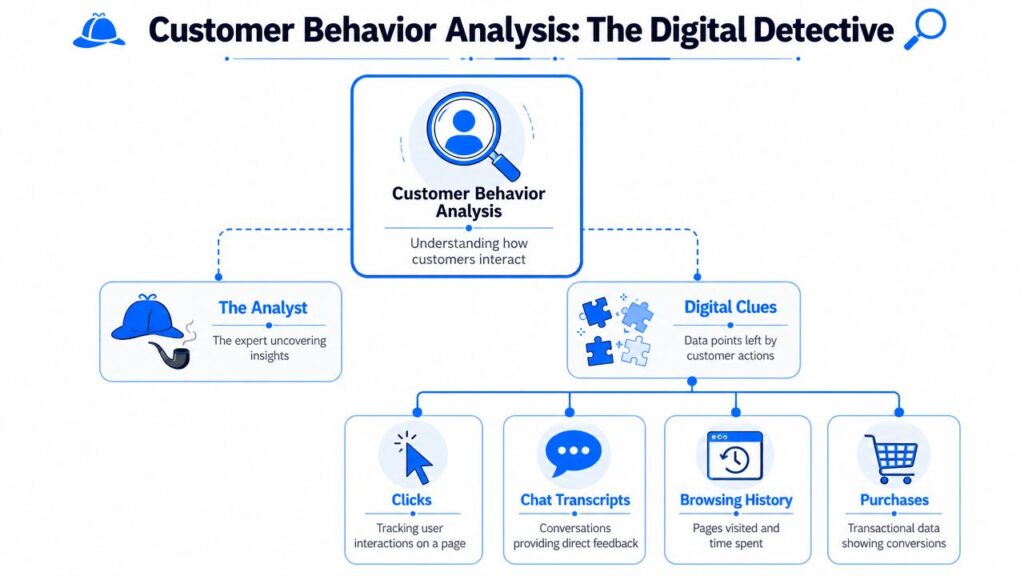
Customer Behavior Analysis Data Tracking
From static profiles to live behavior
A lot of bad analysis starts with the wrong unit of thinking. Teams ask, “Who is this customer?” when they should ask, “What is this customer doing, and what does that behavior suggest?”
That shift has deep roots. A foundational milestone came in the 1950s, when market segmentation became a serious marketing practice. By 1956, Wendell Smith argued that companies should divide heterogeneous markets into distinct groups instead of treating all buyers the same. That idea became the basis of modern customer behavior analysis, which later expanded from survey-based segmentation into tracking click paths, funnel drop-offs, repeat purchases, and support interactions across channels (Glassbox on the history and evolution of customer behavior analysis).
The modern version is far more dynamic. It doesn’t stop at segment labels. It watches what people do.
What the analysis includes in practice
A useful analysis usually combines signals like:
- Behavioral actions: page visits, product views, checkout steps, returns, and repeat purchases
- Conversational signals: chatbot transcripts, FAQ requests, support objections, and handoff moments to human agents
- Journey context: where the customer came from, what device they used, and which stage of the lifecycle they’re in
- Feedback clues: direct complaints, post-purchase comments, and answers to survey prompts
On a website, this tells you where interest builds or leaks.
Inside chat, it tells you why.
A product page may tell you that shoppers stall. A chat transcript often tells you what stalled them.
Why this matters in conversational commerce
Messaging changes the depth of the data.
A website session can imply intent. A conversation can expose it. When a customer says, “I’m between two plans,” “I need this for a gift,” or “Will this integrate with Shopify?” they’re moving from anonymous behavior to explainable behavior.
That makes chatbot and messaging data unusually valuable. It captures hesitation, urgency, objections, preference language, and readiness to buy in the customer’s own words. Used well, it helps marketers tune offers, route conversations, improve product pages, and recover lost sales without sounding robotic.
Customer behaviour analysis, done properly, is not a dashboard category. It’s a way to read buying decisions with enough context to influence them. A practical guide to customer behaviour analysis shows how to connect intent signals with action. Modern customer behaviour analytics tools make this scalable, while strong customer relationship practices ensure that insights translate into trust, loyalty, and measurable outcomes.
Key Data Sources and Metrics You Should Track
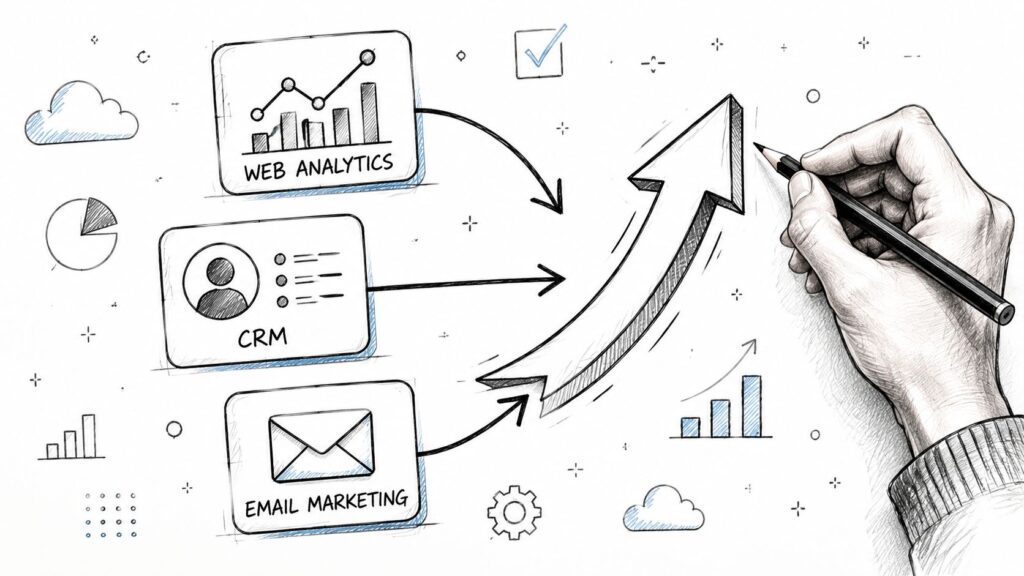
Stores usually have no shortage of customer data. The problem is that the data sits in separate systems, so teams see website behavior in one place, orders in another, and chat logs somewhere else. That split hides revenue opportunities.
The fix is simple. Track three layers together: browsing behavior, transaction behavior, and conversation behavior. Website analytics shows where attention goes. Orders show what converted. Chat and messaging data show what nearly blocked the sale, what reassured the buyer, and what questions repeat often enough to justify a page change, offer change, or bot flow change.
A strong customer behaviour analysis tool helps unify these signals. By combining customer interactions across channels, you can improve the customer experience and reduce friction. Adding sentiment analysis sharpens the picture, showing not just what customers do but how they feel. Mapping the types of customer behaviour — from hesitant browsers to loyal repeat buyers — turns scattered data into actionable insights that drive retention and revenue.
The data sources that matter most
For ecommerce and conversational commerce, start with these sources:
- Website and app analytics: landing pages, product views, add-to-cart actions, checkout starts, exits, and return visits
- Order data: first purchase date, average order value, repeat purchase timing, refund rate, and product mix
- Chatbot and live chat logs: entry points, clicked replies, free-text questions, fallback responses, handoff requests, and conversation outcomes
- Customer support data: ticket themes, resolution reasons, delivery complaints, billing issues, and pre-sale versus post-sale questions
- CRM and lifecycle data: subscriber status, campaign engagement, customer tier, and time since last purchase
- On-site search data: terms searched, zero-result queries, and searches that lead to a purchase
- Survey and review text: satisfaction comments, product objections, and language customers use to describe value or frustration
Used together, these sources show more than movement. They show motive.
A shopper who views the same product twice and then asks, “Will this fit a small apartment?” is giving you better buying-intent data than pageviews alone ever could.
Metrics that tie behavior to revenue
Track metrics in a way that helps you make a decision, not fill a dashboard.
Acquisition and entry metrics
- Traffic source quality: which channels bring buyers, not just visitors
- Landing page bounce rate: where message match breaks
- New visitor versus returning visitor conversion rate: whether your first impression works or your remarketing does the heavy lifting
Product and purchase metrics
- Product view to add-to-cart rate: whether interest turns into action
- Cart abandonment rate: where intent stalls
- Checkout completion rate: whether checkout friction is killing demand
- Average order value: whether merchandising, bundles, or bot recommendations increase basket size
- Repeat purchase rate: whether the first sale is turning into retention
- Refund or return rate by product: whether the sale was high quality
Conversation and chatbot metrics
- Chat open rate on key pages: where customers feel uncertainty
- Suggested reply click rate: whether prompts match real intent
- Fallback rate: how often the bot fails to answer the question
- Human handoff rate: where automation stops being useful
- Conversation-to-product-click rate: whether chats move people back into the buying flow
- Conversation-assisted conversion rate: how often a chat session influences a sale
- Time to resolution: whether messaging removes friction fast enough to save the purchase
If you run Shopify, clean event tracking matters more than fancy reporting. A practical reference is mastering Google Analytics 4 on Shopify, especially if you need to connect storefront events with chatbot interactions and purchase outcomes.
How to read these metrics without fooling yourself
Single metrics rarely answer the core question.
A long session can mean strong interest, but it can also mean confusion. High chat volume can signal healthy engagement, or it can mean the product page is missing basic information. A high handoff rate may point to valuable high-intent leads, or it may mean the bot is failing on simple objections that should have been automated.
Read the signals in combinations:
- High product views plus high pre-purchase chat volume: product interest is real, but buyers still need reassurance
- High add-to-cart rate plus low checkout completion: the offer works, but checkout friction or hidden costs are blocking revenue
- High chatbot open rate plus high fallback rate: customers have questions, but the bot is not answering the ones that matter
- Repeat visits plus repeated comparison questions: buyers are evaluating seriously and need sharper differentiation
- Low conversation length plus high assisted conversion: the bot is doing its job quickly
That last pattern matters. In many stores, the best bot conversation is short, specific, and directly tied to a purchase.
Where conversational commerce adds an edge
Website analytics can show that a shopper dropped off on a pricing page. Messaging data can show why. Maybe they asked about shipping times, compatibility, return terms, or whether a product works for a specific use case.
Those details help teams make better growth decisions:
- Rewrite product copy around common objections
- Trigger the bot earlier on pages with high hesitation
- Add comparison answers for shoppers choosing between products
- Route high-intent questions to sales instead of support
- Build retention flows around post-purchase confusion before it becomes a refund
For cleaner attribution across those touchpoints, it helps to know how to track website visitors across sessions and behavior signals so site data and messaging data describe the same customer journey.
If customers ask the same question before buying, fix the page, the offer, or the bot flow. Do not treat it as isolated support noise.
The metric mistake to avoid
Do not reward activity that does not change business results.
A chatbot with a high open rate and low assisted conversion may be attracting attention without helping people buy. A support inbox full of pre-sale questions may look like engagement, but it often points to missing product information. More messages are not automatically better. Better messages are better.
Track the behaviors that improve conversion rate, average order value, repeat purchase rate, or resolution speed. The rest is background noise.
Core Methods for Analyzing Customer Behavior
Methods matter because each one answers a different type of business question. Use the wrong method and you’ll get noise. Use the right one and patterns become obvious.
Jimdo notes that a strong customer behavior analysis stack should unify event-level data across touchpoints, and that segmenting by device type, acquisition channel, or lifecycle stage exposes materially different patterns. It also highlights methods such as cohort analysis and customer journey mapping for turning interaction logs into actionable signals like purchase propensity and churn likelihood (Jimdo on customer behavior analysis methods).
Segmentation
Segmentation is grouping customers by a trait that matters to the problem in front of you.
That trait could be an acquisition channel, first-time versus repeat status, mobile versus desktop, product category interest, or chat behavior. In conversational commerce, one useful split is “asked a question before buying” versus “bought without asking.”
That alone can tell you a lot. The first group may need reassurance and education. The second group may respond better to speed and convenience.
Funnel analysis
Funnel analysis is leak detection.
You map the path from entry to conversion and inspect where people disappear. On a site, that may mean product page to cart to checkout to purchase. In a chatbot, it may mean welcome message to category selection to product recommendation to click-out.
What works is narrowing the question. Don’t ask, “Why is conversion down?” Ask, “Where in the purchase path do shoppers stop moving?”
RFM analysis
RFM stands for recency, frequency, and monetary value. It’s a practical way to identify your best customers and the ones starting to cool off.
In ecommerce, this is one of the cleanest ways to decide who should receive:
- a replenishment reminder
- an upsell
- early access to a launch
- a win-back message
In messaging, RFM becomes even more powerful when paired with conversational behavior. A recent, frequent buyer who also clicks recommendation flows is very different from a lapsed customer who opens messages but never engages.
Cohort analysis
Cohort analysis looks at how groups behave over time.
A cohort might be “customers acquired from Instagram in spring,” “users who started onboarding last month,” or “buyers who used the chatbot before their first purchase.” This is how you avoid mixing unlike users into one average.
Cohorts help answer questions such as whether a new onboarding sequence improved retention, or whether one acquisition source brings customers who buy once and vanish.
Field note: Cohorts are where you catch delayed problems. A campaign can look good at purchase and still bring weak repeat behavior later.
Customer journey mapping
Journey mapping turns scattered actions into a sequence you can inspect.
For ecommerce, that sequence may span ad click, landing page, category page, product detail, chat question, cart, checkout, post-purchase follow-up, and repeat order. For SaaS, it may move from sign-up to onboarding to support conversation to upgrade prompt.
This method is especially valuable when chat and website behavior interact. A customer may browse, ask one question in WhatsApp, come back direct, and convert on desktop. Journey mapping stops those touchpoints from being analyzed in isolation.
Comparison of Customer Behavior Analysis Methods
| Method | What It Is | Best For Answering… | Example Question |
|---|---|---|---|
| Segmentation | Grouping customers by shared traits or behaviors | Which groups behave differently? | Do mobile shoppers who ask pre-purchase questions convert differently from desktop shoppers who don’t? |
| Funnel analysis | Measuring movement through a defined path | Where are we losing people? | At what step in the chatbot recommendation flow do shoppers stop? |
| RFM analysis | Ranking customers by recency, frequency, and monetary value | Who deserves retention or upsell attention? | Which buyers should get a high-intent product launch message first? |
| Cohort analysis | Comparing groups over time | How does behavior change after acquisition or onboarding? | Do customers acquired through conversational channels return more reliably? |
| Customer journey mapping | Visualizing the end-to-end path across touchpoints | How do channels interact before conversion? | What usually happens before a support chat leads to a sale? |
What works and what doesn’t
What works is choosing the method that matches the decision.
What doesn’t work is throwing every report at the same problem. If retention is slipping, a funnel won’t tell you everything. If checkout is leaking, a broad segment report won’t fix it. Good analysts don’t use more tools. They use the right tool at the right depth.
Your Step-by-Step Process for Running an Analysis
A good analysis follows a loop. Question first. Data second. Test last.
Luth Research points out a major gap in customer behavior analysis: separating true intent from noisy digital behavior. That matters even more as AI-driven personalization becomes standard, and the piece notes that McKinsey reported generative AI adoption in marketing and sales rose sharply in 2024 (Luth Research on underserved aspects of customer behavior analysis).
That’s why the workflow needs discipline. Not every click means interest. Not every chat means buying intent.
Here’s a practical process that keeps teams honest.
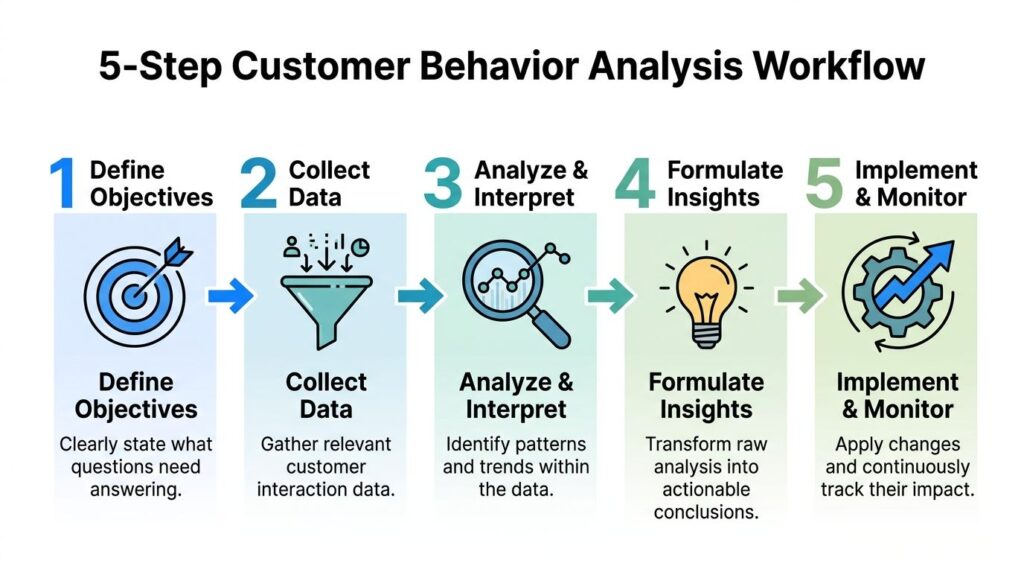
Customer Behavior Analysis Workflow
Step 1: Define one answerable question
Start small enough to act on.
Good questions:
- Why do shoppers ask about shipping right before leaving checkout?
- Which first-time buyers are most likely to come back?
- Where does our product recommendation bot lose momentum?
Bad questions:
- How do customers behave?
- How can we improve experience?
A question should point to a decision someone can make.
Step 2: Pull only the data that fits the question
Don’t dump every possible source into one worksheet.
If you’re studying checkout hesitation, pull cart events, checkout exits, pre-purchase chat transcripts, device type, and traffic source. If you’re studying repeat purchase behavior, pull order frequency, recency, support history, and post-purchase engagement.
This is also where messaging data earns its place. The transcript often contains the missing context.
Step 3: Choose the method that matches the problem
Some examples:
- Use segmentation when one group may behave differently from another.
- Use funnel analysis when movement through a path matters.
- Use cohort analysis when you care about behavior over time.
- Use RFM when you need a retention or reactivation play.
- Use journey mapping when multiple channels influence the same purchase.
Step 4: Separate intent from noise
At this point, many teams go wrong.
A visitor who opens chat may just be exploring. A visitor who asks, “Will this fit a small apartment?” is showing clearer intent. A customer who revisits the same plan page can be either highly interested or utterly confused. Context decides which.
Use a simple filter:
- Repeated product-focused questions suggest active evaluation
- Policy or delivery questions near checkout suggest purchase friction
- Vague top-of-funnel questions suggest research mode
- Bot exits after irrelevant replies suggest experience failure, not low demand
Don’t optimize for the loudest signal. Optimize for the signal closest to the commercial decision.
Step 5: Turn the insight into a test
An analysis that doesn’t produce a test usually dies in a slide deck.
Turn each insight into a hypothesis:
- If shoppers ask about returns on product pages, then a clearer returns message near the add-to-cart button may reduce hesitation.
- If new users stall after the second onboarding step, then a proactive message with one clear action may improve progression.
- If high-value customers respond better to short recommendation flows, then simplify the chatbot path for that segment.
Then test it. Change one thing. Watch the behavior again. Keep what moves the business metric.
Real-World Examples in Conversational Commerce
Conversational commerce creates a cleaner link between behavior and revenue because customers tell you what they need while they’re deciding.
Example 1: Fixing a leaky chatbot funnel
An ecommerce brand noticed that many shoppers started its chatbot product finder but disappeared before clicking through to a product page.
Funnel analysis showed the drop happened right after the bot asked a broad preference question. Transcript review made the issue obvious. Shoppers weren’t confused about the products. They were confused about the wording. The team rewrote the prompt in plain language, added a fast reply for “show me the most popular option,” and inserted a reassurance message for shipping before the click-out.
That’s a classic conversational commerce fix. The bot wasn’t failing because automation is weak. It was failing because the path asked for too much interpretation.
Example 2: Using RFM for targeted direct messages
A course creator wanted to stop sending the same launch message to every follower.
They built a simple RFM-style audience using recent buyers, repeat customers, and people who had recently engaged in DMs. The message to that segment wasn’t generic hype. It acknowledged prior engagement and offered a more relevant next-step product.
Conversational channels particularly shine. A direct message can feel personal without becoming manual. If you’re exploring what more advanced automation looks like in this space, Zinc’s piece on AI agents for ecommerce gives a useful view of how structured agents can support buying flows.
Example 3: Using cohorts to improve onboarding retention
A SaaS company tracked cohorts of new users by onboarding path and saw that one group consistently stalled after setup.
The behavior pattern got clearer once support and WhatsApp conversations were added. New users didn’t dislike the product. They were unsure what to do first. The company responded with a proactive onboarding sequence tied to the user’s stage, focused on one action at a time instead of dumping feature education all at once.
For brands building similar flows across chat, website, and social messaging, a conversational commerce platform helps centralize the interactions so the behavior doesn’t stay trapped in separate tools.
Conversation data is often the shortest path to the customer’s real objection.
Tools and Your Next Steps for Growth
The right stack doesn’t need to be huge. It needs to connect behavior across channels.
A practical stack to start with
- Web analytics: Use Google Analytics 4 for event-level website behavior and funnel monitoring.
- Session and experience tools: Use replay or heatmap tools when the numbers show friction but not the cause.
- Commerce data: Pull order history, repeat purchase patterns, and support interactions into the same review process.
- Messaging and chatbot analytics: Use a platform that shows flow completion, reply choices, handoff moments, tags, and segment behavior. Clepher fits here as one option. It supports chatbot flows, segmentation, live chat, and analytics across the website, Messenger, WhatsApp, and Instagram DM.
- Reporting layer: Keep one operational dashboard for revenue-impact questions, not dozens of vanity charts.
Customer Behavior Analysis Marketing Growth
If you run Shopify and want to compare analytics extensions before adding another tool, this roundup of app store research on Shopify apps can help narrow the field.
What to do this week
Keep the next move simple:
- Pick one business question: Start with a leak, a drop-off, or a retention problem.
- Choose one metric: Use one signal tied to sales or retention.
- Add one qualitative source: Read chat transcripts or support tickets alongside the dashboard.
- Run one test: Rewrite a bot prompt, adjust a page message, or change a handoff point.
- Review the result: Keep learning in short loops.
Customer behavior analysis isn’t a one-time audit. It’s a habit. The teams that build that habit usually stop reacting late and start shaping buyer decisions earlier.
If you want to turn website chats, DMs, and messaging flows into usable customer insight, Clepher gives you one place to build conversations, segment audiences, and analyze how those interactions influence sales and support.

Related Posts
10 Lead Capture Software Tools Compared for 2026
October 18, 2026WhatsApp Chatbot for Ecommerce: A Practical 2026 Guide
October 17, 2026What Is Lead Scoring and How It Drives Real Sales Results
October 16, 2026
Founder Clepher