
Facebook can still be one of the best channels for list growth, but only if you stop treating newsletter acquisition like a generic traffic campaign. The platform reaches 3.070 billion monthly active users worldwide as of 2026 according to Sprout Social’s Facebook stats roundup. That scale changes the question.
The question isn’t whether your audience is on Facebook or Instagram. It’s whether your funnel gives the right people a low-friction reason to subscribe, and whether your tracking tells Meta what a valuable subscriber looks like.
Most brands lose the sale before the welcome email. They run a broad ad, make a weak promise, send the click to a slow page, and hope the form does the rest. That old playbook wastes budget.
A stronger facebook ads newsletter system starts earlier, with offer-market fit, and ends later, with the handoff after the click. That’s where campaigns turn from “we got some leads” into a repeatable growth engine.
Why Most Facebook Newsletter Ads Fail
Most newsletter ads fail because the problem isn’t the ad itself. The funnel is.
Too many teams boost a post, slap “subscribe now” on an image, and expect signups to appear. That approach ignores the size of the opportunity and the precision required to capture it. Facebook’s scale is massive, but scale doesn’t forgive weak messaging or clunky user experience.
If you’re trying to build a facebook ads newsletter funnel, the first mistake is assuming attention equals intent. Someone may stop scrolling because your creative is decent. That doesn’t mean they care enough to open a new tab, wait for a page to load, read a bland opt-in form, and trust you with their email address.
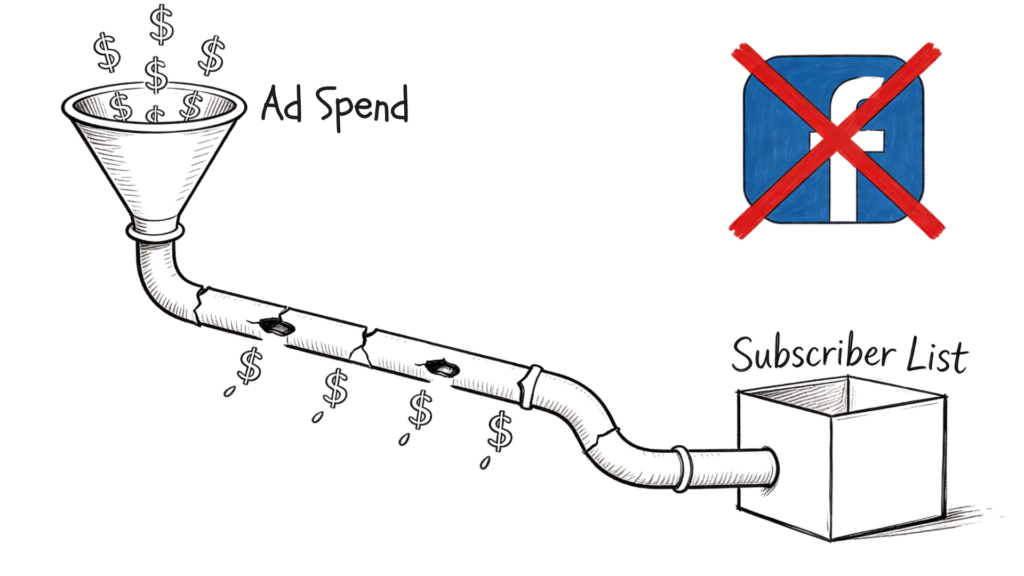
Facebook Ads Newsletter Ad Spend Leak
Where the leak usually happens
The common failure points are predictable:
- Weak offer. “Join our newsletter” is not a compelling reason to act.
- Loose targeting. The audience is broad, but the message isn’t specific enough to filter for the right subscriber.
- Static destination. Generic landing pages create friction, especially on mobile.
- Poor tracking. Meta can’t optimize well if your setup doesn’t pass useful conversion signals.
- No qualification step. You capture emails without learning intent, role, product interest, or timing.
A lot of these issues show up in the same accounts. If you want a practical companion read on that pattern, Sovran’s piece on common mistakes brands make in Facebook Ads is worth your time.
Most “expensive leads” are just mismatched systems. The ad promises one thing, the destination asks for something else, and the follow-up doesn’t continue the conversation.
What actually works
Good newsletter campaigns don’t rely on luck. They align four pieces:
- A clear promise
- Audience-message fit
- Reliable attribution
- A signup experience with minimal friction
When those line up, Meta has something it can optimize. When they don’t, even strong creative gets wasted.
The Strategic Foundation for Newsletter Growth
Before you touch Ads Manager, get three things right. The offer, the subscriber profile, and the tracking layer.
Miss any one of them, and you’ll spend your first weeks diagnosing the wrong problem.
Build an offer people actually want
A newsletter can absolutely be the product. But it still needs a hook.
The best lead magnets don’t feel like generic PDFs. They solve a specific problem, shorten time to value, or package expertise in a form people can use immediately. For ecommerce, that might be a buying guide, product quiz outcome, launch alerts, or a curated insider list. For SaaS, it might be a teardown, template library, onboarding checklist, or short educational sequence.
A useful test is simple. Would your ideal prospect feel slightly annoyed if they missed it?
If the answer is no, strengthen the promise before you spend on traffic.
Here’s a practical way to pressure-test the offer:
- Outcome first. Lead with what changes for the subscriber.
- Speed matters. Fast wins usually convert better than deep but vague education.
- Specific beats broad. “Weekly skincare tips” is weaker than “ingredient breakdowns for acne-prone skin.”
- Match the ad to the asset. If the ad calls out one pain point, the opt-in must continue that exact thread.
If you need inspiration for shaping the value exchange, this Email List Building guide is a useful reference for thinking beyond “sign up for updates.”
Define the subscriber you actually want
A cheap lead that never opens isn’t a win.
For newsletter acquisition, your targeting should start from subscriber quality, not just top-of-funnel curiosity. Build a simple persona around buying relevance. What problem are they trying to solve, what language do they use, what stage are they in, and what would make your emails worth keeping?
I usually map subscribers into three practical groups:
| Subscriber type | What they respond to | Best ad angle |
|---|---|---|
| Problem aware | Relief, clarity, next step | Pain-point hook |
| Solution aware | Comparison, proof, process | Why this newsletter is useful |
| Brand aware | Access, exclusives, updates | Insider benefit or community angle |
This prevents a common mistake. Writing one ad for everyone, then wondering why the click quality feels random.
A strong subscriber persona should include:
- Commercial context. Are they likely buyer, researcher, referrer, or existing customer?
- Intent signal. What behavior suggests they’ll value your emails?
- Content appetite. Do they want tactical advice, product drops, or curated analysis?
- Objection. Why would they hesitate to subscribe right now?
For a hands-on walkthrough of turning that thinking into a real list-building process, see this guide on how to build an email list.
Set up tracking as it matters
This is not optional.
Meta can only optimize based on the data you send back. If your tracking is thin, delayed, or broken across devices, the algorithm gets worse inputs, and your reporting gets noisier. That leads teams to kill good campaigns, scale bad ones, or chase vanity metrics.
The key upgrade is server-side tracking through the Conversions API. According to Cometly’s guide to Facebook Ads optimization with data, implementing server-side event matching by sending detailed user parameters to Facebook’s servers can boost matching quality by up to 20-30%. That matters because newsletter acquisition often includes mobile users, privacy restrictions, and delayed actions.
What to send and why
You don’t need to overcomplicate it, but you do need a clean event strategy.
Focus on events that reflect meaningful progress, such as:
- Lead submitted
- Qualified lead
- Welcome sequence started
- Email confirmed
- Subscriber segmented by interest
Practical rule: If Meta only sees clicks and page views, it will optimize for cheap activity. If it sees qualified subscriber events, it can look for more people likely to complete them.
Also, make sure your naming and definitions are consistent. If one system calls a lead “subscriber” and another calls it “contact created,” reporting becomes messy fast.
Good tracking gives you three advantages. Better attribution, better optimization, and better decisions when performance changes. Without that foundation, creative testing turns into guesswork.
Building Your High-Conversion Ad Campaign
Once the foundation is set, build the campaign around one job. Get the right person to take the next measurable step with as little friction as possible.
That usually means choosing an objective tied to a real conversion event, not a soft engagement metric.
Pick the objective that matches the outcome
For a Facebook ads newsletter campaign, Leads or Conversions are usually the right starting points. The right choice depends on where the signup happens and what event you can reliably track.
If the signup occurs inside Meta’s native flow, Leads can work well. If the user completes the key action on your own property or through a tracked downstream action, Conversions gives you more control over optimization.
The mistake is choosing traffic because it feels safer. Traffic buys visits. It doesn’t tell Meta to find subscribers.
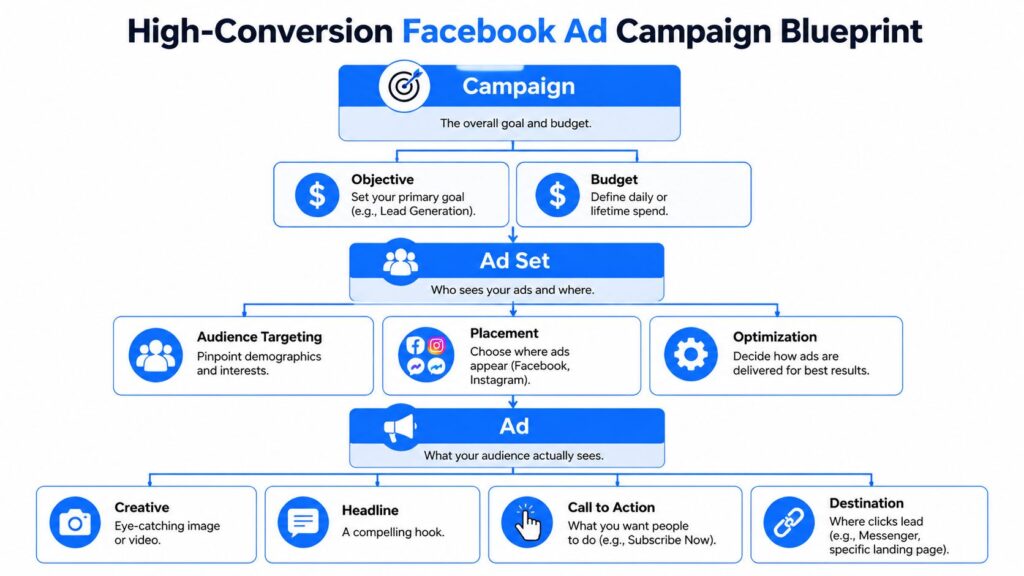
Facebook Ads Newsletter Campaign Blueprint
Structure the account so you can learn fast
You don’t need a sprawling setup. You need a structure that makes it obvious what’s working.
A simple pattern works well:
| Level | What to control | What to avoid |
|---|---|---|
| Campaign | Objective and budget logic | Mixing unrelated goals |
| Ad set | Audience, placement, optimization | Too many tiny audience slices |
| Ad | Hook, creative, CTA, destination | Testing everything at once |
For many accounts, a lean structure beats an “advanced” one. A few clear ad sets with distinct audience logic will teach you more than dozens of overlapping experiments.
Build audiences in layers
Audience strategy should reflect intent, not marketer superstition.
Start with three practical buckets:
- Broad or lightly guided prospecting for discovery
- Seeded audiences, such as lookalikes based on high-quality subscribers or purchasers
- Warm retargeting for people who already showed interest
The reason this works is simple. Different audiences need different messages. Cold users need context. Warm users need a reason to finish what they started.
For analysis after launch, use delivery breakdowns inside Ads Manager. Improvado’s Facebook Ads guide notes that delivery breakdowns by age, gender, and region can uncover gold segments, including examples like 25-34 females in the US driving 40% of conversions at 2x lower CPA. The broader lesson is what matters most. Breakdowns often show that your winner is narrower than your original targeting.
That’s why I rarely trust top-line account averages on their own.
Use creatives that match placement and intent
The ad has one job. Stop the right person and make the next step feel worth it.
A few creative rules hold up across most newsletter campaigns:
- Lead with a single promise. Don’t stack five benefits into the first line.
- Show the asset or experience. Screenshots, issue previews, chat previews, or snippets of value work better than abstract branding.
- Write for the feed. Your copy should feel native to Facebook or Instagram, not like a brochure.
- Align format to placement. Vertical, quick-hit creative often works better in Stories and Reels. Feed placements can carry a bit more explanation.
If you want a deeper tactical reference on that side, this guide on create Facebook ads that convert is useful.
Ad copy formulas that pull qualified clicks
Good newsletter copy doesn’t just attract clicks. It filters for fit.
Try these frameworks:
-
Problem to payoff
Call out the pain, then show what the newsletter helps the reader do next. -
Preview to curiosity
Show a slice of the value. A checklist item, a chart snippet, a strong subject line, a product drop alert. -
Identity to belonging
This works well for niche communities. Speak to the role or mindset of the subscriber.
Examples of stronger angles:
- For a skincare brand, focus on ingredient education and routine mistakes.
- For a DTC coffee brand, focus on early access, brew guidance, and limited releases.
- For a SaaS newsletter, focus on practical operator insights instead of “company news.”
A high CTR is nice. A high CTR from the wrong people creates expensive disappointment later.
What to test first
Don’t test ten variables at once. You’ll get noise, not insight.
Start with these in order:
- Offer angle
- Creative format
- Audience type
- CTA wording
- Destination experience
Keep one thing stable while changing another. Otherwise, you won’t know whether the new result came from the message, the audience, or the destination.
The best campaigns usually become obvious through pattern recognition. One promise keeps attracting better clicks. One audience keeps producing stronger downstream behavior. One creative keeps holding attention across placements. Build around that.
The Conversational Handoff That Turns Clicks into Subscribers
The biggest drop-off in most newsletter funnels happens after the click.
That’s the part many advertisers ignore because they’re still thinking in landing pages. But if your ad wins the click and your destination creates friction, your campaign is already leaking.
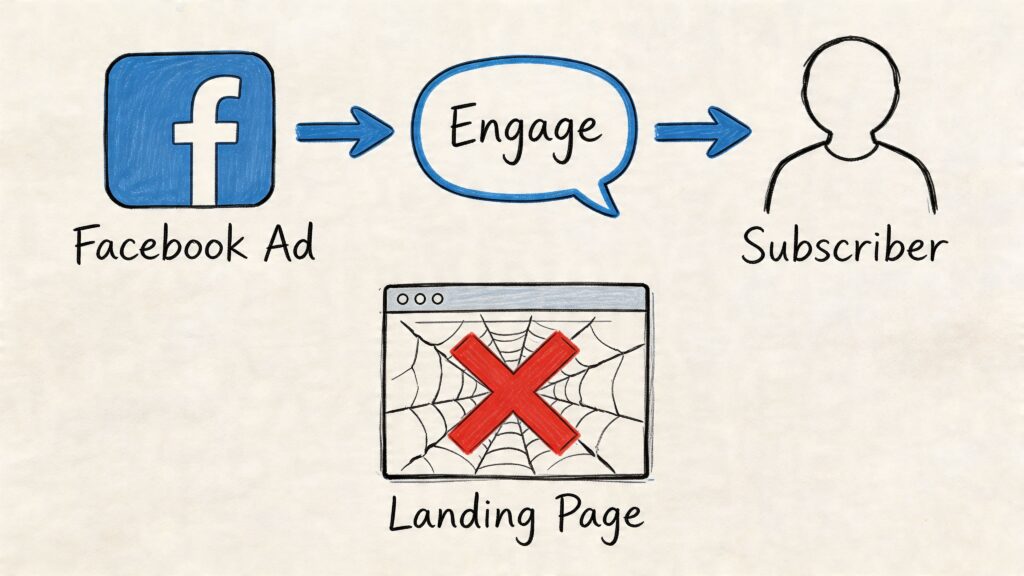
Facebook Ads Newsletter Engagement Diagram
Why static pages lose people
A traditional opt-in page asks the user to switch context. New page, new layout, new trust decision.
That can still work, especially if the page is fast and tightly aligned to the ad. But in practice, many newsletter landing pages are overloaded. They repeat generic brand language, ask for too much information, and feel disconnected from the ad that generated the click.
Facebook Lead Ads reduce some of that friction because the form stays native. They’re useful when speed matters and the offer is simple. The trade-off is that they can produce leads with less intent, and the experience still feels transactional.
A conversation in Messenger or Instagram DM changes the interaction. Instead of dropping users into a form, you continue the momentum of the click.
Comparing the three common destinations
| Destination | Strength | Trade-off |
|---|---|---|
| Landing page | Full control over branding and tracking | More friction, especially on mobile |
| Lead Ad form | Native experience and quick capture | Less context, can reduce lead quality |
| Messenger or Instagram DM | Interactive, contextual, easy to qualify | Requires good flow design |
The reason conversational handoffs work is simple. They feel like a response, not a redirect.
Local Media’s article on newsletter acquisition with Facebook ads cites 35% higher engagement from interactive Messenger handoffs versus static sign-up forms, and notes that AI-driven conversational flows can lead to 25-40% better conversion rates in ecommerce DTC campaigns. That lines up with what many operators see in practice. When the destination feels interactive and relevant, more users keep moving.
What a good chat handoff looks like
A strong conversational flow is short, useful, and clear about the next step.
For example, if someone clicks an ad for a skincare newsletter, the flow might do this:
- Confirm the promise from the ad
- Ask one quick qualifier, such as skin concern
- Offer the relevant content track
- Capture the email naturally inside the conversation
- Tag the subscriber for follow-up
That does two jobs at once. It collects the lead, and it improves future messaging because you know something about the person.
Bad conversational flows make the same mistake as bad landing pages. Too much friction, too many questions, and no immediate value.
Keep the first exchange tight. If the user has to “work” before receiving value, completion drops.
Where AI chat flows help
The advantage of an AI-assisted handoff isn’t novelty. It’s responsiveness.
Inside Messenger or Instagram DM, the system can greet the user immediately, answer basic questions, branch based on intent, and route the person into the right newsletter segment without asking them to fill out a cold form. That’s particularly useful for ecommerce brands with multiple product categories, agencies qualifying service interest, or creators sorting subscribers by topic.
This is also where conversational funnels become more than list growth. They become segmented at the point of capture.
A well-built DM flow can:
- Capture the email without forcing a page load
- Qualify intent with one or two lightweight questions
- Apply tags based on answers
- Sync subscriber data into your email platform
- Start the right welcome sequence based on stated interest
Later in the funnel, this walkthrough on click to Messenger ads is a good reference if you want to see how these ad-to-chat flows are typically structured.
What works better than the old landing-page mindset
The strongest conversational newsletter funnels share a few traits:
- The first message matches the ad
- The user gets value before too many questions
- Email capture feels like a natural next step
- Segmentation happens in the background
- Follow-up begins immediately
For a fashion brand, that might mean asking whether the user wants new arrivals, styling advice, or sale alerts. For a course creator, it might mean identifying beginner versus advanced interests. For a SaaS company, it might mean sorting by use case before the email sequence starts.
This is why the conversational approach matters. It doesn’t just improve conversion flow. It improves list quality and downstream personalization from the first interaction.
How to Optimize and Scale Your Newsletter Funnel
Launching is easy. Knowing what to change next is where many get stuck.
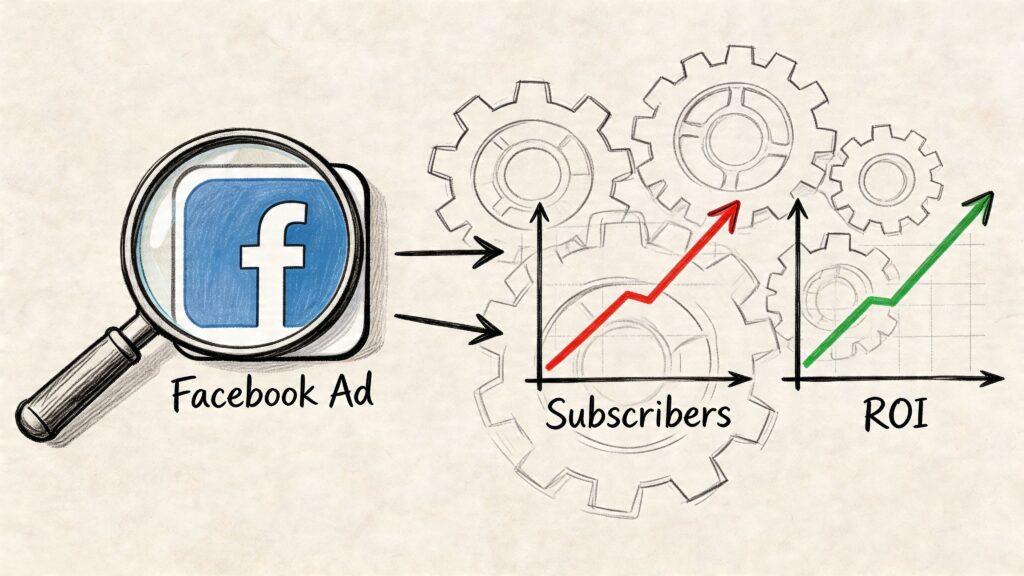
The simplest way to optimize a facebook ads newsletter funnel is to stop treating all leads as equal and start reading the account in layers. Start with click quality, then signup quality, then post-signup behavior.
Facebook Ads Newsletter Facebook Marketing
Benchmarks that help you diagnose faster
Benchmarks don’t replace context, but they give you a starting point. According to KlientBoost’s roundup of Facebook Ads statistics, the average conversion rate for lead generation campaigns is 7.72%, and the average CTR for these campaigns is 2.59%.
Use those as directional markers, not universal truths.
If your CTR is well below that lead-campaign average, the issue often sits in the hook, creative, or audience-message fit. If CTR is healthy but the conversion rate is weak, the problem usually shows up after the click. That’s where the destination, handoff, or signup experience needs work.
The metrics that matter most
I watch these in combination:
| Metric | What it tells you | Common issue when weak |
|---|---|---|
| CTR | Whether the ad earns attention and relevance | Poor hook or wrong audience |
| Conversion rate | Whether the destination completes the job | Friction after the click |
| Cost per lead | Whether the acquisition is efficient | Any bottleneck in the chain |
| Frequency | Whether the audience is tiring of the ad | Creative fatigue |
No single metric should drive decisions alone. A cheap lead with poor downstream engagement can be worse than a more expensive lead that opens, clicks, and buys later.
A practical testing rhythm
Most underperforming accounts don’t need more complexity. They need more disciplined testing.
Use a simple order of operations:
-
Test the offer before minor copy tweaks
If the promise is weak, changing the button text won’t save it. -
Change one variable at a time
New audience plus new creative plus new destination gives you no clean learning. -
Separate prospecting from retargeting
These users need different messages and often produce very different economics. -
Review by breakdowns, not only totals
Age, gender, region, and placement data often reveal where efficiency sits. -
Judge the full path
Don’t stop at lead volume. Check welcome email engagement and segment quality.
The fastest way to waste budget is to scale a campaign that only looks good inside Ads Manager.
When to scale and when to cut
Scale when performance is stable, the lead quality holds, and the account keeps converting across multiple days without obvious fatigue. If one ad set consistently brings in the right kind of subscriber and the handoff experience is solid, increase budget gradually and keep the variables stable.
Don’t scale a campaign just because one ad had a good day. That’s how teams lock in randomness.
Cut or rework when you see patterns like these:
- Low CTR across multiple creatives. The message isn’t connecting.
- Good CTR but poor conversion rate. The destination or handoff is failing.
- Lead quality drops after volume rises. The audience got broader than the offer can support.
- Frequency climbs while results soften. The audience has seen enough of that message.
What scaling usually looks like in practice
The cleanest path is often boring:
- Keep the winning offer.
- Refresh the angle or creative presentation.
- Expand audience inputs carefully.
- Protect the post-click experience.
- Maintain fast follow-up in email or DM.
For ecommerce, that can mean moving from one product-led hook into adjacent use cases. For creators, it can mean turning one strong newsletter promise into several segmented entry points. For agencies, it can mean splitting by vertical rather than pushing one generic lead magnet to everyone.
The point is to scale what’s proven, not to reinvent the funnel every week.
Facebook Newsletter Ads FAQ
If you want to build a conversational newsletter funnel instead of sending paid clicks into a dead-end form, Clepher is worth a look. It lets you create AI-powered Messenger and Instagram DM flows that capture emails, qualify leads, tag subscribers, and route people into the right follow-up without heavy technical setup. For brands that want faster handoffs and better list quality, that’s a practical upgrade.
Related Posts
Chat Bot Responses That Convert: A Practical Guide
October 12, 202610 Broadcast Automation Software Platforms Compared
October 11, 2026Customer Journey Automation: The Practical Guide
October 10, 2026
Founder Clepher