
You’ve probably seen this play out: a marketing team spends weeks designing polished buyer persona slides, presents them in a meeting, and then goes back to sending the same generic campaigns. Sales never opens the document. Product never uses the insights. The chatbot still asks every visitor the same question.
That happens because a persona isn’t valuable as a profile alone without understanding the target audience’s motivation. A useful buyer persona is a living revenue asset, built from customer evidence and connected to the tools that shape acquisition, qualification, conversion, onboarding, and retention. The practical question isn’t only who your buyer is. It’s what that buyer says, needs, rejects, and does next.
Why Most Buyer Personas Fail Before They Ship
A marketer at a growing SaaS company once spent three weeks creating four personas. The deck included names, stock photos, job titles, preferred content formats, and detailed demographic descriptions. The launch meeting went well. Then nothing changed.
The paid team didn’t receive new audience definitions. Sales didn’t get qualifying prompts. Customer success didn’t know which objections belonged to which segment. The personas described an audience, but they didn’t help anyone make a decision.
That failure is common because teams treat persona development as a creative deliverable instead of an operating system for revenue. The document becomes the finish line, when it should be the starting point.
The four failure modes
- Research gets skipped: Internal opinions replace CRM records, customer conversations, product usage, and lost-deal analysis. The result sounds plausible but may describe the company’s assumptions rather than the customer’s behavior.
- Demographics carry the profile: Age, location, job title, and company size can help with targeting, but they don’t explain urgency, objections, decision criteria, or the event that makes someone buy.
- Campaigns stay disconnected: A persona that doesn’t change ad creative, landing-page copy, email segmentation, sales scripts, or chatbot questions has no operational value.
- Nobody owns the profile: Without a named owner and a review routine, the persona becomes outdated while the market, product, and buying committee evolve.
Industry benchmarks show why documentation matters. 71% of companies that exceed revenue goals have documented buyer personas, and those companies are reported to be 2.3x more likely to exceed revenue goals than companies without documented personas, according to HubSpot’s buyer persona research.
Practical rule: If a persona doesn’t change a message, audience, question, qualification rule, or product decision, it isn’t finished.
A persona on paper contains traits and narrative. A persona in the toolstack contains fields, tags, audiences, trigger conditions, talk tracks, and owners. The first may help a team empathize. The second helps a team act.
The rest of the workflow should therefore answer three questions: Is the persona evidence-based? Is it current? Can every customer-facing team activate it?
The Data Triangulation Method at the Heart of Persona Research
The strongest workflow combines three forms of evidence: a quantitative baseline, qualitative research, and validation against actual outcomes. Each source answers a different question, and removing one creates a predictable blind spot.
Quantitative data tells you how to better connect with your customer base, or what is happening at scale. Qualitative conversations reveal why it’s happening. Closed-won and closed-lost records show whether the resulting profile matches real commercial behavior.
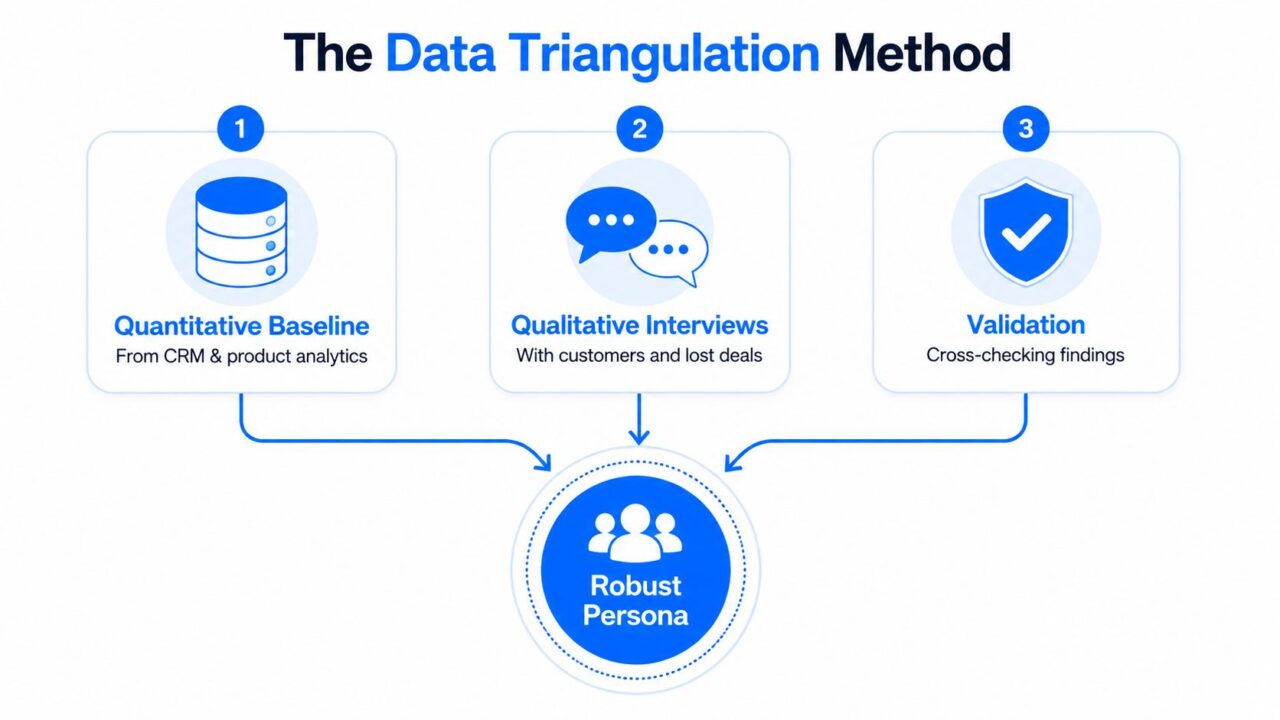
How to Create Buyer Personas Data Triangulation
Start with the quantitative baseline
Export the customer and prospect fields that can reveal meaningful differences:
- CRM records: Source, lifecycle stage, industry, role, geography, deal size, sales cycle, and outcome.
- Product analytics: Activation events, feature usage, frequency of use, plan selection, support activity, and cancellation behavior are crucial for understanding customer persona.
- Commerce data: First purchase, repeat purchase, category preference, discount usage, returns, and customer value.
- Marketing data: Landing-page paths, content engagement, email clicks, ad responses, and chatbot answers.
For a DTC ecommerce brand, Shopify data might show that repeat customers behave differently from first-time discount-driven buyers. Post-purchase surveys can then reveal whether repeat customers care about product performance, convenience, identity, or a specific use case.
A SaaS team would use a different baseline. HubSpot lifecycle stages can be compared with product events, onboarding completion, feature adoption, plan level, and churn status. The team can then inspect whether accounts that convert share a common role, use case, or activation path.
Teams that need a reliable customer data integration workflow can use that foundation to bring CRM, product, and engagement signals into the same segmentation process for creating buyer personas.
Add conversations that explain the pattern
Interview current customers, recently churned customers, promising prospects, and people involved in sales. Ask what they were trying to accomplish, how they searched for a solution, what almost stopped them, and which alternatives they considered.
A single data source produces shallow personas. CRM data may identify a title but miss the emotional reason for urgency. Interviews may reveal a compelling objection but fail to show whether it affects a meaningful segment. Validation prevents the team from overreacting to one memorable conversation.
Validate before publishing
Compare the draft persona against closed-won and closed-lost records. Check whether the supposed goals, objections, roles, and triggers appear in the deal notes and customer behavior to create your buyer personas.
A practical research cycle can run across two to three weeks:
- Days one through five: Pull and clean CRM, product, commerce, and campaign data.
- Days six through twelve: Conduct interviews and distribute a short survey.
- Days thirteen through fifteen: Gather data to refine your free buyer persona. Cluster findings, compare outcomes, and review the draft with sales and customer success.
A useful starting point is 3–5 actionable personas per product line can help the sales team better understand the customer base, followed by a review every six months and a full rebuild by month twelve, based on the buyer persona research framework from Tomba. More personas aren’t automatically better. If two segments receive the same message, follow the same buying path, and need the same product experience, combine them.
Running Interviews and Surveys That Reveal Buyers
Short conversations often produce stronger persona material than elaborate workshops. The quality depends on recruiting people who represent different outcomes, then asking about decisions rather than general opinions.
Recruit four groups:
- Existing customers: They can describe the path from problem to purchase and the value they received.
- Recently churned customers: A vital segment for your market research and persona helps. They expose unmet expectations, adoption barriers, and changing priorities.
- Promising non-converters: They reveal objections that blocked a sale.
- Internal sales and support teams should align their strategies with the customer persona to improve engagement. They hear recurring questions and the language customers use under pressure.
A practical program can include 8–12 people across these groups, as recommended in this buyer persona interview workflow. Those conversations do not prove every segment exists. They provide repeated language and decision context before you design the survey. Use a clear customer feedback collection process to recruit, record consent, and store responses consistently.
Use questions that uncover decisions
Keep each conversation focused on events and choices. Ask:
- What were you trying to achieve when you started looking for a solution?
- What problem made the issue urgent?
- How did you first discover possible solutions?
- Which alternatives did you consider?
- What criteria mattered most when comparing options?
- What nearly stopped you from buying?
- Who else influenced or approved the decision?
- What result did you expect before purchase?
- What changed after you started using the product?
- What words would you use to describe the problem to someone in your position using a buyer persona template?
The final question often improves copy. Customers describe problems in their own language, not in polished marketing terms. Preserve those phrases for headlines, chatbot prompts, sales scripts, qualifying questions, and objection handling. A persona should feed the next revenue workflow, not sit as a profile in a shared folder.
DTC interviews should cover the event that prompted the purchase, the role of reviews, the effect of discounts, and what led to a reorder. SaaS interviews should cover internal approval, implementation concerns, integrations, security review, and the first feature that created confidence. These answers also expose who influences the decision, which helps map the buying committee later.
Use surveys for base rates
Keep the survey short, with 5–8 questions. A useful structure includes:
- Role, job function, or customer type
- Primary goal
- Most frustrating obstacle
- Trigger that caused the search could be linked to specific marketing strategies.
- Preferred way to evaluate solutions
- Main buying objection
- Current solution or alternative
- Priority for the next planning period
Validate each segment with at least 200 respondents during the research-survey phase, according to the Tomba buyer persona research framework provides a template for understanding customer motivations. A segment represented by 200 responses gives you a stronger basis for comparing patterns than one represented by a handful of interviews. Interviews explain language and context. Survey responses show whether a pattern is broad enough to justify a separate persona.
Record interviews with permission, transcribe them, and preserve verbatim phrases in a research repository. Do not rewrite every sentence into brand language. Rough wording often contains the insight a polished persona card would lose. Tag each response with its segment, role, trigger, and outcome so the findings can move into ad audiences, chatbot flows, and qualifying scripts without another round of interpretation.
Clustering Research Into Segments You Can Name and Use
Raw research is rarely organized, which can hinder effective product development. One customer talks about reducing manual work, another talks about avoiding risk, and a third focuses on speed. Your job isn’t to force them into a neat story. It’s to identify which differences change the way you market, qualify, sell, or support them.
Start by tagging every interview, survey response, support note, and deal record across three dimensions:
- Goal: What outcome is the person pursuing?
- Pain point: What blocks or frustrates progress?
- Buying behavior: How do they research, compare, approve, and act?
Add tags for role, channel, urgency, objection, product usage, and trigger event when those fields help explain a meaningful difference. Then count repeated patterns. A frequency count doesn’t make the final persona for you, but it helps separate a recurring segment from an interesting individual story.
Work from shared decisions, not superficial similarity
Consider a boutique agency serving small businesses. Its raw notes might include:
- “I need leads, but I can’t risk another unclear retainer.”
- “I want reporting that proves the channel is working.”
- “I need a faster way to manage several client campaigns.”
- “I’m comparing features, integrations, and workflow controls.”
- “I’m watching cash flow and need a low-commitment starting point.”
The first and last statements may cluster into a price-sensitive solo owner. This person needs clarity, low perceived risk, and a simple path to initial value. The second, third, and fourth may describe a feature-led operations manager who evaluates process control, reporting, and scalability for product or service effectiveness.
The names don’t matter as much as the operational distinction. The solo owner might respond to proof of simplicity and a direct qualification question about budget or urgency. The operations manager may need workflow details, integration evidence, and content for internal evaluation.
A creator’s audience can split in a similar way. Free subscribers who want a structured transformation may become a course-buyer persona, while subscribers who prioritize access, interaction, and peer accountability may become a community-buyer persona. Both consume educational content, but their triggers and offers differ.
A segment deserves its own persona when its buying decision would change your message, channel, qualification path, or product experience.
Build a card that drives activation
Each persona card should include a representation of your ideal customer.
- Name and one-line summary: Gives teams a memorable shorthand and a quick positioning cue.
- Demographics or firmographics: Supports audience filters and account selection, but only where evidence shows relevance to the target audience.
- Goals: Supplies the benefit angle for ads, landing pages, and sales conversations.
- Pain points: Shapes educational content, chatbot responses, and objection handling.
- Channels: Directs budget and distribution choices.
- Objections related to the buyer persona template can hinder effective communication. Creates qualification prompts and follow-up sequences.
- Buying triggers: Identifies signals that a lead is in-market, such as a new role, a product event, a failed workaround, or a specific question.
Use a spreadsheet or database to score patterns by frequency, commercial value, and behavioral difference. Then keep the final set focused, usually 3–5 actionable personas per product line, rather than publishing every variation you find.
Single Buyer vs Buying Group: Which Persona Should You Build First
A founder buying a simple subscription may discover, evaluate, pay for, and use it alone. A security platform sold to a SaaS company follows a different path. Budget, risk, implementation, and daily use may sit with different people, so the persona model must match the purchase.
For complex B2B purchases, buying groups can include 11 stakeholders, with buyers completing about 70% of the decision process before contacting sales, according to Tony Zambito’s buyer persona benchmark coverage. A single “ideal customer” profile can miss the approver, the blocker, or the employee who must live with implementation.
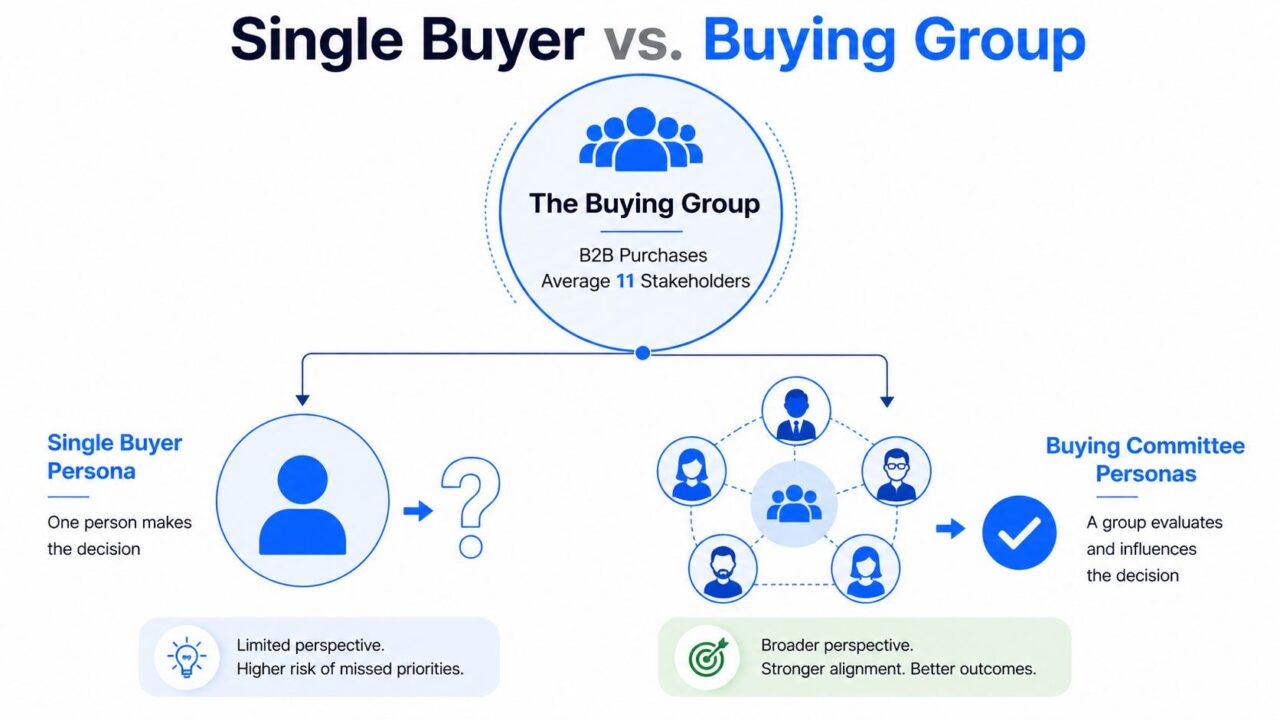
How to Create Buyer Personas Buying Group
Choose the correct model
A single persona may be enough for:
- Low-cost DTC purchases where the customer controls the decision.
- Creator products purchased directly by one individual.
- Local services with a short, owner-led sales process.
- Simple subscriptions without procurement or security review.
Build a buying-group map for:
- Mid-market or enterprise SaaS.
- Agency retainers with several internal reviewers.
- High-ticket DTC products requiring household agreement.
- Purchases involving procurement, security, compliance, or legal review.
B2B buying-committee models commonly separate five roles: economic buyer, champion, end user, security or compliance reviewer, and procurement. A deal may omit some roles or combine them, but each role raises a different question and needs different proof.
Create an influence map
For each role, record four fields in the customer persona template:
| Role | Primary concern | Evidence needed | Useful message |
|---|---|---|---|
| Economic buyer | Business value and risk | Financial or operational impact | Why the investment in market research deserves approval. |
| Champion your product or service by understanding the needs of your buyer personas. | Internal momentum | Enablement and proof | How to build the internal case for creating your buyer personas. |
| End user | Usability and daily outcomes | Workflow and product detail | How the solution fits the job |
| Security or compliance reviewer | Exposure and controls | Policies, integrations, safeguards | How risk is managed |
| Procurement | Terms and process | Commercial and implementation clarity | How the purchase moves forward |
Map who influences whom, where objections begin, and what evidence each person needs before advancing. Marketing can produce role-specific content, sales can spot missing stakeholders, and product can address adoption friction.
Keep the roles connected to one account, opportunity, or purchase. Five isolated profiles can contradict one another and give sales no usable view of the decision.
Use the influence map above to identify which stakeholder role is missing from your next deal review. Then add that role’s concern, evidence requirement, and message to the working persona record.
Turning Personas Into Chatbot Flows, Ads, and Lifecycle Sequences
Section 4 identifies segments and shapes persona cards. This section turns those findings into activation and routing rules that control the next interaction.
A persona earns its place when it changes what happens next. Connect each usable field to a trigger, question, message, and destination segment to enhance your free buyer persona. For example, a visitor arriving from a creator-focused ad could enter a Facebook Messenger Flow asking whether they sell courses, memberships, or coaching. The answer can set the next message, qualification path, and broadcast audience based on the customer persona. A SaaS onboarding user should receive a setup prompt rather than a promotional message.
Use personalization tags to carry known fields into messages, and document the assumption behind each rule. Clepher supports routing across a website, Facebook Messenger, WhatsApp, and Instagram Direct Message with tags, segments, conditions, analytics, and no-code Flows. That creates a practical handoff from research to live conversations.
Persona-to-Activation Map
| Persona | First Message | Qualifying Question | Segment Tag |
|---|---|---|---|
| DTC repeat buyer | “Welcome back. Want help choosing your next product?” | “Are you replacing a favorite or trying something new?” | dtc_repeat_buyer |
| Agency prospect | “Are you looking for lead generation or client campaign management?” | “Is the priority your own pipeline or delivery for clients?” | agency_prospect |
| Course creator can utilize a customer persona to tailor their content more effectively. | “Want to turn more subscribers into course buyers?” | “Do you already have a paid course?” | course_creator |
| SaaS onboarding user | “Let’s help you reach your first useful outcome.” | “Which workflow are you setting up first?” | saas_onboarding |
The same tags can feed Meta audiences, email sequences, sales qualification, and support routing. If a lead requests an implementation conversation, an Appointment Setter resource can help the team plan the human handoff after automated qualification.
Apply these rules to ads and lifecycle messages, then compare outcomes by trigger, channel, and segment. Tag only fields that change a decision. If a field never affects routing, messaging, qualification, or support, remove it instead of keeping it as profile decoration. Document who owns each rule so a campaign change does not leave chatbot logic and sales scripts out of sync.
Keeping Personas Fresh When Buyers Change Their Minds
Treat personas like products. Review them quarterly, even if you do not rebuild them each time. Compare conversion by persona, new win and loss themes, documented objections, chatbot conversations, broadcasts, and shifts in buying-group roles. Persona accuracy can decay without regular research refreshes, so retire stale assumptions rather than preserving them in a polished document.
Rebuild after a new product line or geography, or after a sustained drop in persona-tagged conversion. After Clepher launched its WhatsApp integration in Q3, the agency persona was updated for new support expectations around DM response times. Retire demographics-only profiles, untested assumptions, ownerless documents, and one-time slide decks to focus on actionable insights for your product development.
Map refreshed personas in Clepher to chatbot Flows, tags, segments, conditions, and broadcasts across your website, Messenger, WhatsApp, and Instagram Direct Message. Use the results to update qualifying scripts and lifecycle journeys.
Related Posts
Automated Checkout Bot: Build and Launch Guide
October 7, 2026AI Agent Framework: Architecture, Tools, and Use Cases
October 6, 2026Master Lead Generation Automation for Business Growth
October 5, 2026
Founder Clepher