
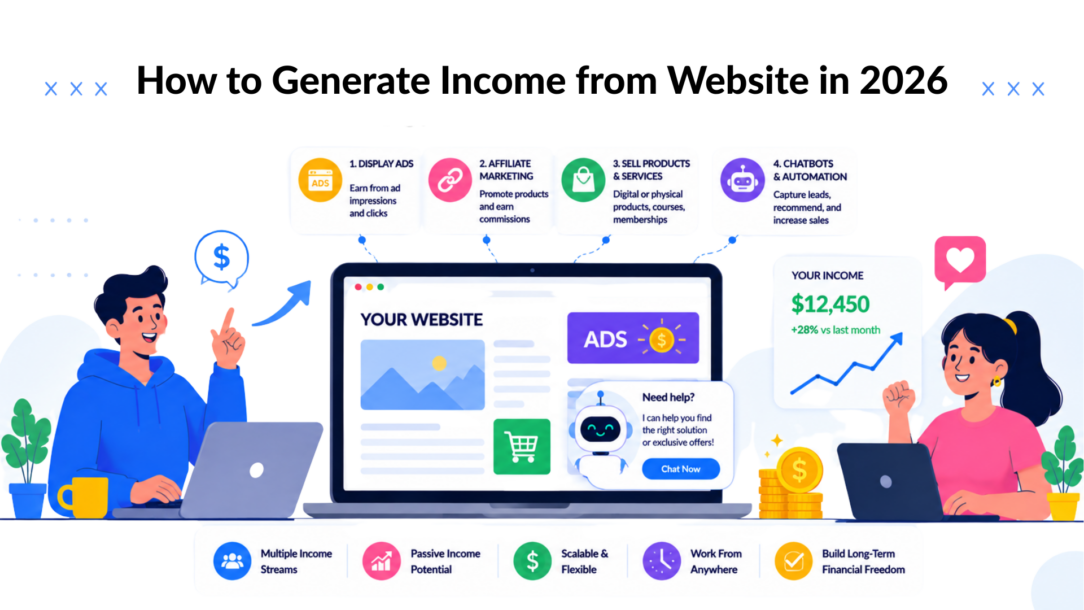
You’ve got traffic, but the payouts are thin, the inbox is quiet, and every “make money online” post seems to assume your site is already a machine. That gap is normal. Most sites don’t fail because the owner picked the wrong revenue model; they fail because the site never reached the level of demand where any model could work well.
How to generate income from a website starts with a harder question than most guides ask, which is whether your pages are already attracting enough attention to convert. If they are, the job is to route that attention into ads, affiliate clicks, lead captures, or direct sales. If they aren’t, the only honest answer is to keep building traffic and intent until the numbers justify monetization.
What Website Monetization Actually Means Today
A site with traffic but no revenue is usually a measurement problem, not a creativity problem. The owners often know they “need to monetize,” but they haven’t defined what monetization is in practice, which is turning existing traffic into revenue through advertising, affiliate marketing, subscriptions, or direct sales. That definition matters because it forces you to look at audience demand first, not at the shiny revenue model you saw on social media for selling physical products.
The first checkpoint is traffic volume. One industry source says many ad networks want 10,000 to 50,000 monthly pageviews or sessions before revenue becomes meaningful, which is why traffic is the foundation, not an afterthought (website monetization overview). That doesn’t mean smaller sites can’t earn anything, but it does mean the site usually needs enough demand before display ads or broad sponsorships feel worth the clutter.
Read the site at page level, not site level
The pages that matter most are rarely the pages the owner likes most. It’s usually the tutorial with repeat visits, the comparison post with outbound clicks, or the service page that already attracts people who are close to buying. The practical move is to sort pages by views, then ask which ones have the highest intent and the clearest next step.
Practical rule: Optimize your content for SEO to increase traffic and potential earnings. Monetize the pages that already attract decisions, not the pages that only attract curiosity.
That’s also where conversational AI can help early, even before any sale. A chat capture widget can turn a visitor on a high-intent page into a subscriber or lead, which gives the page a second job beyond pageview monetization and helps sell products. If you want a simple way to think about the site, use this flow: audience first, content second, engagement third, revenue last.
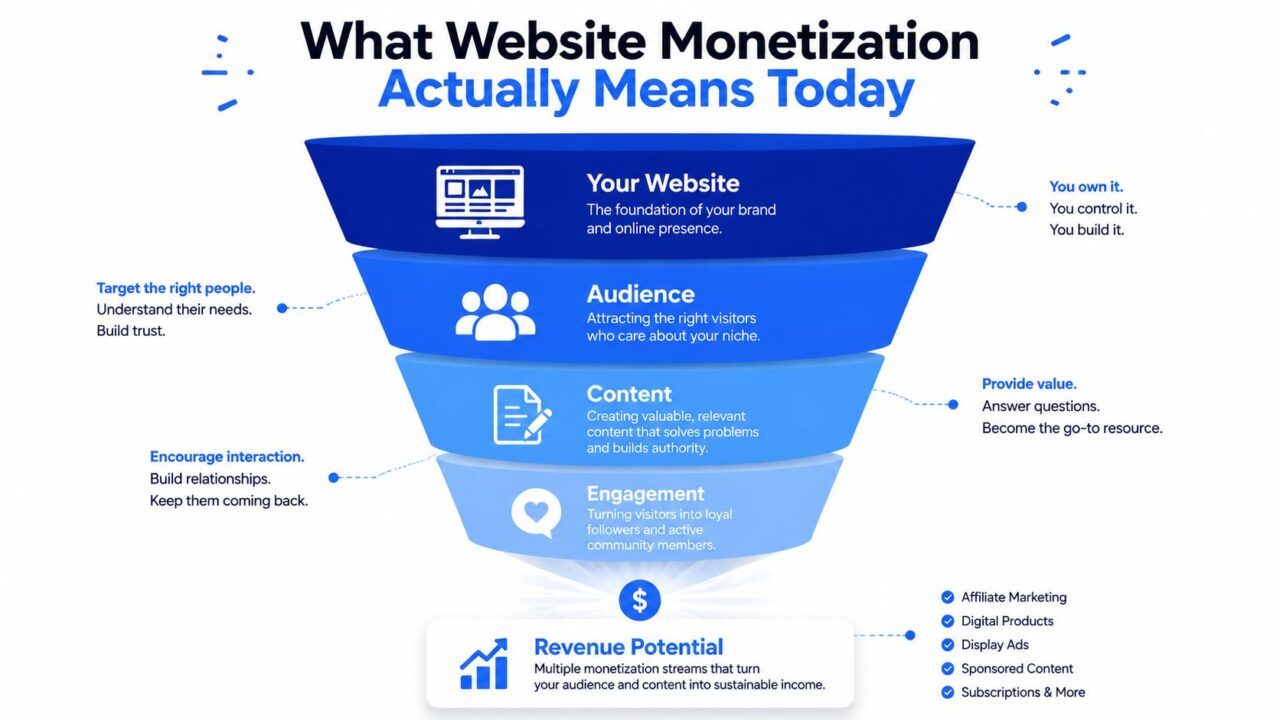
How to Generate Income from Website Monetization Funnel
| Monthly Sessions | Best-Fit Models | Realistic Monthly Income from selling physical products |
|---|---|---|
| Below meaningful ad thresholds | Affiliate links, lead capture, early service offers | Qualitative, site-dependent strategies are essential for effectively selling products or services. |
| Growing traffic with clear intent | Ads, affiliates, newsletter or lead gen | Qualitative, site-dependent |
| Established traffic with repeat visits can significantly enhance ways to make money online. | Ads, affiliates, products, partnerships | Qualitative, site-dependent |
For structure ideas on where site widgets fit into that funnel, the practical breakdown in monetizing a website can be invaluable. This guide to website widgets is worth a look because it shows how a small on-site element can support lead capture without turning the page into a sales pitch.
Choosing the Right Revenue Models for Your Site
Picking a monetization method by trend is how people end up with five half-used income streams and no clear winner. Better operators match the model to selling physical products, traffic stage, audience intent, and effort required to drive traffic to your website. A site with informational search traffic should not behave like a direct-response store, and a service business should not rely on low-paying display ads if it can convert visitors into qualified conversations.
Compare fit, not hype
Here’s the simplest way to decide where to start.
| Model | Best for | Trade-off |
|---|---|---|
| Display ads | Content-heavy sites with steady traffic | Easy to launch, but limited control and weaker earnings at lower volume |
| Affiliate marketing | Reviews, tutorials, comparisons, niche publishers | Depends on relevance and intent, not just traffic |
| Digital products | Audiences with a clear recurring problem | More work upfront, better margin potential |
| Services | Consultants, agencies, freelancers, experts | High-touch sales, but faster path to revenue for the right audience |
| Subscriptions or lead generation | Businesses that can nurture and qualify | Requires trust, follow-up, and a clear value exchange |
The main mistake is trying to force every page into the same funnel. A comparison article can support affiliate links and help readers find the best online courses. A service page can support lead gen. A how-to post can support an email capture flow that later sells a product. That mix is where the 2 to 3 revenue source rule earns its keep, because it lowers the risk of one platform change wiping out the whole model (Sonary on diversified revenue sources).
Launch in the order your intent already supports
Start with the stream that matches the reader’s current buying stage. If they’re researching, affiliate and lead capture fit best for monetizing a website. If they already trust you and keep returning, a product or service offer can work. If the site gets broad informational traffic, ads can fill the gap while you build the stronger streams.
A useful conversion reference for testing offer placement comes from A/B testing for golf club websites, because the same principle applies anywhere a visitor can be nudged toward a clearer next action. Test one offer, one placement, one message at a time, then keep the version that converts more cleanly.
Don’t launch five streams on the same page. The visitor can only take one next step, and mixed signals usually kill that step.
Setting Up Display Ads and Affiliate Income
Display ads and affiliate links are the fastest ways to get a site earning because they don’t require you to build a full product before you start. Ads work because the network handles the buyers, and affiliate marketing works because you earn when the visitor completes a tracked action. Both are practical when the site has traffic but not yet a direct offer.
Display ads are the easiest first layer
Google AdSense is the classic starting point because the setup is low-friction. The site owner signs up, copies the code snippet into the site, and the network serves ads automatically. Save the Student notes that network ads can be added by pasting code into the site, and Hostinger explains that AdSense pays when visitors view or click ads (Save the Student, Hostinger on website monetization).
That simplicity is the point. Ads are useful when you need a baseline revenue layer without hiring a sales team or building a product. They’re not the highest-control option, but they do give content sites a straightforward way to monetize traffic that would otherwise just sit there, creating passive income opportunities.
Affiliate income works when the link matches intent
Affiliate marketing pays on a tracked action. A reader clicks your link and completes a sale or lead, then you earn a commission. Hostinger and Mailchimp both describe the model as commission-based, and the operational mechanics are simple: join a network, get a unique tracking link, and place it where the reader already wants the recommendation.
The placement matters more than the program. Contextual links inside reviews, tutorials, and comparison pages usually convert better than generic banners because they match what the reader is trying to do right now. That’s why niche review sites can outperform broader publishers on affiliate revenue. The page is already part of the buying process.
A practical warning from affiliate operators is easy to ignore but expensive to ignore: don’t recommend products just because the commission looks attractive; instead, focus on ways to make genuine recommendations. Readers notice weak relevance fast, which can negatively impact the site’s ability to earn money. If the offer doesn’t fit the page’s intent, the click rate drops and trust drops with it.
For people evaluating affiliate education options, this affiliate course evaluation is a useful lens because it reinforces the same operational point: relevance beats volume when the goal is conversion.
Benchmarks should shape expectations
An ad-revenue estimate puts a site with 500,000 monthly sessions at about $5,000 per month, while sites above 40 million sessions to your online store can exceed $2 million per month in passive income, which is an impressive goal for any website. In monthly ad revenue, AdSense positioning and scale examples, those numbers show the scale effect clearly. More traffic expands the ceiling, but matching the right landing pages with the right monetization layer makes the difference.
Direct brand partnerships can outperform ad networks once you have an engaged niche audience, because the value is no longer just impressions. It becomes trust, attention, and fit. That’s where monetization starts to look less like a sidebar and more like a business.
Launching Digital Products, Services, and Lead Generation
Once ads and affiliates are live, the next meaningful move is selling something directly. That’s where the margin improves, because you stop borrowing value from someone else’s offer and start capturing value from your own expertise, process, or list on your online store. Digital products, services, and lead generation all fit here, but each one serves a different audience stage.
Choose the offer that matches the reader’s readiness
Digital products work when the audience wants a repeatable solution, such as a course, template, workbook, or ebook. Services work when the audience wants a human to handle the outcome, such as consulting, implementation, or done-for-you work. Lead generation works when the site can capture qualified interest and hand it to a sales process later, which is often the cleanest move for service businesses.
A minimal product flow doesn’t need to be complex to effectively sell products or services. It needs a clear promise, a checkout path, and one follow-up sequence. A service flow needs a booking widget, a qualification step, and a fast handoff to whoever closes the sale. A lead-gen flow needs a form, a reason to submit, and a CRM or inbox process that responds fast enough to matter.
Qualify before the human call
If the site attracts mixed traffic, use conversational AI to separate serious buyers from casual visitors. A chatbot can ask one or two qualifying questions, route the right people to a booking page, and send everyone else into a nurture sequence. That saves time and keeps the sales team focused on better leads.
This is also the place where subscriptions can make sense, but only if the content or service naturally lends itself to recurring value. If it doesn’t, don’t force it. A one-time product or a lead-gen pipeline is usually cleaner than inventing a membership just because it sounds recurring.
The short launch plan is simple. Pick one offer, one checkout flow, one follow-up path. Put it on the landing pages where the intent is already warm. Then watch what the audience does instead of guessing what they might buy.
Using Conversational AI to Multiply Every Revenue Stream
Most sites leave money on the table after the first click, missing opportunities to optimize their monetization strategies. Visitors land, skim, bounce, and never come back. Conversational AI changes that because it turns the site into a live conversion layer that works across ads, affiliates, products, services, and lead capture instead of sitting off to the side as a separate feature.
Treat chat as a funnel, not a widget
A good chatbot does more than answer questions. It captures subscribers, qualifies leads, recommends products, and recovers abandoned intent while the visitor is still present. Clepher, for example, offers a no-code builder with drag-and-drop Flows, AI keyword triggers, segmentation, personalization tags, and native integrations with e-commerce platforms like Shopify. 50+ apps, plus 5,000+ more through Zapier, Make, n8n, and Pabbly (Clepher conversational AI for sales). That kind of setup matters because it lets you move from pageview to conversation without rebuilding the site.
How to Generate Income from Website Clepher Landing Page
Use one bot across multiple revenue paths
A bot can support each monetization stream differently, enhancing the site’s ability to earn money.
- For affiliates: recommend the right product in a conversation instead of hiding it in a banner.
- For products: nudge visitors toward a lead magnet, then move them into the offer sequence.
- For services: qualify the lead before the sales inbox gets involved.
- For ads: capture repeat visitors so the page isn’t the only shot at monetization.
- For recovery: trigger follow-up when a visitor leaves before converting.
The value isn’t that chat is trendy. The value is that it shortens the gap between intent and action. The visitor doesn’t have to search the site, compare five pages, and guess the next step. The bot can ask the right question, segment the answer, and route the person to the right revenue path.
The strongest chatbot flows feel like helpful guidance. The weakest ones feel like popups with extra steps.
Deployment should be fast
A no-code stack should not require a long implementation cycle. If installation takes forever, the funnel gets stale before it ever launches. That’s why chat tools with live chat, broadcast messaging, tags, and automated handoffs are valuable; they let the site owner test offers and recover demand quickly instead of waiting on a custom build.
Measuring What Works and Cutting What Doesn’t
A monetized site gets better when the operator knows what to stop doing. Pageviews alone won’t tell you that, and follower counts definitely won’t. The useful metrics are the ones that connect traffic to behavior, then behavior to revenue.
Track the numbers that actually move income
Start with unique visitors, traffic sources, page-level conversion behavior, time on page, outbound clicks, and assisted conversions. Those are the signals that tell you whether a page is attracting the right people and whether the monetization path is helping or hurting. Use site analytics together with pixel and tag tools so the click path doesn’t disappear the moment a visitor leaves the page.
The best operators also watch revenue-linked indicators such as RPM, CTR, EPC for your online store, and qualified-lead rate. Those numbers don’t exist in isolation. They only make sense when they’re tied to one page, one offer, or one bot flow at a time.
Build a weekly testing rhythm
If a page gets traffic but no affiliate clicks, swap the offer or move the placement higher on the page. If a service page gets visits but few calls, tighten the qualification step. If a chatbot captures leads but doesn’t convert them, the problem is probably the flow sequence or the follow-up timing.
A/B testing matters because it keeps the site from turning into a pile of opinions. You change one variable, observe the result, and keep the winner. Then you repeat it. That rhythm compounds, and it’s how a static site turns into a learning system.
The embedded video below is useful if you want a visual walk-through of visitor tracking logic and how to connect it back to monetization.
For a practical walkthrough on the tracking side, this guide on how to track website visitors fits neatly with the measurement stack because it focuses on what to watch before you start changing offers.
Ignore vanity metrics
A large audience that never clicks, never submits, and never buys doesn’t help much in your way to earn revenue. The pages that deserve more attention are the ones that show engagement and intent together. That’s where monetization compounds, because every improvement hits a page that already has a reason to exist.
Scaling Safely, Staying Compliant, and Your 90-Day Plan
Growth without compliance turns into cleanup later. Sponsored content, affiliate links, data capture, and chatbot flows all touch legal and privacy obligations, even on small sites. The basics matter more than the buzzwords: consent capture, transparent disclosures, sensible data handling, and a clear opt-out path where required for your e-commerce site.
Keep the site clean before you push harder
If the site collects personal data, be deliberate about what gets stored and why. If you run affiliate links or sponsored placements, disclose them clearly so readers know when content has a commercial relationship. If you use a chatbot to capture leads for your e-commerce business, make sure the handoff into email, SMS, or CRM follows the privacy rules that apply to your audience and region.
Tax and entity setup can also catch first-time site owners off guard. Once a site starts generating meaningful income, it stops being a hobby in practice even if it still feels like one in the editor. Treat the paperwork like part of the business, not an annoying add-on.
Use a 90-day rollout instead of guessing
- Days 1 to 30: Audit traffic, add display ads if the site qualifies, and launch one affiliate offer on the highest-intent pages to maximize ways to make money.
- Days 31 to 60: Add one digital product or lead-gen flow, then deploy a chatbot for capture and recovery on the pages that already convert.
- Days 61 to 90: Review the data, A/B test the offer or bot flow, and add a second or third revenue source only if the first one is working cleanly.
The goal is simple. Build one revenue layer, prove it, then stack the next one on top. That keeps the site focused, reduces risk, and stops monetization from turning into clutter.
If you want the conversational layer that helps turn site traffic into captured leads, booked calls, and recovered sales, start with Clepher and map it to the pages that already have buying intent. It’s a practical way to connect chat, automation, and follow-up without rebuilding your site from scratch.
Related Posts
Customer Experience Optimization Playbook
October 8, 2026Automated Checkout Bot: Build and Launch Guide
October 7, 2026AI Agent Framework: Architecture, Tools, and Use Cases
October 6, 2026
Founder Clepher