
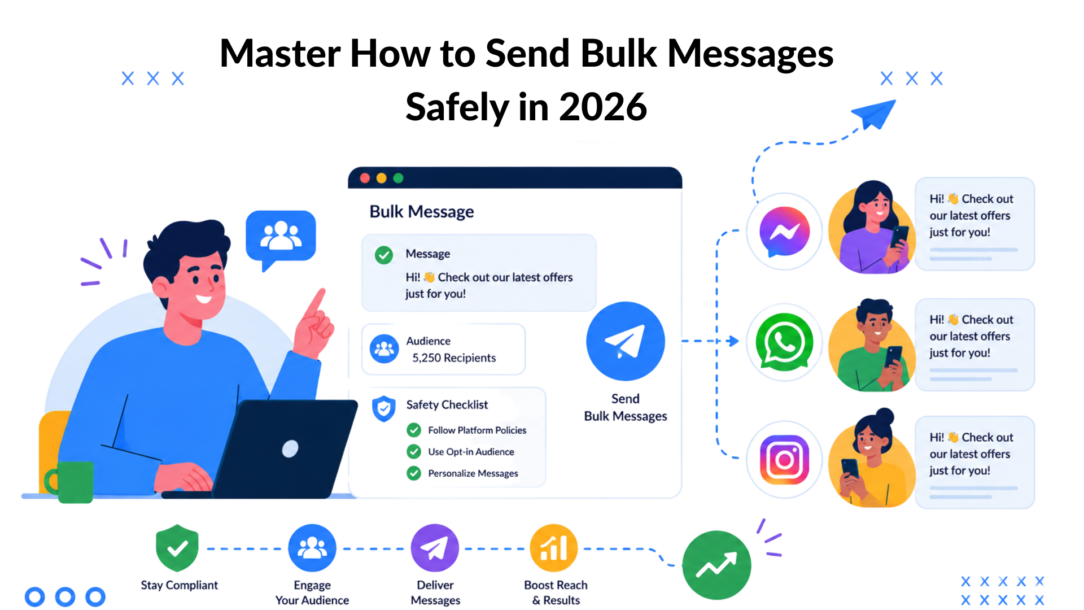
Segmented bulk SMS campaigns generate 2–3 times higher click-through rates and 15–20% lower opt-out rates than non-segmented blasts according to Bitly’s bulk SMS marketing analysis. That single fact changes how to send bulk messages the right way.
Most advice on bulk messaging still sounds like it’s 2018. Upload a list. Write one promo. Hit send. Hope for the best.
That approach breaks fast on modern chat platforms. SMS has legal constraints. Messenger has engagement windows and API rules. WhatsApp and Instagram reward conversation, not blunt-force broadcasting. If you ignore those differences, you don’t just get poor results. You get blocked, filtered, ignored, or disabled.
The work that pays off is simple in principle. Get consent. Segment hard. Write like a human. Respect each platform’s rules. Automate around behavior instead of blasting everyone at once.
The Foundation of Safe and Compliant Bulk Messaging
Bulk messaging starts with one rule that isn’t negotiable. You need explicit consumer consent. The legal baseline is clear: the U.S. Telephone Consumer Protection Act and the EU’s GDPR require permission before sending marketing messages, and under TCPA, businesses must obtain written permission before sending automated promotional texts, with violations carrying fines of up to $1,500 per message according to JustCall’s bulk SMS compliance guidance.
How to Send Bulk Messages Legal Compliance
What explicit consent actually looks like
Consent isn’t a buried sentence in your privacy policy.
It’s a clear action the subscriber takes. They tick a box, submit a form, start a conversation, or opt in through a channel-specific mechanism that leaves a record. The language must make it obvious what they’re signing up for.
A compliant form usually includes:
- Business identity: Name the company sending the messages.
- Message purpose: Say whether messages are promotional, transactional, support-related, or mixed.
- Expected cadence: State how often people should expect to hear from you.
- Exit path: Include an opt-out instruction.
If you use a website widget or pop-up, keep the wording plain and consider adding an option to receive bulk text messages. Something like: “By providing your phone number, you agree to receive text messages from [Business Name].” That’s far safer than implying consent through silence or a pre-checked box.
Practical rule: If a subscriber couldn’t clearly explain what they signed up for, your opt-in process is weak.
Why this matters beyond legal risk
Marketers often treat compliance like paperwork. It’s really deliverability insurance.
Carriers and platforms look for signs that your list is legitimate. If you’re messaging people who never asked to hear from you, spam filters catch it fast. Even before legal exposure becomes a problem, your sender reputation degrades, and future campaigns struggle to land.
Here’s the operating standard I use:
- Capture permission at the source
- Store proof of opt-in
- Tie each subscriber to a channel, including SMS message notifications for better engagement.
- Honor opt-outs immediately
- Keep your disclosure visible everywhere you collect contacts
Common shortcuts that backfire
A lot of teams get in trouble through avoidable shortcuts:
- Uploading old customer lists: Past buyers aren’t automatically marketing subscribers.
- Importing contacts from events without clear opt-in: A business card isn’t messaging consent.
- Using one opt-in for every channel: SMS, Messenger, and WhatsApp don’t all work the same way.
- Skipping unsubscribe language: Even strong campaigns create friction if people can’t leave cleanly.
Done right, compliance with SMS message regulations doesn’t slow you down. It gives you a clean audience, better engagement, and fewer account problems later.
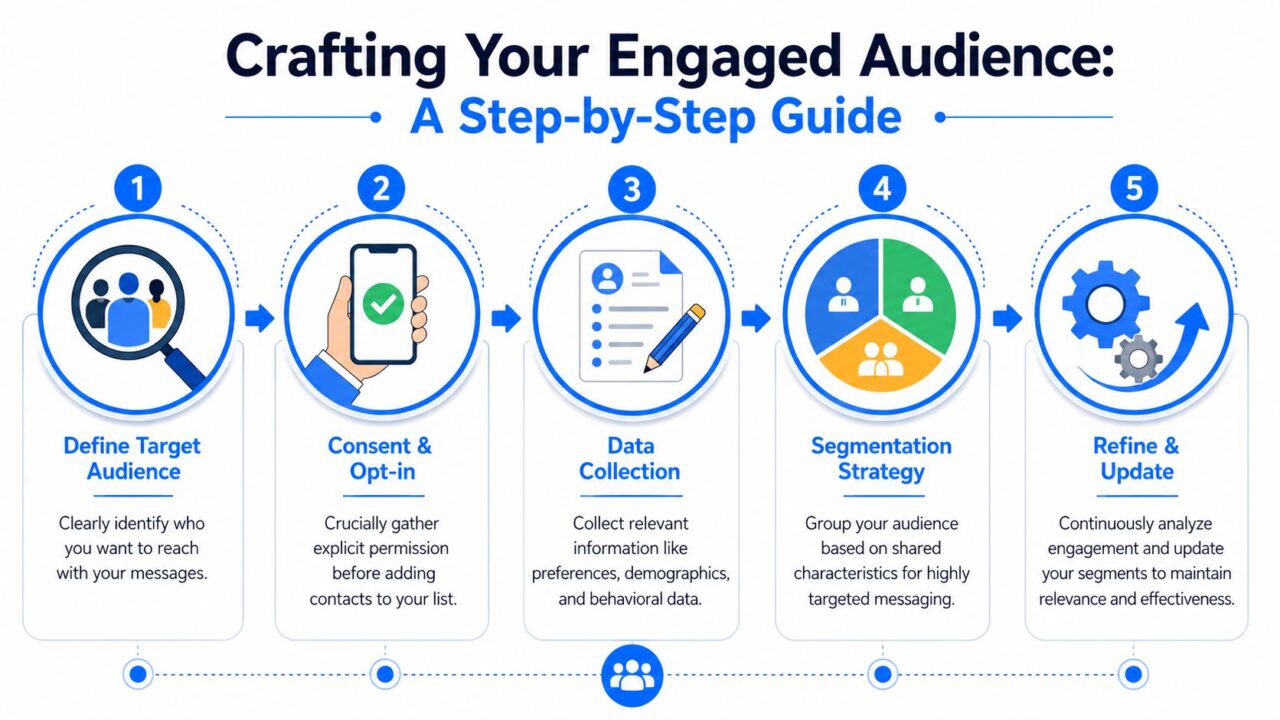
Building and Segmenting an Audience That Wants to Hear From You
A bulk campaign is usually won before the first message goes out. The quality of the audience matters more than the cleverness of the copy.
If you build one giant list and send everyone the same thing, performance drops fast. Segmented SMS campaigns generate 2–3 times higher click-through rates and 15–20% lower opt-out rates than non-segmented blasts, according to Bitly’s breakdown of bulk SMS strategy.
How to Send Bulk Messages Audience Strategy
Start with capture points that fit the channel
Good audience building is boring in the best way. It relies on consistent capture points:
- Website pop-ups: Best for discounts, restock alerts, lead magnets, and early access.
- Embedded forms: Better for lower-friction newsletter and product update signups.
- QR codes: Useful in-store, on packaging, or at events.
- Click-to-chat ads: Strong for Messenger and WhatsApp because they start the conversation in-platform.
A skincare brand, for example, shouldn’t ask every new contact the same question in their bulk text messages. Let visitors self-identify. Offer one path for acne care, another for anti-aging, another for sensitive skin. That single step makes later messaging far more relevant.
Segments that actually help you sell
The easiest mistake is creating segments that look tidy in a dashboard but don’t influence messaging.
Useful segments map directly to what you’ll send next. If you need a refresher on how audience segmentation works, the core idea is simple: group people by attributes that change the message, timing, or offer.
Segments worth building first:
| Segment type | What it’s based on | Example send |
|---|---|---|
| Interest | Product category, topic, service line | New arrivals only for people who browsed running shoes |
| Lifecycle | New lead, customer, repeat buyer, dormant | Onboarding tips for first-time subscribers |
| Behavior | Viewed product, started checkout, clicked prior campaign, and received an SMS message notification. | Cart reminder with product-specific context |
| Location | Country, city, store region | Local event invite or regional stock update |
A practical e-commerce flow
Here’s a simple way this works in practice.
A visitor lands on a store selling fitness gear. They browse resistance bands and yoga mats. Before leaving, they see a pop-up offering training tips and stock alerts if they opt in. They subscribe and choose “home workouts” as their interest.
That subscriber should not receive the same broadcast as someone shopping for protein shakers or lifting belts.
Instead, tag them for:
- Interest in home workouts
- Viewed category
- Subscriber source
- Recent activity window
Relevance lowers annoyance. Annoyance drives opt-outs.
Audience building isn’t about collecting the biggest list. It’s about building the smallest list necessary for each message.
Crafting Messages That Convert, Not Annoy
Most bulk messages fail because they sound automated in the worst possible way. Generic, context-free, and written like nobody expects a reply.
That style doesn’t just reduce conversions. It can also get your account flagged. Facebook’s spam detection algorithms actively flag trigger words like “free,” “earn money,” “click link,” or “promotion,” and senders are safer when they include the recipient’s name or specific context according to this breakdown of Facebook bulk messaging risk.
The bad version and the better version
Bad bulk message:
FREE offer today. Click the link now for promotion and receive a bulk SMS message with exclusive offers. Limited time only.
It’s vague. It screams automation. It gives the recipient no reason to trust the sender.
Better message:
Hi Maya, you left the black carry-on in your cart yesterday. It’s still available if you want to finish checkout today.
Same commercial intent. Completely different experience.
Personalization isn’t optional
Using a first name helps, but surface-level personalization isn’t enough anymore. Strong bulk messaging pulls in context:
- What the person did
- What they showed interest in
- Where they are in the customer lifecycle
- What action makes sense next
A course creator can message webinar attendees differently from people who only downloaded a checklist. A SaaS brand can send setup help to trial users and upgrade nudges to active users nearing plan limits. A local clinic can separate appointment reminders from promotional updates so the inbox stays useful.
If your message could be sent to anyone on the list without changing a word, it probably shouldn’t go out.
A simple copy framework that holds up
Use this sequence:
-
Context first, especially when crafting bulk text messages for your audience.
Mention the relevant behavior, product, or prior interaction. -
Value second
Give the recipient a reason to care right now. -
Action third
Ask for one clear next step.
Examples:
- “Hi Jordan, your trial account is active. If you want, I can send the quick setup steps.”
- “Hi Alina, the boots you viewed are back in stock in your size.”
- “Hi Chris, your consultation is tomorrow. Reply if you need to reschedule.”
What to avoid every time
- Spammy wording: Don’t lean on phrases that feel manipulative.
- Too many links: One clear action usually beats a cluttered message.
- Hard sells in support flows: If the user came in for help, solve that first.
- Template fatigue: Repeating the same opener across every campaign makes your messages feel synthetic.
If your team handles service as well as marketing, it also helps to know when text or DM isn’t enough. This practical guide to escalating support emails to calls is useful because channel choice affects satisfaction as much as copy does.
For marketers cleaning up weak outreach, these examples of spam messages are a good gut check. If your campaign looks similar, rewrite it before sending.
Navigating Platform-Specific Rules for Messenger, WhatsApp, and Instagram
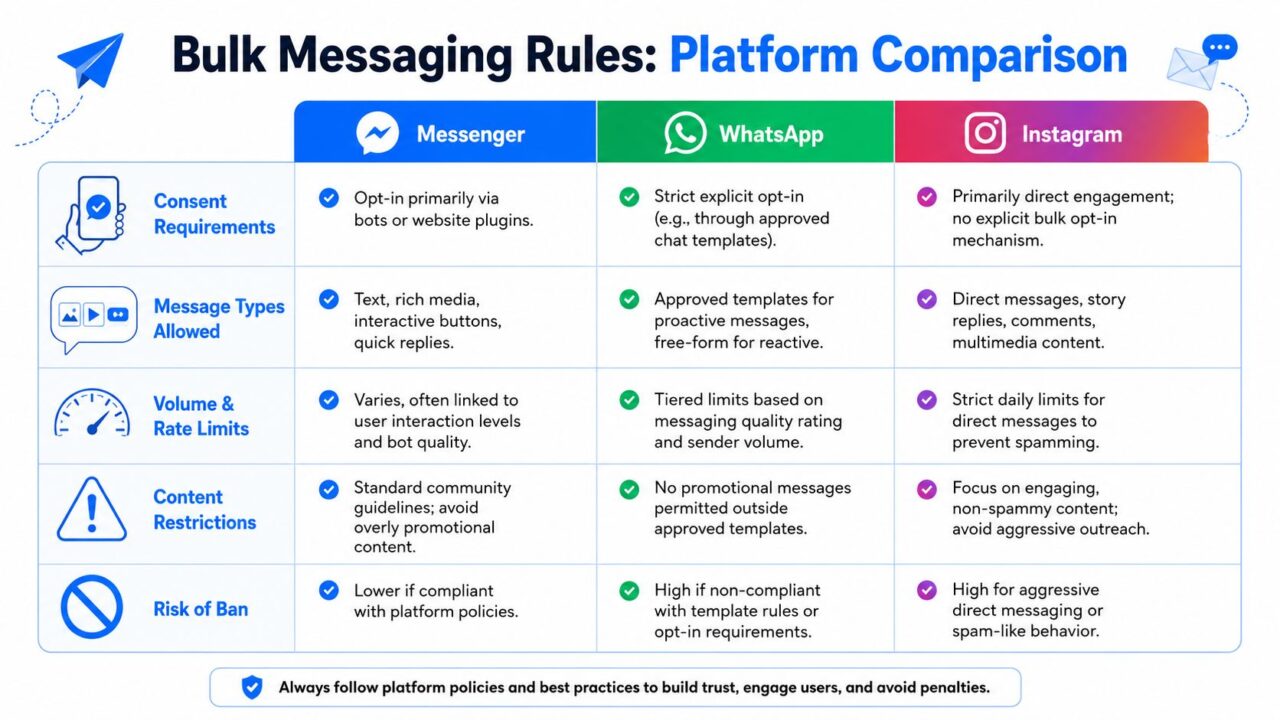
The biggest mistake in bulk messaging is treating every platform like SMS with a different logo.
That’s not how modern chat platforms work. Messenger, WhatsApp, and Instagram each have different expectations around consent, conversation flow, and what counts as acceptable outbound messaging.
How to Send Bulk Messages Messaging Comparison
Messenger works best when the user recently engaged
Messenger is the most familiar starting point for many marketers, but the safe path is narrower than people assume.
Messages sent to users who initiated conversation within the last 24 hours see open rates of 70–80% and click-through rates of 15–25% according to these Messenger campaign benchmarks can be compared to the effectiveness of bulk SMS messages.. That’s the key lesson. Messenger rewards relevance and recency.
For actual broadcast mechanics, the business workflow relies on the Broadcast API. The process uses /message_creatives to create a message object and /broadcast_messages to send it, but only to users who already granted permission, as outlined in the SMS message service agreement. this technical explanation of the Messenger Broadcast API.
What works on Messenger:
- Follow-ups tied to recent conversation can be enhanced with a timely SMS message.
- Support updates
- Targeted re-engagement for opted-in subscribers
- Messages with clear context and natural language
What fails fast:
- Cold outreach
- Identical mass sends to broad segments
- Promo-heavy language with no user history
WhatsApp is built around initiated conversation
WhatsApp punishes lazy broadcasting harder than SMS.
The practical difference is this: many SMS guides talk about list uploads and blast mechanics, but WhatsApp depends heavily on user-initiated conversation. That’s why click-to-WhatsApp ads, QR codes, packaging prompts, and website chat invites matter so much. They create the first message from the customer, which gives you a compliant starting point.
If you’re evaluating broadcast messaging on WhatsApp, think in flows, not blasts. Order updates, restock alerts, abandoned cart nudges, and support handoffs work better when each message clearly follows a user action or expectation.
The more your outbound message feels like a continuation of a conversation, the safer it usually is on chat platforms.
Instagram requires restraint
Instagram DMs are powerful, but marketers often overdo them. The platform is more conversational and less tolerant of aggressive outreach than email.
A creator, coach, or ecommerce brand can use DMs effectively for lead qualification, story reply follow-up, waitlist invites, and customer support, in addition to sending bulk SMS messages. The key is to build from real engagement. Story replies, comments, link-click interactions, and ad-driven conversations create a warmer path than unsolicited outreach.
If you want channel-specific ideas, this guide to effective Instagram direct message marketing is useful because it focuses on engagement patterns rather than bulk-blast tactics.
Here’s the practical comparison:
| Platform | Best starting trigger | Safe mindset |
|---|---|---|
| Messenger | Recent conversation and opt-in | Continue an active thread |
| User-initiated contact | Message inside a clear conversational relationship | |
| Story replies, comments, DM engagement | Keep outreach contextual and light |
Traditional SMS can still support broader announcements. Chat apps usually can’t. They expect interaction, not interruption.
Automating and Scaling Your Messaging with Clepher
Manual outreach works until your list becomes real. Then it collapses under its own weight.
The shift that matters is moving from batch sends to behavior-driven automation. Event-driven triggers and lifecycle segmentation drive 30–50% higher engagement rates than static blasts, according to Evan Gora’s analysis of mass texting strategy. That lines up with what experienced operators see every day. Triggered messages usually outperform generic campaigns because timing carries intent.
A practical setup looks like this:
How to Send Bulk Messages Chatbot Marketing
A cart recovery sequence that doesn’t feel robotic
Take a mid-sized DTC store selling home office products.
A customer browses ergonomic chairs, adds one to cart, starts checkout, then leaves, prompting a follow-up SMS message to encourage completion. A bad automation sends a generic discount blast to the whole list that afternoon. A better automation sends a small sequence only to that cart-abandoner.
Message one might acknowledge the action:
Hi Lena, you left the ergonomic chair in your cart. Want me to send the checkout link again?
If there’s no purchase, the next message can add useful context rather than pressure:
- Product reassurance can be effectively communicated through a well-timed SMS message. Mention stock status or setup details
- Objection handling: Answer common questions about sizing, shipping, or returns
- Support path: Offer help instead of repeating the same sales line
That sequence feels personal because it is based on behavior, not list membership alone.
What automation should control
A decent system should do more than schedule broadcasts. It should manage the conditions around them.
Useful controls include:
- Trigger logic: Start messages after browse, purchase, inactivity, or reply events
- Audience filters: Exclude recent buyers from promo sends
- Local-time scheduling: Respect recipient time zones
- Send throttling: Avoid sudden spikes that look suspicious
- Reply routing: Move real conversations to a person when needed
For teams managing several channels, a multi-channel messaging platform can centralize those workflows across web chat, Messenger, Instagram, WhatsApp, and follow-on channels.
Automation still needs editorial judgment
The trap is assuming automation removes the need for thinking. It doesn’t.
You still need message hierarchy. Transactional updates should not sound like promos. Win-back campaigns should be softer than cart recovery. High-intent leads should get faster follow-up than casual browsers.
Automations scale your judgment. They also scale bad judgment if your triggers and copy are sloppy.
If you’re serious about learning how to send bulk messages without burning out your list, automation is where the economics improve. You send fewer messages overall, but more of them arrive at the right moment.
Critical Best Practices and Mistakes to Avoid
Most bulk messaging problems come from a short list of repeat mistakes. The teams getting steady results usually follow the same habits.
Best practices worth keeping
- Keep opt-outs obvious: Every campaign should make exit easy. People trust brands more when leaving doesn’t require a fight.
- Match cadence to expectation: If someone signed up for shipping updates, don’t suddenly send frequent promotions.
- Separate campaign types: Transactional alerts, support messages, and promotional nudges should not all use the same tone.
- Watch replies, not just clicks: Replies tell you whether the message feels human or intrusive.
Mistakes that damage performance
- Sending too often: Fatigue shows up before you notice it in revenue.
- Using one message for every segment: Broad copy usually underperforms precise copy.
- Ignoring platform context: A message that feels acceptable on SMS may feel invasive in DMs.
- Failing to clean segments: Inactive contacts, stale tags, and wrong lifecycle states create wasted sends and awkward follow-ups.
A simple pre-flight check helps. Confirm consent status, segment logic, message context, opt-out path, and follow-up handling before every launch.
Bulk Messaging Frequently Asked Questions
If you want to put this into practice without stitching together multiple tools, Clepher gives teams a way to build conversational flows, capture subscribers, segment audiences, and run bulk messaging across Messenger, WhatsApp, Instagram, and web chat from one place.
Related Posts
Automated Checkout Bot: Build and Launch Guide
October 7, 2026AI Agent Framework: Architecture, Tools, and Use Cases
October 6, 2026Master Lead Generation Automation for Business Growth
October 5, 2026
Founder Clepher