Instagram affiliate marketing stopped being a side tactic. It now sits inside a much bigger performance channel.
The affiliate industry is valued at $17-18.5 billion in 2025, with projections to exceed $20 billion in 2026. Inside that market, Instagram is the second-most-used platform for affiliate marketing at 61.4% adoption among affiliates, and affiliate channels drive 16% of all e-commerce orders according to Post Affiliate Pro’s industry overview.
That matters because the old playbook is fading. Pretty posts, vague promo codes, and a link dropped into a bio aren’t enough. The accounts that win treat Instagram like a funnel. Content creates intent. DMs handle objections. Tracking shows what sells.
A lot of creators still think monetization starts when a brand reaches out. It usually starts much earlier, with a clear niche, a profile built for action, and content that moves someone from curiosity to conversation. If you’re still shaping that foundation, this guide on how to monetize an Instagram account is a useful companion because it maps the broader revenue paths beyond affiliate links alone.
The Undeniable Rise of Instagram Affiliate Marketing
Instagram affiliate marketing works because it sits where discovery and buying behavior already happen. People don’t open Instagram looking for a product catalog. They open it to solve a problem, copy a routine, compare options, or ask someone they trust what works.
That trust is what turns content into revenue.
Instagram now supports a much more direct path from recommendation to purchase than it used to. For brands, that means affiliate partnerships are easier to measure. For creators, it means you can build a real acquisition channel instead of hoping someone remembers a discount code later.
Why Instagram has become a serious affiliate channel
The platform rewards commercial intent more clearly now. A buying journey can start with a Reel, continue through a Story, and finish in a DM conversation where the recommendation feels personal instead of broadcast.
That creates a better fit for affiliate offers than many marketers realize, especially in categories like beauty, fashion, wellness, software, home, education, and creator tools.
Three things separate profitable accounts from noisy ones:
- Clear niche positioning: People should know what kind of recommendations they can expect from you.
- Audience understanding: You need to know what followers are trying to fix, buy, avoid, or improve.
- Conversion design: Your profile, content, links, and DMs need to guide the next step.
Public content gets attention. Private conversation gets action.
What changes the game
Follower count still matters at the edges, but it isn’t the main operating lever. The better question is whether your content attracts the right buyer and whether your system helps that buyer move without friction.
That is why the strongest Instagram affiliate marketing setups don’t stop at content production. They build a path from post to click, then from click to conversation, then from conversation to purchase.
Building Your Foundation for Affiliate Success
Most affiliate accounts fail before the first offer goes live. The problem usually isn’t effort. It’s setup.
If your niche is fuzzy, your audience is mixed, and your profile doesn’t answer “why follow you?” and “why trust you?”, every promotion feels harder than it should. Before worrying about payouts, it’s worth grounding yourself in what affiliate marketing is, because the model only works when recommendation and relevance line up.
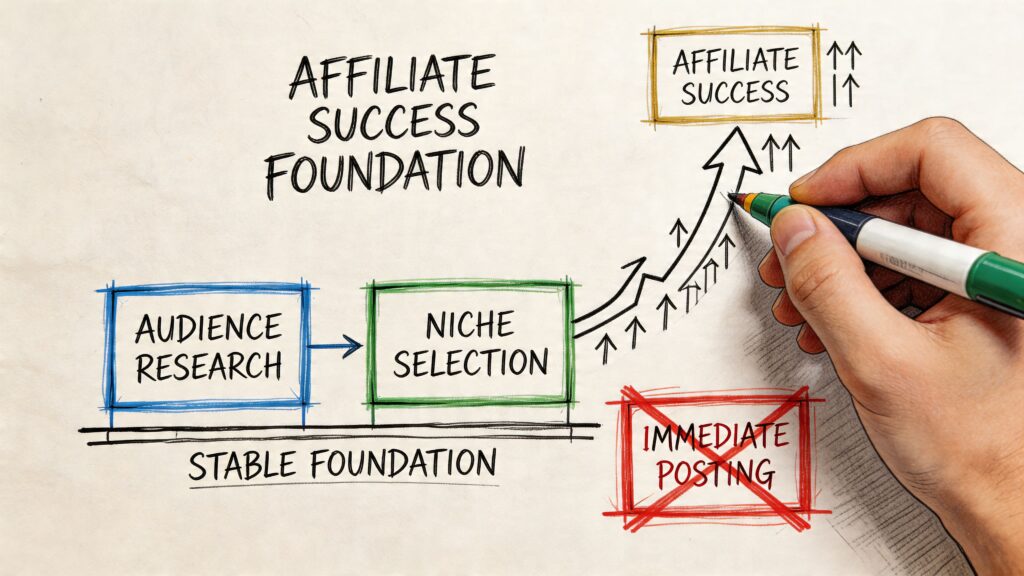
Instagram Affiliate Marketing Success
Pick a niche you can defend
A profitable niche isn’t just popular. It’s specific enough that followers can quickly understand what your page is for.
“Fitness” is broad. “Strength training for busy moms” is useful. “Skincare” is broad. “Barrier repair skincare for sensitive skin” is easier to monetize because the buying intent is clearer.
A good niche usually has these traits:
- You can speak from experience: You don’t need to be the world’s top expert, but you do need usable judgment.
- Products naturally fit the content: If every recommendation feels forced, the niche-offer fit is weak.
- Questions come up often: Repeated questions in comments and DMs signal demand.
- Content can repeat without getting stale: Tutorials, routines, comparisons, reviews, and mistakes all need room to exist.
Learn the audience beneath the demographics
Age and location help. They don’t close sales.
You need to know what followers hesitate over. Are they price sensitive? Overwhelmed by choices? Worried about wasting money? Looking for beginner-friendly recommendations? The better you understand the friction, the easier it is to create content that removes it.
Use your own comments, Story replies, polls, and DMs as research. Save exact phrases people use. Those phrases become hooks, captions, and DM automation triggers later.
If growth is still uneven, this resource is useful because it focuses on attracting followers who engage, not just inflating the top line.
Turn your profile into a landing page
Your profile has one job. Make the next action obvious.
Audit these elements:
- Bio clarity: State the niche, the audience, and the value in plain language.
- Profile image: Keep it recognizable and consistent with your content style.
- Link destination: Send visitors to the most relevant page, not a cluttered menu with too many choices.
- Highlights: Build evergreen proof. Think reviews, FAQs, product demos, wins, or “start here.”
- Account type: Use a Creator or Business account so you can access analytics and content tools.
Practical rule: If someone lands on your profile and can’t tell what you recommend within a few seconds, your affiliate content will underperform no matter how good the post is.
Evaluate offers with more than commission in mind
A higher payout can still be a bad deal if the product is hard to explain, weakly trusted, or poorly aligned with your audience.
| Offer factor | What to check | Why it matters |
|---|---|---|
| Product fit | Does it solve a recurring audience problem? | Relevance beats hype |
| Landing page quality | Is the page clear, credible, and easy to buy from? | Weak pages waste intent |
| Brand reputation | Would you recommend it without a commission? | Trust compounds |
| Tracking clarity | Can you see clicks, orders, and payouts cleanly? | You can’t optimize blind |
| Creative support | Does the brand provide assets, guidance, or examples? | Faster testing, better execution |
Choosing and Securing Profitable Affiliate Offers
A weak offer kills conversion before your content gets a fair shot. On Instagram, that problem gets worse in DMs, where people ask specific questions fast and expect clear answers.
Profitable affiliate programs usually share three traits. The product solves a problem your audience already talks about, the buying path is easy to understand, and the brand gives you enough visibility to track what happens after the click. If one of those breaks, revenue gets harder to scale.
What to look for before you apply
Start with buying intent. A product can have a solid commission rate and still perform badly if it creates too much friction between curiosity and purchase.
Review each offer like a media buyer, not a fan:
- Brand credibility: Read reviews, test support, and check whether customers actually get the result being promised.
- Conversion path: Open the landing page on mobile. If the page is slow, cluttered, or confusing, your Instagram traffic will leak.
- Tracking reliability: Clear reporting matters because you need to know which Reel, Story, or DM prompt drove the sale.
- Message fit: If you cannot explain the value in one Story frame or one short DM reply, the offer is harder to sell than it looks.
- Payout structure: Check cookie window, approval rules, and payout timing. A high commission with poor attribution often underperforms a lower commission with cleaner tracking.
I also look at whether the product works well inside a DM conversation. Some offers convert fine from a public post but stall in private because they trigger too many objections. Others improve in DMs because a short back-and-forth removes uncertainty and gets the click.
If you need help shaping the content angles around an offer, this guide to creating quality Instagram content is a useful reference before you commit to a program.
Comparing Affiliate Offer Types
| Offer Type | Best For | Key Consideration |
|---|---|---|
| Marketplace programs like Amazon Associates | Beginners, broad consumer niches, everyday products | Easy approval and familiar checkout, but margins are often lower |
| Direct-to-consumer brand programs | Creators with strong niche alignment | Stronger positioning potential if the landing page and brand trust are solid |
| Software and digital products | Educators, coaches, B2B creators, productivity niches | Longer education cycle, but often a better fit for DM-based selling |
| Courses and memberships | Authority-led accounts | Objections are higher, so proof and follow-up matter more |
Marketplace programs are often the easiest place to start because the products are familiar and the buyer has less trust to build. Direct brand programs usually take more work up front, but they can give you better conversion support, better creative freedom, and more room to negotiate once you show results.
How to pitch yourself to brands
If a brand does not list an affiliate program publicly, send a short outreach note that shows audience fit and commercial intent.
Include:
- Who you help
- What content format performs best for you
- Why their product matches the questions or problems your audience already has
- A few content angles you would test
- A direct request for terms, tracking details, and approval steps
Follower count is rarely the strongest part of the pitch. Relevance is.
A strong message sounds like this: “My audience regularly asks for beginner-friendly meal prep tools. I already create routine-based content around that problem, and your product fits naturally into a Story sequence, a comparison carousel, and a DM follow-up for people who want the exact setup.”
That last part matters. Brands respond better when you show how the offer will move from content into conversion, especially if you can explain how DMs will handle questions that a caption cannot.
Build a small offer stack first
Start with a tight stack you can effectively test:
- One low-friction product: Good for Stories, quick recommendations, and first-click behavior.
- One comparison product: Good for carousels, reviews, FAQs, and DM conversations.
- One higher-consideration offer: Good for leads who need proof, examples, and follow-up before buying.
This setup gives you cleaner data. It also makes DM automation easier to build later, because each offer has a defined role in your funnel instead of competing for the same click.
Crafting Content That Converts Followers into Clicks
Instagram’s algorithm now prioritizes performance-based ranking over vanity metrics, and carousel posts average 1.36% engagement while Reels average 1.24% engagement according to Maestra’s affiliate marketing statistics. That should change how you plan content.
A lot of affiliates still act like every format does the same job. It doesn’t. Reels are strong for discovery. Carousels are strong for education and decision support. Stories are where urgency and direct response often happen.
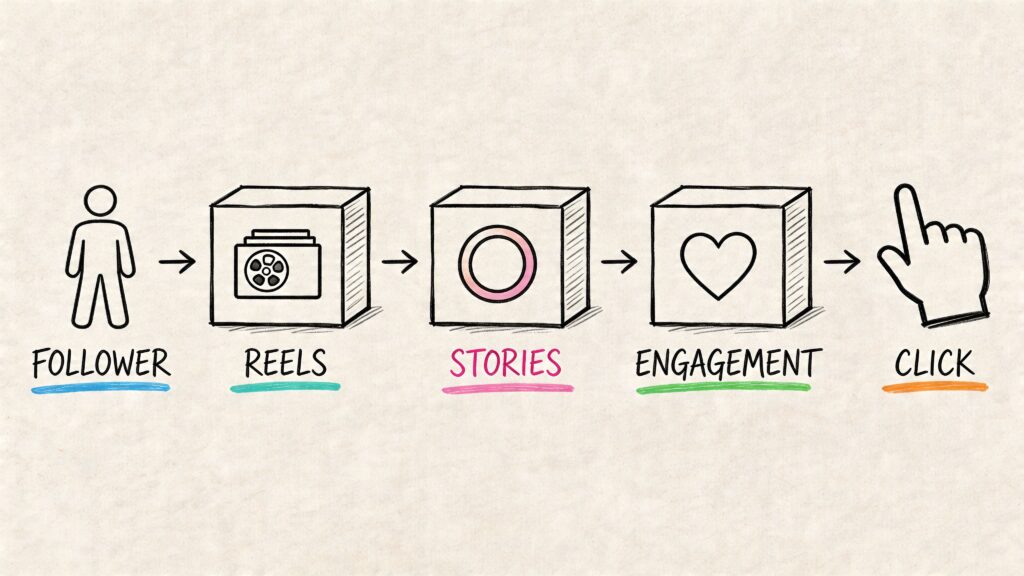
Instagram Affiliate Marketing Funnel
Use each format for a specific stage
Carousels work when someone needs context before they click. Think step-by-step tutorials, “mistakes I made,” before-and-after workflows, ingredient breakdowns, or side-by-side comparisons.
Reels work when you need to create attention fast. Use them to show a transformation, routine, shortcut, or product in action.
Stories work best when you’re continuing a conversation that has already started. Polls, question boxes, and link stickers reduce the jump from passive viewer to active prospect.
A practical content split looks like this:
- Carousel posts: Teach, compare, or break down a process.
- Reels: Hook attention and show a believable outcome.
- Stories: Handle objections, answer questions, and invite a DM.
If you need help improving the quality of the content itself, this is a useful reference for tightening the message, structure, and consistency.
Write captions that move someone forward
Weak affiliate captions sound like ads. Better ones sound like field notes.
Compare the difference.
Hard sell
- Buy this now.
- Link in bio.
- Best product ever.
Better
- I kept getting asked which one I use, so here’s the one I still recommend after trying several options.
- This solved the part of the routine that kept wasting time.
- If you want the exact version and how I use it, DM me “link” and I’ll send it over.
That last CTA matters. It turns a public post into a private conversation.
A click asks for commitment. A DM often feels smaller, easier, and more personal.
Build conversational funnels from public content
The mistake most affiliates make is ending the funnel too early. They create a strong Reel, ask for a click, and hope the product page does the rest.
A better system looks like this:
- Hook in public content: Focus on a problem, routine, or result.
- Invite a low-friction response: Ask people to DM a keyword or reply to a Story.
- Continue in private: Share the right recommendation based on what they need.
- Follow up if needed: Answer objections, offer a comparison, or send the right link.
That private step is where conversions often improve because you’re no longer sending every person to the same destination with the same message.
Here’s a visual walkthrough of how content and conversion can work together:
Content angles that usually work better than direct promotion
Try these instead of “top picks” posts every week:
- Problem-solution posts: Show the frustration first, then the product.
- Routine content: Place the product inside a repeatable habit.
- Comparison content: Help people decide between options.
- Beginner guides: Remove complexity for first-time buyers.
- FAQ content: Turn common DM questions into public assets.
When the recommendation feels like the next logical step in a useful piece of content, followers don’t experience it as a pitch. They experience it as help.
The Instagram DM Funnel: Your Secret Conversion Engine
Most affiliates stop at the link. That’s where they leave money on the table.
DMs are the missing layer. In commerce contexts, Instagram reports DM open rates can reach up to 90%, and Meta data shows conversational commerce in DMs drove 30% higher conversion rates in tests. At the same time, less than 5% of affiliate guides cover DM automation strategies, according to VCommission’s article on Instagram affiliate marketing best practices.
That gap matters because DMs solve the exact problems public content can’t solve well. They let you qualify intent, personalize the recommendation, and answer objections without forcing someone to leave the app too early.
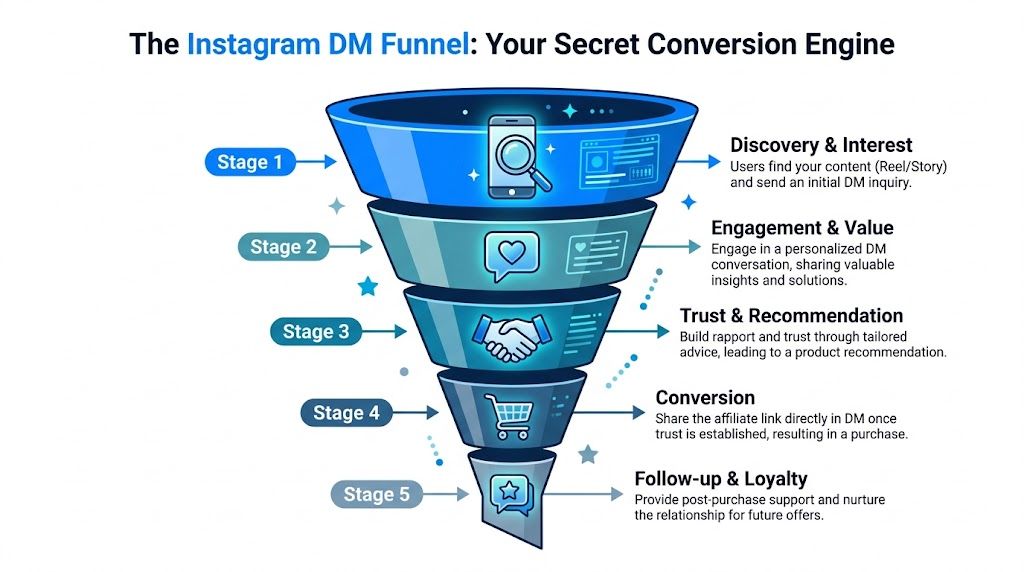
Instagram Affiliate Marketing DM Funnel
Why DMs convert better than a generic bio link
A bio link is one destination for many different people. That’s efficient, but it’s blunt.
A DM lets you ask one simple question before making a recommendation. That question might be:
- What’s your budget?
- Are you a beginner or more advanced?
- Are you looking for daily use or occasional use?
- Do you want the simple option or the more customizable one?
That one branch changes the recommendation quality.
Someone asking for “the best camera” and someone asking for “the easiest camera for indoor product videos” should not get the same answer. A DM funnel fixes that.
How to structure a DM funnel
A working affiliate DM funnel usually has five stages.
-
Trigger
Public content invites a message. Examples include “DM me ‘guide'” or “reply ‘tools’ and I’ll send the list.” -
Qualification
Ask a short question that helps segment the lead. -
Recommendation
Send the product that best matches their need, with a short explanation of why. -
Link delivery
Share the affiliate link only after the recommendation makes sense. -
Follow-up
If they don’t click or buy, send a useful nudge, comparison, or reminder.
Field note: The best DM funnels don’t feel automated. They feel fast, relevant, and clear.
What to track inside the conversation
A DM funnel is only useful if you can see where the drop-off happens.
Watch for:
- Trigger volume: Which posts start the most DM conversations?
- Qualification completion: Whether people answer your first question.
- Link delivery rate: How many conversations reach the offer.
- Click behavior by segment: Which type of person responds to which recommendation?
- Follow-up response: Whether reminder messages revive stalled intent.
UTM-tagged links matter here because they let you separate traffic sources. One product might convert well from Stories but poorly from a Reel. Another might sell best after a DM comparison.
If you want a deeper operational view of this channel, this article covers the mechanics of using Instagram DMs as a structured marketing workflow.
Keep the experience useful, not pushy
Bad DM funnels feel like spam because they rush straight to the link.
Good ones do three things first:
- acknowledge the user’s question,
- narrow the recommendation,
- explain the fit in plain language.
A short DM like “If you want the easiest starter option, this is the one I usually recommend because setup is simple” will usually outperform a bare link with no context.
That’s the advantage of Instagram affiliate marketing through DMs. It doesn’t just distribute links. It helps people choose.
Tracking, Optimizing, and Scaling Your Revenue
Most affiliates don’t have a content problem. They have a measurement problem.
They post consistently, get replies, see some clicks, and still can’t explain why one product sells and another stalls. That’s usually because they treat results as a creative mystery instead of an operating system.
According to Post Affiliate Pro’s guide on follower requirements and optimization, expert affiliates use custom UTM parameters for granular attribution and A/B test captions, CTAs, and paths to scale winners. That same source notes benchmarks where micro-influencers can achieve 20% higher conversion rates by systematically optimizing their strategy.
Build a simple measurement stack
You don’t need a complicated dashboard at the start. You do need consistency.
Track these at a minimum:
- Content source: Which Reel, Story, carousel, or DM trigger started the visit?
- Offer: Which affiliate product was recommended?
- CTA type: Link in bio, Story link, comment prompt, or DM keyword.
- Outcome: Click, conversation, or sale.
UTM parameters make this visible. Add tags that tell you the platform placement, campaign theme, and content variation. Then keep naming clean. If your tags are messy, your reporting will be useless.
Test one variable at a time
A lot of affiliates say they’re testing when they’re changing everything at once.
Don’t do that.
Change one element, then compare:
- Caption angle: tutorial versus personal story
- CTA wording: “DM me for the link” versus “comment, and I’ll send it.”
- Content path: direct link versus DM first
- Offer framing: beginner pick versus premium pick
If you change the creative, CTA, and product at the same time, you won’t know what caused the lift or the drop.
The point of testing isn’t to be clever. It’s to remove guesswork.
Scale the winners, not the loudest posts
A post with strong comments can still be a weak sales asset. A quieter post can produce better buyers.
That means your scale decisions should come from conversion behavior, not applause. When something works, don’t just repost the same asset. Expand the angle.
For example:
- Turn a strong carousel into a Reel summary.
- Turn a high-performing Story sequence into an evergreen Highlight.
- Turn a common DM objection into a new piece of educational content.
- Turn a successful recommendation flow into a repeatable automation path.
Use guardrails as you grow
More offers, more links, and more campaigns don’t automatically create more revenue. They often create confusion.
Keep a shortlist of active offers. Review them regularly. Remove underperformers that don’t justify the audience attention they consume. A narrower offer set usually leads to clearer messaging and better follow-through.
A key scaling move in Instagram affiliate marketing isn’t posting more. It’s identifying the combinations of audience, content format, CTA, and offer that repeatedly produce sales, then building systems around those patterns.
Common Pitfalls That Derail Instagram Affiliates
A lot of Instagram affiliates do the visible work and miss the conversion work.
They spend hours on Reels, captions, and Story design, then treat DMs like inbox clutter instead of the place where buying decisions are made. That mistake shows up fast. Clicks stay low, replies go cold, and affiliate links get ignored because the audience never got enough context to act.
The pattern is usually simple. The product is a weak fit. The posting cadence is erratic. The creator pushes links before building trust. Questions in comments and DMs pile up, but nothing changes in the content or the offer flow. Disclosure gets skipped or buried. Over time, followers stop treating recommendations as useful and start treating them as ads.
The mistakes that show up first
- Promoting products that do not match the audience: If the offer solves the wrong problem, better creative will not fix it.
- Treating follower count as the main metric: A smaller niche audience with clear purchase intent often outperforms a larger audience that only watches.
- Ignoring DM patterns: Repeated questions, hesitation, and objections show exactly where your funnel is breaking.
- Skipping or hiding disclosure: Clear labeling protects trust and reduces compliance risk.
- Only showing up to sell: If every touchpoint feels transactional, response rates drop.
- Sending cold traffic straight to a link: Many buyers need a short DM exchange before they click with intent.
The practical fix for each one
Tighten your offer set first. A narrow set of recommendations makes your positioning clearer and makes it easier for followers to remember what you are known for.
Build a content rhythm that earns the sale before you ask for it. Educational posts, comparisons, setup tips, FAQs, and objection handling give people a reason to trust your judgment. Then your CTA can move interested viewers into DMs, where you can qualify interest, send the right product, and handle the last point of friction before the click.
Treat DMs as a funnel stage, not a support task. Save the questions you get every week. Turn those into quick replies, Story frames, Highlights, and DM automations. If people keep asking whether a tool is beginner-friendly, whether it works on a budget, or whether there is a cheaper option, your public content is missing buying context.
Make disclosure part of the workflow. Add it to captions, Stories, and DM replies that include affiliate recommendations. People rarely object to disclosure. They object when the recommendation feels forced, or the product disappoints after the sale.
One more mistake causes quiet damage. Many affiliates recommend products they would never use themselves because the payout looks good. That decision usually hurts twice. Conversion is weaker up front, and refund risk, buyer disappointment, or audience skepticism makes the next recommendation harder to sell.
If a product creates regret after the purchase, the commission was never worth it.
Strong Instagram affiliate programs are built on fit, trust, and follow-through. Public content gets attention. DMs help convert that attention into sales. Affiliates who ignore that second step usually plateau early.
Your Instagram Affiliate Questions Answered
If you want to turn Instagram DMs into a structured affiliate conversion channel instead of answering messages manually, Clepher helps you build automated DM flows, segment leads, send personalized recommendations, and track what happens after the conversation starts. It’s a practical fit for brands, creators, and agencies that want to scale Instagram conversations without losing the personal feel that drives conversions.