
An Instagram welcome message can reach a business conversation at a remarkably valuable moment. Meta has reported that 150 million people message businesses on Instagram every month, while industry summaries report that 200 million people visit a business profile every day (Instagram DM statistics). That combination makes the first reply more than a polite greeting. It can direct attention toward a product, qualify intent, build trust, or deliver useful education.
The best template depends on who is messaging, what triggered the conversation, and what you want the person to do next. A shopper needs a clear path to a product. A coaching lead may need a question. An agency prospect may respond better to a useful observation than an immediate offer.
Below are seven conversion-focused approaches for e-commerce brands, creators, agencies, SaaS companies, coaches, and local businesses. Each example includes the right CTA, timing, trigger, audience fit, and practical ways to adapt the flow in Clepher. For more ideas on improving your first exchange, explore these AI-powered DM tips.
1. The Direct Value Proposition Welcome
A direct value proposition answers the recipient’s first silent question: “Why should I reply?” Instead of opening with a generic “Thanks for following,” lead with a useful benefit, a relevant offer, or a clear solution to a known problem.
For an e-commerce brand, try:
Hey! 👋 New here? Reply YOUR and we’ll send you a first-order offer.
A DTC skincare brand could make the message more specific:
Welcome! If you’re trying to build a simpler evening skincare routine, reply ROUTINE and we’ll recommend a starting point.
For an agency, the value doesn’t need to be a discount:
Hi! We help local brands turn more website visits into enquiries. Reply AUDIT and we’ll send a quick idea for your homepage.
The strongest version offers one action, not a menu of competing choices. A discount, product recommendation, consultation, and downloadable guide in the same opener create unnecessary friction. Keep the first message focused, then use the response to decide what comes next.

Instagram Welcome Message Discount Offer
Make the offer useful to your flow
Use Instagram Direct message templates to create variations for different products, campaigns, or customer problems. Clepher personalization tags can reference the post, ad, or link that brought someone into the conversation, provided your setup captures that context.
Tag people based on their action. Someone who replies with a keyword should enter a different segment from someone who receives the message but doesn’t engage. A product-specific reply can trigger product education, while a general offer can lead to a broader discovery question.
Your follow-up should add context rather than repeat the offer. Explain who the product suits, answer a common objection, or point to a relevant customer resource. Then review Clepher analytics to compare which value propositions create conversations, not just clicks.
2. The Curiosity-Driven Question Welcome
Some audiences aren’t ready for an offer, but they are willing to describe what they need. A question-led Instagram welcome message turns the opener into a lightweight discovery step and gives you useful first-party information for segmentation.
A marketing consultant might write:
Hey! Quick question. Are you trying to improve content, leads, or sales right now? Reply with the one that’s most relevant.
A course creator could ask:
Welcome! What’s your biggest challenge with learning Spanish right now, speaking, vocabulary, or staying consistent?
The question works because it asks the recipient to choose a direction instead of inventing a response from scratch. Three options are often enough to make the decision easy while still revealing intent. Avoid options that overlap so heavily that the answer becomes difficult to interpret.
Route each answer immediately
Clepher conditional flows can send each response down a relevant path. A person who selects “sales” might receive a case explanation or consultation prompt. Someone who selects “content” might receive a planning resource. Create custom fields for those answers so future broadcasts and follow-ups reflect the person’s stated interest.
Practical rule: Ask a question only when your next message changes based on the answer.
Typing indicators can make the automated exchange feel less abrupt, particularly when the message contains a personal question. More importantly, use the answer in the very next reply. If someone says they need help with lead generation, respond to that problem directly rather than sending a generic menu.
This approach suits agencies, coaches, SaaS onboarding teams, and service businesses where the buyer’s situation matters more than a single product SKU. It is less suitable when the user has already clicked a product-specific ad and clearly expects a direct purchasing path.
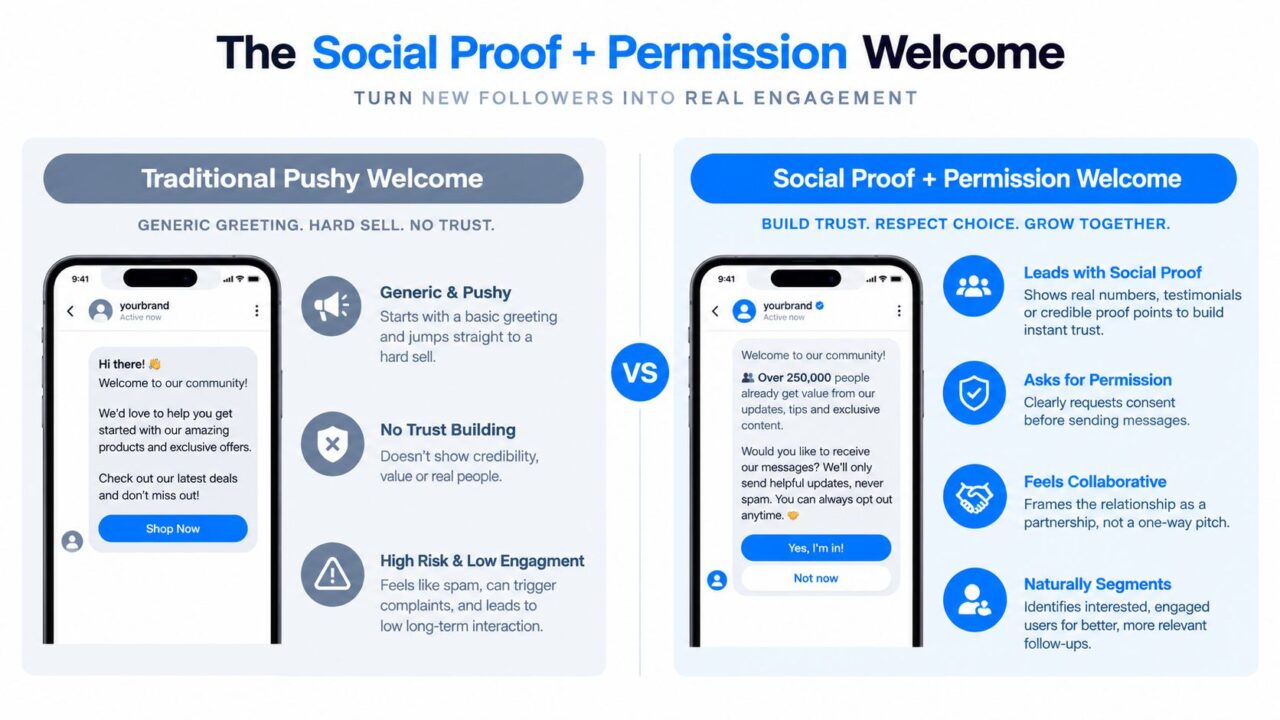
3. The Social Proof and Permission Welcome
Trust matters most when a new contact doesn’t know your brand yet. This format combines a concise proof point with a permission question, so the recipient understands what others value and retains control over the next exchange.
A fitness coach might say:
Hey! 👋 People come to us for practical strength training that fits busy schedules. We share simple routines and occasional coaching openings here. Want us to send you the useful stuff?
A B2B software company could write:
Welcome! Teams use our platform to keep customer conversations organized in one place. We share workflow tips and product updates here. Would that be useful to you?
Use the strongest verified proof point you have, such as a review, a relevant customer result, or a clearly documented product capability. Don’t inflate a vague claim into a number, and don’t use social proof that has no connection to the recipient’s likely goal. “Trusted by everyone” sounds empty. A specific observation about the problem you solve is more credible.
Ask before ongoing messaging
Permission is especially important before adding someone to a recurring broadcast sequence. In Clepher, tag people who explicitly opt in, then keep that audience separate from general Instagram contacts. That distinction helps you control who receives promotional content and gives your team a cleaner view of engagement.
The permission question should also be easy to answer. “Want practical tips?” is more conversational than a long consent paragraph inside the first message. If the person declines, respect it. If they agree, deliver something relevant in the next exchange instead of immediately switching to a hard sales pitch.
This pattern is a good fit for creators, consultants, agencies, and brands selling considered purchases. It may underperform for a highly urgent support request, where the user needs an answer before hearing about your broader community or content.
4. The Personalized Context Welcome
Personalization works when it reflects real context, not when it merely inserts a first name. Mention the post they commented on, the Story they replied to, the product page they visited, or the campaign that brought them into the DM.
A creator could write:
Hey [First Name]! I saw you replied to our post about planning weekly content. Are you building a plan for your own brand or for clients?
An e-commerce brand might say:
Hi [First Name]! You came in through our running shoe guide. Want help comparing cushioning, fit, or everyday durability?
That message feels more relevant because it explains why this conversation is happening. It also gives the recipient a simple way to correct your assumption. Don’t pretend to know more than the data shows. If you only know that someone interacted with a post, don’t claim they need a particular product.
Instagram Welcome Message Marketing Comparison
Capture the source accurately
Use tracking parameters and custom fields in Clepher’s Instagram chatbot tools to record the source of the first contact. A Story reply, a comment keyword, a website click, and an ad click can represent very different levels of intent. Each deserves a different next step.
Official-platform constraints also matter. Guidance on Instagram welcome message automation notes that true new-follower automation isn’t generally available through the official API, so teams commonly begin conversations through permitted entry points such as Story replies, comment keywords, first DMs, or click-to-message ads. Build around the trigger you can use instead of promising a follower workflow your account cannot deploy.
Branching by source lets you send a product walkthrough to an ad clicker, a helpful explanation to a cold content visitor, and a support route to someone who arrived through a help post. Test shallow personalization against source-specific personalization, then judge the quality of the resulting conversations.
5. The Problem-Solution Story Welcome
A story-based opener starts with the frustration your audience already recognizes. It then explains why your product, service, or method exists. This approach gives the recipient a reason to care before you ask for a commercial action.
A workflow SaaS company might write:
Most growing teams struggle to keep customer questions from getting lost across inboxes. We built our workflow to bring those conversations into one place without adding another complicated process. Want to see how it works?
A career coach could say:
We kept hearing from talented professionals who were applying for roles but struggling to explain their value. That’s why we created a practical interview framework built around clearer examples. Want the first exercise?
Keep the problem concise. The opening should sound like a recognizable situation, not a dramatic brand manifesto. Avoid unsupported claims about how much money, time, or effort people lose. The reader doesn’t need exaggerated stakes to recognize a genuine problem.
Let pain points trigger the right reply
Clepher AI keyword triggers can identify phrases that point to a problem in an initial DM. If someone mentions abandoned carts, confusing onboarding, or inconsistent content, route them to a relevant response instead of a general welcome sequence.
The solution should describe an outcome rather than a list of features. “See how to organize replies by customer intent” is more useful than “Our platform has advanced automation.” Follow the opener with a small commitment:
Want me to send one practical tip for that?
That CTA is easier to accept than “Book a call” when trust is still forming. You can test different problem angles in Clepher and compare not only replies, but also whether those replies lead to qualified conversations. The best story isn’t the one that attracts the most attention. It’s the one that attracts people with a problem you can solve.
6. The Exclusive Access and Scarcity Welcome
Exclusivity can turn a general audience into a focused subscriber group, but it only works when the special treatment is real. Tell people what they receive through the DM channel, then give them a clear choice about whether they want access.
For a product brand:
Hey! 👋 This DM group gets first looks at new collections, private product guidance, and occasional codes before we share them publicly. Want access?
For a workshop provider:
Welcome! We’re opening a small group program soon, and this DM channel gets priority details. Reply APPLY if you’d like the information. Reply STOP anytime if you’d rather not receive these messages.
Don’t invent limited inventory, deadlines, or VIP benefits. False urgency may produce a short-term click, but it makes future messages less credible. If you say the audience receives exclusive information, don’t just copy the public feed into the DM.
Instagram Welcome Message VIP Ticket
Deliver the promised access
Create a dedicated segment for DM subscribers and use Instagram DM automation in Clepher to manage the sequence. The second message should validate the invitation with something genuinely useful, such as a private product preview, a relevant guide, or details that aren’t available in the public feed.
Make opting out simple. A clear command such as STOP gives people control without forcing them through a complex process. Keep the VIP audience separate from general followers, and review engagement by segment to see whether the exclusive content is earning attention.
This format suits launches, memberships, workshops, limited services, and creator communities. It isn’t the right choice for every everyday purchase. If the product has no meaningful private benefit, a direct value proposition or educational welcome will usually feel more honest.
7. The Value-First Educational Welcome
Education earns attention without demanding an immediate purchase. It works particularly well for SaaS companies, agencies, consultants, educators, and creators whose buyers need to understand a problem before choosing a solution.
A content agency could send:
Hey! One common content mistake is publishing more before checking whether each post has a clear job. We put together a simple way to map posts to awareness, consideration, and action. Want me to send it?
A SaaS company might write:
Welcome! A useful way to reduce repetitive support questions is to group them by customer intent before building automations. Want our short sorting framework?
The insight should be specific enough to prove that you understand the problem. Generic advice such as “post consistently” gives the recipient no reason to continue. Offer a guide, worksheet, template, or framework that helps them make progress immediately.
Build a useful sequence
Use Clepher link tracking to see which resources generate follow-up questions, then create a progression from educational welcome to a second resource and, only when appropriate, a soft product invitation. Conditional flows can recommend different material based on the person’s source or stated interest.
Ask for a reaction after delivery:
Did that help, or is there a part you’d like us to explain?
The answer reveals which subjects deserve more content and which leads may be ready for a deeper conversation. If you offer a downloadable resource, you can also invite the person to exchange contact details, but keep the value clear and don’t hide the resource behind unnecessary forms.
This approach is slower than an immediate offer, but it can be a better fit for complex services and high-consideration products. It positions the business as useful before it asks the audience to buy.
7 Instagram Welcome Message Styles Comparison
| Template | Implementation Complexity 🔄 | Resource & Speed ⚡ | Expected Outcomes 📊⭐ | Ideal Use Cases 💡 | Key Advantages ⭐ |
|---|---|---|---|---|---|
| The Direct Value Proposition Welcome | Low 🔄, simple script; easy A/B testing | Low ⚡, fast setup; immediate responses | 📊 Higher short-term conversions; ⭐⭐, effective for quick action | E‑commerce, DTC, flash sales, product launches | Immediate relevance; qualifies leads; easy to measure |
| The Curiosity-Driven Question Welcome | Moderate 🔄, needs branching/flows and good question design | Moderate ⚡, slower to convert; richer conversations | 📊 Better qualification and first‑party data; ⭐⭐⭐, high long‑term value | Coaches, consultants, SaaS discovery, lead qualification | Gathers zero‑party data; builds rapport; improves targeting |
| The Social Proof + Permission Welcome | Low‑Moderate 🔄, assemble credible proof points and opt‑in flow | Low ⚡, quick to send but requires proof upkeep | 📊 Increases trust and opt‑ins; ⭐⭐⭐, reduces skepticism and spam reports | Course creators, established brands, skeptical audiences | Builds legitimacy; permissioned audience with higher retention |
| The Personalized Context Welcome | High 🔄, requires tracking, integrations, and custom fields | High ⚡, more setup and slower to scale at one‑to‑one level | 📊 Much higher response rates and attribution clarity; ⭐⭐⭐ | Multi‑campaign marketers, high‑ticket sales, B2B | Feels one‑to‑one; improves campaign attribution and relevance |
| The Problem‑Solution Story Welcome | Moderate 🔄, needs accurate problem framing and concise story | Moderate ⚡, takes longer to engage but drives deeper interest | 📊 Strong emotional engagement and qualification; ⭐⭐⭐ | Transformation offers, coaches, premium e‑commerce | Validates pain; positions solution empathetically; improves LTV |
| The Exclusive Access & Scarcity Welcome | Moderate 🔄, manage exclusivity, inventory, and opt‑outs | Moderate ⚡, fast responses but needs ongoing exclusive content | 📊 High urgency-driven conversions; ⭐⭐⭐, filters engaged users | VIP lists, memberships, limited launches, flash sales | Creates urgency and perceived value; segments high‑intent users |
| The Value‑First Educational Welcome | Moderate‑High 🔄, requires quality content creation and sequencing | High ⚡, resource intensive; slower conversion timeline | 📊 Builds authority and long‑term conversions; ⭐⭐⭐, excellent for trust | SaaS, agencies, educators, content‑led growth | Establishes expertise; nurtures high‑quality leads over time |
Make Every Welcome DM Earn the Next Reply
Choose the template by matching audience, trigger, and conversion job. A product-page visitor may need a direct recommendation. A comment on an educational post may deserve a question. A Story reply about a problem can enter a solution-led flow. A new contact who doesn’t know your brand may respond better to proof, permission, or useful education.
Keep the first exchange focused. Practical setup guidance commonly recommends a short, action-oriented message of 2–3 lines, with a clear next step such as setting reply expectations or inviting a keyword response (Instagram business messaging guidance). Don’t ask for a purchase, a survey, an email address, and a consultation in the same opener. Pick one CTA and make the next reply obvious.
Define the follow-up before you publish. If the person replies with a product keyword, send the product information. If they choose a challenge, acknowledge that exact challenge. If they accept an educational resource, deliver it and ask whether it helped. Automation should remove delay without removing relevance.
Timing matters because Instagram Direct is an active business channel. Independent coverage describes Instagram Direct as having more than 375 million monthly users and more than 400 million business messages per day in 2025-era reporting, while other summaries report open rates around 80–90% and reply rates as high as 60% (Instagram Direct overview). Treat those figures as directional context, not a guarantee for your account. Your trigger, offer, audience, and measurement method will shape performance.
Build four initial variants in Clepher: offer, question, personalization, and education. Apply tags and segments, use conditions to route answers, and review analytics for qualified conversations rather than vanity engagement. A benchmark analysis of 63,286 Instagram DMs reported a pooled reply rate of 15.7%, with 83% of replies arriving within 24 hours and 42% within the first hour (Instagram DM benchmark analysis). That makes a defined follow-up path especially important soon after the opener lands.
Finally, compare triggers, not only wording. Independent automation reporting places comment-to-DM flows at 50–60% average reply rates, Story-reply automation at 40–50%, keyword triggers at 30–40%, and broadcast DMs at 15–25% (Instagram outreach tracking research). The practical lesson is clear: a self-selected action usually gives you better context than a generic broadcast. Use Clepher A/B testing and random path distribution to learn which message and trigger combination creates the strongest business outcome. If you also create supporting video content, a video generation app can help you produce educational assets to share after the first reply.
Clepher gives you a no-code way to build Instagram Direct welcome flows, use keywords and Ice Breakers, personalize replies, segment contacts, and measure what happens after the first message. Visit Clepher to turn these templates into tested conversations for your products, services, or community.
