
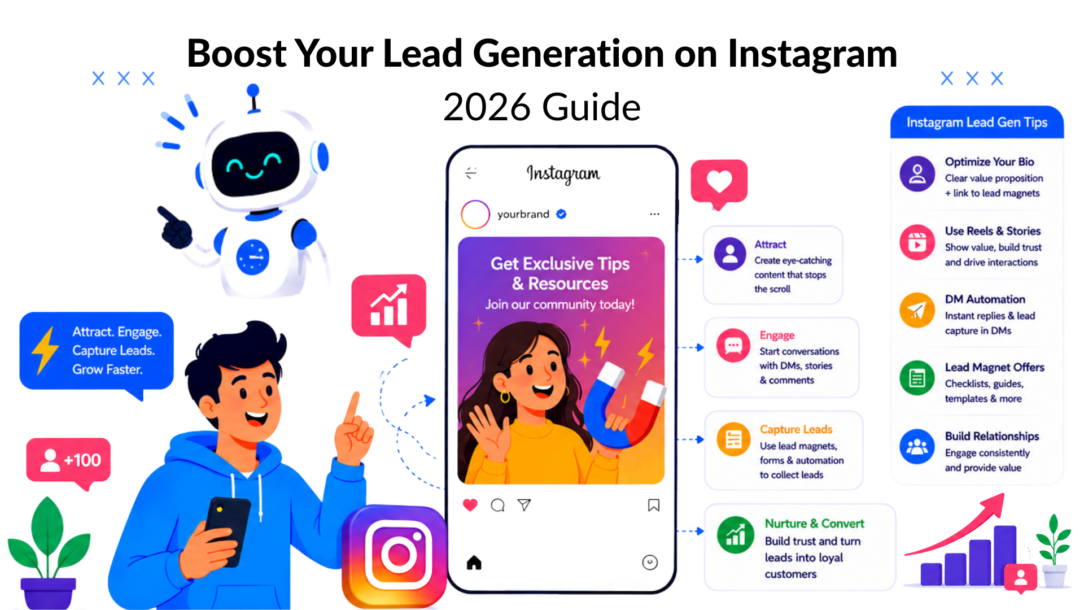
You’re probably posting consistently, getting likes, maybe even a few comments and Story replies, but your pipeline still feels thin. The account looks active. The business doesn’t feel that way.
That gap is why so many brands get frustrated with Instagram. Visibility feels real, but revenue stays fuzzy. A post performs well, people engage, and then nothing happens because there’s no system that turns attention into a conversation, and no conversation that turns into a qualified lead.
Instagram is still one of the strongest places to fix that problem. In 2025, Instagram delivered a 1.85% conversion rate for paid campaigns, the highest benchmark across major social platforms for lead generation and sales, according to Lead Response’s Instagram marketing statistics roundup. That matters because it reframes Instagram from a content channel into a revenue channel, especially for businesses that sell services, appointments, consultations, coaching, or considered purchases.
Most accounts don’t need more content. They need better movement from post to DM, from DM to qualification, and from qualification to booked action.
Turning Instagram Likes into Business Leads
A busy Instagram account can still be a weak sales channel. I see this all the time with service businesses, creators, agencies, and local brands. They’ve built attention, but they haven’t built a path.
The usual pattern looks like this:
- Posts get engagement, but no one knows what to do next
- Stories get views, but there’s no follow-up process
- The bio sounds nice but doesn’t answer who the business helps
- Leads arrive randomly through scattered DMs and vanish in the inbox
That’s not a traffic problem. It’s a conversion design problem.
Instagram works best when you stop treating it like a digital brochure and start treating it like a conversation engine. For lead generation on Instagram, the goal isn’t to collect passive approval. The goal is to create a simple next step that a potential customer can take without leaving the app.
Practical rule: If a stranger can’t tell what you offer and what to do next within a few seconds, your profile is leaking leads.
For many businesses, the fastest path isn’t “click link in bio.” It’s a lower-friction interaction such as “Comment GUIDE below,” “Reply PRICE,” or “Send CHECKLIST.” That shift matters because it moves a cold viewer into an active exchange. If you want more examples of how direct interactions can start the lead journey, look at these Instagram Story reply tactics for conversations that convert.
Lead generation on Instagram becomes predictable when each part of the account has a job. Your bio filters. Your content attracts. Your CTA starts the conversation. Your DM flow qualifies the lead. Your team or automation handles the handoff.
That’s the difference between an account that looks good and one that produces business.
Build Your Lead Generation Foundation
A lead machine starts with three pieces working together. If one is weak, the whole account underperforms. A polished Reel won’t save a vague bio. A great offer won’t help if the profile sends people to one generic homepage link.
For Instagram lead generation in 2026, a frictionless setup starts with a bio that clearly states who you help and what you offer, then uses a branded micro-site style link-in-bio tool to present multiple lead magnets instead of one generic URL, as outlined in Sked Social’s guide to Instagram lead generation.
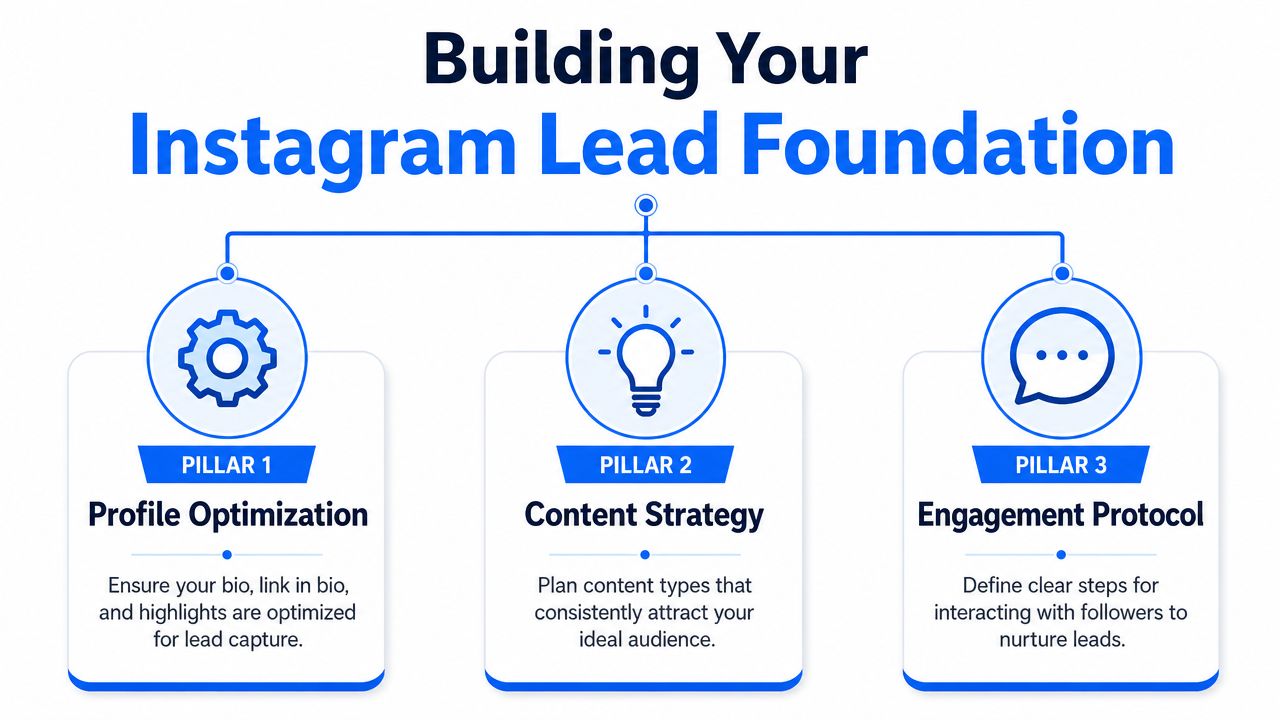
Lead Generation on Instagram Lead Foundation
Clarify the profile
Your bio should answer three questions fast:
- Who is this for?
- What result do you help with?
- What should I do next?
Here’s the difference.
| Weak bio | Strong bio |
|---|---|
| Helping people grow online | Helping fitness coaches book consult calls through Instagram DMs |
| Smile transformations daily | Cosmetic dentist in Austin. Veneer and whitening consults |
| Academic support for students | Online math tutoring for GCSE students. Get the parent starter guide |
A strong bio is concrete. It uses buyer language, not internal brand language.
Use this template:
I help [audience] get [result] with [offer or method].
Get [lead magnet] below.
Examples:
- I help med spa owners book more consultations with Instagram content. Get the treatment promo checklist below.
- I help first-time homebuyers understand the mortgage process. Get the pre-approval guide below.
- I help parents find the right online tutor. Get the student onboarding checklist below.
If you run a tutoring business, your Instagram profile should connect to an actual intake and follow-up process. That’s where a system like tutoring CRM software becomes useful because it gives you a place to organize student inquiries after Instagram starts generating them.
Create lead magnets people actually want
Most lead magnets fail because they’re too broad. “Free tips” is not an offer. A lead magnet should solve one immediate problem your audience already knows they have.
Good examples:
- For a coach: “7 sales call objections and how to answer them”
- For an e-commerce brand: “Shade finder quiz”
- For a SaaS brand: “Onboarding checklist for your first team workspace”
- For a local service business: “Before-you-book checklist”
A lead magnet works when a prospect thinks, “I need that now,” not “I might read that later.”
Make the promise small and specific. Checklists, quizzes, calculators, mini-guides, and short audits usually outperform broad ebooks because they feel faster to consume and easier to act on.
Turn your link in bio into a micro-site
One homepage link is lazy. It forces the visitor to do the sorting.
A better structure gives different buyer types a direct path:
- New visitors get an entry offer such as a checklist or quiz
- Warm prospects get a booking page or demo request
- Existing followers get current promotions, FAQs, or product pages
A simple micro-site menu might look like this:
- Get the free guide
- Take the quiz
- Book a call
- View client results
- Browse offers
Lead generation on Instagram gets cleaner. Instead of asking everyone to take the same action, you let intent determine the path.
Create Content That Attracts and Converts
Content only generates leads when each format has a job. Too many brands post the same message in three places and hope one version works. That’s not a funnel. It’s repetition.
Benchmark data shows that smaller brands with under 10K followers should target a 10% Engagement Rate, while larger brands with over 501K followers should aim for an 8% Reach Rate on posts and 1% on Stories, with peak engagement at 3pm EST and 8pm EST, according to Bazaarvoice’s Instagram metrics benchmarks. The same benchmark notes two common mistakes that hurt lead generation on Instagram: generic CTAs and failing to deliver lead magnets within 24 hours.
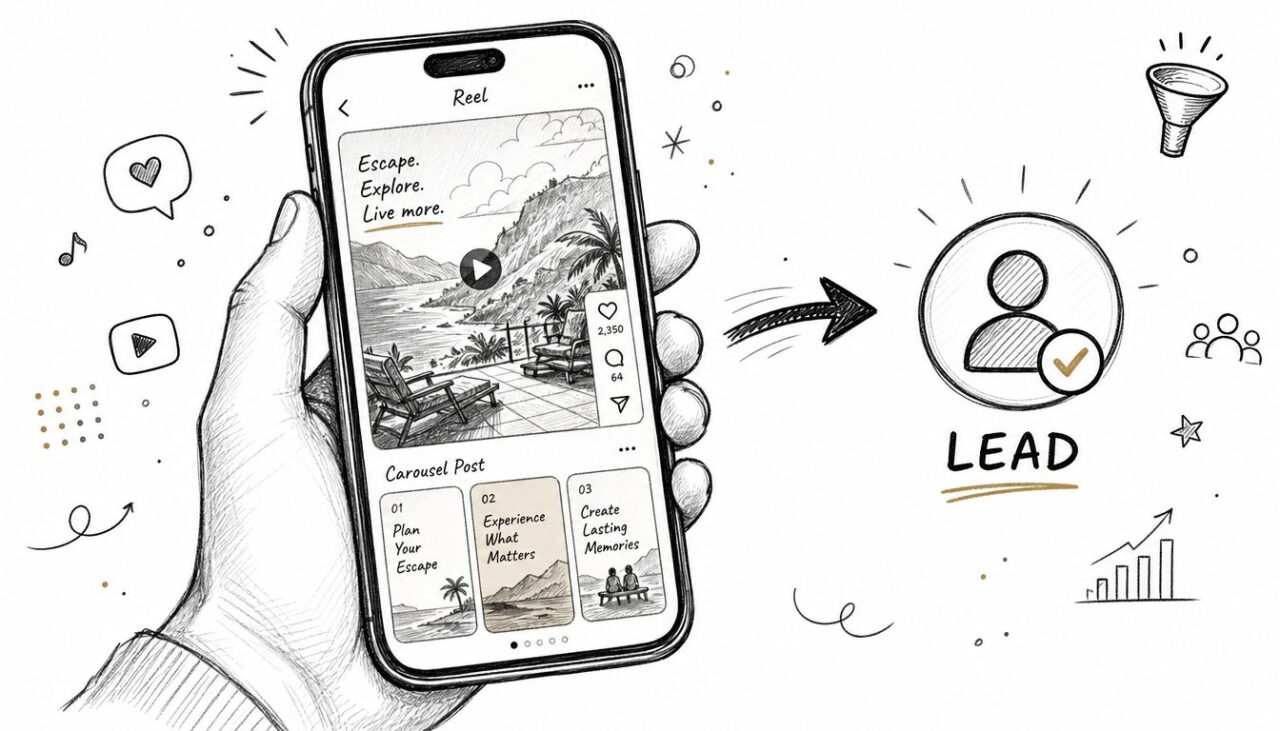
Lead Generation on Instagram Lead Conversion
Use Reels for discovery
Reels are your top-of-funnel magnet. Their job is to reach people who don’t know you yet and give them a reason to interact.
Strong Reel topics usually do one of these:
- Expose a costly mistake such as “Why your clinic’s before-and-after content isn’t booking consults”
- Show a fast win such as “Three product page fixes that reduce abandoned carts”
- Challenge a bad assumption such as “Why posting daily isn’t the problem”
The CTA should match that format. Don’t end with “link in bio.” Give a direct action inside Instagram.
Better options:
- Comment GUIDE and I’ll send the checklist
- DM AUDIT for the template
- Reply PLAN in Stories for the worksheet
For stronger creative direction, study examples of creating quality Instagram content that pulls people toward action.
Use feed posts for trust and qualification
Feed posts are where prospects decide whether you understand their problem. Carousels work well because they let you unpack a specific issue and guide the reader to a next step.
A good lead-focused carousel often follows this pattern:
- Name the problem
- Explain why it happens
- Show what to do instead
- Offer a tool or guide in exchange for engagement
Example for a consultant:
- Slide 1: Why your discovery calls feel unqualified
- Slide 2: You’re attracting curiosity, not buying intent
- Slide 3: Your CTA is too broad
- Slide 4: Ask for a keyword to trigger the right follow-up
- Slide 5: Comment SCRIPT for the qualification framework
The post builds authority. The CTA starts the lead process.
Use Stories for urgency and replies
Stories are where warm followers move fastest. They’re ideal for polls, question boxes, quick offers, time-sensitive reminders, and low-pressure prompts.
Try sequences like:
- Poll: Are you struggling more with traffic or conversion?
- Story 2: If you picked conversion, I made a short checklist
- Story 3: Reply CHECKLIST and I’ll send it
Field note: Generic CTAs like “let me know” create weak response behavior. Verb-led prompts get better action because they remove ambiguity.
Fix the mistakes that kill conversion
A lot of Instagram content fails before the algorithm even matters.
Common issues include:
- Weak CTA wording such as “Check the bio” instead of “Comment PLAN for the worksheet”
- Slow fulfillment when someone responds and hears nothing back until the next day
- No content-to-offer match when a Reel about pricing sends people to a homepage
- Hashtag laziness when every post uses only broad tags and attracts the wrong people
The best content for lead generation on Instagram doesn’t just earn attention. It earns a response you can act on.
Automate Lead Capture with DMs and Chatbots
Most lead forms create a dead stop. Someone fills out a box, leaves the app, and becomes another entry in a spreadsheet or CRM queue. Then the business follows up late, asks the same questions again, and wonders why the lead went cold.
Conversational capture works differently. The prospect raises a hand inside Instagram, gets an instant response, and moves straight into a qualification flow while intent is still fresh.
Lead Generation on Instagram Chatbot Marketing
Meta data cited by Folk’s article on Instagram lead generation shows that click-to-DM ads generated 2.5x higher conversion rates than traditional lead forms in 2025 to 2026, especially for B2B and service-based businesses. That tracks with what many marketers see in practice. A real conversation usually reveals intent faster than a static form.
Why DM workflows convert better
A form asks for information. A DM starts momentum.
That difference matters because people are more likely to continue a process they’ve already begun inside the same app. They don’t need to load a landing page, decide whether to trust it, and then complete a generic set of fields. They just reply.
Here’s where DM automation becomes useful. A tool like Instagram DM automation can trigger responses from comments, keywords, or Story replies, send the promised resource instantly, ask follow-up questions, and tag people based on intent. Used properly, that turns scattered inbox activity into a structured lead qualification system. This is the one place where a platform such as Clepher fits naturally because it handles those Instagram DM flows with no-code logic and segmentation.
The Comment to DM workflow
This is the simplest version of the system.
-
Publish a post with a keyword CTA
Example: “Comment AUDIT, and I’ll send the conversion checklist.” -
Trigger an automatic DM
The message delivers the promised asset immediately. -
Ask one qualifying question
Example: “Are you looking for help with lead generation, follow-up, or both?” -
Segment by response
Tag the lead based on what they selected or typed. -
Route to the next step
Send qualified leads to book a call, request pricing, browse an offer, or talk to a human.
That flow is stronger than a basic form because it captures two things at once: contact intent and buying context.
What to ask in the DM flow
Bad automation feels robotic because it asks too much, too soon. Good automation asks just enough to move the lead forward.
Use questions that help you qualify without creating friction:
- What are you trying to solve right now?
- Is this for your business, your team, or a client?
- Do you want the DIY version or help implementing it?
Each answer should change the path.
A consultant might segment leads into:
- DIY resources
- Done-with-you interest
- Done-for-you high intent
An e-commerce brand might segment into:
- First-time buyer questions
- Product fit questions
- Shipping or promo inquiries
A local service business might segment into:
- Ready to book
- Comparing options
- Just researching
The best DM automation doesn’t mimic a human conversation perfectly. It removes waiting, delivers value fast, and gets the lead to the right next step.
After the first few messages, use a human takeover when the lead shows purchase intent. Automation should do the sorting. People should handle the close when nuance matters.
Examples by business type
Coach or consultant
A Reel teaches one sales mistake. CTA: “Comment SCRIPT.” The DM sends a script template, asks what they sell, then offers a strategy call for people who want help implementing.
DTC brand
A post compares two product options. CTA: “DM MATCH.” The flow asks about preference, need, or use case, then recommends a product page and captures intent signals.
Agency
A carousel breaks down poor ad follow-up. CTA: “Comment CRM.” The DM delivers a checklist, asks whether the person runs in-house or client campaigns, then routes agencies and brands differently.
This is the underused edge in lead generation on Instagram. The conversion doesn’t happen because the content is clever. It happens because the conversation starts immediately.
Scale Your System with Instagram Ads
Ads work best when they amplify an offer and conversation flow that already works organically. If a post gets good comments but weak DMs, don’t spend more money. Fix the handoff first.
The cleanest ad setup for lead generation on Instagram is a click-to-message campaign built from proven content. That means you take a Reel, Story concept, or feed post that already triggered replies, then put budget behind the same angle.
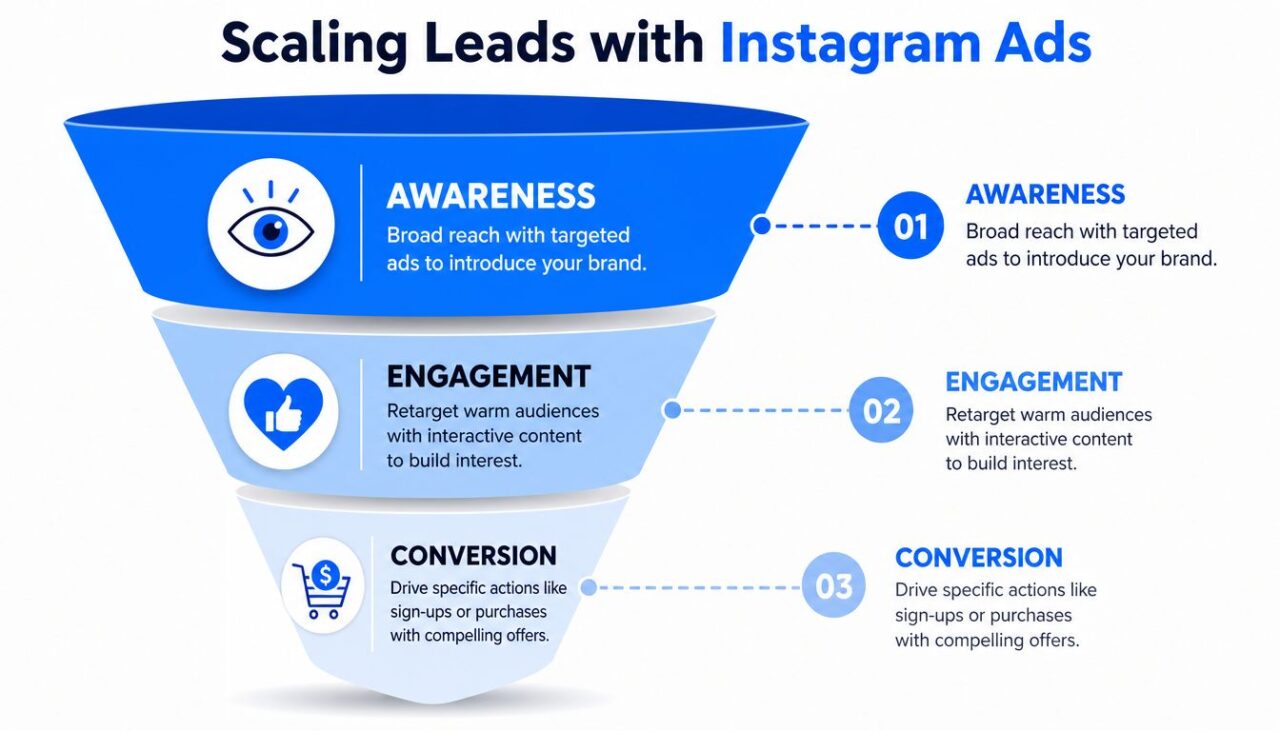
Lead Generation on Instagram Marketing Funnel
Start with proven organic winners
Don’t open Ads Manager and invent a campaign from scratch. Start in your content insights.
Look for posts that did one of these:
- Generated lots of comments with a clear keyword
- Triggered Story replies around a narrow pain point
- Produced strong saves or shares because the topic hit buying intent
- Created DMs from people asking how to get the offer
Those are signs the market already understands the message.
A practical example:
| Organic content signal | Ad version to run |
|---|---|
| Reel about common booking mistakes gets comments | Turn it into a click-to-message ad with “Send BOOKING for the checklist” |
| Story sequence gets many replies about pricing confusion | Build a message ad around “DM PRICE for the guide” |
| Carousel gets saves from warm audiences | Promote it to engagers and route clicks into the same DM flow |
Build for conversation, not traffic
A lot of Instagram ads fail because they send users into a browser detour. The person taps, lands on a page they didn’t ask for, and drops.
A better path keeps the action native to the app.
Use ad copy that tells the user exactly what happens next:
- Send GUIDE to get the checklist
- Tap Message to get the quiz
- DM START to see which option fits you
That wording matters because it sets expectation. The user knows they’re starting a conversation, not clicking into a generic funnel.
Target warm intent first
Scaling doesn’t always mean going broad immediately. Start with people who already know you.
Strong audiences often include:
- Video viewers who watched your educational Reels
- Page engagers who interacted with posts or ads
- Profile visitors who checked your account but didn’t act
- Existing customer lists when the offer fits upsell or reactivation
- Lookalike-style expansion audiences based on your warm segments, if that fits your ad setup
This structure usually produces cleaner conversations because the user already has some context.
Run ads on the message that already earned attention. Don’t pay to test a weak hook at scale.
Keep the DM handoff tight
Once the ad drives the message, the automation has to finish the job. That means:
- Deliver the promised asset instantly
- Ask a short qualifying question
- Tag the lead by need or intent
- Route high-intent leads to a booking or sales action
- Escalate edge cases to a team member
If the ad says “Get the checklist,” the first DM should contain the checklist. Not a welcome paragraph. Not a brand story.
Speed and continuity win here. The user should feel that the ad, DM, and next step are one smooth experience.
Measure, Optimize, and Scale Your Lead Engine
If you’re still judging Instagram by likes, reach, or follower growth alone, you’re managing a media channel, not a lead channel. Those numbers can help diagnose content performance, but they don’t tell you whether the account is creating pipeline.
The useful questions are simpler. How many conversations started? How many of those people matched your ideal buyer? How many moved to the next business action?
Track business metrics, not vanity metrics
Use a lightweight scorecard that follows the lead from first interaction to handoff.
Focus on metrics such as:
-
Cost per lead
What you spend to start a qualified conversation through organic support or paid campaigns. -
Lead qualification rate
The share of incoming leads that match your actual buyer criteria. -
Conversation-to-conversion rate
How many DM conversations turn into booked calls, purchases, applications, or consultations. -
Speed to delivery
Whether the promised resource reaches the prospect immediately. -
Handoff completion
Whether sales, support, or account teams follow through once automation identifies a strong lead.
A smaller account can outperform a larger one if its conversation quality is higher. That’s why lead generation on Instagram should be judged by movement, not applause.
Build visibility into lead quality
Tags, custom fields, and CRM sync become important. When a lead replies in a DM flow, capture useful context:
| Data point | Why it matters |
|---|---|
| Offer requested | Shows what topic created intent |
| Stated need | Helps segment pain points |
| Purchase readiness | Separates researchers from buyers |
| Source content | Tells you which post or ad started the lead |
| Next step taken | Reveals where conversion stalls |
That structure lets you answer practical questions. Which Reel themes bring in stronger prospects? Which CTA brings curiosity instead of buyers? Which qualifying question filters out weak leads fastest?
Run tight tests every week
Don’t redesign everything at once. Test one variable at a time.
Good A/B tests include:
- CTA wording such as “Comment GUIDE” versus “DM GUIDE”
- Offer format such as checklist versus quiz
- First qualifying question to see which one gets more useful responses
- Ad creative angle based on pain point versus outcome
- Human takeover timing to determine when a live reply closes more deals
- Routing options such as booking link versus product recommendation
Small tests compound when your system already captures conversations cleanly.
The biggest shift is mental. Stop asking whether Instagram content is performing. Ask whether Instagram is producing qualified conversations that turn into revenue. When you build around that standard, optimization gets clearer, faster, and more profitable.
If you want to turn Instagram replies, comments, and DMs into a structured lead pipeline, Clepher gives you a practical way to do it. You can build no-code DM flows, trigger instant responses from comments or keywords, qualify leads with tags and fields, and route people to the right next step without relying on slow manual follow-up.
Related Posts
Chat Bot Responses That Convert: A Practical Guide
October 12, 202610 Broadcast Automation Software Platforms Compared
October 11, 2026Customer Journey Automation: The Practical Guide
October 10, 2026
Founder Clepher