
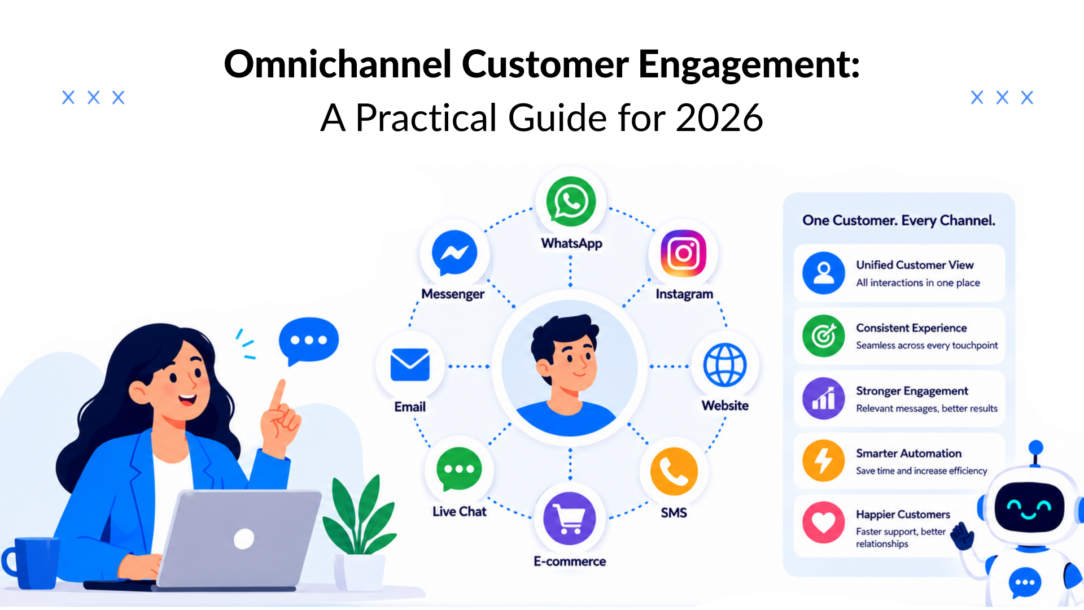
Customer retention changes fast when channel handoffs work. Strong omnichannel programs keep far more customers than weak ones, a gap noted earlier in this article, and in practice that difference usually comes down to operations, not awareness.
Customers rarely stay inside one channel long enough for siloed teams to keep up. They ask a presale question in chat, browse product pages on mobile, reply to an email later, then send a DM when checkout fails. If each touchpoint starts from zero, the brand feels disorganized even when the product is good.
I see the same pattern across e-commerce brands, SaaS teams, agencies, and local businesses. The problem is not a lack of channels. It is a lack of shared context between the channels already in use.
Omnichannel customer engagement fixes that by connecting identity, conversation history, and next-step actions across touchpoints. For a small team, that does not require an enterprise rebuild. A practical multi-channel marketing strategy can start with a CRM, a no-code automation layer, and an AI chatbot that captures intent, routes questions, and passes clean context to a human when needed.
That setup matters when resources are tight. A Shopify store can sync chat questions with email flows so returning buyers stop getting first-time offers. A SaaS company can push demo requests, product usage signals, and support conversations into one lifecycle view. An agency can give clients a connected front end without hiring a full engineering team to stitch everything together by hand.
Your Customers Are Everywhere Are You
73% of customers use multiple channels during a single buying journey. The operational problem is not showing up in enough places. It is keeping context intact as people move between them.
A buyer might ask a product question in chat during lunch, compare options on mobile later, click an email that night, and message Instagram the next morning when something feels unclear. If each channel acts like a first meeting, the experience feels fragmented. Customers read that as disorganization, even when the product and service are solid.
That gap shows up in ordinary moments teams miss:
- Repeated context: A customer explains the same issue in chat, email, and DMs because nothing carries over.
- Channel conflict: Support offers one resolution while a promo email pushes a conflicting message.
- Bad timing: An automation sends a discount or upsell while an open complaint is still unresolved.
- Lost handoffs: A bot collects useful detail, but the sales or support team receives none of it.
I see this most often in smaller teams that already have enough tools, but no system connecting them. A Shopify brand has Klaviyo, live chat, and Instagram. A SaaS company has a CRM, product analytics, and support tickets. An agency manages lead forms, calendars, and inboxes across client accounts. The failure point is usually the handoff, not the channel.
That is why a practical multi-channel marketing strategy needs a shared record of the customer, plus simple automation rules that update the next touchpoint based on behavior. For lean teams, that often means a CRM, a no-code automation layer, and an AI chatbot that captures intent, tags the conversation, and routes it with the right context.
If you want to unify your brand experience, start there. Connect the channels you already use before adding new ones.
Customers do not care which team or tool owns the interaction. They notice whether the next message makes sense.
Omnichannel customer engagement is how e-commerce stores reduce awkward promos, SaaS teams shorten sales cycles, agencies create cleaner client journeys, and local businesses follow up without dropping the thread. It is less about adding reach and more about making every interaction feel connected.
What Omnichannel Engagement Really Means
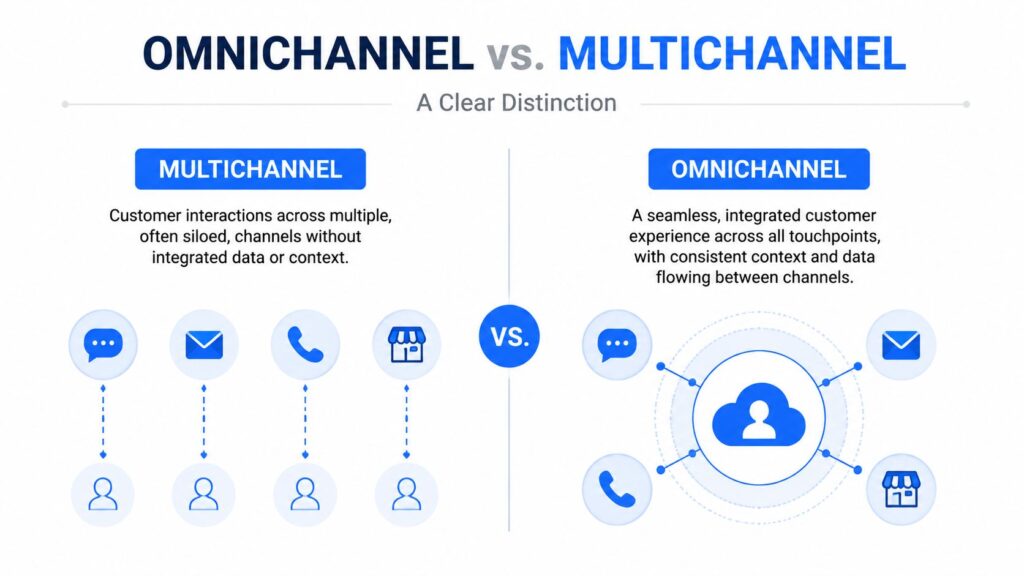
Multichannel means you’re active in several places. Omnichannel means those places talk to each other.
The simplest way to explain it is this. Multichannel is like starting a new conversation in every room. Omnichannel is one intelligent conversation that follows the customer from room to room. Same person, same context, same momentum.
Omnichannel Customer Engagement Multichannel
If a buyer asks about pricing on your site, clicks a retargeting email later, and then replies to a social DM, an omnichannel system should treat those actions as part of one journey. A multichannel setup usually treats them as separate records with separate logic.
The practical distinction
| Approach | What happens in practice |
|---|---|
| Multichannel | You send messages on email, chat, SMS, and social, but each channel runs on its own rules and data |
| Omnichannel | Each interaction updates the customer record, which changes what happens next across every connected touchpoint |
That difference sounds technical, but customers feel it immediately.
Three traits that define omnichannel customer engagement
- Consistency means your offer, tone, and follow-up don’t conflict across channels.
- Context-awareness means the next message reflects what the customer already did.
- Continuity means channel switching doesn’t reset the relationship.
A lot of companies think they’re omnichannel because they reuse the same creative across platforms. That’s not enough. Copy consistency isn’t journey continuity.
Where teams get this wrong
- They duplicate campaigns instead of connecting journeys.
- They organize around tools instead of customer moments.
- They measure channel performance separately and miss the full path to conversion.
If you’re trying to unify your brand experience, the useful shift is to stop asking, “What should we send in an email?” and start asking, “What should happen next for this customer, regardless of channel?”
Practical rule: If a customer switches channels and has to restart, you have multichannel presence, not omnichannel engagement.
That’s the standard worth using.
The Transformative Benefits of an Omnichannel Approach
The business case gets clearer once omnichannel is measured as an operating model, not a branding exercise.
Analysts have noted earlier in the article that companies with stronger omnichannel programs tend to retain far more customers than those with weaker ones. That gap matters because retention changes the economics of growth. If a customer can move from ad click to chatbot to email to support without friction, fewer prospects stall, fewer buyers go quiet after purchase, and fewer accounts need expensive win-back campaigns.
Revenue follows the same pattern. Earlier data also showed stronger annual revenue growth for businesses that connect channels well, along with higher lifetime value from customers who buy across multiple touchpoints. The operational reason is straightforward. Connected channels increase the odds that the next message is relevant, timed correctly, and based on what the customer already did.
That sounds abstract until you look at common workflows.
An e-commerce brand can suppress a discount email after purchase, trigger post-purchase SMS updates, and hand a return question to support with the order history already attached. A SaaS company can route a pricing-page visitor into chat, log the conversation in the CRM, and send onboarding content based on the feature questions they asked. An agency can track whether a lead came in through a form, replied to email, or booked through chat, then push all of it into a shared CRM and ticketing system for sales and support teams so nobody restarts the conversation.
The gain is not just better coordination. It is fewer avoidable mistakes.
Disconnected systems create predictable waste:
- Prospects get nurture emails after they already booked a demo
- Customers receive acquisition offers instead of onboarding help
- Support teams answer questions without seeing prior marketing or sales activity
- Sales follows up cold on accounts that are already active in another channel
Each mistake chips away at trust. Fixing them usually does more for conversion and retention than sending more campaigns.
There is also a market reality behind the shift. Earlier cited research on multichannel commerce points to continued growth in how people research, buy, and ask for help across devices and platforms. For smaller teams, that does not mean building enterprise architecture from scratch. It means connecting the few systems that shape the customer journey most, then using no-code or low-code automation to keep context flowing between them.
That is why omnichannel work pays off even for resource-constrained teams. You do not need a custom data warehouse to get results. You need shared customer context, clear trigger logic, and channel handoffs that make sense for your business model. AI chatbots, workflow builders, lightweight CRMs, and help desk tools can cover a surprising amount of ground if they are configured around customer moments instead of departmental silos.
The return shows up in three places. Customers stay longer. Teams waste less effort. Revenue becomes less dependent on replacing people who should have stayed in the first place.
A Practical Framework for Omnichannel Implementation
Teams often fail here when they try to launch omnichannel customer engagement as a giant transformation project. That usually creates long timelines, too many dependencies, and little visible progress.
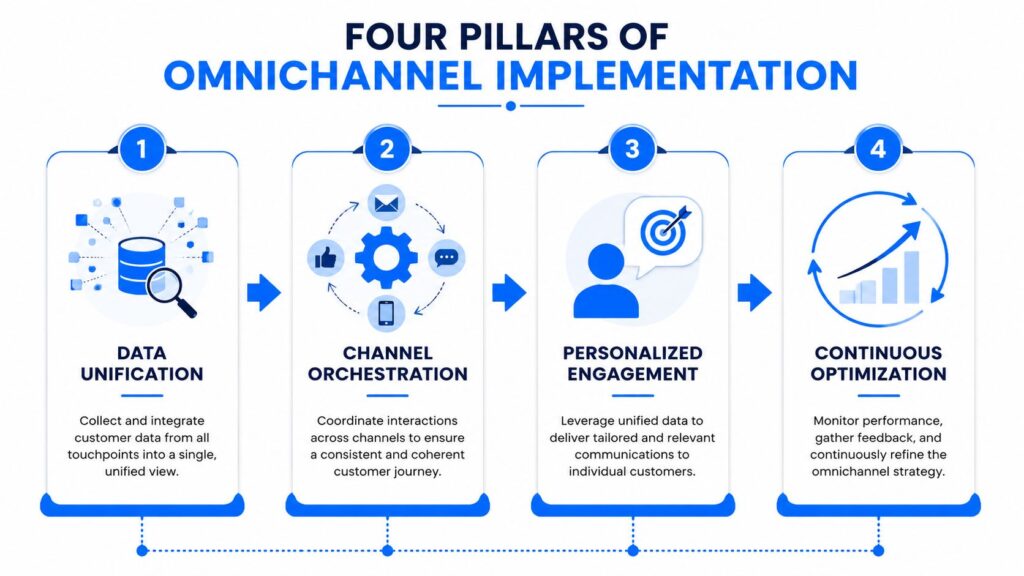
A better approach is to build around four pillars. Get each one working at a usable level, then improve it.
Omnichannel Customer Engagement Strategy
Data unification
Start with one customer record that pulls in activity from the systems that matter most. For smaller teams, that often means your website form tool, chatbot, CRM, email platform, and purchase system.
You don’t need a perfect enterprise architecture on day one. You do need one place where the latest customer state is visible. If support can’t see what marketing sent, and marketing can’t see whether sales already spoke to the lead, your automation will stay shallow.
Personalized engagement
Personalization works when it responds to behavior, not static lists. A user who visited pricing twice, asked a setup question in chat, and downloaded a guide should not receive the same message as a casual blog visitor.
That’s where segmentation usually breaks. Teams build demographic buckets once, then keep pushing people through them long after behavior has changed.
Channel orchestration
Omnichannel becomes real when you map what happens after specific actions and decide how channels back each other up.
A key implementation principle comes from this guide on event-based omnichannel engagement: messages should fire when a customer acts, and businesses should define key customer events such as cart abandonment, then map each event to a multi-channel sequence that escalates from a primary channel like an in-app message to a backup channel like SMS if the first message isn’t opened or acted upon.
That’s more effective than a fixed calendar because it respects intent.
A simple orchestration map might look like this:
- Event: Visitor asks for pricing in chat.
Next step: Send a personalized email recap with the plan they viewed. - Event: Trial user stops after setup.
Next step: Trigger an in-app prompt, then a support email if no action follows. - Event: Shopper abandons cart on mobile.
Next step: Use the primary reminder channel first, then escalate to a backup channel if there’s no response.
Continuous measurement
You need to measure journeys, not isolated messages. Track where people move forward, where they stall, and where context gets lost. If your handoff from chat to email works but your email-to-SMS escalation feels abrupt, fix that connection.
A shared system matters here. A connected CRM and ticketing system gives marketing, sales, and support one operational view of the customer instead of three competing versions.
Map one journey end to end before you automate five. Most teams discover the real problem during the handoffs.
That’s the framework. One customer view, behavior-based personalization, event-driven orchestration, and steady optimization.
Channel Specific Tactics That Actually Work
The most effective omnichannel customer engagement tactics don’t treat channels like separate campaigns. They use each channel for what it does best.
Web chat and chatbot flows
A visitor lands on a product page and asks a setup question in web chat. The bot answers the common question immediately, offers a relevant guide, and asks whether the visitor wants the resource sent by email.
If the visitor opts in, email becomes the follow-up channel, not a separate campaign. That evening, they receive a message with the guide, a short FAQ, and a link back to the original conversation. If they click but still don’t start, a human rep can step in the next day with context. This is omnichannel customer engagement working the way it should — each channel picking up where the last one left off.
What works here is continuity, and that continuity depends on the right omnichannel customer engagement platform underneath it. The chatbot handles speed. Email handles detail. A human handles edge cases. A customer engagement platform ties all three together so no context is lost between touchpoints and the experience feels like one conversation, not three separate ones.
Social DM to lead qualification
An agency prospect replies to an Instagram Story asking about pricing. The DM automation asks a few qualification questions, captures the project type, and offers a booking link for a discovery call.
If they don’t book, email can send a concise follow-up with service examples specific to the interest they selected. If your team publishes across several social platforms, these PostClaw’s social media management tips can help reduce posting friction so you can focus more on response flows and less on distribution.
What makes social DMs work
- Low-friction entry: People ask questions in DMs they’d never submit in a form.
- Fast qualification: Short prompts gather enough context to route the lead correctly.
- Clean handoff: Once intent is clear, move the conversation to the channel best suited for scheduling or sales detail.
Social DMs are excellent for starting conversations, not for carrying every conversation to the finish line.
Email as the continuity layer
Email works best when it continues an interaction that already started somewhere else. For SaaS, that could mean sending an onboarding checklist after an in-app support exchange. For e-commerce, it could mean a product education email after a customer asked about sizing in chat.
What doesn’t work is blasting the same sequence to everyone who touched the site. Omnichannel email should sound like a follow-up, not a broadcast.
SMS for urgency and action
SMS belongs later in the journey and only when the message justifies the interruption. A local business can use it well after a web form or chatbot opt-in. A customer asks about appointment availability, receives options by email, and then gets an SMS reminder to confirm the booking.
For e-commerce, SMS can work as a backup channel when a time-sensitive action matters more than long-form content. The key is restraint. If SMS becomes your first response to everything, people opt out mentally long before they opt out technically.
Choosing Your Omnichannel Tech Stack
A good stack for omnichannel customer engagement isn’t the biggest stack. It’s the one your team can operate without breaking context between tools.
Omnichannel Customer Engagement Chatbot Marketing
Start with the data layer
The technical foundation is a unified Customer Data Platform, or a tightly integrated CRM if you’re keeping things lean. As explained in CX Foundation’s guide to omnichannel customer engagement, a CDP creates a single source of truth by ingesting real-time data from customer touchpoints through API integrations, and that enables dynamic segmentation based on real-time behavior rather than static demographic segments.
That distinction matters. Static segmentation says, “This person is in the SMB list.” Dynamic segmentation says, “This person visited pricing, opened onboarding help, and abandoned checkout.” One of those is useful for action. The other is mostly descriptive.
The core tools most teams need
A practical low-code stack usually includes:
- Customer record system: A CDP or CRM that holds contact history, tags, and lifecycle status.
- Conversation layer: A chatbot or live chat tool for website and messaging channels.
- Messaging platforms: Email and SMS tools that can trigger from behavior, not just scheduled campaigns.
- Integration middleware: Zapier, Make, n8n, or native integrations that pass data between systems.
- Support workflow: A help desk or shared inbox so human handoffs don’t lose context.
What to prioritize when budget is limited
Build for integration depth, not channel count. It’s better to connect your site, chat, CRM, and email properly than to add five channels that don’t share state.
For many growing teams, no-code and low-code systems are enough if they’re connected well. Tools that support APIs, webhooks, tags, and event triggers will take you further than heavyweight software that your team can’t configure quickly. These no-code automation tools are a useful reference point if you’re evaluating how to connect workflows without heavy engineering.
A lot of teams also overinvest in top-of-funnel spend before tightening the post-click journey. That’s backwards. Better orchestration often improves monetization efficiency before you need more traffic. If you’re thinking about engagement from a paid acquisition angle, AdStellar AI’s ROAS optimization methods offer a useful lens on connecting customer engagement software with stronger downstream performance.
Buy tools that share context. Skip tools that force your team to copy and paste customer history between tabs.
That’s usually the stack decision that separates “we have automation” from “we have an actual omnichannel system.”
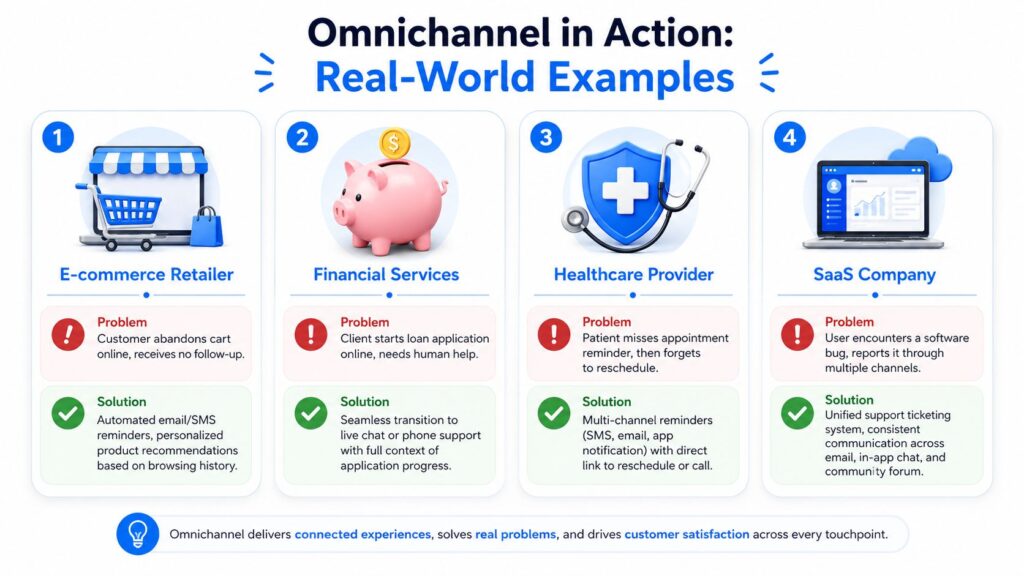
Omnichannel in Action Examples for Your Business
Different business models need different flows. The good news is the logic stays similar. Start with a customer action, preserve context, and let channels support each other instead of competing.
Omnichannel Customer Engagement Examples
E-commerce brand
A shopper adds products to cart on mobile, opens a product FAQ in chat, then leaves. The recovery flow doesn’t start with a generic discount. First, a message reminds them of the exact product category they viewed and answers the concern they raised. If there’s still no purchase, an email follows with a buying guide and a path back to support.
That sequence works because it handles hesitation, not just abandonment.
SaaS company
A new trial user signs up, reaches the dashboard, and stalls after the first key step. Instead of waiting for a weekly lifecycle email, the product sends an in-app nudge tied to that moment. If the user leaves, email follows with a short setup tutorial. If they reply with confusion, support sees the original product state and can pick up without asking basic questions again.
Why this flow converts better qualitatively
- It reacts to usage: The system responds to product behavior, not a fixed onboarding calendar.
- It reduces friction: Help appears near the moment of confusion.
- It preserves history: Support can continue the journey instead of restarting it.
Digital agency
A prospect responds to a LinkedIn or Instagram message after seeing portfolio work. The first automation asks what they need: lead generation, creative, or paid media support. Based on the answer, the system offers a relevant case-example deck by email and a booking option. If they book, the strategist already has the answers from the earlier DM exchange in the CRM.
Agencies waste a lot of pipeline by splitting outreach, qualification, and scheduling into separate manual steps. Omnichannel joins them.
Local small business
A gym, clinic, salon, or restaurant can use omnichannel customer engagement without building a complex stack. A customer scans a QR code in store, joins a promotion by SMS or chat, and gets a follow-up customized for that location or service interest. If they ask a question later on social media, staff can see the earlier opt-in and promotion history before replying.
Small businesses don’t need enterprise software to feel coordinated. They need one clean handoff between the channels customers already use.
The common pattern across all four examples is simple. One action starts the journey. Another channel continues it. A shared record keeps the conversation coherent.
Start Your Omnichannel Journey Today
Omnichannel customer engagement doesn’t start with adding more tools or launching on every platform. It starts when you stop making customers restart the relationship every time they switch channels.
The practical path is narrower than many expect. Build one shared customer view. Trigger communication from real behavior. Connect the channels that already matter to your business. Then tighten the handoffs until the journey feels continuous.
If you’re short on time or resources, keep the scope small. Pick one journey that affects revenue or retention directly. Cart abandonment. New user onboarding. Lead qualification. Appointment follow-up.
Fix one broken connection inside that journey first. Then add the next one.
That’s how omnichannel gets implemented in practice. Not as a giant rollout, but as a series of connected improvements customers can feel immediately.
If you want a practical way to build that kind of connected journey without heavy development, Clepher gives teams a no-code way to run chat-based marketing, sales, and support across website, Facebook, Messenger, WhatsApp, and Instagram DMs. It’s a strong fit for businesses that want to turn scattered conversations into one coordinated customer experience.
Related Posts
Revenue Optimization: A Practical Playbook for Growth
October 19, 202610 Lead Capture Software Tools Compared for 2026
October 18, 2026WhatsApp Chatbot for Ecommerce: A Practical 2026 Guide
October 17, 2026
Founder Clepher