
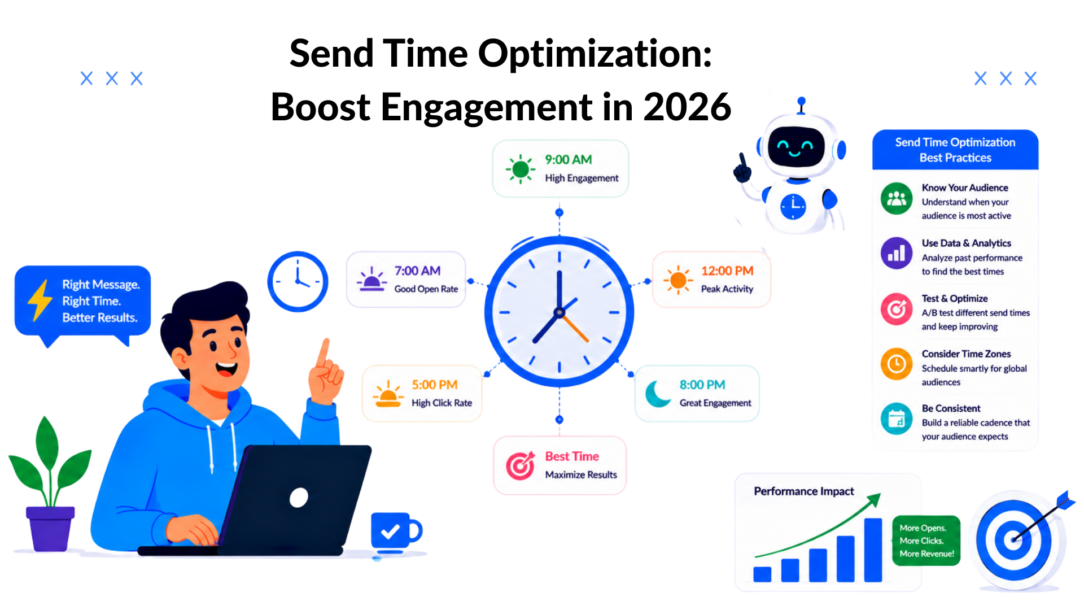
Email open rates peak at 8 PM with a 59% open rate, not at the tidy mid-morning slot many teams still treat as default, according to Bloomreach’s analysis of send times. That one number should change how you think about campaign timing.
Most DTC brands still spend more time debating copy than delivery timing. Copy matters. Offer matters. Segmentation matters. But if your message lands when the customer is busy, asleep, or already deep in another app, the rest of your work gets buried.
That’s why send time optimization matters now. Not as a nice-to-have email feature, but as a practical way to match outreach to real behavior across email, SMS, and conversational channels. For ecommerce brands, coaches, and subscription businesses, the shift is simple. Stop asking for the best time to send. Start asking for the best time for each person to receive.
Why The Best Time to Send Is Obsolete
“Best time to send” used to be a useful shortcut. It is a weak operating model now.
Batch scheduling came from a period when email was the main channel, automation was limited, and brands had to pick one optimal send for everyone. That approach falls apart once the same customer can see your message in an inbox, on a lock screen, or inside Instagram and Messenger at completely different points in the day.
A DTC shopper might ignore a 10 AM campaign email, click an SMS at 1 PM, and reply to an Instagram DM after dinner. A coaching lead might read your email subject line in the morning, do nothing, then respond to a reminder message that evening when they finally have calendar space. Those are not edge cases. They are normal buying patterns, and they are exactly why a single fixed hour to send email marketing no longer holds up across channels.
This is where a send-time optimization feature earns its place. Instead of locking every contact into one send window, send time optimization works by learning when each individual person actually engages, then timing delivery to that pattern, channel by channel.
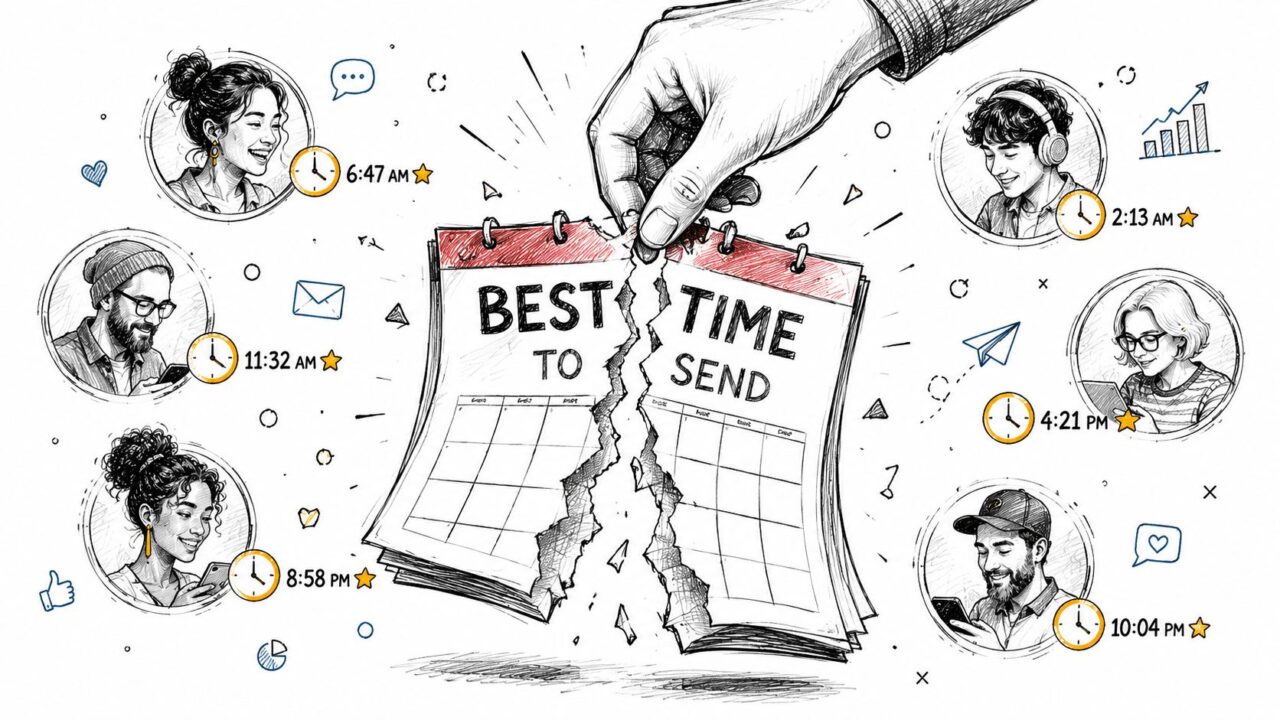
Send Time Optimization Calendar Analysis
Static schedules create hidden losses
The cost of a fixed send schedule is not only lower opens. It shows up in missed revenue, wasted message inventory, and bad channel sequencing.
Send a product drop email at the wrong hour, and some subscribers never see it before the inbox gets crowded. Send the SMS follow-up too soon, and it feels pushy because the customer has not had a fair chance to engage with the email yet. Send a Messenger reminder too late, and the urgency is gone. One rigid schedule creates friction across all three channels.
This gets more expensive in channels that feel personal. Email can be ignored and found later. SMS and DMs are judged faster. Bad timing there does not just reduce clicks. It can train people to mute, dismiss, or mentally downgrade your brand.
As noted earlier, broad send-time research already shows that engagement often peaks outside the business-hour slots many brands still default to. The bigger takeaway is operational. There is no single hour that fits a full customer file once behavior varies by channel, device, routine, and intent.
What send time optimization actually changes
Send time optimization shifts timing from campaign-level guesswork to contact-level delivery. The message stays the same. The delivery window changes based on when that person tends to engage.
In practice, that means a Clepher user can run one campaign with channel-specific timing rules instead of forcing the same schedule everywhere. Email can wait for the subscriber’s usual reading window. SMS can be held for people who act quickly on mobile. Messenger or Instagram follow-ups can be timed for the periods when replies are more likely, not just when your team is online.
That matters because channel timing should match channel behavior. A back-in-stock email for a skincare brand may perform best when a shopper checks promotions after work. The SMS follow-up should go only to the people who did not act and who usually click texts within a short window. For a coach filling a webinar, the email invite might go first, then a DM reminder can be timed for the evening for leads who tend to respond conversationally rather than click through immediately.
Good STO starts with behavior data, not calendar folklore. If your engagement history is scattered across platforms, clean that up first with customer behavior analysis across email, SMS, and chat touchpoints. Without that foundation, timing rules stay generic, and the gains stay small.
The Data Science Behind Perfect Timing
Send time optimization sounds mysterious until you break it into inputs and predictions. It’s not guessing. It’s pattern recognition.
The model looks for repeated engagement behavior, then uses that history to predict a future delivery window for each contact. The output looks simple. The work underneath isn’t.
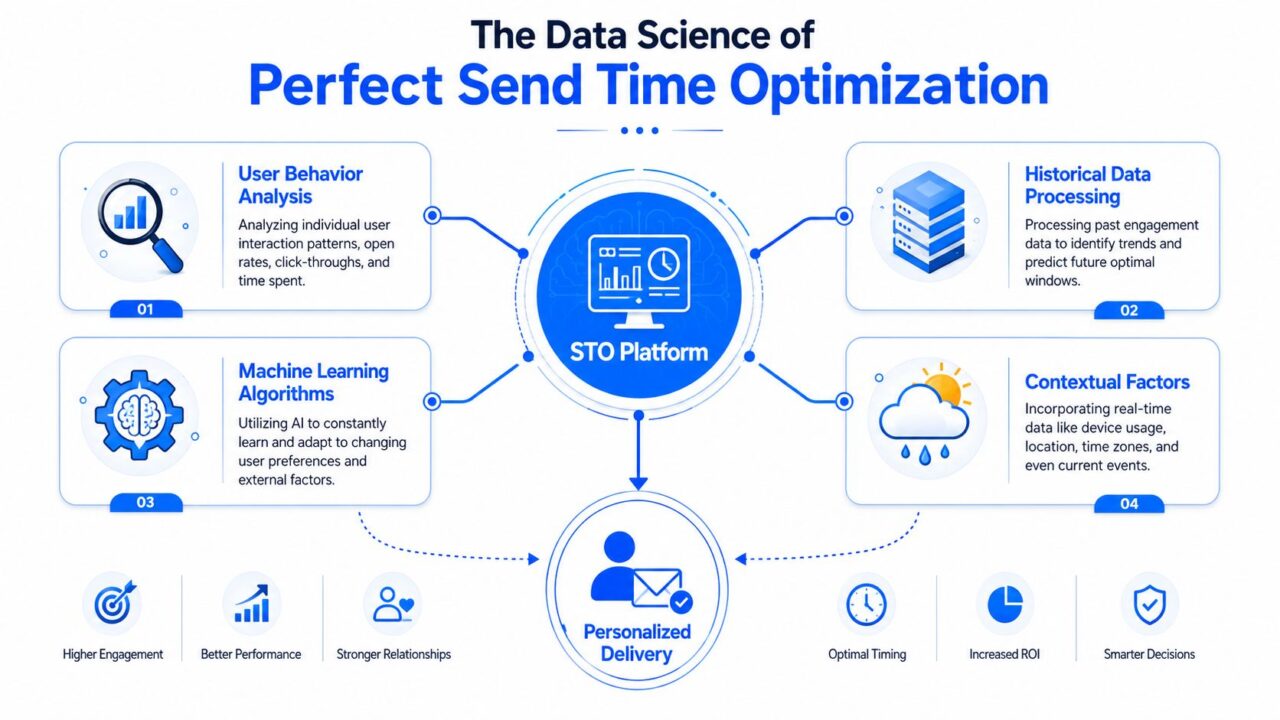
Send Time Optimization Process Diagram
The system needs enough history to work
A reliable send-time model needs data. Implementing send time optimization requires a foundational data history of 3–6 months of consistent engagement, and initial performance improvements are typically reported within 2–4 weeks of consistent execution, according to Monday.com’s STO overview.
That matters because early-stage brands often expect instant precision from a small list with irregular campaigns. The model can’t learn if you’ve only sent a few broadcasts or if engagement is too thin to form patterns.
A practical rule is to earn the right to personalize timing:
- Send consistently: Irregular volume creates noisy signals.
- Track behavior cleanly: Opens, clicks, session timing, and channel interactions should be captured in one place.
- Avoid premature micro-segments: Tiny groups often don’t produce enough repeat behavior.
If you’re still building that foundation, focus first on clean segmentation and behavioral visibility. A good starting point is a structured approach to customer behavior analysis, because timing works best when it sits on top of real engagement signals.
What the model pays attention to
The strongest systems don’t just look at time zones. They study patterns such as:
- Open history: When a person usually checks and opens messages
- Click frequency: Whether they engage immediately or return later
- Device usage patterns: When they tend to browse on mobile versus desktop
- Session frequency: How often they return during a week
- Channel-specific interactions: Whether they answer SMS fast, ignore email, or react to DMs first
That last point matters more than is commonly expected. Someone may open email late, but reply to a conversational message much faster in a social app. If you apply one timing assumption to every channel, you flatten real behavior into a weak average.
Practical rule: Treat timing as a behavioral forecast, not a calendar setting.
Why predictions improve over time
The model keeps recalibrating. That’s why send time optimization usually gets stronger with steady execution. A buyer’s routine changes. A lead starts engaging during different windows. Seasonal shopping shifts behavior. The system adapts if you keep feeding it recent activity.
STO transcends being merely a scheduling tool; it functions as a feedback loop. Every open, click, and response helps the next send land closer to the moment that person is most likely to pay attention.
For a DTC brand, that can mean a cart reminder reaching the customer when they usually revisit offers. For a coaching business, it can mean a deadline reminder landing when leads are most likely to finally submit the application instead of just reading it.
Your Actionable Multi-Channel STO Playbook
Many organizations start send time optimization in email, then stop there. That leaves a lot of value on the table.
Customers don’t experience your brand in one inbox. They bounce between email, text, website chat, Messenger, and Instagram. A timing strategy that only fixes one channel often creates friction in the others. You send the email at the perfect time, then accidentally stack an SMS on top of it an hour later. Or your DM arrives while the customer is still considering the email and it feels pushy instead of helpful.
That’s why STO works best as a coordinated playbook.
Send Time Optimization Chatbot Marketing
Start with email because it gives you the cleanest learning loop
Email usually has the deepest engagement history, which makes it the best first testing ground.
For ecommerce, begin with campaign types that already have clear intent:
- Abandoned cart emails: Strong fit because the customer has shown immediate interest
- Back-in-stock alerts: Timing matters because demand decays fast
- Product education sequences: Useful for higher-consideration products
- Win-back campaigns: Better sent when disengaged buyers tend to revisit
For coaches or course sellers, strong candidates include:
- Webinar reminders
- Application deadline emails
- Nurture emails tied to lead magnets
- Sales sequence follow-ups after discovery calls
Don’t turn STO on for every campaign at once. Pick one repeatable campaign family and keep the creative as stable as possible while you evaluate timing impact.
Use SMS selectively, not as a copy of email timing
SMS is immediate by nature. That’s exactly why sloppy timing causes more irritation there.
A useful way to handle SMS is to reserve it for moments where speed and visibility matter:
- Urgency-based reminders: cart expiration, event reminder, limited stock
- Short transactional nudges: follow-up to a form start or checkout interruption
- High-intent sequences: when a subscriber has already taken a meaningful action
What doesn’t work is copying your email calendar into text. If your team sends a promo email and then a matching SMS to the same segment without spacing or suppression, customers feel the repetition before they notice the offer.
A better workflow is channel priority. Decide which channel gets first right of contact for that campaign. Then suppress the others for a window unless the person doesn’t engage.
Segment conversational audiences by behavior, not by platform alone
Messenger and Instagram DMs reward a different kind of timing. People often check them in short bursts, often outside classic “marketing hours,” and they respond when the message feels native to the conversation flow.
That changes how you should segment:
- Night-engagers: subscribers who tend to read or respond later in the day
- Fast responders: people who usually interact soon after a message lands
- Offer-clickers: contacts who engage more with promotions than education
- Conversation-first leads: users who answer DMs but rarely click email
Those segments are more useful than broad labels like “Instagram followers” or “newsletter subscribers.” Behavior tells you when and where to send next.
A strong operating model is to map timing by engagement style inside your broader multi-channel marketing strategy. That keeps you from treating every channel as its own silo.
If a shopper ignores email but replies to a DM, your problem isn’t message quality alone. It may be channel-timing fit.
Build practical workflows for DTC and coaching
Here’s what this looks like in the field.
DTC example with a product launch
A skincare brand drops a new bundle. Instead of blasting all channels at once, the team can:
- Send the launch email through STO so each subscriber receives it in their likely open window.
- Hold SMS for the highest-intent segment only, such as recent site visitors or cart builders.
- Use Messenger or Instagram DM for subscribers who often engage socially but don’t click email.
- Suppress any user who already clicked or purchased from follow-up reminders.
The result is a cleaner customer experience. The brand looks coordinated, not desperate.
Coaching example with an application deadline
A business coach promotes a cohort close date. A simple timing flow might look like this:
- Email first: deadline reminder personalized by send window
- DM second: only to leads who previously engaged with conversational content
- SMS last: only for opted-in leads who started but didn’t complete the application
That order matters. Coaching offers are trust-heavy. If timing is too aggressive across channels, the message feels like pressure. If sequencing is measured, it feels like support.
What to configure before you launch
Before your first STO campaign goes live, tighten the operational basics:
- Set suppression rules: Don’t let email, SMS, and DMs pile onto the same user at once.
- Define engagement windows: Build tags or segments around actual response patterns.
- Separate campaign types: Promotional timing often differs from educational timing.
- Write channel-native creative: A DM shouldn’t sound like a copied email subject line.
- Review fallbacks: Decide what happens when a user doesn’t have enough behavior history.
The practical goal isn’t to automate everything. It’s to make each message arrive when it has the best chance of being welcomed.
Designing and Measuring Your STO Tests
A clean STO test answers one question: did better timing improve results enough to change how you send across email, SMS, or conversational channels?
That only happens when everything else stays stable. If you change the offer, the audience, and the send logic in the same campaign, the result is noise.
Build a clean control first
Start with the version of the campaign you would have sent anyway. For a DTC brand, that might be a Tuesday 10 a.m. promo email, an abandoned cart SMS set to go out two hours later, or a Messenger follow-up sent in a fixed afternoon window. That is your control.
The test version gets the same copy, same offer, same audience rules, and the same suppression logic. The only difference is timing.
For a first STO campaign, keep the setup tight:
- One campaign type: test a promo against a promo, or a reminder against a reminder
- One audience definition: keep segment rules fixed for the full test
- One primary channel: prove the timing effect before layering in cross-channel orchestration
- One decision metric: decide before launch whether you care most about conversion, revenue per recipient, or replies
Good STO testing is boring on purpose. Boring tests produce decisions you can trust.
Choose metrics that match the channel
Open rate can help with email. It tells you whether the message showed up at a time when people were willing to look. It does not tell you whether the campaign made money.
Use a channel-specific scorecard instead.
| Channel | Primary metric | Secondary checks | What a good result usually means |
|---|---|---|---|
| Conversion rate or revenue per recipient | Click rate, unsubscribe rate | Better timing reached shoppers when buying intent was higher | |
| SMS | Click rate or conversion rate | Opt-out rate, revenue per message | The text arrived close to a decision moment, not after it passed |
| Messenger / Instagram DM | Reply rate or assisted conversion | Read rate, booked call, application completion | The conversation started when the lead was ready to engage |
That distinction matters. A coaching business may care more about replies and booked calls than opens. A skincare brand running a weekend sale may care more about revenue per recipient than click rate. Clepher users should set that hierarchy before they launch, because the platform can route messages across channels, but it cannot decide what success means for your business.
Set up a test window you can actually read
Run the control and STO groups in the same time period. Do not compare this week’s optimized campaign to last month’s fixed send. Seasonality, payday timing, promotions, and inventory changes can distort the result.
I usually recommend testing one repeatable campaign first. For example:
- A weekly product drop email for a DTC apparel brand
- A cart recovery SMS for a supplement store
- An application reminder DM for a coaching program
Those campaigns happen often enough to generate signal, and they are tied to a clear business outcome.
If you use Clepher across more than one channel, resist the urge to test email STO, SMS STO, and Instagram DM timing all at once. Start by proving lift in one channel. Then test orchestration rules such as “email first, SMS only if no click within 24 hours” or “DM only for subscribers who previously replied.” That sequence gives you cleaner learning and lowers the risk of overcontacting engaged customers.
Read results like an operator
A lift in opens with flat clicks usually means the send window improved attention, but the message or offer did not match intent.
A lift in conversions with little movement in opens is still a strong outcome. Revenue matters more than vanity metrics.
A drop in unsubscribes or SMS opt-outs also matters. Better timing often reduces the feeling that the brand is interrupting people at the wrong moment.
For ecommerce, review STO results by campaign role:
- Promotions: did timing increase purchases before the offer expired?
- Lifecycle messages: did cart, browse, or replenishment reminders convert at a higher rate?
- Retention sends: did the campaign drive revenue without increasing unsubscribes or opt-outs?
For coaching and lead generation, the readout is different:
- Replies: did more leads respond when the message arrived in their active hours?
- Booked calls: did timing improve consultation scheduling?
- Application completion: did deadline reminders convert better when sent near each lead’s engagement window?
Turn the result into the next test
The first STO test should end with an operating decision, not a slide deck.
If STO wins in email, keep it on for that campaign type and test the next constraint. Compare weekday vs weekend prediction quality. Test whether SMS should fire only when email STO does not produce a click. For Clepher users, multi-channel timing is particularly useful. You are no longer asking, “what time should I send?” You are asking, “which channel should go first, how long should I wait, and what behavior should trigger the next touch?”
That is how STO becomes a playbook instead of a feature.
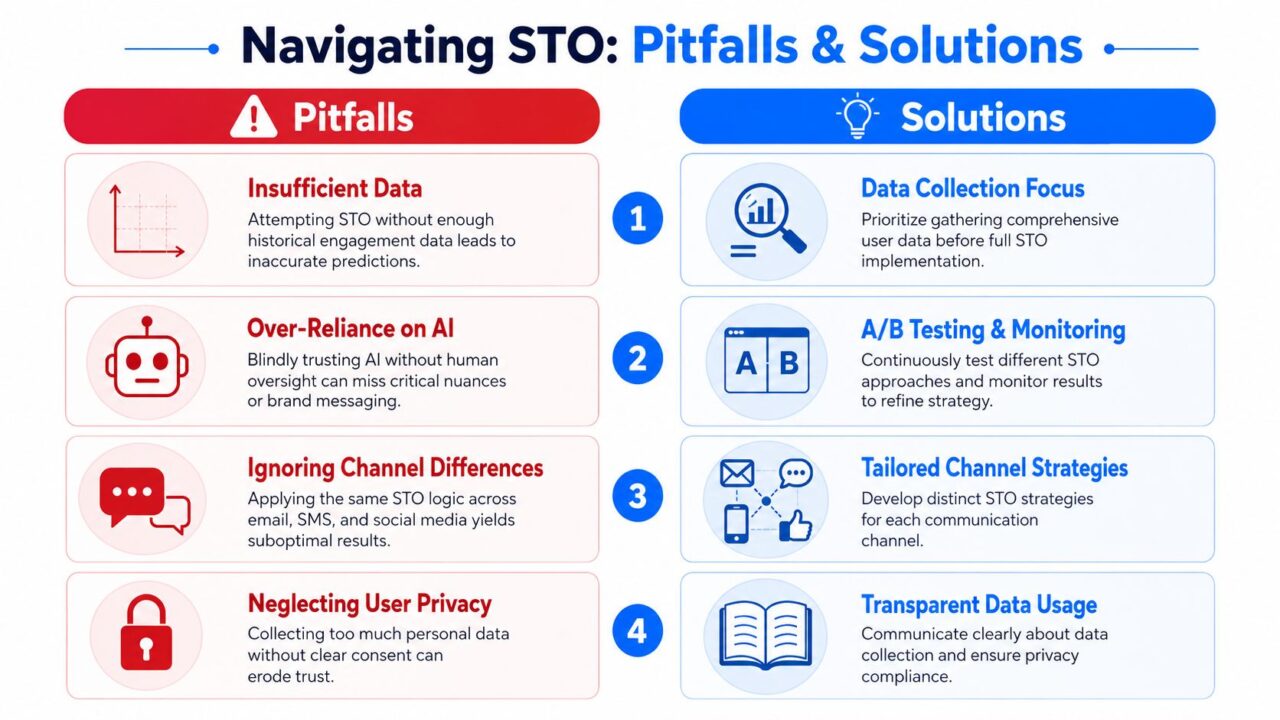
Common STO Pitfalls and How to Avoid Them
Teams usually get in trouble with send time optimization for a simple reason. They treat timing as the strategy instead of one variable inside the strategy.
That mistake shows up fast in multi-channel programs. A DTC brand turns on STO for email, keeps the same generic promo for everyone, then layers SMS and Instagram reminders on top. Open rate might improve, but revenue, opt-outs, and reply quality often do not.
Send Time Optimization Guide
Pitfall one is forcing STO onto weak or tiny segments
Individual timing models need enough behavioral history to be useful. Small segments, new subscribers, seasonal buyers, and inconsistent send schedules usually do not provide that.
Start one level higher. Use segment-level timing based on broad patterns such as first-time buyers, VIPs, recent cart abandoners, or warm coaching leads. Once that group has enough activity, shift to person-level timing.
In Clepher, this matters across channels. If email engagement is thin but SMS clicks are strong, do not force an email-based prediction onto the whole journey. Set channel-specific timing rules until each channel has enough signal to earn more precise automation.
Pitfall two is optimizing timing while ignoring message fit
Good timing gets attention. Relevance gets action.
A common ecommerce mistake is sending a well-timed discount for a category the customer never browsed. The send time was right. The offer was wrong. The same problem shows up in coaching when a lead receives a “book now” message before they have engaged with the case study, testimonial, or objection-handling content that builds trust.
The fix is simple, but it requires discipline. Pair STO with clear audience logic:
- recent product viewers get category-specific follow-up
- cart abandoners get urgency or reassurance, depending on price and buying cycle
- repeat customers get replenishment or cross-sell timing
- coaching leads get timing based on funnel stage, not just activity hour
If you are building more advanced automation around that logic, Clepher’s guide to using AI in marketing is a practical next step.
Pitfall three is creating cross-channel fatigue
This is the failure pattern I see most in first-time orchestration setups. Email is optimized. SMS is optimized. Messenger or Instagram DM is optimized. The customer experiences all three in the same 24-hour window.
That is not optimization. It is congestion.
Set guardrails before you launch:
- Frequency caps: set a max message count across all channels, not per channel
- Cross-channel suppression: stop SMS if the customer clicked the email, replied on Instagram, or completed checkout
- Priority rules: choose the first channel by campaign type, such as email first for product education and SMS first for expiring cart reminders
- Recency exclusions: pull out recent purchasers, support tickets, active conversations, and refund requests
For Clepher users, the practical setup is a channel ladder. Example: send the email at the predicted open window, wait 18 to 24 hours, trigger SMS only if there was no click, then use Messenger or Instagram only for subscribers who have engaged there before. That sequence protects margin and reduces opt-outs.
Pitfall four is assuming every channel should use the same timing logic
Each channel has a different job.
Email supports richer storytelling, bundles, product drops, and lifecycle education. SMS works better for short decision windows, appointment reminders, and high-intent nudges. Messenger and Instagram perform best when the message feels like an ongoing conversation, not a mini email stuffed into a DM.
A DTC example makes this clear. A launch campaign can start with email during the customer’s likely reading window, follow with SMS near cart urgency, then use Instagram DM for shoppers who already replied to story polls or product questions. A coaching business can do something similar. Send the case study email when the lead usually reads, send the text reminder close to the webinar or deadline, then use Messenger for objection handling or quick qualification.
One timing rule across all channels usually produces average performance in all of them.
Pitfall five is giving AI full control without review
Automation helps. It does not understand every business condition you care about.
Teams still need to review launch calendars, inventory constraints, discount pressure, support volume, and audience fatigue. If a product is selling out, if customer service is backed up, or if a lead segment is getting too many reminders, the model should not keep firing because the predicted send window looks good.
Use a simple review process:
- check channel performance weekly by campaign type
- review unsubscribe rates, SMS opt-outs, and reply sentiment, not just clicks
- override timing rules during launches, service issues, or inventory shortages
- audit channel order every month to confirm the first-touch channel still makes sense
For a broader view of where predictive messaging is heading, the idea behind an AI shopping agent is useful. Timing is only one decision. The larger shift is toward systems that decide channel, content, and next action together.
The teams that get STO right do not hand the keys to an algorithm and hope for the best. They set rules, watch customer response across email, SMS, and conversational channels, and adjust the playbook as behavior changes.
The Future of STO with AI and Clepher
Send time optimization is becoming part of a larger shift in marketing automation. The next step isn’t just predicting when someone should receive a message. It’s deciding which channel should carry it, and which content fits that moment best.
That matters because customer attention is fragmented. Someone may ignore email, respond to Instagram, then convert after a follow-up text. The strongest systems won’t treat those as separate campaigns. They’ll treat them as one coordinated conversation with timing built into the logic.
This is also why the broader rise of AI-driven commerce matters. If you want a useful look at how automated decision-making is moving closer to purchase behavior itself, Zinc’s guide to the AI shopping agent is worth reading. It shows where personalized assistance and intent prediction are heading across the buying journey.
For teams building toward that future, STO is one of the most practical starting points. It teaches the organization to respect behavior instead of relying on averages. It forces better segmentation. It also makes channel orchestration more disciplined.
If you’re planning that evolution, it helps to think of timing as one layer inside a broader system of AI-assisted messaging, personalization, and automation. That’s where approaches like using AI in marketing become useful, especially when your customer communication already spans conversational channels along with traditional ones.
The brands that win here won’t be the ones sending the most. They’ll be the ones that send at the right moment, in the right place, with a message that matches intent.
If you want to put this into practice across your website, Facebook, Messenger, WhatsApp, and Instagram DMs, Clepher gives you the tools to build conversational flows, segment audiences by behavior, and run more coordinated multi-channel campaigns without heavy setup.

Related Posts
Lead Qualification Marketing: A Practical 2026 Guide
October 9, 2026Customer Experience Optimization Playbook
October 8, 2026Automated Checkout Bot: Build and Launch Guide
October 7, 2026
Founder Clepher