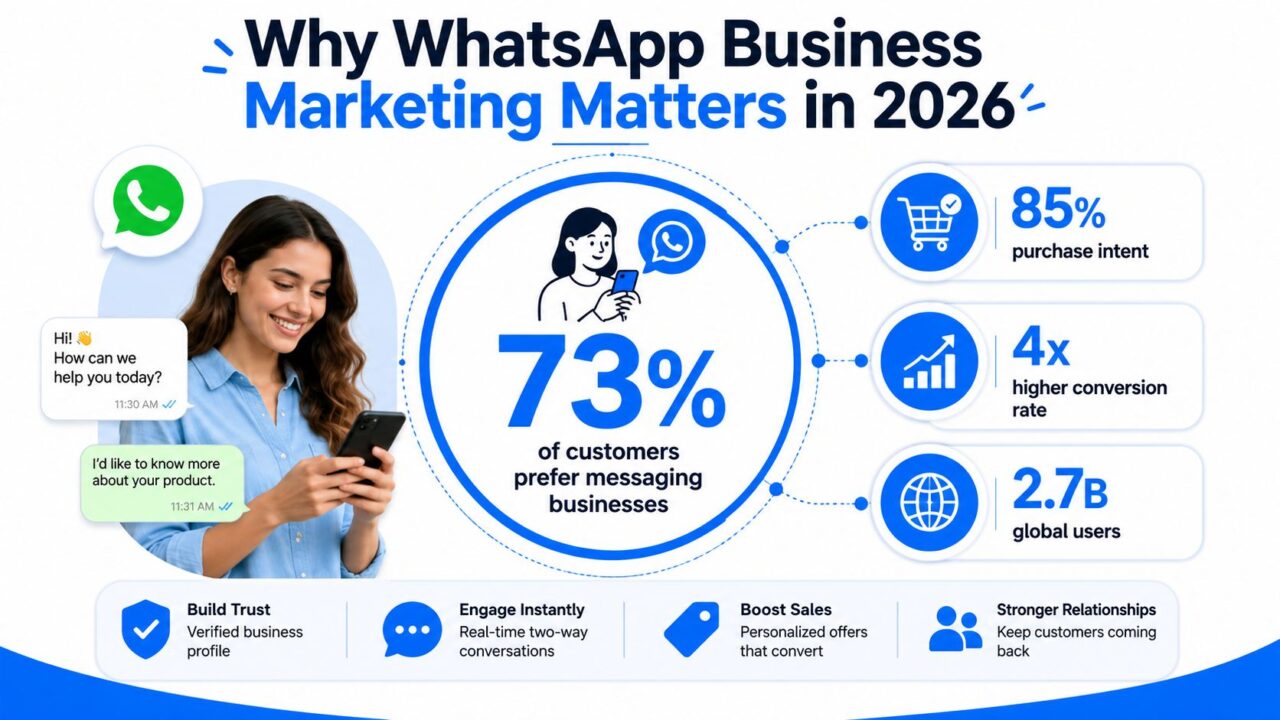
73.3% of consumers across 22 global markets prefer messaging when communicating with a business, according to WhatsApp’s 2026 customer engagement report. That changes the job of WhatsApp Business marketing. It isn’t merely a place to send sales announcements or delivery alerts. It’s a high-intent conversation layer where acquisition, sales, support, and retention can share context.
The opportunity is large, but the old broadcast playbook is incomplete. Open rates can look impressive while margin falls, customers become promotion-dependent, and sender quality deteriorates. The practical 2026 approach is to manage conversation economics, messaging capacity, quality rating, consent, and incremental revenue together.
Why WhatsApp Business Marketing Matters in 2026
WhatsApp’s reach gives marketers access to an audience that already uses messaging as part of everyday communication. 2026 market coverage cites more than 3.3 billion monthly active users and around 284 million active WhatsApp Business accounts worldwide, up from 200 million the prior year. Those figures describe scale, but behavior matters more than scale alone.
Every day, 175 million people message a business account, while businesses and customers exchange more than 2.2 billion messages daily, according to WhatsApp’s business messaging data. That volume shows why the channel has moved beyond occasional customer support. Customers use it to ask questions, compare products, recover purchases, resolve delivery issues, and decide whether to buy.
Whatsapp Business Marketing Statistics Infographic
The strategic shift
A strong WhatsApp Business marketing program starts with a different question. Instead of asking, “How many people can we broadcast to?”, ask, “Which customer conversation can we improve, and what should happen next?”
For an e-commerce brand, that may mean:
- Acquisition: Turn a click-to-WhatsApp interaction into a qualified product conversation.
- Conversion: Help a shopper choose between products or return to an unfinished checkout.
- Retention: Deliver useful post-purchase education, replenishment reminders, or subscription support.
- Service recovery: Resolve a delivery problem quickly enough to protect the relationship.
The channel’s value comes from combining these moments, not isolating promotions from the rest of the customer journey.
Practical rule: Use WhatsApp where a customer’s next action benefits from a reply, a choice, or timely assistance. Use a one-way broadcast only when the recipient has a clear reason to welcome it.
The rest of the operating model follows from that principle. Teams need to choose the right WhatsApp product layer, understand the 24-hour rules, ramp capacity without damaging quality, build templates that support real flows, and test whether WhatsApp adds revenue beyond email and SMS.
Understanding the WhatsApp Business Platform
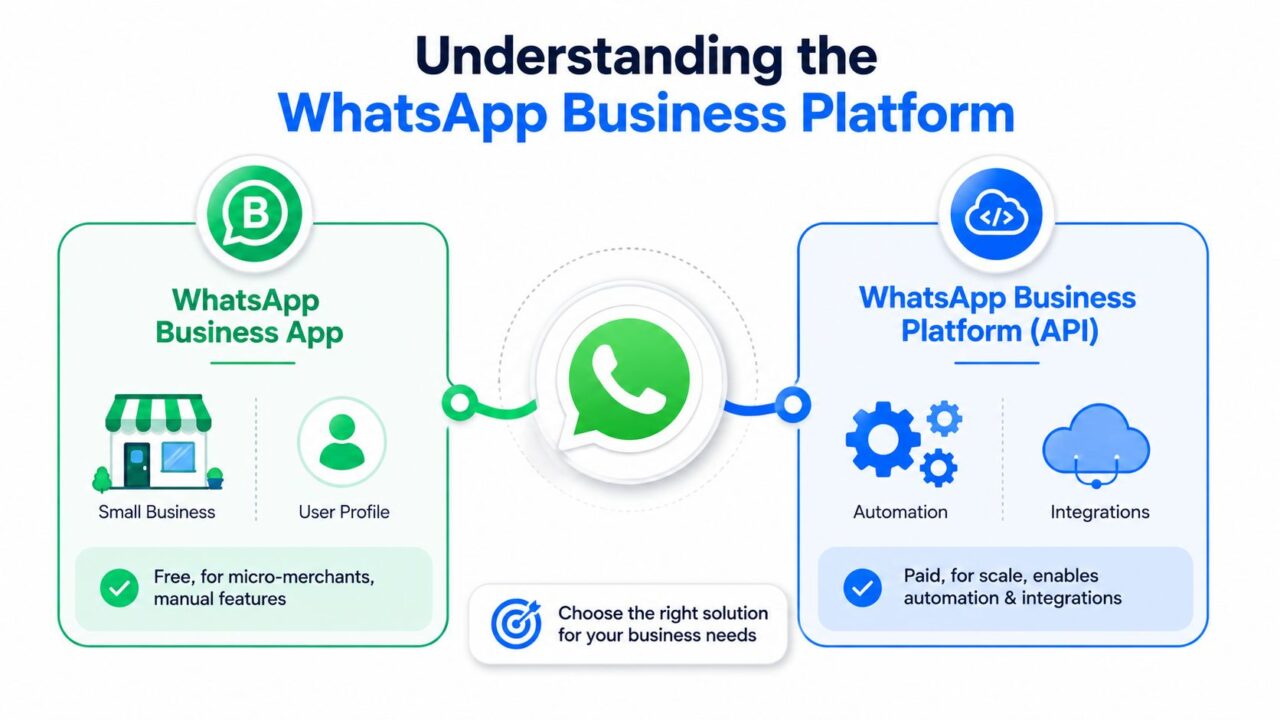
Choosing the right product layer determines how reliably a team can turn customer intent into revenue. A micro-merchant managing conversations manually can start with the WhatsApp Business app. A brand connecting a CRM, commerce platform, and support desk needs the WhatsApp Business Platform, commonly accessed through the API.
The app supports a small catalog, one-to-one chats, labels, quick replies, and manual follow-up. Its broadcast function has hard limits. Each list holds 256 saved contacts, and messages reach only people who have saved the business number, as explained by Blueticks’ overview of WhatsApp Business app limitations. That may suit a neighborhood service provider or merchant with a personal customer base. It becomes difficult once the team needs audience segments, attribution, multiple agents, or event-triggered messages.
Whatsapp Business Marketing Platform Comparison
App versus API
The Platform/API provides the automation layer. It connects WhatsApp with commerce systems, CRMs, analytics tools, chatbots, and agent workflows. A DTC team can trigger an abandoned-cart message, route a lead according to its reply, or transfer a complex support issue to a human while retaining the conversation history.
Industry coverage estimates that more than 6 million medium and large enterprises use the WhatsApp Business Platform/API, while more than 5 million businesses use the API for customer engagement at scale. 2026 industry coverage offers those estimates. The app remains a practical entry point. The API supports segmentation, automation, and lifecycle coordination when manual broadcasting stops producing dependable results.
The service window
The API also sets a clear operating boundary. After a customer messages the business, the company can send free-form replies during the 24-hour service window. Once that window closes, an outbound message must use a pre-approved template, as described in the WhatsApp 24-hour rule.
That requirement shapes staffing and workflow design. If a shopper asks about sizing, an agent can answer naturally while the window remains open. If the brand wants to restart the conversation later, it needs an approved template and a valid reason to send it.
For a small operation, the app may be enough. Businesses that need reliable triggers, shared agent access, audience rules, or reporting should build on the Platform instead of stretching a manual tool into an automation system. That choice supports measurable conversation flows, rather than open-rate reporting or broadcast volume alone.
Pricing Models and Messaging Capacity You Must Plan Around
WhatsApp Business Platform economics are built around conversations, timing, and message category. A conversation is a 24-hour thread, and once it opens, additional messages within that window don’t create another session start. Meta’s pricing documentation describes paid categories including Marketing, Utility, and Authentication, while service conversations are user-initiated and free.
The pricing model changed on July 1, 2025, when per-message pricing applied to all businesses. Service conversations had already become free for all businesses on November 1, 2024, according to the same Meta pricing reference. Marketers should therefore forecast spend by message type and timing, not by treating every outbound message as interchangeable.
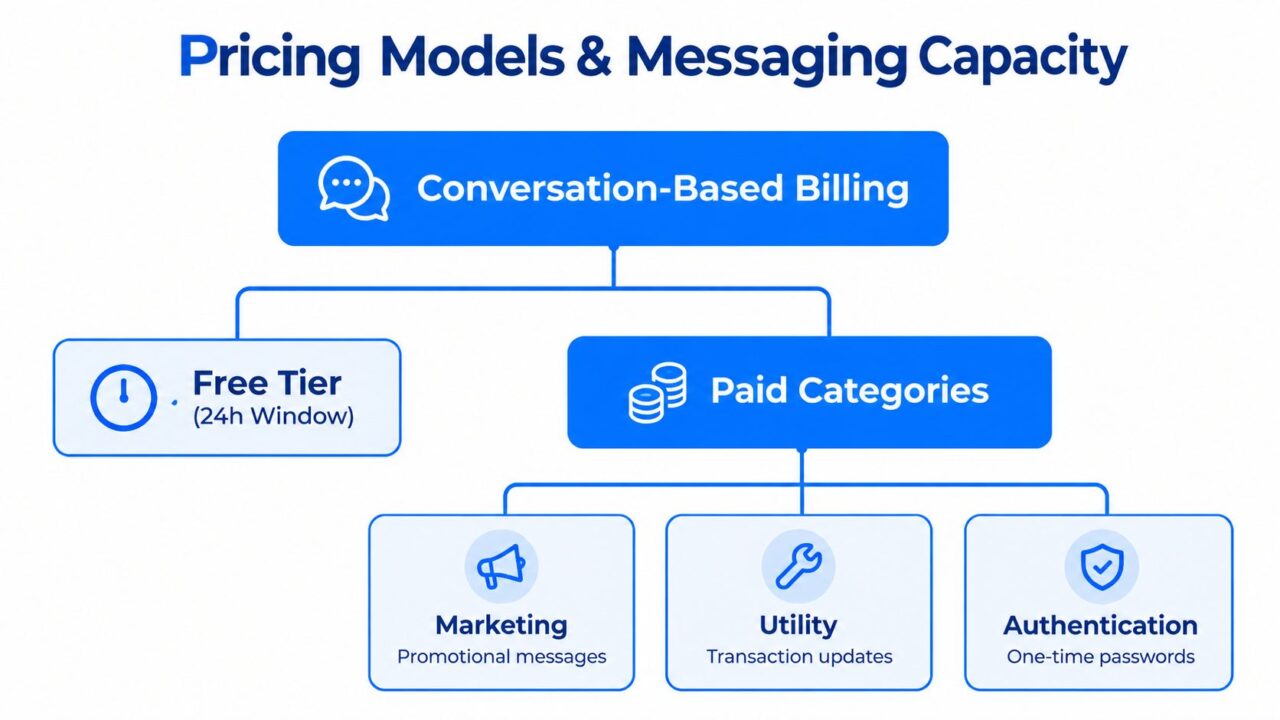
Whatsapp Business Marketing Pricing Models
Build around the opening message
A promotional template can open a marketing conversation. Follow-up messages inside that 24-hour window should complete the job, rather than creating a long sequence of separate openings.
For example, an abandoned-cart flow might:
- Open with relevance: Remind the shopper which product remains in the cart.
- Answer objections: Offer sizing, shipping, or ingredient information through buttons.
- Recover intent: Provide a direct checkout action or invite a reply for assistance.
- Stop cleanly: End the flow if the customer doesn’t engage, rather than continuing to chase.
The same principle applies to lead qualification and limited-time offers. Group the highest-intent actions into a concentrated conversation, then use lifecycle triggers later only when they have a distinct purpose. A useful reference for budgeting and implementation is Clepher’s breakdown of WhatsApp costs.
Capacity is a quality problem
Messaging capacity is measured by the number of unique customers a business can initiate conversations with during a rolling 24-hour period. Documented tiers include 250, 1,000, 10,000, 100,000, and unlimited, with progression tied to volume, quality, and compliance, according to the 2026 explanation of WhatsApp Business messaging limits.
Some documentation presents a tier sequence that includes 250, 2,000, 10,000, 100,000, and unlimited, as outlined by Chatarmin’s messaging limit guide. The operational lesson is consistent even when tier descriptions differ by account or documentation context. Your audience size doesn’t guarantee throughput.
Ramp gradually. Segment tightly. Monitor quality rating and recipient feedback before increasing volume. A sudden promotional spike can consume capacity or damage sender reputation, leaving high-intent customers harder to reach later.
Designing Campaigns, Templates, and Automation Flows
Good WhatsApp copy sounds like a useful message from a recognizable business, not a compressed email newsletter. The creative team should define the customer event first, then select the template category and the next interaction.
Match the template to the job
Marketing templates support promotions, product launches, recommendations, win-back messages, and other commercial invitations. A concise example might be: “Your saved item is back in stock. View the product or reply with a question.” The copy should identify the business, state the value, and give the customer a clear action.
Utility templates handle transactional or account-related updates. Order status, appointment reminders, delivery changes, and subscription notices belong here when the message serves an existing customer action rather than creating a new promotion.
Authentication templates support identity verification and one-time passwords. Keep them narrowly focused. Mixing promotional language into an authentication message creates unnecessary compliance risk and confuses the user.
For more examples and implementation guidance, use Clepher’s WhatsApp Business message template resource.
Design the conversation, not just the send
A campaign should have an entry condition, a response path, and a stopping rule. Consider an e-commerce cart recovery flow:
- Entry: A shopper leaves a product in the cart and has opted into WhatsApp.
- First message: Show the product name and a button to return to checkout.
- Reply path: Offer “Sizing help,” “Shipping details,” and “Complete order.”
- Agent handoff: Route product questions to a sales or support agent.
- Exit: Stop promotional follow-up after a purchase, opt-out, or clear lack of intent.
A lead qualification flow can ask what the prospect wants, their preferred use case, and whether they’d like a product recommendation. A limited-time promotion can state the offer terms, let the recipient browse relevant products, and direct high-intent replies to a salesperson.
Write for approval and replies
Avoid vague urgency, misleading claims, and copy that hides the commercial purpose. State who’s contacting the customer and why. Use personalization only when the underlying data is reliable. A first name inserted incorrectly damages trust faster than a neutral greeting.
Keep the first message focused. Rich media, buttons, carousels, and guided Flows can reduce friction, but every component should move the customer toward a decision or make the next reply easier. The goal isn’t to fit a full campaign into one send. It’s to open a useful conversation and finish the highest-value action inside the available window.
From Broadcast Channel to Customer Journey Infrastructure
Broadcast strategies can generate quick clicks, but they rarely build durable growth when customers learn to wait for discounts. The stronger commercial case is conversation economics: each message should either reduce service cost, improve conversion quality, retain a customer, or produce incremental revenue beyond email and SMS.
WhatsApp can support onboarding, delivery assistance, product education, renewal reminders, service recovery, and selective promotions within one customer record. That continuity matters when marketing, support, and sales share the same relationship. A customer can move from a campaign reply to an agent conversation without restarting the context.
Where the channel creates durable value
A subscription business can use onboarding messages to explain setup, answer common questions, and identify customers who need help before they churn. A retailer can send post-purchase guidance, recommend compatible items, or invite a support question. A local business may gain more from booking confirmation and rescheduling than from another discount announcement.
These workflows create first-party behavioral signals. Someone asking about delivery has different intent from someone comparing product features, while a promotion click alone reveals less. API-based routing lets teams use those signals to choose the next message, audience, or human handoff instead of sending every contact the same broadcast.
Teams assessing how customer records, agent conversations, and automation should connect can review CRM for WhatsApp as one implementation reference.
Open rates aren’t the finish line
Independent 2026 summaries report 95%+ open rates for some WhatsApp campaigns, but Kanal’s analysis of WhatsApp marketing statistics argues that opens provide limited differentiation when visibility is already high. An opened message can still fail to produce profitable incremental revenue.
A visible message isn’t automatically a valuable message.
Measure WhatsApp against a holdout or the channel that would normally receive the same customer. If an email reminder would have produced the purchase, crediting the sale entirely to WhatsApp inflates its contribution. If WhatsApp resolves a support issue, prevents cancellation, or moves a qualified lead to an agent, its value may appear in retention or assisted conversion rather than last-click revenue.
Meta’s push toward unified campaign management across WhatsApp, Facebook, and Instagram, together with more AI-driven business features, raises the importance of this measurement discipline. Growth teams should assign WhatsApp to customer moments where a reply, decision, or human intervention can change the outcome, then judge performance by incremental lift and quality of conversations, not broadcast volume alone.
Compliance, Consent, and Deliverability Best Practices
Permission determines whether WhatsApp Business marketing remains useful or becomes a source of complaints. Customers should know they are opting in to messages from a named business on WhatsApp, rather than just submitting a phone number for an unrelated purpose.
Record the consent event and its context. State which message types customers may receive, provide a clear opt-out route, and avoid treating one purchase as permission for every future promotion. Local privacy requirements still apply, including GDPR-style expectations for purpose, access, retention, and deletion.
Protect sender quality
Quality rating reflects recipient responses to your messages. Blocks, complaints, irrelevant templates, and sharp volume increases can weaken account health even when initial delivery appears strong. A practical audit should cover:
- Consent records: Store the source, timestamp, business identity, and stated purpose for each opt-in.
- Frequency controls: Set limits by audience and journey stage so customers do not receive overlapping campaigns.
- Template hygiene: Separate marketing, utility, and authentication use cases. Do not disguise a promotion as a service update.
- Opt-out handling: Process stop requests immediately and suppress the contact from the relevant message category.
- Quality monitoring: Review rating, delivery behavior, replies, blocks, and tier movement before scaling.
Analysts place WhatsApp Business opt-out rates around 0.3% to 0.5% in recent market summaries, but WhatsApp’s 2025 conversations discussion cautions against treating low opt-out levels as proof that unlimited promotional volume is safe. Customers may ignore, mute, or block messages without completing a formal opt-out. Judge deliverability by conversation quality and incremental revenue, not open rates alone.
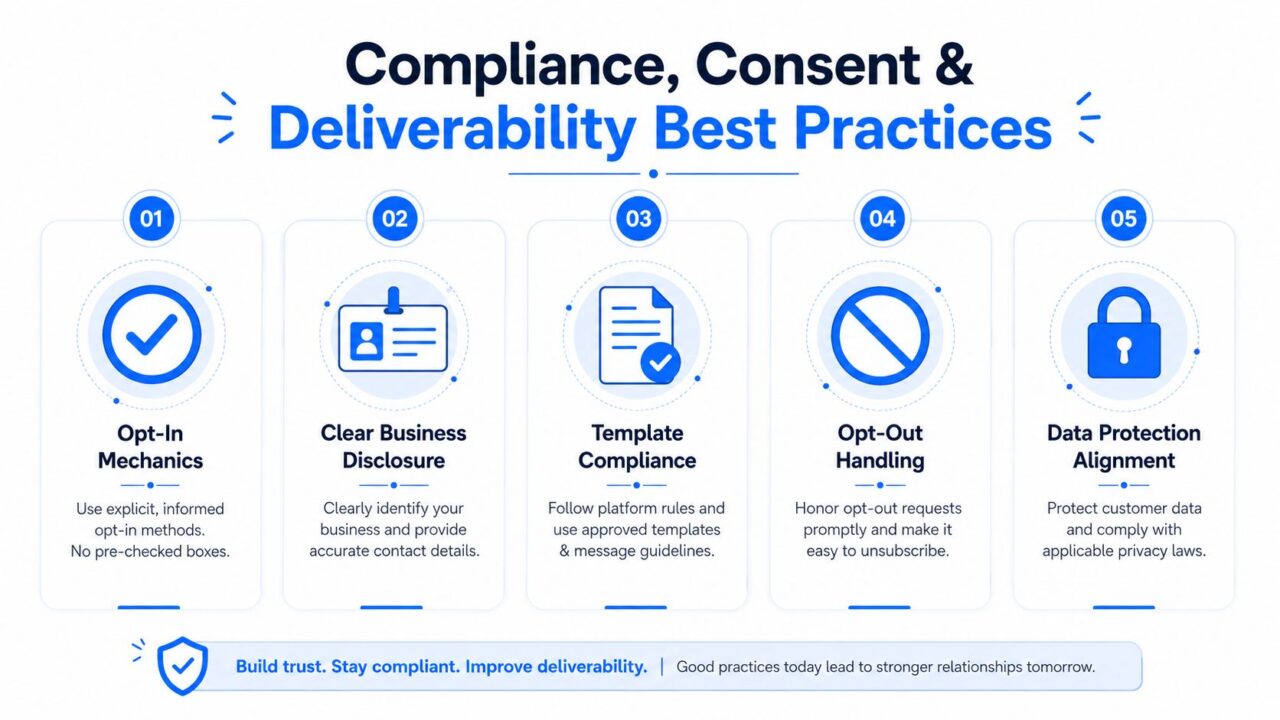
Whatsapp Business Marketing Compliance Best Practices
Agency safeguards
Agencies should separate client portfolios, approval processes, consent sources, and reporting. Never copy a high-performing template from one client into another without checking the business identity, offer, audience expectation, and category.
Before each scale-up, confirm that the audience is segmented, the template matches the promised value, suppression rules work, and the account can handle the planned unique-user volume. If a customer replies with a question, route that conversation to the right agent instead of forcing another broadcast. Deliverability is an operating discipline, not a final checkbox.
Use Cases for E-commerce, Agencies, Creators, and Local Businesses
The same platform behaves differently depending on the customer event. The strongest use case is usually the one with clear intent and a natural reply path.
E-commerce and DTC
Start with abandoned-cart recovery using a marketing template. Open with the product and a checkout button, then route sizing or shipping questions to an agent. Browse abandonment can work when the recommendation reflects the viewed category, while win-back should use a real reason to return rather than repeating a generic discount.
The KPI mix should include recovered margin, qualified replies, assisted conversion, and opt-out behavior. The mistake is sending every product promotion to the full customer list.
Agencies
Agencies need reusable flow logic without flattening each client’s voice. Build separate templates and consent records for every client, use shared reporting definitions, and show clients the relationship between initiated conversations, qualified opportunities, sales, support outcomes, and quality rating.
For broader context on how messaging channels continue to change, CallZent’s overview of communication channel trends offers a useful strategic reference. The avoidable error is reporting opens as the primary outcome while ignoring incremental lift and contact fatigue.
Creators and coaches
A creator can deliver a lead magnet through a utility-style interaction when the customer requests it, then qualify the person with questions about goals, experience, or timing. A launch sequence should invite a reply, answer objections, and route serious prospects to a call or checkout page.
Track qualified conversations, booked calls, purchases, and unsubscribes. Don’t turn every audience interaction into a sales pitch.
SaaS and subscription businesses
Onboarding flows can guide setup, surface activation problems, and connect customers with support. Upgrade prompts should follow demonstrated product use, while churn rescue should ask what went wrong before presenting an offer.
The core KPI is retention or activation lift, supported by support deflection and qualified escalations. Avoid sending promotional upgrades before the customer has reached a meaningful product milestone.
Local businesses
A salon, clinic, restaurant, or service provider can use WhatsApp for promotions, bookings, confirmations, rescheduling, and review requests. Utility messages should support a real appointment or order, while marketing messages should target customers who’ve consented to relevant offers.
Measure completed bookings, response time, repeat visits, and missed-appointment reduction. The common mistake is treating a local customer list as permission for frequent broadcasts.
Measuring What Actually Works and a 90-Day Launch Checklist
A campaign can show strong opens and still lose money. Build the dashboard around outcomes that connect conversations to profit, service capacity, or retention.
| KPI | What it tells you | When to act |
|---|---|---|
| Incremental revenue | Whether WhatsApp created sales beyond the normal email and SMS path | Run a holdout test when last-click attribution dominates reporting |
| Cost per qualified conversation | What you pay to create a sales-ready interaction | Adjust targeting or template relevance when low-intent replies rise |
| Conversion and margin | Whether conversations produce profitable orders, not just clicks | Reduce promotional volume when discounts drive sales without acceptable margin |
| Support deflection | Whether automation resolves routine questions without agent effort | Improve Flow paths when customers repeatedly request human help |
| Retention lift | Whether lifecycle messaging changes repeat purchase or renewal behavior | Compare exposed and holdout groups before expanding the journey |
| Quality rating and tier movement | Whether volume is sustainable for the account | Slow the ramp when quality weakens or capacity fails to progress |
The 90-day operating checklist
Days 1 to 30: Document consent sources, connect the commerce or CRM data, define suppression rules, and establish email and SMS baselines. Build a small set of approved marketing, utility, and authentication templates.
Days 31 to 60: Launch one high-intent flow, such as cart recovery or lead qualification. Ramp unique-user volume gradually, review quality rating, and record replies, conversions, support outcomes, and opt-outs.
Days 61 to 90: Run the first holdout test against the existing email or SMS journey. Compare incremental revenue, margin, retention, and support impact. Keep the flow only if WhatsApp adds measurable value.
Clepher provides official WhatsApp Business API automation with no-code conversational Flows, broadcasts, follow-up logic, segmentation, and analytics for marketing, sales, and support journeys. Visit Clepher to evaluate whether its workflow tools fit your next WhatsApp Business marketing test.