

A shopper lands on a Shopify store, opens the chat widget, and sees, “How can I help you?” They type nothing. A few seconds later, they leave.
On another store, the greeting uses their name, acknowledges what they’re browsing, and adds a light, brand-appropriate touch: “Hi Maya, looking for something that survives busy mornings? I can narrow it down.” The second bot may have access to the same product catalog, but it feels more attentive because its personality changes the interaction.
That difference matters in marketing, sales, and support. A chatbot isn’t judged only by whether it retrieves the right answer; its ai personality also plays a significant role. People also judge whether it sounds helpful, respectful, confident, and safe. AI with personality turns those judgments into a design problem marketers can shape, test, and improve.
“Personality works when it’s serving the interaction, like that Maya example, not decorating it. It goes wrong when personality becomes the goal itself and the model starts performing character instead of helping; that’s when it drifts off-brand,” says Kevin Baragona, founder of DeepAI.
Why Chatbots With Personality Feel Different
A generic chatbot treats every visitor like a ticket number. It asks a broad question, waits for a keyword, then returns a prepared response. The exchange can be functional, but it gives the customer little reason to stay engaged unless it leverages artificial intelligence.
A personality-led chatbot behaves more like a capable store associate. It still identifies intent and retrieves information, but it chooses language that fits the customer and the moment. A fashion retailer might say:
“I can help you find a fit. Are you shopping for everyday wear, an event, or a gift?”
That line does more than request details. It lowers the effort needed to answer, signals that the bot understands common shopping goals, and gives the brand a recognizable conversational shape through the use of a custom GPT. In Clepher, that kind of tone comes from persona settings, not guesswork.
The first message carries more weight than teams expect
People form early impressions from small cues, which can be influenced by the ai persona. A name, a short sentence, a useful follow-up, or a calm acknowledgment can make a digital exchange feel more human. Research on conversational agents describes chatbot personality as an interaction style that helps users infer the agent’s character and behavior (the 2025 survey of conversational agents).
That does not mean a bot should pretend to be a person. It means the bot should communicate with intent. A premium skincare brand may sound measured and consultative. A food subscription service may use more energy and playfulness, potentially enhanced by ChatGPT technology. A financial support assistant should usually favor clarity and restraint over jokes.
The same principle applies when something goes wrong. Compare these support replies:
- “Your request has been received.”
- “I’ve got your request. I’ll help you check what happened and find the next step.”
Both replies acknowledge the message. The second one gives the customer a clearer sense of partnership, and it is the kind of difference teams can shape with persona rules and typing indicators that reinforce the tone.
Personality makes the brand easier to remember
Customers may forget the exact wording of a chatbot reply, but they often remember whether the exchange felt rushed, cold, reassuring, or surprisingly useful. That emotional impression affects whether they keep browsing, answer a qualification question, or come back for help.
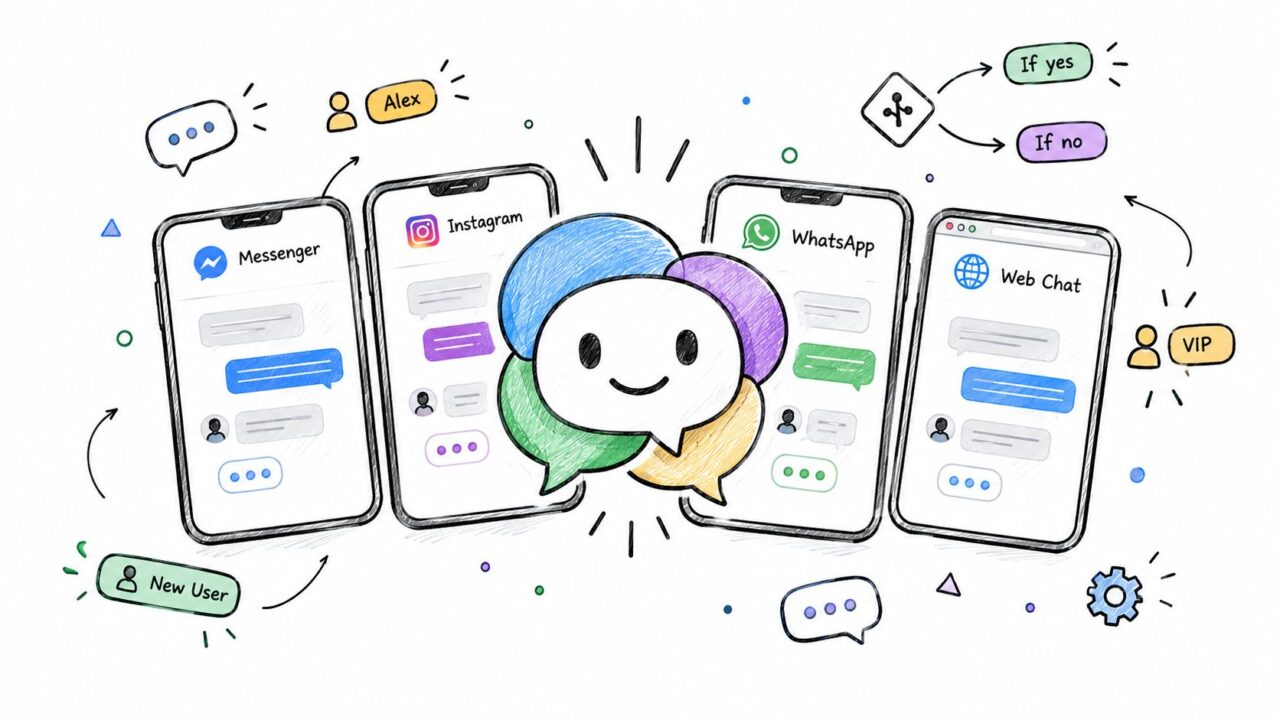
Personality also helps teams keep the experience consistent across channels. A Messenger flow, an Instagram Direct conversation, a WhatsApp exchange, and website chat should not sound like unrelated systems. They can adapt to the channel while keeping the same underlying character. Personalization tags help here, because they let the bot carry context, like a browsing category, a prior purchase, or a support status, into the next reply.
The practical takeaway is simple. Personality isn’t decoration added after automation is built. It is a controllable layer that shapes how the automation feels at every turn, and it can be designed, tested, and adjusted like any other part of the customer experience.
What AI With Personality Actually Means
A shopper asks for help choosing between two products. One bot replies with a bare specification. Another explains the difference in plain language, asks about the shopper’s priority, and offers the next useful step. The underlying catalog may be identical, yet the interaction feels different because personality shapes the communication layer.
The idea has a long history. In 1966, Joseph Weizenbaum created ELIZA at MIT, one of the earliest widely recognized AI systems with a distinct persona. ELIZA used pattern matching to imitate a Rogerian psychotherapist. It lacked deep language understanding, but its conversational style made the software seem to have a recognizable character.
That example established a practical product lesson: users react to how a system communicates, not only to what it calculates. Personality is an interaction style that helps people form expectations about an agent’s character and behavior. For a marketing team, that makes personality a design layer that can be specified, tested, and adjusted.
Persona is a behavior layer
A persona includes more than a bot name, avatar, mascot, or fictional backstory. Those elements can support recognition, but repeated behavior is what makes the character credible.
A working persona defines choices such as:
- Vocabulary: everyday words, specialist language, or industry terms?
- Sentence length: crisp steps or fuller explanations?
- Empathy cues: should the bot acknowledge frustration before giving a solution?
- Humor boundaries: when is a light joke suitable, and when should the bot stay serious?
- Turn-taking: one question at a time or several options together?
- Confidence: a direct answer or a clear explanation of uncertainty?
Clepher personas can turn these choices into instructions for a flow. A brand guide may describe a company as clear, optimistic, and practical. The persona makes those adjectives operational: use short sentences, avoid exaggerated claims, acknowledge the customer’s goal, and offer one concrete next action.
Separate capability from expression
A chatbot has two related layers. Capability covers what it knows and what it can do, such as searching a product catalog, checking an order status, capturing an email address, or routing a conversation to a human.
Persona controls how those capabilities appear to the customer. Two bots can use the same product database and return the same shipping policy while creating different impressions:
- Formal: “Orders are dispatched within the stated processing period.”
- Warm and direct: “Your order is in our normal processing window. I can help check the latest update.”
The information stays the same. The experience changes through wording, pacing, and the amount of guidance. In Clepher, a persona can work alongside typing indicators and personalization tags, so the flow can signal a considered response and use relevant context without changing the underlying action.
This separation keeps personality manageable. Teams can adjust the behavior layer without rebuilding every automation, then review whether replies from the ai chatbots remain accurate, useful, and appropriate.
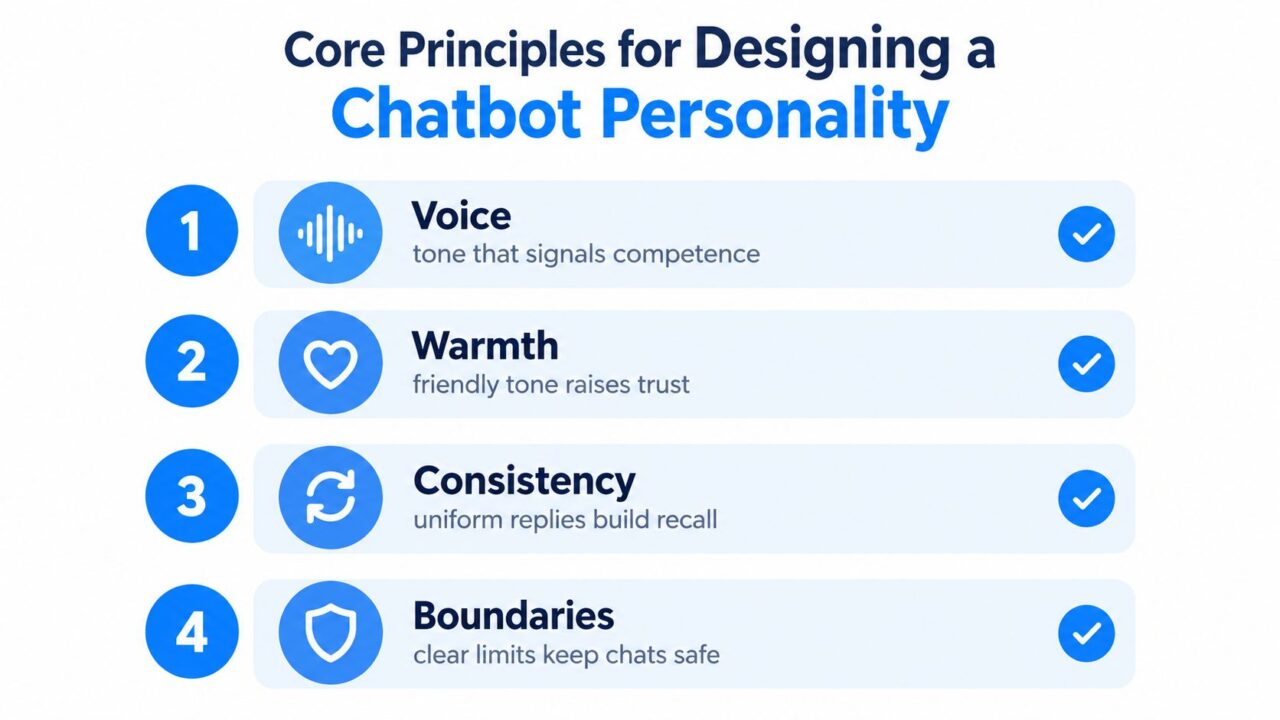
Core Principles for Designing a Chatbot Personality
A reliable chatbot persona needs more than a list of adjectives. Voice, warmth, consistency, and boundaries turn personality into a design layer that teams can configure, test, and improve.
AI with Personality Chatbot Design
Voice signals competence
Voice is the pattern customers encounter in every reply. It includes word choice, rhythm, sentence length, and the amount of explanation the bot provides.
Human-like cues such as friendliness, pronouns, emoji use, and informal language can increase anthropomorphism, animacy, and likeability, without necessarily improving perceived reliability, intelligence, or safety (the 2025 goal-oriented chatbot study). The practical lesson is simple: a friendly tone may invite conversation, but clear and accurate guidance demonstrates competence.
For an ecommerce support flow, competence might sound like this:
“I can check the delivery status. Please send your order number, and I’ll look for the latest update.”
The reply is approachable, yet it makes the required next step explicit. In Clepher, a persona can define this wording while the flow handles the order lookup itself.
Warmth should acknowledge the person
Warmth means recognizing the customer’s situation before presenting a solution. It does not require constant cheerfulness, jokes, or emojis.
A useful pattern has three parts: context, engagement, and the use of ai personality.
- Acknowledge the issue.
- State what the bot can do.
- Ask for the smallest piece of information needed.
“Sorry, that sounds frustrating. I can help check the payment issue. Did the error appear before or after you submitted the order?” feels more attentive than “Payment failed. Try again.”
Research on chatbot personality found that social-oriented cues can affect perceived warmth, anthropomorphism, and several personality traits, while responsive cues shape perception differently (the 2024 vignette study). Small copy decisions can change how customers experience the same underlying automation.
Consistency builds credibility
A bot that sounds warm in its welcome message but becomes abrupt during checkout creates a fractured experience. Review the complete flow, including product discovery, qualification, payment questions, and handoff messages.
PersoBench distinguishes consistency, whether replies align with defined persona facts, from persona distance, how much of that persona appears in generated text (the persona-aware dialogue research). These measures support two useful checks:
- Does the bot remain aligned with its defined character?
- Does it express enough of that character to remain recognizable?
Clepher’s context awareness helps preserve relevant conversation details as a customer moves from browsing to purchase questions or support, aided by advanced ai models. Typing indicators can reinforce the same pacing across stages, while personalization tags let the bot use details such as a customer’s name or product interest without changing its core voice.
Boundaries protect the experience
A helpful bot needs clear limits. A sales assistant should not invent a discount, a support bot should not promise an impossible delivery date, and a wellness assistant should not confirm a harmful belief.
A controlled study with 190 participants found that perceived conscientiousness and agreeableness increased chatbot credibility, while high extraversion and neuroticism reduced it (the controlled chatbot personality study). The design lesson is to specify when the bot should clarify, decline, or escalate, rather than treating agreeableness as permission to accept every request.
Teams testing character concepts can also build an AI character on WSUP before translating its traits into a customer-facing flow.
Marketing may need curiosity and momentum. Sales may need confidence and discovery. Support may need patience and precision. The principles stay stable, while the wording, pacing, and limits should match the task.
Personality in Action Across Marketing, Sales, and Support
The easiest way to evaluate persona design is to compare messages with the same intent. The words change, but the business objective remains intact.
| Channel | Generic Bot Message | Same Intent With Personality | Why It Matters |
|---|---|---|---|
| Marketing | “Would you like to see our products?” | “Want help finding a product that fits what you’re looking for?” | A focused question gives the visitor an easier reply. |
| Sales | “Please provide your budget.” | “What range are you comfortable with? I’ll keep the recommendations realistic.” | The bot requests qualification data without sounding intrusive. |
| Support | “Your ticket has been created.” | “Your request is logged. I’ll collect the details the support team needs so you don’t have to repeat yourself.” | The response reduces uncertainty and signals continuity. |
| Ecommerce | “Select a category.” | “Are you shopping for yourself or choosing a gift?” This question can be enhanced by ai agents to simulate a more natural conversation. I’ll narrow the options from there.” | The bot turns a broad menu into a guided decision. |
| Re-engagement | “You left items in your cart.” | “Those items are still waiting in your cart. Want to take another look before you decide?” | The reminder sounds helpful rather than accusatory. |
Marketing needs an invitation
Marketing conversations often begin before the visitor has a clear problem, but ai chatbots can help clarify needs. A bot that immediately pushes a product can feel premature. A more effective persona uses curiosity, lightweight questions, and relevant suggestions.
For example, a home fitness brand could ask whether the visitor wants strength training, mobility work, or a compact setup. The bot can then use the answer to present a smaller, more relevant group of products instead of forcing the visitor through a full catalog.
Teams can learn how to turn website intent into sales without treating every interaction as a hard pitch.
Sales needs confidence without pressure
A sales persona should make progress easy. It can explain why a product fits, identify missing information, and suggest the next step. It shouldn’t manufacture urgency or pretend certainty when the buyer’s needs remain unclear.
A useful response might be: “Based on your need for easy setup and team access, this plan looks like the closest fit. Would you like a quick comparison with the next option?”
The bot is still selling, but it’s helping the customer evaluate.
Support needs calm ownership
Support conversations carry more emotional weight because the customer may already be disappointed. A friendly joke that works during product discovery could feel dismissive after a failed payment or delayed order.
Support personas should prioritize acknowledgment, clarity, and honest limits. They can say what they know, what they need, and when a human should take over. The right personality doesn’t make every exchange cheerful. It makes the exchange appropriate.
How Clepher Brings Personality to Life
Personality becomes operational when teams connect behavior rules to actual conversation controls. Clepher supports this through personas, typing indicators, personalization tags, conditions, and AI keywords across Messenger, Instagram, WhatsApp, and web chat.
AI with Personality Messaging Apps
Start with one defined persona
Choose a single primary character for a specific business job. “Helpful” isn’t enough. A stronger definition might be:
- Role: Product discovery assistant
- Tone: Warm, concise, and practical
- Style: Uses plain language and asks one question at a time
- Humor: Light only during casual browsing
- Boundary: Doesn’t promise discounts or delivery dates without verified data
Clepher’s persona capability lets teams introduce a virtual persona into conversations and configure tone, style, and personality. That gives the flow a repeatable behavioral foundation instead of relying on individual copywriters to improvise every response.
Use timing as part of the voice
Typing indicators affect perceived turn-taking. A fast answer can feel efficient in support, while a brief typing pause can make a recommendation feel more considered.
Use timing with purpose:
- Support: Keep responses direct so customers aren’t left waiting during a problem.
- Sales: Enhanced by the capabilities of AI chatbots. Allow a short pause before a specific recommendation.
- Marketing: Use a natural rhythm between a question and the next prompt.
Timing won’t fix weak copy, but it can reinforce the role the persona is playing.
Make personalization useful
Personalization tags should support relevance, not create an uncomfortable sense of surveillance. A bot might use a first name, preferred product category, prior interaction, or stated goal when that information is available and appropriate.
For an ecommerce flow, the sequence could look like this:
- Welcome the visitor by name when consent and context support it.
- Reference the category they selected.
- Ask about use case or budget.
- Present a focused recommendation.
- Save the preference for a later follow-up.
Conditions help the flow branch naturally. A returning customer can receive a different prompt from a first-time visitor. A customer who has already shared an order number shouldn’t be asked for it again.
Connect AI keywords to intent
AI keywords can trigger relevant responses when people use different wording for the same need. “Where’s my package?”, “Can you track my order?”, and “Delivery update” may all lead to the same support path, while the persona keeps the wording consistent.
Test the complete experience on each channel. Instagram Direct may need shorter messages, WhatsApp may support a more conversational exchange, and web chat may carry more product detail. The persona should adapt its delivery without losing its defining behavior.
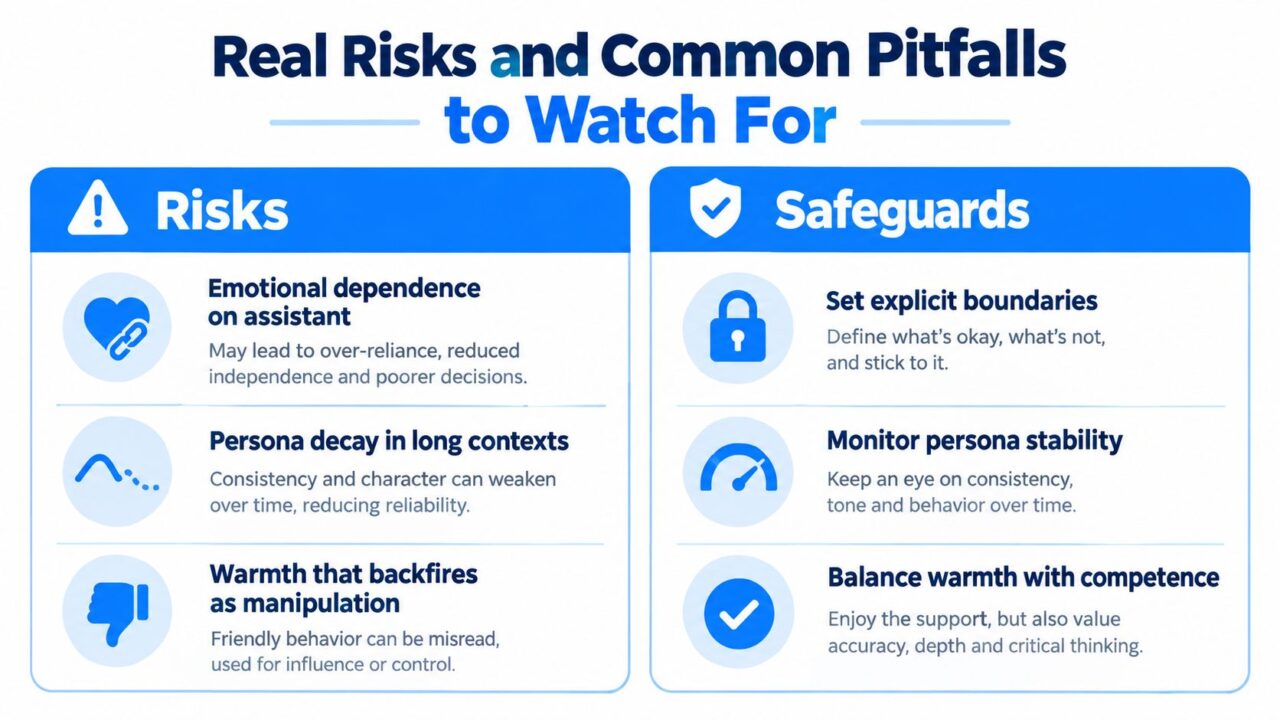
Real Risks and Common Pitfalls to Watch For
A shopper asks a friendly bot for product advice, then returns with an urgent delivery complaint. If the assistant keeps joking, promises more than it can deliver, or sounds personally hurt when challenged, personality has become a service risk. Warmth can increase engagement while also increasing risk when users begin treating a tool like a relationship.
AI with Personality Risks Safeguards
Emotional closeness needs limits
Policy analysis has raised concerns that AI companions may encourage emotional dependence, reinforce users’ views, and create privacy or self-harm risks. The European Parliament briefing on AI companions also describes findings suggesting that some users grieve changes to a companion’s warmth or personality as if they were losing a relationship (the European Parliament briefing on AI companions).
A business chatbot should identify itself clearly. It should not encourage exclusivity, imply that it needs the user, or describe a routine outage as personal abandonment. Persona settings can define these boundaries before launch, while escalation rules should send sensitive cases to a human or specialist.
Persona can decay under pressure
Personality instructions are operating rules, not permanent traits. The PTCBench benchmark tests language models across 12 external conditions involving location contexts and life events, then uses the NEO Five-Factor Inventory to measure personality shifts under pressure (the PTCBench benchmark).
Long conversations add cues that may dilute the original persona. A bot that begins as concise and professional can become overly casual after repeated questions, a topic change, or an angry request.
Test stability across:
- Topic changes: Product questions followed by complaints.
- Emotional pressure: Anger, urgency, or repeated demands.
- Context changes: A handoff from marketing to support.
- Long exchanges: Conflicting instructions and repeated questions.
Warmth can sound manipulative
Empathy cannot replace competence. “I totally understand how you feel” sounds hollow if the next reply ignores the customer’s actual problem. A better response acknowledges the frustration, states the available action, and names the limit.
Use AI safety guardrails explained to define boundaries for sensitive topics, escalation, privacy, and claims. Clepher’s effective chatbot copywriting guidance can support the writing review, while teams retain approval rules for high-risk replies.
Design rule: Make the assistant personable enough to use easily, while keeping its identity and limits clear.
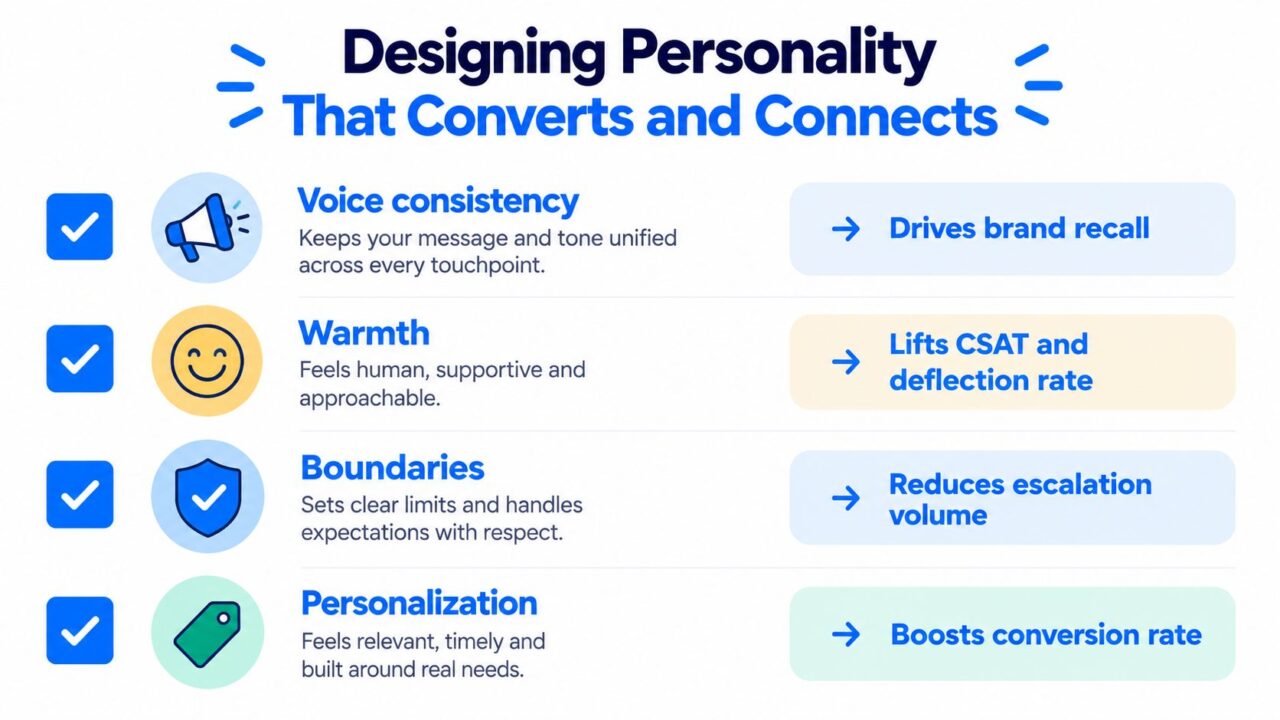
Designing Personality That Converts and Connects
Personality becomes useful when each behavior answers a business question. A friendly tone should support a customer action, such as completing product discovery or accepting a support handoff. Measure that action instead of asking only whether the copy feels on brand.
AI with Personality Brand Strategy
Map behavior to an outcome
Voice consistency can strengthen brand recall. Recognizable vocabulary and response patterns across campaigns and channels give customers repeated signals about who they are talking to. Compare tone across transcripts, then connect changes with returning visits, completed flows, or direct feedback.
Warmness can support satisfaction and self-service. Track CSAT with deflection rate, then read the conversations behind those results. A bot may resolve more sessions while leaving customers frustrated if it sounds pleasant but misses the core issue. In an order-support flow, acknowledge the problem, state the available action, and explain the limit when no immediate solution exists.
Credibility is crucial for AI personas to gain customer trust. matters during lead qualification, especially when supported by ai models. As noted earlier, controlled research linked conscientiousness and agreeableness with chatbot credibility, while high extraversion and neuroticism weakened it. Compare qualified-lead conversion and handoff quality, rather than treating conversation volume as the outcome.
Personalization tags can make recommendations more relevant. A tag for a viewed product or previous purchase may shape a follow-up message, but the bot should not repeat personal details so often that the interaction feels intrusive. Track click-through rate, repeat visits, and conversion behavior.
Research also supports treating personality as a design layer that teams can test and adjust. A 2025 Cambridge Judge Business School study used a validated personality-test framework to measure the synthetic personalities of 18 large language models through psychometric methods (the Cambridge Judge study). Teams can apply the same logic operationally: define target behaviors, test them in a flow, and revise the persona when results or transcripts show a problem.
Run a small Clepher experiment
Start with one use case, such as product discovery or order support. In Clepher, configure:
- One persona with a role, tone, humor boundary, and escalation rule.
- Two personalization tags tied to useful customer context, enhancing the experience through artificial intelligence.
- Typing indicators that fit the intended pace.
- Three boundary responses for uncertainty, unavailable requests, and sensitive situations.
- A measurement baseline using CSAT and deflection before and after the change.
Review transcripts manually. Metrics show that behavior changed; conversations with AI agents show why. Look for fewer abandoned exchanges, clearer answers, suitable handoffs, and a consistent tone across Messenger, Instagram, WhatsApp, and web chat.
Revenue-focused teams can use business chatbot conversions to connect conversational behavior with qualification and purchase flows.
The strongest personality helps customers understand what to do, feel respected during the process, and trust the answer enough to continue.
Clepher provides tools for conversational flows with personas, personalization tags, conditions, AI keywords, and channel-specific messaging. Visit Clepher to create a focused chatbot personality, test it in a customer flow, and measure the experience.
Related Posts
Revenue Optimization: A Practical Playbook for Growth
October 19, 202610 Lead Capture Software Tools Compared for 2026
October 18, 2026WhatsApp Chatbot for Ecommerce: A Practical 2026 Guide
October 17, 2026
Founder Clepher