
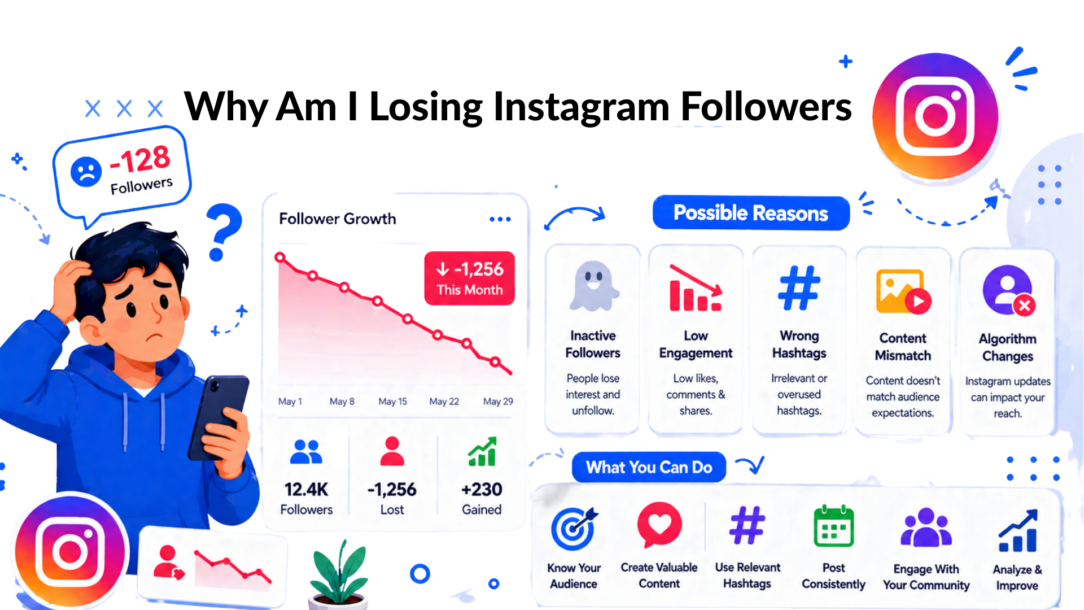
You open Instagram, tap your profile, and the number is down.
That drop can feel personal, especially if you’ve been posting regularly, testing formats, and trying to grow a business from the platform. For creators, ecommerce brands, agencies, and coaches, follower loss often looks like a verdict. It usually isn’t.
The useful question isn’t “why am I losing Instagram followers?” in the abstract. It’s “what kind of loss am I looking at?”
A sudden drop can mean Instagram cleared out fake or inactive accounts. A slow decline usually points to content fatigue, poor timing, weak engagement signals, or a mismatch between what people followed and what you’re publishing now. Those are very different problems, and they need different responses.
I’ve seen teams make the same mistake over and over. They notice a dip, panic, overhaul the content plan, post more, promote harder, and make the account less stable. The better move is to diagnose first. If the loss is mostly low-quality followers disappearing, that can improve the health of the account. If the loss is coming from real people who used to care, you need to fix the experience they’re having.
The goal isn’t to protect a vanity number at all costs. The goal is to build an audience that still engages after Instagram changes, bot purges hit, and trends move on.
That Sinking Feeling When Your Follower Count Drops
A follower drop creates a very specific kind of frustration. You might have launched a campaign, published a Reel you expected to perform, or finally gotten back into a posting rhythm, and then the count falls anyway.
That’s why this moment trips up smart marketers. The same symptom can point to opposite realities.
One account loses followers because its content got repetitive, too promotional, or inconsistent, which may signal the need for more quality content. Another loses followers because Instagram removed fake accounts that were never going to buy, reply, or click in the first place. These fake followers were not valuable to begin with, and their removal actually benefits your Instagram following in the long run. Those are not equal losses.
Not every unfollow is bad news. Some follower loss is cleanup, not rejection, especially if you’re focused on gaining new followers on Instagram who are genuinely interested in your content. If your account has recently hosted a giveaway, you might see some temporary dips as people who followed solely for the promotion decide to leave.
For a DTC brand, this matters because bad diagnosis leads to bad decisions. If your count dipped because low-quality followers disappeared, changing your offer, voice, or creative direction may do more harm than good. If your count is falling because loyal followers have stopped seeing value, then “wait it out” is the wrong move. In 2026, staying proactive with content that resonates is key to keeping your audience engaged and growing your Instagram following organically.
Losing followers on Instagram isn’t always a sign of failure—sometimes, it’s just part of the process of refining your audience.
Good loss versus bad loss
Think about follower loss in two buckets:
- Good loss: fake accounts, inactive profiles, giveaway-only followers, follow-unfollow churn, people who were never a fit.
- Bad loss: ideal customers, warm prospects, repeat viewers, engaged community members, people who used to interact and now leave.
Good loss usually makes future performance cleaner. Bad loss weakens reach, lowers response quality, and makes future posts harder to distribute.
What a useful response looks like
A strong response starts with pattern recognition.
- Sudden and sharp: often a platform cleanup or a technical visibility issue.
- Slow and steady: usually content relevance, cadence, audience mismatch, or engagement weakness.
- Loss after specific posts: often creative or promotional misfires.
- Loss after changes in format or frequency: often expectation mismatch.
If you treat every drop like a content emergency, you’ll keep rewriting a strategy that may not be broken. If you ignore every drop as “just Instagram,” you’ll miss clear signs that your audience has moved on.
Your Diagnostic Toolkit: Pinpointing the Real Reason for Follower Loss
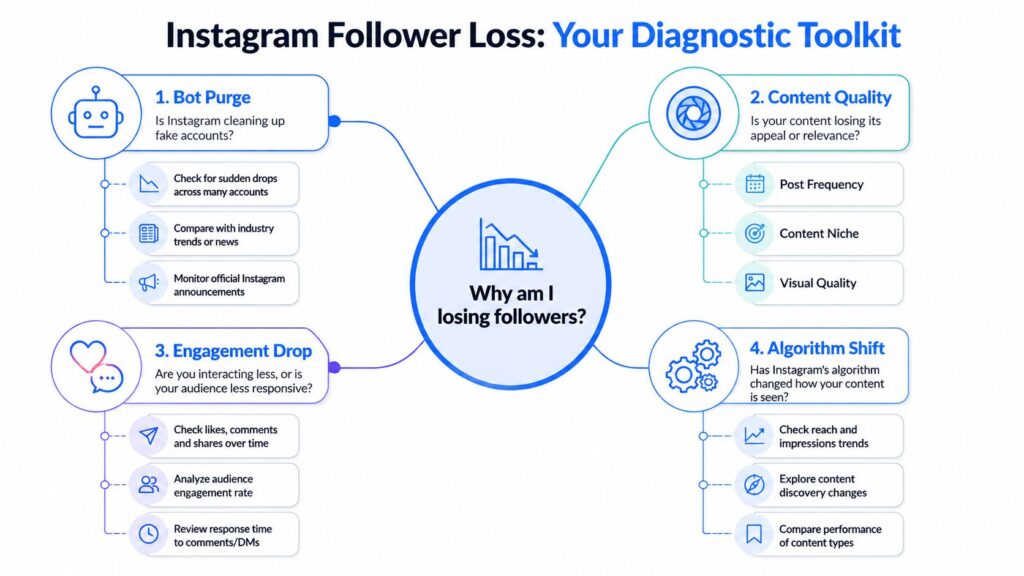
Before you change your bio, niche, offer, posting schedule, and creative style all at once, check the evidence. Instagram can remove low-quality accounts in waves, and Instagram removed over 490 million fake accounts in the past year. That kind of cleanup can look like a content problem when it isn’t.
Diagnostic Toolkit
The fastest way to diagnose follower loss is to compare what happened to the count with what happened to reach, profile activity, and post-level engagement. If the count drops but your engaged audience behaves normally, you may be looking at a healthy cleanup. If the count drops along with reach and interactions, the problem is more likely content or distribution.
What to check first in Instagram Insights
Open Insights and look for timing before interpretation.
Start with a simple sequence:
- Check the date of the drop. Was it one abrupt decline or a repeated pattern?
- Compare follower loss to reach. If followers dropped but reach held steady, your active audience may still be intact.
- Review recent posts. Did losses spike after one topic, one promo burst, or one format change?
- Look at profile visits and interactions. A healthy account can lose followers while keeping strong visits and replies.
- Check audience quality signals. If many followers weren’t engaging before the drop, losing them may improve account health.
If you need a refresher on what each metric means inside the app, Clepher has a useful breakdown of Instagram Insights meanings.
Red flags that separate the purge from the Instagram strategy problem
Use this quick comparison before making changes.
| Red Flag | Likely Cause | Where to Look |
|---|---|---|
| Sudden drop in followers with no obvious content change | Bot or fake account purge | Follower trend line and recent account history |
| Gradual decline across several weeks | Content fatigue or audience mismatch | Reach, saves, comments, shares, post themes |
| Loss after a burst of promos | Overly sales-heavy content | Unfollows are tied to specific posts |
| Reach falling before follower loss | Algorithm visibility problem | Post-level performance and timing patterns |
| Audience confusion after a topic shift | Niche drift | Engagement differences by content pillar |
How to tell if the loss is actually healthy
If the accounts leaving were never interacting, never buying, and never replying, your top-line count may shrink while your real audience becomes clearer. That can improve decision-making because you’re no longer optimizing for people who were never part of your market.
A healthy cleanup often looks like this:
- Follower count falls
- Comments from real buyers stay consistent
- Story replies still come from the same core audience
- Website traffic quality doesn’t worsen
- Product questions and DMs remain steady
Practical rule: Don’t rebuild your strategy around a follower drop until you know whether engaged people left or low-value accounts disappeared.
When the pattern points to a real issue
If your losses are tied to post types, timing, or message shifts, the account is telling you something useful. Followers don’t leave because of one imperfect post. They leave when the account stops matching the reason they followed.
That’s why diagnosis has to come before fixes. Otherwise, you risk solving the wrong problem and teaching the algorithm that your account is unstable.
Common Content Mistakes That Make You Lose Followers
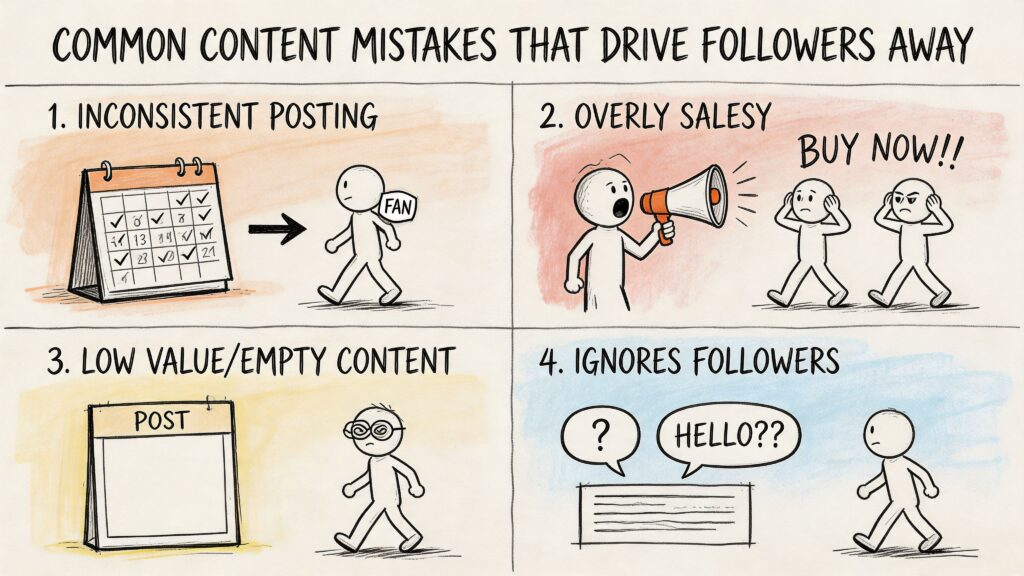
Once you’ve ruled out a purge, content is the next place to look. Most follower decline becomes preventable through content.
A 2024 HubSpot survey found that 44% of marketers said not posting often enough is the top reason brands lose followers, while 18% said posting too much also causes follower loss in HubSpot’s analysis of follower decline on Instagram. That’s the core tension. People want consistency, not chaos.
Content Mistakes
Inconsistency breaks familiarity
If you disappear for stretches and then come back with a flood of posts, followers have to re-learn who you are. Most won’t bother.
Bad version:
- You post heavily during launches.
- You vanish between campaigns.
- Your Stories are active one week and silent the next.
Better version:
- You keep a repeatable weekly cadence.
- You use recurring formats, so followers know what to expect.
- You make launch content feel like part of the same account, not a takeover.
A practical way to tighten this is to build a lightweight content system around a few reliable post types. This guide on creating quality Instagram content is useful if your feed feels improvised rather than planned.
Incoherence makes the account feel random
People don’t need every post to look identical. They do need a clear sense of what your account is about.
That confusion shows up when:
- A coach alternates between mindset posts, family selfies, affiliate links, and random memes with no connective thread
- A product brand swings between polished campaigns and low-context reposts
- .A creator changes tone every week depending on trends
Followers may not consciously say “this account lacks coherence.” They just stop caring.
Irrelevance is the quiet unfollow trigger
This is the most common problem I see. Brands talk about what they want to announce, not what the audience wants help with.
Here’s a simple before-and-after.
Instead of this salesy post:
- New drop live now
- Limited stock
- Shop today
- Link in bio
Use this value-driven product post:
- The problem this product solves
- Who it’s for
- How customers use it
- What makes it different
- Then the call to action
The product doesn’t need less visibility. It needs more context.
Followers usually tolerate promotion when it feels useful. They leave when every post asks for attention without earning it.
Three content checks worth running this week
Use these if your account feels stale:
- Audit your last dozen posts. Which posts got comments, saves, replies, or meaningful DMs? Which ones got polite likes and nothing else?
- Map your content promise. What did people follow for? Education, product inspiration, entertainment, identity, behind-the-scenes access, or niche expertise?
- Check ratio and rhythm. If your recent feed feels like one long ad, followers feel it too.
A strong Instagram account usually has a recognizable promise. That promise can evolve, but it can’t disappear without consequences.
Navigating Instagram Algorithm Penalties
Sometimes the issue isn’t just what you posted. It’s how Instagram interprets the account’s behavior.
The platform pays close attention to early response. According to SupGrowth’s breakdown of Instagram follower decline, Instagram’s algorithm prioritizes engagement in the first 10-20 minutes, and posts that fail to hit benchmark interaction levels such as the 0.45% industry average, can enter a visibility decline that affects later posts too.
Why early engagement matters so much
Instagram doesn’t distribute every post equally. It tests. If people respond quickly, the platform keeps showing the content. If they don’t, distribution slows.
That creates a painful loop:
- you publish
- followers don’t engage quickly
- the post reaches fewer people
- fewer people see the next post
- account momentum weakens
- unfollows become more likely because the content feels less present and less relevant
This is why timing and audience fit matter more than “posting more.”
What shadowbanning usually looks like in practice
Creators use the word loosely, but the practical issue is real. An account can lose visibility without getting a clear warning.
Common triggers include:
- spammy or irrelevant hashtag use
- repetitive promotional behavior
- suspicious automation
- activity patterns that look inauthentic
- guideline issues that reduce trust
You usually notice it indirectly. Reach drops. Hashtag discovery weakens. Followers stop seeing posts consistently. Story interactions soften. Nothing looks broken from the outside, but the account feels harder to move.
A simple check for penalty-related loss
Look for a mismatch between effort and exposure.
If your creative quality is stable but:
- your non-follower discovery suddenly dries up
- your usual followers stop reacting at normal levels
- your posts perform noticeably worse regardless of topic
- your account recently used aggressive engagement tactics
then the issue may be less about creativity and more about trust signals.
Strong accounts don’t just create good posts. They make it easy for Instagram to trust the account behind the posts.
What usually works better than hacks
The safest path is boring and effective.
Remove questionable hashtags. Stop any engagement pod behavior. Avoid mass, repetitive outreach that feels automated. Publish content built for replies, shares, and saves from real followers. Get the first wave of engagement from genuine audience interest, not tricks.
A lot of follower decline is really visibility decline in disguise. If people don’t see you enough, they stop remembering why they followed.
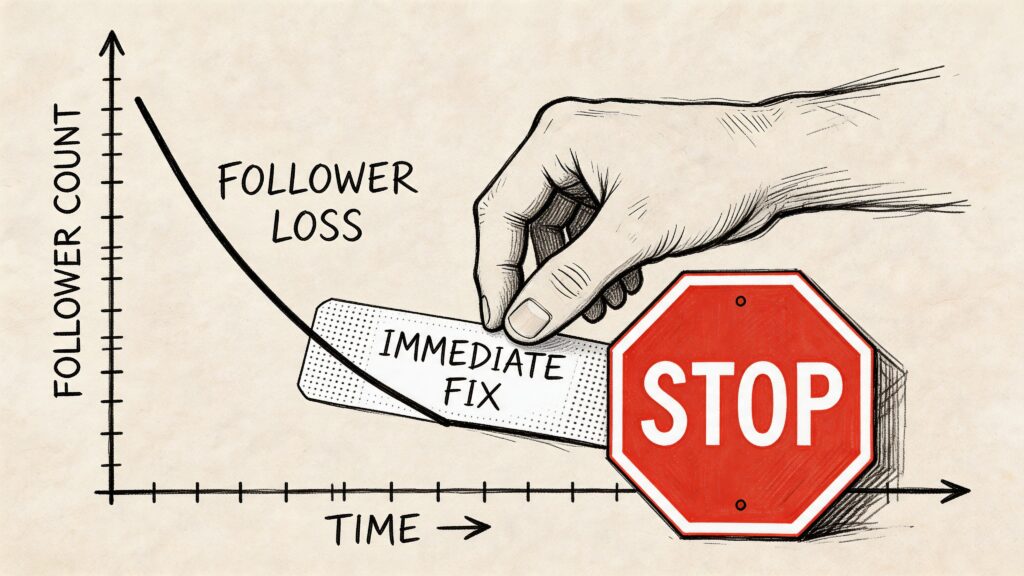
Immediate Fixes to Stop Losing Instagram Followers
When follower loss is active, don’t overcorrect. Stabilize first.
The goal the next day isn’t to regain every lost follower. It’s to stop making the account easier to unfollow and easier for Instagram to suppress.
Instagram Followers Loss
Your 24-hour triage list
- Pause hard promotion: If your recent posts feel sales-heavy, stop pushing offers for a short stretch and publish something useful, entertaining, or highly relatable instead.
- Review recent captions and hashtags: Remove anything that looks spammy, repetitive, or off-topic.
- Publish a Story people can answer quickly: Polls, sliders, quizzes, question boxes, and simple this-or-that prompts help reactivate dormant followers.
- Reply to active comments and DMs: That won’t magically fix reach, but it does reinforce account activity and relationship depth.
- Check your posting cadence: If you disappeared and then returned with a content dump, slow down and get back to a predictable rhythm.
- Pin your clearest value post: Make sure profile visitors immediately understand who the account is for and why they should stay.
One thing not to do
Don’t panic-post.
Flooding the feed after a drop often makes the problem worse, especially if your audience is already fatigued or confused. More content is only helpful when the content itself is relevant, and the schedule feels natural.
A quick reset format that often helps
If you need one practical move today, use this sequence:
- Publish a Story that invites an easy response.
- Follow with a feed post that teaches, solves, or clarifies something your audience cares about.
- Spend time responding to the people who engage.
That combination won’t fix every underlying issue, but it can steady an account that’s slipping.
Building a Resilient Follower Base for Long-Term Prevention
A fragile Instagram strategy depends on constant reach spikes. A resilient one depends on people who want to hear from you.
That distinction matters because volume alone doesn’t protect retention. In fact, Spurnow’s review of Instagram follower loss notes that 18% of marketers report losing followers from posting too much, and that accounts posting over 4 Reels per week saw 15% higher unfollows as the platform increasingly rewards dwell time over sheer output.
Build for fit, not just frequency
The strongest accounts don’t ask, “How much can we post?”
They ask:
- What does our audience want repeatedly?
- What kind of promotion will they tolerate because it’s useful?
- Which format helps them spend more time with the content, not just glance at it?
That’s a better way to think about posting frequency. The right cadence is the one your audience can absorb without feeling ignored or overwhelmed.
A stronger content mix for retention
For most brands, I’d structure content around balance:
- Useful posts that solve small problems
- Trust-building posts that show proof, process, or behind-the-scenes clarity
- Identity posts that make the audience feel seen
- Promotional posts that connect the offer to a real need
If promotion dominates the mix, followers feel handled. If value dominates but never connects to an offer, the account may build attention without business outcomes. You need both.
The best follower base isn’t the biggest one. It’s the one that still responds when you ask people to do something.
Why relationship depth beats follower inflation
A lot of brands waste energy. They chase the count because it’s visible, but the count doesn’t tell you whether the audience is durable.
A healthier benchmark is whether followers:
- recognize your recurring themes
- Reply to Stories
- understand what you sell
- Stay after campaign periods
- engage even when a post isn’t trend-led
If you run an online store, it helps to look at follower retention alongside broader merchandising and content planning. This practical guide to an eCommerce Instagram marketing strategy is a good reference because it frames Instagram as part of customer acquisition and brand trust, not just a place to chase surface metrics.
The shift that changes everything
Stop trying to become impossible to unfollow.
Aim to become worth following for the right people. That shift changes your content decisions, your posting rhythm, your promotional ratio, and your expectations. It also makes follower drops less emotionally loaded because you can tell the difference between losing noise and losing market fit.
How Clepher Automates Engagement to Retain Followers
Manual consistency is hard. Manual personalization at scale is even harder. That’s where automation becomes useful, not as a shortcut for fake activity, but as infrastructure for better follow-up.

Automation Growth
A tool like Clepher can help teams keep the account responsive between posts by handling Instagram DM conversations, segmenting contacts, and creating automated flows that continue the interaction after someone comments, replies to a Story, or asks about an offer. If you want to see what that setup looks like, the platform’s page on automated Instagram messaging shows the operational side.
Where automation helps retention most
The best use cases are practical:
- Instant replies to Story or comment triggers: useful when someone shows intent but you can’t answer manually right away
- Segmented follow-up: better than sending everyone the same promotion
- Re-engagement flows: a soft way to bring warm followers back into conversation
- Lead qualification in DMs: helpful for agencies, coaches, and high-consideration products
Retention improves when followers feel that the account responds, remembers context, and delivers relevant next steps.
What automation should not do
It shouldn’t imitate bot behavior.
Avoid generic blasts, repetitive keyword stuffing, or aggressive outreach that makes the account feel transactional. Good automation makes the experience more human and more timely. Bad automation makes the account easier to mute or unfollow.
For teams refining the creative side of engagement, these expert social media tips are a useful complement to automation because they focus on what earns interaction once people see the content.
The durable play is simple. Use automation to support real conversations, not replace them.
Your Questions About Instagram Follower Loss Answered
A few questions come up every time follower counts dip. Here are the straight answers.
Quick answers to the biggest concerns
| Question | Answer |
|---|---|
| Is losing followers always bad? | No. Losing fake, inactive, or low-fit followers can improve audience quality. |
| Should I post more to fix a drop? | Not automatically. If the issue is fatigue, confusion, or poor fit, more posting can worsen it. |
| Can one bad post cause major follower loss? | One weak post usually isn’t the real problem. Repeated mismatch is. |
| Should I delete low-performing posts? | Usually no. Diagnose the pattern first before editing history. |
| Do promos make people unfollow? | They can if every post feels like a pitch and not enough posts deliver value or relevance. |
| Can automation help without hurting the account? | Yes, if it supports timely, relevant conversations instead of spammy behavior. |
Short answers people often need to hear
If you want a more reliable way to retain followers and turn Instagram engagement into actual conversations, Clepher helps you automate DMs, segment audiences, and build no-code flows that keep your account responsive without relying on spammy tactics. It’s a practical fit for brands, agencies, coaches, and ecommerce teams that want stronger Instagram retention with less manual follow-up.
Related Posts
Chat Bot Responses That Convert: A Practical Guide
October 12, 202610 Broadcast Automation Software Platforms Compared
October 11, 2026Customer Journey Automation: The Practical Guide
October 10, 2026
Founder Clepher