92% of marketers say customers and prospects expect a personalized experience, up from 85% in 2019, and 80% of consumers are more likely to purchase when brands offer personalized experiences. (HubSpot summary) That expectation changes the job. Personalization isn’t a decorative layer added after a campaign is written. It determines whether the message fits the customer’s situation at all.
Dynamic messaging is the operating system behind that fit. It uses behavior, intent, timing, channel, and customer data to decide what someone should see or receive next. The strongest programs don’t just insert a first name. They preserve context as a buyer moves from an Instagram comment to a private conversation, from a website chat to email, or from a product question to a human support handoff.
Why Dynamic Messaging Is the New Baseline
99% of marketers believe personalization helps advance customer relationships, and 78% describe its impact as strong or extremely strong, according to the 2025 HubSpot summary. (HubSpot summary) Those figures support a practical conclusion: relevance is now part of message quality. A static campaign makes every recipient interpret the offer alone. A dynamic message uses the available context to make the next action clearer.
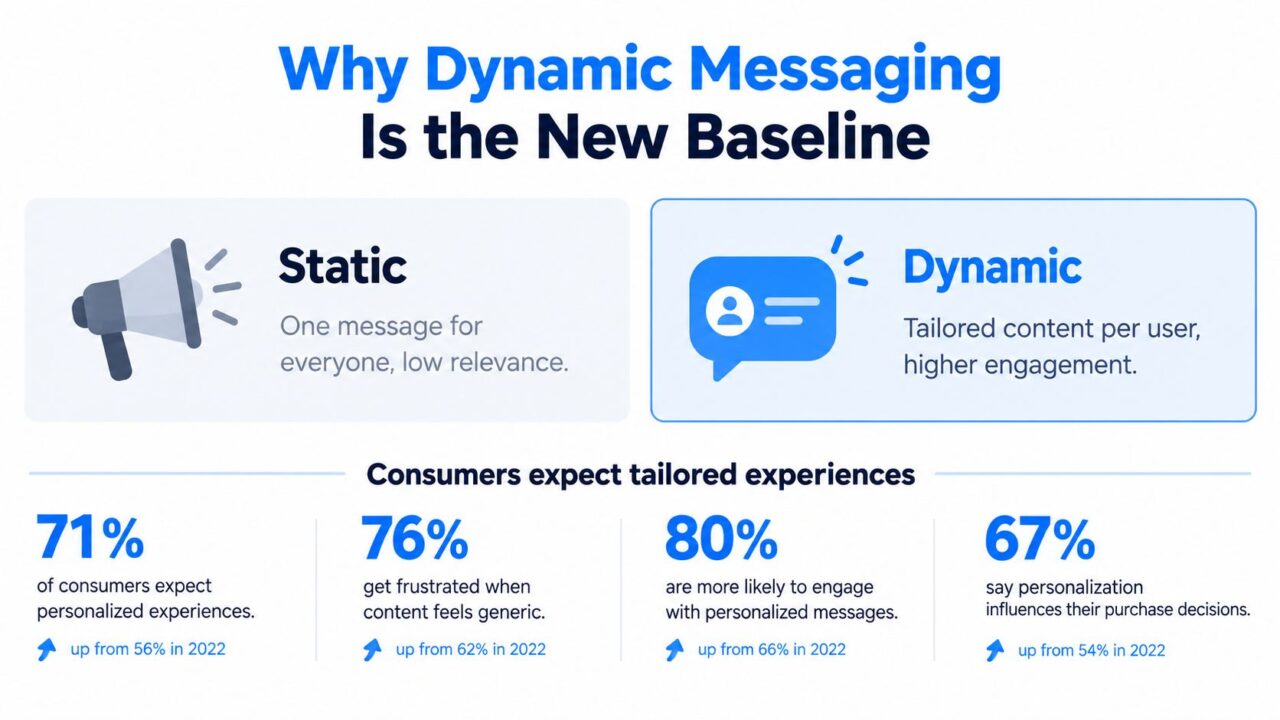
Dynamic Messaging Personalization Infographic
Dynamic messaging changes the content, offer, route, or timing based on what a person has done, asked, purchased, or ignored. In a cross-channel program, that context must travel with the customer. Someone who comments on Instagram, asks a question in chat, and later opens an email should not receive three disconnected introductions. The system should preserve the conversation, adjust the framing for each channel, and hand off to a person when automation no longer fits.
From segmentation to situational relevance
Email segmentation established the basic operating model. A retailer could separate recent purchasers from prospects or vary promotions by broad interest. That improved on a single broadcast, but each segment still contained people with different needs and levels of intent.
Dynamic messaging works with more specific signals:
- Behavior: A visitor comparing two products needs a different prompt from someone who has only read an educational article.
- Intent: A delivery question should lead to operational information, not another awareness message.
- Lifecycle: A new SaaS user may need onboarding help, while an active account holder may need a feature-specific recommendation.
- Channel: An SMS alert, Instagram reply, and detailed email need different lengths and calls to action.
- Conversation state: The next message should acknowledge what the customer already said rather than restart the exchange.
This approach scales message variation without requiring a separate campaign for every individual. It also creates operating requirements. Teams need clear rules for which signals are trustworthy, which variations are approved, how frequency is controlled, and when automation must stop. Those controls prevent personalization from becoming repeated contact with a different label, which can create fatigue and weaken trust.
Why the performance case is durable
Personalization produced useful results before current AI tools. Campaign Monitor’s compiled research reported an 18.8% open rate for personalized emails versus 13.1% for nonpersonalized emails in 2016, found that personalized subject lines were 26% more likely to be opened, and cited 58% of revenue coming from segmented and targeted emails. (MarTech’s summary of personalization research)
These figures do not make every dynamic element effective. They show that relevance can improve response when it supports a real customer decision. Apply variation to choosing a product, completing onboarding, resolving an issue, or returning to an unfinished purchase. Avoid changing copy merely because a data field is available.
Practical rule: Personalize the decision a customer is trying to make, not every field you happen to store about them.
Real-World Applications Across Key Channels
A dynamic message becomes valuable when it helps someone complete a task with less friction. The channel matters because each surface carries a different level of attention, context, and conversational depth.
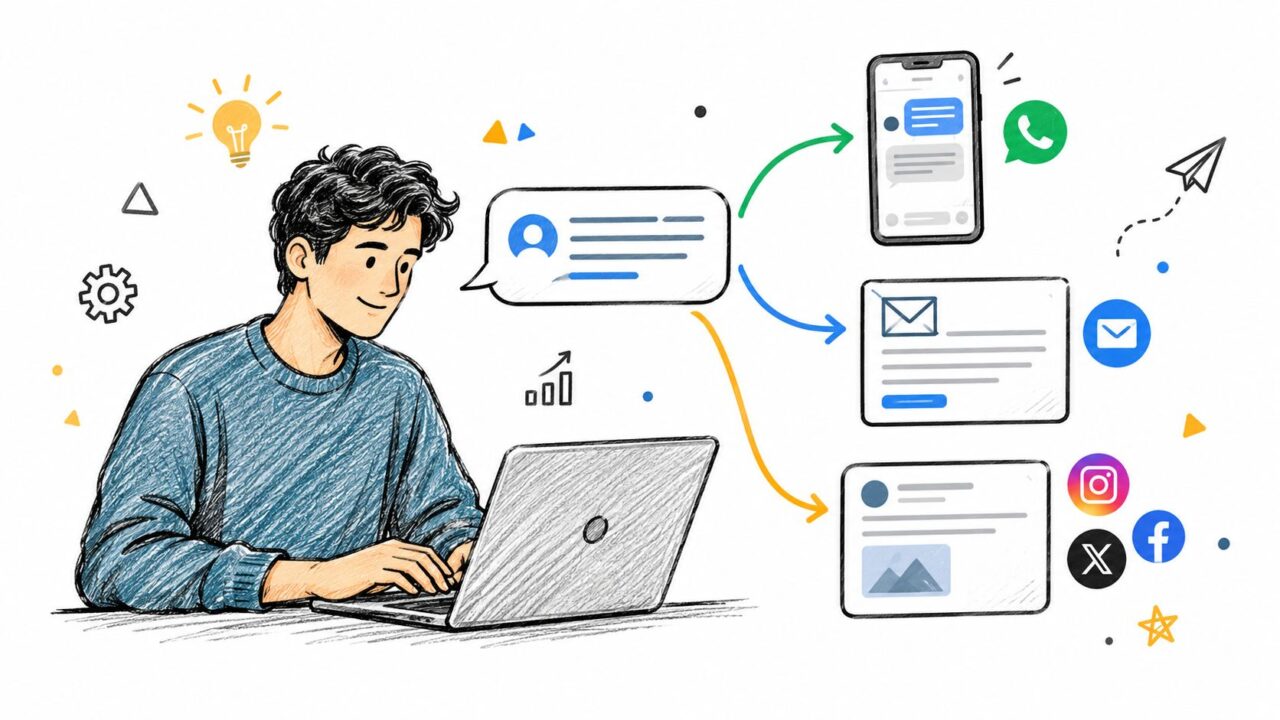
Dynamic Messaging Multichannel Communication
Website chat
A website visitor who lands on a pricing page may need help comparing plans. Someone arriving from a support article may be trying to fix a specific problem. A useful chat flow recognizes the page context, asks a focused question, and routes the visitor toward the relevant answer instead of displaying the same welcome prompt everywhere.
For SaaS, that might mean offering an onboarding path to a new visitor and a troubleshooting path to an existing user. For e-commerce, the flow can handle sizing questions, product comparisons, stock questions, and pre-purchase inquiries. Business messaging is particularly suited to product questions, issue triage, visual troubleshooting, routing, support questions, order updates, and pre-purchase conversations. (Quiq’s channel best-practice guide)
The best website flows keep the first interaction narrow. They don’t ask for a complete customer profile before answering a simple question. They collect only the information needed for the next useful action, then pass that context to a support or sales system.
Instagram Direct Messages and Messenger
Social messaging often starts with lightweight intent. A person comments on a product post, replies to a story, or sends a short question. The automation should convert that public signal into a private, relevant conversation without pretending to know more than it does.
An e-commerce brand could respond to a product comment with a private message containing the item discussed, then ask whether the customer wants details about fit, availability, or delivery. A creator could route a question about a course toward the appropriate offer, while a local business could distinguish promotion requests from service inquiries.
For teams building influencer-led campaigns, an influencer attribution case example offers useful context for thinking about how social activity and commercial outcomes can connect. The operational point is to preserve the originating source and conversation intent, so the follow-up feels like a continuation rather than a generic sales sequence.
WhatsApp and operational updates
WhatsApp is useful when the customer expects a two-way exchange. A retailer can send an order update and provide a path to report a delivery issue. A service business can ask for an image before routing a visual problem to the right team. A subscription company can respond differently to a cancellation request, a payment question, and a product-use question.
Meta reports that roughly one billion conversations between people and businesses happen weekly across Facebook, Instagram, and WhatsApp. Those conversations support marketing, customer service, updates, and sales, making the surfaces important well beyond promotional broadcasts. (U.S. Chamber coverage of Meta’s business messaging)
The common thread is intent. Dynamic messaging works when it changes the next action based on what the customer is trying to accomplish.
Building Blocks of Personalized Conversations
You don’t need a large engineering project to create a useful dynamic flow. You do need a clean data model and clear rules for what happens when a customer provides, omits, or contradicts information.
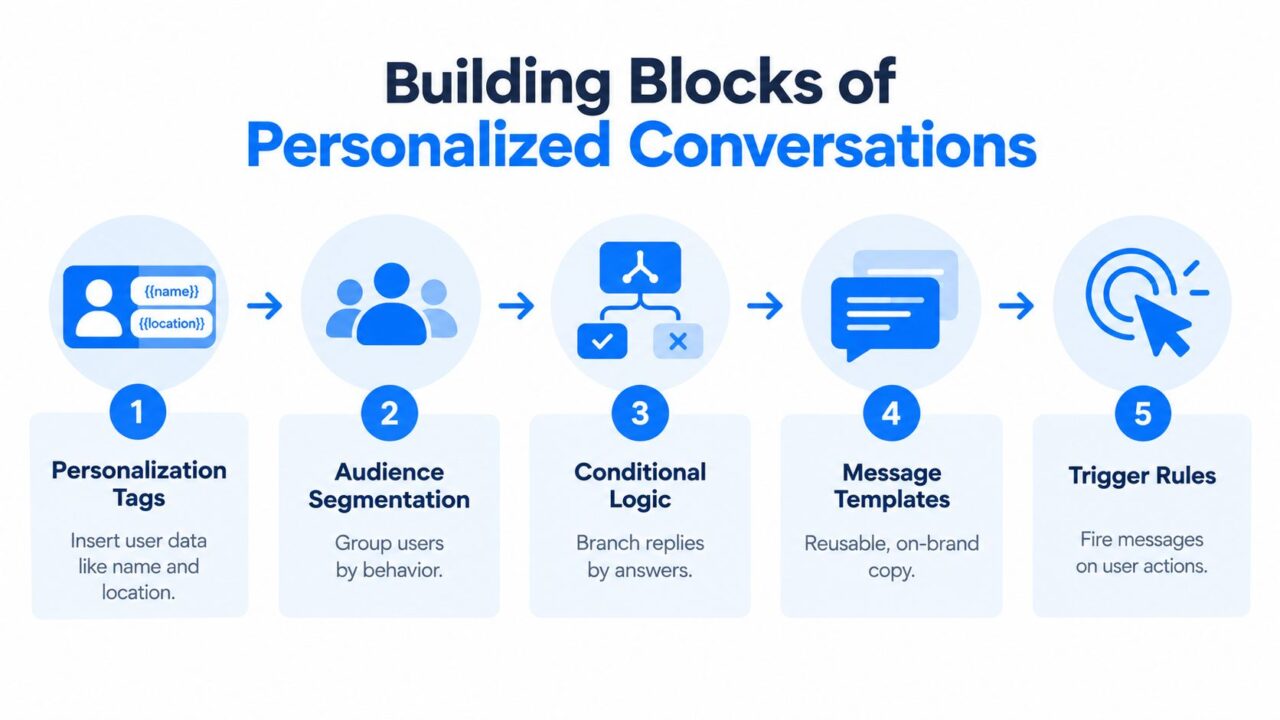
Dynamic Messaging Personalized Conversations
Start with data that changes the next step
Personalization tags insert known values such as a name, location, product, link, or account status. Use them where they improve recognition or clarity. A customer’s name in a confirmation can feel natural. A string of unnecessary personal details can feel invasive.
Audience segments group people by meaningful behavior rather than vague demographic assumptions. Useful segments might include visitors who viewed a category, customers who purchased a specific product, leads who requested a demo, or subscribers who haven’t completed onboarding.
Conditional logic turns those segments and fields into decisions. If a customer says they need help with delivery, show delivery options. If they indicate a technical problem, collect the relevant details and offer a human route. Keep the branches understandable enough that a marketer can audit them later.
Build reusable flow components
Message templates should protect brand voice while leaving room for relevant variables. Write a stable core sentence, then define the parts that can change, such as product recommendations, support instructions, calls to action, or follow-up timing.
Custom fields carry information collected during the current conversation. Global fields hold values that multiple flows may need. A visitor might provide a preferred product category in one interaction, then receive a more relevant follow-up later, subject to your consent and data-retention rules.
AI keyword triggers can recognize variations in user language, but they shouldn’t be treated as a substitute for clear routing. Include fallback phrases, ambiguous-intent handling, and a human handoff for cases where the system can’t confidently identify the request.
For a broader perspective on building personalization for founders, focus on the connection between useful customer data and operational simplicity. The same principle applies in no-code conversation design. Store information because it supports a decision, not because the platform makes storage easy.
A practical flow-building sequence looks like this:
- Define the customer outcome. Choose one action, such as answering a product question or booking a call.
- Select the minimum data required. Avoid collecting fields that won’t affect the next message.
- Create the primary path. Write the clear, helpful response for the most common intent.
- Add exceptions. Include uncertainty, unsupported requests, and escalation routes.
- Distribute variations for testing. Use random path distribution to compare different framings while keeping the underlying offer consistent.
A no-code platform such as personalization in digital marketing can help teams connect these components without building every branch from scratch.
Avoiding the Over-Personalization Trap
More variation doesn’t automatically create more relevance. A message can use a customer’s name, reference a recent click, and still feel wrong if the timing, offer, or framing doesn’t match the customer’s actual situation.
The central trade-off is between relevance, data quality, and trust. If the data is stale, dynamic content can expose that weakness. If the logic is too aggressive, customers may feel watched. If every channel changes its wording independently, the brand can sound inconsistent from one interaction to the next.
Framing matters more than field insertion
A personalized template might show the same recommendation to everyone in a segment while changing only the greeting or product name. Context-aware framing asks a more useful question: why is this person receiving the message now, and what concern should the message address?
A PRISMA-guided survey of 28 sources reported controlled deployments with CTR improvements ranging from +8% to +14.5% over static templates. In a DoorDash deployment, recommendations stayed constant while only the framing changed, producing a +1.8% engagement lift over personalized templates. (survey and deployment analysis)
The finding supports a practical approach. Test the reason and framing of the message, not just the variable fields. A product reminder framed around replenishment may work differently from the same product framed around discovery. A support prompt should acknowledge the unresolved task rather than push a promotion.
Set limits before launch
Use governance rules that answer basic customer-experience questions:
- Frequency: How many automated messages can a person receive before a pause applies?
- Suppression: Which recent actions should stop a campaign, such as a purchase, complaint, or completed booking?
- Confidence: When should uncertain AI interpretation send the conversation to a human?
- Consistency: Which offers, claims, and tone rules must remain fixed across channels?
- Privacy: Which fields can be used for personalization, and where must consent be rechecked?
The most sophisticated flow is often the one that knows when not to send another message.
Fewer, better-timed interactions can outperform constant variation because they protect attention. Review message fatigue as a customer-experience problem, not merely a delivery metric. A high click rate isn’t a success if the same audience receives conflicting follow-ups or loses confidence in the brand.
Orchestrating Cross-Channel Experiences
A customer doesn’t experience your marketing stack as separate tools. They experience one relationship. If an Instagram conversation promises a follow-up, the email should know why it was sent. If WhatsApp resolves the issue, the abandoned support reminder should stop.
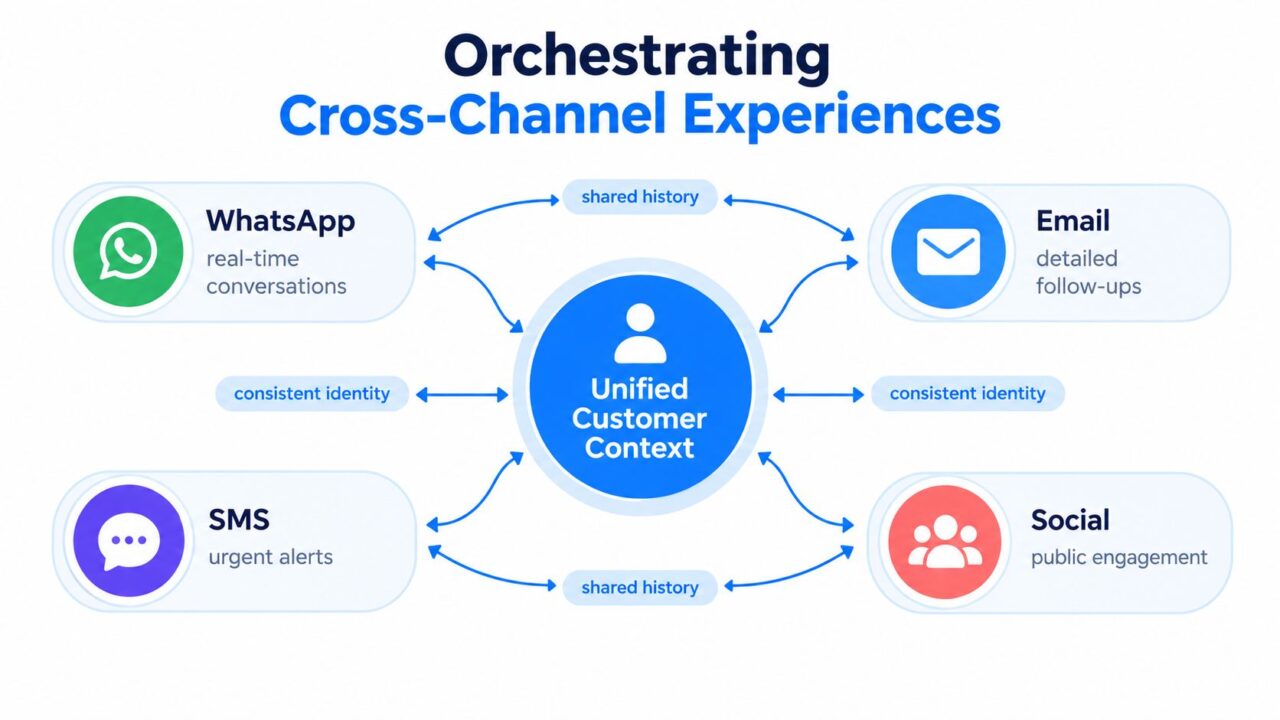
Dynamic Messaging Cross Channel Orchestration
Make context portable
Start with a shared customer record or event layer. It doesn’t need to expose every interaction to every system. It does need to make essential state available, such as current lifecycle stage, active issue, last completed action, consent status, assigned owner, and campaign suppression.
Native chatbot integrations can handle channel-specific events, while Zapier, Make, and n8n can pass tags, fields, and triggers between conversation tools, customer relationship systems, email platforms, and SMS providers. The design principle is simple. Let each system do what it handles well, but define one source of truth for identity and conversation state.
The handoff from a public Instagram comment deserves special care. Store the originating post, product, or campaign, then open the private thread with a message that reflects that context. If the person later moves to email, pass the unresolved intent and collected details rather than a transcript that a support agent must interpret from scratch.
Design channel roles instead of duplicating messages
Each channel should have a job:
| Channel | Useful role | Dynamic decision |
|---|---|---|
| Two-way conversation and updates | Whether the customer needs information, troubleshooting, or escalation | |
| Detailed follow-up and education | Which content matches the customer’s lifecycle and previous action | |
| SMS | Time-sensitive notification | Whether the event requires immediate attention |
| Social messaging | Discovery, engagement, and qualification | Whether to continue privately, recommend an item, or route to support |
Cross-channel adoption is already operational rather than theoretical. One messaging platform reported 628 billion total interactions in 2025, with the highest share coming from brands using four channels. It also reported more traffic from five-channel users than two-channel users, along with a sixfold increase in brands incorporating RCS into omnichannel strategies. (Infobip’s omnichannel trends report)
Those figures don’t justify adding every channel by default. They show why orchestration becomes more important as the number of active surfaces grows. Before launching another channel, define how it inherits identity, history, consent, suppression, and handoff status.
Teams evaluating a multi-channel messaging platform should test those operational details, not just the channel checklist. A stack that sends everywhere but can’t stop a conflicting message creates more work and weakens trust.
Measuring Impact and Iterating on Flows
Dynamic messaging needs a measurement plan that separates delivery from usefulness. An open or click can show that a message attracted attention, but it doesn’t prove that the conversation solved the customer’s problem or produced a valuable business action.
Measure the complete path
Track metrics in layers:
- Reach and response: Monitor delivered messages, opens where the channel supports them, clicks, replies, and opt-outs.
- Conversation quality: Measure completion of the intended flow, branch-level drop-off, fallback frequency, human handoffs, and unresolved requests.
- Business outcome: Connect conversations to purchases, qualified leads, booked meetings, retained subscriptions, or resolved support cases.
- Experience risk: Watch complaint signals, repeated contacts, suppression events, and inconsistent outcomes across channels.
Email benchmarks show why the first layer can be useful but incomplete. One cited study reported 29% higher unique open rates and 41% higher unique click rates for personalized promotional emails, while segmented campaigns delivered up to 30% more opens and 50% more clicks than non-segmented campaigns. (dynamic email content analysis) Treat those figures as directional evidence, not a promise for every audience or flow.
Test the message logic
A/B testing should isolate one meaningful change. Compare two framings, two calls to action, or two routing decisions while holding the audience and offer steady. Random path distribution makes this practical for conversational flows, provided each path has a clear success event.
Review results by segment and channel. An overall conversion rate can hide a broken branch for high-intent visitors or a fatigue problem among repeat customers. Look for the point where people stop replying, ask the same question again, or abandon the flow after a particular prompt.
Conversation analytics can help teams inspect those patterns rather than relying on surface-level engagement. Use conversation analytics to identify drop-off points, compare flow paths, and connect interaction data with the next operational action.
A strong iteration cycle is deliberately narrow:
- Diagnose one failure point. Find the branch with the clearest friction.
- Change one variable. Improve the framing, question, timing, or handoff.
- Check downstream impact. Confirm that a higher click or reply rate also supports completion and commercial outcomes.
- Document the decision. Record the audience, channel, hypothesis, and suppression rules.
- Promote cautiously. Expand the winning path only after checking brand consistency and support capacity.
Dynamic messaging earns its place when it makes the next interaction more relevant without making the relationship feel automated. Measure that balance, then keep refining it.
Clepher helps teams build personalized two-way conversations across website chat, Facebook Messenger, WhatsApp, and Instagram Direct Message, with flows, segmentation, AI keyword triggers, testing, and analytics for cross-channel execution. Visit Clepher to design a context-aware messaging flow and connect it to the customer journeys your team already manages.