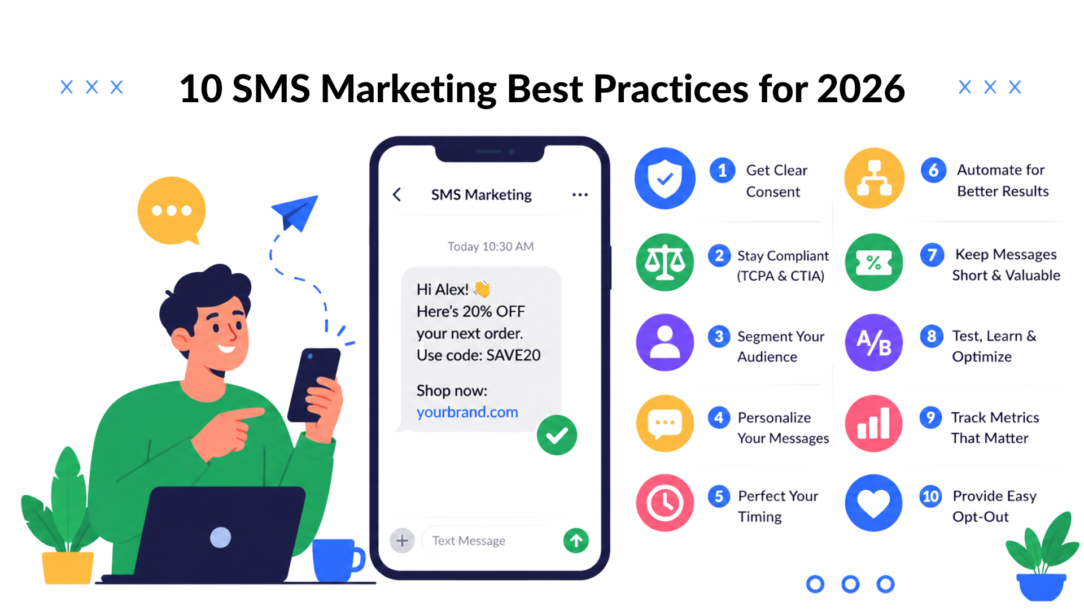
Can your SMS program reach customers quickly without giving them a good reason to respond? Speed magnifies every weakness. Vague consent creates risk, poor timing creates irritation, irrelevant offers drive opt-outs, and a broken follow-up turns a promising click into a lost sale.
The strongest SMS marketing best practices connect four disciplines:
- Permission, so subscribers know who’s contacting them and why.
- Relevance, so each message matches a real customer need or behavior.
- Restraint, so frequency supports trust instead of causing fatigue.
- Measurement, so the team can optimize revenue rather than celebrate visibility alone.
SMS gets attention quickly. Your operating system determines whether that attention becomes a reply, a purchase, a booking, or an unsubscribe.
This guide moves from compliant opt-in infrastructure to segmentation, conversational automation, send-time decisions, ethical urgency, lifecycle flows, concise copy, meaningful metrics, consent management, and systematic testing. It also covers MMS use cases and integrations that connect SMS with broader customer conversations.
1. Build Opt-In Flows With Clear Value Propositions
A phone number isn’t a marketing strategy. The opt-in experience has to explain what the subscriber will receive and why SMS deserves a place in their inbox.
A generic “Join our text list” prompt gives people little reason to subscribe. A specific promise sets expectations before consent:
- E-commerce: “Text SAVE10 for an exclusive discount on your next order.”
- SaaS: “Get SMS reminders for upcoming webinars and product updates.”
- Coaching: “Receive daily motivation and exclusive coaching tips.”
- Local business: “Subscribe for same-day table reservations and members-only specials.”
Promotional SMS generally requires explicit, informed consent. The signup language should identify the sender, explain that messages are promotional, disclose that message and data rates may apply, state the expected frequency, and explain how to opt out, as outlined in this SMS compliance guide.
Make the first message prove the promise
Use the same value proposition in your website footer, checkout, social profile, QR code, and post-purchase experience. Then deliver the promised discount, content, access, or convenience in the first SMS, ideally within the first day of signup.
Test the offer, not just the button color. One audience may prefer a discount, while another responds better to early access, product education, appointment convenience, or useful reminders. Track opt-ins alongside unsubscribes and clicks for your SMS subscribers. A larger list isn’t necessarily healthier if the new subscribers don’t engage.
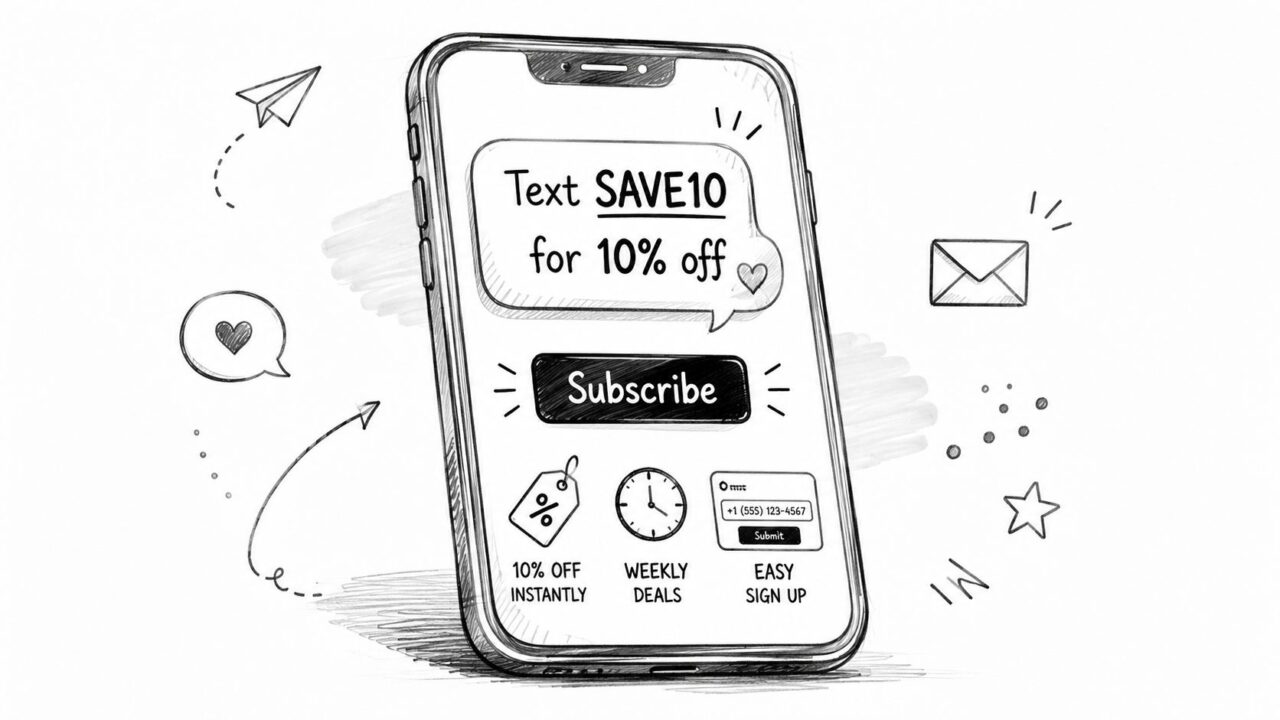
SMS Marketing Best Practices Mobile Subscription
2. Segment Your Audience Before Sending Messages
The fastest way to make SMS feel like spam is to send every subscriber the same promotion. Start with the data your business already owns, including purchase history, browsing behavior, location, engagement, product interest, signup source, and lifecycle stage.
A shoe retailer might send a restock alert only to subscribers who viewed a particular style. A subscription business could send renewal reminders to active customers while giving at-risk subscribers a different explanation or offer. A local restaurant might separate nearby weekend diners from office workers who respond to weekday lunch promotions.
Begin with a manageable foundation:
- New subscribers: Set expectations and deliver onboarding value.
- Active customers: Promote replenishment, loyalty benefits, and relevant launches.
- Inactive subscribers: Use carefully controlled win-back messages.
- High-value customers: Offer early access or service-led experiences.
Behavior usually tells you more than a static demographic label. A cart abandonment, product click, purchase, or support request gives the next message a clear context. For a broader framework, use these customer segmentation strategies to organize audiences around intent and value.
Build segments that change the message
Don’t create segments merely to rename your list. Each segment should receive a different offer, timing rule, suppression rule, or conversational path. A course provider could remind enrolled users who haven’t started the first lesson, while celebrating progress with users who completed it.
Review segment performance regularly. If one group clicks and converts consistently, give it more relevant opportunities. If another group ignores or unsubscribes from messages, reduce pressure and revisit the offer.
3. Use Conversational Flows Instead of Broadcast Blasts
A broadcast asks the customer to act alone. A conversational flow in your SMS marketing strategy gives them a simple way to respond, qualify themselves, ask for help, or choose the next step.
For example, a fashion brand could ask, “Which color do you prefer? Reply 1 for black, 2 for white, or 3 for blue.” The automation can then send a relevant recommendation instead of another generic catalog message. A SaaS company might ask whether a new user needs help with onboarding and route “HELP” to support while sending a tutorial after “VIEW TUTORIALS.”
Keep each branch easy to understand:
- One question: Ask for one decision at a time.
- Few options: Limit the path to a small set of replies.
- Clear escape: Offer STOP for unsubscribing and HELP for assistance.
- Useful automation: Create keyword actions for replies such as YES, NO, CONFIRM, and HELP.
Conversational SMS also works for lead qualification. A coach can ask a subscriber for a short progress update. A local business can confirm an appointment or collect a preference before a visit.
The important metric isn’t just delivery. Watch replies, completed branches, handoffs to a human, clicks, conversions, and opt-outs. A high reply rate can reveal strong interest, while a sudden drop may signal that the question is confusing or the audience has become fatigued.
4. Time Messages for Engagement, Not Just Visibility
SMS is highly visible, but visibility doesn’t guarantee action in an SMS marketing campaign. Independent benchmark roundups place delivered-message open or read rates around 90% to 98%, and some note that roughly 95% of texts are opened within three minutes, making them a powerful tool in your SMS marketing efforts., according to this SMS marketing benchmark roundup. That makes timing a question of customer readiness, not whether the message will be seen.
A restaurant can send a lunch offer while people are planning lunch, then a dinner promotion before the evening decision. A coach may send a morning prompt to one audience and an evening accountability message to another. A SaaS welcome flow should respond to signup behavior, while a product announcement can wait for a deliberate, tested window in your SMS marketing strategy.
Build timing around context
Start by grouping subscribers by local time zone. Then compare clicks, replies, conversions, and opt-outs by day and hour to refine your SMS marketing strategy. Don’t assume a schedule that works for one audience will work for another.
Use behavior-triggered sends where intent matters more than the calendar. A cart reminder should respond to abandonment, subject to local-time and compliance controls, rather than arrive at a fixed hour that may be irrelevant. The send-time optimization guidance can help teams turn timing into a measured operating rule rather than a guess.
A message can be perfectly written and still fail if it arrives when the customer can’t act.
Test sensitive windows with smaller audience groups before broad deployment. Keep quiet-hour controls, cooldowns after purchases, and suppression rules in the workflow, not in a spreadsheet someone may forget to consult.
5. Leverage Urgency and Scarcity Ethically
SMS has a natural speed advantage, so it fits genuine deadlines and limited availability. It doesn’t justify manufacturing pressure.
A flash sale can work when the sale ends at the stated time. A limited product drop can work when inventory is constrained. A course enrollment message can mention remaining capacity only when those places are real. Repeated “last chance” messages for an offer that reappears next week teach customers to ignore your claims.
Use urgency selectively:
- Real deadline: State when the offer ends and link directly to the relevant page.
- Real inventory limit: Explain what is limited, such as a product, appointment, or cohort.
- Clear action: Ask the recipient to shop, reserve, enroll, or reply.
- Consistent landing page: Make sure the destination matches the promise in the text.
Scarcity often feels more credible when it reflects a real operational constraint. A local business might message, “Happy hour today from 4 to 6 PM. The first customers receive the advertised reward.” An e-commerce brand might notify interested customers that a viewed item is back in stock.
Don’t use urgency in every campaign. High-pressure copy loses force when subscribers see it constantly, and it can increase opt-outs when the offer isn’t relevant. Reserve it for launches, genuine stock changes, enrollment windows, appointments, and short-lived promotions.
6. Automate Transactional and Lifecycle Messages
The best automation starts with a customer event. A new subscription, completed purchase, shipment update, abandoned cart, renewal date, or period of inactivity gives the message a reason to exist.
Useful lifecycle flows include:
- Welcome flow: Confirm the subscription, deliver the promised value, and explain what comes next.
- Cart recovery: Remind a shopper about the items they left behind, then suppress the flow after purchase.
- Post-purchase flow: Provide order information, support guidance, and relevant care or replenishment content.
- Re-engagement flow: Use a controlled invitation when a previously active subscriber stops interacting.
- Renewal flow: Explain the upcoming charge or renewal action in language that matches the customer’s plan.
Start with a few high-value journeys instead of building an elaborate maze. Map every entry condition, branch, exit, conversion, and suppression rule before activating the flow. A customer who buys should leave a cart-recovery sequence immediately, and someone who has opted out should be excluded everywhere.
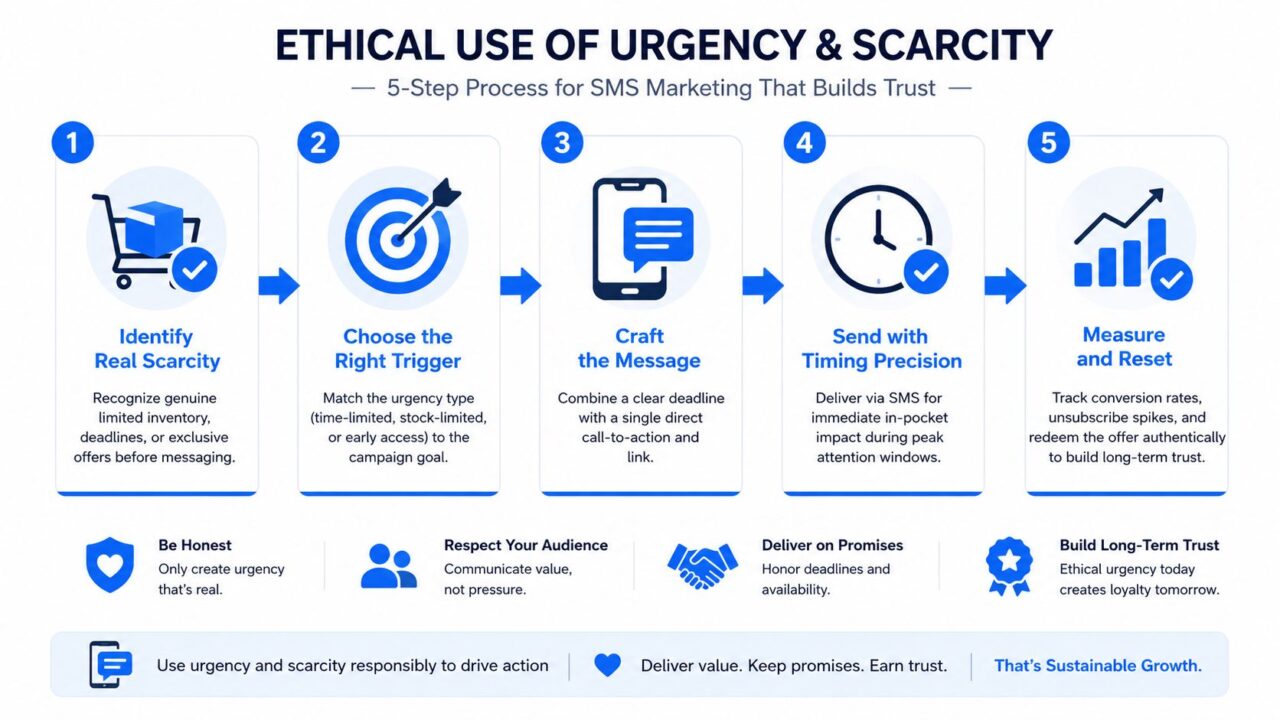
SMS Marketing Best Practices Urgency Scarcity Process
Optimize flows by business outcome
Triggered messages often outperform one-off batch sends because they align with behavior. Recent benchmark guidance reports flow-based SMS click rates nearing 10% on average, with top performers exceeding SMS campaign benchmarks. 16%, as described in Klaviyo’s SMS benchmarks. Treat that evidence as a reason to prioritize lifecycle orchestration, not as a promise for every business.
Review each automation for revenue, conversions, replies, support load, and opt-outs in your email marketing and SMS marketing efforts. A flow that generates clicks but attracts complaints may need a better offer, slower cadence, or a more useful destination.
7. Keep Messages Short, Clear, and Action-Focused
SMS isn’t email compressed into a smaller screen. The recipient may be walking, shopping, commuting, or handling another task, so the copy needs to make the decision obvious.
Lead with the benefit, add only the context needed to trust the offer, and give one next action. Compare these two approaches:
- Weak: “We have a new collection available with a variety of styles and colors at competitive prices for a limited time.”
- Stronger: “New collection live now. Shop the latest styles here: [link]”
A SaaS message could say, “Ready to start? Book a free call: [link].” A profile reminder could say, “Finish your profile for more relevant recommendations: [link].” The shorter version isn’t automatically better, but every word should help the reader understand the offer or act on it.
Edit for one decision
Read the message aloud. If the sentence sounds like an email subject line followed by three footnotes, remove the footnotes. Use one link, one code, or one reply instruction unless the customer needs multiple choices.
- Front-load value: Put the benefit in the opening words.
- Match the destination: Send shoppers to the exact product, cart, booking page, or resource promised.
- Protect the voice: Keep the brand personality, but don’t let jokes obscure the action.
- Track the click: Use a destination and tracking setup that identifies campaign quality.
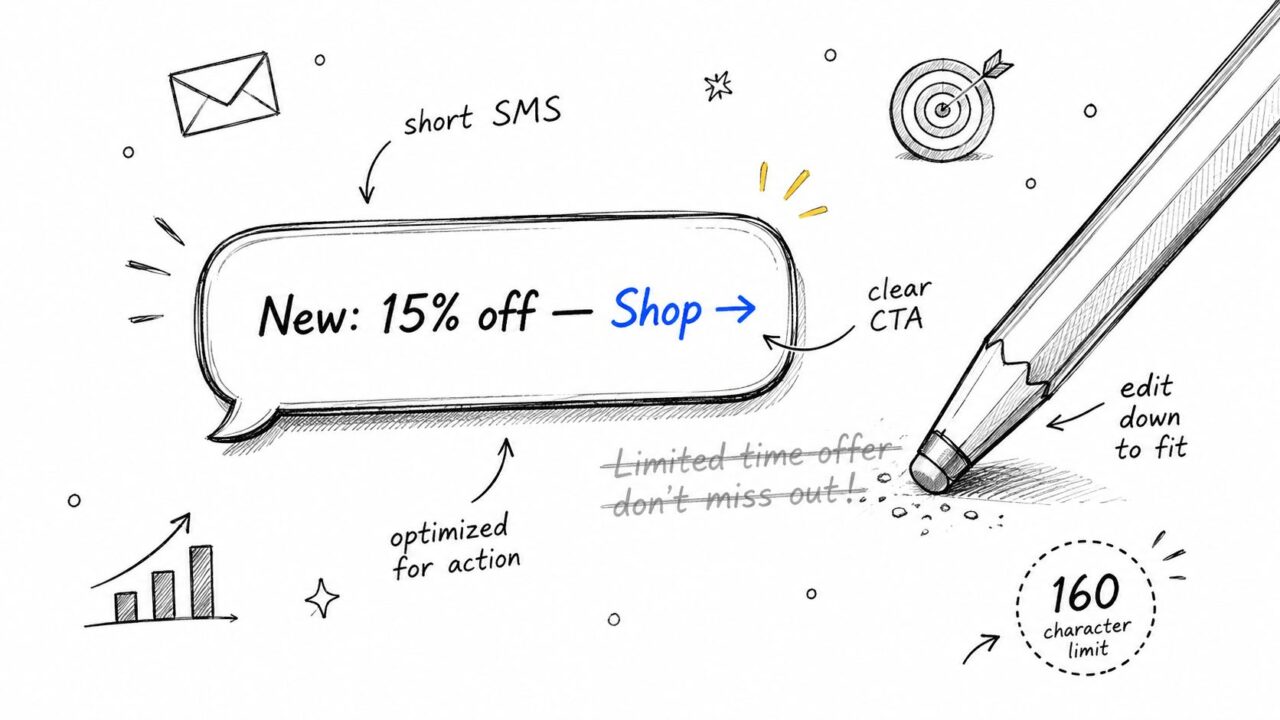
SMS Marketing Best Practices: Marketing Design
Short copy also makes testing cleaner. If a campaign fails, you can more easily identify whether the problem was the offer, CTA, timing, audience, or landing page.
8. Monitor Metrics That Matter: Engagement Over Volume
Open rate is a weak optimization target for SMS because most delivered messages are highly visible. The more useful question is whether a message creates a qualified click, reply, purchase, booking, renewal, or other business outcome.
Benchmark summaries place average-to-good SMS CTR commonly between 8% and 14.5%, while top-quartile campaigns reach about 15% to 20% or more. Some e-commerce reports cite median click rates near 19.3% of SMS subscribers engaged with our latest text message marketing campaign., but the variation is precisely why operators should compare campaign type, audience quality, and automation context, as explained in these SMS marketing statistics.
Track each campaign across a consistent funnel:
- Delivery: Did the platform deliver the message?
- Unique clicks: Did subscribers take the intended next step?
- Replies: Did the message create useful conversation?
- Conversions: Did the action become revenue, a booking, or another defined outcome?
- Opt-outs: Did the message damage list health?
- Incremental lift: Did SMS add results beyond what would have happened without it?
Build a weekly review habit
A small dashboard is enough if it supports decisions related to SMS marketing campaigns. Compare flows with broadcasts, segments with segments, and revenue outcomes with message pressure. If clicks fall while sending volume rises, stop increasing volume and audit relevance, timing, fatigue, landing pages, and offer quality.
Use control groups where practical. A holdout can show whether SMS generated incremental revenue instead of merely receiving credit for customers who were already likely to buy. That distinction matters for e-commerce teams, agencies reporting to clients, and small businesses deciding whether a workflow deserves more budget.
9. Respect Frequency and Consent to Build Long-Term Trust
How often should a customer hear from your brand before helpful messages become pressure? Set frequency by lifecycle stage, industry, message type, and customer value. Current guidance suggests one to two promotional texts per week maximum, with an unsubscribe rate above 1.5% treated as a warning signal, according to this SMS marketing strategy. SMS frequency and benchmark guidance. Use these figures as operating alerts, not fixed rules.
Separate promotional sends from transactional updates. After a purchase, suppress promotions when order-related messages already occupy the customer’s attention. Coordinate SMS with email, social campaigns, and broader customer conversations, including Clepher integrations, so one person does not receive several versions of the same offer on one day.
Double opt-in adds a confirmation step and strengthens the consent trail. Keep audit-ready records of the timestamp, phone number, signup source, and exact consent language, following this consent management guide and this SMS marketing best-practices guide.
Make opting out simple
Every promotional flow needs clear opt-out instructions. Process STOP requests promptly, remove the number from promotional audiences, and block re-entry through later imports or automations. Never buy lists or add contacts because a partner says they may be interested.
Use a preference center when the audience needs more control. Subscribers can choose deals, education, appointment reminders, or no promotional SMS. Review unsubscribe reasons, declining clicks, and complaints by flow. A spike in one automation often identifies a specific promise, timing rule, or frequency conflict, giving e-commerce teams, agencies, and small businesses a clear workflow to fix rather than a reason to abandon SMS.
10. Test and Iterate Systematically on High-Impact Elements
Testing should answer a business question. Instead of changing five parts of a message and calling the better result a winner, isolate one variable and document the decision.
Useful tests include:
- Offer: Compare a discount with free shipping, early access, or a useful resource.
- CTA: Test “Shop now,” “Claim access,” “Reply YES,” or another action that matches the customer’s context.
- Timing: Compare local-time windows for the same segment and message.
- Copy: Test a direct benefit against a curiosity-led opening.
- Destination: SMS subscribers’ engagement. Compare a product page, collection page, booking form, or conversation reply.
Use unique clicks and conversions as primary campaign-quality signals. CTR is more variable than opens, which makes it more useful for distinguishing a clear, relevant message from a merely visible one. Record the audience, send time, offer, creative, suppression rules, clicks, conversions, opt-outs, and revenue outcome.
Turn winners into operating rules
A test result is valuable only when it changes the system. If a particular segment responds better to a product-specific CTA, update that segment’s default template. If an urgency message increases clicks but also raises opt-outs, treat the trade-off as part of the result rather than declaring a simple winner.
Keep a shared test log. Include the hypothesis, single variable, audience definition, duration, decision metric, and next action. Then repeat the process across lifecycle flows, broadcasts, conversational prompts, and MMS creative.
MMS can support product images, event visuals, appointment details, or a richer launch message when the visual adds decision-making value. It shouldn’t become decoration. Use it when an image clarifies the offer, and use plain SMS when speed and clarity matter more.
Top 10 SMS Marketing Best Practices Comparison
| Item | 🔄 Implementation Complexity | ⚡ Resource Requirements | ⭐ Expected Effectiveness | 📊 Expected Outcomes | 💡 Ideal Use Cases |
|---|---|---|---|---|---|
| Build Opt-In Flows with Clear Value Propositions | Low–Medium, design + copy + UX tweaks | Creative offers, mobile forms, A/B tests | ⭐⭐⭐⭐ | Higher opt-in rate, better subscriber quality, lower unsubscribes | New list growth, checkout upsells, social bio CTAs |
| Segment Your Audience Before Sending Messages | Medium–High, data modeling & tagging | Clean customer data, segmentation tools, maintenance | ⭐⭐⭐⭐⭐ | Higher CTR/conv, improved ROI, fewer complaints | Targeted promos, restock alerts, retention campaigns |
| Use Conversational Flows Instead of Broadcast Blasts | High, flow design & branching logic | Two-way messaging platform, monitoring or AI agents | ⭐⭐⭐⭐ | Strong engagement, lead qualification, richer data | Lead gen, support, personalized recommendations |
| Time Messages for Maximum Open Rates | Medium, analysis + scheduling logic | Analytics, time-zone support, send optimization | ⭐⭐⭐ | Improved open & CTR with minor effort | Time-sensitive offers, welcome sequences, local deals |
| Leverage Urgency and Scarcity (Ethically) | Low–Medium, cross-team coordination is essential for effective SMS marketing campaigns. | Inventory sync, precise timing, truthful offers | ⭐⭐⭐⭐ | Immediate conversion spikes; risk of fatigue if overused | Flash sales, limited-stock drops, enrollment deadlines |
| Automate Transactional and Lifecycle Messages | Medium, mapping journeys + integrations | Integrations (e‑commerce/CRM), templates, triggers | ⭐⭐⭐⭐⭐ | Very high open/CTR, reduced support, scalable revenue | Order confirmations, cart recovery, onboarding flows |
| Keep Messages Short, Clear, and Action-Focused | Low, disciplined copywriting | Copy resources, templates, short-link tools | ⭐⭐⭐⭐ | Higher CTR, faster actions, lower unsubscribes | All SMS sends, promotional CTAs, reminders |
| Monitor Metrics That Matter: Engagement Over Volume | Medium, tracking + dashboards | Analytics platform, conversion tracking, reporting | ⭐⭐⭐⭐ | Early warning signs, data-driven optimizations, clear ROI | Ongoing program health checks, executive reporting |
| Respect Frequency and Consent to Build Long-Term Trust | Low–Medium, policy + enforcement | Compliance tools, preference center, ops discipline | ⭐⭐⭐⭐ | Sustainable growth, lower legal risk, higher LTV | Subscription services, long-term retention strategies |
| Test and Iterate Systematically on High-Impact Elements | Medium, test design & analysis | A/B tools, sufficient sample sizes, test cadence | ⭐⭐⭐⭐ | Incremental CTR/conv lifts, documented learnings | Scaling campaigns, creative/offer optimization |
Build the SMS System Your Customers Want to Hear From
The ten practices work best as one operating system, not as isolated copy tips. Permission determines who can receive messages. Segmentation determines what they should see. Conversational flows determine how they can respond. Lifecycle triggers determine when the message has a useful reason to arrive. Metrics determine whether the system is creating revenue or merely generating activity.
A practical rollout can stay focused:
- Verify consent and infrastructure. Confirm the sender identity, opt-in language, opt-out handling, records, quiet-hour controls, and provider configuration.
- Clarify the promise. Decide whether subscribers are joining for offers, early access, support, reminders, education, or a combination they can understand.
- Create a few high-value segments. Start with new subscribers, active customers, inactive customers, and a meaningful value or product-interest group.
- Launch core automation. Build welcome, cart or browse recovery, post-purchase, and support handoff flows before adding complexity.
- Set frequency guardrails. Add cooldowns, suppression rules, local-time controls, and lifecycle-specific limits.
- Improve copy and media. Keep SMS direct, use MMS when visuals help, and connect every message to one clear action.
- Measure outcomes. Review clicks, replies, conversions, opt-outs, revenue, and incremental lift rather than relying on open rates.
- Test continuously. Change one high-impact variable at a time and turn reliable findings into reusable rules.
E-commerce and DTC teams can begin with cart recovery and post-purchase support through SMS messaging. Agencies can create reusable client frameworks while customizing consent, segments, offers, and reporting. Coaches, course creators, SaaS companies, and local businesses can start with one conversational capture flow and one behavior-based follow-up instead of buying a complex stack before the fundamentals work.
Clepher can sit in the broader conversation layer, supporting conversational capture, audience tags and segments, AI-assisted flows, analytics, and handoffs to SMS through native integrations or connected tools such as Zapier, Make, n8n, and Pabbly. Its no-code builder is designed for customer conversations across website chat, Facebook Messenger, WhatsApp, and Instagram Direct Message, while SMS-related automation can connect through integrated providers such as Twilio. That setup lets a team capture intent in one channel, qualify the contact, and pass the right data into an SMS workflow instead of treating every text as a disconnected broadcast.
Before your next SMS message send, ask one practical question: what customer event or permission makes this message appropriate right now? If you can’t answer it clearly, improve the workflow before increasing volume.
Clepher helps businesses build conversational capture, segmentation, AI-assisted flows, analytics, and SMS handoffs through connected tools such as Zapier, Make, n8n, and Pabbly. Visit Clepher to connect customer conversations with more focused SMS marketing workflows.