
TikTok has a scale problem, and that changes how marketers should think about automation. In 2022, TikTok removed over 256 million suspected fake accounts, a 282% increase from 2021, and some tests showed up to 97% of ad clickers were bots, according to Fraud0’s reporting on TikTok bots and fake accounts. That’s not just a moderation story. It’s a marketing story.
A TikTok account automation bot can mean two very different things. It can mean a spammy growth script that follows people, drops generic comments, and tries to brute-force visibility. Or it can mean a controlled automation layer that helps you automate TikTok tasks: publish your TikTok videos on time, manage captions, respond to demand, and move serious buyers into a real conversation.
Those are not the same category of tool, even if people use the same phrase for both.
Most bad advice treats TikTok automation like a shortcut to vanity metrics. Most useful advice treats it like operations. If your TikTok business content gets traction, can you answer DMs fast enough? Can you route product questions? Can you capture intent before attention fades? Using the API to streamline workflows and automatically schedule posts or update captions ensures growth is captured, not lost. If not, traction becomes leakage.
The Hidden World of TikTok Automation Bots
The phrase “TikTok bot” often conjures images of fake followers, spam comments, and sketchy dashboards. That exists. It’s also only part of the picture.
The more useful definition is functional. A TikTok automation bot is any software system that performs repetitive TikTok tasks without a person clicking every step. That might be harmless scheduling. It might be a DM responder. It might also be an aggressive follow bot that gets an account burned.
Why brands keep reaching for automation
TikTok creates pressure fast. Content moves quickly, comments pile up, and response windows are short. Teams that post manually and answer everything by hand usually hit a ceiling long before they run out of ideas.
That’s why a TikTok automation tool keeps getting attention. Brands want an advantage. Creators want consistency. Agencies want a process they can repeat across client accounts. By learning to use automation strategically, teams can stay ahead without sacrificing engagement.
For the organic side of growth, it helps to combine automation thinking with actual audience-building fundamentals. Choosing from the best TikTok automation services ensures your workflows are reliable, scalable, and aligned with real engagement goals.
Practical rule: If the tool exists mainly to fake interest, it’s a liability. If it exists to handle real interest faster, it can be valuable.
The real divide
The divide isn’t “automation versus no automation.” The divide is between artificial engagement and operational support.
Artificial engagement tools try to manufacture signals. They like, follow, comment, and unfollow at scale in hopes that the algorithm or other users react. Operational support tools help you handle what your content already generates. They keep posting consistently. They answer common questions. They move people into a cleaner sales or support flow.
That distinction matters because marketers often lump every bot into one bucket. Then they either avoid automation completely or use the wrong kind.
A smart TikTok setup doesn’t chase fake momentum. It removes friction after attention appears.
A Taxonomy of TikTok Bots
Not every TikTok automation bot does the same job. Think of these tools like departments inside a digital marketing team. One handles publishing. One handles inbound conversations. One tries to do cold outreach at scale. One watches a performance.
That mental model makes evaluation easier. You’re not asking, “Should I use a bot?” You’re asking, “Which role am I automating, and what risk comes with it?”
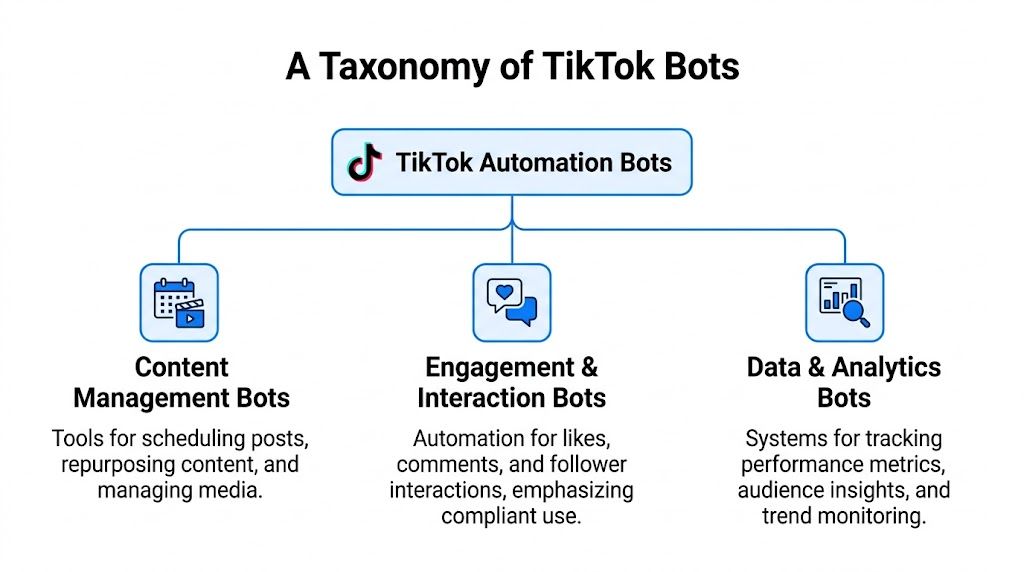
TikTok Automation Bot Taxonomy
Posting schedulers
These are the least controversial tools in the category. Their job is simple. Queue content, publish at planned times, and reduce the chaos of manual posting.
For a DTC brand, the use case is obvious. Batch-produce product videos, customer proof clips, and creator content, then spread them across the week instead of posting whenever someone remembers.
The main benefit isn’t speed. It’s consistency.
DM and comment responders
Automation starts becoming commercially useful when its tools react to viewer interactions such as questions, video comments, or direct messages.
A practical example is a comment-to-DM flow. Someone comments on a keyword on a product demo, and the system sends details privately. For a coach who might deliver a lead magnet. For an e-commerce brand, it might send a size guide, a coupon, or a product link.
This category can support real buying intent because it responds to users who have already initiated contact.
Growth bots
Growth bots are the tools commonly referred to as “TikTok bots.” They automate follows, unfollows, and profile interactions to attract attention.
These systems are common because they promise a visible result. More profile visits. More followers. More activity. The problem is that the mechanism is usually manipulative, easy to overdo, and hard to align with platform rules.
If a tool’s core promise is “we’ll engage with hundreds of accounts for you,” caution should go up immediately.
Engagement bots
These sit close to growth bots but focus more on likes and comments than follow activity. Many DIY bots are built in Python using Selenium WebDriver to automate actions like auto-liking videos based on hashtags, following hundreds of accounts daily, and posting pre-set comments to mimic human engagement and trigger algorithmic visibility.
That sounds efficient until you watch the output. Generic comments weaken trust fast. Low-context liking patterns also attract the wrong audience, or no meaningful audience at all.
Analytics bots
This category doesn’t get enough attention because it doesn’t feel flashy. But automation that tracks trends, organizes performance signals, and surfaces conversation patterns is often more valuable than automation that clicks buttons.
Good analytics automation doesn’t replace judgment. It gives the team a faster feedback loop.
For agencies, this can mean monitoring content response patterns and identifying which topics generate comments that signal purchase intent. For operators, that’s more useful than another batch of low-quality followers.
How TikTok Automation Works Under the Hood
Not every marketer needs to write code, but they do need to know how a tool interacts with TikTok. The method matters because it usually tells you how risky the product is before you even test it.
There are two broad ways automation tools work. One uses approved access points. The other simulates human behavior inside a browser or app environment.
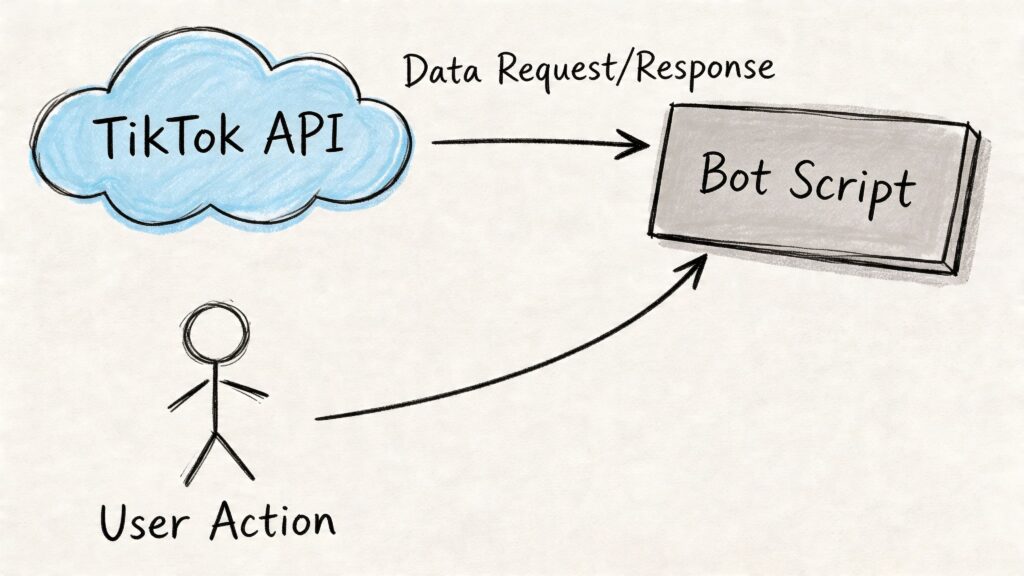
TikTok Automation Bot API Diagram
The front door approach
When a tool uses an official integration path, it’s operating more like a software partner than an intruder. The platform grants limited access, the tool performs allowed actions, and the workflow stays inside defined rules.
This is typically how safer scheduling and business messaging automations work. The software isn’t pretending to be a person tapping screens all day. It’s interacting through a sanctioned system.
For marketers, this usually means fewer surprises. The feature set may be narrower, but the operational risk is lower.
The window approach
A lot of risky growth software uses browser automation. It opens a browser session, logs in, and performs actions the same way a human would. Click. Scroll. Follow. Like. Comment. Repeat.
That’s where Selenium often comes in. Instead of integrating through a formal access layer, the script controls a browser directly and imitates human use. In practice, this is how many auto-like, auto-follow, and auto-comment bots are built.
Here’s the non-technical version:
- Browser control: The bot opens TikTok in a browser and acts on the page.
- Scripted actions: It can search hashtags, visit profiles, like videos, or post prewritten comments.
- Looped logic: It repeats those actions based on rules, such as target keywords or competitor audiences.
Why that distinction matters
The biggest risk signal isn’t whether the landing page says “AI.” It’s whether the tool needs to impersonate a human account in ways TikTok can scrutinize.
A scheduler or DM workflow built around permitted messaging behavior is very different from a script built to hammer engagement actions all day. One supports customer operations. The other tries to exploit attention mechanics.
Ask every vendor one blunt question: “Does your product rely on browser automation or an official integration path for core features?”
If they dodge the answer, that tells you enough.
What does this mean when you evaluate tools?
Before buying anything labeled TikTok automation bot, check these basics:
| Checkpoint | What you want to hear | What should worry you |
|---|---|---|
| Access method | Official integration or approved workflow | Browser simulation for core growth actions |
| Core use case | Messaging, scheduling, moderation, routing | Mass likes, mass follows, bulk comments |
| Human oversight | Clear controls and manual takeover | “Set it and forget it” growth promises |
| Brand fit | Supports lead handling and service | Focuses on vanity metrics only |
A tool’s architecture doesn’t just affect performance. It shapes your exposure.
The High-Stakes Game Risks Versus Rewards
There’s a reason risky TikTok automation keeps selling. It offers a simple fantasy. Press a button, create visible activity, and let the account grow while you sleep.
That fantasy is built on incentives marketers understand well. More followers look credible. More notifications feel like momentum. More interaction creates the impression that the system is working.
The problem is that short-term surface gains can hide long-term damage.
Why risky bots still tempt people
A growth bot can create movement fast enough to feel productive. It may generate profile visits, inflate interaction counts, or make an account appear active. For a small brand trying to break out of zero engagement, that can feel better than waiting for content to compound.
But the trade is brutal. You’re outsourcing your account behavior to systems that often optimize for volume, not trust, not intent, and not durability.
How TikTok detects bad automation
TikTok’s enforcement isn’t guessing. TikTok’s detection systems removed 720 million fake accounts in H1 2024, analyze behavior velocity, flag actions like over 200 follows per hour, and use machine learning to identify rigid bot patterns that can lead to shadowbans or account termination.
That tells you a lot about what’s dangerous. The issue isn’t only one action. It’s the pattern.
Common red flags include:
- Velocity spikes: A burst of follows, likes, or comments that doesn’t look human.
- Rigid timing: Actions happening on fixed intervals with no browsing variation.
- Repetitive output: The same comment style, same targets, same motion all day.
A marketer may see “efficiency.” The platform sees automation signatures.
The hidden business cost
Risky bots don’t just threaten the account. They also skew your data. If your inbound engagement quality drops, your team starts making decisions on contaminated signals. If public comments look spammy, buyers notice. If your growth source is low-intent traffic, conversion rates don’t match the headline metrics.
That’s one reason a lot of “growth” campaigns fail. They create more activity without creating more demand.
For brands already using social automation elsewhere, this same distinction shows up on other channels too. The safer path tends to look more like inbox management and conversation routing than mass engagement behavior. That’s why approaches like Instagram comment automation for inbound conversations are strategically more useful than old follow-unfollow playbooks.
Risky Bots vs. Safe Automation
| Feature | Risky Growth Bots | Safe Automation Alternatives |
|---|---|---|
| Primary goal | Inflate visible activity | Capture and handle real intent |
| Typical actions | Mass follow, mass like, bulk comment | Scheduling, DM routing, comment-triggered replies |
| Detection exposure | High | Lower when built around compliant workflows |
| Lead quality | Often weak or mixed | Stronger because user-initiated contact |
| Brand impact | Can look spammy | Can feel responsive and organized |
| Team value | Short-lived metric lift | Supports sales, support, and retention workflows |
The more a bot tries to simulate popularity, the less useful it becomes for an actual business.
What works versus what doesn’t
What usually doesn’t work is trying to trick distribution with automated account behavior.
What does work is reducing lag once someone shows interest. If a prospect comments, asks a product question, or messages after a video performs well, speed matters. Routing matters. Follow-up matters.
That’s where the reward side of automation becomes real. Not because the bot “grew the account,” but because the system prevented attention from leaking out of the funnel.
The Smarter Alternative: Integrating TikTok with Conversational AI
The strongest TikTok automation strategy doesn’t treat TikTok as a closed system. It treats TikTok as the top of a conversation flow.
That’s the part most guides miss. They focus on isolated platform tricks, when the main operational challenge begins after the user engages.
The gap most teams leave open
A major weakness in current TikTok automation strategies is the failure to connect TikTok DMs with a broader messaging ecosystem. ShortsNinja’s analysis of TikTok automation gaps notes that 70-80% of leads from viral videos go cold when brands can’t manage the message volume through a unified follow-up system.
That’s the difference between “we got attention” and “we captured demand.”
If a video pops and the team can’t respond across channels, lead handling becomes fragmented. One person is checking TikTok. Another is watching Instagram. Support is in the email. Sales is waiting for CRM updates. No one has a clean view of the customer journey.
What a better workflow looks like
A smarter setup uses TikTok as the trigger, not the entire machine.
A common example looks like this:
- A creator or brand posts a video with a clear CTA.
- Users comment on a keyword or send a DM.
- An approved messaging workflow responds immediately.
- The conversation branches based on intent, such as pricing, support, wholesale, booking, or product selection.
- High-intent contacts move into the broader messaging or CRM environment for follow-up.
That structure is much stronger than trying to automate outbound noise.
Why conversational systems outperform isolated bots
The point of conversational AI isn’t to sound clever. It’s to route people correctly, answer repetitive questions, and preserve momentum while a human team handles edge cases.
That matters most when demand spikes. Viral traffic is chaotic. Message quality varies. Some users want a discount. Some want sizing help. Some want collaboration details. Some are just browsing. A static one-size-fits-all response wastes that attention.
A conversational layer lets you segment intent in real time and continue the relationship outside a single inbox. If you’re comparing options, it helps to understand how conversational AI works in customer interactions before selecting a vendor or building your first flow.
The most useful automation doesn’t chase strangers. It organizes conversations from people who already raised their hand.
Real use cases for e-commerce and DTC
This approach works especially well in a few scenarios:
- Product launch traffic: A video demo triggers a wave of sizing, price, or availability questions.
- Creator-led commerce: A founder account attracts DMs after a tutorial or testimonial clip.
- Promo campaigns: A comment keyword drives users into a coupon or bundle flow.
- High-consideration offers: Service businesses and coaches pre-qualify leads before handing them to a closer.
The key shift is strategic. Stop asking how to automate attention extraction. Start asking how to automate response quality across the channels buyers use.
How to Build Your Compliant TikTok Automation Strategy
The safest way to use a tiktok automation bot is to design the workflow around inbound intent, not platform manipulation. That means choosing software carefully, setting one useful flow first, and connecting the output to the rest of your stack.
Teams get into trouble when they buy a tool before they define the job.

TikTok Automation Bot Strategic Planning
Choose the vendor by use case, not by promise
A good vendor conversation should feel operational. If it feels like a growth hack pitch, walk away.
Use this shortlist:
- Access model: Ask whether the platform uses approved access and what features are officially supported.
- Messaging focus: Favor tools built around DMs, comment triggers, routing, and team handoff.
- Integration depth: Check whether lead data can move into your CRM, email platform, support desk, or spreadsheets.
- Human fallback: Make sure a person can step into the conversation cleanly.
- Policy posture: If the company sells mass liking, mass commenting, or bulk follow behavior as a headline feature, that’s a bad sign.
Start with a comment-to-DM campaign
For most brands, the first automation should be simple.
A practical e-commerce flow looks like this:
- The video ends with a CTA such as “Comment GUIDE for sizing.”
- A user comments on the keyword.
- The system replies and sends a DM.
- The DM flow asks one or two qualifying questions.
- The user receives the right product page, quiz, offer, or support option.
That’s manageable, useful, and measurable.
For service businesses, switch the offer. Instead of a sizing guide, send a booking link, intake question, or short qualification path. The principle is the same. Move from public engagement into a structured private conversation.
Build for spikes, not average days
Automation’s value shows up when demand jumps. Using compliant DM automation, one creator doubled their monthly leads to over 1,000 with zero extra effort, while another booked 10 new clients in a single day by automating message handling after a viral video.
That’s the operating model to copy. Don’t build for a calm inbox. Build for the day the inbox floods.
Operational advice: Your first flow should answer the top repetitive question your team is tired of answering manually.
Connect TikTok to the rest of your marketing stack
Often, many teams stop too early. A DM automation that doesn’t pass data onward is only half-built.
Once the conversation captures intent, route it:
| Destination | What to send | Why it matters |
|---|---|---|
| CRM | Contact details, topic, intent tag | Sales can prioritize follow-up |
| Email platform | Lead magnet request, product interest | You can nurture beyond TikTok |
| Support tool | Order or product questions | Service stays organized |
| Internal alerts | High-intent or high-value inquiries | Team responds faster |
Zapier, Make, or native integrations can usually handle this handoff. The exact tool matters less than the discipline. Every useful conversation should become structured data somewhere your team can act on.
Keep the flow tight
The best first automations are short. One trigger. One promise. One next step.
If the flow asks too many questions too early, users drop. If the bot tries to replace a salesperson entirely, quality suffers. The job is to capture, qualify lightly, and route.
That’s enough to turn TikTok activity into a repeatable pipeline.
Measuring the True ROI of TikTok Automation
A lot of TikTok automation reporting is junk because it focuses on what’s easiest to inflate. Follower counts, likes, and raw activity can all move while revenue stays flat.
The better question is simple. Did the automation create more qualified conversations and move them closer to purchase?
Metrics that actually matter
Use a small set of business metrics:
- Lead generation rate: How many comments or DMs turn into identified prospects?
- Qualification rate: How many conversations reveal clear buying intent?
- Conversion rate: How many automated conversations produce a sale, booking, or sign-up?
- Response coverage: How many inbound questions get handled without manual delay?
- Pipeline contribution: How much revenue can be tied to TikTok-originated conversations?
If your team needs a cleaner framework for connecting conversations to outcomes, this guide on marketing attribution across customer touchpoints is a useful place to sharpen measurement.
What to ignore
Don’t let the tool vendor define success for you. A dashboard full of automated actions is not ROI.
Track whether your system shortens response time, prevents lead loss, and improves the handoff into sales or support. If those things improve, the automation is doing work. If all you gained was motion, you bought a theater.
A useful TikTok automation system should make your funnel easier to measure, not harder to trust.
Conclusion: From Risky Hacks to a Real Strategy
The term TikTok automation bot covers two very different worlds. One world is built on shortcuts. It automates follows, comments, and superficial engagement in hopes of forcing growth signals. That world is crowded, fragile, and risky.
The other world is operational. It helps teams publish consistently, respond to attention quickly, and convert buyers from a TikTok interaction into a real customer journey. That’s the version worth building.
The hard truth is that TikTok doesn’t need more fake activity. Most brands already have enough noise around them. What they need is a better system for handling real interest when it shows up.
That means fewer growth gimmicks and better workflows. Fewer scripts pretending to be people. More messaging automation that qualifies intent, routes questions, and supports actual revenue.
The marketers who win with automation usually aren’t the ones chasing inflated metrics. They’re the ones who treat TikTok as one input in a broader funnel, then design the handoff properly.
If your current automation idea depends on volume without context, it’s probably the wrong idea.
If it helps your team answer faster, segment better, and follow up across channels, you’re building something durable.
Frequently Asked Questions About TikTok Bots
If you want to turn social conversations into a usable sales and support system, Clepher is worth a look. It helps teams build AI-powered conversational flows, unify messaging across channels, segment leads, and keep follow-up organized without turning automation into spam.

Related Posts
Client Account Management: A Practical Playbook
October 13, 2026Chat Bot Responses That Convert: A Practical Guide
October 12, 202610 Broadcast Automation Software Platforms Compared
October 11, 2026
Founder Clepher