
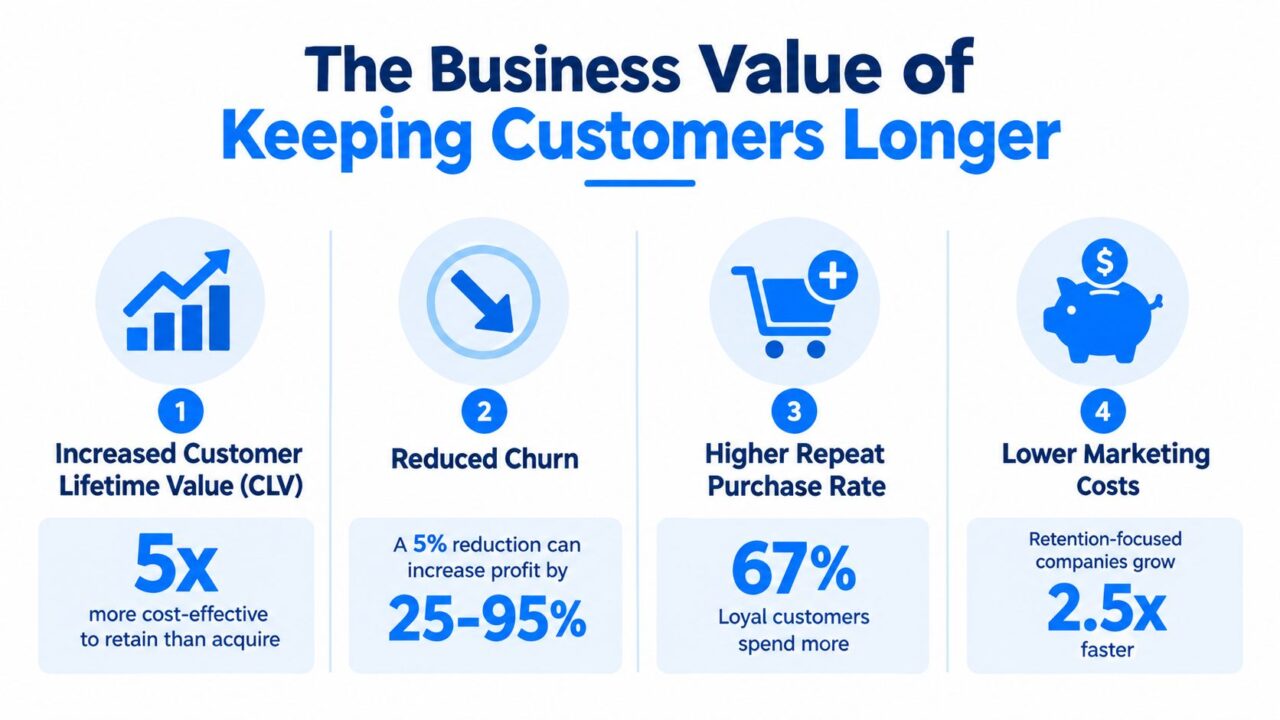
A new customer can cost 5 to 25 times more to acquire than to retain, while a 5% increase in retention can raise profits by 25% to 95%, according to Bain’s long-used benchmark as summarized by Digital Applied’s retention automation analysis. That changes the question. Customer retention automation isn’t mainly about sending more reminders. It’s about recognizing the right moment to help, deciding when to stay quiet, and proving whether an intervention changed the outcome.
Introduction Why Retention Automation Matters Now
A customer places an order, receives the delivery, and disappears. Your team notices weeks later, after the usual repeat-purchase window has passed. Someone sends a friendly follow-up, but the message arrives after the customer’s attention has moved to another brand.
This pattern appears everywhere. A subscriber stops using a service but doesn’t cancel immediately. A SaaS customer opens support tickets, then becomes quiet. A shopper adds products to a cart, leaves, and never returns. Manual follow-up fails because people usually act after the warning sign has become obvious.
Customer retention automation gives your team a way to respond while intent is still visible. A purchase, product view, billing event, support interaction, inactivity period, or renewal milestone can start a workflow. The system can select a relevant message, deliver it through an appropriate channel, and pause when the customer needs human support instead.
That distinction matters for improving customer loyalty. A fast message can recover attention, but an ill-timed message can damage trust. A helpful WhatsApp reminder may feel personal, while repeated promotional messages in a busy chat channel can feel invasive. Retention automation should therefore operate more like a careful store assistant than a loud sales machine.
The retention problem in practical terms
Suppose a first-time buyer has purchased a product that normally needs education before the next purchase. A confirmation message alone doesn’t create customer engagement and retention. The customer may need setup guidance, usage tips, answers to common questions, and a reason to return. Automation connects those moments without asking a marketer to remember every customer manually.
The same logic applies to subscriptions and services. A customer who shows signs of friction needs a different response from one who is inactive. The system must distinguish intent, value, lifecycle stage, and service context before choosing an action to optimize customer support.
Operator’s rule: Automate the decision path, not just the message send.
This guide explains the mechanics without jargon, then turns them into practical workflows for ecommerce, subscriptions, SaaS, and service businesses. You’ll see how to define triggers, create segments, choose timing, build conversational flows with Clepher, connect chat channels to email and SMS, and measure incremental retention lift rather than celebrating clicks that don’t change customer behavior.
What Customer Retention Automation Really Means
Think of a good shop assistant. They remember what a customer bought, notice when that person returns, and offer help that fits the situation. They don’t recommend winter coats to someone who just reported a defective zipper. They also don’t interrupt every visit with the same promotion.
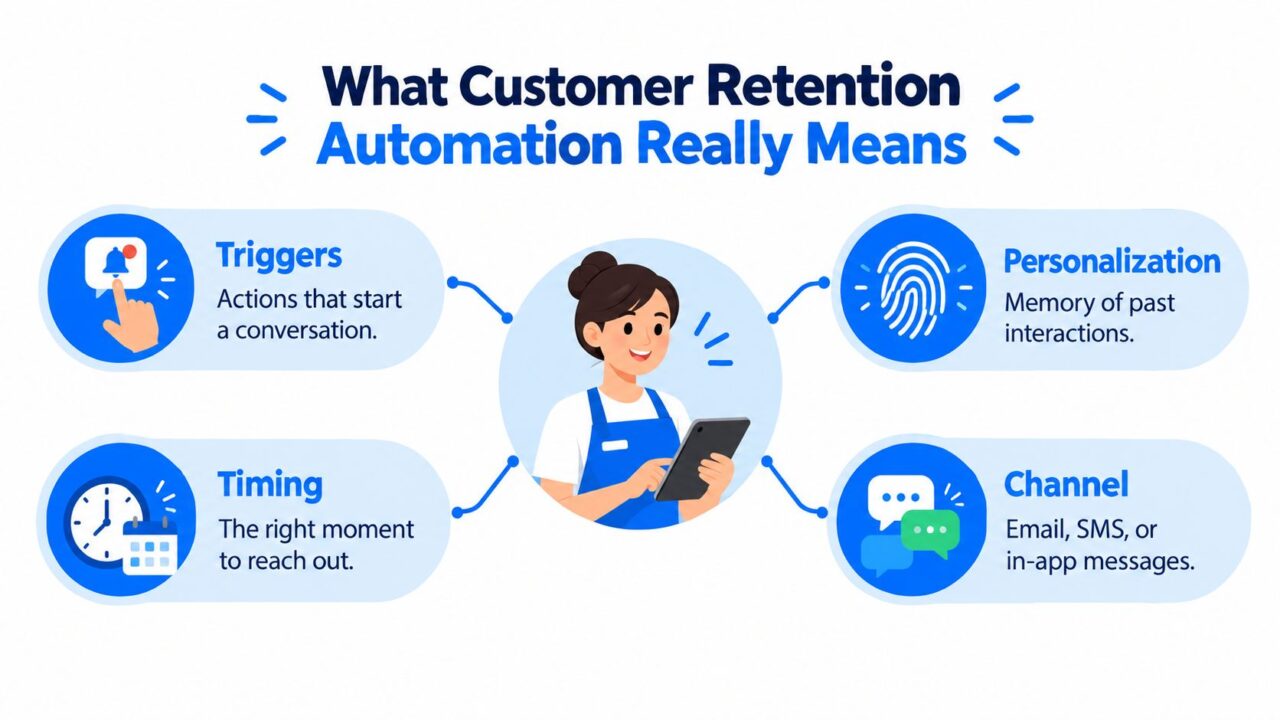
Retention automation applies that logic to digital interactions. It joins four connected decisions:
- What happened? A trigger records a meaningful event.
- Who is affected? A segment interprets the customer’s context.
- When should the business respond? Timing protects relevance and attention.
- Where and how should the response arrive? Channel and personalization shape the experience.
Customer Retention Automation Infographic
Start with the trigger
A trigger is an event that starts a workflow. It might be a completed purchase, a failed payment, a support ticket closure, a period of inactivity, a product page visit, or a renewal approaching.
The important point is specificity in enhancing customer satisfaction. “Send a retention campaign” isn’t a trigger. “Customer bought a refillable product and hasn’t reordered within the expected usage period” is much closer to an actionable condition.
Add context through segmentation
Segmentation determines what the event means. Two customers can show the same inactivity but require different responses. A new buyer may need onboarding education. A long-term subscriber may need renewal support. A high-value customer with an unresolved complaint should probably receive human attention, not a discount code.
Useful inputs include:
- Behavioral data, such as purchases, views, clicks, logins, and replies.
- Lifecycle data, such as new customer, active user, renewal stage, or inactive account.
- Commercial context, such as product category, subscription status, or purchase history.
- Service signals are crucial for understanding customer success, such as open tickets, negative feedback, or recent complaints.
Build a workflow with a feedback loop
A one-off campaign sends a message and stops. A retention workflow evaluates what happens next to improve customer retention rates. If the customer replies, the flow can route the conversation to an agent. If they purchase, it can suppress recovery messages and begin post-purchase education. If they ignore the outreach, the system can stop after a defined sequence rather than escalating indefinitely.
Email, SMS, chat, and social messaging work best when they share the same customer state. A customer shouldn’t receive a Messenger win-back message after responding to support on WhatsApp. Centralized events, tags, and conditions prevent those contradictions.
Human judgment still matters. Teams decide the value rules, escalation paths, offer boundaries, privacy permissions, and language that fits the brand to foster customer loyalty. Automation handles repeatable execution. People handle ambiguity, emotion, complaints, and exceptions.
The Business Value Behind Keeping Customers Longer
Retention protects value at several points in the customer relationship. A returning customer already understands the brand and has made an earlier buying decision, so the next useful action may require less persuasion than a first purchase. A well-timed workflow can reduce avoidable churn, help the customer reach value sooner, and preserve margin.
The economic case is substantial. Digital Applied summarizes Bain’s benchmark as finding that acquiring a new customer can cost significantly more than improving retention rates. 5 to 25 times more than retaining an existing one, while a 5% retention increase can raise profits by 25% to 95%. Those figures are benchmarks, not promises for every company. They show why a modest improvement can justify careful retention investment.
Why the category keeps expanding
Retention automation turns that business case into operating routines. It combines triggered outreach, segmentation, lifecycle rules, and churn-risk signals across several business models:
- Ecommerce brands can use post-purchase education, replenishment reminders, cart recovery, and cross-sell journeys.
- Subscription businesses can watch renewal intent, failed payments, declining usage, and cancellation signals.
- SaaS companies can connect adoption, support, billing, and engagement events to customer health actions.
- Service businesses can automate follow-ups, customer feedback requests, milestone check-ins, and reactivation through retention platforms.
The software category is now large enough to track independently. One estimate places global customer retention software at USD 27.5 billion in 2023, with a projection of customer success metrics. USD 94.7 billion by 2033 and a 15.0% CAGR, according to Data Insights Market. The same report gives another estimate of about USD 5.49 billion in 2024, forecasting USD 15.0 billion by 2035 at a 10.6% CAGR. The estimates differ in scale, but both point in the same direction. Retention is becoming an operating capability, not an occasional campaign.
Customer Retention Automation Business Value
Turn the business case into a priority rule
Start with the customer action that has meaningful value, such as a second purchase, renewal, successful onboarding milestone, or resolved service issue. Then find the delay that keeps your team from responding at the right moment.
Timing and trust should determine the automation level. Automate quickly when the signal is clear and the response is useful. Suppress outreach when a customer has replied, cap frequency when repeated prompts could feel intrusive, and route sensitive complaints to a person. Across chat channels, measure whether the intervention created incremental lift rather than crediting every later conversion to automation.
A strong use case has three qualities:
- A visible signal shows that the customer needs help or may be ready to act.
- A repeatable response can run without custom planning each time, making it one of the best customer retention software options available.
- A measurable outcome in customer loyalty can significantly impact business success. connects the intervention to purchase, renewal, continued usage, or resolution.
Retention automation supports product quality and customer service by making sound practices consistent and easier to evaluate. It cannot repair a poor experience on its own.
Proven Automated Workflows That Drive Repeat Purchases
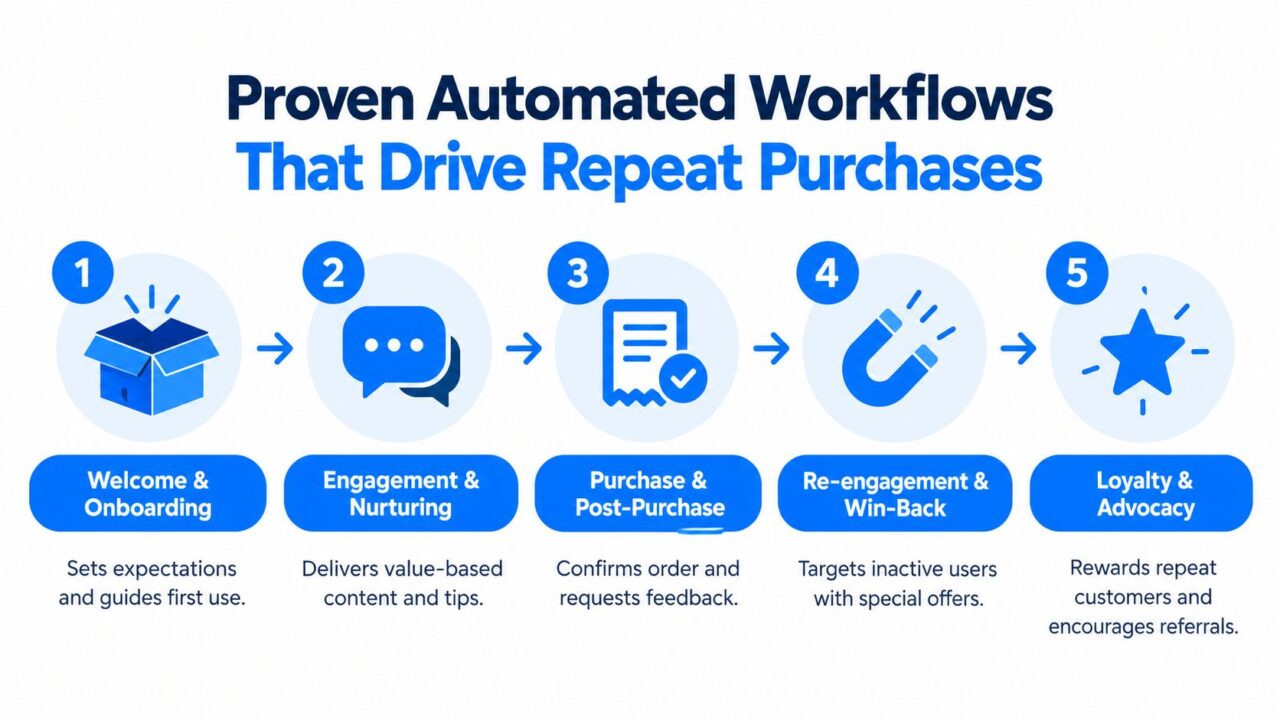
A retention program works best when it follows the customer lifecycle. Start with expectations, support first value, reinforce the purchase, respond to risk, and reward continued engagement.
Customer Retention Automated Workflows
Welcome and onboarding
The first workflow begins after signup or purchase. Ask what the customer wants to achieve, tag the use case, and send the next useful action rather than a general brand introduction.
For a physical product, that might mean setup instructions followed by care guidance. For SaaS, it could be a short path to the first meaningful feature. Include a clear reply option so questions reach a person instead of trapping the customer inside a sequence. Teams that need a deeper implementation reference can review customer onboarding automation.
Post-purchase nurture
A receipt confirms the transaction, helping to manage customer expectations. A retention workflow helps the customer get value from it. Send usage guidance, answer common questions, request feedback after the customer has had time to use the product, and recommend a related item only when the context supports it.
The trigger is the completed purchase. The timing depends on the product’s use cycle, but the logic should stay consistent: teach first, ask for feedback next, and promote a related purchase only after the customer has a reason to trust the recommendation.
Replenishment and cross-sell
Replenishment flows work when the product has a recognizable consumption pattern. Use product type, previous purchase, and customer response history to estimate when a reminder might help. Avoid treating an estimate as certainty. Give the customer a snooze, skip, or preference option.
Cross-sell messages should solve a related problem. A customer who bought a camera may need storage or setup help as part of their customer journey. A customer who purchased a subscription plan may need education about a feature that supports their stated goal.
Abandoned cart and browse recovery
Cart recovery acts while the purchase decision remains active, contributing to best customer retention strategies. One industry source recommends sending the first abandoned-cart message within 1 to 4 hours of abandonment, describing that period as the most effective recovery window for a cart sequence, as reported by Sequenzy.
Use a short sequence rather than a barrage to enhance customer engagement. The first message can restore the product context and enhance the customer experience. A later message can answer an objection or offer support. Stop the flow immediately after purchase, support contact, or a clear opt-out.
Win-back and re-engagement
Win-back campaigns target customers whose activity has declined. Don’t begin with a discount by default. Test a value reminder, new education, product news, or a direct question about what changed.
Timing should reflect the business cycle. A subscription account approaching renewal needs a service-oriented message. An ecommerce buyer who hasn’t returned may need a product reminder. A customer with a recent complaint should be suppressed until the service issue is resolved.
For subscription businesses, subscription retention strategies for Shopify offers additional ideas for renewal, churn prevention, and subscriber experience design.
Loyalty and advocacy
Once a customer has completed a positive milestone, invite the next form of participation. That might be a loyalty reward, a referral, a review, or feedback that helps improve the product.
The trigger should be a meaningful success signal, not merely time elapsed. A customer who just received a successful resolution or completed a repeat purchase is more likely to respond naturally than someone selected only because they have been on a list for a long time.
| Business Signal | Priority Workflow | Trigger and Timing |
|---|---|---|
| New customer needs help reaching first value | Welcome and onboarding | Signup or purchase, then guide the next action immediately |
| Customer bought but may not understand the product | Post-purchase nurture | Completed order, followed by education tied to product use |
| Product has a repeat consumption pattern | Replenishment | Previous purchase and expected usage window can help in predicting churn risk. |
| Customer showed buying intent but stopped, indicating a potential churn risk. | Cart or browse recovery | Abandonment event, with the first cart message within 1 to 4 hours |
| Subscriber shows renewal or cancellation risk | Renewal save | Usage, billing, or cancellation signal before the renewal decision |
| Previously active customer has gone quiet | Win-back | Inactivity condition, with suppression for unresolved service issues, can indicate churn risk. |
Segmentation and Timing Strategies That Make Automation Feel Personal
Retention is now an attention problem as much as a messaging problem. Customers decide whether to continue engaging within moments, so a broad demographic segment often tells you less than a recent behavioral signal regarding customer loyalty. A customer who viewed a product, opened a support conversation, or reached a usage milestone has given you more useful context than an age or location category.
Compare speed with trust
Fast automation is appropriate when intent is clear, and the customer expects a prompt response. Cart abandonment, an instant confirmation, or a direct keyword reply can justify immediate action. Trust requires slower or human-led handling when the customer reports a problem, expresses frustration, or faces a sensitive billing decision.
Use four segment types together:
- Behavioral segments reflect what the customer did recently.
- Lifecycle segments show where the customer is in the relationship.
- Value segments help prioritize effort and escalation.
- Intent segments indicate whether the customer is buying, learning, comparing, complaining, or leaving.
Teams building more responsive audiences can explore customer interactions to enhance the customer journey. dynamic data-driven segments for ways to connect changing customer signals to audience rules.
Set limits before you write copy
Frequency caps are a trust control. Define how many promotional messages a customer can receive within a period, then create exceptions for transactional or support-critical updates. A cap should apply across channels where possible, not separately to Messenger, Instagram, WhatsApp, SMS, and email.
Suppression rules matter just as much:
- Open support issue: Pause promotional messages until the issue is resolved.
- Recent complaint: Route the customer to service recovery rather than a sales flow.
- Recent purchase: Stop cart or win-back messages and begin post-purchase care.
- Opt-out or quiet period: Honor the preference across every connected channel.
- Human conversation underway: Let the assigned person own the next step.
Explainability improves the experience too. Tell customers why they received a reminder, give them an easy way to change preferences, and avoid pretending that an automated message is a personal note from an employee.
Good customer data integration gives these rules the context they need. Without shared purchase, support, billing, and conversation data, one system may continue messaging while another is already handling the problem.
AI can help interpret replies and select conditions, but it shouldn’t be allowed to improvise sensitive promises. Define approved offers, escalation language, and handoff conditions. In high-frequency chat channels, fewer relevant messages usually create more trust than constant activity.
Here’s a simple test for every automated touchpoint: if the customer asks, “Why did I get this now?”, can your team answer clearly? If not, the segment or trigger needs more work.
Real Examples and Clepher Flows You Can Copy
A useful retention flow has a small number of decisions, clear exit conditions, and a human handoff. The following examples show how an operator can translate customer signals into conversational actions.
Ecommerce cart recovery
Trigger: a customer feedback request to gauge satisfaction. A shopper adds an item to a cart but doesn’t complete checkout.
Flow:
- Send a Messenger or Instagram DM reminder that names the product and preserves the cart context.
- Ask whether the shopper needs help with shipping, product fit, or payment.
- Apply a tag based on the reply, such as
Shipping questions can impact customer satisfaction and the overall customer experience.orproduct-question. - Route complex questions to live chat.
- Stop the sequence after purchase, reply, or opt-out.
- Test a value-focused message against a support-focused message, rather than assuming a discount is the answer.
The same flow can pass a subscriber or purchase event to email and SMS through Zapier, Make, n8n, or Pabbly, improving customer experience. That prevents duplicate outreach and lets the brand coordinate channels around one customer state.
Subscription renewal save
Trigger: A subscriber reaches a renewal-risk condition, such as declining engagement, a billing problem, or a cancellation-start event.
Flow:
- Use WhatsApp to explain the next account action in plain language.
- Offer choices such as updating payment details, changing the plan, skipping, or speaking with support.
- If the customer describes a service problem, suppress promotional messages and create a human handoff to prioritize customer satisfaction.
- If the customer confirms value, send a concise reminder about the relevant benefit.
- Record the result as renewed, paused, canceled, unresolved, or escalated.
This approach treats retention as problem resolution instead of immediate persuasion. It also creates cleaner measurement because the business can compare outcomes by risk signal and intervention path.
Post-purchase education
Trigger: A customer completes a purchase that benefits from setup, training, or complementary use.
Flow:
- Confirm the order and invite questions.
- Deliver one practical usage lesson.
- Ask a short feedback question.
- Use the answer to branch into troubleshooting, advanced education, or a human conversation.
- Present a related product only after the customer engages with the educational content.
- Start a second-purchase path after a meaningful usage signal.
A no-code builder can combine capture widgets, tags, segments, broadcasts, personalization fields, conditions, and AI keyword triggers. The important design choice isn’t the feature count. It’s whether every branch has a reason, an exit, and an owner.
For customers who have already gone inactive, a focused win-back campaign can organize the reactivation sequence around the last useful behavior instead of sending a generic “we miss you” message. Clepher supports conversational Flows across website chat, Facebook Messenger, WhatsApp, and Instagram Direct Message, with integrations that can hand data to other marketing systems.
Measuring ROI and Avoiding Common Pitfalls
Retention automation earns its place when it changes an outcome, not when it produces activity. Track repeat purchase, churn, renewal, customer lifetime value, and service resolution. Then connect each result to the specific trigger, audience, channel, and treatment that produced it.
A triggered flow may outperform a traditional campaign because it reaches customers with stronger intent. That doesn’t prove the automation caused the purchase. Some customers would have returned without the message.
Prove incremental lift
Use a holdout or controlled comparison where practical. Keep the audience definition stable, separate customers who receive the workflow from comparable customers who don’t, and measure the same outcome over the same evaluation window.
For omnichannel programs, record the full sequence across web chat, Messenger, WhatsApp, Instagram, email, and SMS. Attribute the conversion to the journey, but report incrementality separately. This distinction prevents a last-click message from claiming credit for demand that already existed.
Automation also needs deliverability and experience checks. Marketers reviewing email performance can use MailGenius’s guide to checking whether emails are going to spam as part of a broader diagnostic process. A message that never reaches the inbox can’t retain existing customers, while a message that arrives too often can weaken trust and reduce churn.
Launch with a practical checklist
- Choose one risk: Start with cart abandonment, renewal risk, inactivity, or post-purchase friction.
- Define the trigger: Write the exact event and the customer context required.
- Set suppression rules: Include support issues, recent purchases, replies, and opt-outs.
- Create the handoff to ensure effective customer support and enhance the customer journey. Decide when a human takes control.
- Select the channel: Match urgency and sensitivity to email, chat, SMS, or social messaging.
- Name the outcome: Measure purchase, renewal, continued usage, or resolution.
- Review incrementality: Compare treated customers with a suitable holdout before scaling.
Measurement principle: If you can’t describe what would have happened without the workflow, you don’t yet know its return.
Clepher helps teams build no-code conversational Flows for post-purchase follow-up, cart recovery, onboarding, win-back, and support across website chat, Messenger, WhatsApp, and Instagram Direct Message. Visit Clepher to connect customer signals, manage segments, and turn timely retention interventions into workflows your team can test and improve using a customer retention tool.
