
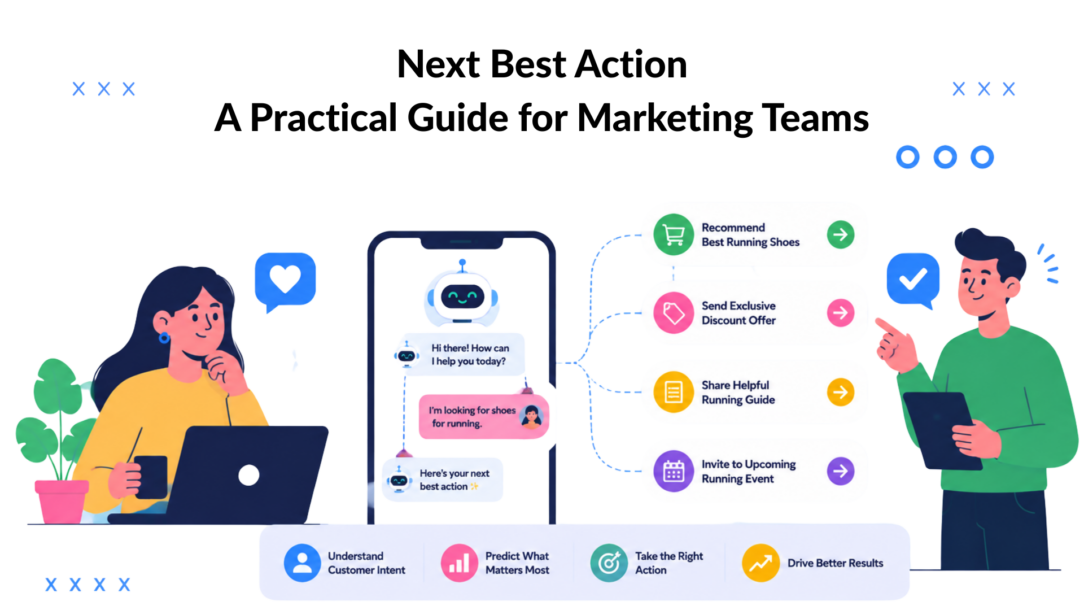
Your team has the same problem every week. A shopper opens a Messenger promo, clicks around your site, then vanishes before buying. Meanwhile, the Instagram DM inbox keeps filling, the website chat is waiting, and someone on your small team has to decide what happens next. Send a discount, ask for a review, push a replenishment reminder, route to support, or stay quiet. That decision is the core job of next best action.
Many teams treat that choice as a gut call. A marketer glances at the last campaign, a support rep looks at the complaint tag, and a founder picks the message that feels safest. Next best action gives you a cleaner way to make that call, by turning scattered signals into one relevant next step for one customer at one moment. It’s less about clever automation and more about removing daily decision fatigue.
The Moment Every Marketer Faces the Next Best Action Decision
A small DTC skincare brand can feel this pain in real time. A loyal subscriber opens a flash sale broadcast, browses two products, then stops. In one inbox, a teammate wants to send a discount. In another, someone suggests a replenishment nudge. The support lead thinks the customer should get a review request after the last order. No one wants to overdo it, but no one wants to miss the sale either.
That’s the exact moment next best action is meant to solve. It gives you a single decision layer that says, “What should happen next, on which channel, for this person, right now?” The answer might be a message. It might be an offer. It might be no message at all.
Why the daily choice matters
In small teams, channel chaos usually comes from good intentions, but understanding customer behavior can help to optimize interactions. Messenger feels fast, Instagram feels personal, and website chat feels immediate, so each channel starts making its own decisions. The customer experiences those decisions as repetition, inconsistency, or silence.
Practical rule: If two channels can both fire, one of them needs a clear priority rule to optimize customer behavior and engagement.
That’s why this topic matters for teams using conversational tools and flows. A clear action layer keeps the brand from sounding like three different businesses at once. It also saves you from using the same message for every signal, which is where many campaigns start to blur.
When you look at it that way, next best action isn’t an enterprise buzzword. It’s a practical answer to a very ordinary marketing question: what do we do next?
What Next Best Action Really Means and What It Is Not
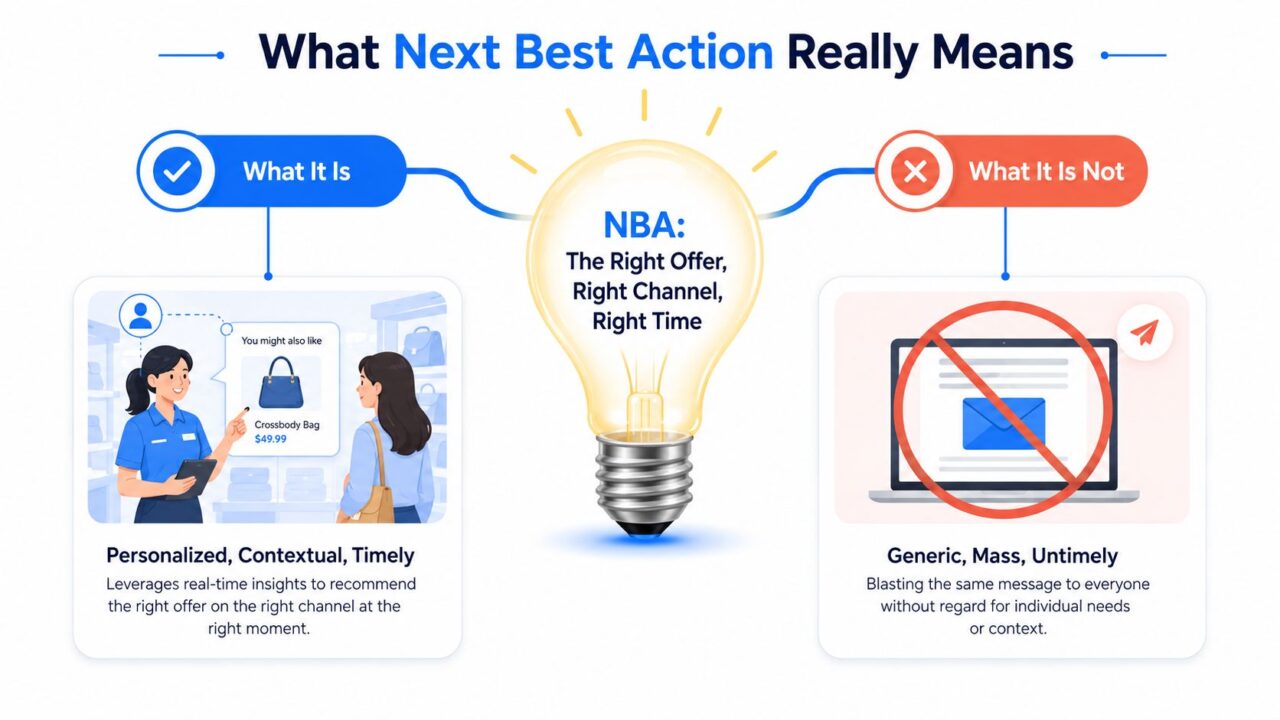
Next Best Action Marketing Comparison
Think of next best action like a smart store associate. They don’t shout every promotion at every shopper. They watch what the person picks up, notice whether they hesitate, and suggest the one thing that fits the moment best. The technical version is a real-time decision engine that combines customer profile data, behavioral signals, and business rules to recommend the single most relevant action at a given moment – a technical next best action system definition.
What it is
It’s a decision layer. It looks at what someone has done, what the brand knows about them, and what the business allows, then picks one action. In practice, that action could be a message, an offer, a routing step, or silence.
What it is not
It’s not just a product recommendation. A recommendation engine can suggest “people also bought” items without considering fatigue, channel caps, or service issues. It’s also not journey orchestration, which maps a broader path across many touchpoints. And it’s not personalization in the shallow sense of adding a first name to a template.
The three most common confusions
- Product recommendations focus on what to sell next, while NBA focuses on what to do next.
- Journey orchestration manages the sequence, while NBA decides the moment.
- Personalization changes the content, while NBA changes the choice.
A useful test is simple. If your system only swaps headlines, it’s personalization. If it chooses the next action, it’s NBA.
The difference matters because marketers often solve the wrong problem. They keep polishing message copy when the core issue is decisioning. That’s why a strong next best action setup feels calmer than a busy one; it narrows the options before the message is written.
Short distinction box
| Concept | Main job | What it decides |
|---|---|---|
| Product recommendation | Suggest items | What product to show |
| Journey orchestration | Coordinate paths | What sequence to run |
| Personalization | Tailor content | What words or content to use to effectively analyze customer behavior and enhance engagement. |
| Next best action | Pick the next move | What should happen now |
The Four Building Blocks of Every Next Best Action System
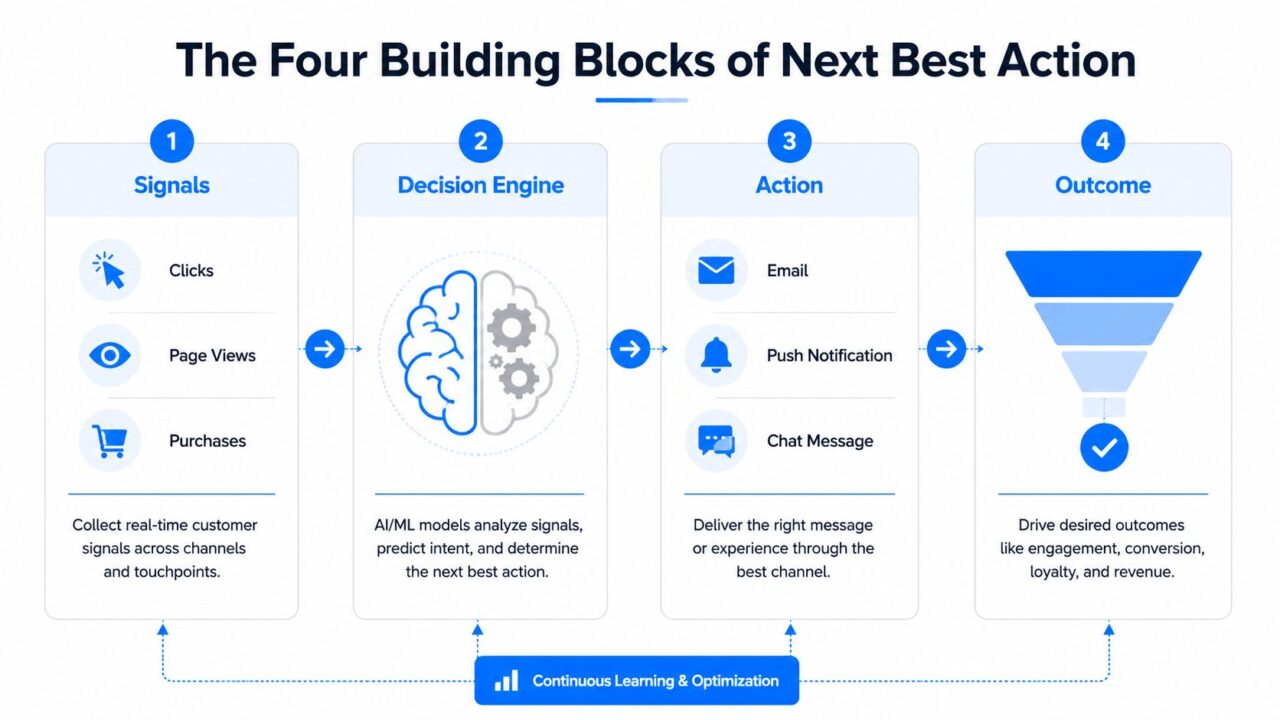
Next Best Action Marketing Strategy
A next best action system is easier to understand if you watch one customer journey from start to finish. A customer taps a Messenger ad, replies to an Instagram DM, visits the website, then goes quiet. The marketer now has one decision to make: what should happen next, and the answer comes from four building blocks that work together.
The pattern is simple. Signals tell you what happened. A decision engine interprets those signals. Actions are the choices the system can take. Outcome is the result you measure after the choice goes out.
Signals, decision engine, action, and outcome
Signals are the events you collect. A click, a purchase, a reply, a timeout, or a support tag all count. In a chat platform, these often become custom fields, labels, and segment membership. A sudden drop in replies can matter just as much as a strong click, because it changes what the next message should be.
The decision engine is the part that turns signals into a choice. It can be a simple rule set, a scorecard, or a more advanced model. The important point is that it does the deciding before the message is written. The Pega definition of next best action frames this as using data and intelligence to select the most relevant response at the right moment, which is the same logic smaller teams use in a simpler form.
Actions are the outputs your team can send. That could be a Messenger nudge, an Instagram DM, an email, a handoff to a human agent, a website banner, or no message at all.
Outcome is the feedback loop. Did the customer reply, convert, ignore the message, or move into support? Without that last step, the system is just sending content and guessing.
How this maps to a smaller stack
A marketer using a no-code flow builder can wire these pieces together without building a data platform from scratch. Custom fields can store the signals. Conditions can express the rules. Segments can separate active buyers from cold leads. Broadcasts and flows can deliver the action.
If your team is still stitching customer records together, the cleanest starting point is often your data connection layer. A practical overview of that setup lives in this guide to customer data integration.
A useful way to keep the system honest is to ask one question before every automation goes live: what signal earned this action? If the answer is vague, the flow is probably reacting to noise instead of behavior.
Practical rule: Don’t start with the action. Start with the signal you trust most, then decide what the system should be allowed to do to optimize customer engagement.
The reason this matters is control. A strong NBA setup does not just predict. It filters. It keeps the brand from sending the wrong thing to the right person at the wrong time, which is the difference between a message that feels helpful and a message that feels noisy.
For teams running sequential offers, pacing still matters, and stop wasting ad spend with Wojo Media is a useful reminder that message order affects performance across channels.
Next Best Offer Versus Next Best Restraint in Clepher
The most overlooked part of next best action is restraint. BCG’s 2026 analysis points to a common implementation gap, many programs over-index on personalization ideas but fail to turn them into consistent decision rules, channel constraints, and measurable business outcomes BCG on implementation gaps. In plain English, brands keep asking, “What should we send?” when a better question is, “Should we send anything at all?”
Offer logic and restraint logic
Next best offer is the obvious version. A customer browses a product, and you send a discount, a bundle, or a cross-sell.
Next best restraint is the quieter version, which helps to personalize the user experience. A customer just complained, so you suppress promotion and route them to service recovery. A recent buyer is still within your last-contact window, so you hold back. A tired subscriber is better served by silence than by another broadcast.
That second option is where smaller teams usually win back trust. It also reduces the kind of fatigue that turns high engagement into unsubscribes and complaint tags. For a useful lens on sequencing and pacing, stop wasting ad spend with Wojo Media is a helpful read on how message order affects performance across channels.
How to express restraint in a flow
Inside a tool like Clepher, restraint usually comes from three places:
- Last contact time checks, so a person doesn’t get hit twice in a row.
- Complaint or support tags, so marketing steps aside when service should take over.
- Segment exclusions, so recent buyers, refund requests, or inactive leads don’t enter the same branch.
Teams gain more from timing than from copy. The best message in the wrong moment can still hurt the relationship. The right restraint can keep the next offer effective later.
If you work in DTC, the practical goal isn’t to maximize clicks at all costs. It’s to balance conversion with fatigue control, because a brand that keeps talking eventually gets muted.
Three Real World Next Best Action Scenarios You Can Model
The best way to understand customer lifetime value is to analyze purchasing patterns over time. next best action is to watch it repeat across very different businesses. The job changes, but the decision pattern stays the same. A real-time model recommends what a sales or service person should do next, based on the customer’s profile, previous actions, and needs, which is exactly why the idea works for marketing, onboarding, and support alike Bain on next-best-action models.
A skincare buyer who opened but didn’t purchase
A DTC skincare brand sees a subscriber open a replenishment email and browse the product page, then stop, indicating potential churn. The strongest next action isn’t another discount right away. It’s a short Messenger reminder that references the product they already viewed and gives them an easy path back.
The signals are simple: open, browse, no purchase. The condition is just as simple: the person engaged but didn’t convert. The action block can send the follow-up while a suppression rule keeps a second promotional path from firing at the same time.
A course student who drops off mid-lesson
A course creator watches a subscriber complete half the welcome module, then disappear. A generic broadcast won’t help here. A better move is a targeted follow-up that addresses the exact point of drop-off, along with a direct path back to the lesson.
The useful signal is video progress or lesson completion. The condition is a stall after engagement. The action might be a DM with a short recap, a checklist, or a live link to the next module.
A SaaS trial user who skipped onboarding
A SaaS trial user logs in several times but never finishes setup. A live chat nudge can outperform a passive reminder here, especially when personalized to the customer’s needs. The next action can invite them to book a setup call, or connect them with a human when the trial behavior says they’re interested but stuck.
The important point is that the same logic works in all three cases. You’re not asking, “What is our best campaign?” You’re asking, “What is the next move that fits this person’s current state?”
A useful internal model for this kind of workflow is a simple marketing automation map, and this overview of marketing automation workflow is a good companion when you’re turning the idea into a live process.
A Practical Playbook for Building Next Best Action in Clepher
A marketer opens Messenger, sees a lead who asked about pricing yesterday, then notices the same person clicked an Instagram story and visited the site again. The question is simple: which message, offer, or next step should go out now? Salesforce Einstein Next Best Action describes that kind of decisioning as a recommendation engine that uses business logic, filters, and optional AI predictions to suggest the next move, thereby maximizing customer lifetime value. Salesforce Einstein Next Best Action. In a smaller stack, the same logic can run with no-code rules, flow branches, and clear guardrails.
Start with one decision you keep making by hand
Pick one choice your team repeats over and over, such as whether a lead gets a follow-up DM, a support handoff, or a discount. Do not try to model the whole customer journey on day one. Start with the one decision people keep debating in Slack or in review calls.
A simple way to map it is to break the decision into four parts.
- Capture the signal. Use AI keyword triggers, form fills, page visits, or custom fields.
- Score the intent. A tag, a condition, or a simple engagement check can stand in for a deeper model.
- Apply the guardrails. Set channel caps, engagement thresholds, exclusions, and complaint filters.
- Choose the output. Send a message, offer help, route to a human, or do nothing.
A chatbot scenario makes this easier to see, as it can analyze customer behavior in real time. A visitor asks about shipping in Messenger, then returns on Instagram later that day. The signal is not “general interest,” it is “still deciding, probably needs one more nudge.” The next best action could be a short reply with shipping details, a store locator, or a human handoff if the question stays open.
Keep the tests close to the decision
A/B testing should compare actions, not only subject lines. If one branch sends a discount and another branch sends a reminder, you learn what the customer needed at that moment. Random path distribution makes that comparison fair, which matters when you are checking whether the next step is doing the work.
For sales follow-up timing, the Mail Tracker for Gmail strategy guide shows how the choice of message and timing changes response quality. The same idea applies inside chat flows. If a prospect replies with a soft objection, the better test is whether a reassurance path outperforms a promo path, not whether a button label gets a few more clicks.
Connect the decision to the rest of the stack
A decision layer only helps if it can pass the result to the tools your team already uses. Native integrations can push actions into email, SMS, and CRMs. Zapier, Make, n8n, and Pabbly can handle the rest of the handoff work.
One practical way to build that handoff is to pair Clepher’s flows, segments, broadcasts, and chatbot automation with a broader marketing automation workflow so the choice does not live in one isolated branch. That lets a rule fire in Messenger, a segment update the audience, and the website or email follow the same logic instead of sending mixed signals.
Clepher fits well here because it gives you one place to choose the next step and send it to the right channel. A lead can get a DM, a site visitor can be routed into a different branch, and a warm contact can be held back from a second offer path. For a smaller team, that keeps the decision layer visible instead of buried across separate tools.
If the team starts with one repeatable decision, tests the action itself, and connects the result to the channels already in use, the system stops feeling abstract. It becomes a practical rule set for the next message, offer, or step.
Measuring Next Best Action and Avoiding Common Pitfalls
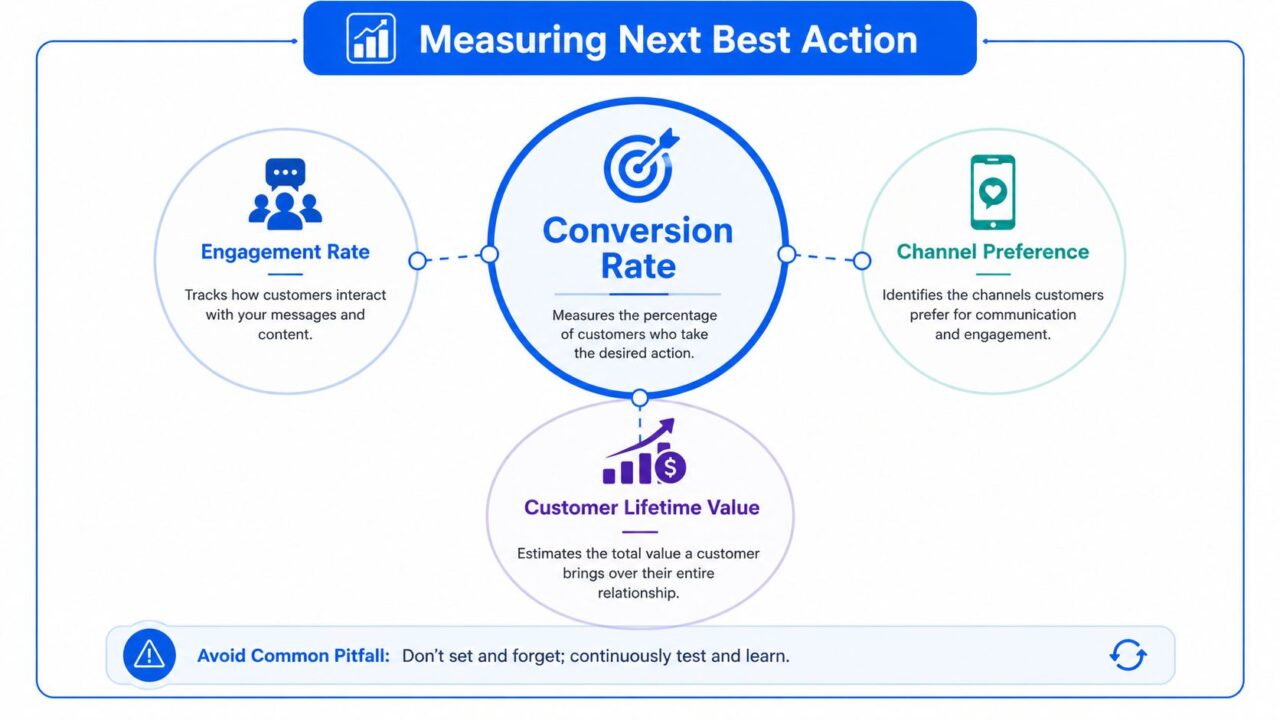
Next Best Action Metrics Diagram
IBM reported that the share of organizations using AI reached a milestone, showcasing the power of predictive algorithms in business. 72 percent in 2024, yet many firms still struggle with workflow integration, governance, and trust in IBM’s AI adoption. That gap is exactly why next best action can’t be treated like a set-and-forget feature. The model is only as good as the rules, handoffs, and feedback loops around it.
What to measure first
Focus on the outcome of the decision, not just the send itself.
- Conversion per recommended action: Did the chosen step move the person forward?
- Revenue per send: Did the message earn its place, or did it create noise?
- Fatigue signals: Watch opt-outs, complaint tags, and response drops.
- Time to first value: For onboarding, measure how quickly the customer reaches a meaningful milestone to enhance their lifetime value.
The pitfalls that quietly break the system
The biggest problem is overlapping segments, which can lead to increased churn if not addressed. If a customer can enter two branches at once, your careful decisioning collapses into duplicate messaging. The second problem is ignoring suppression logic, which turns a useful flow into a spam engine. The third is assuming more personalization always wins, when the gain often comes from choosing less, not more.
Keep this in mind: Every new branch should earn its place by changing the next decision, not just adding more content.
A strong analytics layer helps here because it shows which actions are working and which ones are only looking busy. If you want a deeper look at that measurement mindset, this guide on what is analytics in marketing fits naturally with the decisioning work you’ve built, particularly in optimizing customer interactions through machine learning.
Day one checklist
- Track the one action you want each branch to produce.
- Watch the channels where fatigue shows up first.
- Review overlap, suppression, and timing after the first test.
- Adjust the rule, not just the copy, when results stall.
The teams that get this right don’t chase more messages. They build a cleaner decision layer using machine learning, then let the right action win based on predictive analytics.
Clepher gives you a no-code way to turn customer signals into flows, segments, broadcasts, and chatbot actions across website chat, Messenger, WhatsApp, and Instagram Direct. If you want to build a practical next best action system without turning every decision into a manual back-and-forth, visit Clepher and map your first decision flow around the channels you already use.

Related Posts
10 Lead Capture Software Tools Compared for 2026
October 18, 2026WhatsApp Chatbot for Ecommerce: A Practical 2026 Guide
October 17, 2026What Is Lead Scoring and How It Drives Real Sales Results
October 16, 2026
Founder Clepher